Swimming Amongst the Wingtip Sharks
The White Carpet Caper
Why would lawyers have nothing to fear when swimming in shark infested waters? Answer: “Professional courtesy.” What is the difference between catfish and an attorney? Answer: one is a bottom dwelling, slime sucking animal. The other is a fish. You’ve heard all the lawyer jokes. But, actually, I am here to say that in this world there are upstanding, honest, straight-talking attorneys. I think I know both of them.
The Paint Turned Yellow – Sue Everybody
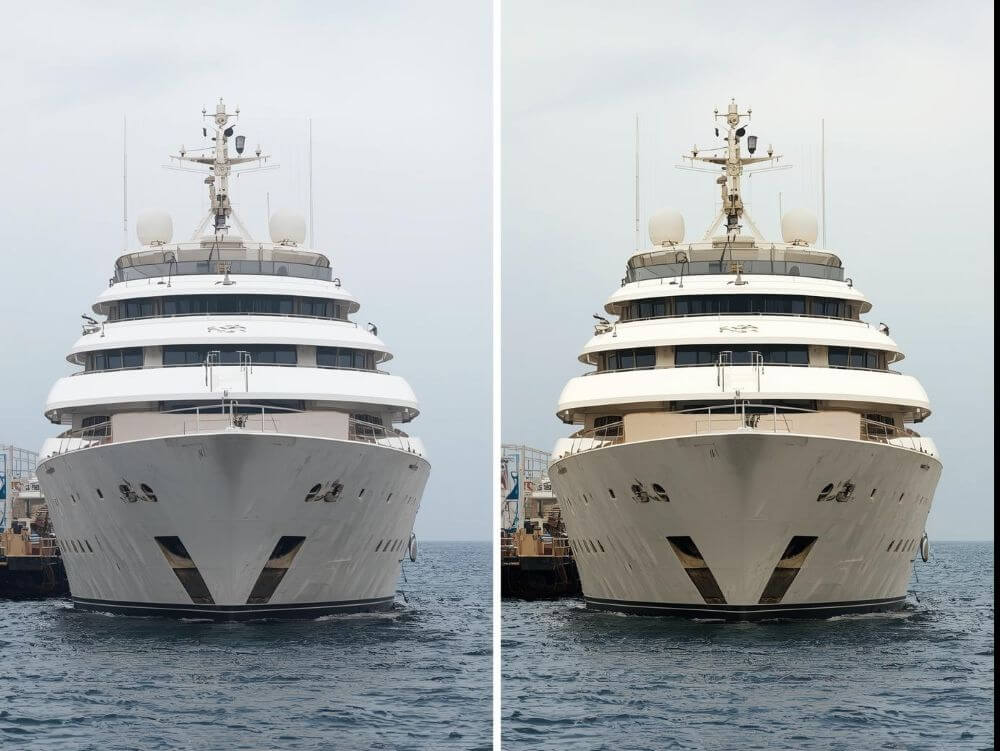
When you are in the yacht design business, you cannot help but have contact with attorneys whether as an expert witness, providing depositions for litigation you are peripherally involved in or being sued by various insane parties. Designers of yachts involved in litigation are inexorably sucked in to the process – rightfully or not. There have been many cases were the snowy white exterior paint on yachts yellowed and the owner sued: the paint company, the builder, the broker and… the yacht designer. Now what the yacht designer has to do with paint turning yellow is a mystery but he is pulled in the process – usually for the free expert testimony. Invariably, as time goes on, the ante is upped against the designer as the lawyers pile on other ridiculous claims. Extricating oneself from this morass even if you are completely innocent and the charges are ridiculous is not easy. You need to hire a lawyer, attend depositions and then go before a judge to (hopefully) have the case thrown out. This process can cost ten to twenty thousand bucks.
The Dingy Carpet Case
I am here to tell you a story about litigation involving dingy white carpeting. As usual, the initial charge against the architect morphed as time went on. The case involved a large motoryacht in which the owner (or his lovely wife) elected to install plush, snow-white carpeting throughout the vessel – so thick it had to be mowed weekly. The owner’s initial “bitch” was that the carpeting was turning gray around the edges and blamed it on exhaust soot circulating in the AC system. This was obvious, he said, because one could observe dirt around the AC outlet. In fact, a small leak was found in the exhaust system, which the builder promptly repaired, however, that did not solve the problem.
The builder and architect maintained that the carpet was graying due to normal dirt found in the atmosphere inside the boat. No matter how well a boat is built, there only is a thin membrane of plywood or aluminum or fiberglass separating the engineroom and all the dirty, smelly, terrible things it contains from the plush, stylish (and very expensive) fifth avenue penthouse directly over it. Moreover, when a large motor yacht is under way, the high, squared off superstructure aft produces a “station wagon” effect pulling a vacuum behind it, which can suck in exhaust particulate. If the aft door is left open under way, the interior will be trashed in matter of hours. Even small openings around windows and doors can allow some exhaust to enter the interior. That’s why most yachts have pressurized interiors. The fact that snow white carpeting should never have been installed in the first place was never a consideration here – only that it was turning gray and the owner was upset and, as usual, was looking to blame someone else.
Boat Odor?
A meeting was arranged on the vessel in Miami. All parties attended including the builder, broker, architect and attorneys representing each party (the owner brought along two or three). As we sat at the dining table discussing the case, a new concern became painfully obvious. The boat stank. It was diesel fuel combined with a few other things. A motor yacht can be a rotten, smelly place. The odor of diesel oil is overwhelming (for sure in this modern age, someone could come up with diesel that smells like honeysuckle). This combined with holding tank stench, lubricating oil, cooking odors, and a ripe crew being aboard for two years and never taking a shower can be debilitating. Such was the case during the meeting and a new charge was added to the complaint. The boat had B.O. (boat odor)! We took a cursory look around but could not find any diesel fuel leaks. The captain claimed this was normal. The boat always smelled this way.
Do You Swear…
And so, after about a year of claims, counter claims, depositions, expert testimony and the like, the case came to trial in Fort Lauderdale. Being a non-jury trial, the hearing was held in the judge’s office high up in one of the towers that dominates the Fort Lauderdale skyline. We had a female judge who seemed like a reasonable lady. When my turn came to testify about the exhaust soot in the cabin, I went through my spiel about the ridiculous white carpet, the absence of exhaust leaks, etc., etc. During my testimony (which became very boring as the opposing attorney asked really dumb questions), I leaned back in my chair and looked up (out of frustration or, perhaps, seeking divine intervention). Low and behold, there was an air conditioning grill directly over the judge’s desk. As I was testifying about the soot that collected around the air conditioning discharge registers (on the boat’s white headliner) my testimony went something like this: “on the vessel, dirt was observed around the air conditioning discharge grills.” It was then that I looked up and saw the judge’s air conditioning grill and continued… “much like the dirt around the grill over your desk.”
The judge looked up and took it all in. At this point, I felt the dirt issue was effectively diffused. Then came the matter of the B.O. problem. A unique way of deciding this issue was implemented. It was arranged for the boat to be brought from Miami to Fort Lauderdale during the proceedings and the good judge would visit the boat during the trial and sniff for herself. The boat was docked at Bahia Mar and we all stood around waiting for the judge and her entourage to arrive. Having previously boarded the boat, we were happy to smell that the diesel odor no longer existed. The judge came aboard and entered each cabin, sniffing the air like a cat on a night breeze. The owner pointed out the soot around the air discharge grills (which looked exactly like the soot in her office). After spending about fifteen minutes aboard, the judge disembarked and headed back to her chambers.
A few weeks later, the ruling came down. The soot around the discharge grills was normal and the boat “smelled like a boat”. Case dismissed! (After the fact, we learned that, on that day in Miami when we met aboard and were overwhelmed by the diesel stench, there was a diesel spill in the bilge. Figuring it would make a better case, the slime ball captain neither cleaned it up nor passed on the information that a spill had occurred). And so, all the wingtip sharks retreated to their lairs awaiting the next scent of blood.
(Reprinted with permission of Regina Fexas.)
If you would like to read more of Tom's pearls of wisdom, tune in next Friday -- "Fexas Friday."
Better yet, why not get a full dose of infectious Fexas whenever you need it -- and buy one of the volumes below. Better yet, why not buy all of them -- we call them the "Fexas Five." They will provide many evenings of fun reading (better than Netflix), and you'll make the widow Regina very happy knowing that Tom will live on with you the way most of us remember him.
Order 1, 2 or "The Fexas Five" --

To find the "Fexas Five" on Amazon, click here...
Tom Fexas (1941-2006) was one of the most influential yacht designers of the last quarter of the 20th century. With the narrow Wall Street commuters that were built in the 1920s and '30s always on the back of his mind, he wanted to design boats that were at once fast, comfortable, seaworthy and economical to operate. Over the years, he and his firm designed over 1,000 yachts for some of the most prestigious boat builders in the world, including Choey Lee, Palmer Johnson, Grand Banks, Mikelson Yachts, Burger, Abeking & Rasmussen and many others.
Even though toward the end of his career he only designed megayachts and superyachts, including the remarkably influential PJ "Time" in 1987, he is best remembered for his first major vessel in 1978 -- Midnight Lace -- which became a series of 44-52-footers. They were light, narrow, and fast with relatively small engines. He was also influential in the boating community because of the monthly column he wrote for Power and Motoryacht, which began in its very first issue in January 1985.