Thank You, Mr. Archimedes
EZ Design Made
All of us in the marine industry owe a debt of gratitude to the famous ancient Greek inventor, physicist (and bather) Archimedes. It was Mr. Archimedes who discovered the principle of displacement, which is: a floating object floats to a level where it displaces its own weight in water.

Displacement
Displacement is not when your gut pops out over your belt. It is widely agreed that Archimedes discovered displacement one fine Grecian morning when he jumped into his bathtub and noticed that the level in the tub rose. At that historic moment, Archimedes exclaimed: “Eureka!” which, in Ancient Greek, means “the damn water is too hot.” Anyway, based on this simple principle, the marine industry as we know it today including personal watercraft was founded. This principle applies to all floating vessels – except rag boats. Puff boats always displace less than their volume of water because marina and dry storage fees are usually based on the length and width of the boat. So, blowboaters, being as tight as a clam’s butt, invariably lie about their vessel’s dimensions.
Picture this: a vessel – any kind of vessel – let’s say a 13-foot Boston Whaler – is afloat at its mooring. Then, imagine the water freezing solid and the owner of the Whaler, horrified that his precious boat will be crushed by the ice somehow wrenches her out of the frozen surface leaving a depression of the shape of the bottom in the ice. Now, imagine filling this depression full to the top with seawater. The weight of the water filling that depression will exactly equal the weight of the Whaler, which is her displacement.
Napkin Sketches
Any new boat design starts with an idea or visualization by the prospective owner and/or the architect. These ideas are transferred to paper in the form of sketches – usually very bad sketches on scraps of paper or gravy-stained napkins over dinner at some dining establishment with a name like “Vinny’s Eats.” From these humble beginnings, the architect will prepare what we call “pretty pictures” – scale drawings interpreting the scribbling on the napkin. These scale drawings will show the vessel from the outside (called an Outboard Profile Drawing) and interior layout (called the Arrangement Drawing).
Before this can be done, however, a realistic hull shape must be approximated to prevent the owner sleeping with his head outside the hull (a common problem at this stage). At this early point in the design, the shape of the hull can only be an educated guess. Here is where the vast (sometimes half vast) experience of the architect comes into play. The architect will draw a set of preliminary hull lines, which is, in affect an envelope for the interior accommodations taking into account what the estimated weight of the boat, her intended purpose, her speed, and approximately where the center of buoyancy will lie. The center of buoyancy is simply the center of volume of the water that the hull displaces.
The “pretty pictures” are usually kicked back and forth between the architect and the owner a number of times until everybody is happy. Sometimes, the owner will require something that can’t or should not be done. The architect should never do anything he feels is:
1) double butt ugly (“butt ugly might be OK but you must draw the line at “double butt ugly”),
2) unsafe and,
3) not fun.
“Fun” is important because pleasure boats are designed for one purpose: to provide the owner with fun. It should be fun for the designer too. If, for any reason, the designer thinks the project may not be fun he should bail out (after all, boat designers are in business for the fun of it – not to get rich. Any competent yacht designer could make a lot more money designing toasters or even playing the piano in a whorehouse.)
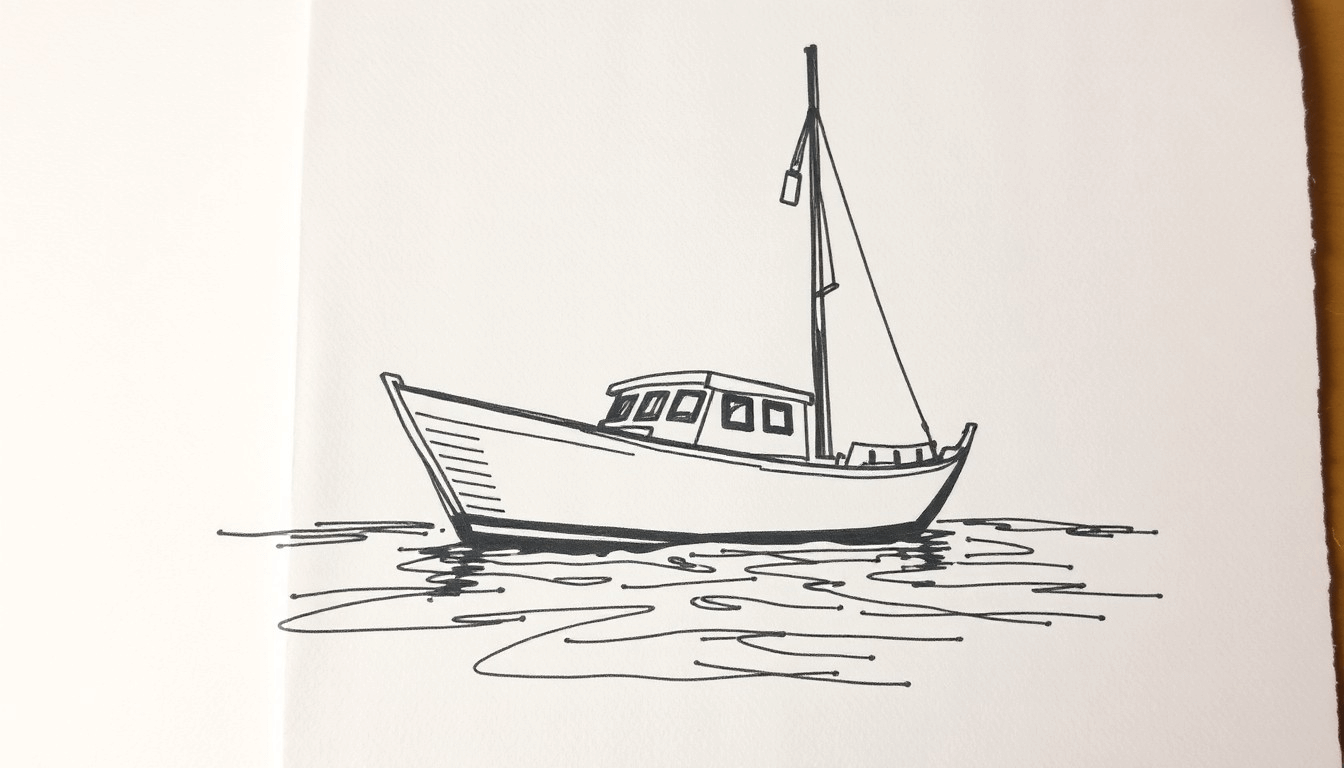
From Sketches to Reality
Well, the client in his long life of yachting has never seen such a magnificent example of the art of yacht design and wants to build his boat now. A detailed set of specifications is written and bid packages prepared for submittal to prominent builders for quotes. The owner picks a builder in the Black Forest of Germany (staffed completely by Bavarian elves) and informs the architect they are ready to proceed. Now, the architect has a big problem. The initial step for a custom yacht construction is the fabrication of a hull.
You cannot draw the final hull lines until you know the weight and position of everything in the boat (the overall center of gravity) and you cannot know the weight and position of everything in the boat until the hull lines are done. This initial stage of a vessel’s design is like juggling raw oysters. Essentially, the architect must “build” the entire vessel in detail on paper without any drawings. So, the architect must look towards his vast experience, extensive schooling and infinite knowledge of all things nautical… and then guess, estimate, approximate, infer, presume, suppose, and surmise like hell to produce preliminary weight/balance calculations. If this stage is improperly done, you can end up with a vessel so far down by the bow that she looks like she is preparing for a deep dive.
Weight calculations are probably the most tedious, unrewarding part of designing a vessel but are vital to a successful project. Everything in the vessel must be taken into account: if the owner plans to cruise with his cat Barfball, you need to take the cat, cat food, and kitty litter into account. If the owner is in the cement galoshes industry, the weight and position of those cement galoshes must be tabulated. If the owner maintains a pig iron collection aboard, the pigs and their location must be taken into account as well as the location and weight of everything else: structure, machinery, wiring, woodwork, plumbing, tanks, etc.
Only now, can the hull be shaped to support the weight with the center of buoyancy lies directly under the center of gravity resulting in a hull that floats on her lines. This final hull drawing allows the builder to get started and, in the meantime, the architect rushes forward with the detailed drawings to keep ahead of the builder at all costs – the so-called “fast track” method of construction. This puts a lot of pressure on the architect but, 99% of all custom vessels are built this way. In fact, since the dawn of mankind, only a handful of clients have opted to first design the entire boat before construction started. Reason? A 100-footer might take eight months for drawings and another 15 to build resulting in a nearly two-year gestation period. This is unacceptable to most owners who want their new boat now.
And so, all of you out there who have always wanted to be yacht designers now have the knowledge to do so. Buy yourself a cheap computer, get a program like “Frontal Lobotomy and Yacht Design for Beginners” for $29.95, follow this article carefully and whether your present occupation is stuffing cotton in an aspirin factory, rooting around people’s molars or sniffing armpits in a deodorant laboratory (a real job, by the way) you too can go forth and design boats with the best of us. There is so much more to discuss here but I’ve run out of space and, besides, it is time for my piano practice.
(Reprinted with permission of Regina Fexas.)
If you would like to read more of Tom's pearls of wisdom, tune in next Friday -- "Fexas Friday."
Better yet, why not get a full dose of infectious Fexas whenever you need it -- and buy one of the volumes below. Better yet, why not buy all of them -- we call them the "Fexas Five." They will provide many evenings of fun reading (better than Netflix), and you'll make the widow Regina very happy knowing that Tom will live on with you the way most of us remember him.
Order 1, 2 or "The Fexas Five" --

To find the "Fexas Five" on Amazon, click here...
Tom Fexas (1941-2006) was one of the most influential yacht designers of the last quarter of the 20th century. With the narrow Wall Street commuters that were built in the 1920s and '30s always on the back of his mind, he wanted to design boats that were at once fast, comfortable, seaworthy and economical to operate. Over the years, he and his firm designed over 1,000 yachts for some of the most prestigious boat builders in the world, including Choey Lee, Palmer Johnson, Grand Banks, Mikelson Yachts, Burger, Abeking & Rasmussen and many others.
Even though toward the end of his career he only designed megayachts and superyachts, including the remarkably influential PJ "Time" in 1987, he is best remembered for his first major vessel in 1978 -- Midnight Lace -- which became a series of 44-52-footers. They were light, narrow, and fast with relatively small engines. He was also influential in the boating community because of the monthly column he wrote for Power and Motoryacht, which began in its very first issue in January 1985.