Thru-Hull Hose Clamp or 2? What is the ABYC Standard?
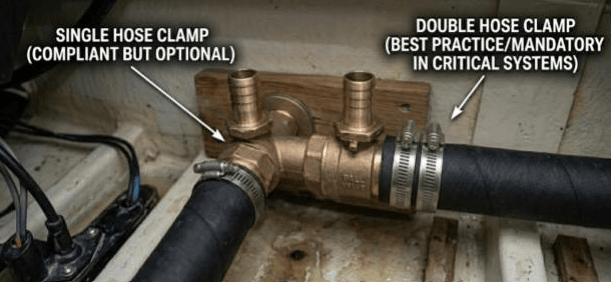
We often receive questions from BoatTEST readers regarding whether double hose clamps are required by the American Boat and Yacht Council (ABYC) on hoses connecting to thru-hull seacocks or ball valves. There is a widespread assumption across the marine industry that two clamps are universally mandated below the waterline.
However, ABYC standard H-27, "Seacocks, Thru-Hull Fittings, and Drain Plugs," contains no general double-clamp requirement. Neither the U.S. Coast Guard (USCG) nor the ABYC require double clamps on standard thru-hull fittings. In fact, federal regulations under USCG Title 33—which govern recreational boat manufacturing—do not address thru-hull hose clamping requirements at all.
ABYC Mandates: Exhaust Systems and Fuel Fills
The ABYC is highly specific about where double hose clamps are legally required to meet compliance standards. There are only two narrow applications where double clamping is mandatory:
- Exhaust Systems: Every exhaust hose connection must be secured with at least two clamps at each end. These clamps must be constructed entirely of stainless steel, feature a minimum band width of 1/2 inch, and cannot rely solely on spring tension.
- Fuel Fills: Double clamps are strictly required on fuel fill hoses to ensure structural integrity and grounding continuity from the deck fill plate to the fuel tank.
Outside of these two specific systems, a raw-water intake hose secured to a seacock below the waterline with a single clamp is technically ABYC-compliant. The organization's stance prioritizes clamp quality and proper installation over sheer quantity.
Marine Best Practice vs. Compliance
While a single clamp meets the letter of the law for standard raw-water systems, double-clamping all connections below the waterline remains a critical industry best practice. Marine surveyors, mechanical technicians, and hull inspectors widely advocate for two clamps because mechanical components operating in a harsh marine environment are prone to corrosion and vibration fatigue.
As detailed in the documentation found in image_1841a1.png, if a marine surveyor flags a boat for utilizing single hose clamps on a standard seacock, they are technically incorrect regarding the official ABYC standard but completely correct regarding vessel safety and best practice.
Technical Note: When double-clamping, the hose barb must be long enough to fully accommodate both bands. Placing a second clamp partially past the end of the barb will distort the hose, crush the rubber, and actually increase the likelihood of a catastrophic mechanical failure.
BoatTEST Takeaway
Older boats are most particularly at risk. Remember, stainless steel clamps can and do rust. Even compliant hoses degrade over time. Annual boatowner through hull inspections are mandatory for a well-found ship.