Tidal Electrical Power Picks Up Steam
What Happened to the East River Turbines?
1. The RITE Project’s Lifecycle
- The RITE Project began with experimental testing starting in 2006, including a short-term array of six 35 kW turbines that supplied power to a local supermarket and parking garage on Roosevelt Island—marking the first-ever grid-connected tidal turbine array in the world.
- That initial test ran until about 2008–2009, generating around 50 MWh of electricity.
2. Advancement and Pilot License
- In 2012, the project secured a FERC hydrokinetic pilot license—the first of its kind in the U.S.—allowing Verdant Power to continue advancing tidal turbine technology.
3. Generation of Gen5 Turbines
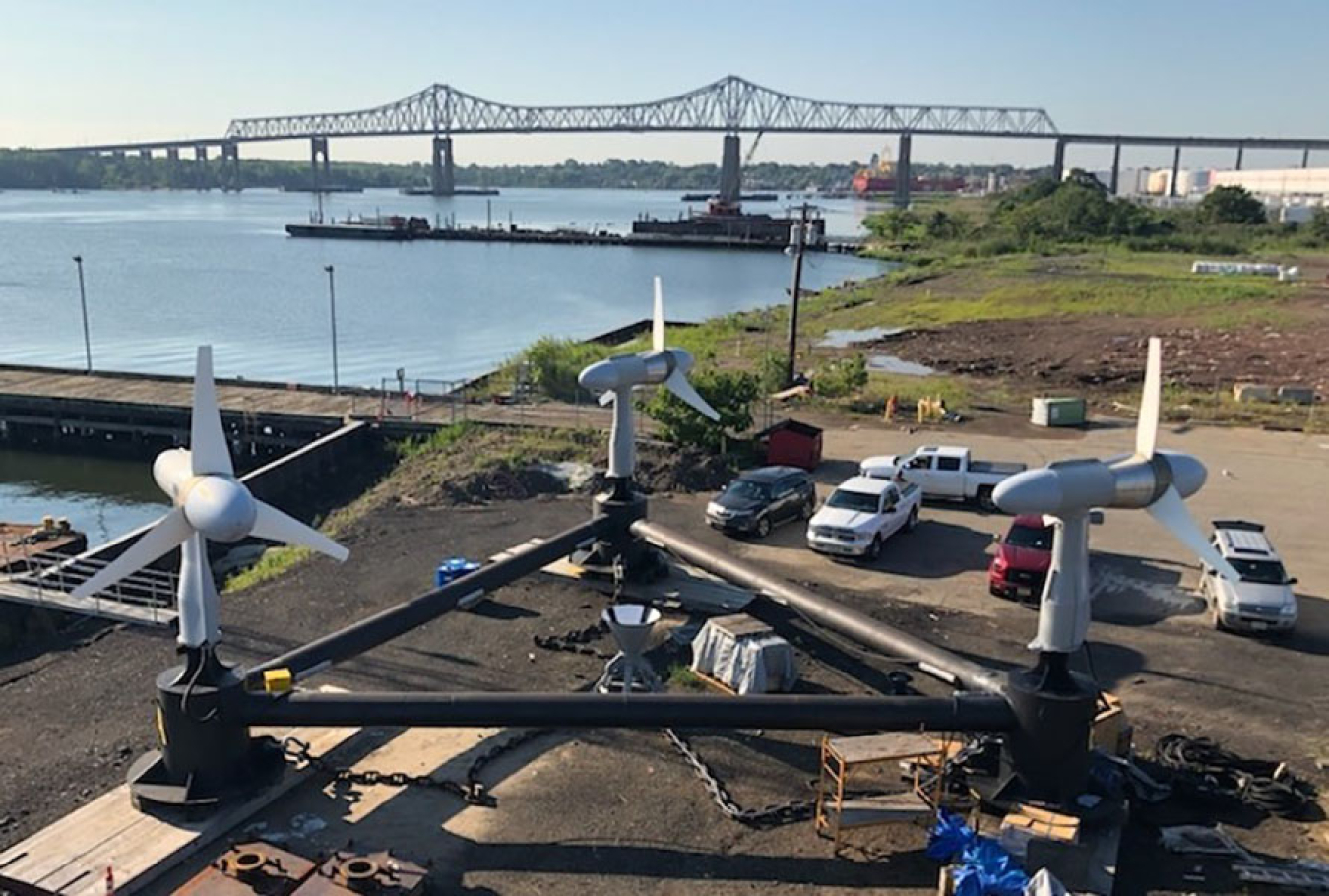
- In October 2020, Verdant Power installed three upgraded fifth-generation (Gen5) turbines mounted on their new TriFrame™ structure at the Roosevelt Island site.
- These turbines performed exceptionally well—delivering roughly 40% more energy than forecast, achieving nearly 100% availability, and generating approximately 312 MWh of electricity for the grid between late 2020 and December 2021.
4. Decommissioning in 2021
- The RITE Project was successfully decommissioned in 2021, having achieved Technology Readiness Level 9—the highest level, indicating the technology is proven and ready for commercial deployment.
- Following the concluding operations, all turbines and associated infrastructure were removed—today, “there’s little evidence RITE ever existed” at the site.
The Following Article is Courtesy of IBI
Fish Friendly Tide Turbine to be Trialed Off Orkney
Harnessing the reliability of tides and river currents, Spiralis Energy’s 3D-printed turbines offer a low-impact way to power harbors and coastal communities.
Designed to be anchored in rivers or in tidal zones, the Spiralis tide turbine should soon be powering the island of Alderney and is suitable for any tidal harbor
Harbors and marinas are often located in areas of either strong tidal flows or river currents, so provide a good base for the establishment of renewable power. Whilst wind and solar are well proven technologies, wave and tidal power are still relatively new, but the harbor infrastructure often provides a good base for installing prototype equipment.
Capturing the Power of Tides
Of all the water-based renewables, tidal is by far the most reliable. Tides are highly predictable, and often very powerful, whilst river currents can vary dramatically, especially during periods of drought. Harnessing the power of both is London-based start-up Spiralis Energy, which has spent the last few years scaling up its prototype and having various designs tested in real life locations to validate its output. The energy produced has come to within 1% of simulated models, proving the predictable nature of this renewable power source.
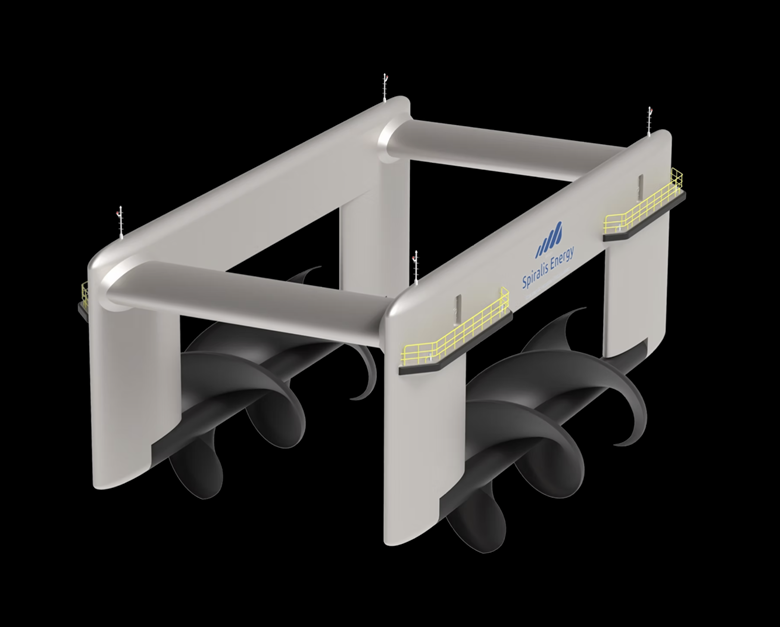
The idea is relatively simple and is based on the Archimedes screw. A submersible turbine is 3D printed from recycled plastic and held in a bracket made from repurposed steel. The retractable assembly is slung beneath an anchored 40 x 20m barge and can provide anywhere from 5kW to 500kW daily depending on its size.
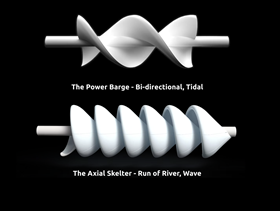
Unlike the bladed underwater turbines, which can have a negative impact on marine ecosystems, the Axial Skelter design merges almost seamlessly with the ecosystem. The shape, based on a spiral shell, turns gently and even has fish swimming safely through the voids, as can be witnessed on the company’s website.
There are two basic turbine designs, one optimized for a steady, slow moving omni-directional current such as in a river, and a bi-directional configuration that harnesses a tide that changes direction every 6 hours.
With a full-scale version built and ready for testing, the location for sea trials has recently been changed. Originally the small island of Alderney, located off the coast of Normandy, France, was to be the testbed, mainly due to the powerful tidal race which can run at up to 12 knots across the sheltered harbor. The Spiralis barge was destined to supply most of the entire 3sqml (8km2) island’s electricity needs, minimizing the time the large diesel-powered generator had to run, but the shore-based infrastructure was deemed to complex to adapt. Instead, the final tests will take place in the Orkney Islands off the northern coast of Scotland, in an area already set up for tidal research. Once fully validated, the barge will be moored off Alderney harbor and investment in the local grid will be made so the island can be connected via an underwater umbilical.
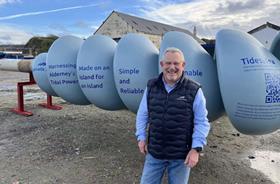
Spiralis Energy CEO Guy Levene says this type of energy barge could be moored in any international location with steady currents, such as the Mississippi, the Danube, or the Rhine. The tidal versions could find themselves powering harbors and coastal communities in thousands of locations that experience significant tidal ranges, such as off the coastlines of Canada, South America, or New Zealand.
“Each one of our power barges will be registered and certified as a seagoing vessel and be safely anchored,” he said. “We know they will be seaworthy as they have gone through an official testing process.”
Each turbine will cost around £1 million, with service and maintenance costs of around £100,000 a year. Having just one moving part below the water, and a modular approach to upscaling, has kept the installation costs and downtime relatively low.