Time to Upgrade Your Battery Chargers?
By Frank Sargeant
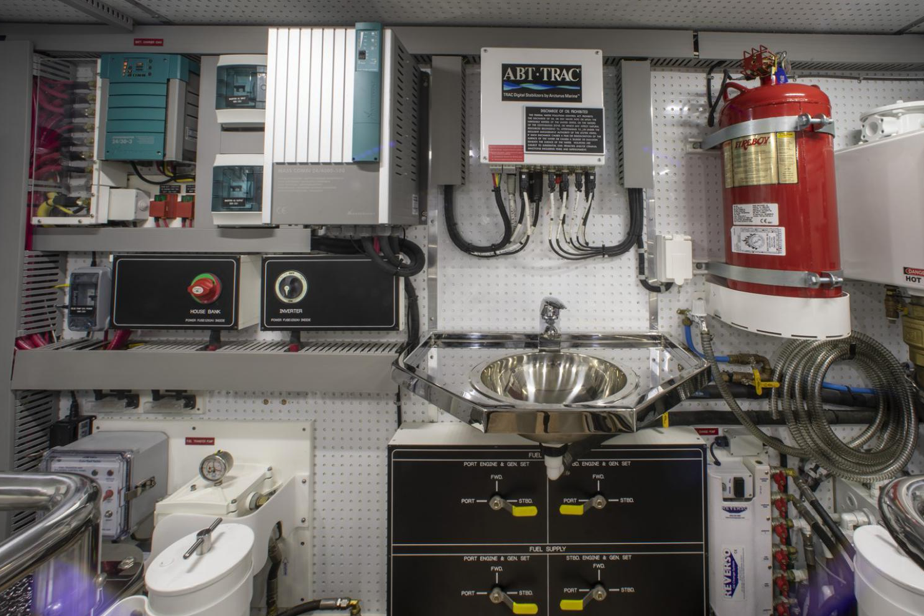
Electrical demand is multiplying geometrically aboard for many of us these days, whether we run a 20’ (6.1 m) bass boat or an 80’ (24.38 m) LRC and a well-equipped boat has to include systems to supply that demand consistently and dependably. If you haven’t upgraded your systems in a few years — or if you’re buying a new boat — it’s smart to tally up all the likely electrical loads aboard to be sure you’ll have the necessary power to run everything when you want (or need) to.
Get a Charge On
Most of us are basically familiar with battery charging systems that provide current via the alternator on the internal combustion engine. Other power sources are onboard gas, diesel or solar generating systems. When you’re docked, shore power linking to an AC charger on board does the job. Whatever the source, you need enough output of the right kind for the battery system on your boat.
The basic battery types include lead-acid, absorbed glass mat (AGM), gel and more recently lithium-ion. Some boats today include several of these types of batteries, complicating the charging needs.
Shore Power Chargers
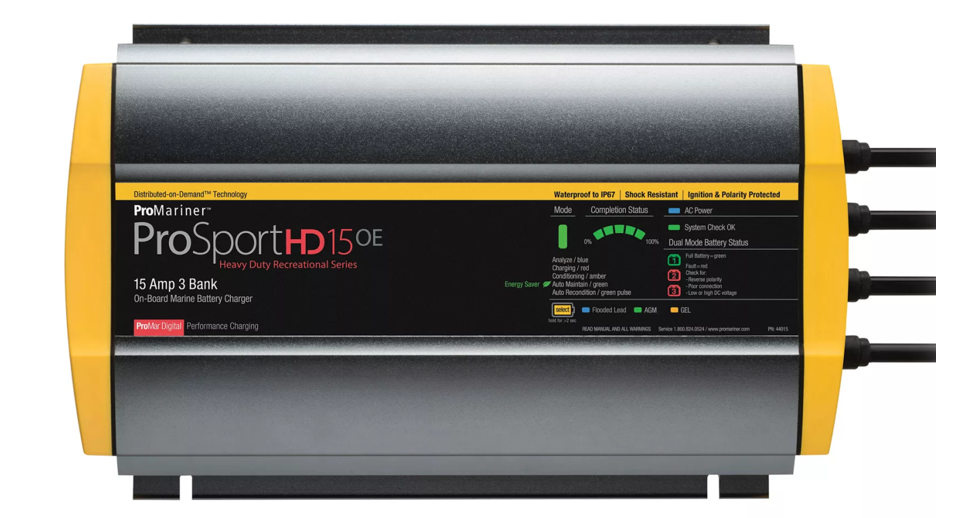
Batteries do best with chargers that can charge in phases suited to the internal chemistry, whether that’s traditional lead-acid, absorbed glass mat (AGM) gel or lithium-ion.
Shore-power chargers for marine use first go into the “bulk charge” phase when hooked up and plugged into AC power. Ideally the bulk charge quickly brings the battery to about 75% of full charge. Some chargers have different settings for the various types of batteries — use them to avoid overheating or undercharging.

Battery companies recommend charging a 12V battery at a rate of 20% to 40% of the battery’s capacity in amp hours to a voltage of about 14.6 volts, or 14.1 volts for gel. For example, a 200 amp-hour battery would be charged at 40 to 80 amperes until it gets to about 75% of full charge. Smart chargers take care of this without any input from the user other than setting the charger for the right type of battery.
At 75%, smart chargers go into what’s called the “acceptance phase,” with reduced amperage as the battery approaches a full charge. Once it’s fully charged, this phase ends as well.
Float and Equalization Phase
The charger then goes to the “float phase” with the voltage reduced to 13.4 (13.8 for gel) to maintain the battery without boiling off electrolyte. It can stay on this phase for extended periods without overheating or being damaged — but note that low-end chargers may not have a float phase. It’s best to spend a little extra and get this important feature.
Some chargers also offer an “equalization” phase for lead-acid batteries, which is a sort of extended maintenance phase that forces the battery to its highest possible state of charge, actually boiling the electrolyte just enough to dissolve the lead sulfate crystals that have collected on the battery’s plates. This extends the battery’s life for a time. Battery makers suggest the equalization process every 30 recharge cycles or so. (The battery should be disconnected from the equipment it feeds during the process, since the overcharging may damage some delicate circuits.)
The Lithium-Ion Difference
Lithium-ion batteries can charge at a much higher current and they charge more efficiently than lead-acid, which means they can be charged faster via chargers with higher output. Lithium batteries don’t need to be charged if they are partially discharged, unlike lead-acid batteries.
Virtually all lithium-ion batteries come with an internal battery management system that protects the battery from being over-charged and over-heated, an important feature in batteries that can cost more than $3,000.
Most lead-acid or general purpose chargers will charge lithium batteries, but those with an automatic desulfating system should not be used on lithium-ion batteries since they can damage them, according to the manufacturers.
The Right Output
The size of the charger your boat needs depends on whether it lives in a home slip nearly every night, or may spend days or weeks harbor-hopping or anchored out. A smaller charger does the job for those boats that return to the same hookups night after night and are used mostly on weekends. In fact, if you run your engines for any length of time on the weekends, you probably won’t need to hook up to shore power that often.

On the other hand, if you anchor out and run lots of accessories late into the night without cranking up the generator, a powerful shore-power charger will be appreciated when you return to the docks. (Of course, your starting batteries should be protected from house loads so that you never have starting issues.)
It’s best to keep your house batteries at somewhere between 50% and 85% of full charge during daily operations according to most battery companies. A charger powerful enough to restore all of your use from a day on the water in an hour or two will ease a major concern when you’re cruising away from your home port.
Charging From Your Alternators
The alternators on your internal combustion engines will provide all the electrical power your batteries need while underway, but a “smart” voltage regulator is also a must.
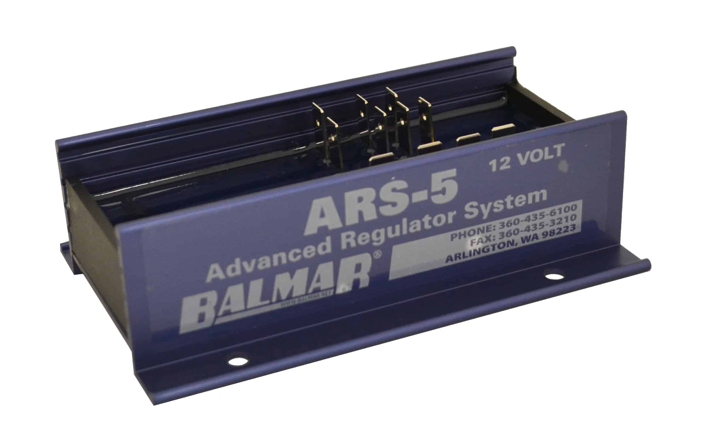
Intelligent voltage regulation meets the needs of newer battery types, and the added load that modern electronics and inverter technology demand. Intelligent regulation matches the output of the alternator to the specific needs of your batteries whatever the type so they charge faster based on the needs of their unique construction, without the danger of overcharging or overheating.
Some premium voltage regulators are equipped with the ability to monitor both battery and alternator temperature, and respond by increasing or decreasing voltage levels to maximize both safety and performance. In the event of a condition that poses danger to the system or the vessel, the regulator has the ability to discontinue charging completely.
Keeping your batteries charged is just part of the equation aboard — if you have any alternating current or AC devices aboard, from TVs to toasters, you’ll also need a quality inverter — we’ll talk about them next time.