Tough Love - On Board Rossinavi's 59m Explorer Yacht Akula
Designed to her owner’s exacting specifications and nautical knowledge, Akula is an unusual and ingenious explorer. Risa Merl steps on board.
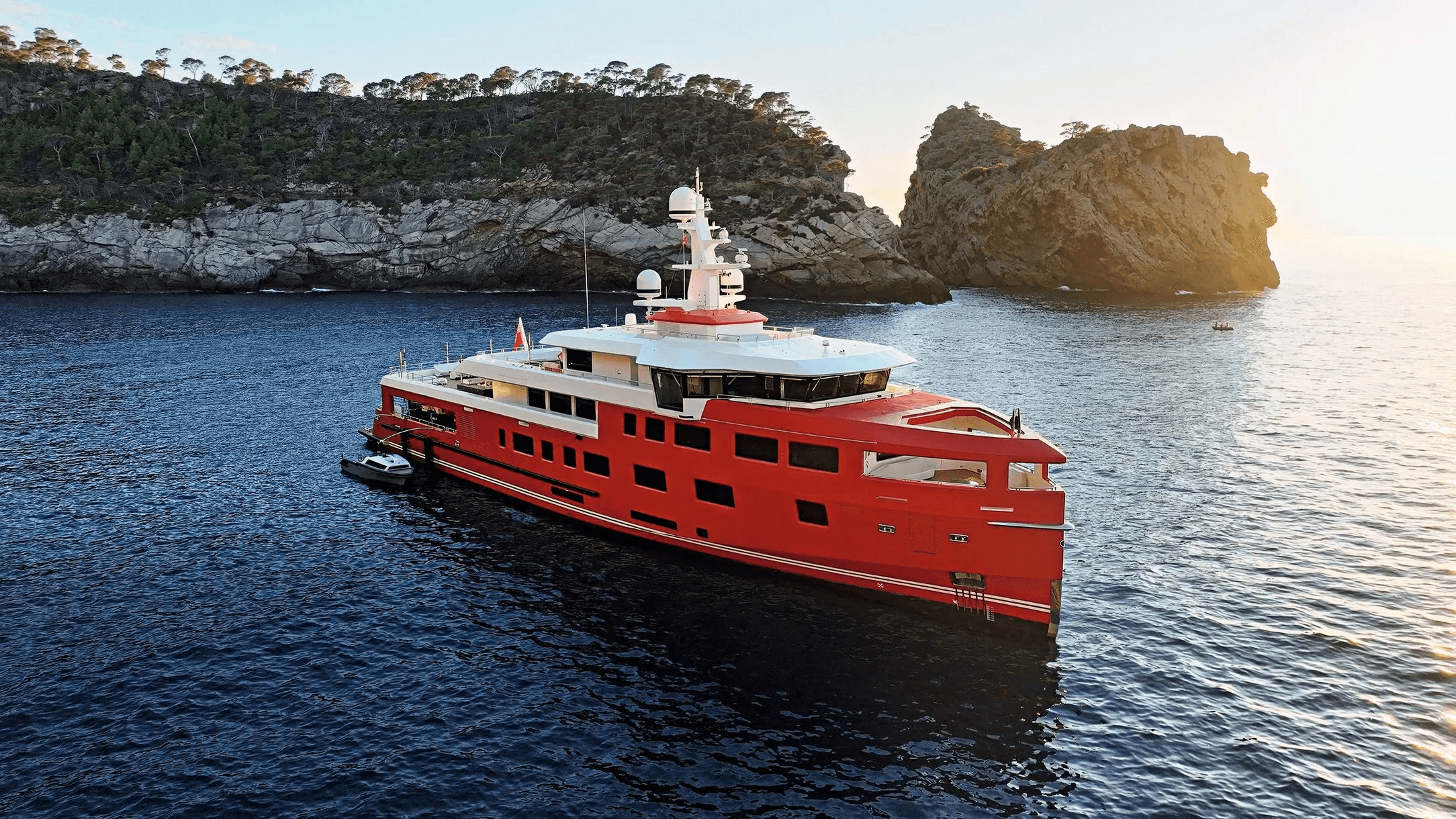
Zipping along the northern shore of Ibiza, the tender pulls into a quiet cove where the new 59.4- meter Rossinavi Akula looms above smaller sailing boats bobbing at anchor nearby. Even if she weren’t the only superyacht in the vicinity, with a bold red paint job and brawny explorer build that foretells her intended purpose, she’d be eye catching in any harbor. But Akula’s standout features are more than skin deep: a creative general arrangement; a focus on sustainability; the ability to host scientists on board; and every element of her design highly customized to suit her owners’ needs as they travel around the world.
“This is a yacht that is born to explore the world,” says Akula’s interior designer Francesca Muzio, founder of FM Architettura, as we stand on board the yacht under the hot Balearic sun. Somewhat unusually, the interior designer was the owner’s first port of call for the project. More precisely, the owner’s wife, having discovered Muzio’s work online, cold-called the FM Architettura office. “She literally called the answering service and said ‘I’m looking for a designer for a 60-metre boat, can someone call me back?’” Muzio recalls with an appreciative laugh.
Custom Yacht Vision
The full-custom project started with a blank sheet of paper – and a detailed list of specs and must-haves based on their many decades of yacht-owning experience. Speaking of those nearby sailing boats that Akula towers over, her owners had started their boating life with a 17-metre sailing boat.
Their background as sailors can be seen in the integrated handholds and lack of sharp corners throughout the interior of their superyacht. Prior to Akula, they had a 24-metre motor yacht before making the leap to this much larger custom project. “We knew what we needed, from the cabins to the technical spaces and the fuel consumption to the tenders,” says Akula’s owner.

They approached Rossinavi, encouraged by the Italian yard’s reputation for building custom yachts. Rossinavi’s COO Federico Rossi connected the owners with Gian Paolo Nari, who was hired to create the yacht’s rugged exterior.
Arrabito Naval Architects rounded out Akula’s all-Italian build team to develop the yacht’s sea-kindly hull. Nari received a simple instruction that turned out to be crucial for preparing for his first pitch meeting with Akula’s owners.
“The owner desired a robust, reliable yacht for family use, with the goal of circumnavigating the globe. I needed to focus on the stature and solidity of large commercial ships and research vessels,” says Gian Paolo Nari, founder of Gian Paolo Nari Yacht Design.
“The clean profile and military-inspired details captured the client’s attention. The silhouette of the design, with its sharp angles, convey strength, robustness and reliability. Entering a port with such an imposing vessel would be like driving an enormous truck into a parking lot full of cars.”
The exterior designer worked closely with Akula’s owners, with the yacht undergoing an evolution from the initial proposal. “Nonetheless, the profile has always been conceived as a single volume, where shapes emerge from material subtraction rather than overlapping elements,” he says.
Openings, or “subtractions” as Nari calls them, such as the large side windows, a generous aft garage and an expansive open-air observation deck that appears to be carved into the bow, have all been carefully integrated. These impactful design choices lighten the imposing structure and give Akula’s hardy profile a more a sophisticated, contemporary identity.
From the outset, the requested hull color was red paint in a matt, untreated commercial finish that would require minimal maintenance. This shade extends upwards, wrapping around the upper-deck bow. The rest of the superstructure is finished in white, with the exception of a pop of orange at the base of the mast on the sundeck up top.
A level down, openings are cut into the bow along the upper deck – two on either side, one forward and a triangular opening in the roof above – creating an indoor/outdoor sky observation lounge, as it’s been dubbed.
“Designing the observation deck posed a technical challenge, as it required freeing up the deck for guests and relocating the manoeuvring area below deck,” says Nari. This area backs onto a cosy interior observation lounge with a forward-facing sofa, positioned for the owners and their guests to bask in the joy of the voyage.
A Collection of Curiosities
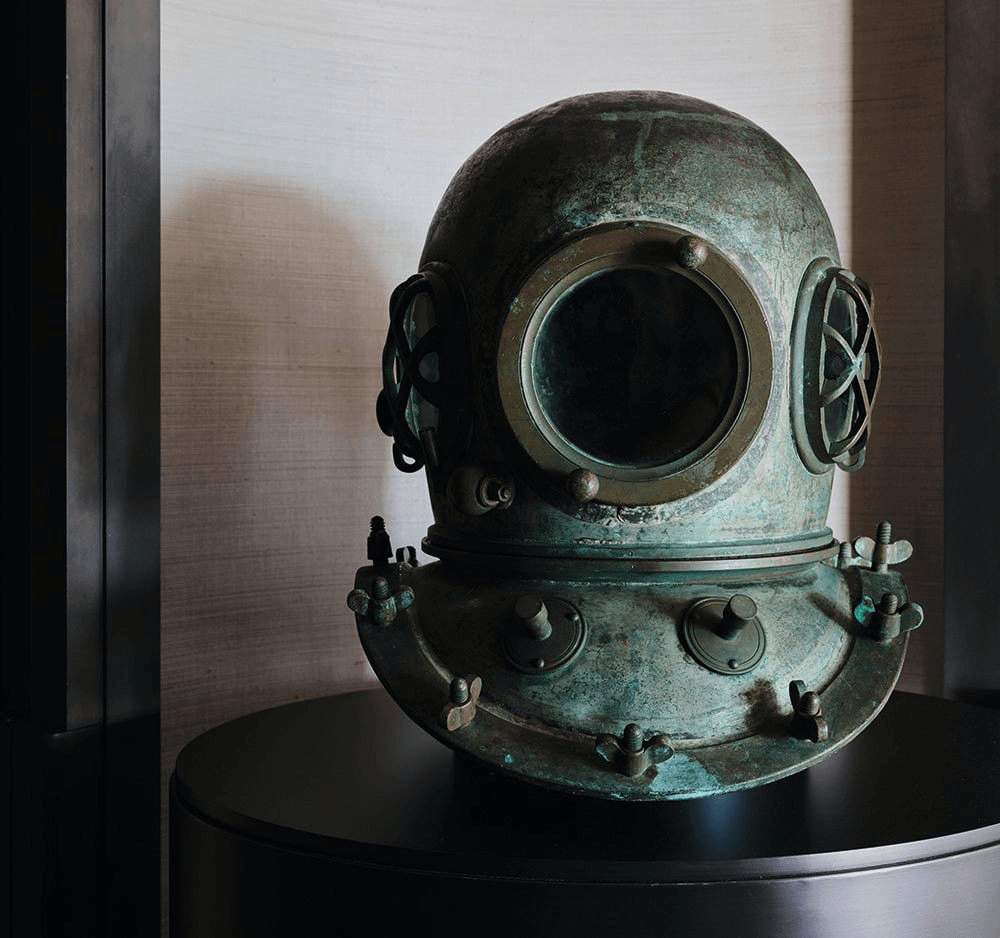
None of the nautical antiques and collectables displayed on board Akula was bought for this vessel.
Instead, each comes from the owner’s collection of more than 200 maritime wonders. Spanning the 18th century to present day, it features compasses, nautical clocks, sextants, toys, maps and blueprints.
The items on board include:
Yokohama Diving Co. 12-Bolt Diving Helmets, circa 1965 In the early 1960s, Yokohama started manufacturing helmets with an unusual design, influenced by American diving equipment manufacturer Robert Kirby, who had modified several Yokohama helmets for greater practicality.
Akula Submarine Model Akula gets her name from a Russian submarine, whose model, built by the yacht’s owner at 1:90 scale, is found on board. The Akula class, designated Project 971 Shchuka-B by the Soviet Union, is a class of nuclear-powered attack submarines first deployed by the Soviet Navy in 1986.
Submarine Crest Collection. Twenty-five original submarine crests were crafted to commemorate sub launches or as gifts for special guests. The collection includes crests from Strategic Nuclear Submarines, Nuclear Attack Submarines and standard submarines, primarily from the US and EU. Made of solid brass, each crest is mounted on a wooden shield.
Steger Marine Celestial Globe, circa 1950. This rare marine celestial globe was used for nautical training during the Cold War. The metal sphere, covered with 12 gores of chromolithographed paper, rotates freely on ball bearings. It shows the tropics, constellations and stars at five degrees of magnitude, with the Milky Way marked in green.
Spencer Browning & Co. Octant, circa 1840. Fittingly set in Akula’s mud room, this 32cm octant features an ebony T-frame with ivory plates, a signed inset arc scale divided to 100°, a braced index arm, pinhole sights, two mirrors, five shades, pin feet and housed within a keystone box.
Warm, Welcoming Interior
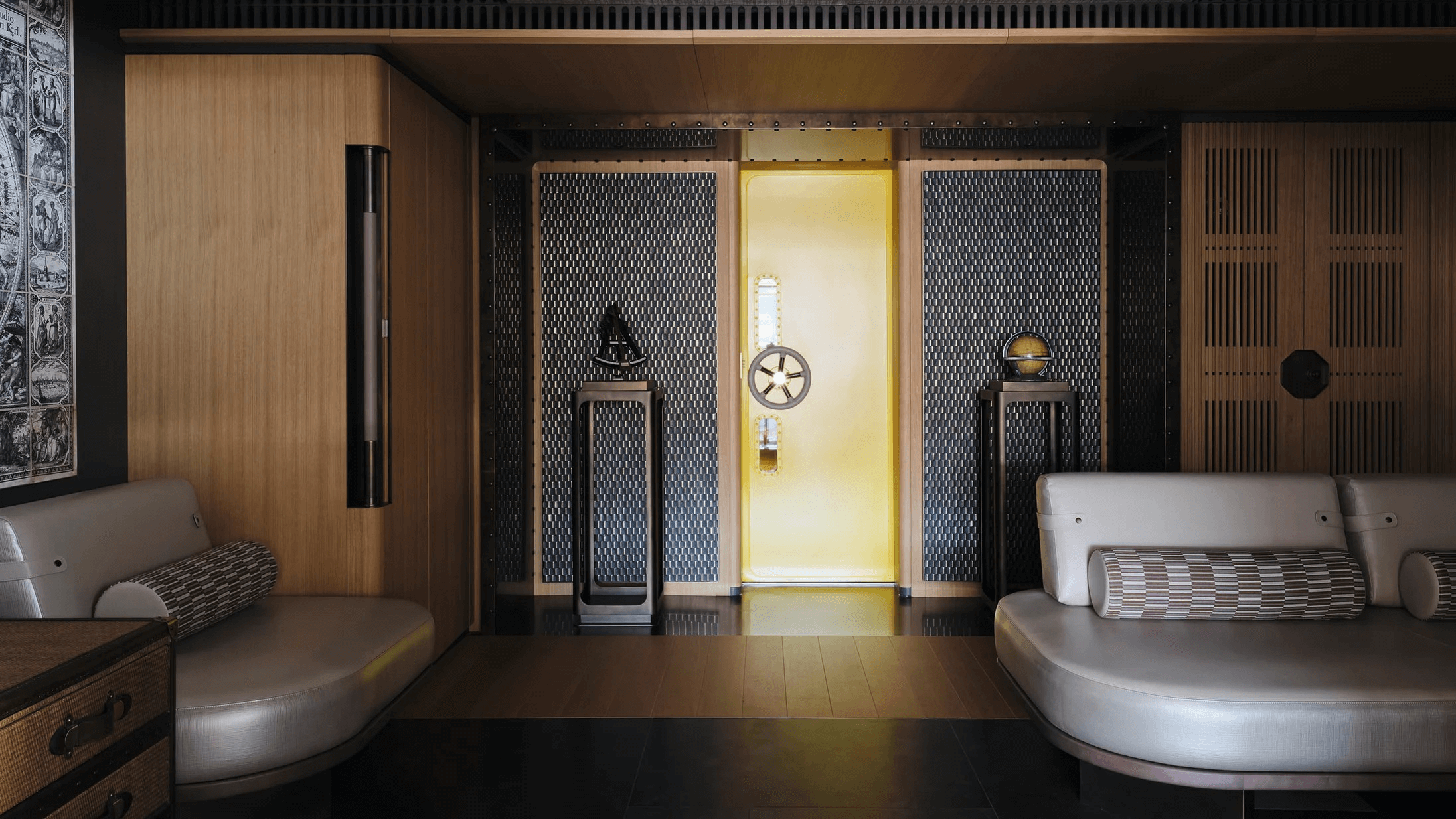
“Akula is very masculine from the outside, but inside you’ll find a warm, homely and detailed vessel,” says Muzio. The feeling of being invited on a spectacular journey was one of Muzio’s themes for Akula’s design, and it’s evidenced by placing a high-end mud room at the main-deck entrance. Far from a pared-back area for peeling off damp expedition gear, this is a warmly welcoming space with hard-wearing stone flooring and deep sofas on which to sit and slip off your boots.
On many explorer vessels, this sort of room might be relegated to the lower deck and have a commercial finish. But Akula’s owners and designers decided to make this the first interior area that guests encounter, an overt reference to the yacht’s world-girding purpose. It also serves as a transitional space between the rugged exterior design and inviting interior, and metaphorically between the adventures to be had outside and the haven of home within.
“It is literally the place you’ll come when you come back from exploration,” says Muzio. Akula combines form and function at every turn, and the mud room, despite its good looks, is a highly functional space. Slatted wooden doors conceal cupboards – with built-in drains and air conditioning – where outdoor gear can be stored and dried until the next adventure.
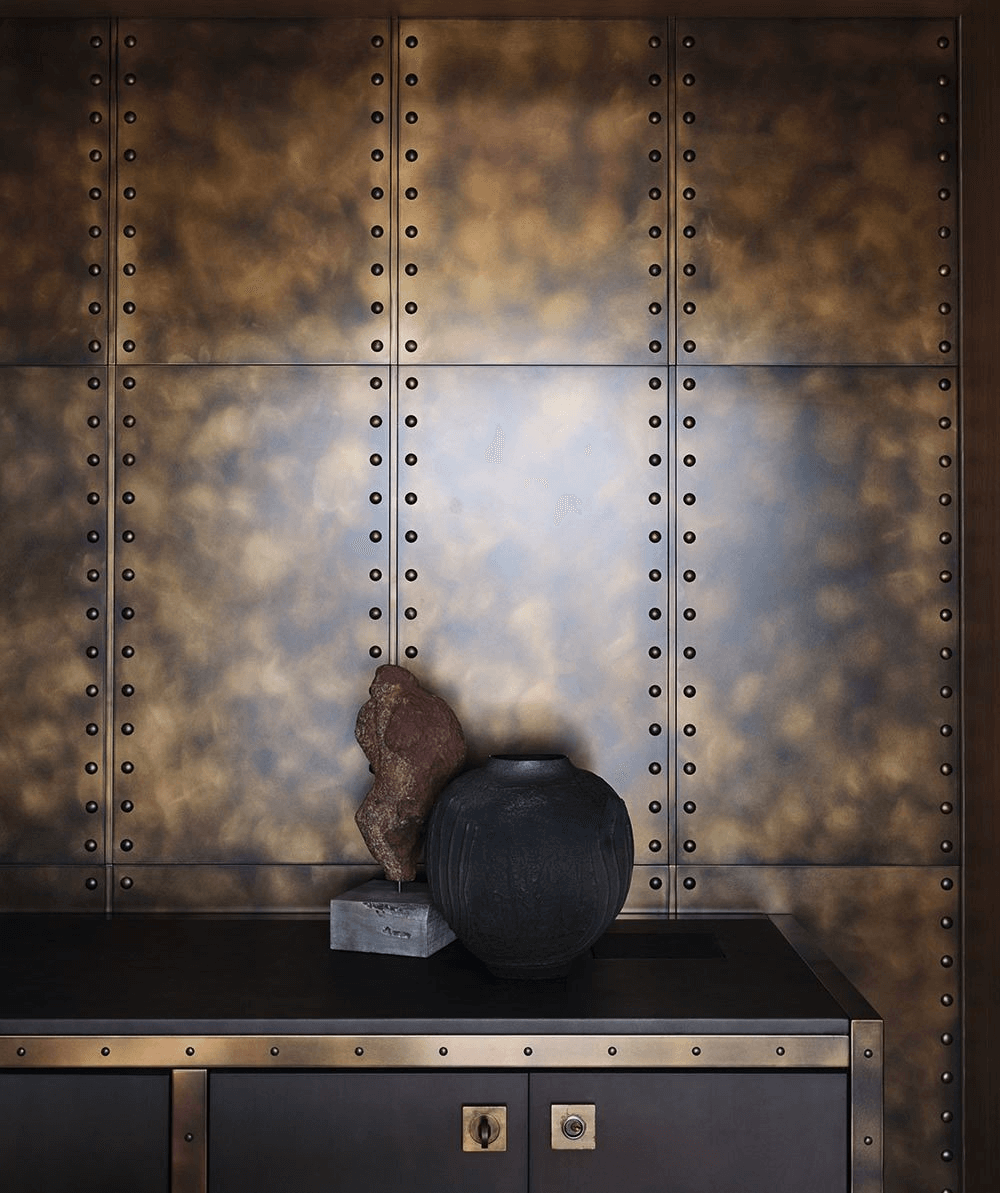
The room itself is a visual feast, with a wall featuring a “liquid” metal finish on the forward bulkhead, a reflective ceiling and a world map, chosen by the owner’s wife, covering the port wall. The space also sets the scene for design motifs carried throughout the yacht, such as bronze detailing with rivets and exposed vents that nod to industrial design. A hand-painted yellow door with a handwheel at the centre leads to the main guest living spaces, which include three cabins, a media room and the owner’s cabin forward.
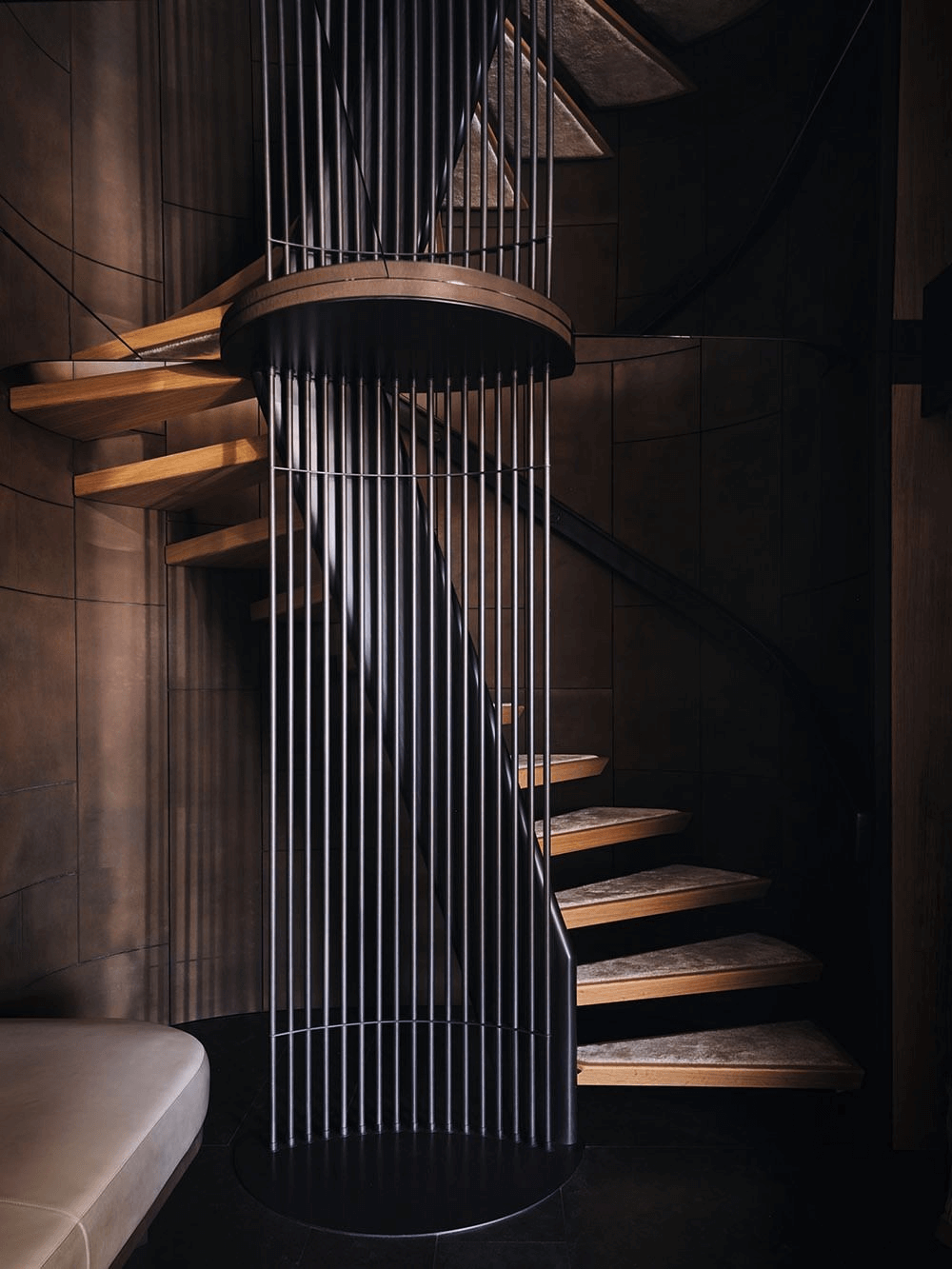
Akula’s layout is far from the norm. There is no saloon nor a grand central staircase to be found forward on the main deck. Instead, a spiral staircase tucked into the corner to starboard winds its way skywards. While the placement of the staircase makes it less conspicuous, the stairs themselves are a visual treat. The floating wooden steps wrapped around a sculpture of metal rods are reflected in the ceiling above like a stairway to heaven or, in this case, the detail-rich main saloon on the upper deck above.
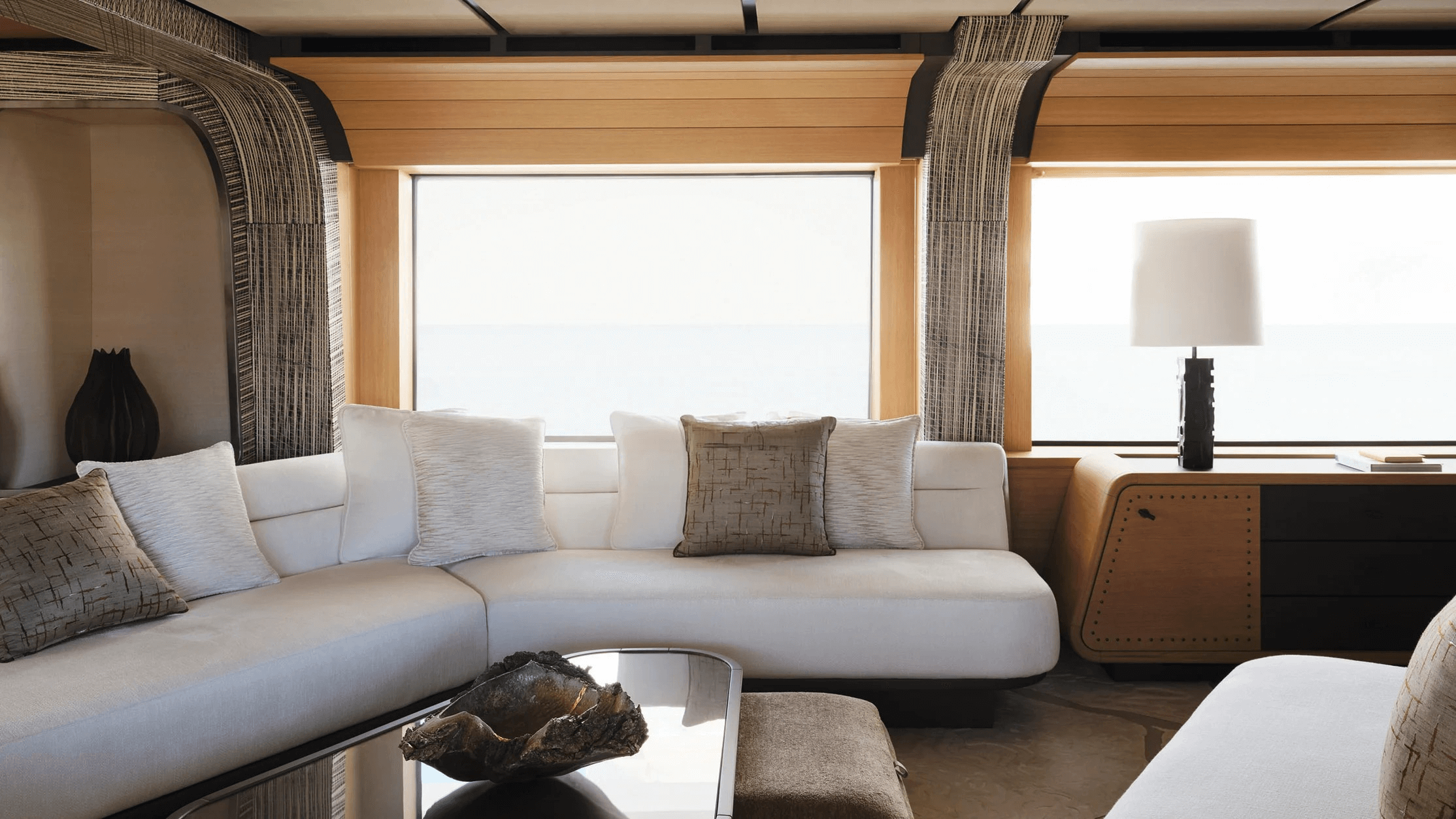
A wall set at an angle in the centre of this saloon separates the seating area, with its boomerang-shaped sofa covered in soft white chenille, from the forward dining room. “The owner’s wife didn’t want to walk in and see the table, so instead of having a transverse layout that is traditional, we created a dynamic flow with separate, yet connected, areas,” says Muzio.
Custom designed by FM Architettura, the dining table base recalls the shapes and metal finish of gears, while the top is made of wood with inserts of tobacco leaf procured from Nature Squared and applied using vegan glue.
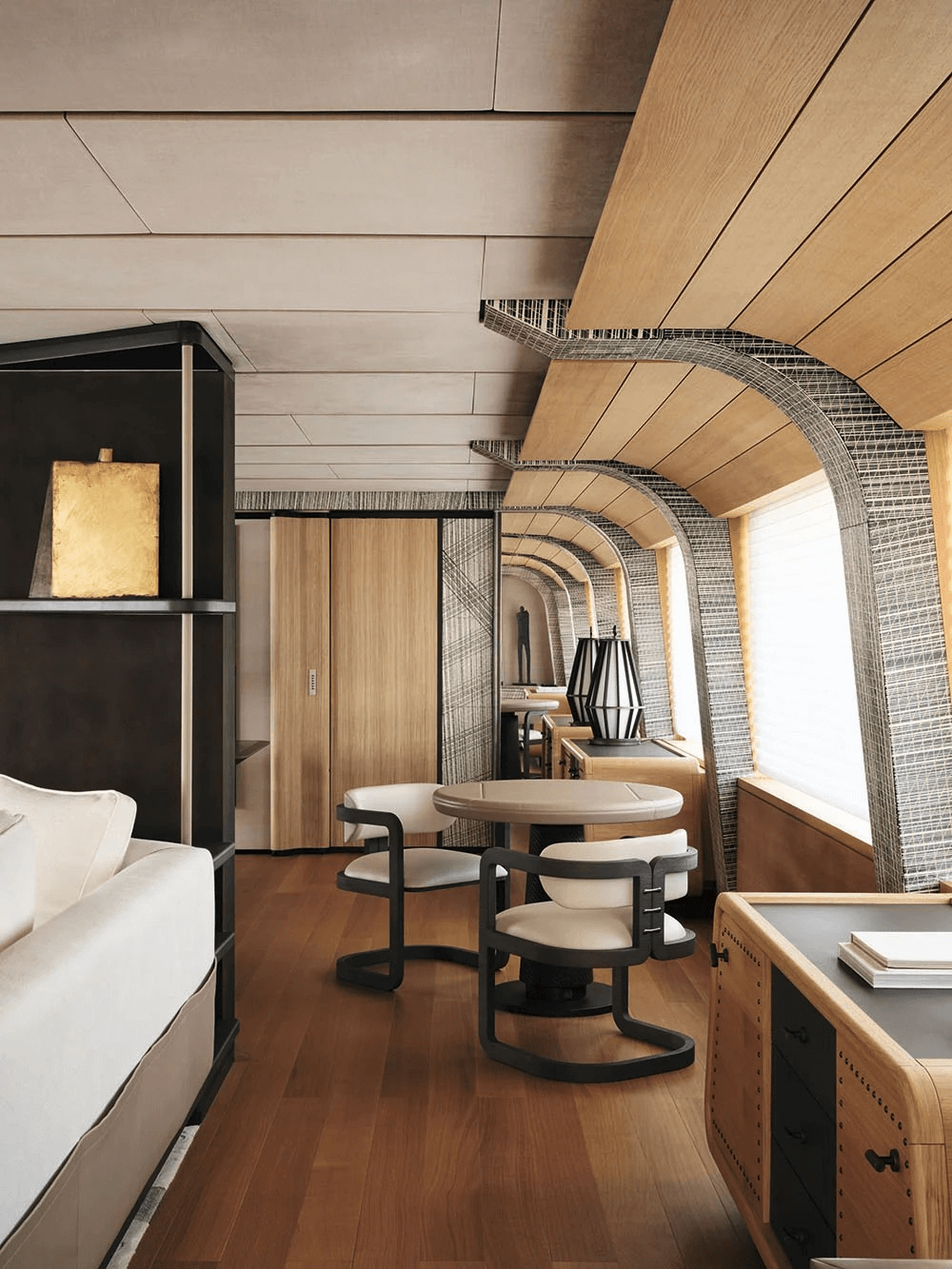
Arched columns inspired by the ribcage of a whale frame the entire room. These are covered in Kevlar from recycled sails, which is also used on the forward bulkhead by the dining table. The black-and-white Kevlar was painstaking to install. “We matched the lines like you would marble – I can’t even tell you how many drawings it took to get it right,” says Muzio.
Along with recycled sails, Akula sports other eco-minded materials such as rattan wallpaper and naturally finished leather. Each was intensively researched and chosen for its sustainability, short supply chain and lack of chemicals. “The owner gave us the challenge to use sustainable materials, and the concept for the interiors is inspired by environmental respect, with the conscious use of materials and their application while maintaining a high attention to detail,” says Muzio.
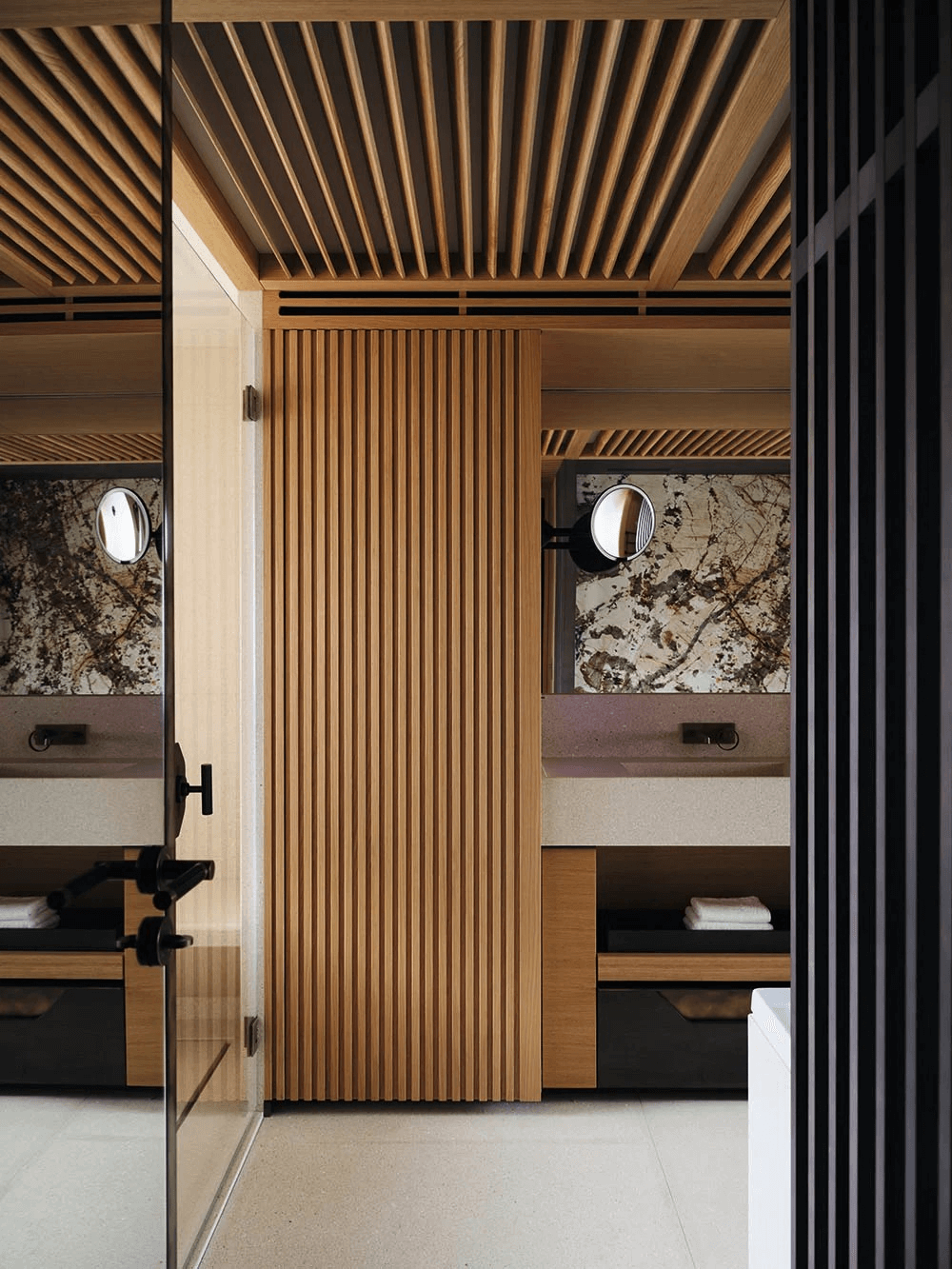
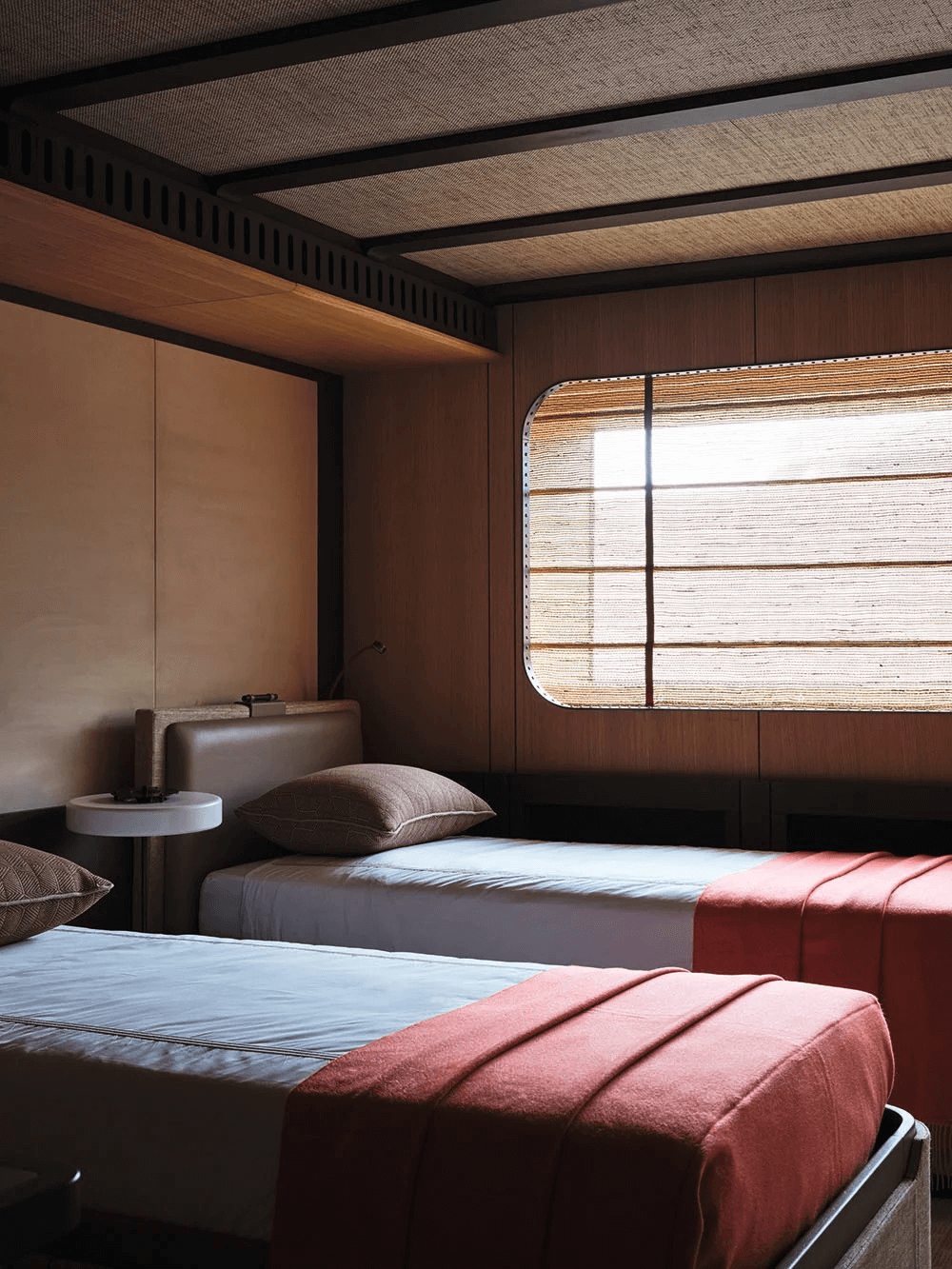
Natural finishes also add to the tactile, textured nature of Akula’s interior design. Throughout the yacht, the European oak joinery is untreated, with no chemical finishes. “When you touch it, you really touch the wood,” says the owner. “You can feel the grain, you can smell it, it’s really special.”
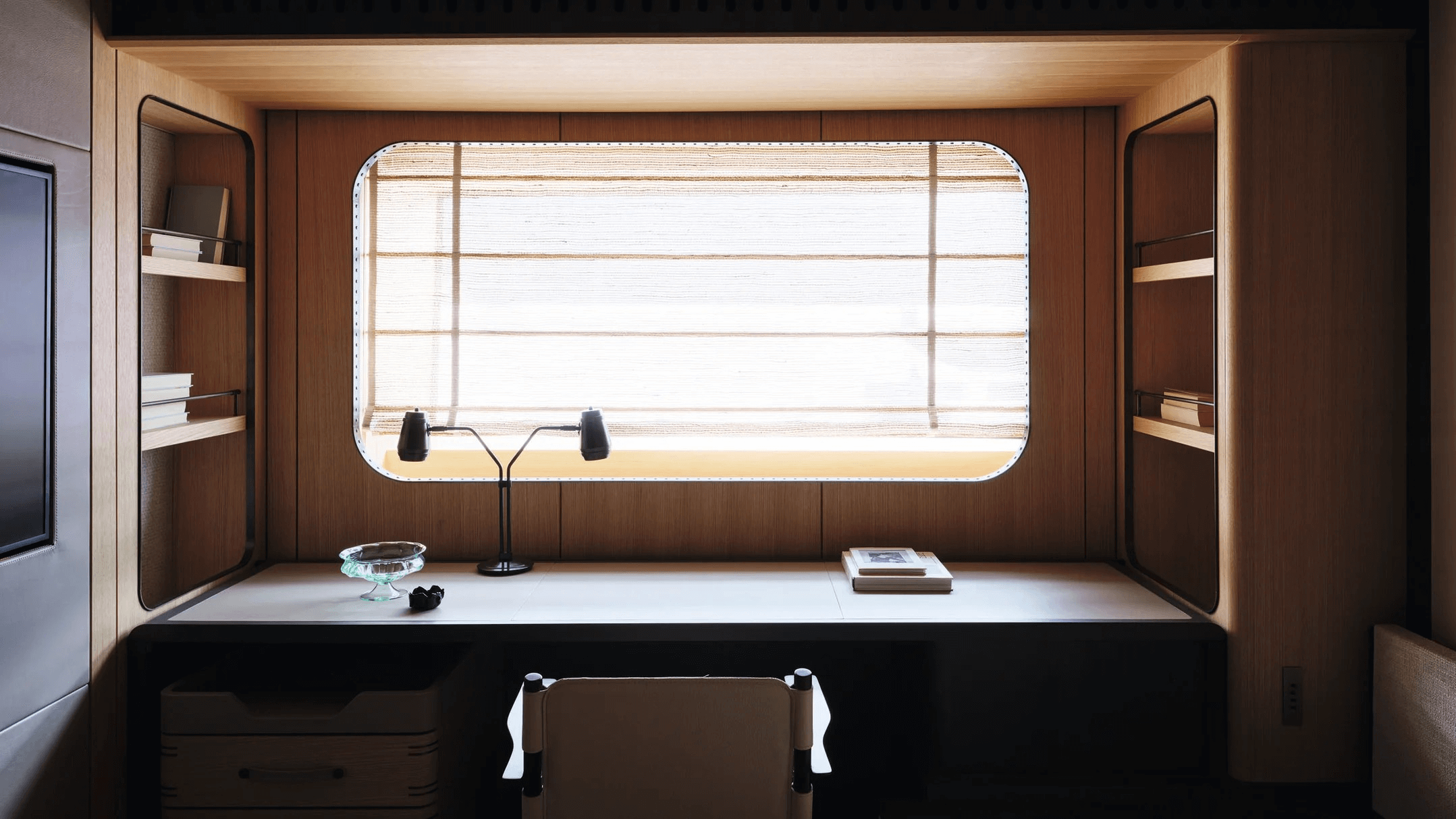
While the owners will welcome friends and family on board, for the majority of the time – and for months on end – Akula will be enjoyed solely by the two of them. As such, they required fewer guest cabins but needed more personal spaces for their hobbies, and, of course, a Japanese-inspired spa with sauna to unwind after expeditions ashore. The owner has his own workshop on the lower deck where he can tinker and an office/“man cave” set aft on the bridge deck.
The space is adorned with nautical antiques from his personal collection, which are also peppered throughout the yacht, set into recesses or atop pillars. The owner’s wife has a room of her own, too – an office/“craft cave” that precedes the owners’ cabin on the main deck. Her cave has a custom-made table where she can work on her embroidery and other crafts of choice, and the soft carpet under foot, made by Tai Ping, is designed to look like a wave lapping the shore.
Meanwhile, the carpet in the owners’ cabin resembles the cracked earth of a salt plain. Even the layout of the owners’ cabin is unusual, with the bedroom to port and, a few steps up, a raised platform library area to starboard. “The idea was that you can see out as you sit and read, like being on a veranda,” says Muzio. Finished in a lighter wood, the platform does almost feel like stepping out onto a sun-drenched balcony.
Sustainable, Quiet Performance
Underpinning Akula’ s commitment to sustainability is her two-storey engine room. The owner requested diesel-electric propulsion with azimuthing pods. Power comes from four Caterpillar generators, twin Veth L-drive thrusters and counterrotating propellers working together to deliver 2,600 kilowatts.
Akula can reach a top speed of 14 knots and cruise at 12. “But we usually go around 11.5 knots,” says the owner. “At 12 knots we can do 8,000 nautical miles but at 10 knots can do more than 12,000 nautical miles. She also has very low consumption, burning less than 150 litres per hour.”
The hybrid propulsion not only lessens Akula’s fuel consumption but makes her incredibly quiet. “What you hear now is the same you hear at 12 knots – no generator noise, no engine noise, no anchoring noise,” says the owner. “It’s important Akula is quiet for us, but also for the animals in the water.” Dynamic positioning will allow the yacht to hover over protected areas during their travels.
With an Ice Class hull, Akula is ready to roam the far reaches of the world, which is all part of the owner’s multi-year cruising plans. The yacht has already made her way around the Mediterranean and is inching her way northward, visiting Scotland, Norway and Greenland with plans to cross the Atlantic and then the Panama Canal.
Along the way, Akula may serve as a base for scientific research – laboratory containers can be placed on the aft upper deck, and the owners are collaborating with scientists from the University of Oxford.
As we round out our time on board, Muzio muses, “When you step on board Akula, you feel this is completely different from other things on the market.” Many a designer might claim this about their creation, but with this boat it rings true. Hopping back on the tender and peeling away from Akula at anchor against the backdrop of orange cliffs, it’s easy to imagine her in many a far-flung harbor, fitting in as a world explorer, yet always standing out boldly.
Specifications
|
LOA 59.4m |
Gross tonnage 1.241GT |
|
LWL 59.3m |
Engines Diesel-electric with VETH pods and dynamic positioning |
|
Beam 11.3m |
Generators 2xCATC32; 2xCATC9.3; 1xCATC7.1 |
|
Draught 3.45m |
Speed (max/cruise) 15/12 knots |
|
Range at 12 knots >8,000nm |
Stabilizers Naiad Dynamics Zero Speed |
|
Fuel capacity 150,000 liters |
Owners/guests 10 |
|
Freshwater capacity 26,900 liters |
Crew 12+1 |
|
Tenders 1 x 9m Tidemann RBB900; 1 x 8.5m Custom X-Craft |
Construction Steel hull; aluminium superstructure |
|
Classification C @ Hull • MACH YCh (EFP) ICE; AUT-UMS; Green Plus |
Naval architecture Arrabito Naval Architects |
|
Exterior styling Gian Paolo Nari |
Builder/year Rossinavi/2024 Viareggio, Italy |
|
Interior design FM Architettura |