Twisted Observations, Part 1
Spectating the Intracoastal
We docked at Britannia Marina in Northport Harbor, Long Island, New York after traversing the Intracoastal Waterway from South Florida at the date and hour planned. After 100 hours and 12 days, hundreds of throttle up/throttle downs (those pesky blowboats, you know), hundreds of markers, thousands of crab/fish traps, scores of bridges (and one lock) the trip passed uneventfully.
We were delivering a brand new Mikelson 43’ (hull #2). The crew consisted of myself, my wife Regina, California Dick Peterson (high muckety muck of Mikelson Yachts) and his wife Jill. This will not be your typical boring boat trip travel log detailing every stop and event along the way (“Regina bought a hot dog in Swansborough and, when she took a bite, the dog slid off the roll!”). No, I won’t subject you to that. I will merely give you some of my twisted observations along the route.
Follow the Yellow Brick Road
Running the Intracoastal in Florida is like driving your car on I-95: keep the pointy end between the red and green sticks and you will be OK. It is like following the yellow brick road – no seafaring skills required. Things get a bit hairier in Georgia and the Carolinas were the Intracoastal becomes a series of cuts connecting rivers and sounds (some quite large) which must be crossed before getting to the next cut. The only time we got lost on the whole trip was in Saint Andrew Sound in Georgia were we could not locate a critical marker that had to be rounded. It turned out it was located in (what seemed to be) the middle of the Atlantic Ocean! After clearing Norfolk, the “home stretch” is open water cruising in the Chesapeake, Delaware Bay and the Jersey Coast.
Life on Mars
If you like desolation, the Intracoastal Waterway of Georgia is the place for you. Aside for three bastions of civilization (Brunswick to the south, Jekyll Island in the middle and Savannah to the North) there is absolutely nothing – nothing along the intracoastal except desolate, open marsh as far as one can see. The day we went through Georgia, it was windy, cool and cloudy. Often we were the only boat for miles around and in stretches were there were no markers there was absolutely no trace of civilization anywhere. One as might as well be on Mars! Very weird for the overdeveloped East Coast.
Dire Warnings
Prior to the trip, I spent a hell lot of time studying the Waterway Guides and marking the charts with dire warnings from the guides concerning shallow water, rocks, outcroppings, fallen trees, dangerous crossings, strong currents, etc. As it turned out, virtually none of this was necessary since, it appears the Waterway Guides are written for low powered (or no powered) deep draft puff boaters. Any moderate draft powerboat with reasonable power will have no problems with any of this.
Warnings for example, about Pamlico Sound and Albemarle Sound in North Carolina were frightening. Yes, the crossing of Pamlico Sound (actually Pamlico River) can get quite hairy if the weather kicks up. But the entire crossing was only six nautical miles. In a 20-knot powerboat, this distance is covered in… 18 minutes! How bad can it get for 18 minutes? Albemarle Sound is a bit wider – about 14 nautical miles – a 42-minute run at 20-knots. Hell, anybody can stand anything for 42 minutes but a ragboat running at 6-knots would take a 2-1/2 hour pounding.
How Fast is “Fast?”
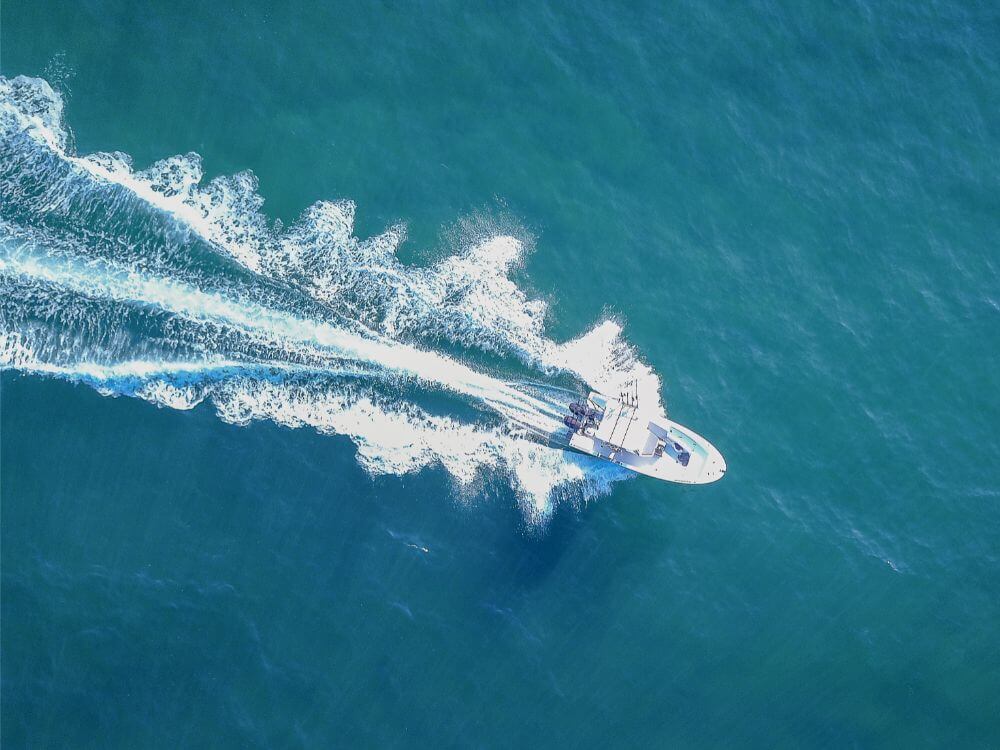
This brings up the subject of speed. In all my years drawing funny boats, I have always maintained that an honest 20-knot cruise speed was fast for a cruising boat. On this trip, we were always able to maintain a 20-knot cruise speed even fully laden. When a bit lighter, we cruised at 21 or 22-knots. Aside from the small boats/speed boats, on the entire trip we were passed by exactly one boat – a Carolina Sportfisherman we encountered in Northern Virginia.
Other than this one boat, we consistently passed Sportfisherman, Motoryachts and Express Cruisers with advertised speeds far higher than 20-knots. I found that most vessels realistically cruise in the 16 to 18-knot range. So, for now and forever after, let it be known that 20-knots shall be considered a fast-cruising speed. Yes, at 20-knots we passed just about everything but the fuel docks (although a mile a gallon at 21- knots is not too shabby).
Bubba the Tiger
Fuel prices varied wildly along the route. In North Carolina, we saw diesel for 63 cents a gallon. Admittedly, it wasn’t a brand name – no Texaco or Exxon here – the fuel brand would have a name like “Rednexon” or “Bubbaco” but at 63 cents, so long as it is clean, who cares? At Atlantic City, diesel went for a $1.23 and in Long Island Sound, it was $1.56 – about 2 and half times the cost of fuel in Carolina! Northeastern boatsman are taking a hosing at the fuel dock.
Floating Markets
Sailboats clog the intracoastal like cholesterol in veins. Some of them even have their sails up in a halfhearted attempt to “sail” although even those with their rags up invariably they had their engines running proving my theory that, worldwide, of all zepherboats underway at a given time, 98% will be under power. Day after day we passed the same poor bastards plodding along at 6-knots trying to look happy in their little cockpits. We would leave port at 7 or 8 and get in by 3 or 4 while these guys had to leave before dawn and arrived in the middle of the night. Many of these zepherboats were quite comical – they looked like they belonged in the floating markets of Hong Kong.
These boats averaging around 30 or 32-feet had junk festooned all over them; on deck you would see bikes, hanging plants, surf boards, gas tanks, dogs, dinghies, birds, outboards, cats and wash out to dry. Fenders were invariably over the side (hell there was no room anywhere else for them). String pullers under power is something I’ve never understood. They are supposed to be true mariners. The weather was good on our trip north with a decent breeze most days, so why were these guys running the intracoastal under power? Why were they not outside sailing with the wind in their face, spray running down their butts, pulling on strings and wires and walking at funny angles? The answer, my friends is… most of these crap laden vessels are simply not fit to go to sea! On this trip, I developed a true pity for our ragbagger brethren and resisted dumping ice cubes over the side when we passed them.
Life is not easy for a powerboater along the intracoastal. Although we were happy to see long stretches without low-speed zones north of Florida, the many puffboats and small fishing boats anchored in the middle of the channel required repeated throttle downs/throttle ups. I must admit we throttled down for every dammed sailboat we passed between Stuart and Northport to avoid another Cranberry Juice Incident (See Spectator – September 1997). I must say the stringpullers really appreciated us slowing down and waved amicably as we passed, as did the fisherman.
If you miss next month’s exciting episode, you will never know about Jarhead bridge tenders, inbreeding in North Carolina and a time warp in Chesapeake.
(Reprinted with permission of Regina Fexas.)
If you would like to read more of Tom's pearls of wisdom, tune in next Friday -- "Fexas Friday."
Better yet, why not get a full dose of infectious Fexas whenever you need it -- and buy one of the volumes below. Better yet, why not buy all of them -- we call them the "Fexas Five." They will provide many evenings of fun reading (better than Netflix), and you'll make the widow Regina very happy knowing that Tom will live on with you the way most of us remember him.
Order 1, 2 or "The Fexas Five" --

To find the "Fexas Five" on Amazon, click here...
Tom Fexas (1941-2006) was one of the most influential yacht designers of the last quarter of the 20th century. With the narrow Wall Street commuters that were built in the 1920s and '30s always on the back of his mind, he wanted to design boats that were at once fast, comfortable, seaworthy and economical to operate. Over the years, he and his firm designed over 1,000 yachts for some of the most prestigious boat builders in the world, including Choey Lee, Palmer Johnson, Grand Banks, Mikelson Yachts, Burger, Abeking & Rasmussen and many others.
Even though toward the end of his career he only designed megayachts and superyachts, including the remarkably influential PJ "Time" in 1987, he is best remembered for his first major vessel in 1978 -- Midnight Lace -- which became a series of 44-52-footers. They were light, narrow, and fast with relatively small engines. He was also influential in the boating community because of the monthly column he wrote for Power and Motoryacht, which began in its very first issue in January 1985.