US Military Explores Drone Boat Opportunities
By Norris Comer
The US Department of Defense’s new 180’ protype unmanned surface vessel (USV) Defiant was spotted plying the waters near Everett, Washington after a successful construction and launch in February 2025. The USX-1 model is a 240-metric ton ship that will undergo extensive tests before departing on a multi-month at-sea demonstration this spring. Defiant is designed by UK-based Serco and built at the Nichols Brothers Boat Builders shipyard of Washington State.
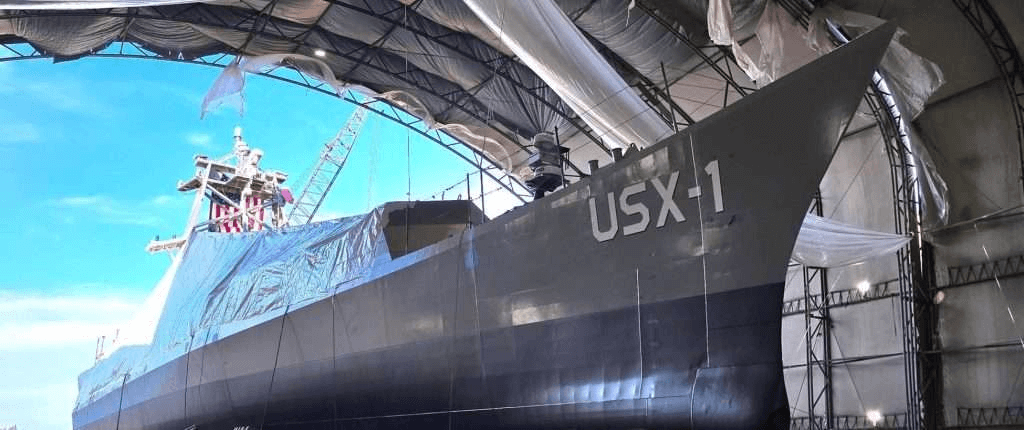
Defiant is the latest vessel of the military’s No Manning Required Ship (NOMARS) program. According to the Defense Advanced Research Projects Agency (DARPA), the NOMARS program aims to “challenge the traditional naval architecture model, designing a seaframe (the ship without mission systems) from the ground up with no provision, allowance, or expectation for humans on board. By removing the human element from all ship design considerations, the program intends to demonstrate significant advantages, which include: size, cost, at-sea reliability, greater hydrodynamic efficiency, survivability to sea-state, and survivability to adversary actions through stealth considerations and tampering resistance.”
In essence, NOMARS plans to create working prototypes of fully autonomous ships as proof of concept.
“We are honored to be chosen by Serco North America, the prime contractor and designer of the vessel, to embark on this innovative journey,” said Gavin Higgins, CEO of Nichols Brothers Boat Builders, in a press release after the company was awarded the contract. “The NOMARS program envisions a future where maritime operations can benefit from enhanced efficiency and performance through autonomous technology. This initiative aligns with our dedication to pushing the boundaries of what’s possible in boat building. Our talented team of engineers, designers, and technicians is eager to demonstrate our expertise in developing cutting-edge vessels.”
While parties involved with the Defiant project are generally tightlipped on the details (note the covered deck in the released shots), the emphasized benefits of the NOMARS approach in released statements has been efficiency and cost-effectiveness. The USX-1 should be able to complete its defined mission at a fraction of the cost of a traditional fully crewed vessel. Defiant and other unmanned naval vessels may have the capability to conduct naval operations in contested waters without the increased cost and undue risk that crewed operations bring. They can also conduct naval espionage surveillance and patrols without putting operators in harm’s way.
Macro-Trend with Manta Ray
The Defiant is not the only major DARPA unmanned vehicle launch of note in the last year. Northrup Grumman and Martine Defense Group prototype submersible drone Manta Ray completed Southern California in-water testing in May 2024. Officially dubbed an uncrewed underwater vehicle (UUV), Manta Ray has an approximate beam (or wingspan) of around 45’ with a length overall of around 33’. The craft is designed to operate on long range, virtually unsupported missions for extended periods of time.
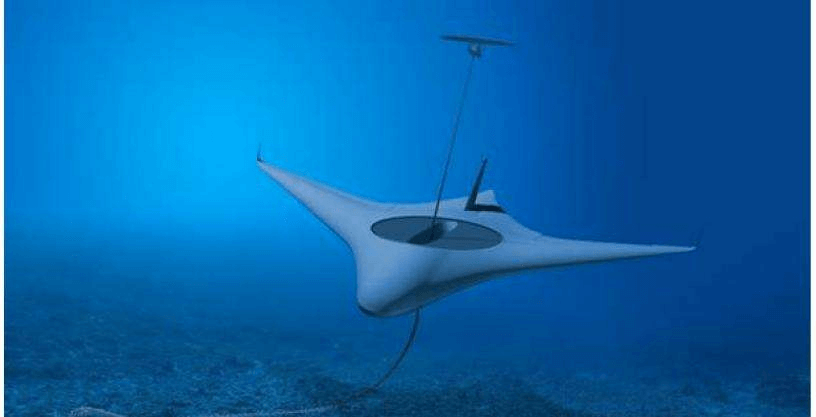
Figuring out exactly what the Manta Ray does and its full suite of capabilities is no doubt a state secret of some kind, but public statements tout a few key abilities. Manta Ray has a payload delivery feature which may include launching ordinance. It can also anchor to the seafloor, perhaps as a mobile sensor of espionage. Maybe a pack of them can go near-dormant down there for months, gliding to the surface silently en masse to supply special forces or deploy their own swarm of aerial drones. Perhaps there are Pentagon dreams of these things blanketing geopolitically charged waters as our eyes and ears in the depths.
Bottom line, the military is taking completely unmanned and partially unmanned boats seriously. As reported by Naval News, Serco touts rendered videos of a near-future where formations of NOMARS vessels are standard US Navy escorts. What’s better than a surface warfare destroyer? How about one flanked by six robot boats that can intercept incoming missiles, maybe with lasers. Or light up incoming small boat hostiles with 75-rounds-per-second Phalanx CIWS?
Maybe teams of secret mantas can chase down and destroy enemy submarines or release underwater drones to attack surface ships or shoreside installations. They could also cruise close to shore, pop up, and launch scores of aerial drones for both combat operations and to resupply troops. Whether or not these rendered scenarios become realities remains to be seen.
The Takeaway: Skynet Narrative v. Bang-for-Buck Reality
The “robots are taking over” narrative is probably an innate human survival instinct and concern that’s, frankly, probably healthy. But none of these drone ships, Defiant and Manta Ray included, seem to represent a truly new age of fully robotic navies. Rather the dominant case for these drone boats may be about finding a bargain versus creating unstoppable fully self-sufficient Terminators. If we were to imagine military success as a spent dollars-to-firepower and capability ratio, integrating unmanned or partially manned, highly specialized drone boats make a ton of sense.
A major bonus of autonomous ships is preventing casualties by keeping our equipment on the front lines while our soldiers can potentially remain at a safer distance. In WWII for example, thousands of US merchant mariners delivering supplies across the Atlantic to the Allies fell victim to German U-boat ambushes. If a portion of those US boats were autonomous drone transport ships, fewer sailors would’ve died.
If the hypothetical potential of Defiant is realized, it will probably translate to more capability thanks to being able to build three of these USX-1s versus one traditional manned peer. Likewise with the Manta Ray, we might get twenty of these things for the cost of one manned underwater recon version. Are they really doing things that humans can’t? Most times probably not. But if they can do a job effectively it may save money and possibly lives.

A final word of caution to those bullish on drone boats is that the military arms race is never-ending. While aerial drones have become a staple in modern battlefields, new anti-drone technology has begun to rise. Reportedly Iran hacked and hijacked a US aerial drone in 2011, landing it successfully and keeping it for reverse engineering. Radio Frequency Directed Energy Weapons (RFDEW) are being successfully field tested. RFDEW operators can flip a switch and instantly neutralize entire drone swarms that fall out of the sky.
Drones whether aerial or naval are a growing sector in modern armament. The ability to conduct military operations while keeping soldiers further away from the action and the potential cost savings of these autonomous weapons projects are intriguing. Whether this leads to battalions of droid soldiers delivered to combat areas by NOMARS ships and aircraft or simply the unmanned military equipment being remotely operated is yet to be seen. What we do know is that modern technology is rapidly making what was once science fiction into a reality.
Associated images posted on www.darpa.mil may be reused according to the terms of the DARPA User Agreement.