Whale-Fin Inspired Propeller Increases Efficiency By Up To 15%
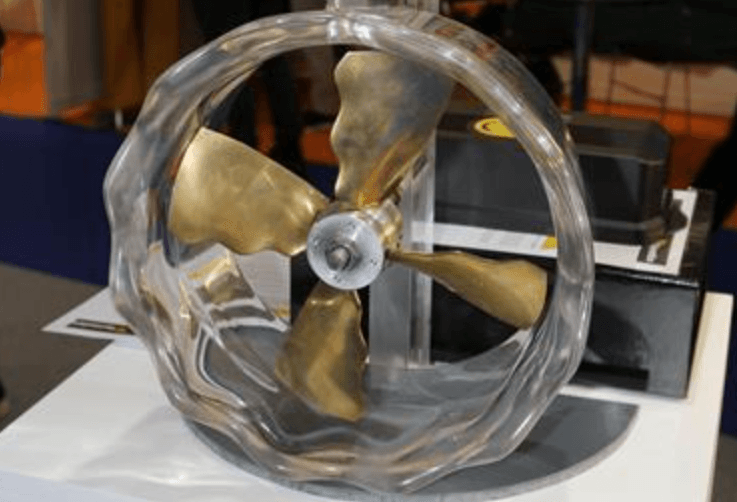
Several propeller manufacturers have discovered that adding natural grooves called tubercles to a propeller blade can improve efficiency and reduce noise.
Drawing attention on the Seawork Innovation Showcase was the German marine company O.S.Energy, which was exhibiting a new propeller design and its associated cowling. The profile of both the blades and the housing that protects them mimics the grooves and protuberances found on a whale fin, with the claim that under high loads efficiency is significantly improved.
This is an interesting innovation for displacement vessels and workboats but not planning-speed boats because of the excessive drag of the nozzle.
A small-scale example of the new propeller, including its shaped cowling, was on display at Seawork. The idea is that the loading is spread evenly across the blade, and efficiency is improved right across the rev range.
In its overview of the new design, O.S.Energy says the key innovation is how the nature-inspired profile changes the flow over the blade, improving performance across the full operating range rather than at just one point. ‘Sea trials have shown real-world gains,” the company announced. “This is a significant step beyond theoretical or model-based development. The tubercles help to smooth out load variations, which is important for vessels that do not operate under steady conditions.”
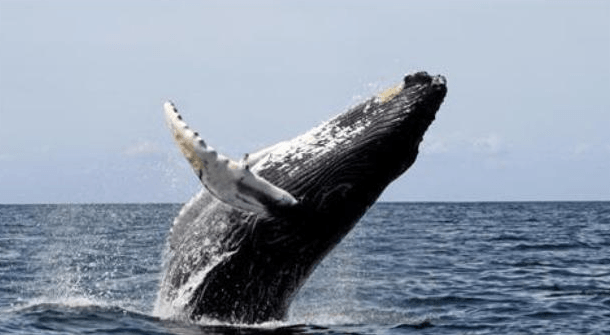
The inspiration for TAPs (Tubercule Assisted Propeller) comes from the humpback whale, the tubercles clearly visible on the fins.
The company says that the final design of the blades was developed by the UK’s Newcastle University, and prototypes have since been installed and tested on two of O.S.Energy’s ships, Fortuna Crane and Prince Madog.
“We recorded efficiency gains of up to 15% in real operating conditions,” the company reports. “It works by reducing flow separation and smoothing load fluctuations on the drive train. This leads to more efficient and stable propulsion. TAPs is particularly well suited to workboats where performance, fuel use and reliability matter.”
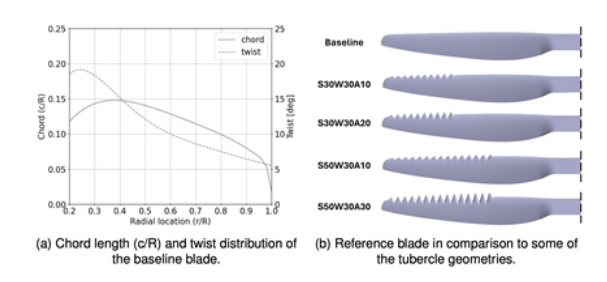
The aeronautical sector is also exploring TAPs as a means of reducing the noise of Vertical Take-Off and Landing aircraft (ATOL). Lower acoustics from marine propulsion will also benefit many sea dwelling mammals, for whom propeller noise is becoming a major problem. Graphic: ICAS/ Technische Universität Wien, Austria.
The study of tubercles is not just the remit of marine propellers but is also being explored by the International Council of the Aeronautical Sciences (ICAS). In a paper about ‘aeroacoustics’, for example, the authors Dominik Skrna, Marcos de Rosa Jacinto and Martin Berens suggest TAPs can improve thrust-to-torque coefficients by around 3.3%. This is important as they argue that one of the biggest barriers to the use of Advanced Air Mobility (AAM) is the noise that the propellers make. If more lift can be generated for less noise, then this will help air taxis and cargo drones become more socially acceptable. TAPs is also being explored for the wind turbine sector, which could also lead to more efficient and quieter blades for smaller marine and domestic versions. https://os-energy.de/en/company/