Wherefore DCFBs?
A Configuration as Extinct as Dinosaurs
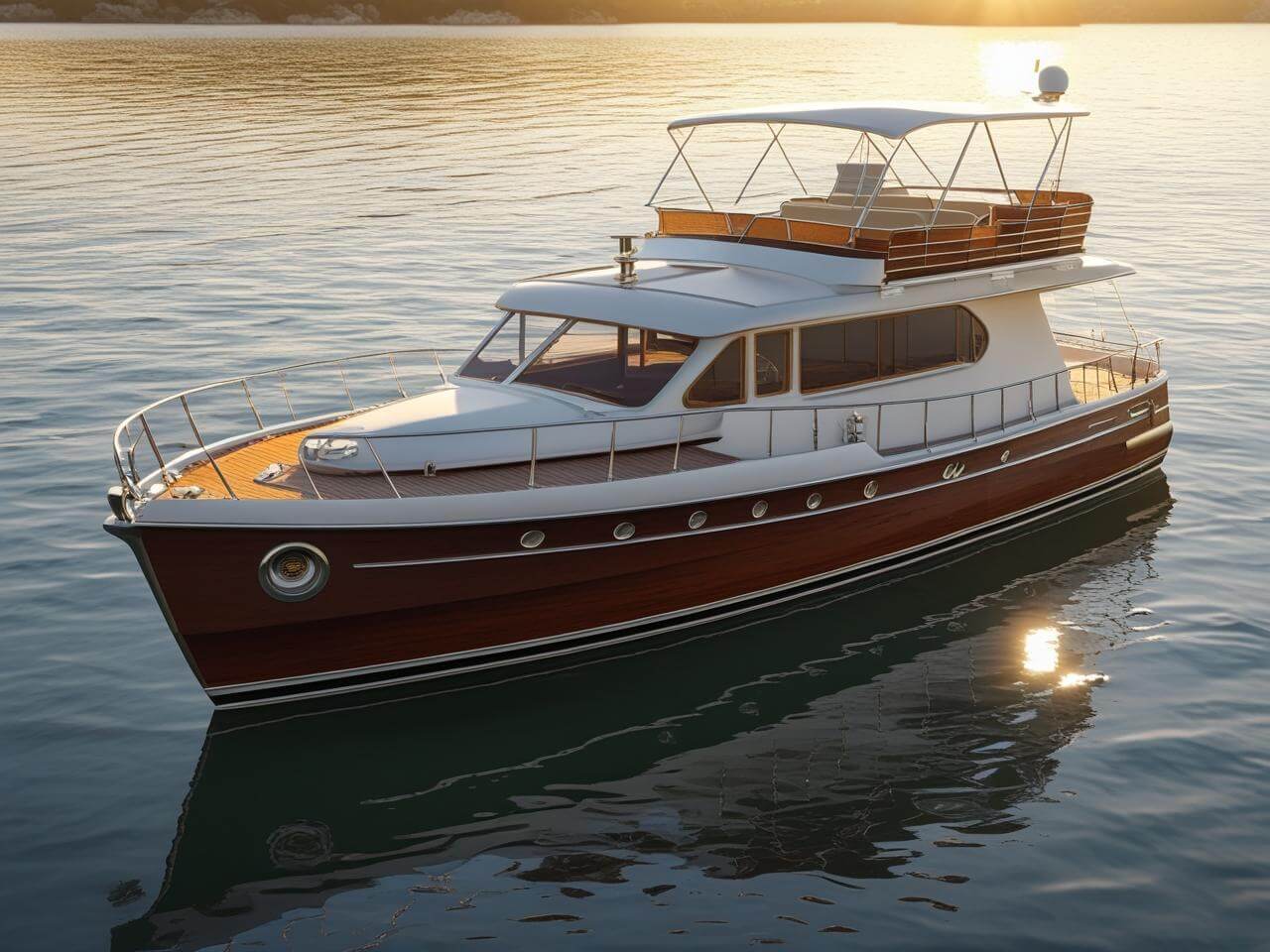
Back in the 50’s before motor yachts turned into over inflated beach balls that appear ready to explode, DCFBs were THE hot ticket for midrange motor yachts. DCFB stood for “double cabin flying bridge” – a configuration rarely, if ever, seen in modern boats but one that makes a lot of sense for many reasons.
The Genius of It
As with most vessels, the DCFB evolved over time. In the 20’s and 30’s, double cabin cruisers were introduced. These vessels ranging in size from, say, 36-feet to 50-feet or so, had a saloon amidships with a cabin (or cabins) forward under the main deck and a cabin (or cabins) aft under a low trunk. Usually, a small cockpit was located at the extreme stern directly accessible from the owner’s cabin aft.
Then, in the 40’s, someone got the bright idea to install controls atop the aft trunk for fresh air piloting. Soon, a windshield was added and the sides were enclosed producing a great flyingbridge. Thus, the “DC” was transformed to a “DCFB” and became the hottest trend in motor yachts. The great thing about the DCFB configuration – the genius of it – was that a full motor yacht could be packaged in a low, sleek silhouette that was, in effect, only 1-1/2 decks high. That is why DCFBs from the 50’s that were only 50-feet looked so long and sleek.
Contrast this to what DCFBs eventually morphed into – flush or stepped deck motor yachts – and you immediately see what I am talking about. Flush/stepped deck motor yachts eliminated the small aft cockpit and the side decks around the owner’s stateroom producing more volume in this cabin at the expense of losing the “look.” This is readily evident if you peruse the pages of boat magazines and study the lines of some modern flush deck motor yacht monstrosities in the 50-foot range. These bloats... er, excuse me – boats – are three decks high and appear like dammed gigantic floating watermelons. My editor will not allow me to name names here but, like pornography, you will know one when you see one.
The Greed/Length Ratio
Bloated boats are the result of pure and simple greed. Greedy interior designers dictated that boats be designed from the “inside out” rather than the “outside in.” I have always had the “outside in” philosophy. If a boat resembles a well-melted candle or a floating stuffed turkey or a doorstop and doesn’t look right the owner will never really be happy with her and, since, most owners spend much more time looking at pictures of their boat hanging the wall than actually using their boats, appearance becomes very important.
Yes, first get the profile right then design the interior as best you can to fit within the envelope. In the 50’s, although many boat manufacturers such as Matthews, Richardson, Wheeler and Huckins produced DCFB configuration motor yachts, Chris-Craft absolutely owned the segment. Back then, Chris-Craft was what Hatteras is today – the preeminent producer of American mid-range motor yachts. Most Chris-Craft motor yachts were DCFBs in sizes ranging from 34-feet to 53-feet. In the upper lobby at the Bahia Mar Hotel in Fort Lauderdale, there is a large picture of the marina, as it existed in the 50’s. I counted about 1/3 of the boats in the marina to be Chris-Crafts! Chris-Craft evolved the DCFB into its highest form – the so-called supersundeck (SSDCFB). A 1955 53-foot Conqueror remains one of my all-time favorite designs and the boat appears contemporary to this day.
The rounded bow and stepped sheer compliments the soft superstructure. The way the superstructure is handled aft with the gently rounded cabinsides curving down to a coaming surrounding the cockpit. The cockpit is covered with an integrated hard top and the “supersundeck” is enclosed on four sides with the control station forward and two large settees fitted. There is access forward down to the saloon and aft down to the cockpit. A product or species always reaches its highest form of development just before it is wiped out. Sadly, this was the case for Chris-Craft who, in the late 50’s was subjected to a juggernaut – a fiberglass juggernaut – from North Carolina named Hatteras. Chris- Craft was slow to convert to fiberglass and their styling lost its edge in the ‘60s. As a result of this, they lost their commanding market share – never to regain it again.
Interestingly enough, about 7 years ago, I was working with the President of Chris-Craft and pitched him a modern rendition of the DCFB, which, I felt (and still do feel), would help put Chris-Craft back on the map. It was a 50-footer as I recall but, financial woes prevented anything from ever developing with this project – something for the new management at Chris-Craft to ponder since, as I mentioned last month in my article, the line of Chris-Crafts just introduced, while very nice boats, do not draw on the immense pool of styling ques and innovations that Chris- Craft introduced in the 50’s.
These new boats instead draw from styling of the 60’s, which, as I said, had lost the magic. Hell, if Chris-Craft won’t do it, I’ll just do it myself. We are presently working on a DCFB 50-foot Midnight Lace – our tribute to Chris-Crafts of the 50’s. After spending hours noodling this design, I can tell you that packaging everything in this configuration is a real challenge and I am now appreciating just what Chris-Craft did back then. By default, the engineroom must be located under the saloon just forward of amidships, which then dictates the whole design. I have faith in American boatsman. I believe they will buy boats that look right even though the interior may not be as palatial as a “max volume” boat. A famous designer once said, “when it looks right it is right” and I thoroughly subscribe to this philosophy. DCFBs just plain look right and make a lot of sense from a styling, windage and stability standpoint.
Bring back the DCFB!
(Reprinted with permission of Regina Fexas.)
If you would like to read more of Tom's pearls of wisdom, tune in next Friday -- "Fexas Friday."
Better yet, why not get a full dose of infectious Fexas whenever you need it -- and buy one of the volumes below. Better yet, why not buy all of them -- we call them the "Fexas Five." They will provide many evenings of fun reading (better than Netflix), and you'll make the widow Regina very happy knowing that Tom will live on with you the way most of us remember him.
Order 1, 2 or "The Fexas Five" --

To find the "Fexas Five" on Amazon, click here...
Tom Fexas (1941-2006) was one of the most influential yacht designers of the last quarter of the 20th century. With the narrow Wall Street commuters that were built in the 1920s and '30s always on the back of his mind, he wanted to design boats that were at once fast, comfortable, seaworthy and economical to operate. Over the years, he and his firm designed over 1,000 yachts for some of the most prestigious boat builders in the world, including Choey Lee, Palmer Johnson, Grand Banks, Mikelson Yachts, Burger, Abeking & Rasmussen and many others.
Even though toward the end of his career he only designed megayachts and superyachts, including the remarkably influential PJ "Time" in 1987, he is best remembered for his first major vessel in 1978 -- Midnight Lace -- which became a series of 44-52-footers. They were light, narrow, and fast with relatively small engines. He was also influential in the boating community because of the monthly column he wrote for Power and Motoryacht, which began in its very first issue in January 1985.