Will Tariffs Make Mercury Outboards More Expensive?
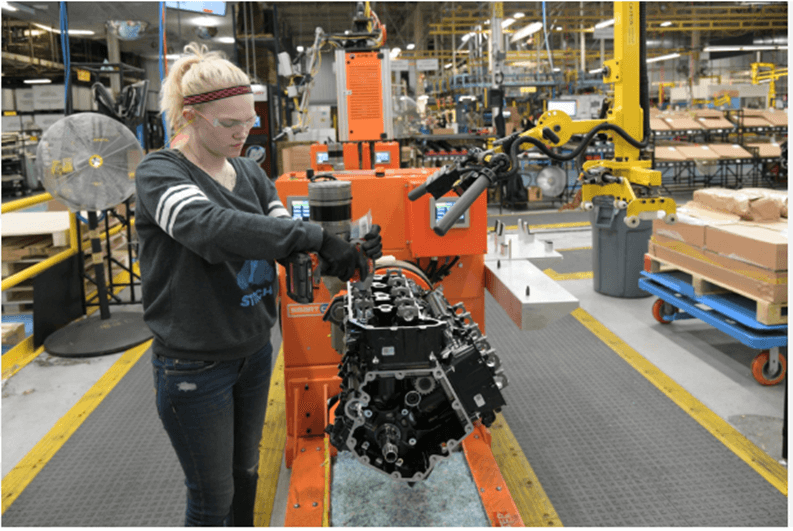
When the U.S. government imposed a 25% tariff on imported aluminum and steel recently, the inevitable rise in materials is expected to hit outboard engines made in the U.S. because most of their weight is composed of aluminum and steel. Since there is only one major manufacturer of outboards in the U.S., that means Mercury Marine will have to bear the brunt of the tariffs.
Ironically, a tariff that is suppose to create more of a level playing field for U.S. industry, and "bring back" jobs to America could actually do just the opposite.
So, the question begs, what will the 25% tariffs do to the prices of Mercury outboard engines which have 60% or more market share in America?
Aluminum: The Heart of the Modern Outboard
Aluminum isn’t just a peripheral material in outboard construction—it’s at the core. Mercury Marine, one of the largest outboard engine manufacturers in the world, builds its engine blocks from proprietary aluminum alloys. Mercury's alloys are patented and generally considered to be among the best anti-corrosive alloys in the industry. They are called Mercalloy, and have at least three different formulations, each for a different function in its engines.
The company makes it own aluminum blocks, along with aluminum powerheads, pistons, legs, lower unit gear housings, and many other parts which maximize their engine's power-to-weight ratios. Each part has it's own needs for strength, heat-resistance, or anti-corrosion, thus the different formulations.
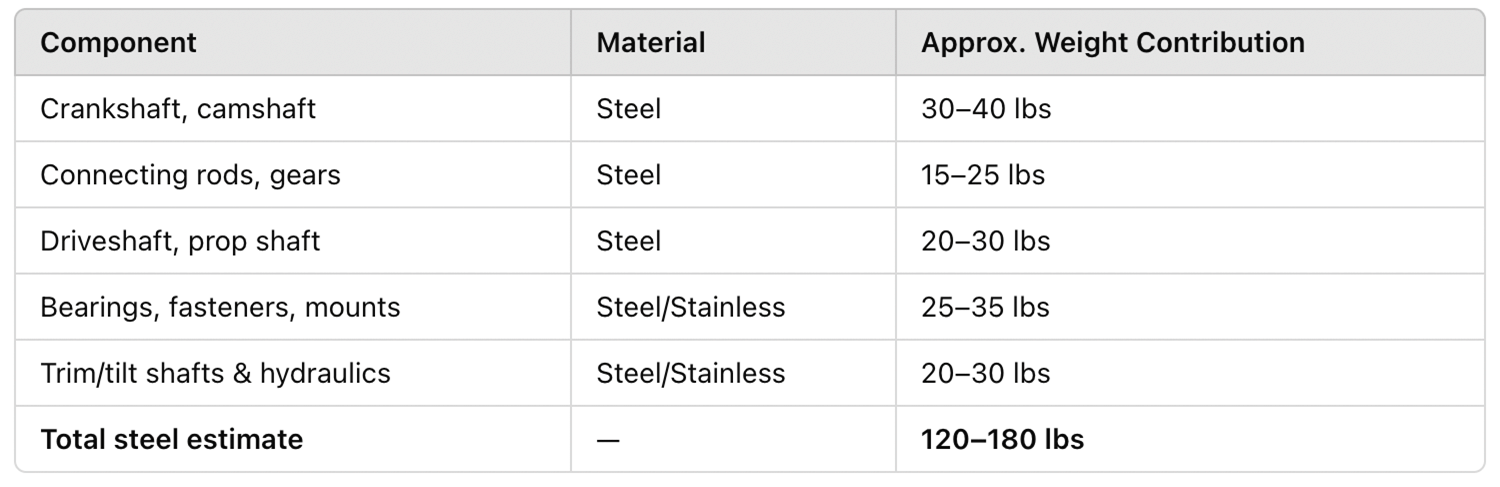
Steel is used in critical components that need high strength such as drive shafts, gears, cylinder valves, crankshafts, etc. See below for an approximation of what the steel elements weigh on the 200-hp Mercury V6 FourStroke engine. This engine is the lightest 200 horsepower engine on the market at 475 lbs., so we can assume that most of the weight that is not steel, is aluminum.
How Tariffs Affect Raw Material Costs
The U.S. imports roughly 50% of its aluminum supply, and Canada is the largest foreign supplier, providing more than 60% of all U.S. aluminum imports, according to one source. The newly reimposed 25% tariff applies to all imported aluminum and steel, no matter where it's from.
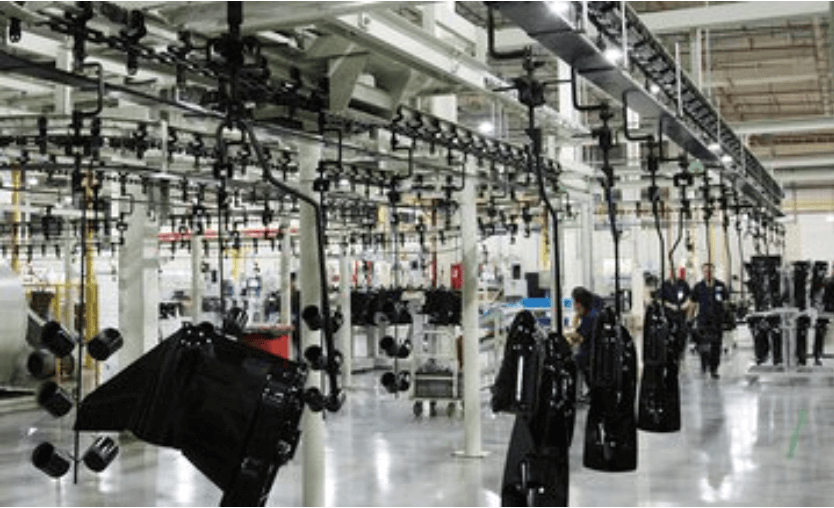
Raw aluminum and steel are commodities when they come out of the smelter and are cast into aluminum billets and steel in iron pigs. It is on these bars of aluminum and steel which the 25% import duty will levied.
The raw metals then go to a mill where they are smelted once again with the proprietary formulas that Mercury specifies for specific parts in the engine. For steel, that is where the X7 stainless steel is made that will be used in Mercury props, and the 316 marine grade stainless steel is created for all manner of other parts.
Even if 100% of the aluminum and steel used in making Mercury's parts suffered the 25% tariff the impact on final retail pricing should be miniscule. Reuters on March 25th reported that the price of raw aluminum has risen to $.40 per pound, up from $.24-$.30 per pound at the beginning of the year. A Bank of America analyst says it could go to $.47 per pound. Likewise, a 25% increase on raw steel is measured in pennies per pound, not dollars.
Now, let’s bring this into the context of building outboards.
A Drop in the Bucket
Aluminum Cost. A Mercury 200-hp V6 3.4L FourStroke outboard weighs 475 lbs. (216 kgs.). (See BoatTEST’s Outboard Engine Buyer’s Guide) If we assume that 70% of 475-lbs. is aluminum weight (332.5 lbs.), the cost of that raw material has gone from about $100 in January of 2025, to $133 today, and possible as high as $156 in the future.
Steel Cost. If we assume for the purposes of this exercise, that all the remaining weight in the Mercury 200-hp V6 is steel (which it isn’t), then there is 142.5 lbs. of that material in the unit. Reuters says that 25% of the steel used today in America is imported.
Added together, these two estimates of the increase in the outboard’s raw metal costs would be about $188 more, or less than 1% of the engine’s $20,260 MSRP. And this is only if 100% of the metal used was imported -- a worst-case scenario.
In fact, once market forces are able to reach some sort of equilibrium, there will be a "blended" rate in the U.S. for raw aluminum and steel, and that should be far less than 25% jump in current pricing.
Breaking Down the Elements of Outboard Engine Pricing
Assuming the following conservative cost structure for an outboard engine made in the US--
- Raw materials and Manufacturing: 25–30%
- Labor: 20–25%
- Engineering, tooling, and amortization: 5–10%
- Overhead and operations: 10–15%
- Marketing, distribution, and margin: 15–20%
These percentages are rough estimates but illustrate the fact that a rise in raw material cost is only a small part of the retail price of an engine.
Tariffs on Chinese Goods
On March 4th, the U.S. imposed a 20% tariff on virtually everything coming out of China, including outboard motors. Mercury imports its 40 to 60-hp engines from China, so they will be the ones hit by the 20% tariff. But once again, the cost of the unit coming in does not include corporate overhead, marketing and U.S. distribution expenses, so we should not see anything like a 20% increase in prices for the smaller outboards.
Mercury also has several of its outboard engines made in Japan from 2.5-hp to 30-hp which come in duty free – as do engines made by Yamaha, Suzuki, and Honda. All of those engines should be completely unaffected by the 25% tariffs.
Inflation Rate in the U.S. and Japan

It is not the 25% tariffs on imported aluminum and steel that American consumers should be concerned about, rather it is the core inflation rate in the U.S. -- ultimately, this will be what drives prices of outboard engines, and most everything else, higher.
As can be seen in the chart above, the U.S. didn’t suffer high inflation rates until 2021, and it hit Japan in 2022, but at a much lower percentage.
Below is a chart showing what happened to average pricing on outboard engines from 200-hp to 249-hp – including Yamaha, Suzuki, Honda and Tohatsu, as well as Mercury—for the same 9-year period.
Average Retail Price of 200-249-HP Engines in U.S. 2015 -2023

Observations
For those who care to analyze these numbers, they speak volumes about what is going on in the outboard engine business, and price elasticity. First, what can be seen is that even though there was a 10% tariff on imported aluminum and a 25% duty on imported steel from July 2018 to May 2019, there was no appreciable increase in the retail price of 200-hp outboard engines. Second, the rate of U.S. -- and perhaps Japanese -- core inflation is what is really affecting prices of these engines.