Access More Boat Tests
Already have an account? Login
Aquila 46 Yacht Power Catamaran (2026-)
2 x 320-hp Volvo Penta D4

Brief Summary
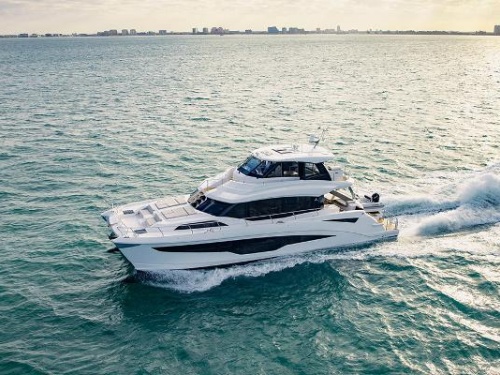
With 40+ years in the design, engineering, and manufacturing of powercats, including its latest strategic partnership with MarineMax, Aquila Yachts has found itself a leader in the marine industry with over 500 of its boats and yachts plying the world’s waters. The new 46 Powercat is one of five models offered in the Yacht lineup and is built with many of the innovative features Aquila is known for: A pleasing and aesthetically, well-proportioned profile, voluminous interior and exterior space, the latest in advanced electronics and navigational equipment, a well-balanced and practical engine package, and an impressive list of standard and optional offerings.
Test Results
| RPM | MPH | Knots | GPH | MPG | NMPG | SM | NM | dBa |
|---|---|---|---|---|---|---|---|---|
| 650 | 3.6 | 3.2 | 0.6 | 6 | 5.3 | 2588.2 | 2249.1 | 56 |
| 750 | 4.5 | 3.9 | 0.9 | 5.3 | 4.6 | 2261.9 | 1965.6 | 59 |
| 1000 | 6 | 5.2 | 1.5 | 4.1 | 3.6 | 1767.9 | 1536.3 | 61 |
| 1250 | 7.2 | 6.3 | 2.7 | 2.7 | 2.3 | 1141.2 | 991.7 | 65 |
| 1500 | 8.5 | 7.4 | 4.5 | 1.9 | 1.6 | 805.2 | 699.7 | 68 |
| 1750 | 9.4 | 8.2 | 6.6 | 1.4 | 1.2 | 608.8 | 529 | 68 |
| 2000 | 11 | 9.6 | 9.5 | 1.2 | 1 | 495.6 | 430.7 | 69 |
| 2250 | 11.6 | 10.1 | 13 | 0.9 | 0.8 | 383 | 332.8 | 71 |
| 2500 | 12.4 | 10.8 | 18 | 0.7 | 0.6 | 294.4 | 255.9 | 70 |
| 2750 | 13.9 | 12.1 | 22.5 | 0.6 | 0.5 | 264 | 229.4 | 72 |
| 3000 | 17 | 14.8 | 29.5 | 0.6 | 0.5 | 247.3 | 214.9 | 72 |
| 3250 | 19.9 | 17.3 | 34.5 | 0.6 | 0.5 | 247.2 | 214.8 | 73 |
| 3500 | 22.4 | 19.5 | 42.5 | 0.5 | 0.5 | 225.6 | 196.1 | 75 |
| 3650 | 23.7 | 20.6 | 49 | 0.5 | 0.4 | 207.3 | 180.1 | 76 |
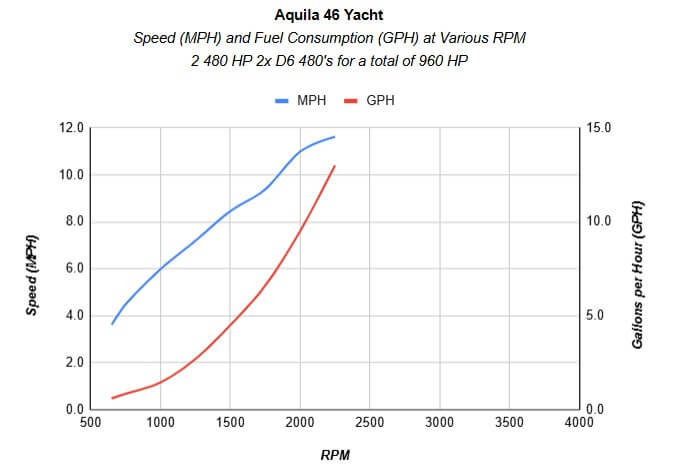
Specifications
| Length Overall |
47' 2" 14.36 m |
|---|---|
| Beam |
23' 3" 7.1 m |
| Draft |
4' 1" 1.24 m |
| Fuel Capacity |
476 gal 1,800 L |
| Water Capacity |
211 gal 800 L |
Acceleration Times & Conditions
| Props | Duoprops |
|---|---|
| Load | Persons & Gear: 600 lbs/272kg; Fuel on board: 2,031 lbs/921 kg; Water on board: 542 lbs/246 kg; Total Load: 3,173 lbs/1,439 kg |
| Climate | 76°F; 67% humidity; wind: 2-5 mph; wave: 1'; salt |
Engine Options
| Tested Engine |
2 x 480-hp Volvo Penta D6 |
|---|---|
| Std. Power |
2 x 320-hp Volvo Penta D4 |
| Opt. Power |
2 x 480-hp Volvo Penta D6 |
Cat with The Heart of an Eagle
Captain's Report Aquila 46 Powercat
by Capt. Ken Kreisler
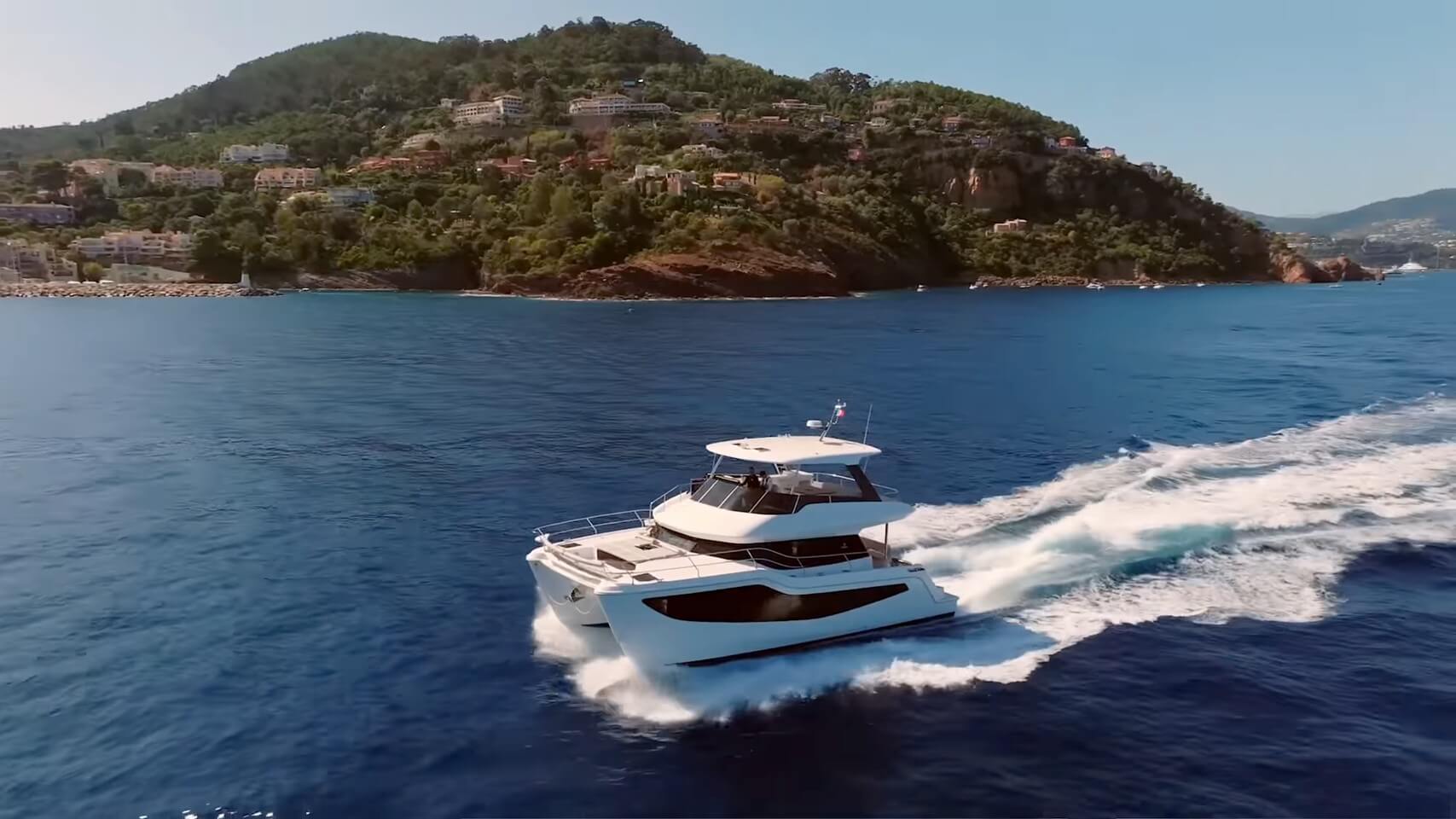
Aquila is Latin for eagle and if you have even wondered about whether or not you would like to soar on a powercat, this premium builder, the largest manufacturer of these exceptional boats and yachts worldwide, just may present, with its 46 Powercat Yacht, an answer to your question.
Major Features
- Three cabin/three head layout
- 2 x 320-hp D4 Volvo Penta inboard diesel engines
- Hard top with stainless supports
- Line cutters on shafts
- 70-lb Delta anchor w/chain
- Fiberglass flybridge table
- One way fuel transfer from starboard to port @ 7.94gal/min
- Electric induction two burner cooktop in salon galley
- Dark or light interior finish w/covered accented wall and ceiling upholstery
- Washer/dryer single combo unit
- 7” Volvo display at helm
Notable Options
- 2 x 480-hp D6 Volvo Penta or 2 x 550-hp Yanmar inboard diesel engines
- Slepner bow thrusters for port and starboard hulls w/control at upper helm
- 4 or 5 cabin/head layout
- Teak wood flybridge table
- Spotzer 25 gal/hour water maker
- Lower helm steering and nav package includes 12” Raymarine plotter, autopilot control, adjustable captain’s chair
- Upper helm steering and nav package includes 1 x 16” Raymarine Axiom2 ProS plotter, Raymarine 170s multifunction display, Raymarine 63 VHF w/remote station and antenna, Raymarine cam300 aft facing camera
- Raymarine Quantum 2 Q24D 18” Radome color scanner
- Underwater foil system
- Electric 1,000 lb capacity crane lifting system
- 11-kW or 12-kW generator w/remote control and fuel transfer pump
- 14 x 120w solar panels
- 211 gal reserve fuel tank
Boat Inspection
Given her cat profile and dimensions, with her 23’3” beam carried fully forward, the Aquila designers and engineers had plenty of space to work with in order to supply her owners and guests aboard the 46 Powercat Yacht with optimum entertaining, cruising, storage, along with both extensive interior and exterior gathering areas.
Stern and Transom
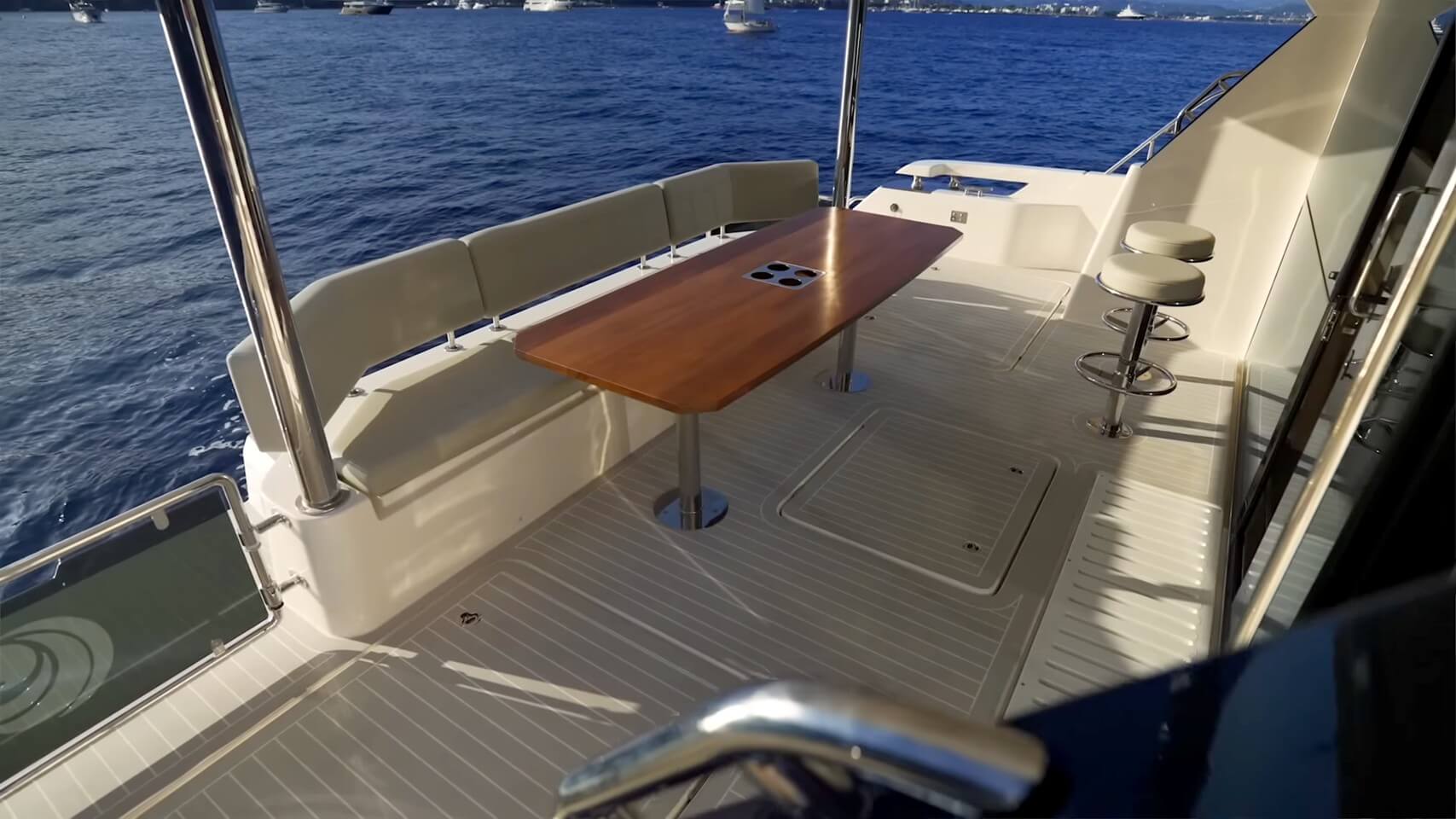
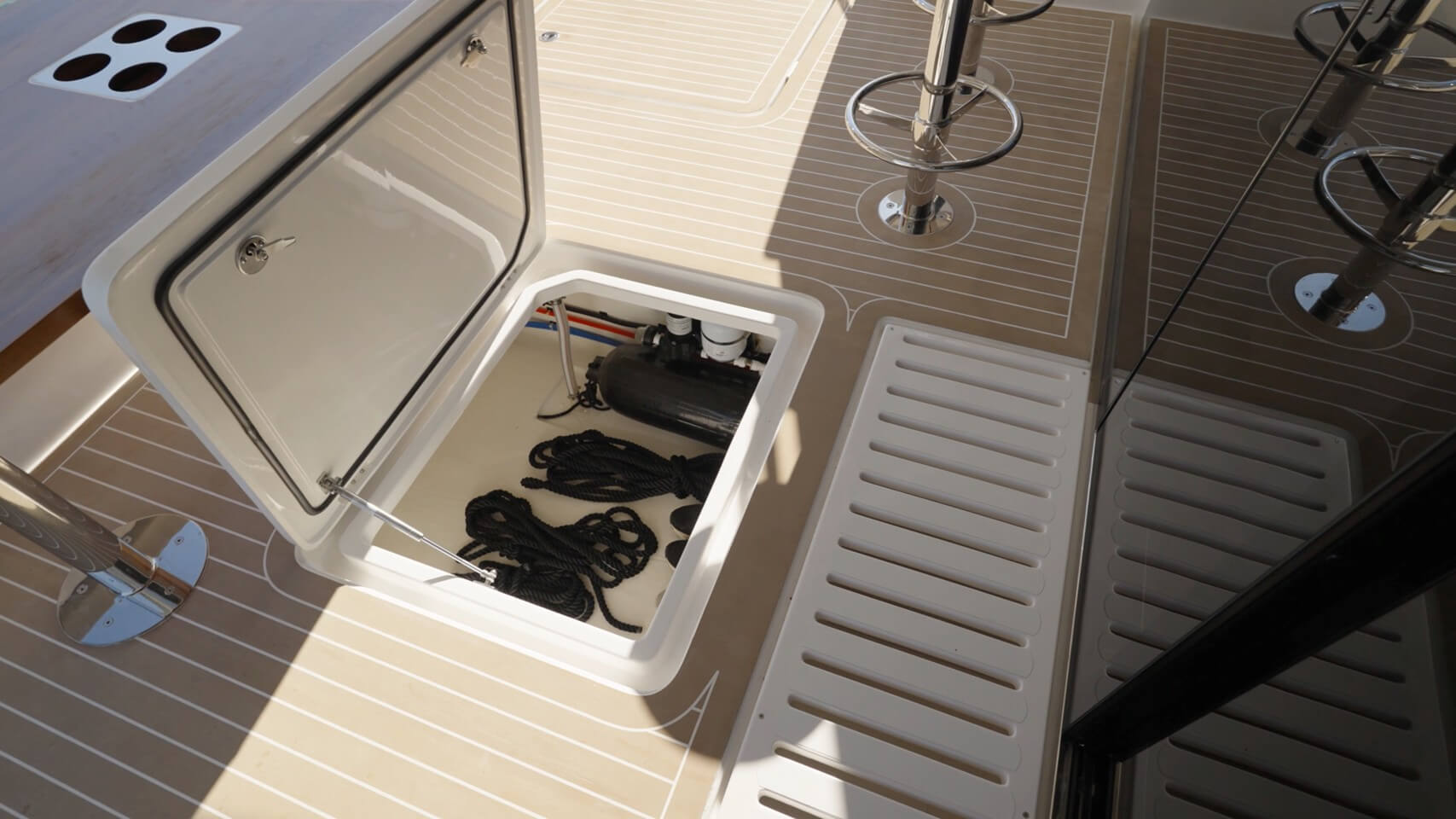
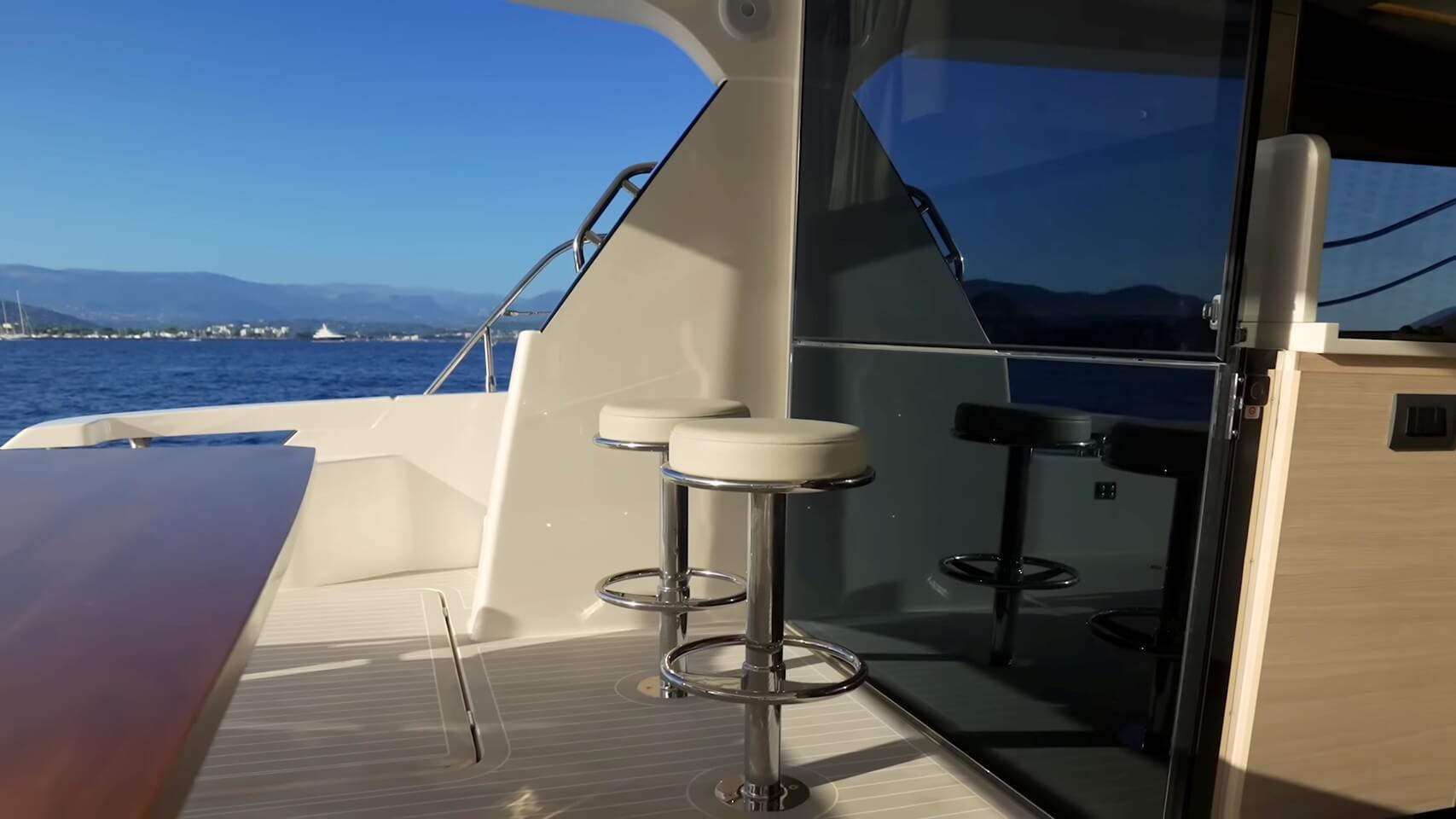
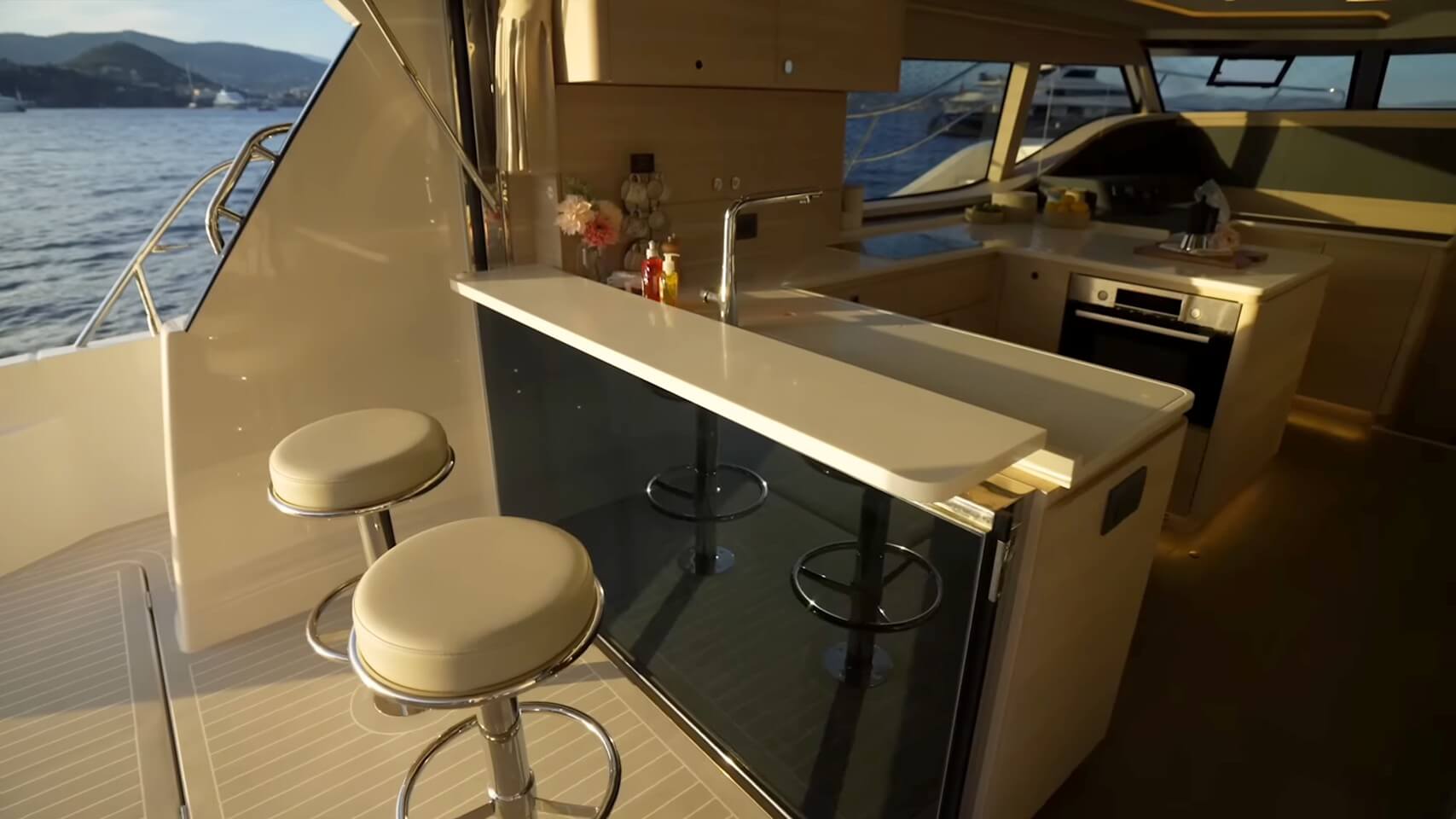
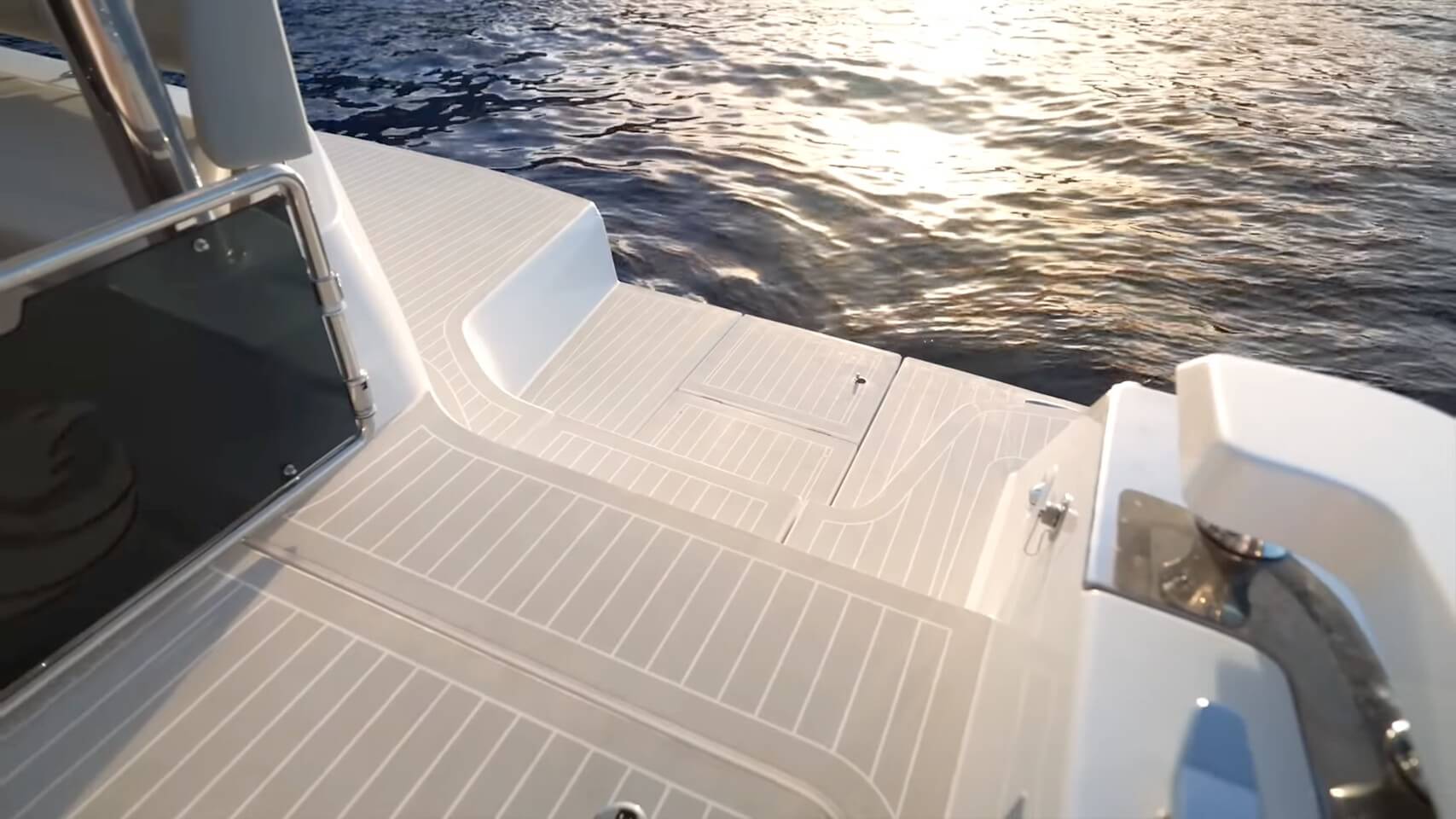
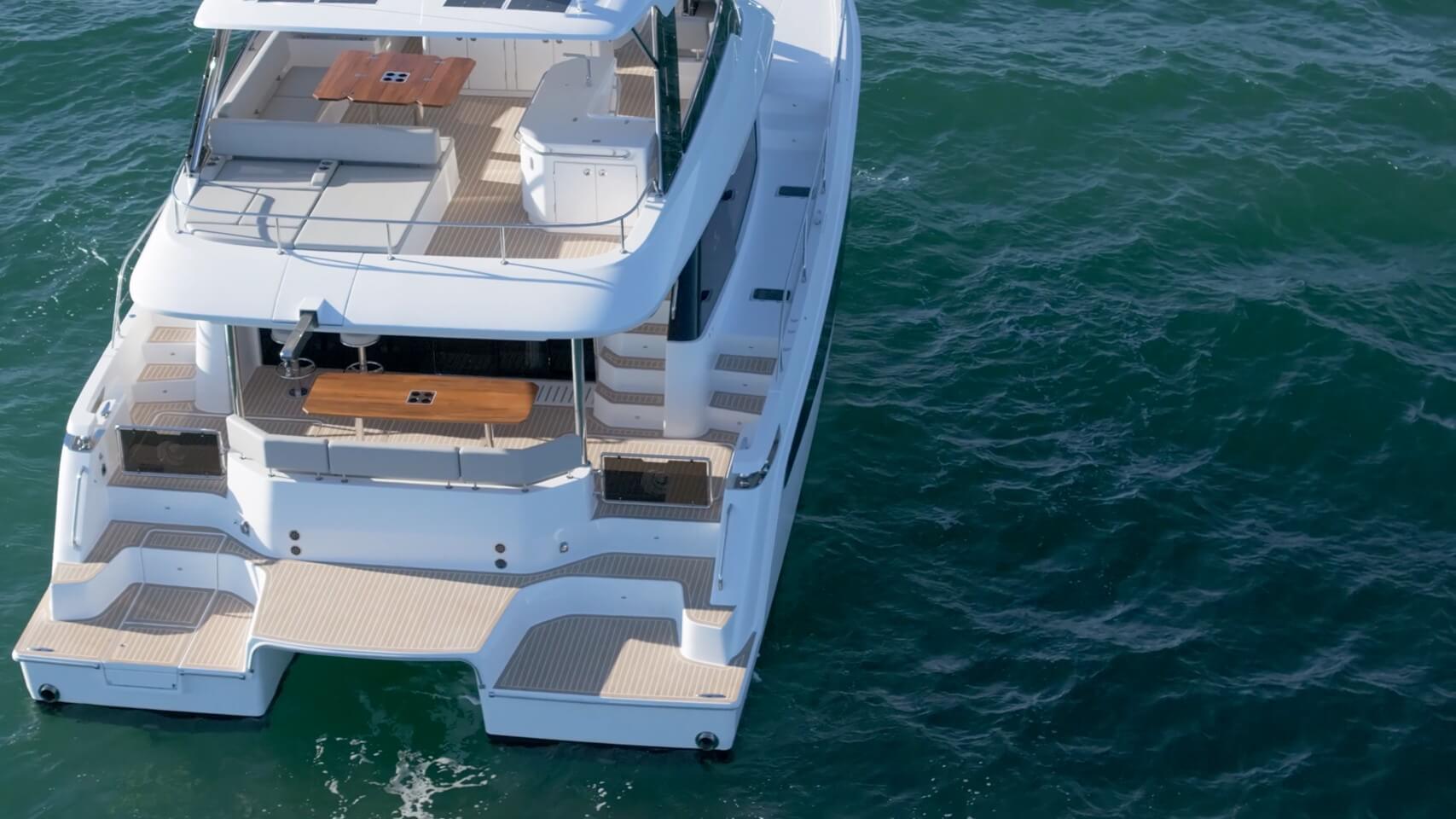
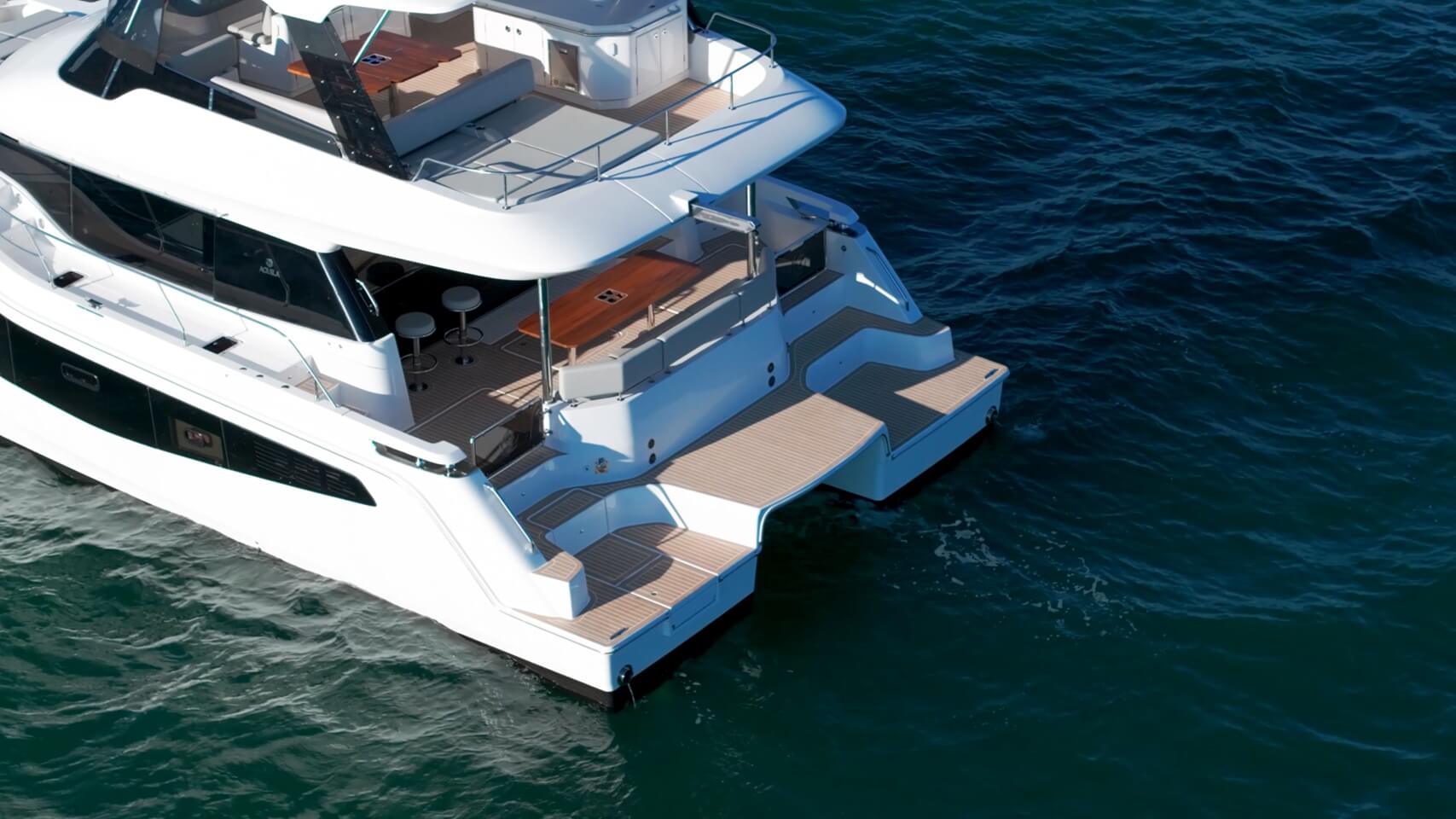
The Aquila 46 Powercat Yacht is laid out for long distance travel as well as supplying entertaining and gathering spaces from bow to stern where exceptional dining and get-together locations are found.
Salon and Lower Helm
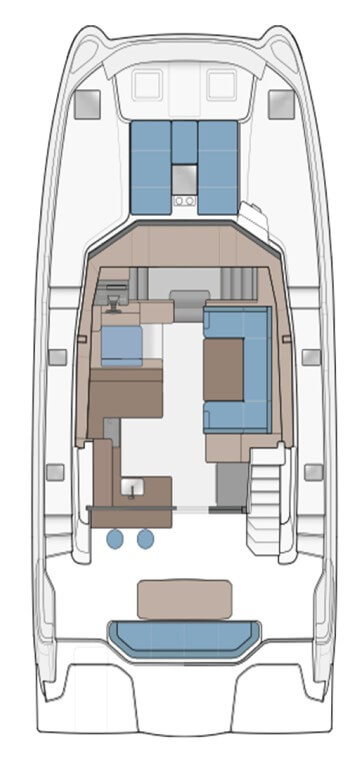
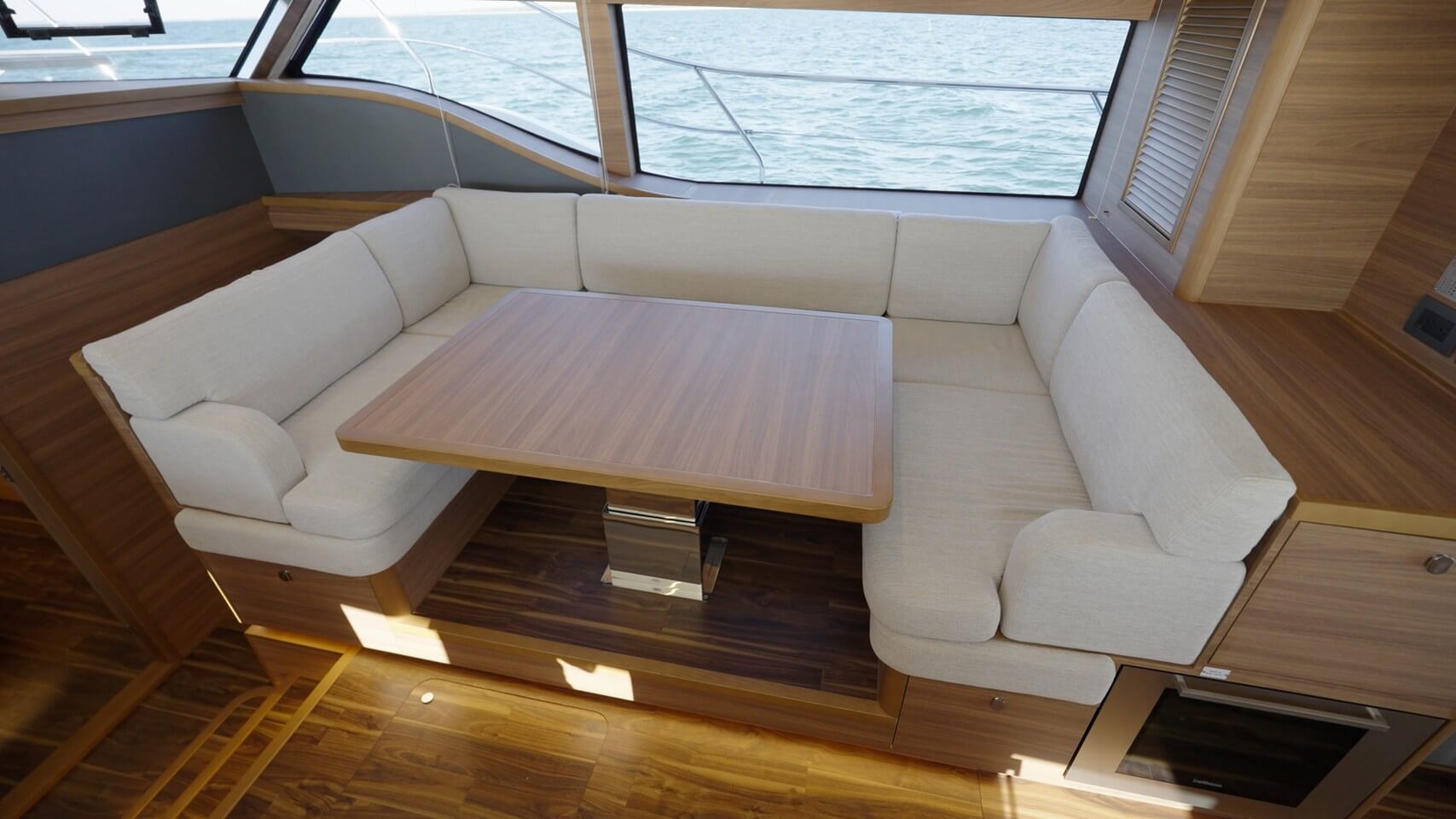
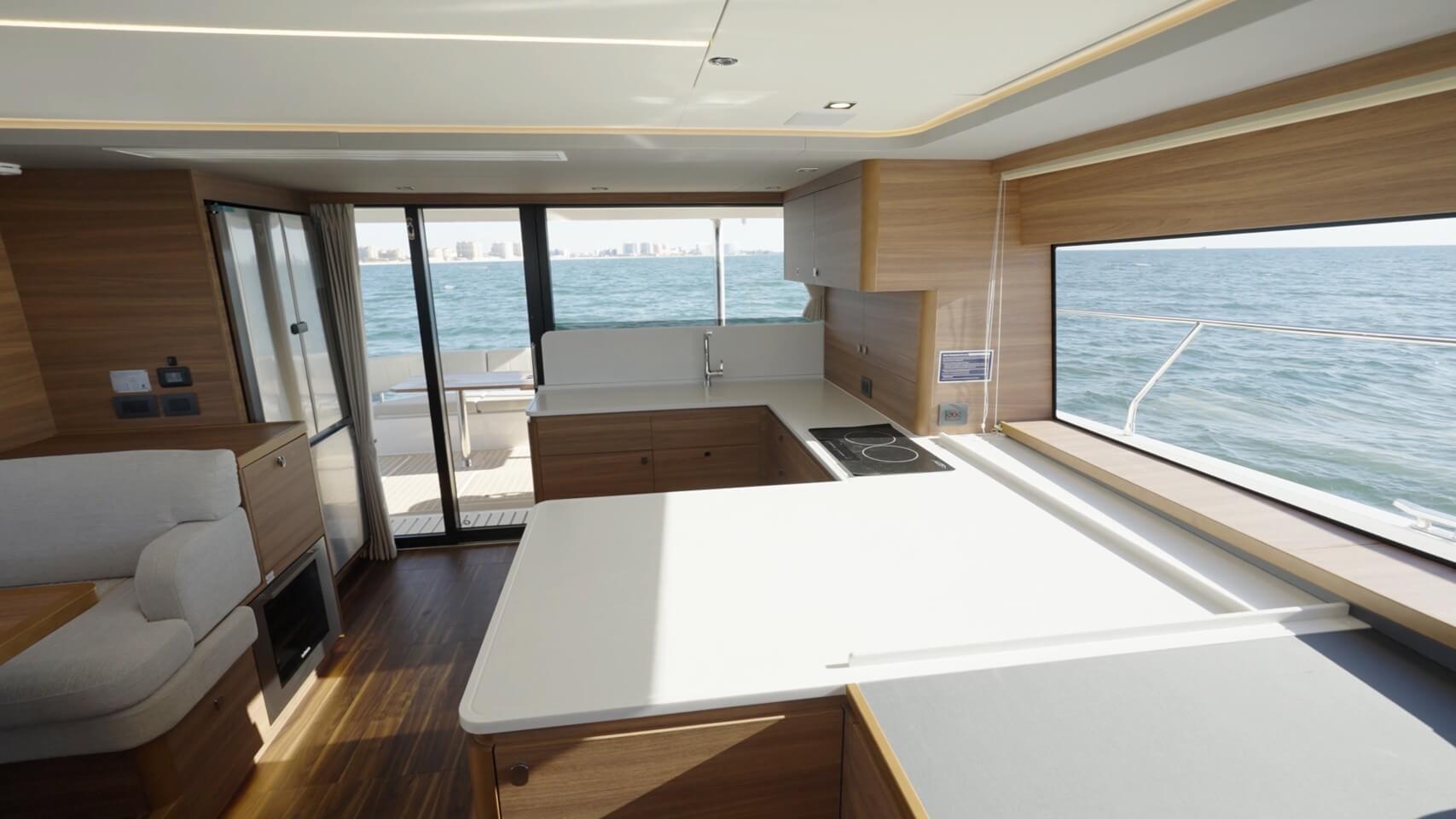
The expansive theme continues on the main deck salon with wide open gathering spaces and a fully found galley, complete with convection oven, sink, microwave, spacious, deep drawer and cabinet storage and counterspace, all surrounded by extra-large windows allowing the salon to be flooded by natural light.
Living Accommodations
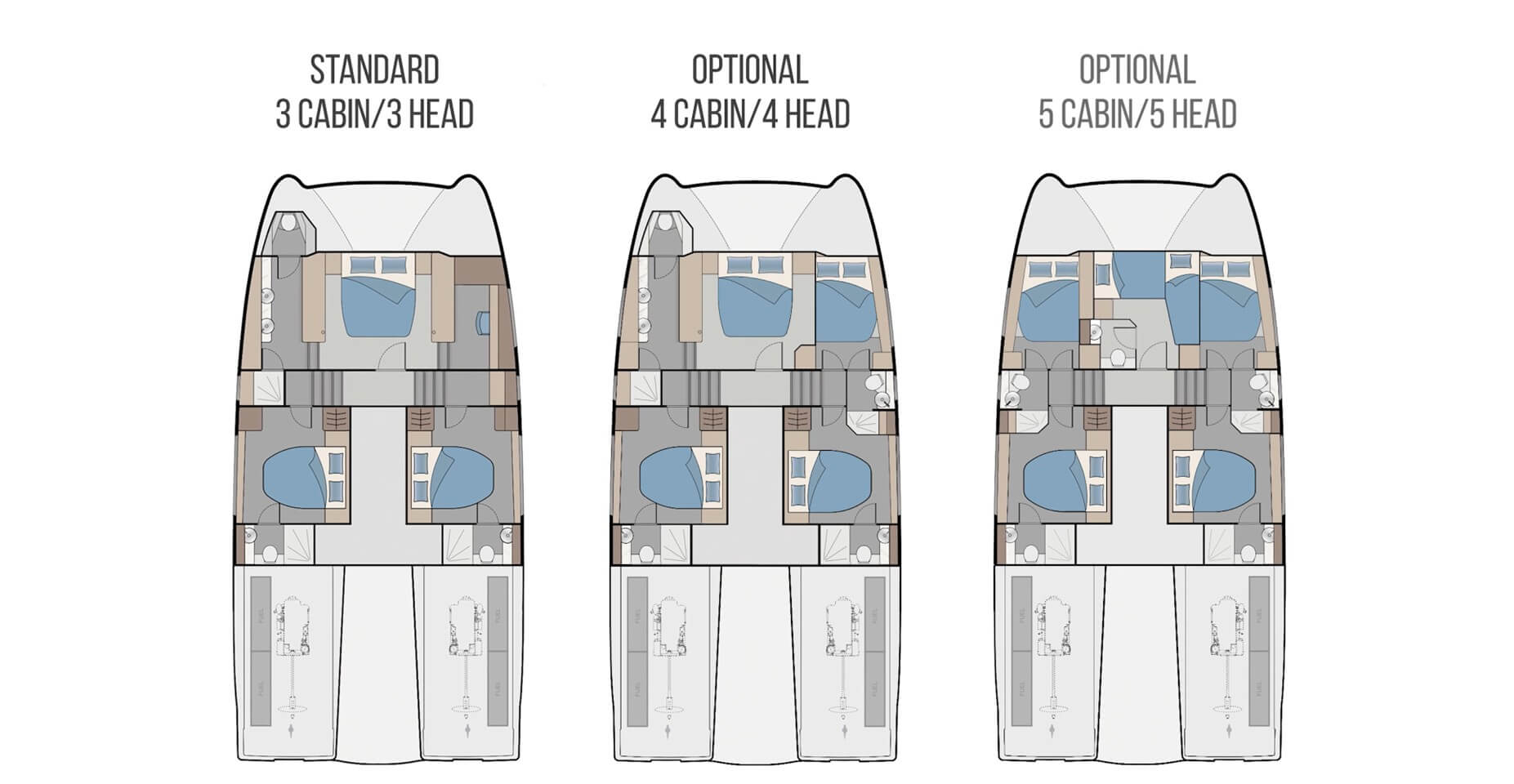
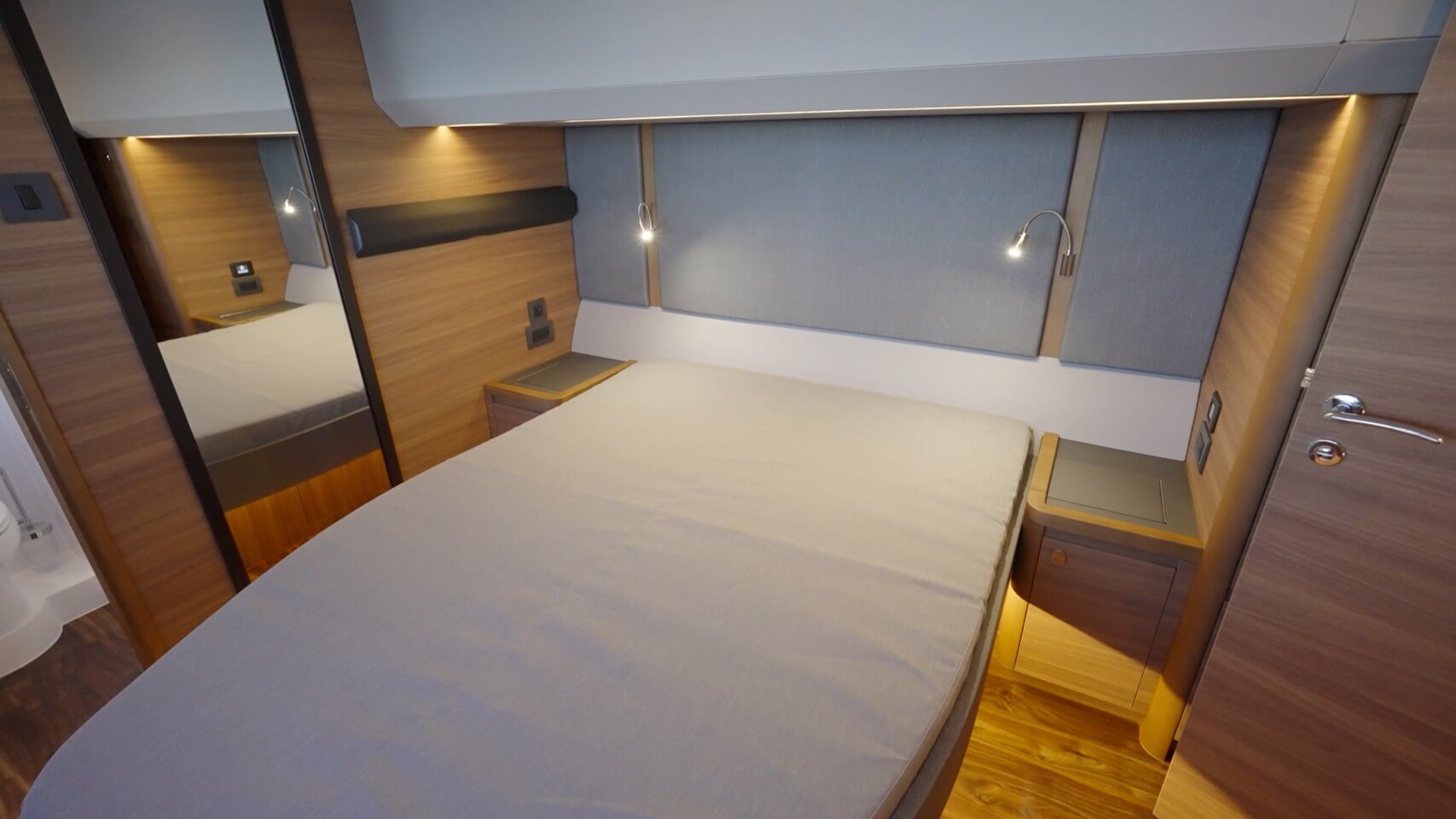
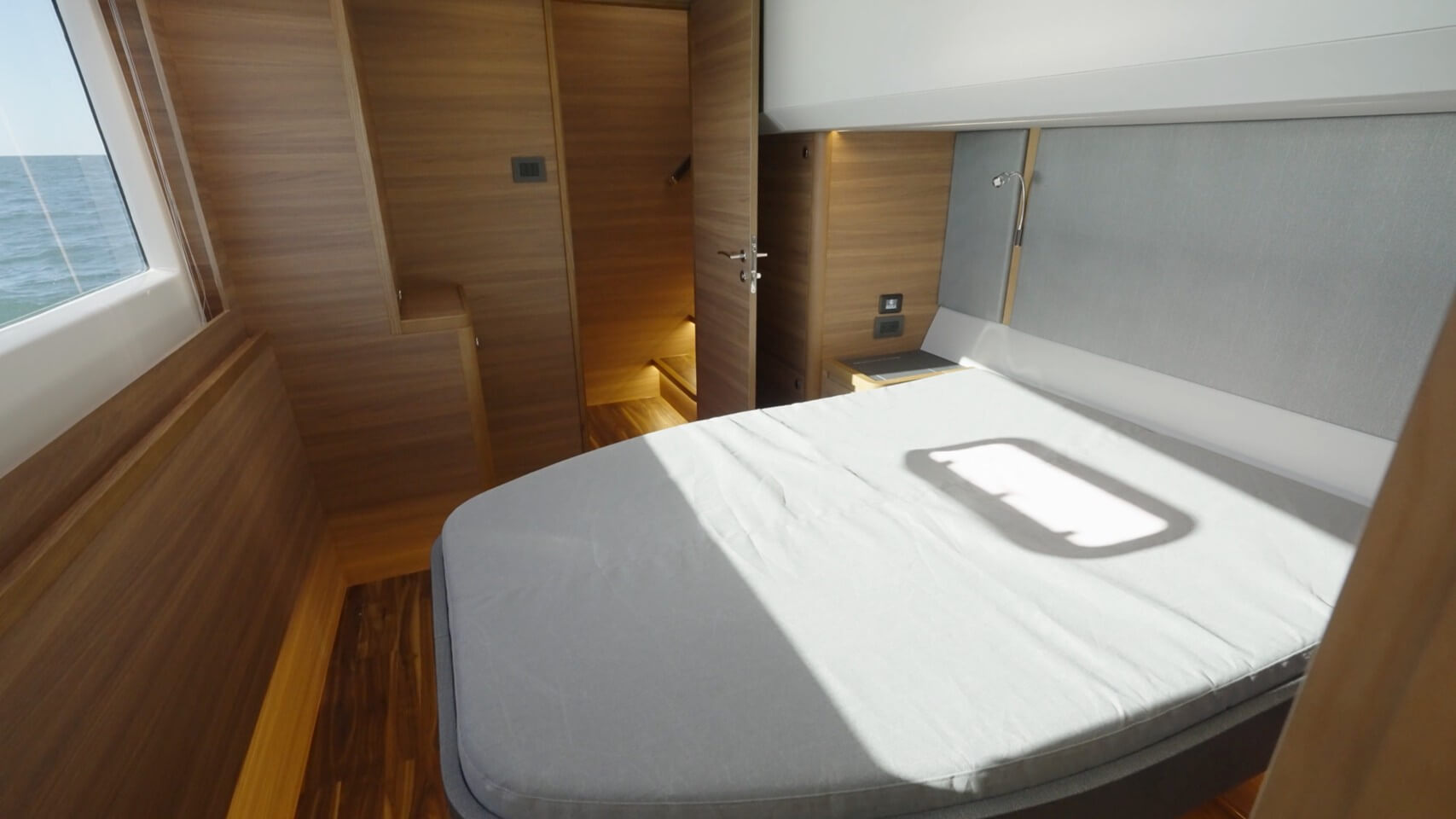
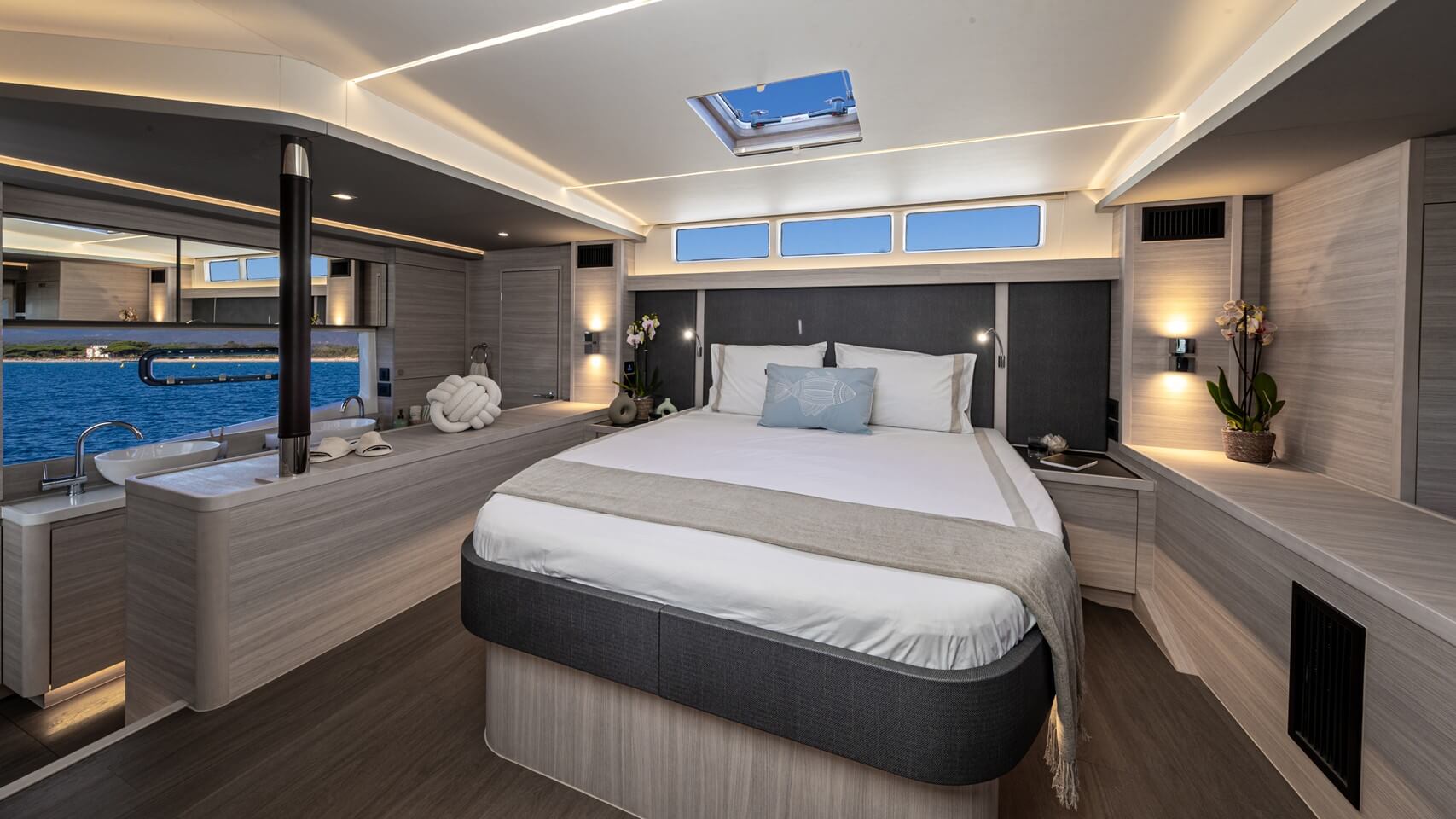
The Aquila 46 Powercat Yacht comes standard with a three stateroom, three head layout. However, because of her interior volume, and some rather exceptional design and engineering maneuvers, Aquila is able to offer four or five stateroom/head layouts.
Bridge Deck
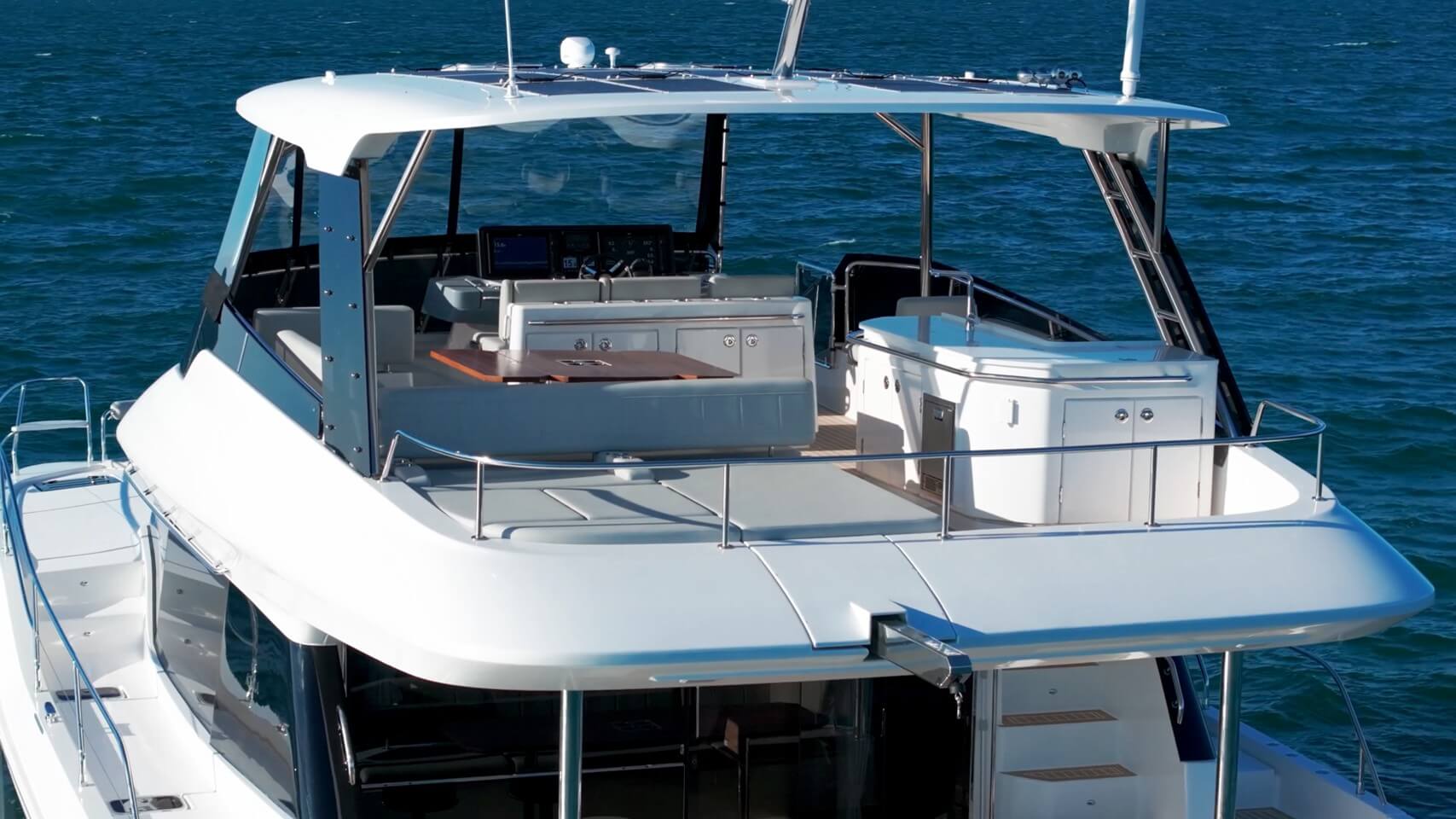
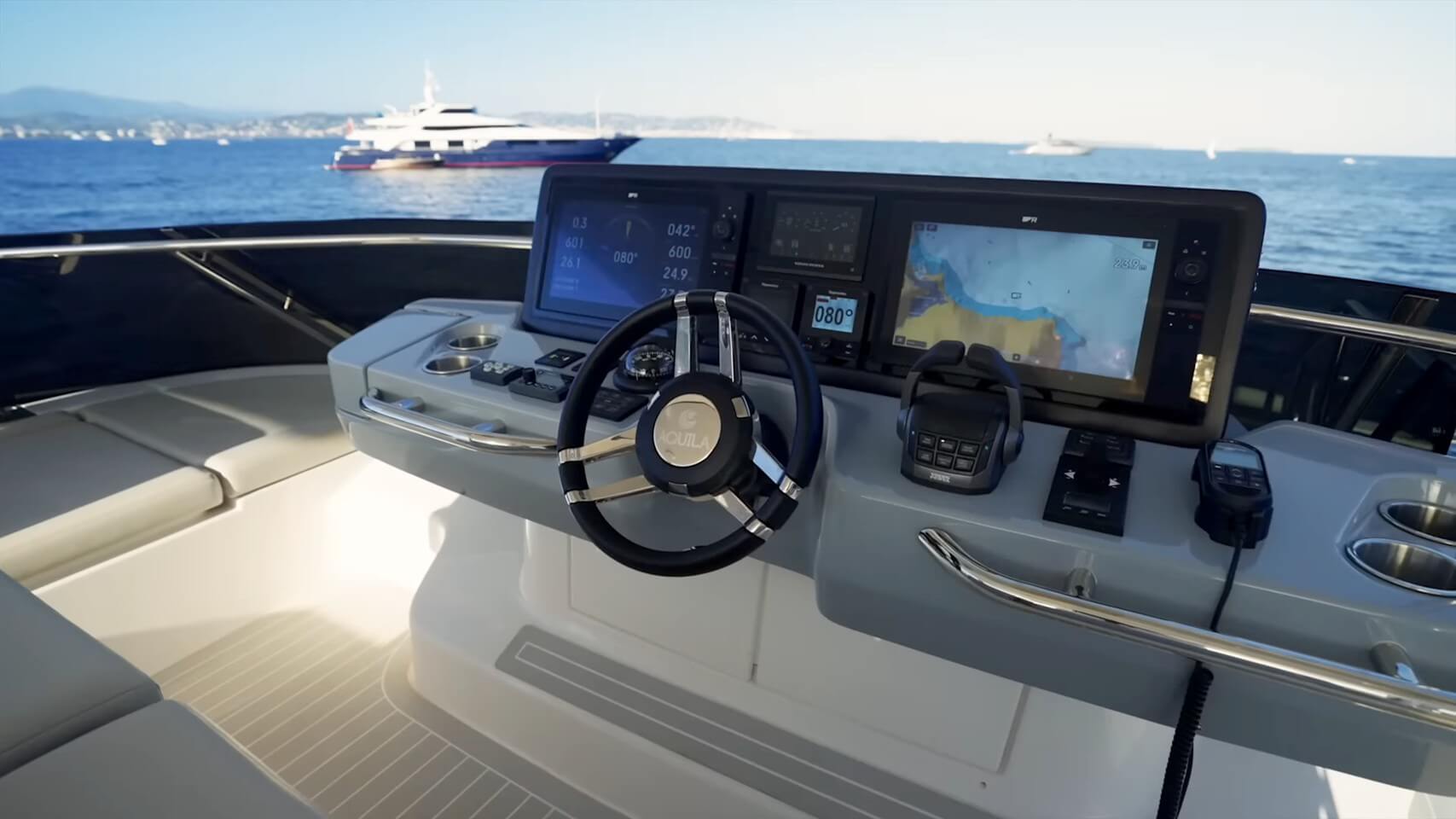
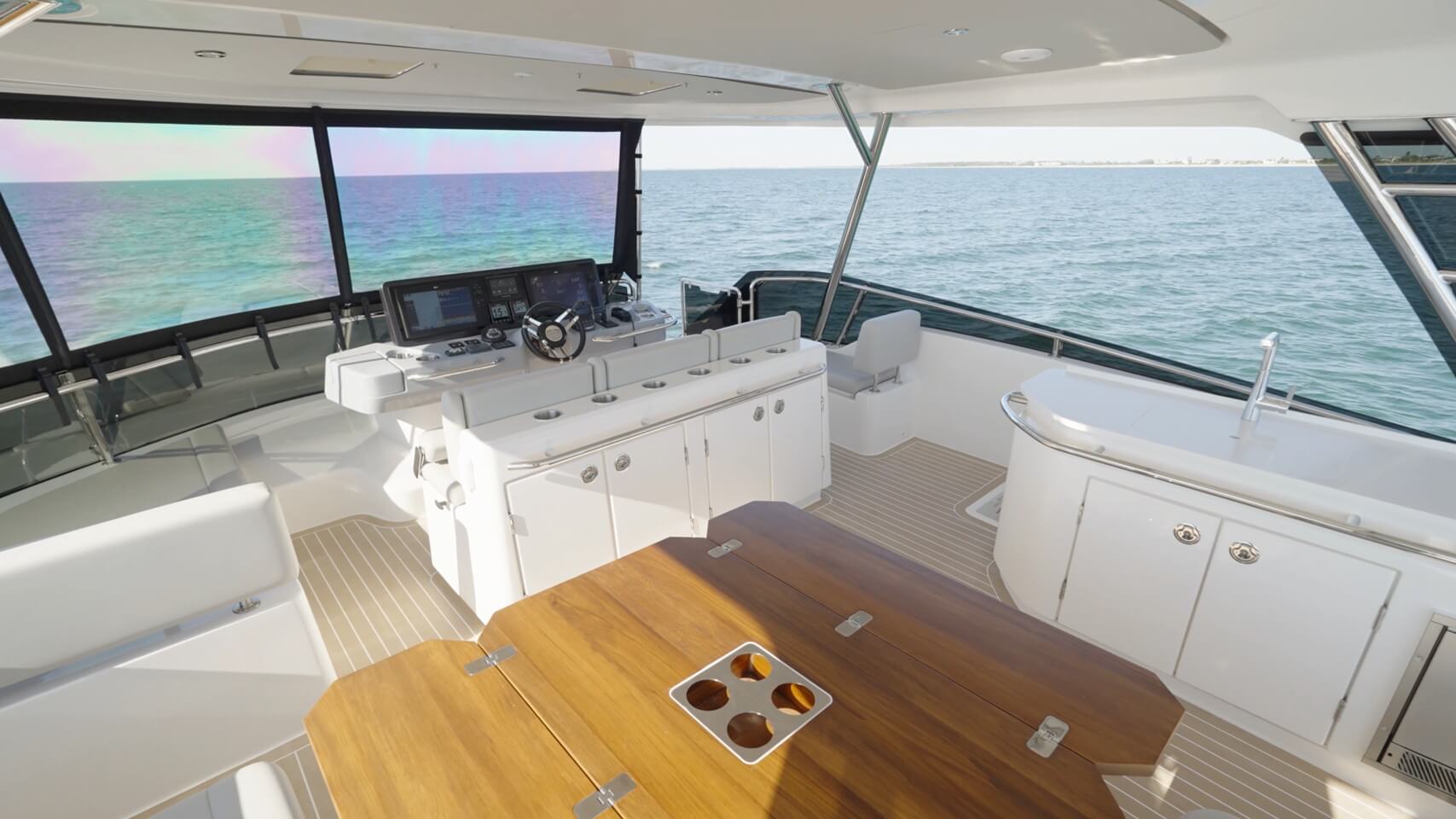
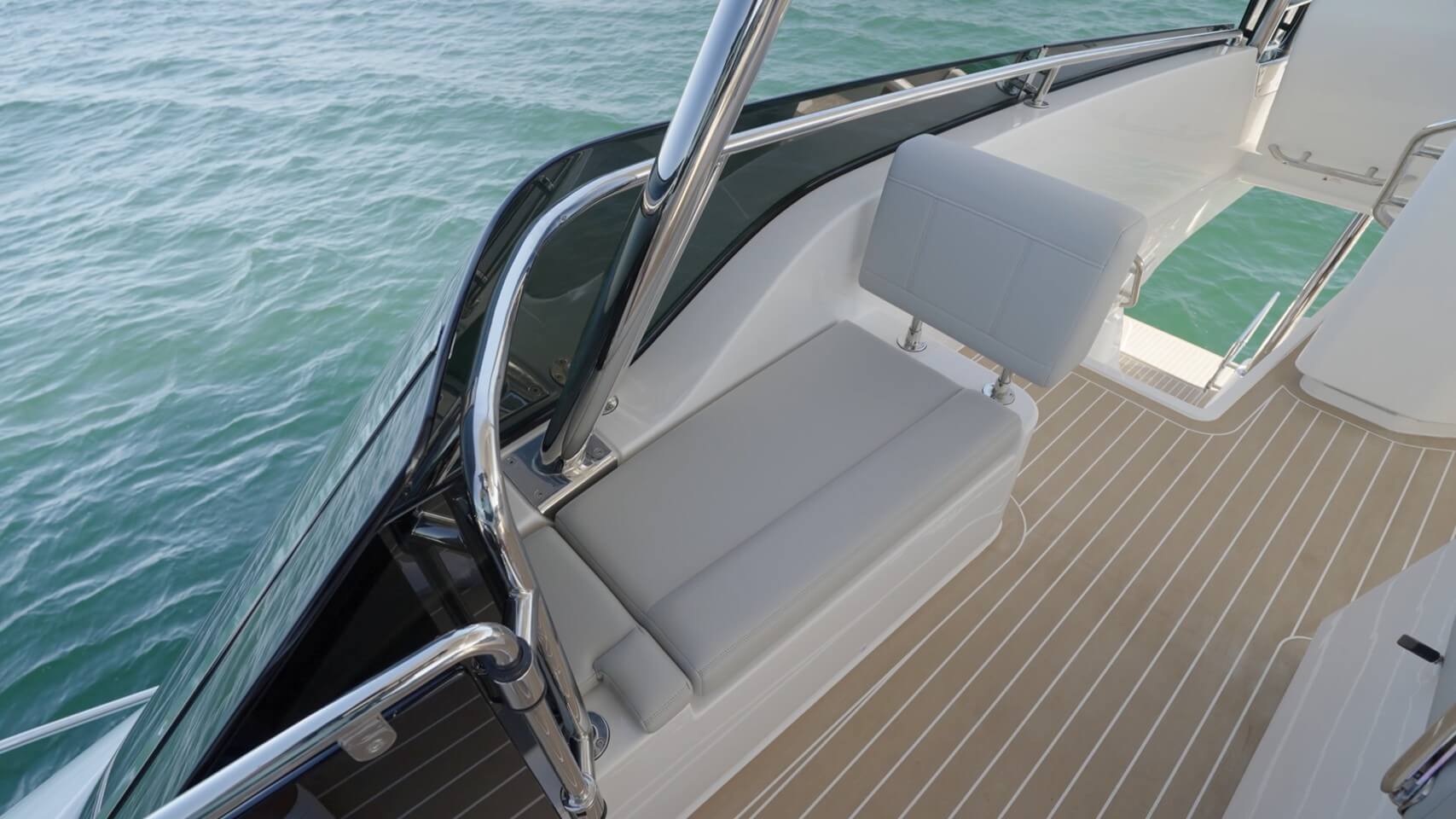
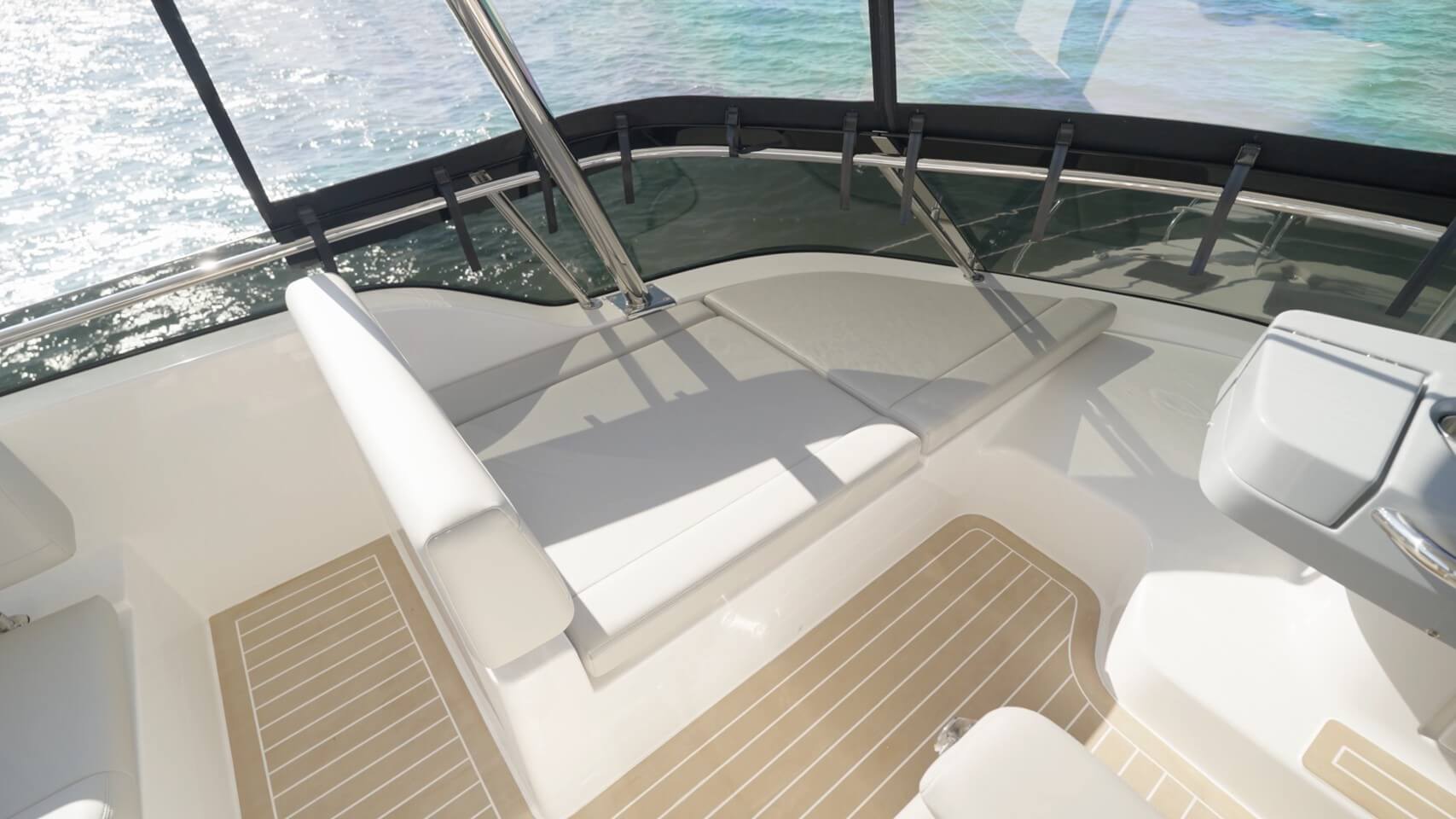
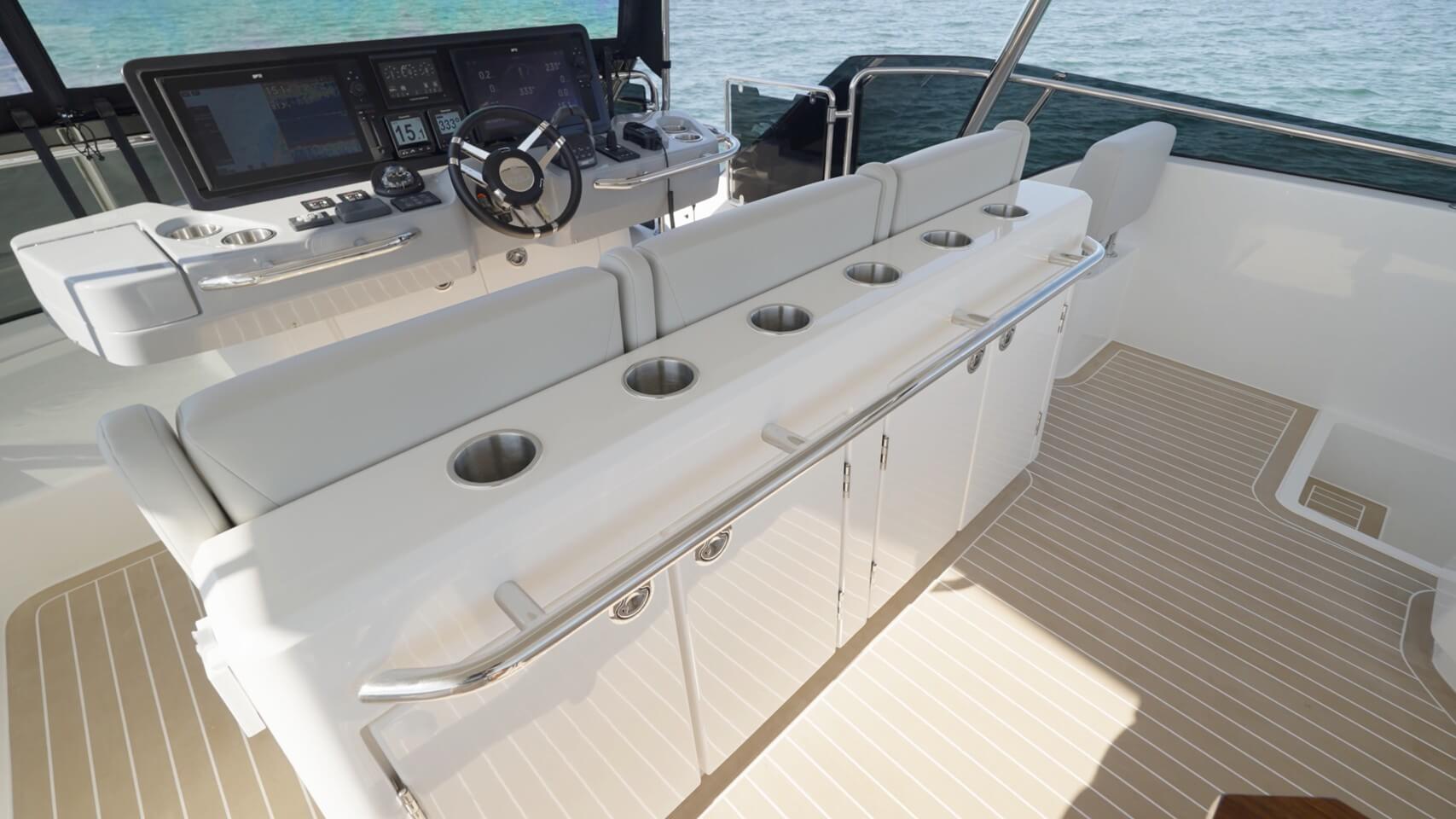
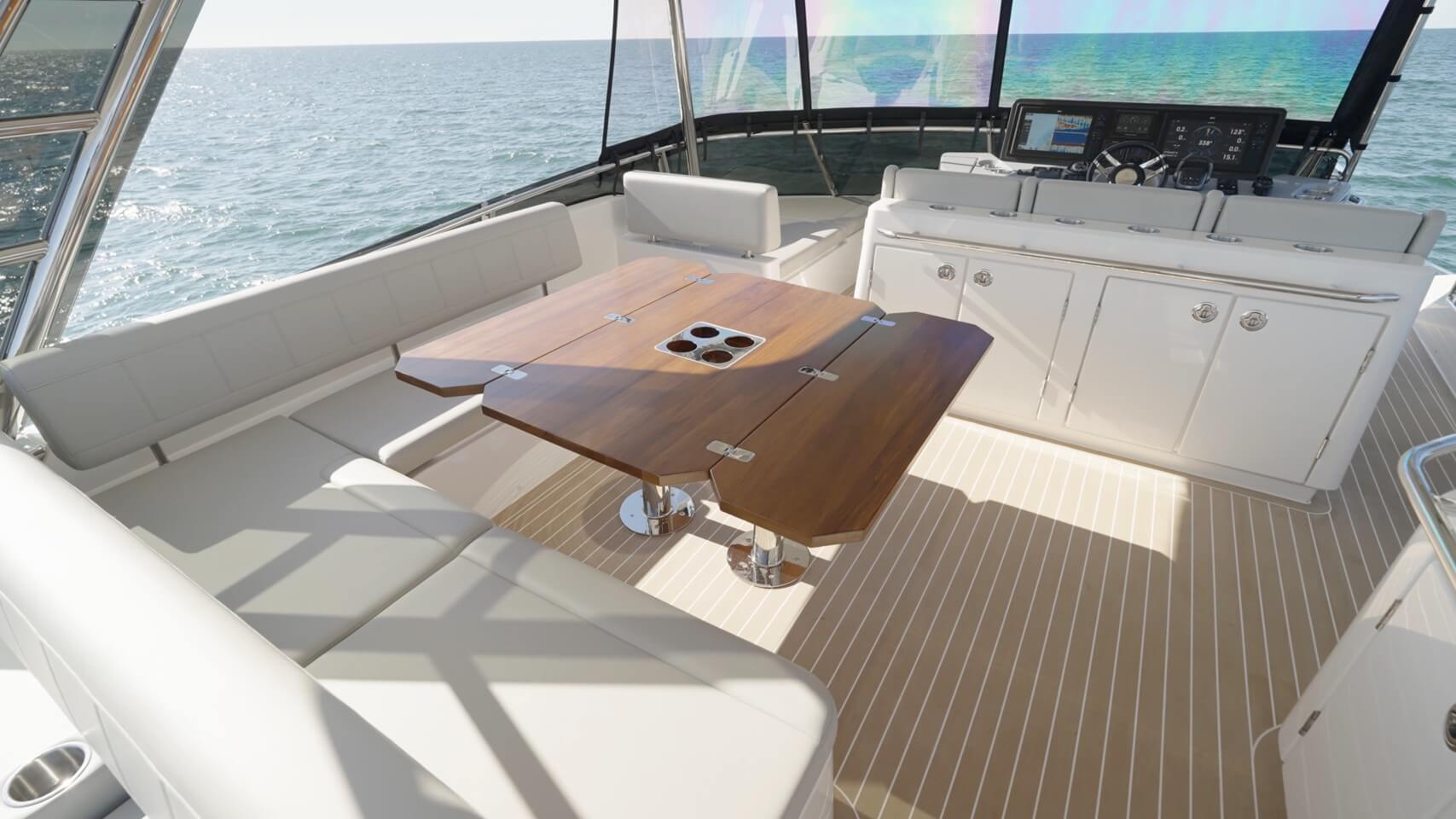
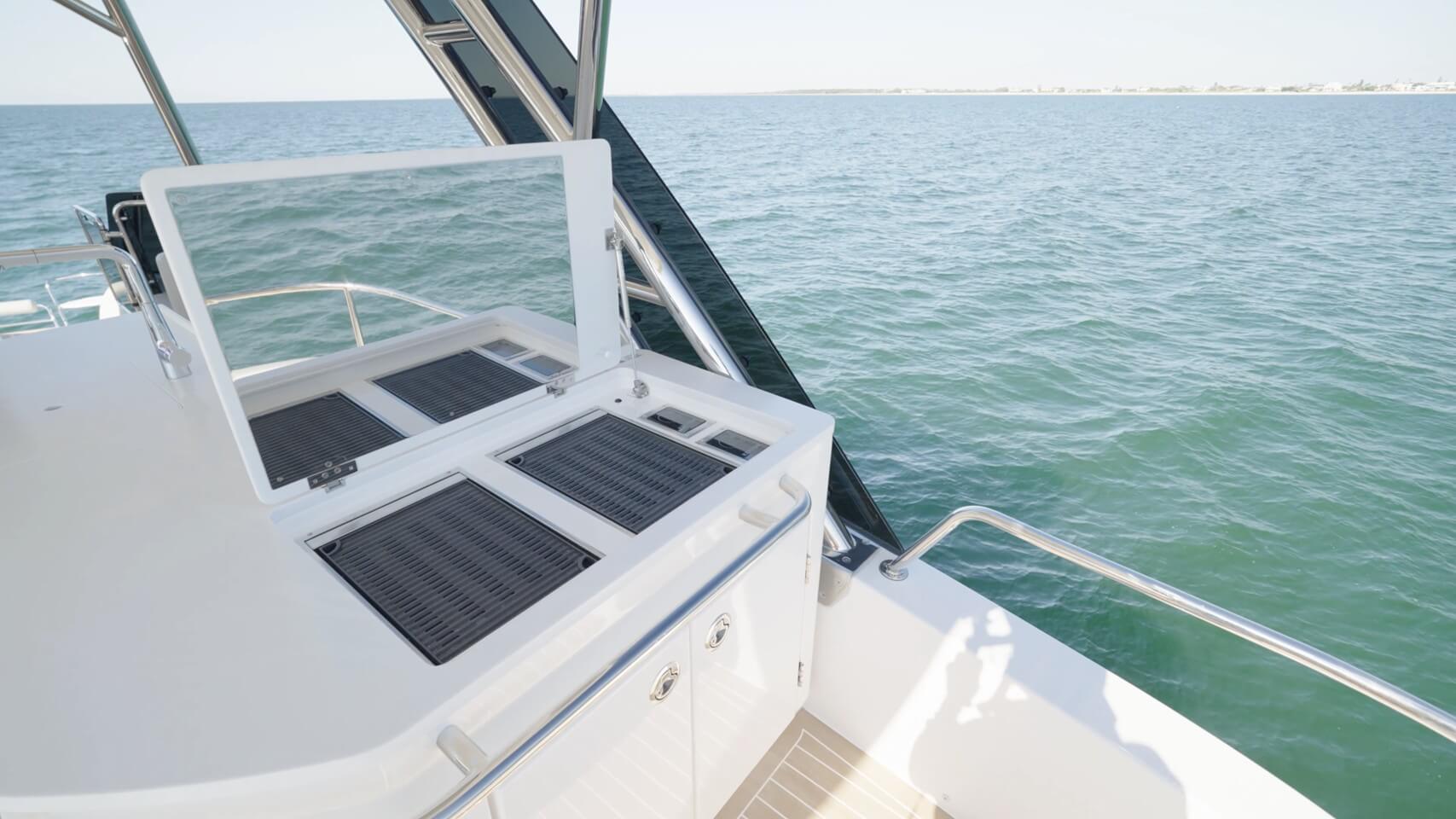
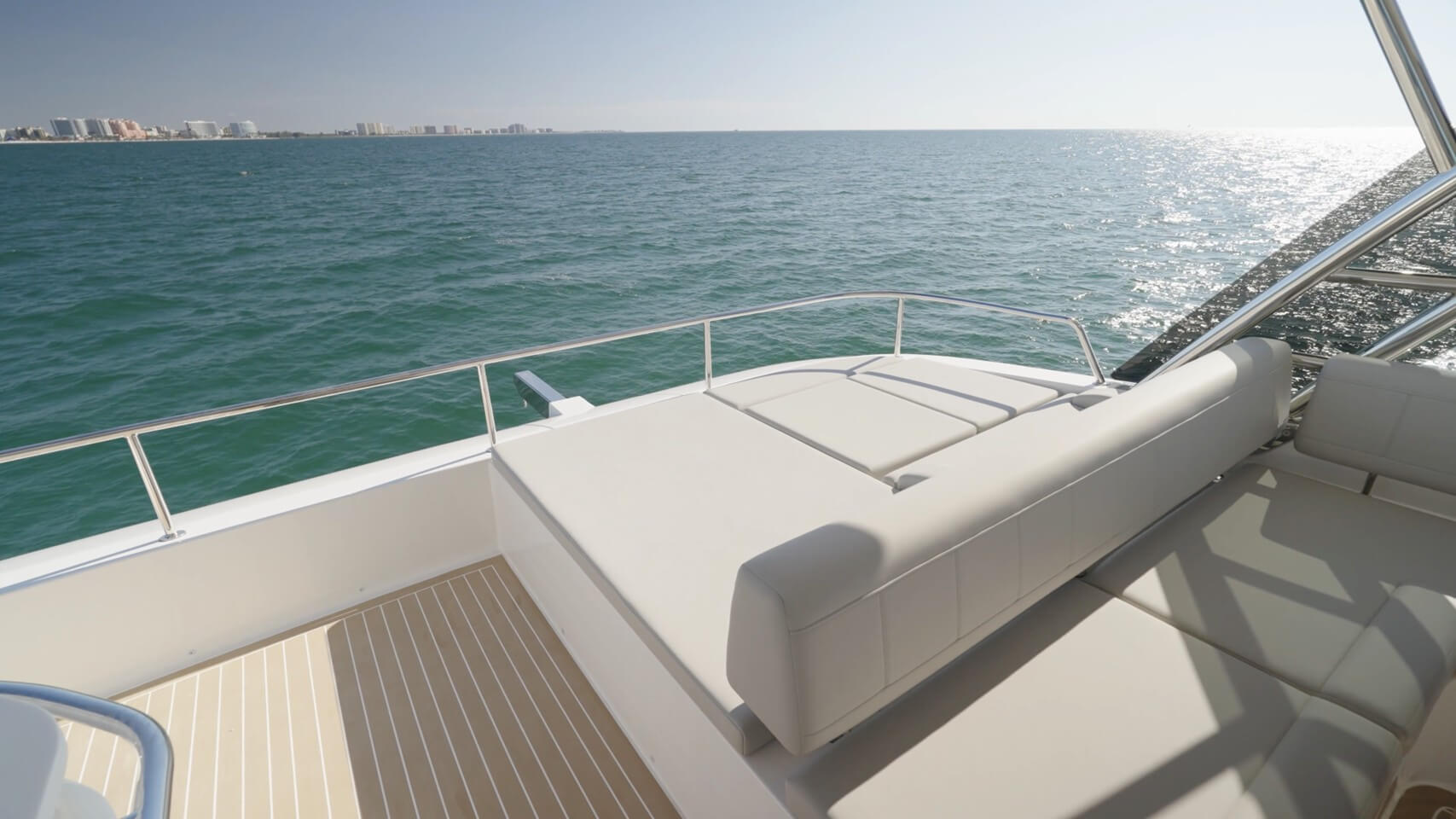
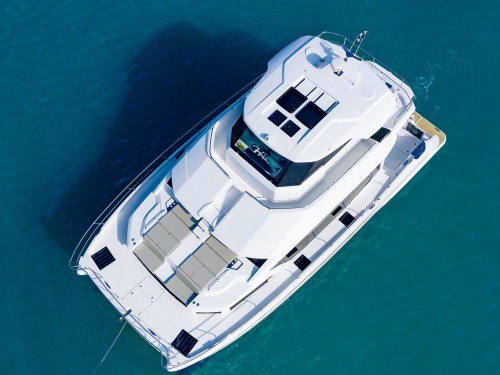
As we’ve seen, a key word to describe what the Aquila 46 Powercat Yacht presents is expansive, and topsides, on the bridge deck, is where this is perfectly illustrated with spacious outdoor room.
Bow
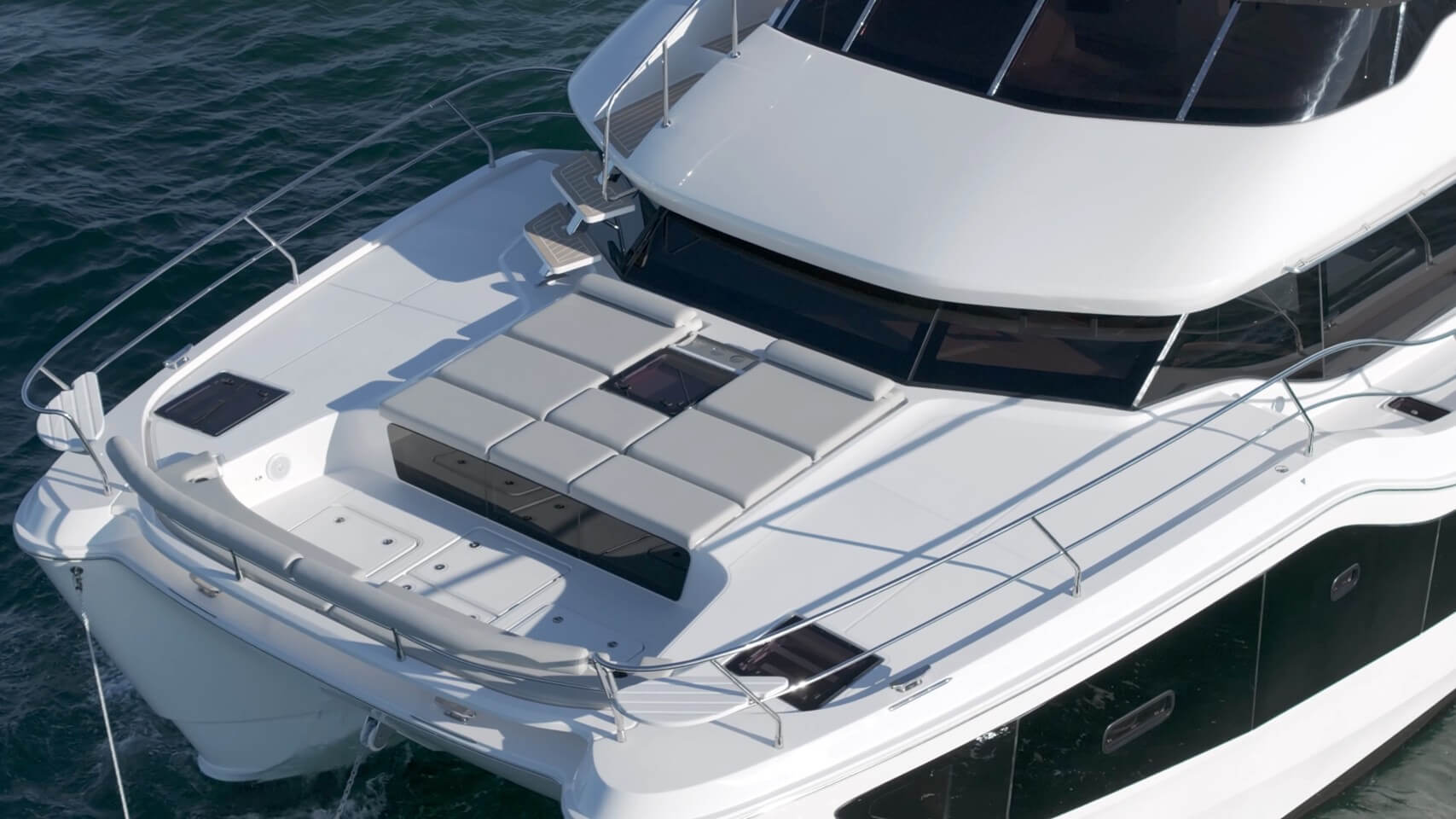
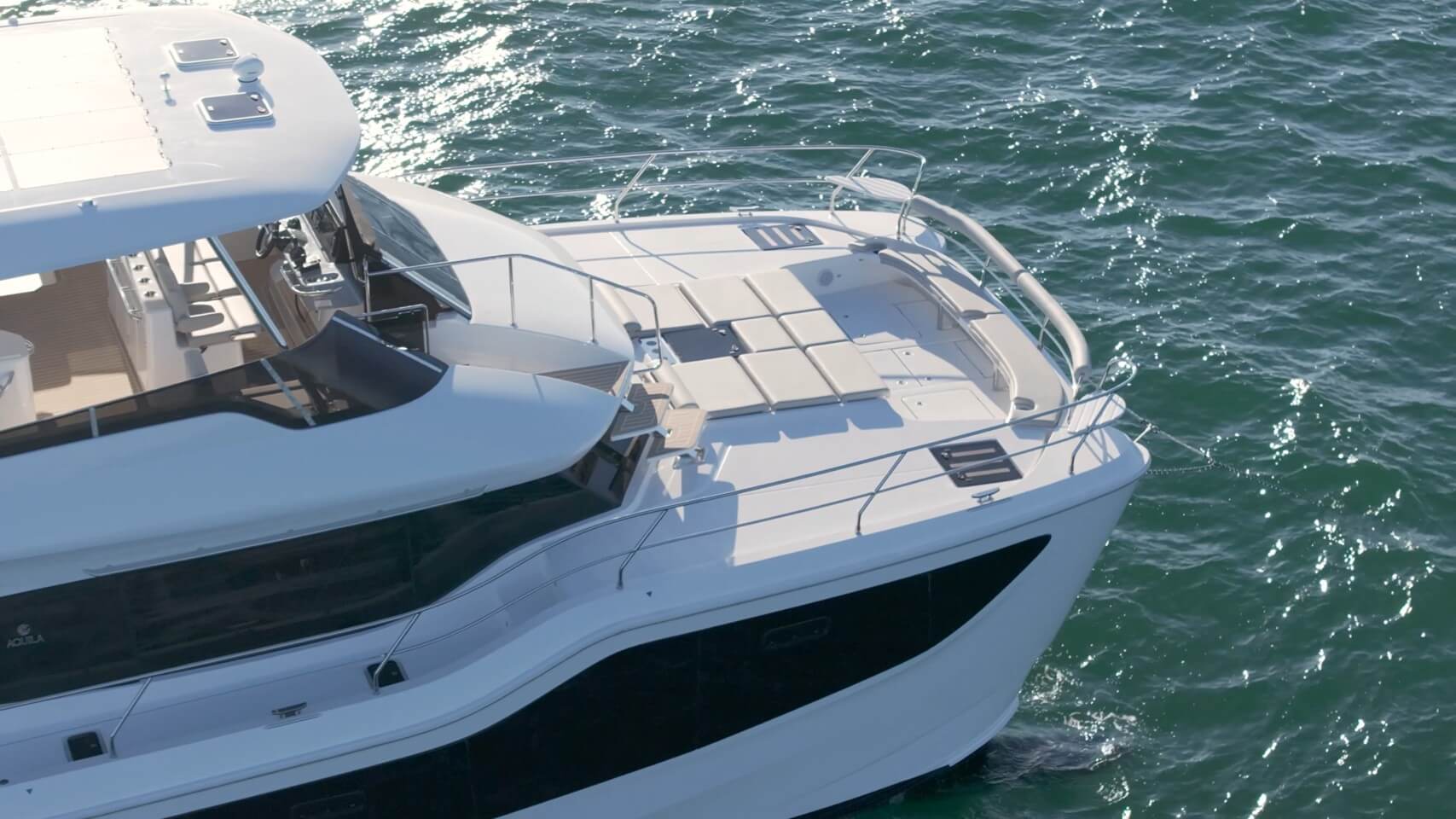
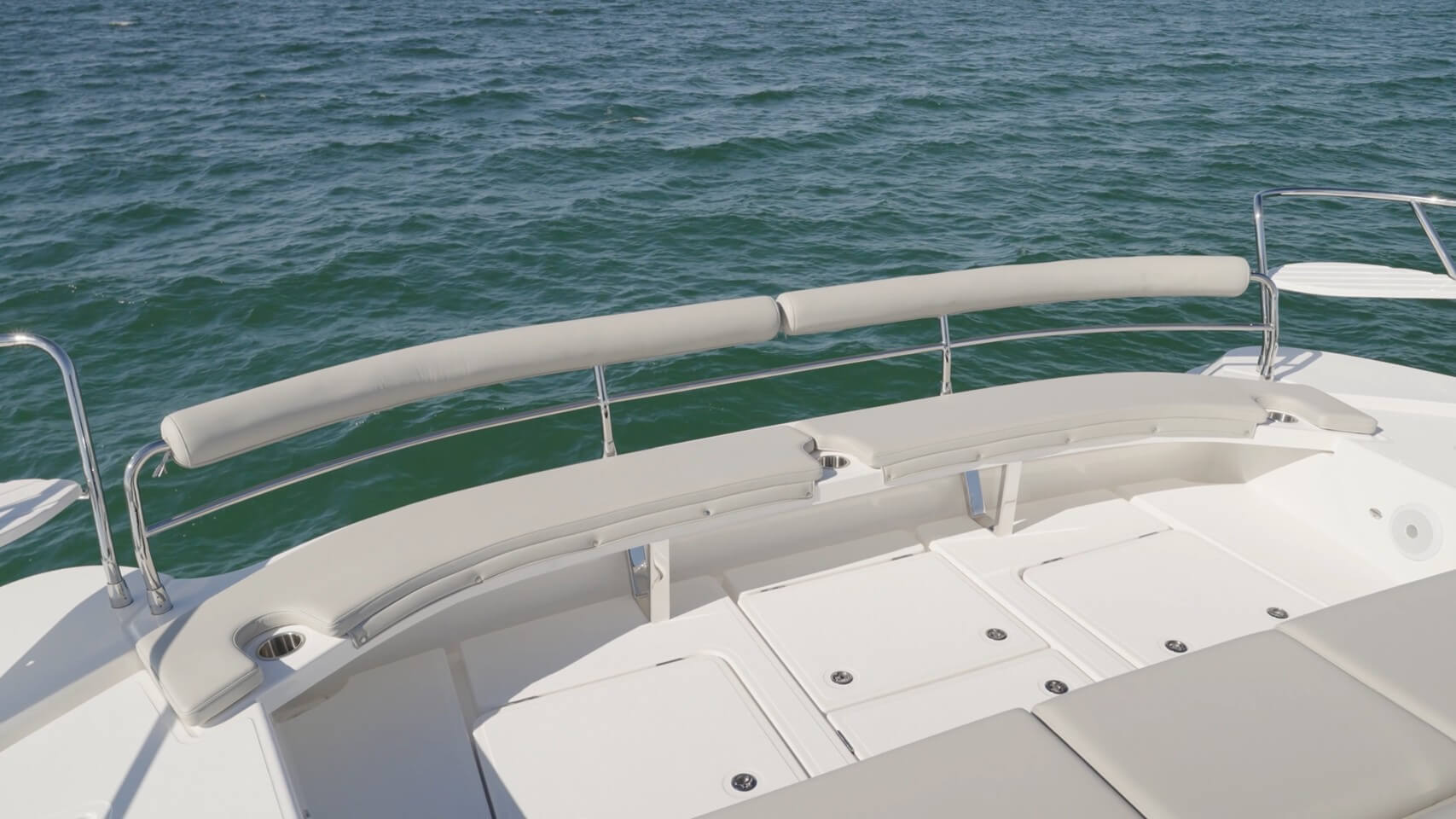
With the ability to carry the 23’3” beam fully forward means that everywhere aboard the Aquila 46 Powercat Yacht, extra room is afforded to creating exceptional gathering and entertaining spaces.
Machinery Space
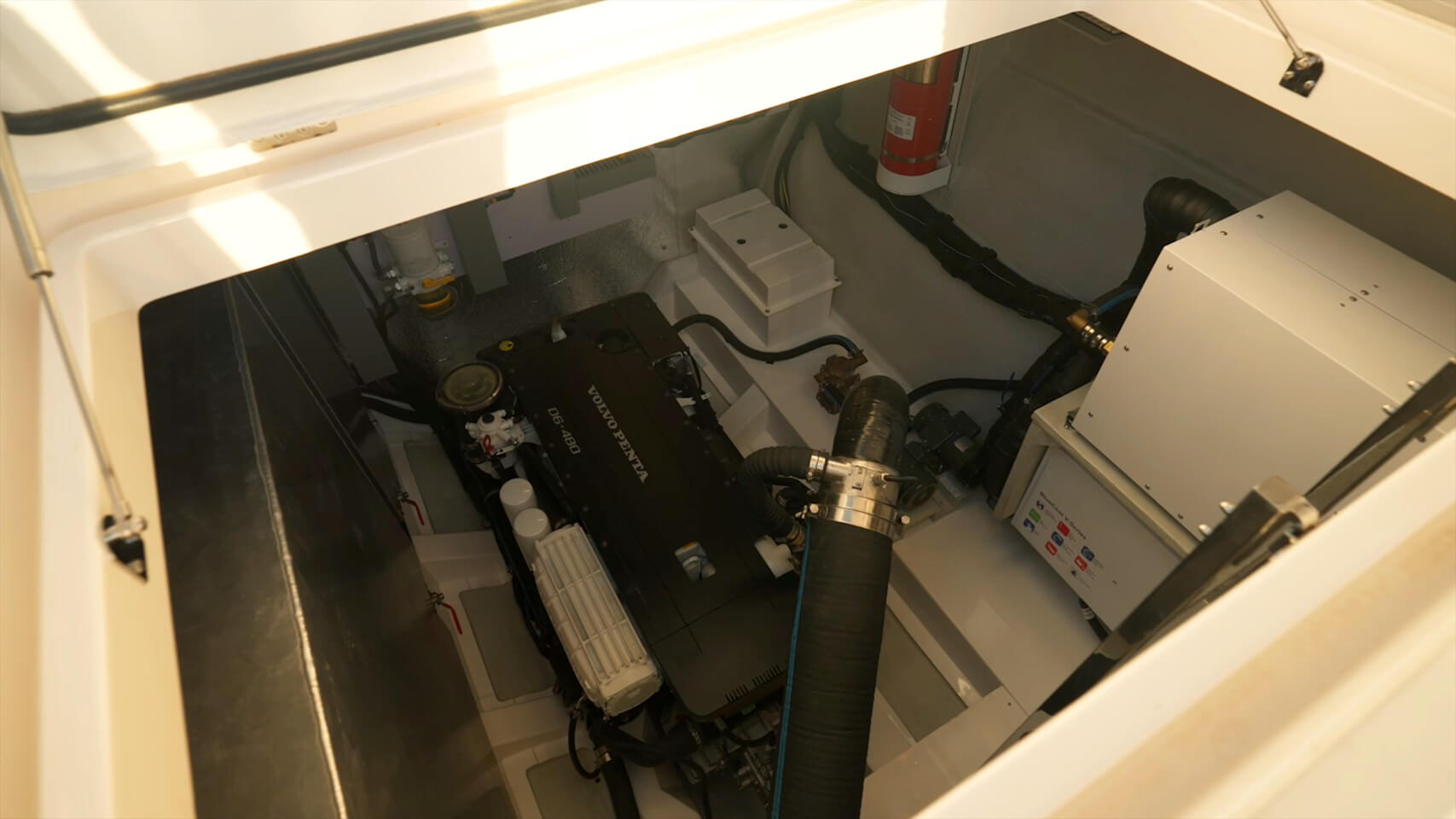
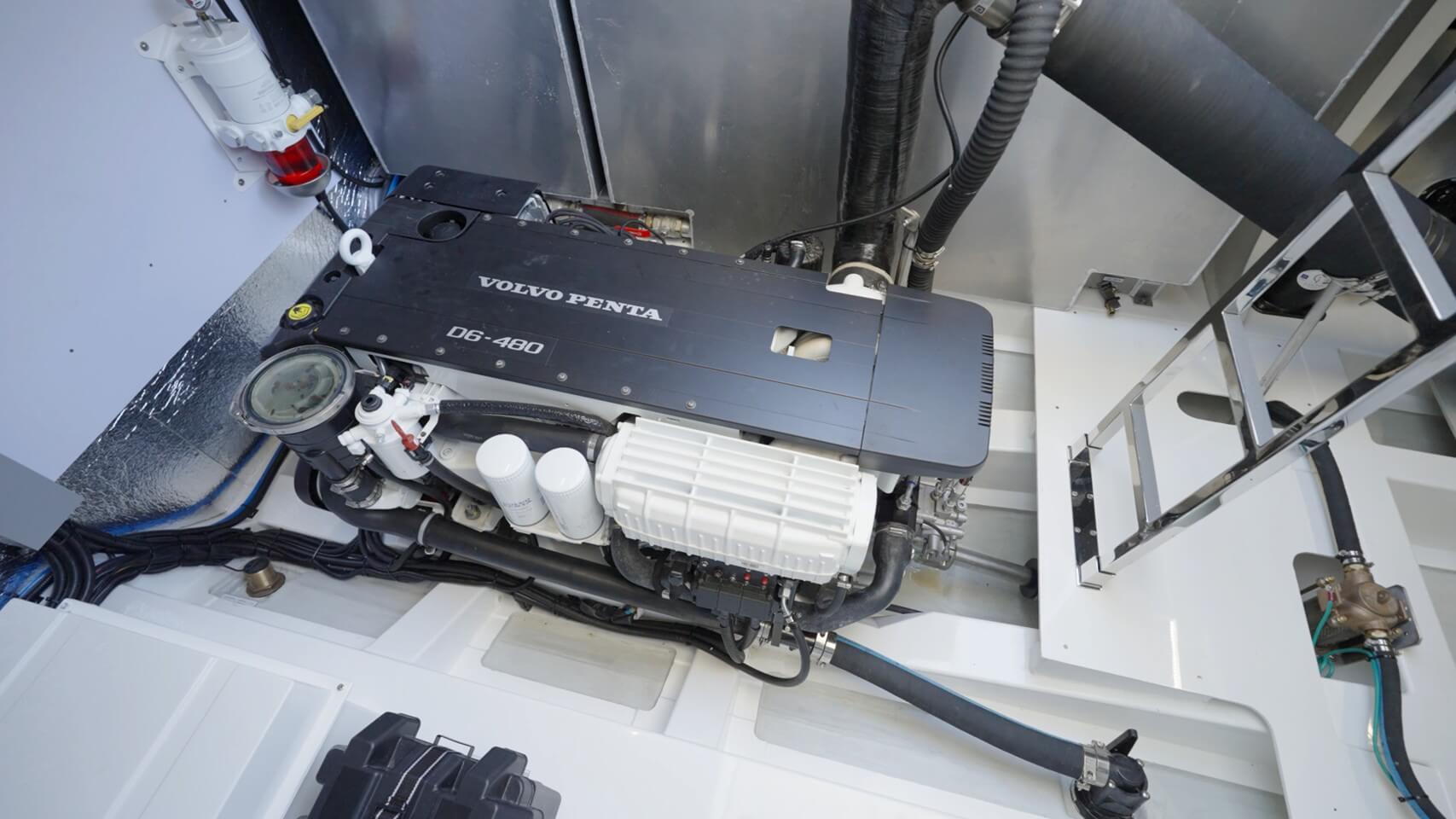
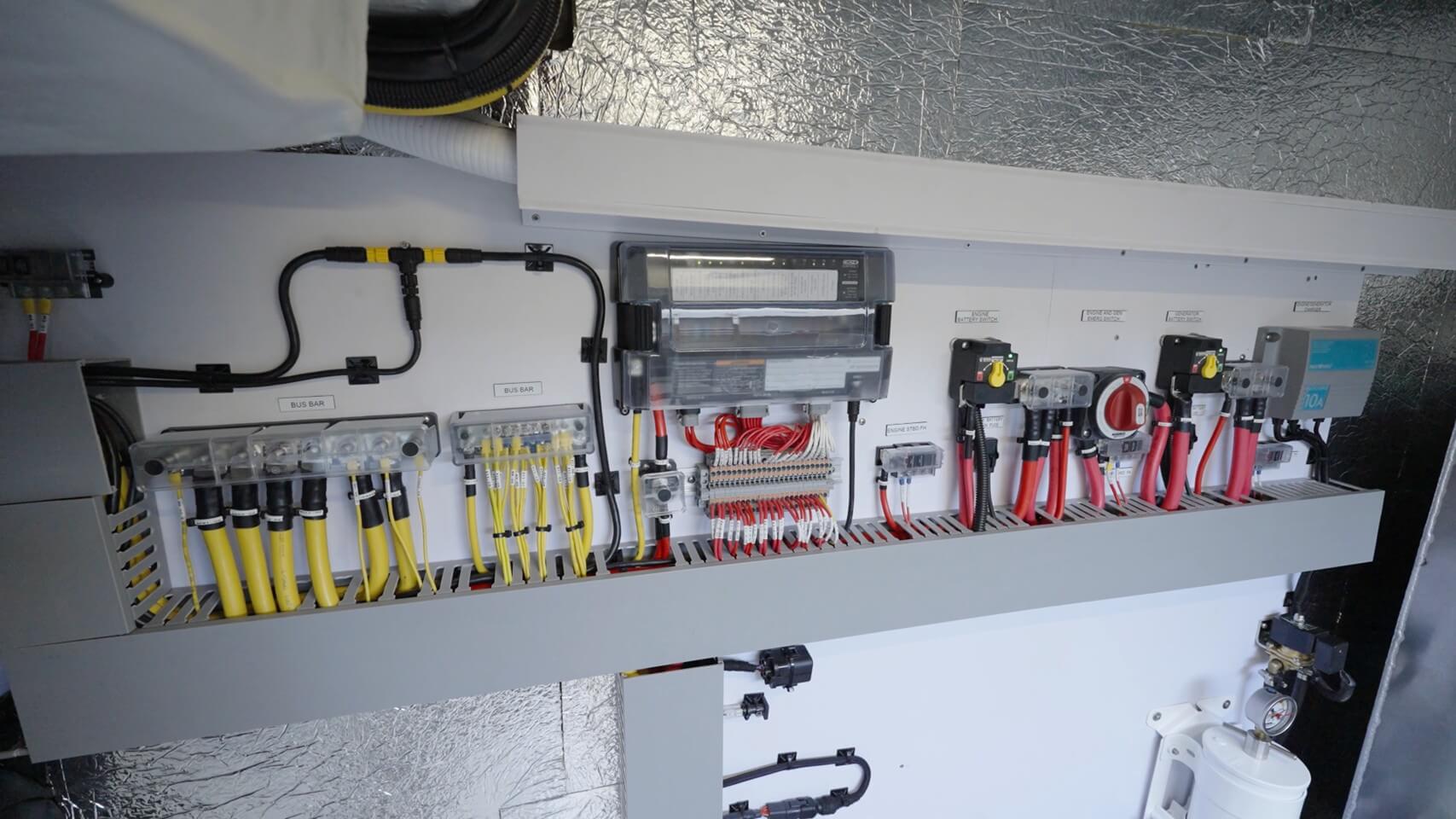
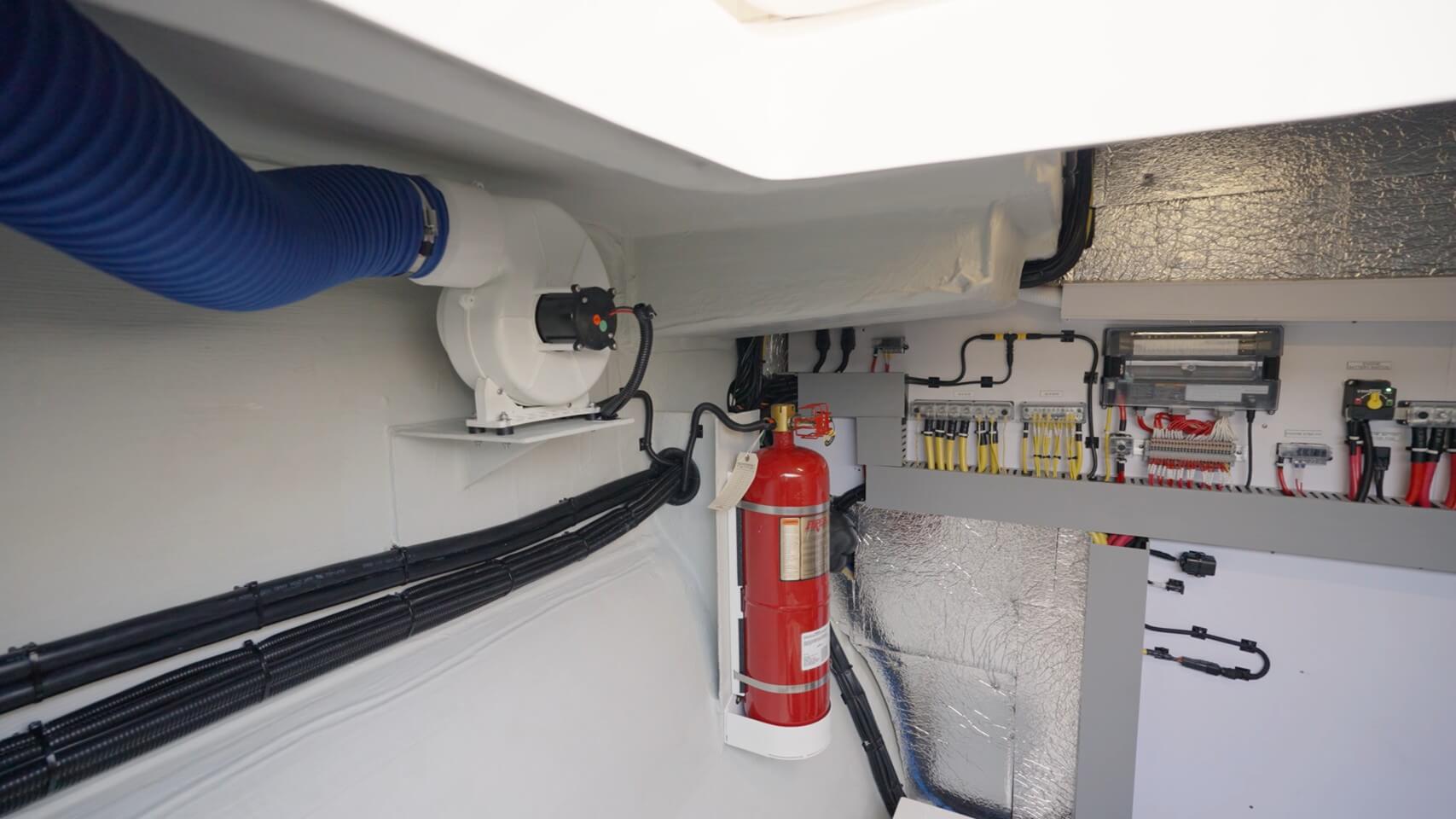
The all-important engine room—there are two aboard the Aquila 46 Powercat Yacht—has been designed and equipped for easy access to all critical areas including the engines, pumps, hoses, generator, wiring, and safety equipment among many others.
A Word About Performance
As our test day delivered, the Aquila 46 Powercat Yacht, with six passengers aboard, successfully balanced the economics of a cruising yacht with the right power package, including optional engine offerings, with her ability to provide comfort and safety while underway.
Conditions were calm with a 5 knot wind, air temp of 76°, and a relative humidity of 67%, and the first thing we noticed was how quickly our test boat, powered by standard twin D6 Volvo Penta 480-hp inboards, with an approximate weight of 49,000 lbs and 60% of our 476 gallon fuel capacity. We got up on plane during our hole shots, and with no trim to consider, went from 0 to 10 kts in an average of 5.4 seconds and 0 to 20 kts in an average of 18.3 seconds. In high speed maneuvers, we experienced little leaning during hard over turns, and noted a decrease of 2 knots of speed before settling her into straight runs. We topped out at 20.6 knots at 3650 rpm and noted our best cruise speed settling in at 3000 rpm, with a comfortable speed of 14.8 knots where we calculated a range of about 214.9 nm with a 10% fuel reserve.
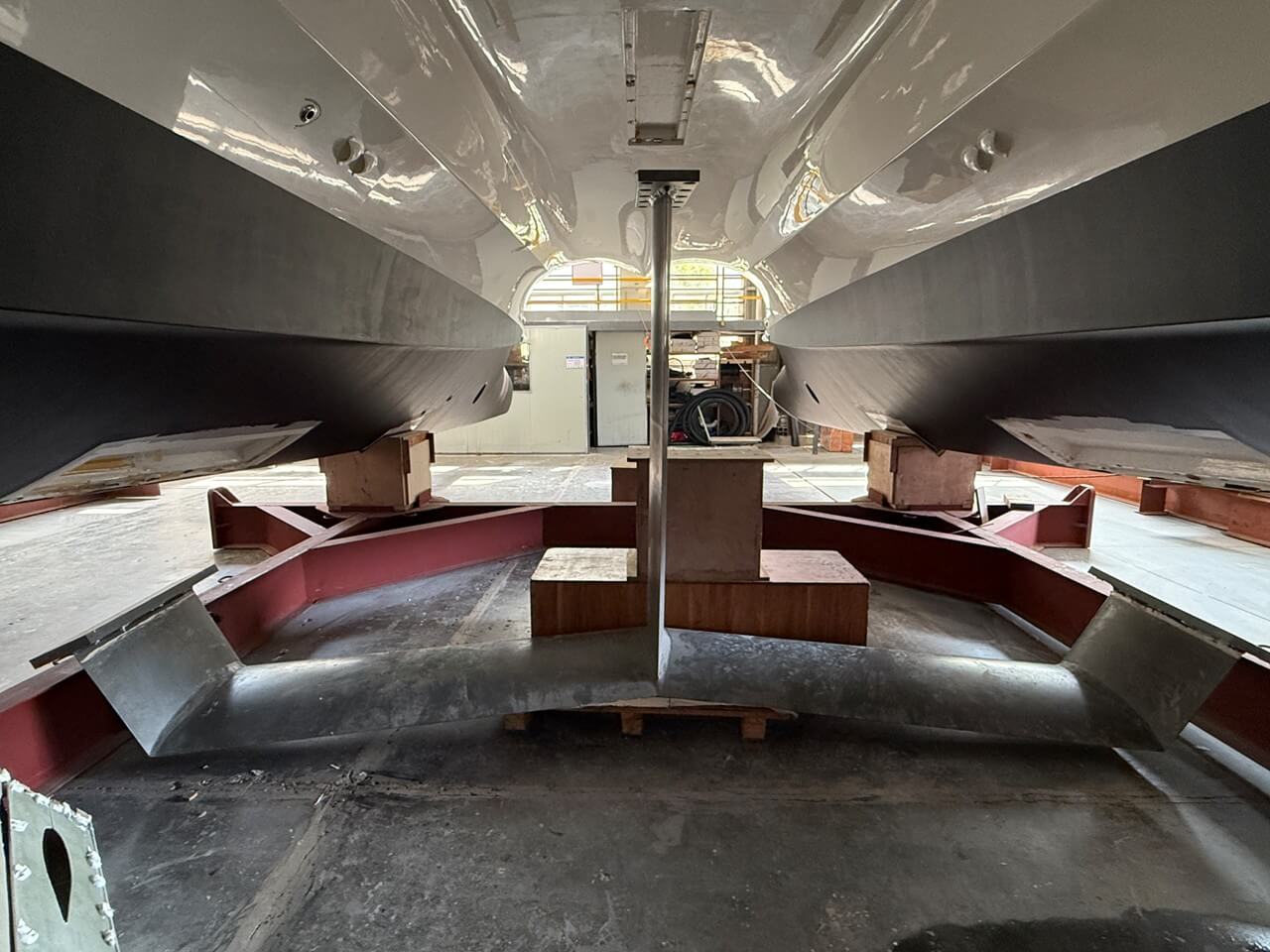
One thing to consider that will affect the Aquila 46 Powercat Yacht’s overall performance is opting for the hull foil. If the foil option is chosen, it must be matched with the Volvo Penta D6 480-hp or the Yanmar 550’s. This is because once the foil becomes activated, between 19 and 21 knots, and it starts generating lift, the additional horsepower is necessary. The overall effect will increase speed, enable the machinery to be more efficient, and result in a smoother ride.
Summary
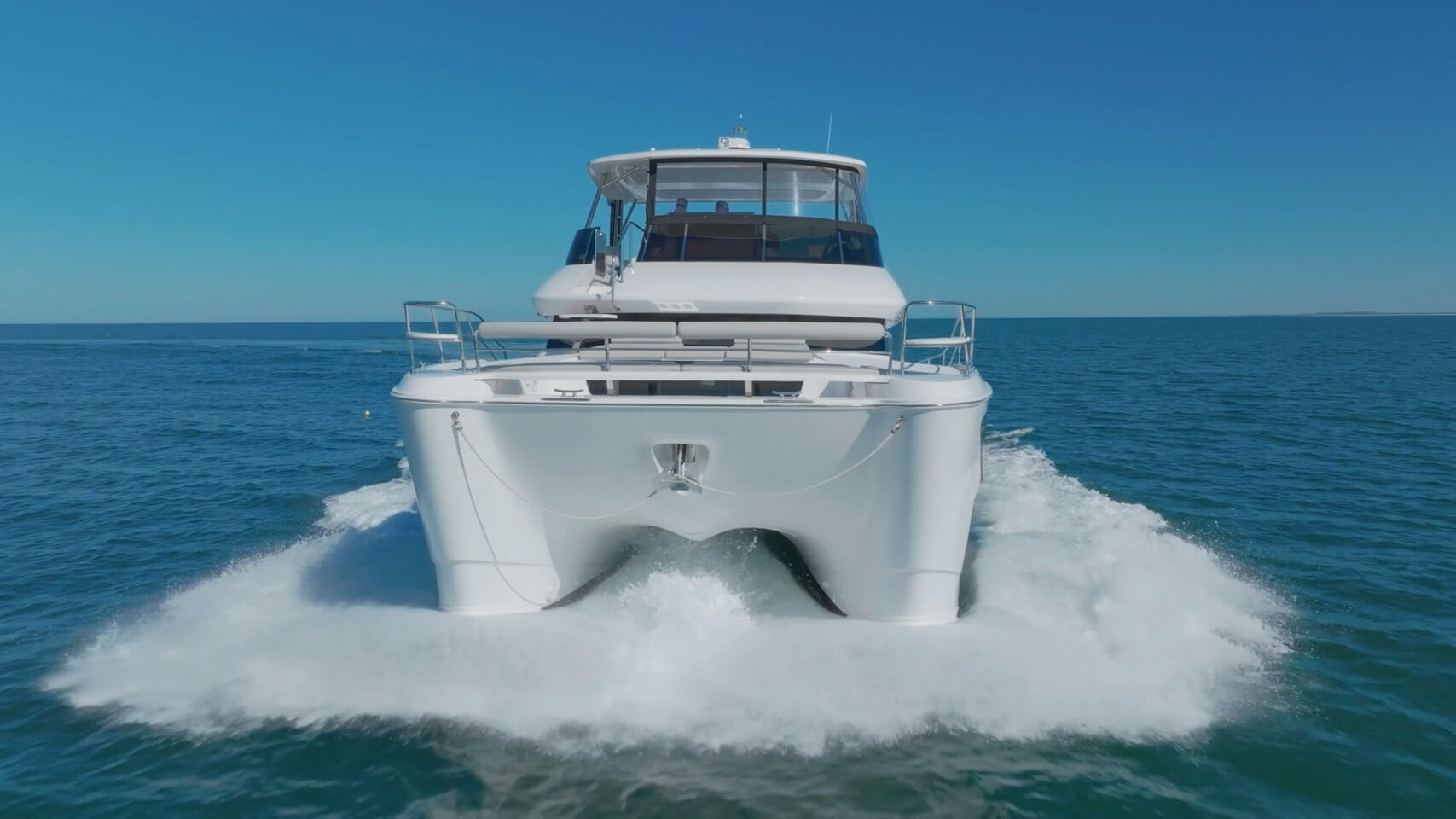
By now, the plus side of catamarans are well known and accepted; a wide, stable, fuel efficient platform supplying voluminous exterior and interior space. Aboard the Aquila 46 Powercat Yacht those qualities are elevated with superior construction, elegant and luxurious touches, and the kind of design and engineering making it a cat apart and ready to supply the kind of special on-water adventures for all those aboard. With up to a five stateroom, five head option, and an overabundance of storage space, she is more than able to take her owners and their guests away in comfort whether on a weekend jaunt or longer cruises.
Remember, life is better on a boat!
Performance Test Video Transcript
Overview
The Grand Aquila 46 Yacht features bulbous bows below the waterline for efficiency and high bows above the waterline, stated as capable of handling 13-foot waves and a Force 9 gale. She is built 100% with vinylester resin, has hull side windows meeting ISO standards, and carries a CE Category A rating for ocean crossings. Propulsion uses straight shafts for low maintenance, with prop tunnels enabling shallow draft. At 7 knots, she is stated to be capable of reaching anywhere in the Bahamas and back to Florida on a single tank of fuel.
Acceleration / Hole Shot
Captain Tripp's account: "I spin the throttles, you can hear the turbos immediately start to spool. Boat picks up, we're already doing 11, 12, 14, 15, 16, 17 knots. This boat tops out just over 20 knots and we're there without any delay."
He noted a catamaran-specific handling trait: "Just being a cat, there's no trimmer or anything to worry about — you just give it throttle wherever you want her to go and she's gonna sit nicely."
Turning / Handling
Testing was conducted in calm conditions, so offshore/rough-water handling wasn't directly assessed, though Captain Tripp noted the elevated freeboard should serve the boat well in that regard.
In turns: "Whenever I make my [maneuvers] and turn, there's no heel, no lean, the boat does drop in speed about two knots, which really isn't that much. And as I come back and straighten her up, she picks back up to 20 [knots] really, really quickly."
Comparison to the sportier coupe model: "Since this is the yacht [model] and not their 46 coupe, it's not quite as sporty. So whenever you're making those aggressive turns, your passengers are gonna feel secure and safe." He noted a tight turn was completed quickly during testing.
Cruise Performance / Efficiency
Volvo engineers recommend running these engines at approximately 80% engine load. Captain Tripp's assessment of 18-knot cruise: "This is a really good cruise speed. You're gonna get where you need to go pretty swiftly, finished for a 46-foot yacht cruising boat, and might I say, pretty efficiently." At this speed, fuel burn was 37 gallons per hour.
Helm Comfort
Seating: A wide helm seat with a bolster; Captain Tripp tested it down: "Oh wow, okay. I'm even more comfortable now." A forward footrest is also fitted.
Visibility: "I have complete 360-degree visibility all the way around the boat" — noted as important given crab pots in the water off Clearwater during testing, to avoid running one over.
Electronics: Twin Raymarine 16-inch screens, Volvo Penta engine display, autopilot, and other controls — all within easy reach.
Companion seating: Chaise lounges on either side of the helm, allowing passengers to join the operator.
Central helm placement: Captain Tripp specifically praised this layout choice: "Something else I like is how the helm seat is centrally located. So even though I'm operating the boat, all my guests that may be back here hanging out while we're underway... everyone's still right here with the party."
Specifications (Test Boat)
- Length overall: 47 feet, 2 inches
- Beam: 23 feet, 3 inches
- Draft: 4 feet, 1 inch
- Test weight: approximately 49,000 pounds
- Engines: twin Volvo Penta D6
Performance Numbers
- Top speed: 20.6 knots at 3,650 RPM
- Best cruise: 17.3 knots at 3,250 RPM, burning 34.5 gallons per hour, achieving 0.5 nautical miles per gallon
- Range at best cruise (standard 476-gallon tanks): 214.8 nautical miles, with a 10% fuel reserve
With optional 211-gallon tank upgrade (total capacity 687 gallons):
- Range at best cruise: 310 nautical miles, with a 10% reserve
Long-Range Efficiency
Captain Tripp highlighted this as where the boat "excels": at 1,500 RPM, traveling 7.4 knots, she burns just 4.5 gallons per hour, giving a range of just under 700 nautical miles (standard tankage).
At 6.3 knots: Range extends approximately 300 miles further. Captain Tripp noted: "You could theoretically make it from Miami to St. Thomas on a single load of fuel."
With the optional 211-gallon tank upgrade, at 6.3 knots: Range extends to 1,443 nautical miles — Captain Tripp noted this covers "the whole Caribbean or [a run] to Nova Scotia from Miami on one load of fuel."
Side Deck / Bow Walkway
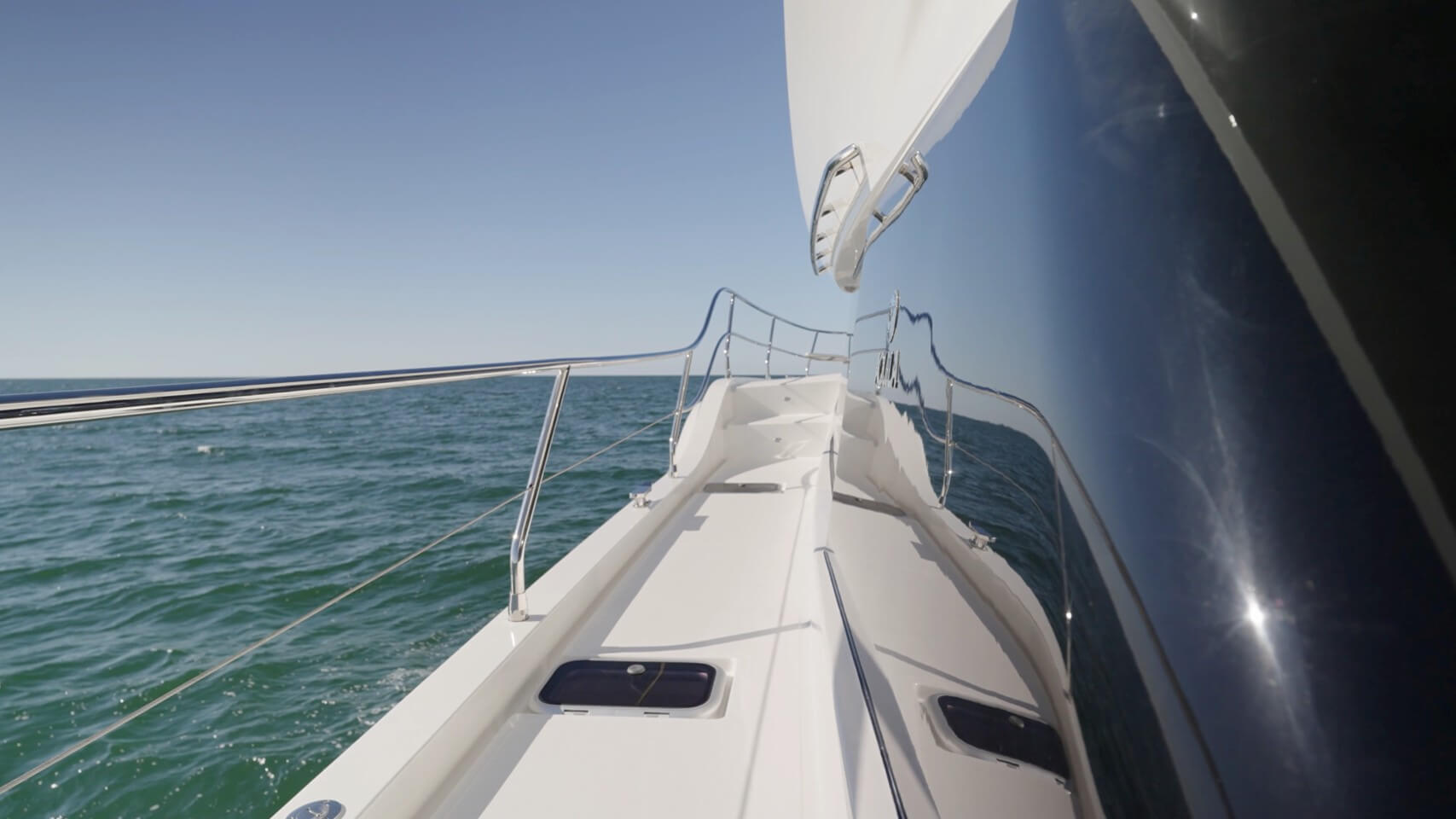
Three steps lead up to the walkway, described as roomy ("didn't skimp on that"). A grab handle is mounted against the cabin top, plus a handrail set high for security while moving forward.
Anchor System (Bow)
Centerline anchor locker access, with an electric quick windlass (remote-operated) and a washdown hose for cleaning a muddy rode/anchor. An eye is fitted for attaching a bridle — deployed during filming — which Captain Tripp noted reduces swing at anchor.
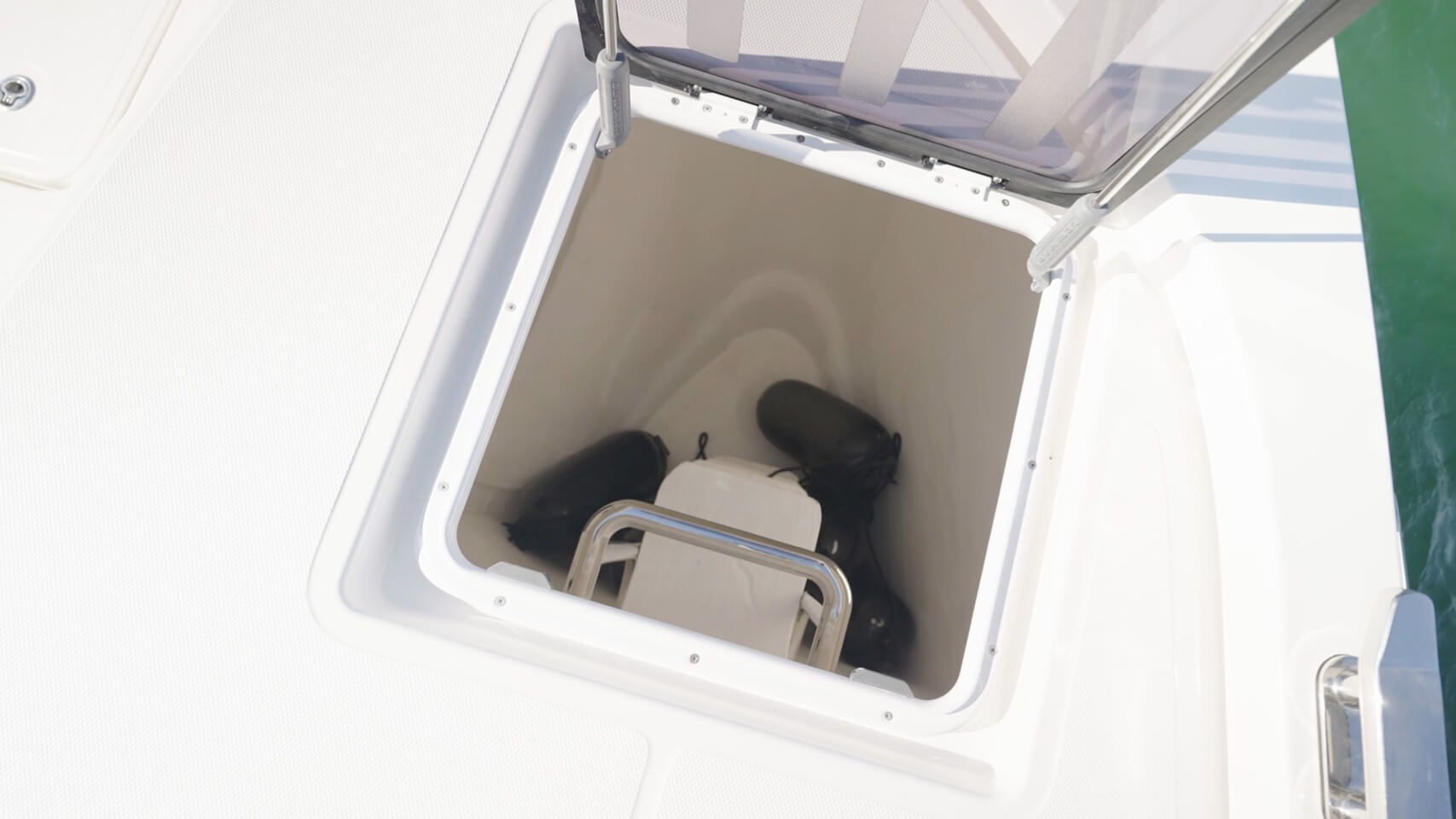
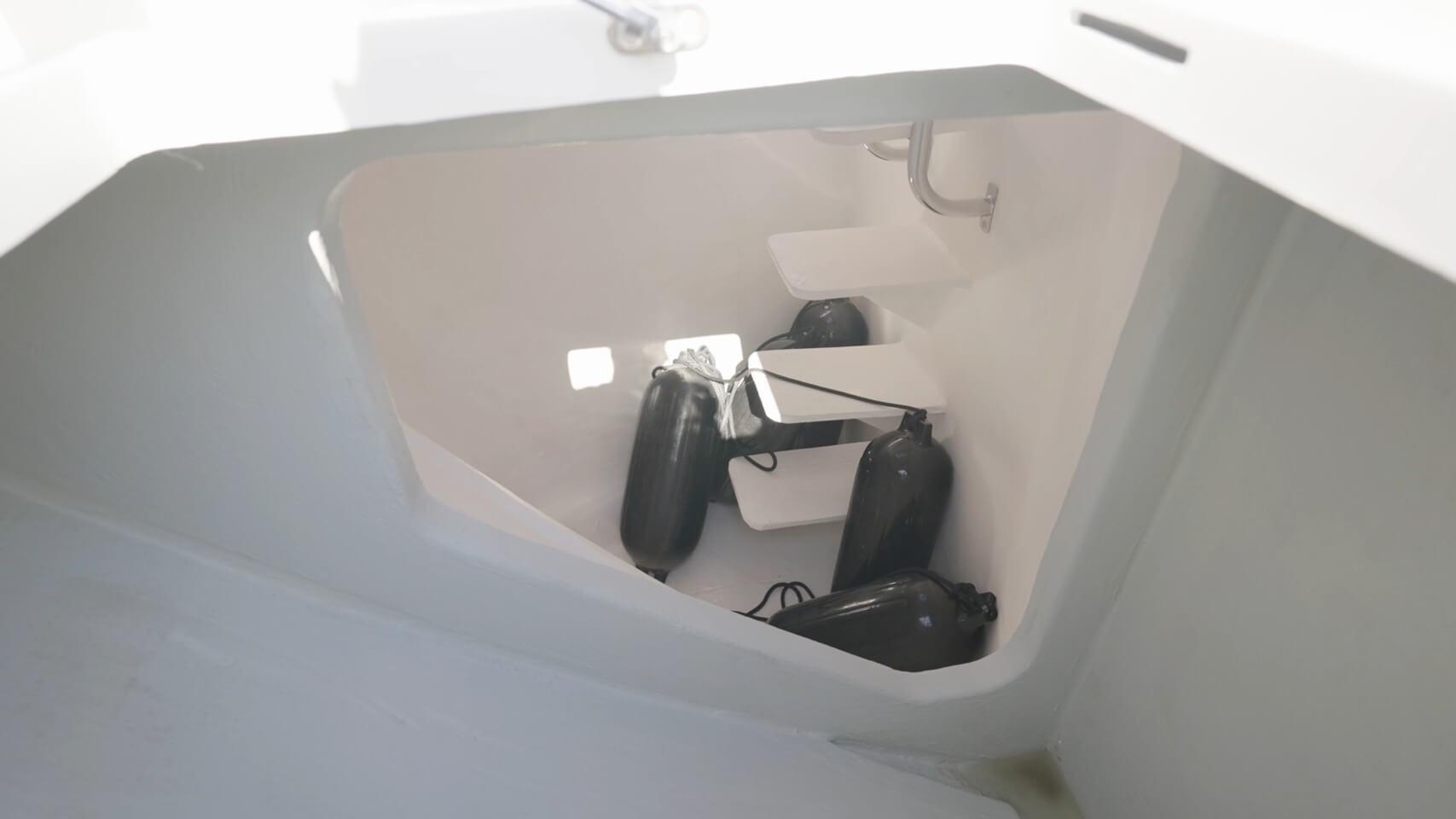
Additional bow storage: A large connected storage space below, accessed via a ladder of unstated depth, currently holding fenders; Captain Tripp noted significant additional capacity. A separate deck hatch at the center of the foredeck provides storage for additional fenders and lines (e.g., stern lines).
Engine Rooms
Both port and starboard engine rooms are accessed via deck hatches on the aft deck (transcribed as "half deck"). Captain Tripp's assessment: "There's a lot more room down there than I expected. You're probably not going to have many techs or mechanics complaining about working down here." This holds true even with the 238-gallon fuel tank and 105-gallon reserve tank installed in each engine room (identical setup on both port and starboard sides).
Serviceability: "This engine is gonna be very easy to service, very easy to do your daily checks." Racor fuel filters are noted as easy to access.
Electrical system: Captain Tripp praised the build quality: "Just behind me you can see how professionally done this electrical system is. It just looks fantastic. Everything is protected. I really like seeing that." Also noted: a fire suppression system, blowers, and general tidy/elevated component placement.
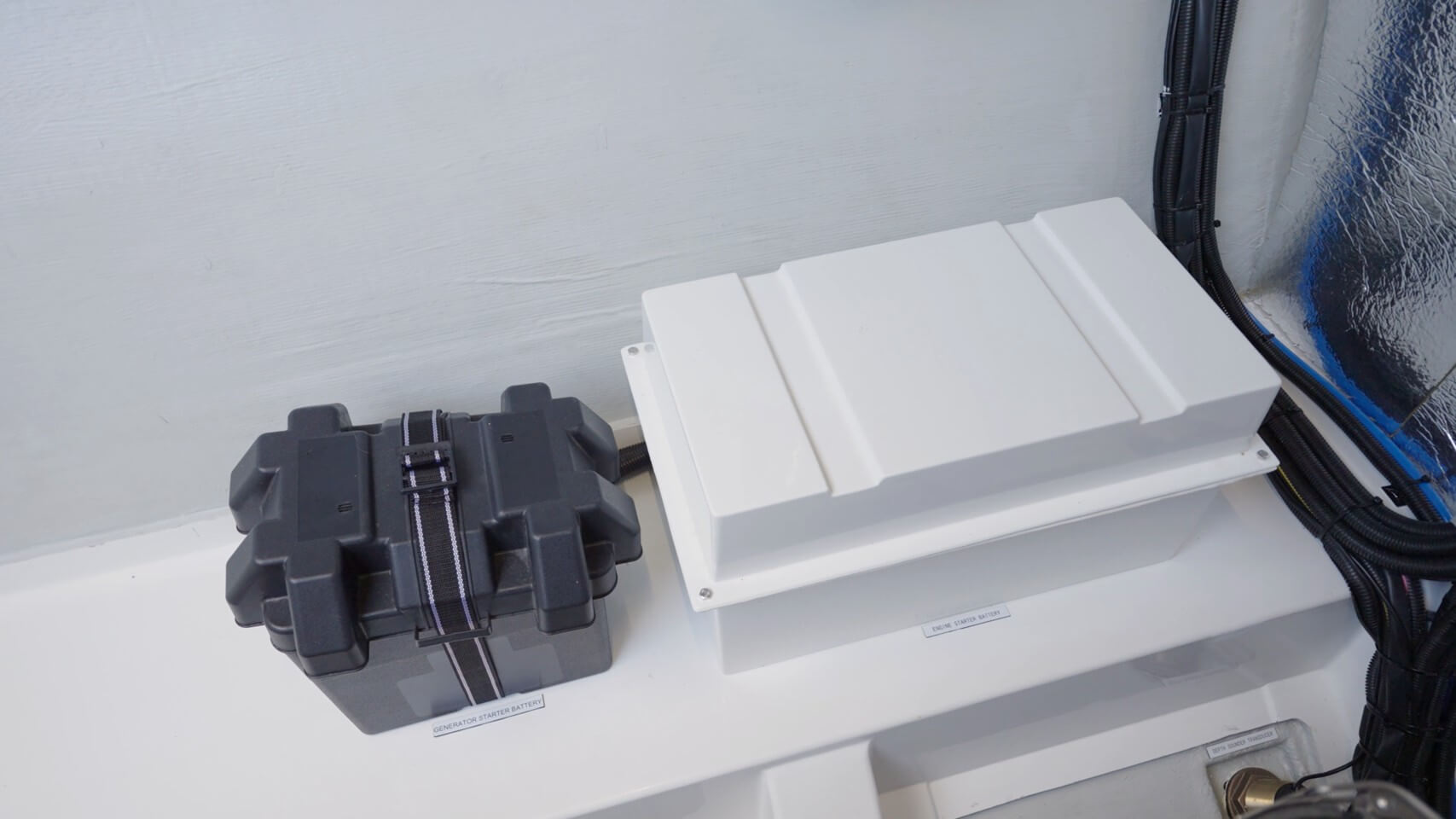
Start battery: Housed in its own case — Captain Tripp cited this as evidence of the builder's premium-yacht approach: "This really just goes to show all the care Aquila is doing to make this more of a premium yacht."
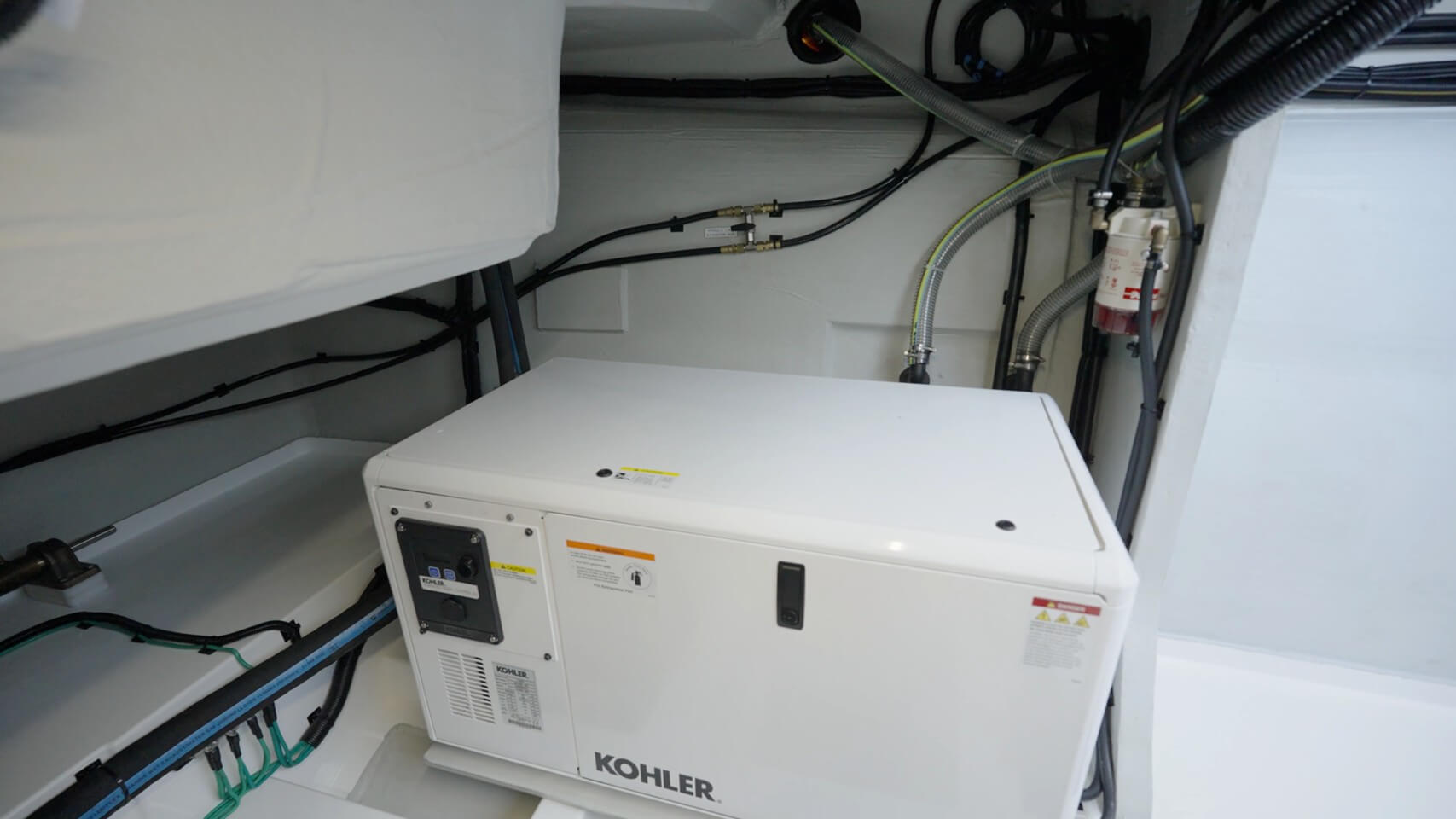
Generator: Kohler, with two generator options available for this model; Captain Tripp noted a hybrid version may be introduced in the future, and that the engine room's generous size would accommodate the additional battery capacity such a system would require.
Generator access: Easy access for servicing, including the fuel filter and steering gear.
Raw water strainer (suggested improvement): Captain Tripp noted the through-hull and raw water strainer for the generator are easily accessible, but suggested an improvement: "I would like to see the same type of sea strainer on the generator raw water intake as it's mounted on the Volvo engine, with a transparent top for a quick check and clean out if necessary."
Raw water intake (D6 engine): Noted specifically, along with a general safety point about catamarans: "When a boat takes on water, it's almost always because something let go in the engine room, but all cats have two engine rooms, which means you have to have quick access to the through-hulls, stuffing box, and the rudder post." Red bilge pump warning lights are fitted at both the helm and nav station.
Labeling: All components throughout the engine room are labeled with engraved placards.
Shore Power
50-amp shore power hookup located at the port stern; the test boat was optioned with a Cablemaster electric cable reel.
Nav Station (Opposite Salon Table)
In the tested configuration, this area functions as a secondary control station: VHF radio, CZone system for lighting/tank monitoring, and a Fusion audio head unit. Some storage is present, though this space can alternatively be optioned as a second interior helm/control station. Captain Tripp noted good visibility for operating the boat from this elevated position, suggesting it as a good spot to run the boat in inclement weather.
Main Electrical Panel
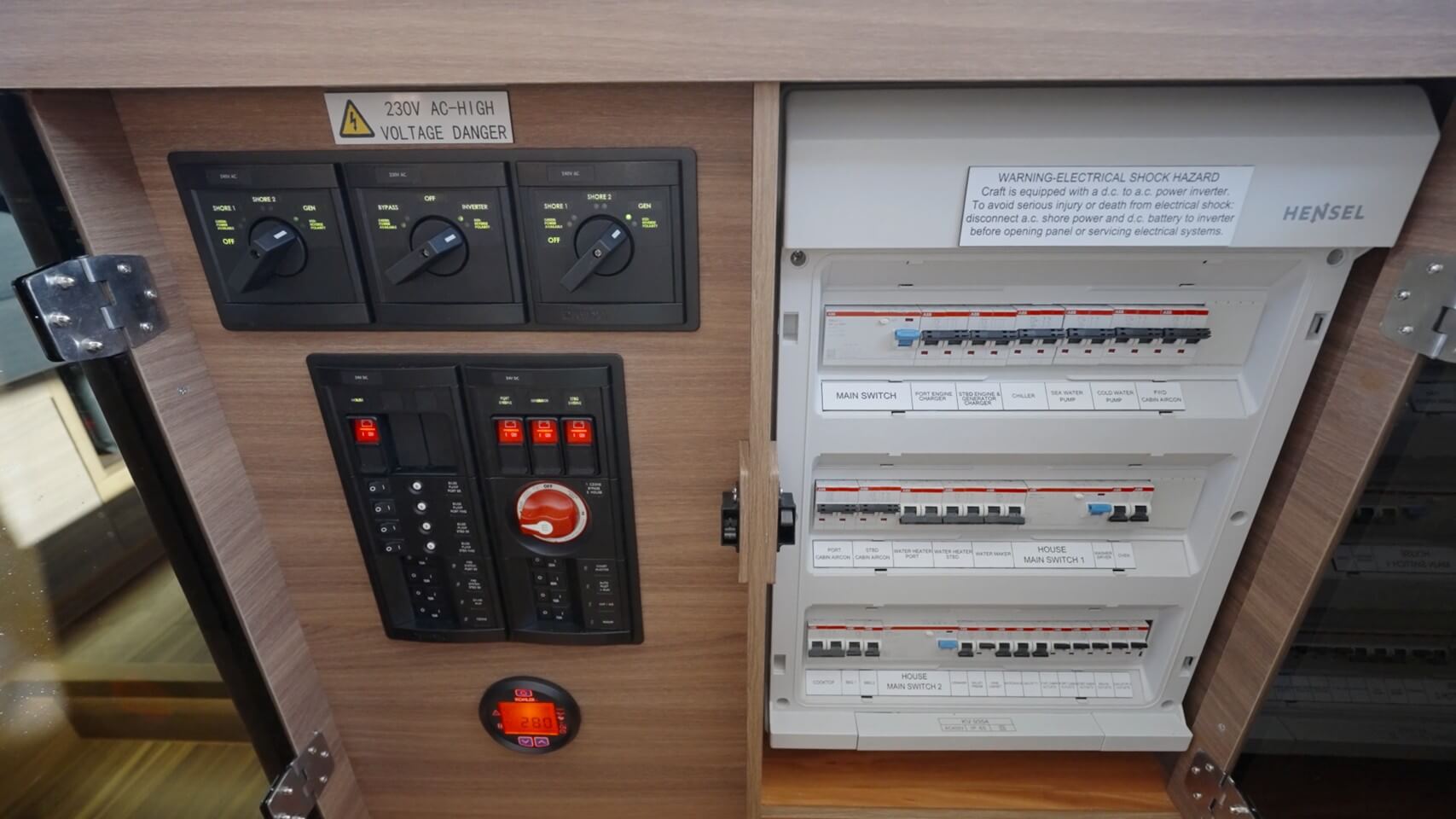
Located at the entry to the forward cabin. Houses AC electrical breakers, generator/shore power selector switches, DC switches, battery switches, and the generator control panel.
Closing
Captain Tripp: "Hope you enjoyed this performance evaluation and technical walkthrough of the Aquila 46 Yacht."
Features Walkthrough Video Transcript
Overview
Captain Tripp's opening framing: "If you've always thought cruising cats were awkward outside and tight inside, you're definitely not alone. But then along came the new Aquila 46, which looks graceful on the outside and has more room below than most 46-foot monohulls."
This is hull number two for this model. Captain Tripp identified two headline changes Aquila is introducing with this line:
- "Explorer" aesthetic — a raised bow forward, providing benefits both below deck and underway
- Three cabin layout options, making the boat versatile for different owner needs
Flybridge
Captain Tripp's first impression: "Stepping into the flybridge, you immediately realize how grand this space is and how well you could entertain a lot of guests up here."
Small sun lounge: Sized for one person. Captain Tripp singled this out as a personal favorite: "It might be my preferred spot on the boat if I wasn't at the helm... You're really comfortable kind of over here on the edge, and if you need to go forward or have quick access, you're still engaged and nearby to the operator."
Port-side lounger: Larger, with underneath storage. The back of the helm seating includes additional storage, six cup holders on top, and a 110-volt outlet.
Main gathering area: L-shaped seating with a table (leaf, cup holders in the middle). Captain Tripp's assessment of build quality: "This thing is beefy, it's sturdy, it's not going anywhere, so if you're up here enjoying dinner, drinks in the evening, you have a good secure place to have that dinner and you can have many of your guests here with you, but you have fantastic 360-degree views all the way around you." Storage is present under all seats.
Grab rails: Captain Tripp specifically praised Aquila's inclusion of these on the flybridge: "If you have a lot of guests on board and you're underway, maybe get into some sort of seas, you want everyone to be able to safely grab onto something."
Flybridge Wet Bar / Galley Area
- Sink with storage below
- Pullout trash can (starboard)
- Ice maker
- 110-volt outlet, positioned for a blender — Captain Tripp: "You can plug in your blender, place it right up top here, and everyone can be sure to have a good time. Something cold to drink tucked away neatly."
- Grills: Double electric Kenyon grills under the countertop, optionable for propane, with additional storage underneath
Flybridge Sun Pad
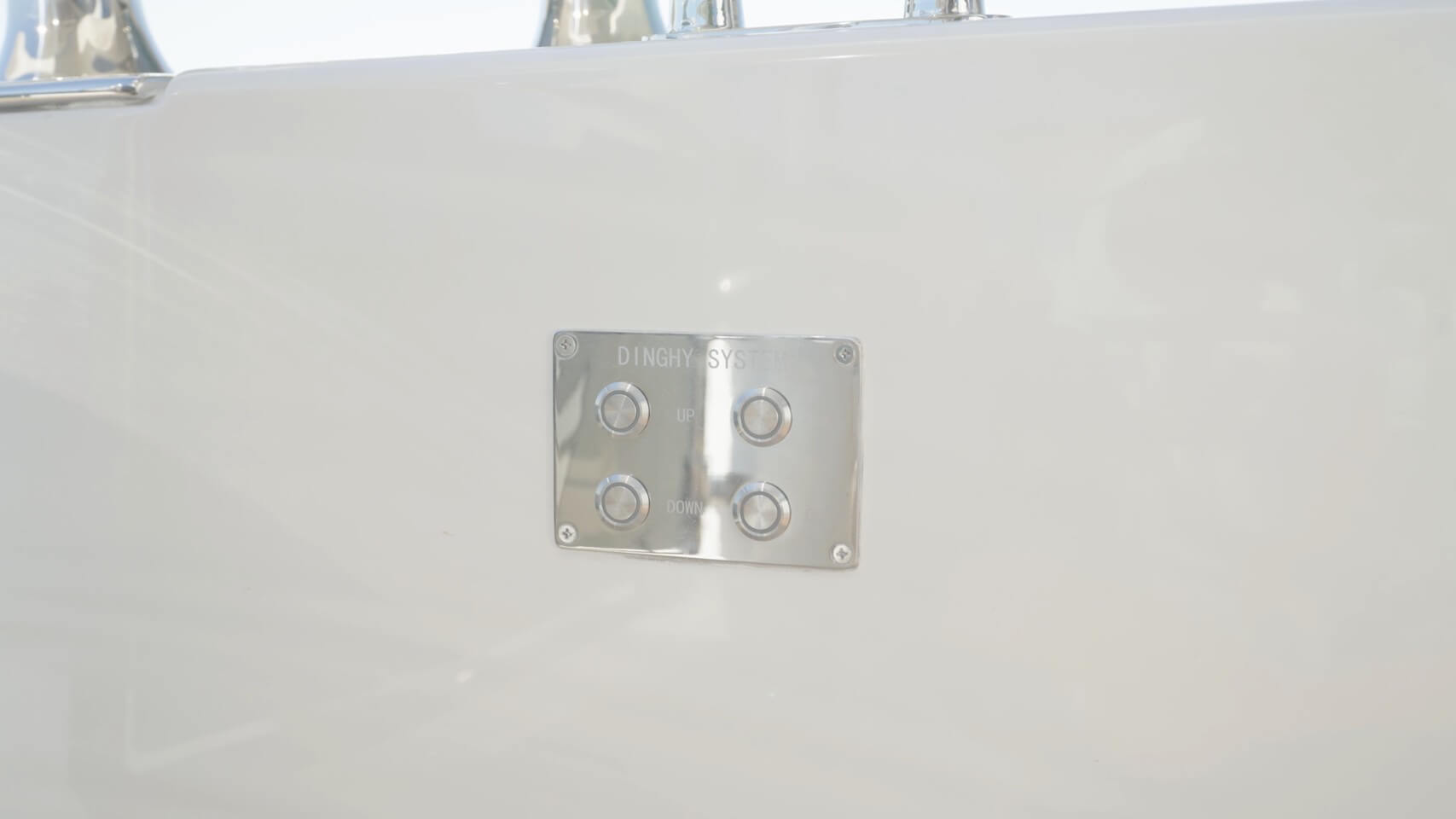
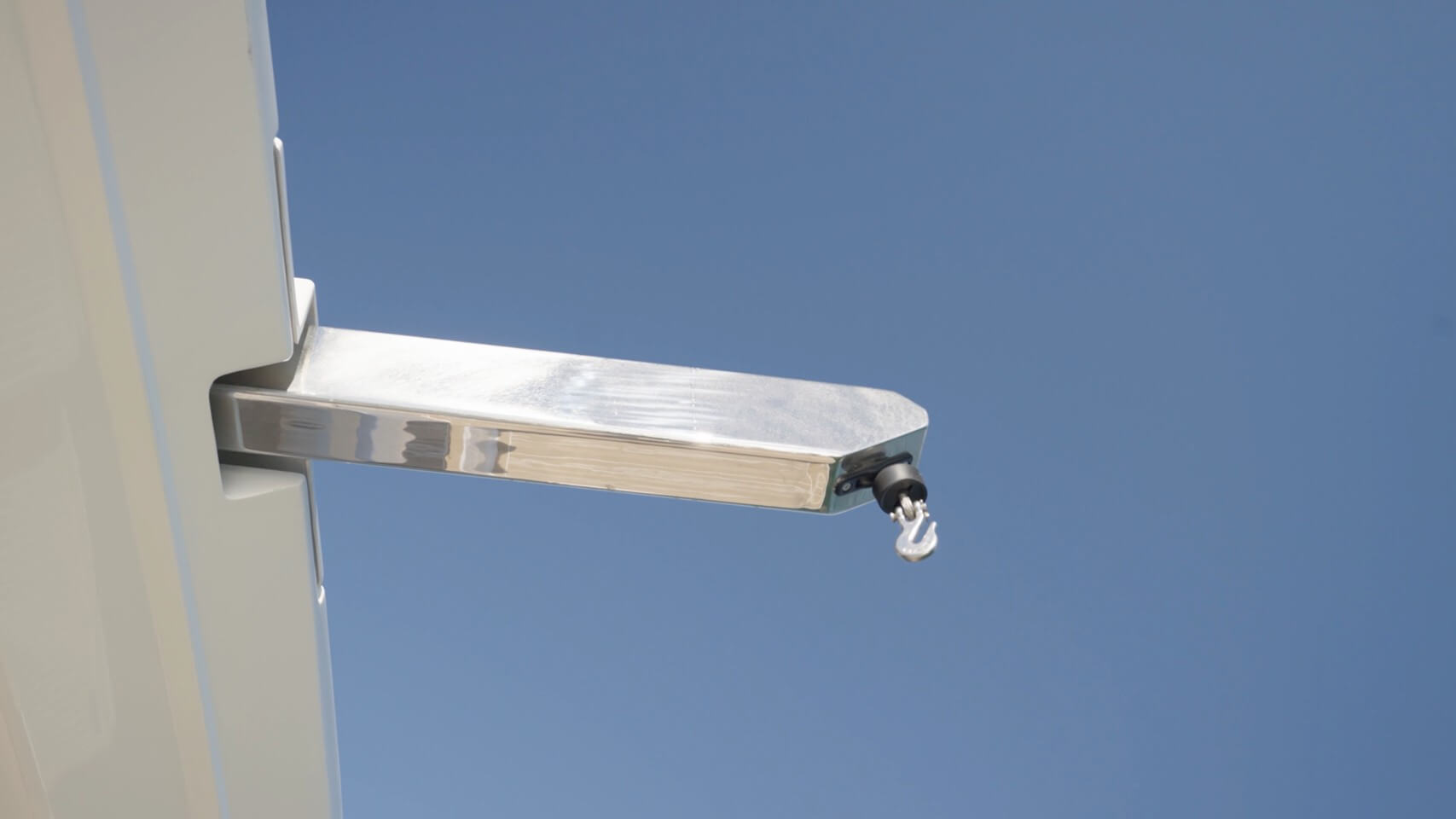
Rated by Captain Tripp for three to four people. No underneath storage — but he clarified this is intentional, not a shortcoming: "There is no storage underneath, but that's not a negative... there's no storage because of Aquila's patented dinghy crane lift system, which will lift the tender on and off of the swim platform that's on the stern."
Aft Stairwell / Cockpit Access
Grab handles and handholds are present throughout the descent to the aft cockpit. Captain Tripp flagged this as a priority safety zone: "This is probably the most important part of the boat where you want these grab handles. It's the easiest place to slip and fall."
Swim platform separation door: Wide opening; Captain Tripp praised the simple one-hand operation: "One hand lifted up, spin it, it drops into place, and this will swing either way."
Swim Platform Steps
Two decent-sized steps lead down. Captain Tripp noted Aquila is adding corner steps in response to customer feedback, though he personally found the existing steps manageable: "For me, my steps, they're really not too bad, but I can understand where someone may want some assistance there."
Step design (dual dock height): The step wraps around fully, intended to work for both fixed docks (using the upper step for elevation) and floating docks (using the bottom step to sit level with the dock).
Swim Platform / Aft Deck
Described as having substantial room for water activities or moving on/off a tender. The center elevated portion is designed to store a tender or PWC, with chocks to secure it. The dinghy crane (mentioned earlier) hangs overhead for loading/unloading water toys.
Swim ladder (port side): Captain Tripp praised the design philosophy: "I've always been impressed with how Aquila does their swim ladders. A lot of times simpler is better, and this is one of those cases." Notes: robust and sturdy construction, dual handrails on either side, and wide treads — "That's gonna make it very comfortable for your feet."
Additional swim platform feature: Pressurized hot and cold freshwater shower, with dinghy crane system controls positioned just forward.
Side Deck / Bow Walkway
Three steps up lead to the walkway. Features a grab handle against the cabin top and a high handrail for security. Hatches along this route bring natural light down into the cabins below.
Design detail: The handrail carries curvature matching the elevated bow shape — Captain Tripp noted this curvature is echoed inside the cabin interior as well: "[It] really gives a bit of elegance to the boat."
Bow
Beam: 23 feet, 3 inches — Captain Tripp noted this delivers "an enormous amount of space" carried all the way forward, being a catamaran.
Forward flybridge access: Provides an additional route to/from the bow, allowing circulation around the entire boat.
Protected hangout area (stepped down, forward): Includes a large storage hatch connecting to an even larger cavernous space beneath, reached via a ladder of undetermined depth. Currently holding fenders, but Captain Tripp noted significant unused capacity: "There's a tell [tale] what you could fit in there."
Bow sun pad: Configurable — backrests lift to form full-length lounges, or the center cushion raises to create opposing seating facing the existing bow seating.
Master cabin windows (beneath bow seat): The seat base beneath these windows is hollow, allowing a sightline through to give occupants of the master cabin a clear view of their surroundings rather than fiberglass. Captain Tripp's assessment: "You're not just looking out at some fiberglass."
Aft Cockpit
Captain Tripp noted the design continues to leverage the boat's beam here: "With all this space and all this beam up top, we know there's gotta be a lot of space down below in the cabins, and there is at the aft cockpit. They continued taking advantage of all this beam."
Table: Very long, with substantial seating capacity — Captain Tripp: "You could almost sit a whole family just on that one side."
Convertible bar top: A push-button-and-latch mechanism opens the area entirely by dropping the bar top into a flush position. Captain Tripp confirmed the sturdiness of this feature directly.
Galley (Aft Cockpit Area)
- Countertop space with an undermount sink and cover (for additional counter space when needed)
- Dedicated storage suited to spirits, plus overhead glass storage
- Microwave overhead
- 110-volt outlet for a blender, positioned under the countertop
- Pullout two-bin trash can beneath the sink
- Cooktop: Currently two-burner on the test boat, but Captain Tripp noted Aquila plans to relocate and upgrade it to a four-burner configuration, which will also free additional countertop and cooking space
- Pullout spice rack in the corner
- Convection oven with a deep drawer below for larger items
- Starboard side: full-size side-opening refrigerator with a drawer freezer beneath
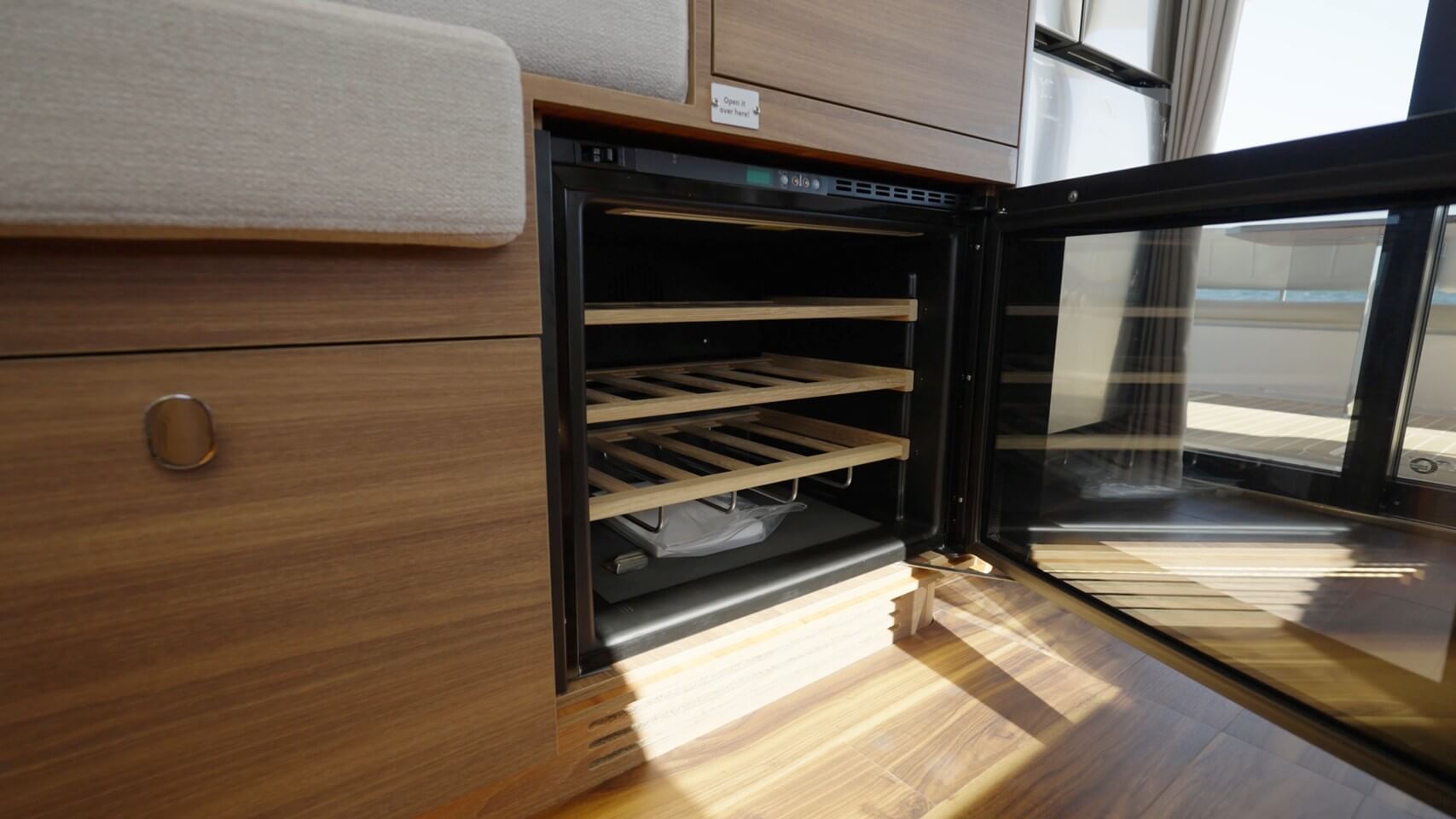
- Deep drawer forward, cut out for wine bottle storage, with an optional wine chiller below (or standard drawer storage as an alternative)
Salon
U-shaped table: Provides indoor dining with full visibility around the boat in poor weather. Captain Tripp noted matching design language here: the "swoop" shape echoes the exterior railing design.
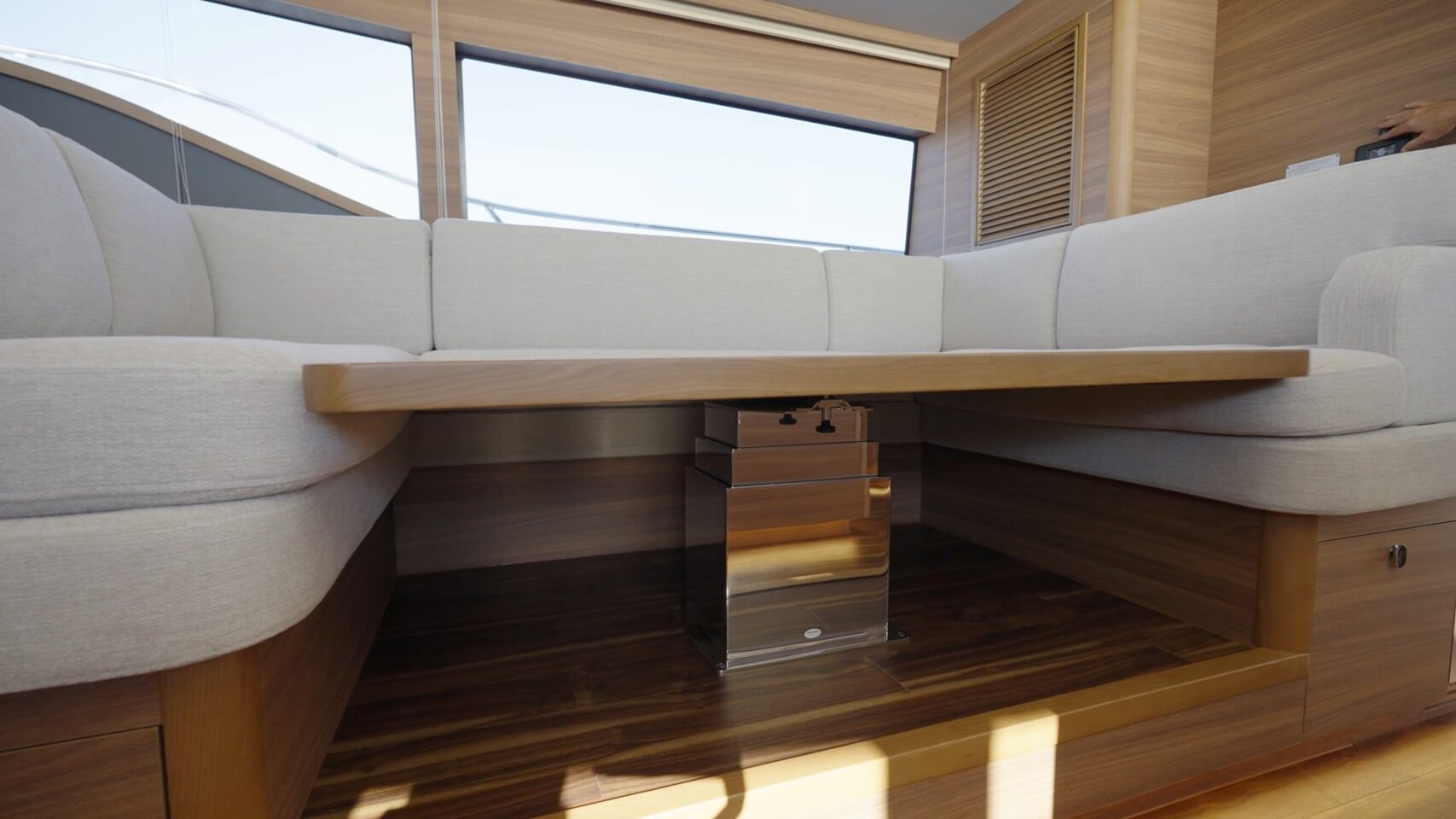
Storage / convertible seating: Storage beneath the seating; this is a high-low table — a button press lowers it, and with an infill cushion added, becomes an additional berth.
Optional interior helm station: This area of the salon can alternatively be outfitted as a second interior helm — covered in more detail, per Captain Tripp, in the companion performance video.
Structural note on the "swoop" design element: Beyond aesthetics, Captain Tripp noted the elevated shape provides additional headroom and interior volume in the cabins below.
Below-Deck Access / Laundry
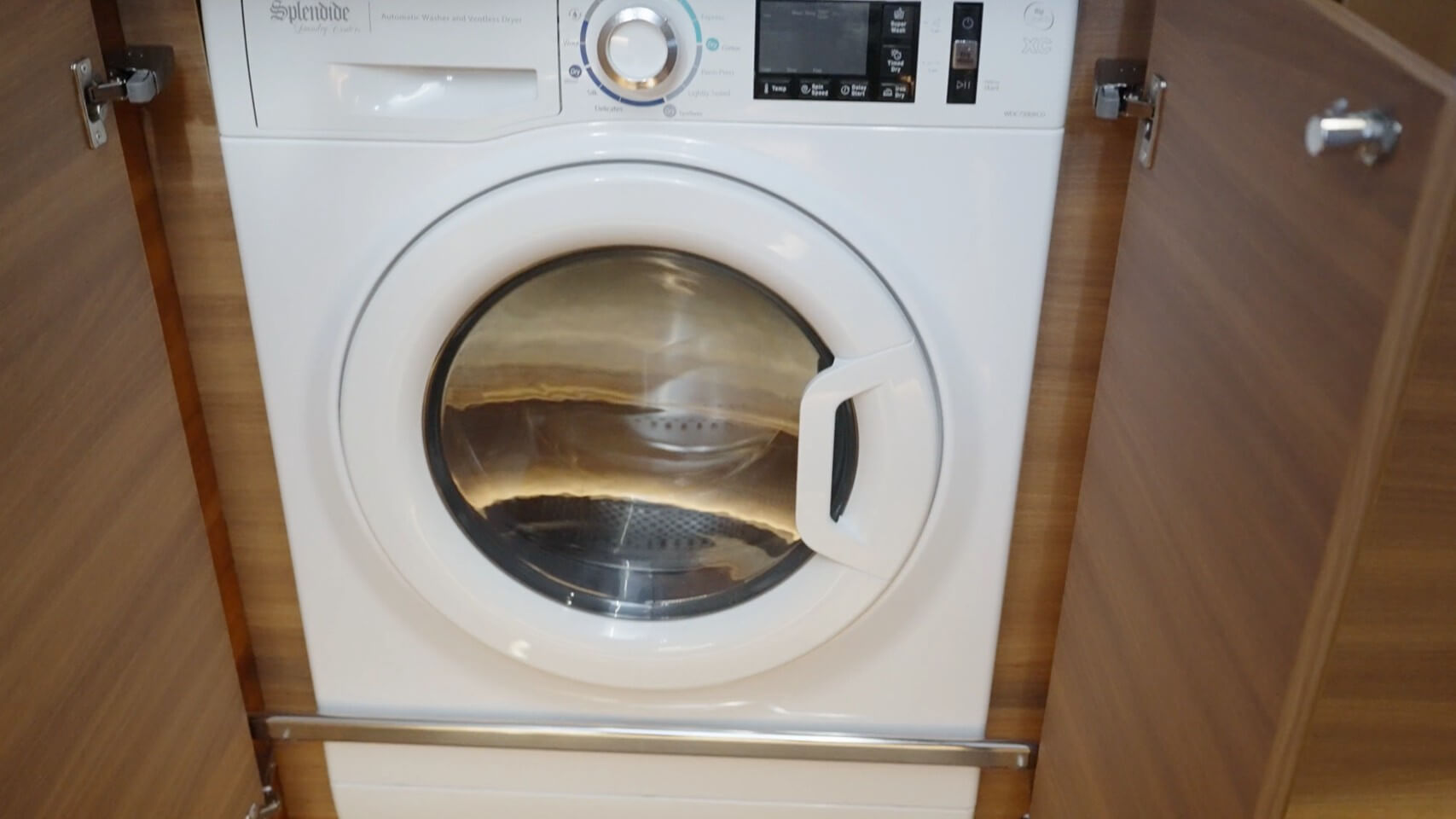
Four steps down lead to the cabin area. Before entering the cabins, a laundry area with a washer/dryer combo and adjacent storage is positioned along this route. Captain Tripp praised the placement: "I like that this isn't tucked away in a cabin somewhere, so if someone needs to access the laundry, they can do so without disturbing anyone."
Starboard Cabin (Three-Cabin Layout)
Substantial space with headroom clearance and natural light via a hull-side window and overhead source.
Features:
- Island berth with full walk-around access
- Individual side tables for each side of the bed
- Reading lights, upholstery, and finish work noted as high quality
- Drop-down overhead TV with a Bluetooth speaker connection for audio/devices
- Cabinet storage above and below, plus additional storage behind the door and under the bed
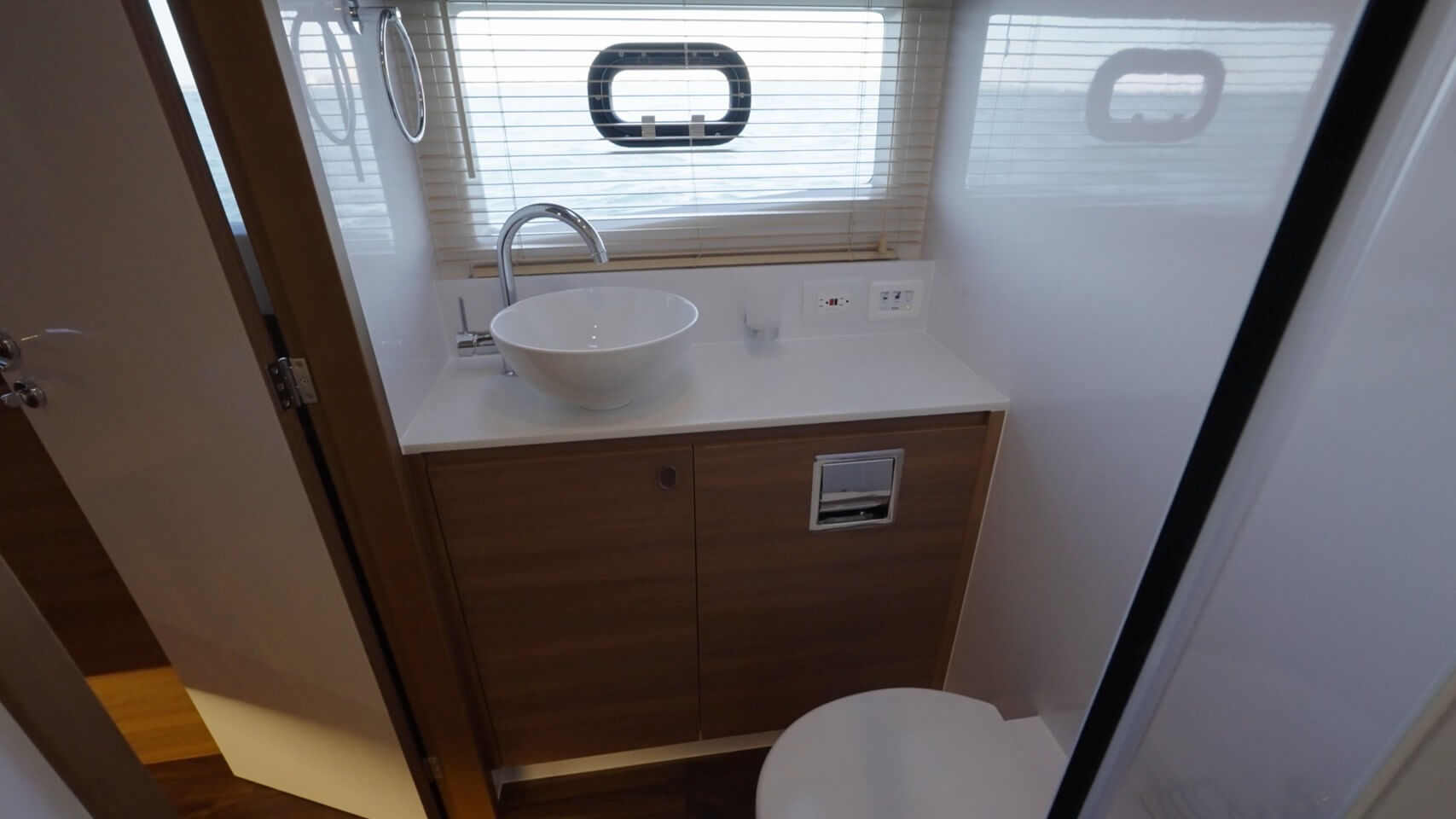
Private head (aft): Vanity with a decent amount of storage, natural lighting via a hull-side window and overhead source, and a dedicated shower — Captain Tripp specifically noted this is not a wet head: "Everyone's gonna appreciate that it's not a wet head. It's a dedicated shower with plenty of space."
Port cabin (three-cabin layout): Essentially a mirror image of the starboard cabin described above.
Master Cabin
Captain Tripp's framing: "Let's go see what everyone's been waiting on."
The master cabin again showcases the boat's 23-foot, 3-inch beam. The elevated bow ("swoop") design provides added openness on both sides of the cabin.
Bed: Large island berth on centerline, with side tables on each side.
Window (previously referenced beneath the bow sun pad): Provides a horizon view from the berth — Captain Tripp confirmed directly: "I can see the horizon just fine."
Vanity/office area (starboard side of master): Described by Captain Tripp as a good spot to get ready, though he personally preferred it as a home office space: large hull-side window for natural light, plus substantial surrounding storage.
Port side (two steps down from main cabin level): Remains open and connected to the main cabin space rather than closed off. Captain Tripp's rationale for valuing this: "I like this because when you're getting ready, you're not confined in a small little room."
Shower: Large hull-side window keeps the occupant visually connected to the surroundings, with a privacy blind available if desired.
Cabin Layout Configurability
Captain Tripp explained the three available configurations directly:
- Three-cabin layout (as toured): includes the home office space described above
- Four-cabin layout: the home office space converts into an additional cabin
- Five-cabin layout: an additional area converts to a cabin, and the center section becomes crew quarters — Captain Tripp noted these crew quarters are generously sized: "Which is something you don't often see."
Closing
Captain Tripp: "Thanks for joining me on this features walkthrough of Aquila's new 46 Yacht. If you wanna see more of the technical aspect and performance of the boat, be sure to check out our performance video."
Related Boats
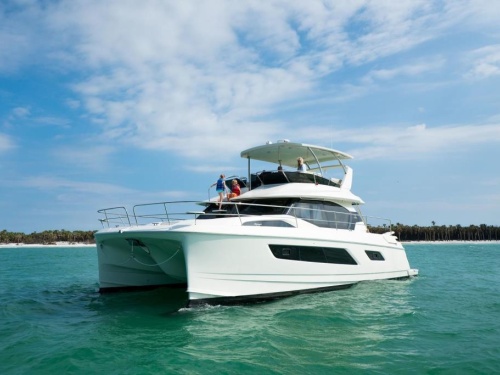
Aquila 44 (2018-)
2 x 300-hp Volvo Penta D4 V-Drive
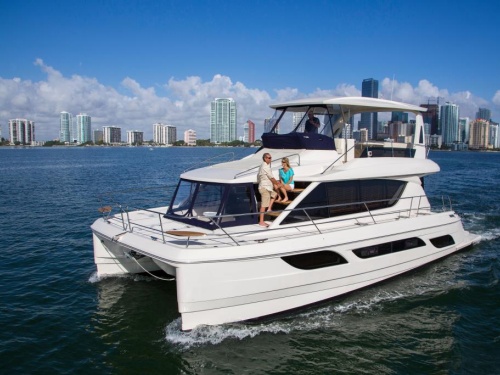
Aquila 48 (2016-)
Currently no test numbers
Aquila 70 Luxury Power Catamaran (2021-)
2 x 1,000-hp Volvo Penta D13
Aquila 54 Yacht Power Catamaran (2021-)
2 x 480-hp Volvo Penta D6