Access More Boat Tests
Already have an account? Login
Aquila 50 Yacht Power Catamaran (2025-)
2 x 380-hp Volvo Penta D6

Brief Summary
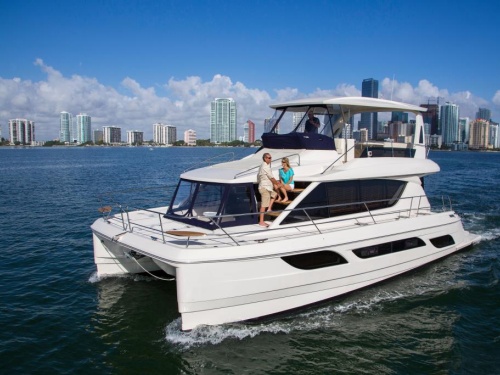
After 40+ years of boat building, and more than a decade-old partnership between Marine Max and Sino Eagle, the Aquila shipyard has positioned itself as one of the premier builders of power cats. The new 50 Power Cat is proof positive the company has indeed, learned something special. Since its stability, comfort, space, maneuverability, fuel efficiency, and well-planned and executed use of both exterior and interior space, is all part of the catamaran profile, the 50 Power Cat is poised to take its well-deserved position as a serious, and enjoyable, cruising yacht.
Test Results
| RPM | MPH | Knots | GPH | MPG | NMPG | SM | NM | dBa |
|---|---|---|---|---|---|---|---|---|
| 600 | 3 | 2.7 | 0.6 | 5.1 | 4.4 | 2369 | 2059 | 53 |
| 750 | 3.9 | 3.4 | 0.8 | 4.9 | 4.3 | 2280 | 1981 | 58 |
| 1000 | 5.4 | 4.7 | 1.7 | 3.3 | 2.8 | 1528 | 1328 | 60 |
| 1250 | 6.7 | 5.8 | 2.7 | 2.5 | 2.1 | 1152 | 1001 | 63 |
| 1500 | 7.9 | 6.9 | 4.2 | 1.9 | 1.7 | 886 | 770 | 67 |
| 1750 | 8.8 | 7.7 | 6.4 | 1.4 | 1.2 | 641 | 557 | 68 |
| 2000 | 10.1 | 8.8 | 9.8 | 1 | 0.9 | 479 | 416 | 69 |
| 2250 | 11.1 | 9.7 | 13.5 | 0.8 | 0.7 | 383 | 333 | 70 |
| 2500 | 11.7 | 10.2 | 18 | 0.6 | 0.6 | 303 | 263 | 73 |
| 2750 | 12.5 | 10.9 | 23 | 0.5 | 0.5 | 254 | 221 | 73 |
| 3000 | 13.5 | 11.7 | 31 | 0.4 | 0.4 | 202 | 176 | 73 |
| 3250 | 18.7 | 16.3 | 36.5 | 0.5 | 0.4 | 239 | 208 | 73 |
| 3500 | 21.8 | 19 | 42 | 0.5 | 0.5 | 242 | 210 | 75 |

Specifications
| Length Overall |
52' 2" 15.9 m |
|---|---|
| Beam |
25' 6" 7.76 m |
| Dry Weight |
50,735 lbs 23,013 kg |
| Draft |
4' 2" 1.26 m |
| Person Capacity | 30 |
| Fuel Capacity |
518 gal 1,964 L |
| Water Capacity |
212 gal 800 L |
Acceleration Times & Conditions
| Props | Michigan 4 4/blade |
|---|---|
| Load | Persons + Gear = 600 lbs (272 kg) | Fuel = 2,648 lbs (1,201 kg) | Water = 834 lbs (378 kg) | Total Load = 4,082 lbs (1,852 kg) |
| Climate | 77°; 69% humidity; wind: east, 10-15 mph; waves: 1-2'; salt |
Engine Options
| Tested Engine |
2 x 480-hp Volvo Penta D6 |
|---|---|
| Std. Power |
2 x 380-hp Volvo Penta D6 |
| Opt. Power |
2 x 480-hp Volvo Penta D6 2 x 550-hp Yanmar |
Purebred Cruising Cat
Captain's Report Aquila 50
by Capt. Ken Kreisler

Major Features
- Standard power includes 2 x 380-hp D6 Volvo Penta direct drive inboards
- Three stateroom/three head layout
- Fiberglass aft cockpit and flybridge tables
- Stainless flybridge supports
- Manual opening hardtop hatches
- Interior finishes in dark or light walnut
- Windows in hull and deck meet ISO standards
- Eight opening deck hatches carefully positioned to enhance ventilation in cabins and thirteen opening portlights installed in hull side windows and forward salon windows
- Forward flybridge access via forward starboard bow steps with built in
stainless steel handrail for safety - Automatic fire suppression heat activated system w/alarm monitors at helm station
- Propeller tunnels for reduced draft and maximum efficiency
- Dedicated aluminum fuel tanks for each engine w/safety shut off valves and level monitors
- Engine room insulation – flame retardant polyurethane foam covered metalized polyester film
- Bulbous bows separately molded and attached to each bow w/breakaway for safety
- FUSION audio system w/Bluetooth and eight Fusion speakers and 4 Zone Sound Control
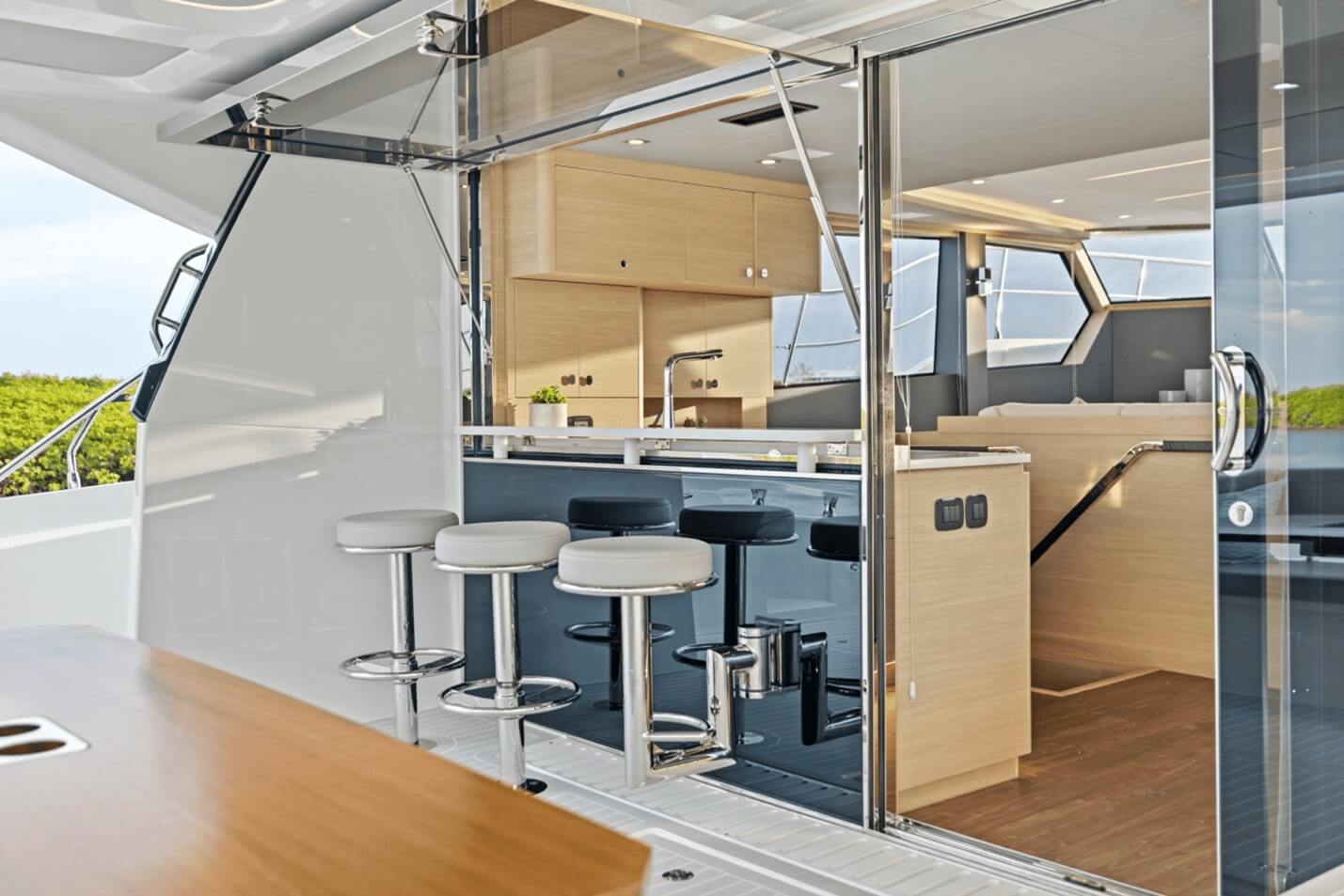
- Aft deck/cockpit bar area with three 316L stainless steel bar stools and large hinged
window to open to galley area
Notable Options
- 2 x 480-hp D6 Volvo Penta direct drive diesel inboards
- 2 x 550-hp Yanmar diesel inboards
- Aquila Hydro Glide Foil System™, only compatible with Yanmar engine option
- Hybrid engine package
- Lower helm station includes 16" Raymarine chart plotter, engine throttle control and display, autopilot control, adjustable captain’s chair, windshield wiper control
- Aquila 14’ Cat RIB sport console tender, electric start with 40HP Mercury outboard, lifting bridle and securing tackle
- Forward starboard hull captain’s cabin
- Over/under bunk beds instead of laundry room
- Individual captain’s pedestal seats at the upper helm
- Port & starboard hull Sliepner E170/250TC-24v bow thrusters w/thruster control at upper helm
- MakeFast electrical retracting canvas shade system integrated into aft section of hard top
- Electrical dinghy crane lifting system with fixed aft platform for dinghy
- Hydraulic aft lifting platform between hulls
- 2 x 116g/440L reserve fuel tanks
- Solar panels on hardtop - 6 x 145w, 2 x 10⁵w, 3 x 100w. Total 1400w
- SeaXchange XTCII 1200 fully automatic water maker @ 189ltr/50gal per hour
- Chilled water air conditioning - V50-50000 BTU
- Upper helm navigation package includes 1 x Raymarine 16" Axiom2 ProS chart plotter with CPT-S transducer / Raymarine I70s multifunction display / Raymarine 63 VHF with Raymic remote station and antennae Raymarine cam300 camera mounted to face aft port onto transom area / Raymarine Evolution Autopilot with P70 Rotary Display. Additional 1 x 16" Axiom2 Pro chart plotter at main helm station, Raymarine Radar - Quantum 2 Q24D Radome 18" color scanner. Additional Raymarine cam300 camera mounted to face aft starboard into transom area
- Choice of 13.5, 16, 18, or 21kW generators w/sound shield, remote control, and fuel transfer pump
Vessel Inspection


With her impressive dimensions, including an LOA of 52’6”/15.99m, and an overall beam measuring 25’6”/7.76m, the Aquila 50’s team of designers and engineers had plenty of room to work with; the result is a cruising yacht providing the kind of space for optimizing entertaining and traveling. And it all starts on the bow.
Bow


Bridge Deck
Again, with her impressive dimensions, especially in the beam, the Aquila 50 has the capacity of provide large entertainment and gathering areas throughout the yacht. And here, on the bridge deck, is a perfect example of how this is accomplished.


Aft Deck
As we’ve seen so far, the Aquila 50 takes full advantage of her dimensions to provide spacious entertaining and gathering spaces aboard. As we have a look at the aft deck area, the promise of things to come is evident.


Main Deck
The opportunities for providing entertainment spaces aboard the Aquila 50 are fully realized on the main deck…and even before entering the area.


Living Accommodations
The Aquila 50 Power Cat can be configured in several ways to accommodate the staterooms and heads. On this boat, we have a three stateroom, three head layout. A four-cabin option is available as is a lower helm forward and to starboard.


Machinery Space
Two hulls mean two separate areas to house all the components that go into not only moving the Aquila 50 Power Cat through the water, but all the other equipment necessary for its safe operation. With plenty of freeboard, each hull has the kind of space for all critical maintenance checks, and in addition if any other work is necessary, provides the kind of space to avoid any knuckle busting, knee scraping, or elbow knocking situations.


A Word About Performance
The Aquila 50 Power Cat has a few advantages over a monohull when it comes to performance. One of them is her impressive beam of 25'6"/7.76 M, and an LOA of 52'2"/15.9 M. Combined, these dimensions, and a draft of 4'2"/1.27M, not only allows for added interior space but also has a positive effect on her performance by allowing air to pass through the hulls and ‘lift’ the boat up slightly thus reducing its wetted footprint as it moves through the water. Add a pair of bulbous bows for dealing with choppy or other conditions which can make for a bumpy ride, while also decreasing drag. Other benefits include improved fuel economy and speed, and a reduction in pitching and rolling. The outcome is having a boat designed to deal with those situations in a positive way.
Our test boat came in at approximately 54,817lbs/24,864.57kg, with 72% of her 518gal/1,960.84l and four people aboard. Conditions that day saw a 10-15 knot wind, cloudy conditions and an air temperature of 77°, a relative humidity of 69%, and a sea state of two feet. She was powered by a pair of Volvo Penta D6 480-hp diesel inboards turning Michigan 4-bladed props. She got up on plane at about 1900 rpm and found our best cruise at about 1600-1700 rpm. And just a word about operating the boat under plane speeds: It’s best to use the sticks to maneuver rather than the wheel and rudder as the big cat responds a bit better. Once up on plane, it's time to grab the wheel.
We recorded a top speed of 20.3 knots at 3680 rpm, and a best cruise of 19 knots at 3500 rpm. At that rate, we calculated a range of about 210 nautical miles with a 10% fuel reserve. And because the hulls are so far apart, successful close quarters maneuvering in and around the dock is the product of a short learning curve.
Conclusion
Aquila engineered and designed the new 50 Power Cat with numerous important things in mind. Among them are comfort, expansive entertaining space both outside and inside, and of course, safety. She presents the kind of overall length and beam allowing for maximum use of bridge, main, and lower deck accommodations, along with lots of storage space, to make for a superb cruising yacht capable of spending extended time away.
Also under consideration were the most economical inboard diesel engines to choose from along with a comprehensive list of standard and must-have optional equipment, this to make your Aquila 50 Power Cat a personal statement of ownership. She can also be equipped with solar panels on the hardtop, a hybrid engine package, and an Aquila Hydro Glide Foil System™, compatible with the Yanmar 550-hp engine option.
There is a lot more to see on this big boat and should you be in the market for a yacht of this type, your time will be well spent by visiting your Aquila dealer and making an appointment for a visit and a sea trial aboard the 50 Power Cat. It will be an eye-opening experience and one that just might change your boating adventures for a long time.

Remember, life is better on a boat!
Features Walkthrough Transcript
Overview
Captain Tripp introduced a key design change on this model: "If you're familiar with their vessels and you look at this boat, you'll notice that it's a little bit different. They have increased the height of the freeboard forward. That has not only made the boat look more aggressive and attractive, but what it has allowed the designers to do is to design in a full-beam, single-level master cabin forward."
Side Deck Access (Wing Access)
Four-and-a-half wing access is available on either side of the cabin top: four 9-inch steps lead up to a 34-inch-wide walkway, bordered by a 28-inch-high rail and a grab rail alongside the cabin top leading forward, followed by one more 9-inch step entering the bow.
Foredeck
Width: 22 feet, 6 inches. Wing depth: 12 feet, 9 inches.
Sun pads: 51 inches by 87 inches, with cup holders and a small side cubby. Both the outer and inner backs lift, creating stadium-style seating — Captain Tripp: "Maybe there's a beautiful sunset or the on-the-water concert, fantastic spot for a large group of people to enjoy themselves."
A hatch here provides access to the master cabin below.
Railing: 28 inches off the deck, running from the bow to the aft deck entry point. Captain Tripp: "28 inches is a lot to keep people on board safely, which is a good thing... it even curves with the lines of the boat to just really fit in and mesh well with this new design."
Forward lounge deck: One step down, 18 inches below the standard deck level, with a 154-inch bench across the bow. This lower section is open beneath, aligning with large master cabin windows just forward — Captain Tripp: "With this being opened under here, the view from the master cabin is exceptional."
Cabin Layout Options
Standard configuration is three cabins, three heads. Optional: a small crew cabin with bunks and a wet head can be installed in the forward compartment.
Additional bow features: Two seats within the railing on either side, cup holders, substantial under-deck storage, courtesy lighting, speakers, and four deck drains to quickly clear any water taken aboard.
Flybridge Access
Sturdy grab rail with three 8-inch steps leading up, then a 19-inch-wide passageway with a closing gate and handrails throughout.
Flybridge
Headroom under hardtop: 6 feet, 11 inches. Features speakers, recessed LED lighting, and a fold-down TV.
Island cabinet (behind helm seat): 51 inches, with three cup holders, countertop, and storage underneath.
L-shaped dinette: 177 inches of seating, with fold-in table leaves providing access to additional grab rails when stowed, or folding out for dining. Four cup holders are built into the wooden table. Storage underneath the seating is finished out — Captain Tripp: "which is a sign of a premium boat."
Flybridge Galley
Countertop: 138 linear inches, described as exceptionally deep.
Features: A proper, deep, usable galley sink; pull-out refrigerator; storage cabinets; 110-volt outlet; ice maker. A grab rail runs the full underside of the countertop. A double electric Kenyon grill is underneath, with two more large storage cabinets and an electrically actuated sunshade.
Flybridge Aft
Rail height: 30 inches. Sun pad: 101 inches by 87 inches — Captain Tripp compared it to "almost the size of a king-size bed."
Descent to Aft Deck
Eight 10.5-inch steps with courtesy lighting; Captain Tripp counted six grab rails along this route.
Aft Deck
Dimensions: 21 feet, 2 inches wide by 8 feet, 6 inches deep. Overhead clearance: 7 feet, 2 inches.
Starboard side: Storage locker under the stairwell. Gunwale height: 30 inches. Freeboard: 79 inches from the top of the gunwale to the water. Large cleat, fairleads for dock lines, and controls for the hydraulic swim platform. Shore power cables on electric Cablemaster reels are located across the walkway.
Boarding Gate / Swim Platform Access
A lockable boarding gate bearing the Aquila logo, grab rails, and a storage locker just inboard. A pop-up cleat is on the swim platform, with a swim ladder concealed beneath a hatch.
Swim ladder detail: Built in-house by Aquila, like all the boat's stainless work and upholstery. Deployment: fold out the bottom steps, slide the ladder out, release the lock to drop it into the water. Captain Tripp noted the design gives "a clean look" when stowed.
Stern (Starboard Swim Platform)
Dimensions: 112 inches by 61 inches. Fitted with brackets for tender or PWC storage. The platform lowers to just above water level for water sports or boarding a tender/PWC.
Davit: Aquila's patented, in-house-built semi-concealed davit system, rated for 1,000-pound capacity.
Port swim platform: Essentially a mirror image, though the ladder hatch can instead be optioned as storage (noodles, water toys) or an additional ladder/pass rail. Port side also houses davit controls, a hot/cold freshwater shower, a freshwater rinse outlet, and a city water inlet.
Aft Deck — Dining / Living Space
Table: 34 by 78 inches, backed by a 114-inch bench along the transom with underneath storage.
Glass enclosure: Opens via gas-assisted struts to connect the aft deck and cabin into one large space. Includes three bar stools with a flip-down bar top; the bar stool bases pivot out of the way to allow a large deck hatch (providing access to mechanical components and dedicated storage) to open.
Galley (Interior)
Starboard: Full-size refrigerator/freezer, adjacent to a 59-inch countertop. Above: the boat's primary electrical panel. Below: two storage drawers and a shelved cabinet.
Ceiling height: 6 feet, 9 inches, with recessed LED lighting, an AC vent, and speakers overhead; upholstered overhead panels contribute to fit and finish.
Countertop (galley): 114 inches, with a convection oven/microwave beneath (dishwasher optional), a drawer, and two cabinets, including dedicated trash bin space. A generously sized, deep sink and an electric induction Kenyon stovetop are also included.
Overhead (galley): Concealed microwave, storage cabinets with shelves, and a small cubby with a fiddle rail for small items.
Salon
Ceiling height steps up approximately 6 inches moving forward, with recessed LED strips overhead and around the edges.
Settee: 175 inches of seating around the space. The table is on an electrically actuated high-low base — lowering it with a filler cushion creates a large berth. A 50-inch TV is positioned forward, with AC vents nearby and extensive windows providing natural light throughout.
Bench (aft of settee): 48 inches, with three cup holders — Captain Tripp noted this as a good spot for guests to gather and stay protected in bad weather.
Starboard VIP Cabin
Stairwell: 24 inches wide. Headroom (VIP): 7 feet, 2 inches.
Berth: Island configuration, 59 inches wide by 77 inches long. Small reading lights and chargers on either side, AC controls, small drawers/storage below, and additional storage access in the headboard. A soundbar accompanies a 46-inch flat-screen TV that electrically lowers from the ceiling and tucks seamlessly into the upholstery when raised.
Windows: Large hull-side window, vented for ventilation.
Vanity: Includes a reading light, outlets and USBs, and a lit jewelry storage compartment within the top, with a mirror.
Storage: 25-inch hanging locker with drawers underneath. A full-size mirror is mounted on the back of the head door.
VIP Head
Shower: Dedicated, 50 by 30 inches, with a small bench and a large hull-side window for natural light.
Vanity: 45 inches wide, vessel sink, backlit mirror along the wall, storage underneath, and a toilet.
Port Cabin
Entryway: 26 inches wide, four steps down.
Berth: Island configuration, 59 by 77 inches — Captain Tripp noted this allows walking fully around the bed for making it or getting in/out. Includes an overhead TV, soundbar, a large hull-side window, and storage throughout.
En suite head: Includes a dedicated shower space (not a wet head).
Storage: 34-inch hanging locker behind the cabin door.
Aft End of Port Cabin — Laundry / Optional Bunk Room
As optioned: a laundry room with countertop space, cabinet storage, a dedicated washer/dryer, and a wine chiller. Alternatively, this space can be configured as a bunk room, relocating the washer/dryer to where the wine chiller sits — trading the wine chiller for bunk space.
Master Cabin (Forward, Full Beam, Single Level)
Access: Nine-inch steps down. Headroom: 6 feet, 9 inches.
Captain Tripp highlighted the signature design feature here: "Now we can see that prominent advantage to the design of this boat, and that is the full-beam, single-level master cabin."
Dimensions: 8 feet, 8 inches fore-and-aft, by 23 feet, 6 inches port-to-starboard — described as "just a gigantic space." Large hull-side windows and the previously noted bow window cutouts allow visibility from standing height; Captain Tripp confirmed he could stand and see the surrounding mangroves at the anchorage.
Walk-in closet (starboard, entering and turning): Floor-to-ceiling mirror leads to a closet with 35 by 51 inches of walking space, hanging space and cubbies on each side, and drawers below.
Vanity: Small, with dedicated jewelry storage, light and mirror (as seen in the VIP cabin), reading light, outlet, and AC vent.
Seating: 105 inches of L-shaped seating under the hull-side windows.
Berth: 73 by 78 inches, flanked by two small vanities with pull-out drawers. Angled upholstery detail along the back end. A skylight overhead provides ventilation and natural light, with recessed LED perimeter and puck lighting. A 50-inch TV with an underneath soundbar is positioned nearby.
Master Head
A peninsula separates the head from the bedroom area, with an optional glazed half-glass divider available for added privacy.
Vanities: One 68 inches wide with cabinet storage; a second, 67 inches wide, with two vessel sinks, overhead storage, a hull-side window, mirrors, additional storage compartments, and cabinets underneath.
Shower: Concealed behind a glazed door — reveals a rain shower head and a wand, a hull-side window with a vent, and a teak floor grate for drainage.
Private head (forward): Additional storage and a ceiling hatch.
Closing
Captain Tripp: "This is only part of the story of the new Aquila. Be sure to see our performance video and discover the speed and range of this compelling cruising catamaran."
Performance Review Transcript
Overview
The Aquila 50 features increased forward freeboard, giving the boat a more aggressive appearance. Its wide beam provides greater stability, spaciousness, and comfort offshore and at anchor. Captain Tripp noted that the beam is approximately 10 feet greater than comparable monohulls.
Engine Room
Access: A large removable hatch, secured with bolts rather than permanent hinges. The hatch can be removed to allow major equipment, including the generator, to be taken out or replaced, and provides access for future repowering.
Equipment: Twin Volvo Penta D6 engines, two large fuel tanks, Kohler generator, hot water heater, generator battery, Fireboy suppression system, and organized, labeled wiring.
Serviceability: Equipment is well spaced rather than tightly packed, providing easier access for maintenance.
Flybridge Helm
Sun lounger: 81 by 51 inches, with two storage compartments underneath and an additional smaller lounge.
Helm seating: Upgraded captain's chairs with bolsters, flip-up armrests, fore-and-aft and vertical adjustment, rotation, and flip-down footrests. Standard configuration is bench seating.
Visibility: 36 inches of clearance through the forward windshield from the seated helm position. Two overhead hatches provide ventilation.
Electronics: Twin 16-inch Raymarine displays, Abacus 360 camera system, Volvo Penta engine display, two additional Raymarine screens, autopilot, depth, Fireboy controls, Fusion audio, spotlight and bow-thruster controls, Optimus steering display, Richie compass, VHF, and Volvo Penta engine controls.
360-degree camera: Combines the surrounding cameras into a single view, providing additional visibility when maneuvering and docking.
Helm Access
The helm is asymmetrical, with foredeck access on the starboard side. Captain Tripp noted that this arrangement makes it easier to move quickly between the helm and foredeck when operating the boat alone.
Test Conditions
- Dimensions: 52 feet, 2 inches LOA; 25 feet, 6 inches beam; 4 feet, 2 inches draft
- Test weight: 54,817 pounds
- Fuel: 518-gallon capacity, with approximately 72% onboard
- Conditions: Four passengers, 10–15 knot wind, approximately 2-foot seas, 77°F, 69% humidity
- Propulsion: Twin Volvo Penta D6 480 engines with Michigan four-blade propellers
Getting on Plane and Handling
The boat was brought onto plane at approximately 18–19 knots, then backed down to 16–17 knots, identified as the most economical and comfortable cruising speed during the test.
At low speeds, Captain Tripp recommended using the control sticks for maneuvering. Once on plane, the wheel provided the best handling.
Performance Numbers
- Top speed: 20.3 knots at 3,680 RPM
- Best cruise: 19 knots at 3,500 RPM, producing 0.5 nautical miles per gallon, with approximately 210 nautical miles of range at a 10% fuel reserve
- Economical cruise: 16.5 knots, at approximately 0.5 nautical miles per gallon
Bulbous Bows
The bulbous bows lengthen the waterline, reduce wave-making resistance and drag, and add forward and lateral buoyancy. The design is intended to improve speed and fuel efficiency while reducing pitching and roll.
Performance comparison: At 3,000 RPM, the boat ran 11.7 knots. At 3,250 RPM, it reached 16.3 knots — a reported 39% increase in speed with only a 17% increase in fuel consumption.
Rough-Water Operation
Captain Tripp reported that, according to operators familiar with the boat, maintaining higher speed in some rough conditions can help the boat ride higher and clear waves and chop rather than allowing them to impact the underside of the bridge deck.
Related Boats
Aquila 70 Luxury Power Catamaran (2021-)
2 x 1,000-hp Volvo Penta D13
Aquila 54 Yacht Power Catamaran (2021-)
2 x 480-hp Volvo Penta D6
Aquila 44 (2018-)
2 x 300-hp Volvo Penta D4 V-Drive
Aquila 48 (2016-)
Currently no test numbers