Access More Boat Tests
Already have an account? Login
Cruisers Yachts 38 VTR EC (2026-)
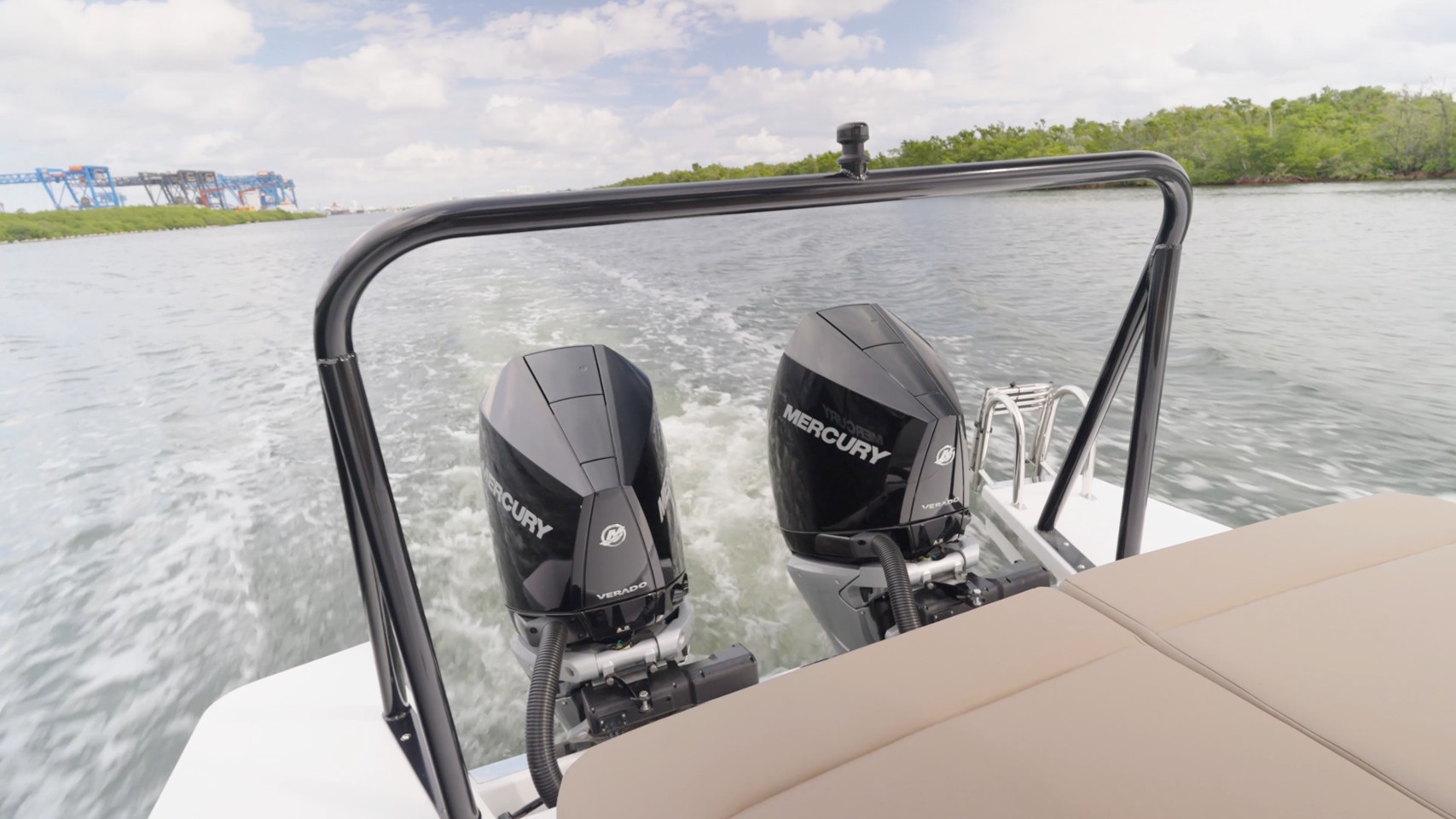
2 x 300-hp Mercury Verado V8

Brief Summary
Cruisers Yachts can trace its heritage back to long before its founding in 1953 in Oconto Wisconsin, and has always been known for its sturdy, American-made styling and amenities. Now, breaking the mold with its VTR Series—for Venture, Trek, Roam—these new models, one with an open deck, the other with an enclosed cockpit, both have modern profiles and plumb bows.
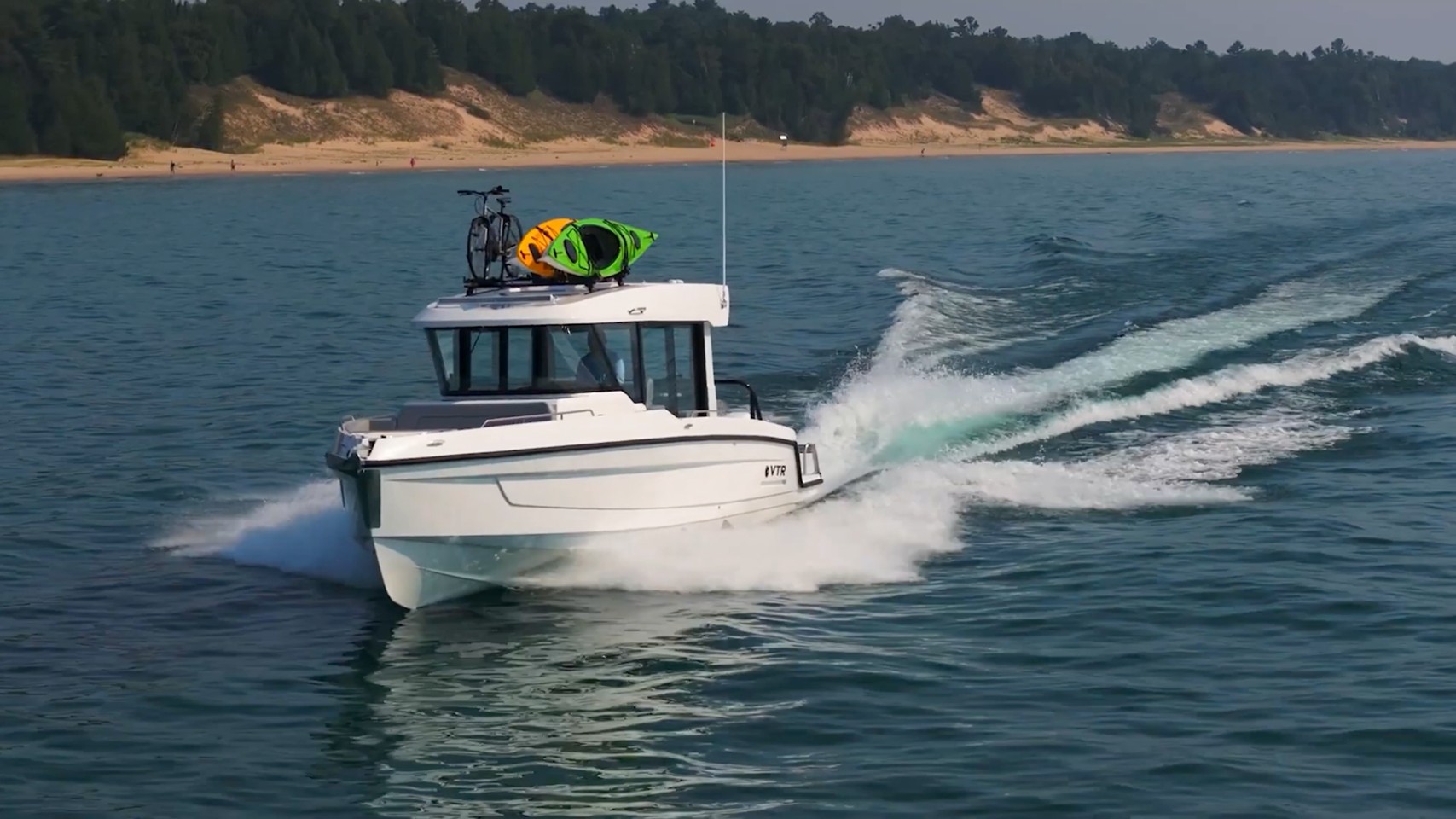
They live up to everything the company’s design and engineering teams wanted when they first put ‘pencil to paper’ in imagining a pair of sisterships that would provide both performance and luxurious features. With its enclosed cockpit, the Cruisers Yachts 38 VTR EC delivers an all-weather pocket cruising yacht with accommodations for four enabling its owners and their guests to enjoy extended time away. The 38 VTR EC is NMMA Certified and Yacht Certified.
Unfortunately, on test day the optimal props were not fitted to the 38. A few days later the techs scored the right props. Test numbers below were provided by Mercury Marine.
Test Results
| RPM | MPH | Knots | GPH | MPG | NMPG | SM | NM | dBa |
|---|---|---|---|---|---|---|---|---|
| 600 | 3.6 | 3.13 | 1.5 | 2.4 | N/A | 528 | N/A | 58 |
| 1000 | 5.8 | 5.04 | 2.9 | 2 | N/A | 440 | N/A | 64 |
| 2000 | 9.6 | 8.34 | 6.7 | 1.43 | N/A | 315.22 | N/A | 68 |
| 2500 | 10.9 | 9.47 | 8.3 | 1.31 | N/A | 288.92 | N/A | 71 |
| 3000 | 14.2 | 12.34 | 12.5 | 1.14 | N/A | 249.92 | N/A | 77 |
| 3500 | 17.6 | 15.29 | 15 | 1.17 | N/A | 258.13 | N/A | 79 |
| 4000 | 26.5 | 23.03 | 22.5 | 1.18 | N/A | 259.11 | N/A | 84 |
| 4500 | 33.4 | 29.5 | 29.5 | 1.13 | N/A | 249.08 | N/A | 85 |
| 5000 | 38.5 | 33.45 | 39.6 | 0.97 | N/A | 213.89 | N/A | 86 |
| 5200 | 39.7 | 34.5 | 40.9 | 0.97 | N/A | 213.55 | N/A | 86 |
| 5400 | 41.5 | 36.06 | 42.8 | 0.97 | N/A | 213.32 | N/A | 86 |
| 5600 | 43.4 | 37.71 | 45 | 0.96 | N/A | 212.18 | N/A | 86 |
| 5800 | 45.1 | 39.19 | 48 | 0.94 | N/A | 206.71 | N/A | 86 |
| 6000 | 46 | 39.97 | 51.2 | 0.9 | N/A | 197.66 | N/A | 87 |
Specifications
| Length Overall |
41' 11" 12.8 m |
|---|---|
| Beam |
11' 10" 3.6 m |
| Dry Weight |
15,446 lbs 7,006 kg |
| Draft Up |
23" 0.58 m |
| Draft Down |
36" 0.92 m |
| Bridge Clearance |
12' 2" 3.7 m |
| Fuel Capacity |
233 gal 882 L |
| Water Capacity |
50 gal 189.3 L |
Engine Options
| Tested Engine |
2 x 300-hp Mercury Verado V8 |
|---|---|
| Std. Power |
2 x 300-hp Mercury Verado V8 |
| Opt. Power |
2 x 400-hp Mercury Verado V10 |
Sibling Rivalry
Captain's Report Cruisers Yachts 38 VTR EC
by Capt. Ken Kreisler
Major Features
- White hull color
- Silver ash interior wood
- Single 9” Simrad display
- Battery charger
- Cabin defroster
- Electric trim tabs
- Fuel overflow recovery system
- Tilt steering wheel
- Electrically operated port beach door
- Fixed cockpit table w/leaf
- Wet bar w/sink
- Electric head w/holding tank
Notable Options
- Twin Mercury Verado 300-hp, black or white, Twin Mercury V10 400-hp, black or white
- Aft seat, Cockpit seating, Sunlounge, Sunlounge w/aft cabin; gray or taupe
- Anchor washdown system
- Mercury joystick piloting system
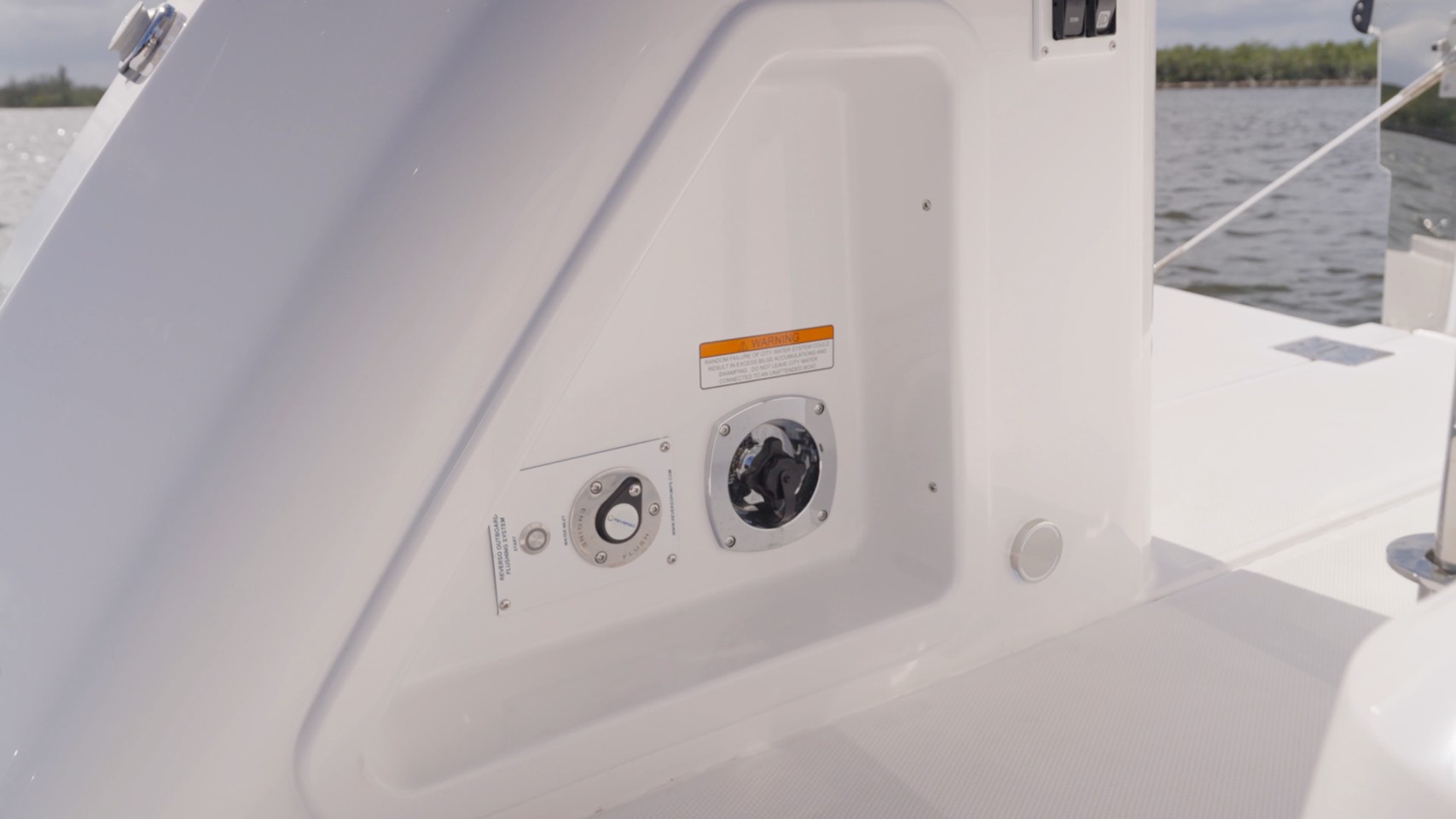
- Reverso engine flush system
- Simrad 15” single or dual Ultrawide displays
- Bow thruster
- Windlass w/galvanized anchor, line and chain
- Air conditioning
- Bow table w/filler cushion
- Tow bar
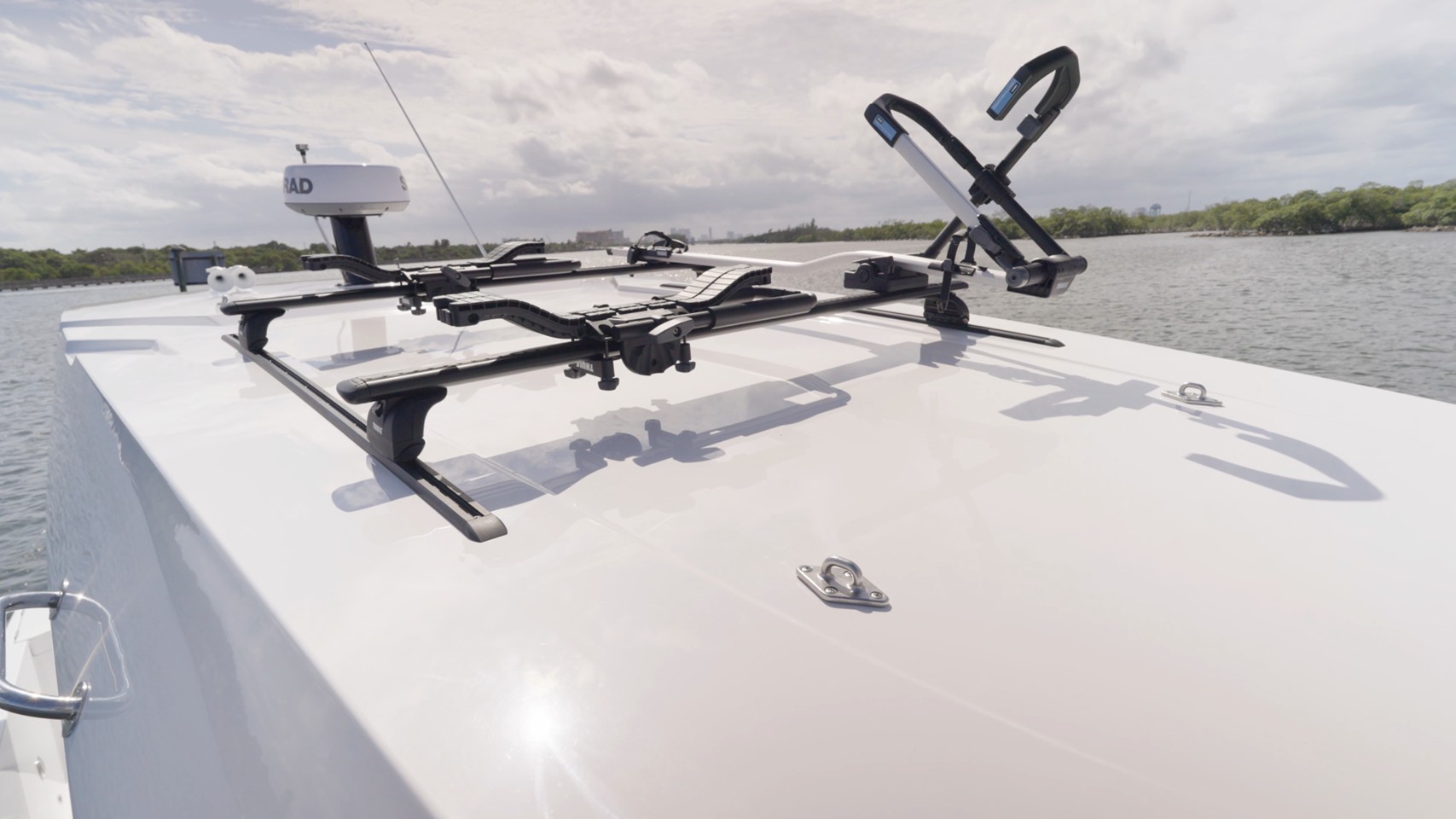
- Thule roof rack
Vessel Inspection
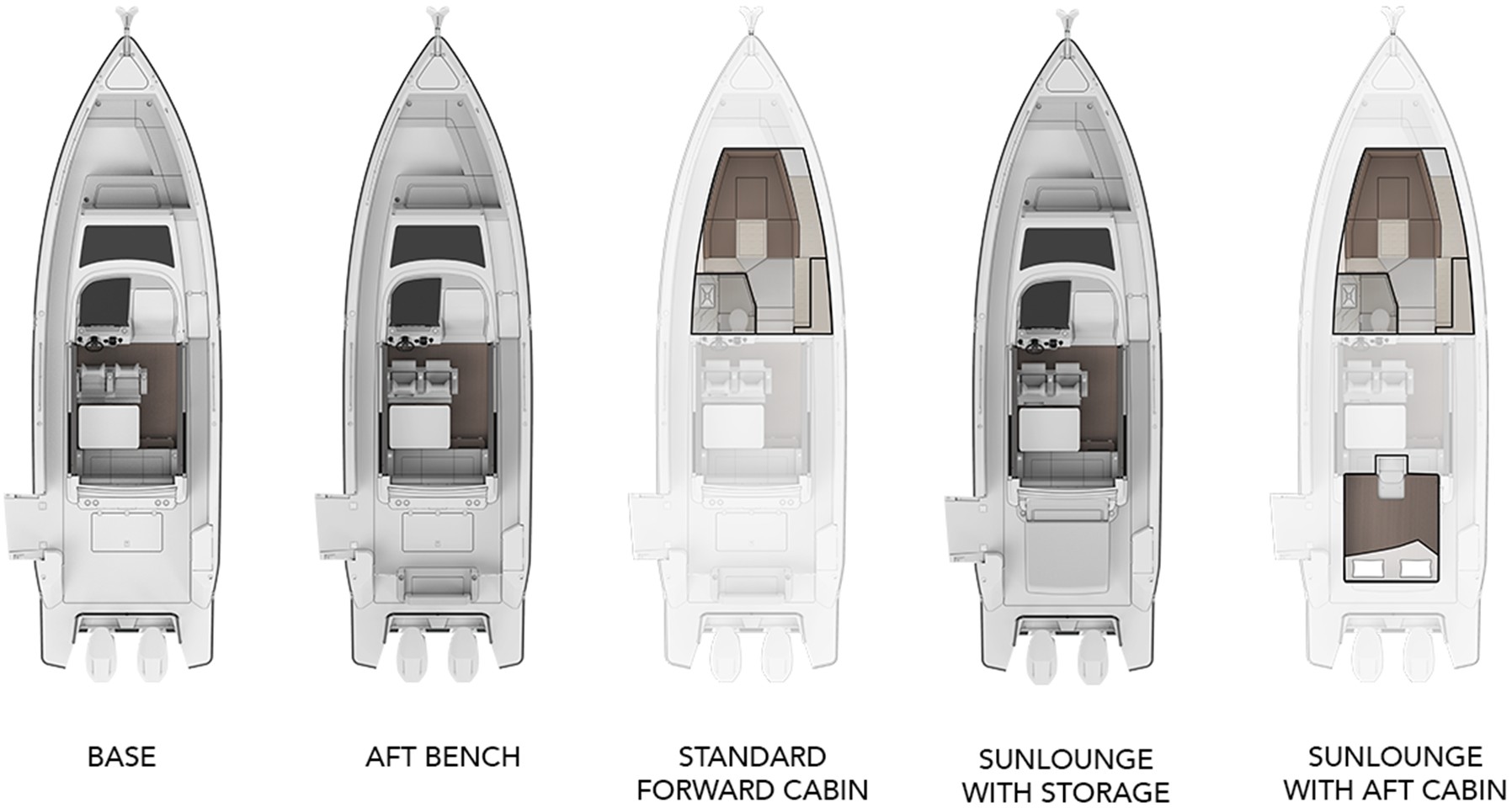
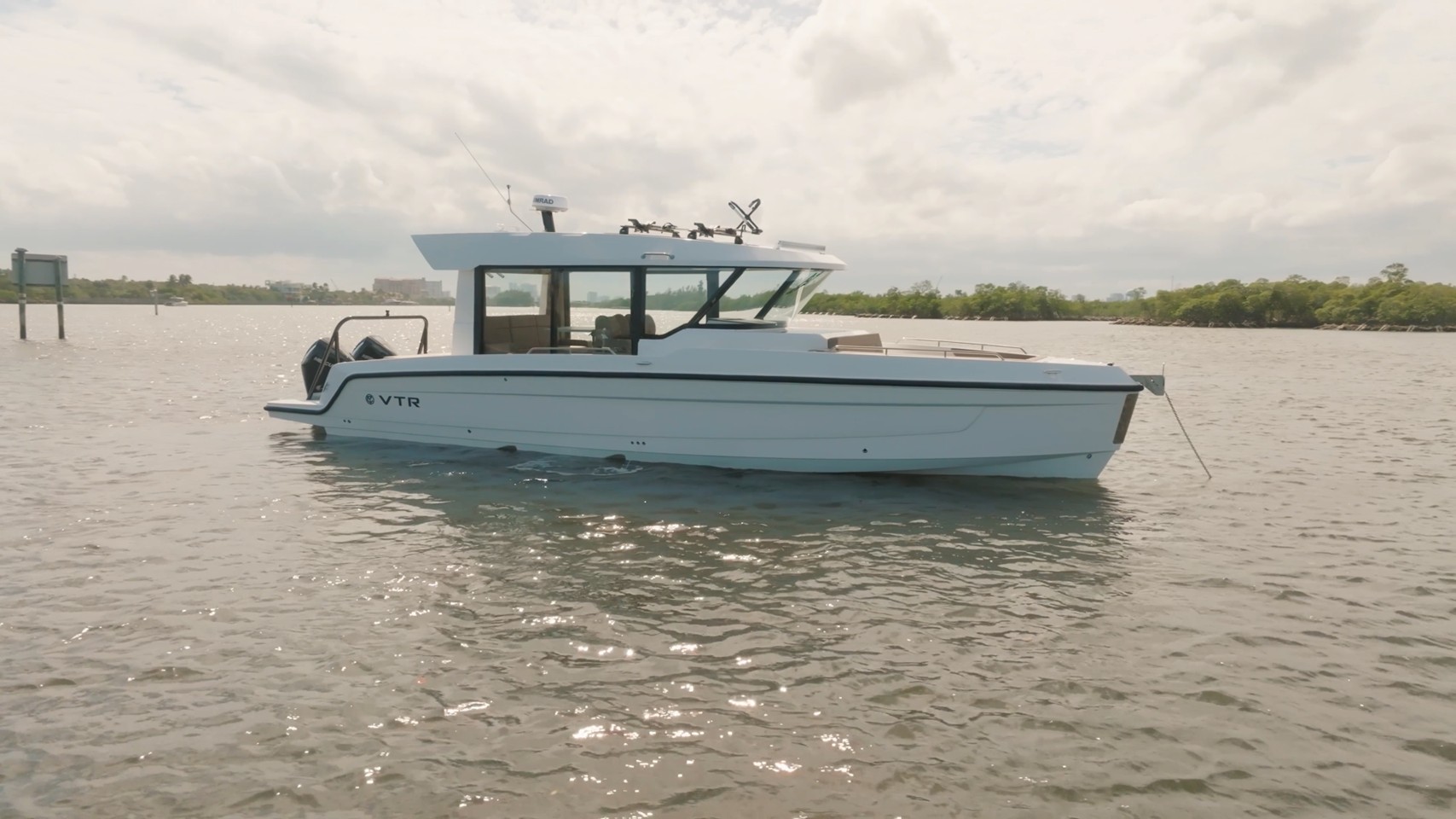
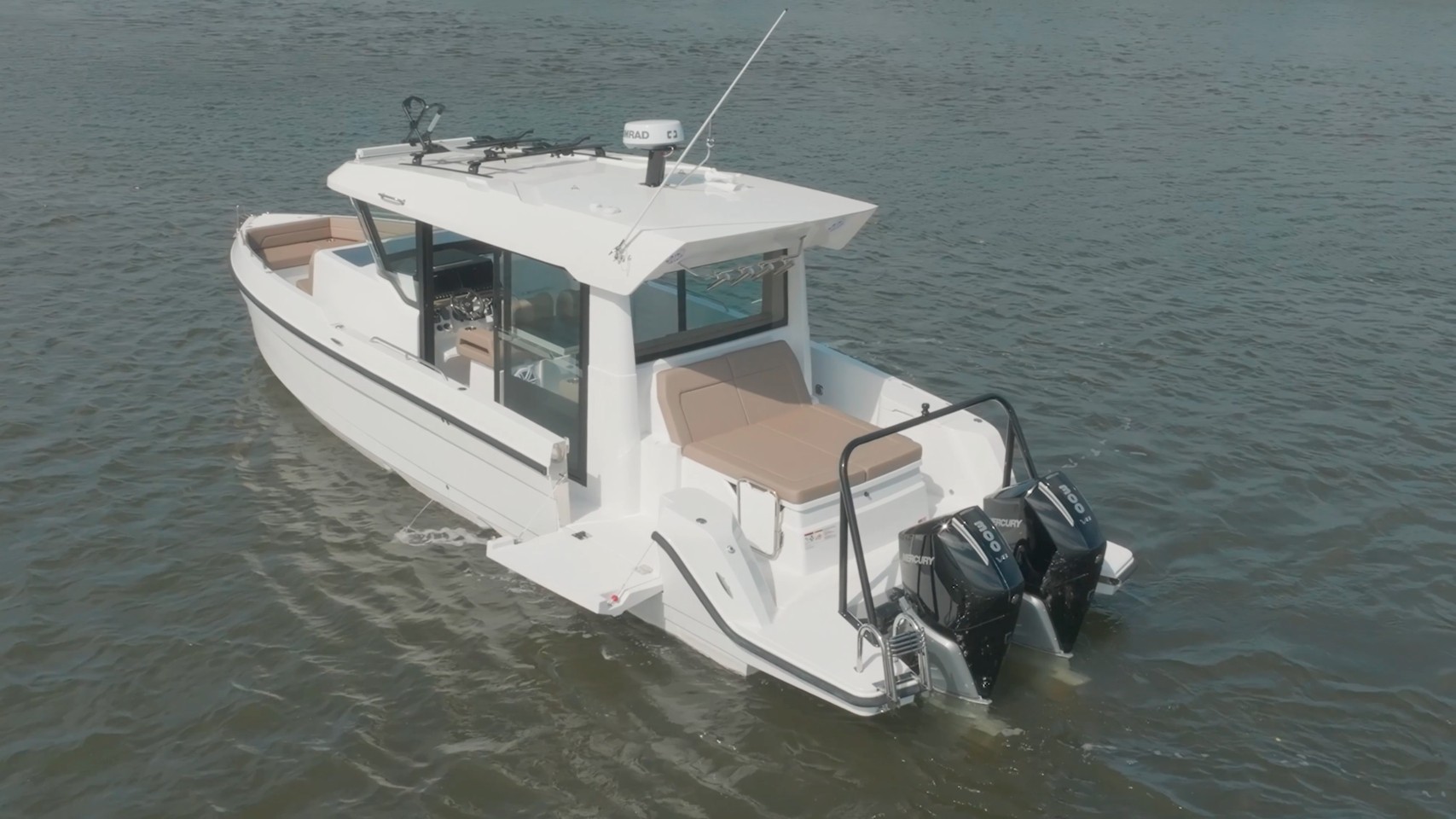
A great part of the appeal of the Cruisers Yachts 38 VTR EC is her versatility as part adventure/cruising boat all wrapped up in one exciting package. Seating abounds from bow to stern in addition to a choice of four layouts building on the base boat. From left to right, the Base layout offers wide open deck spaces while the Aft Bench provides access to the swim platform for your water enthusiasts. The Sunlounge layout presents an aft-facing bench with another choice of an aft-cabin beneath the deck lounge. The Beach Door to port is standard on all layouts.
Bow
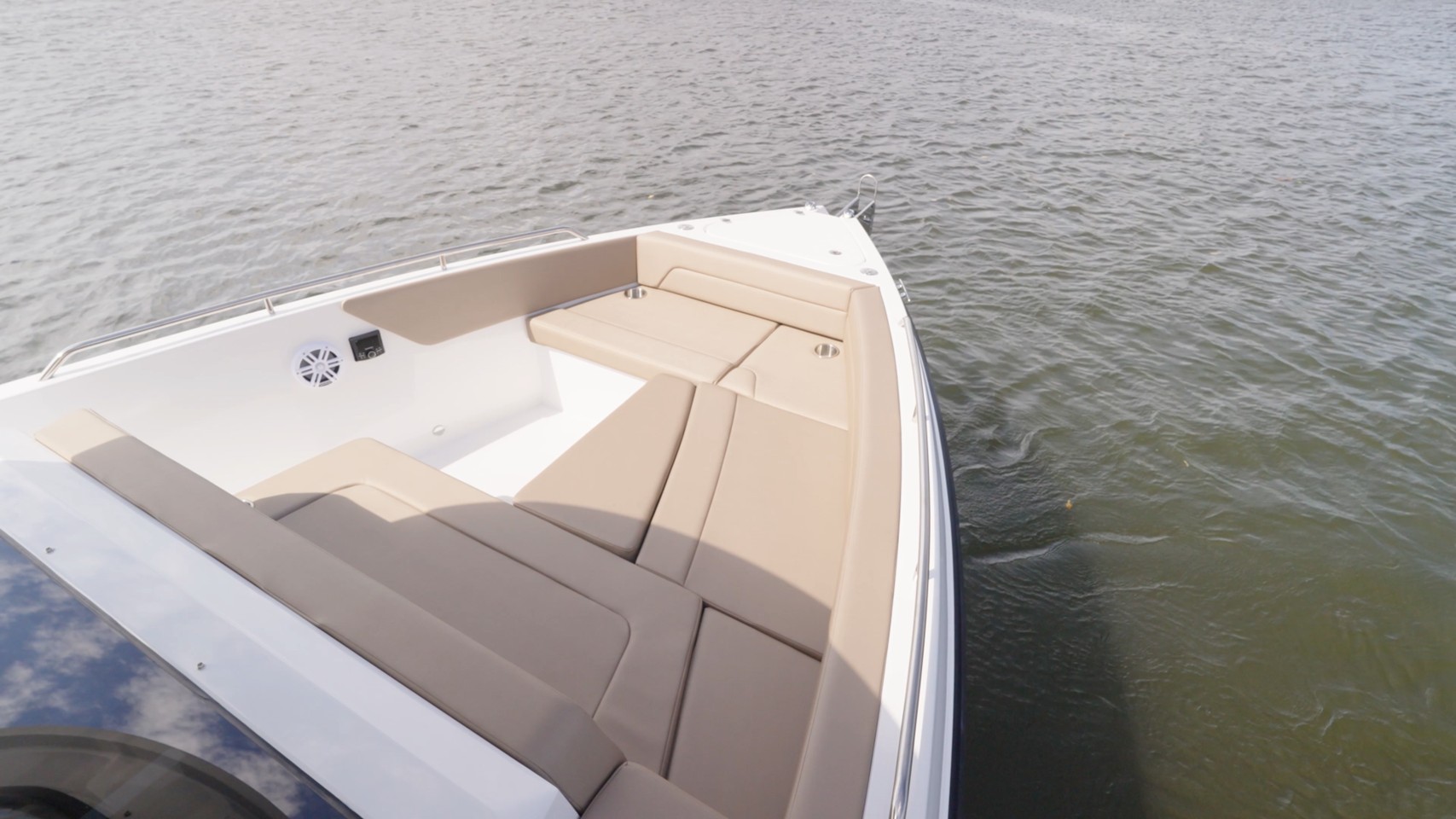
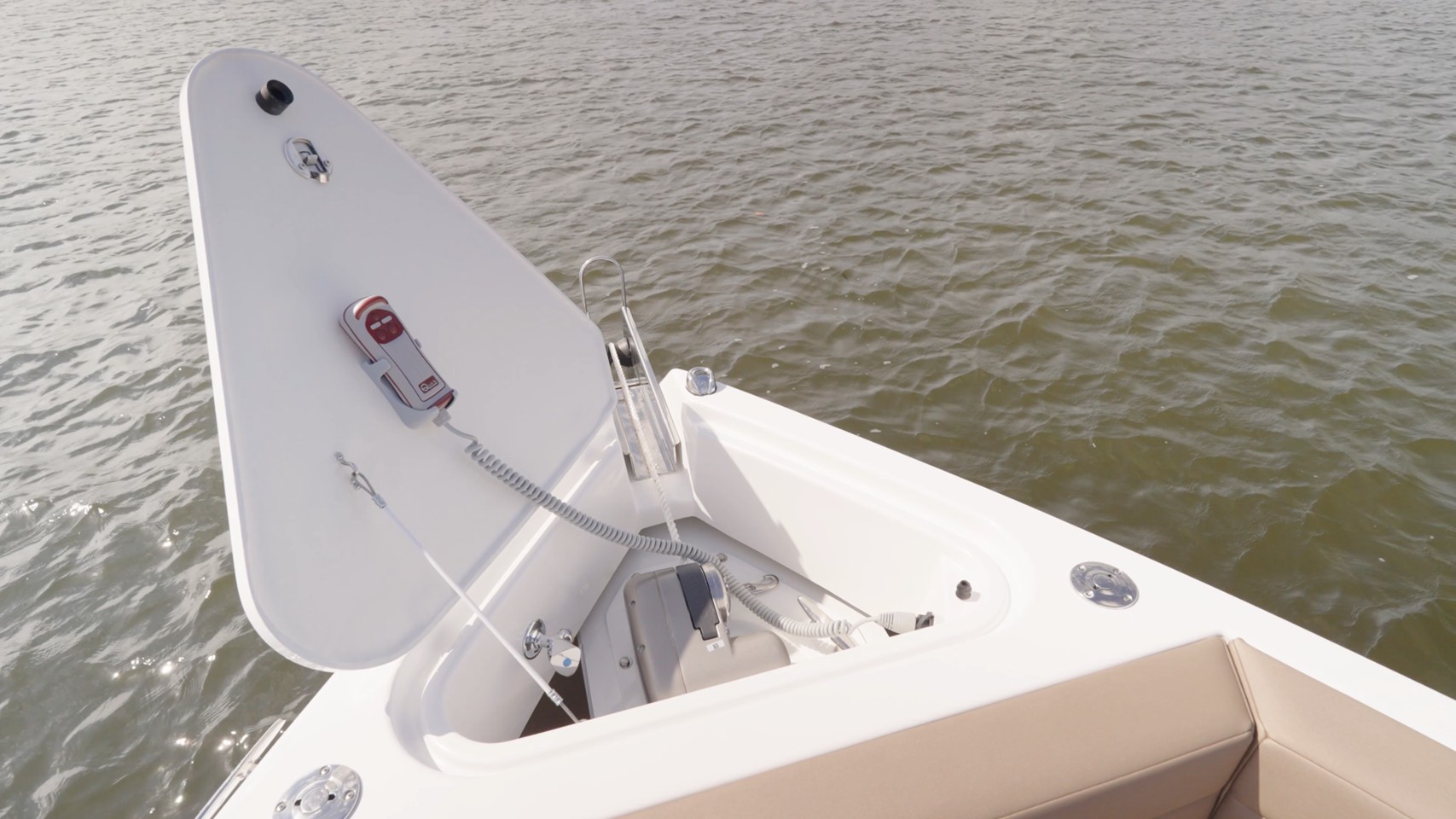
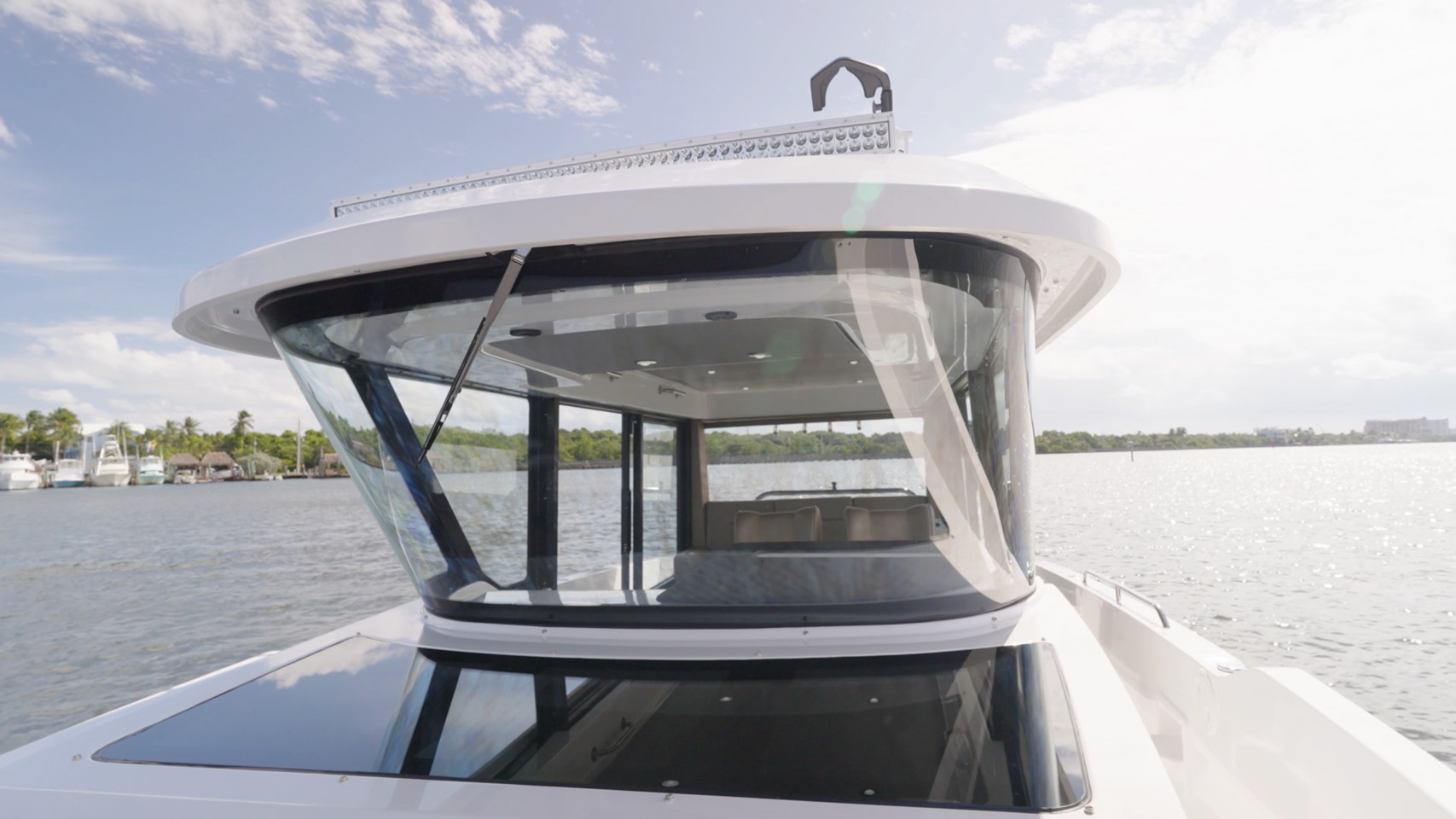
Resourcefulness has a place aboard the Cruisers Yachts 38 VTR EC and it begins in the bow.
Helm
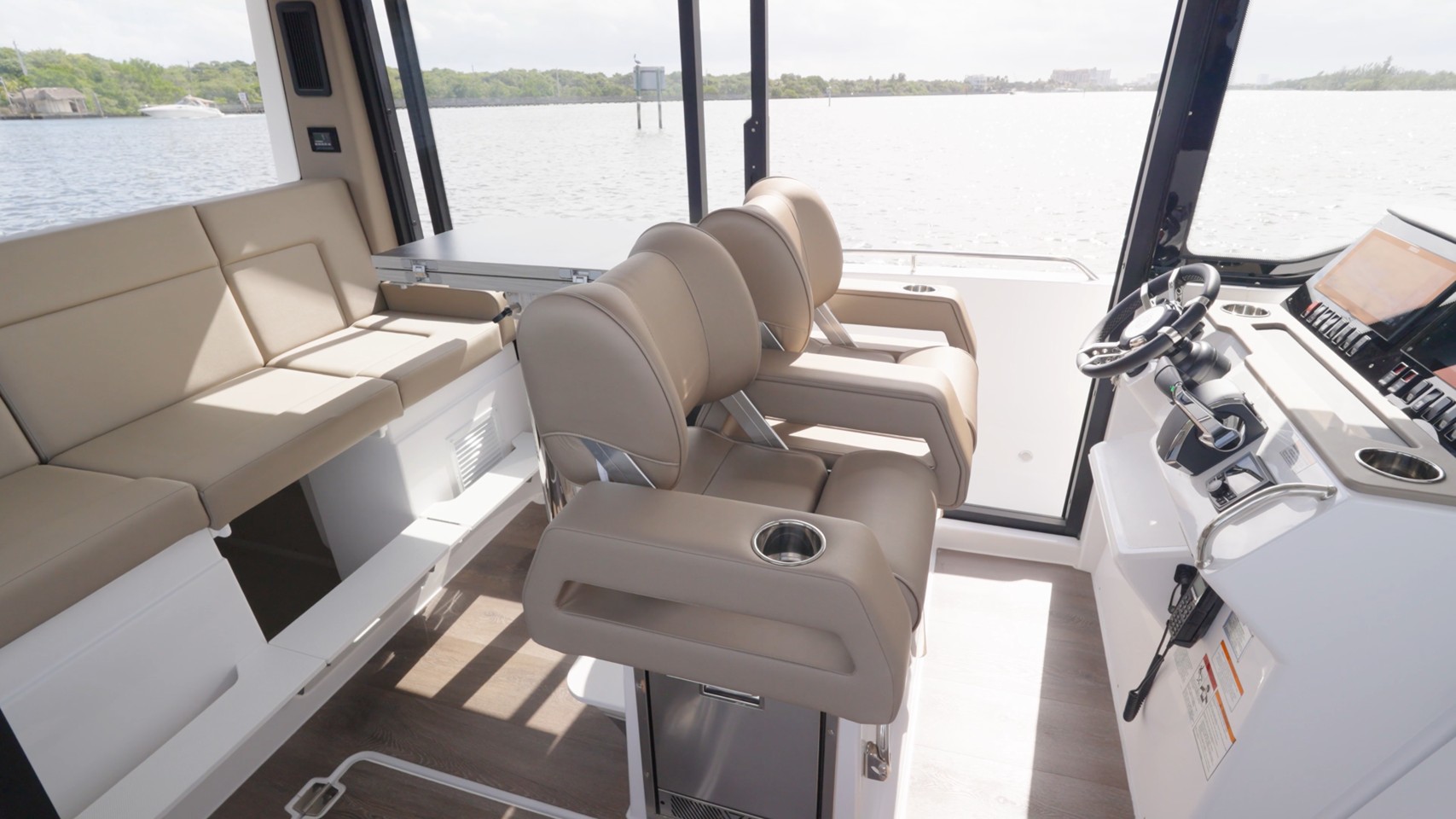
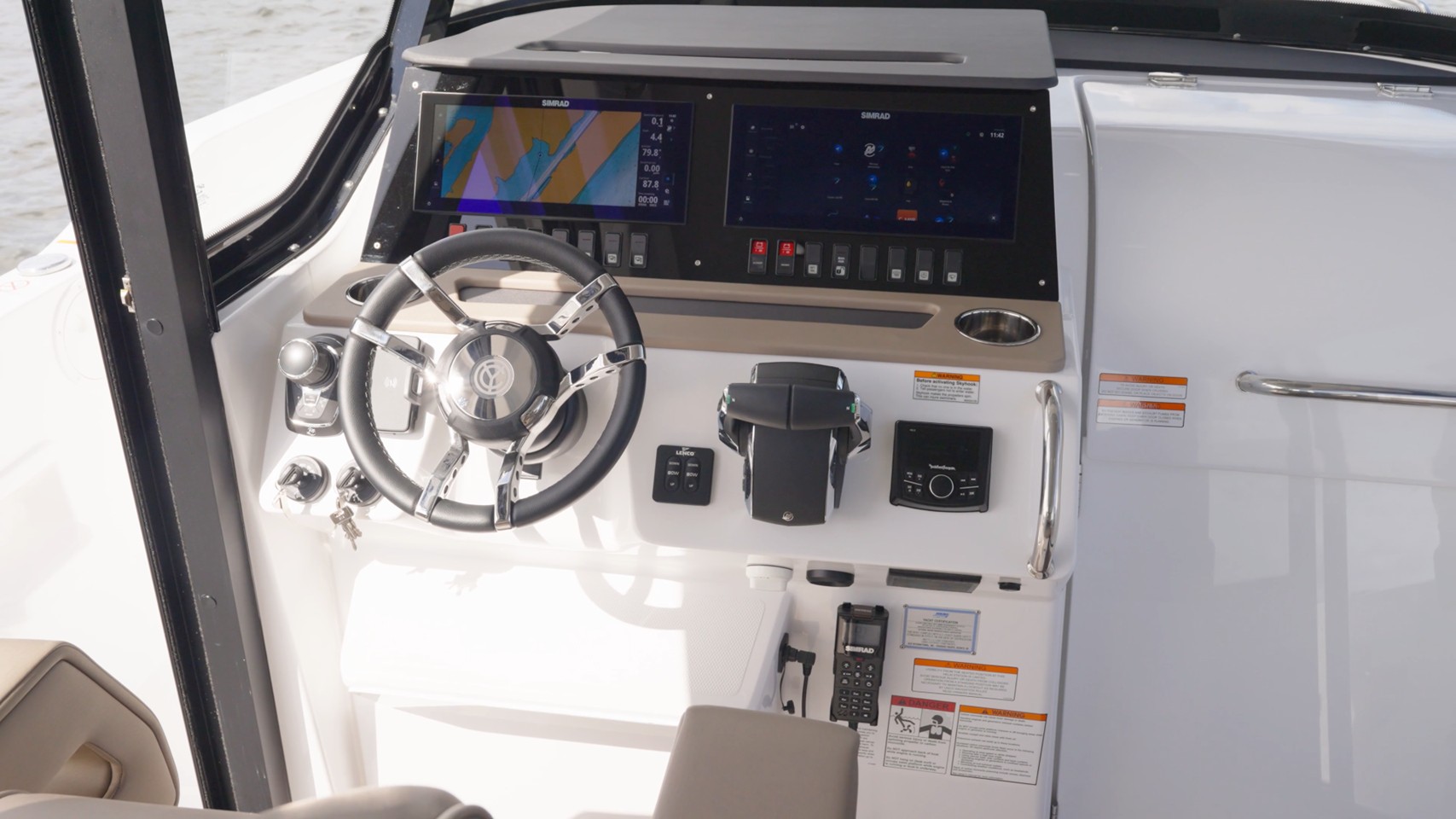
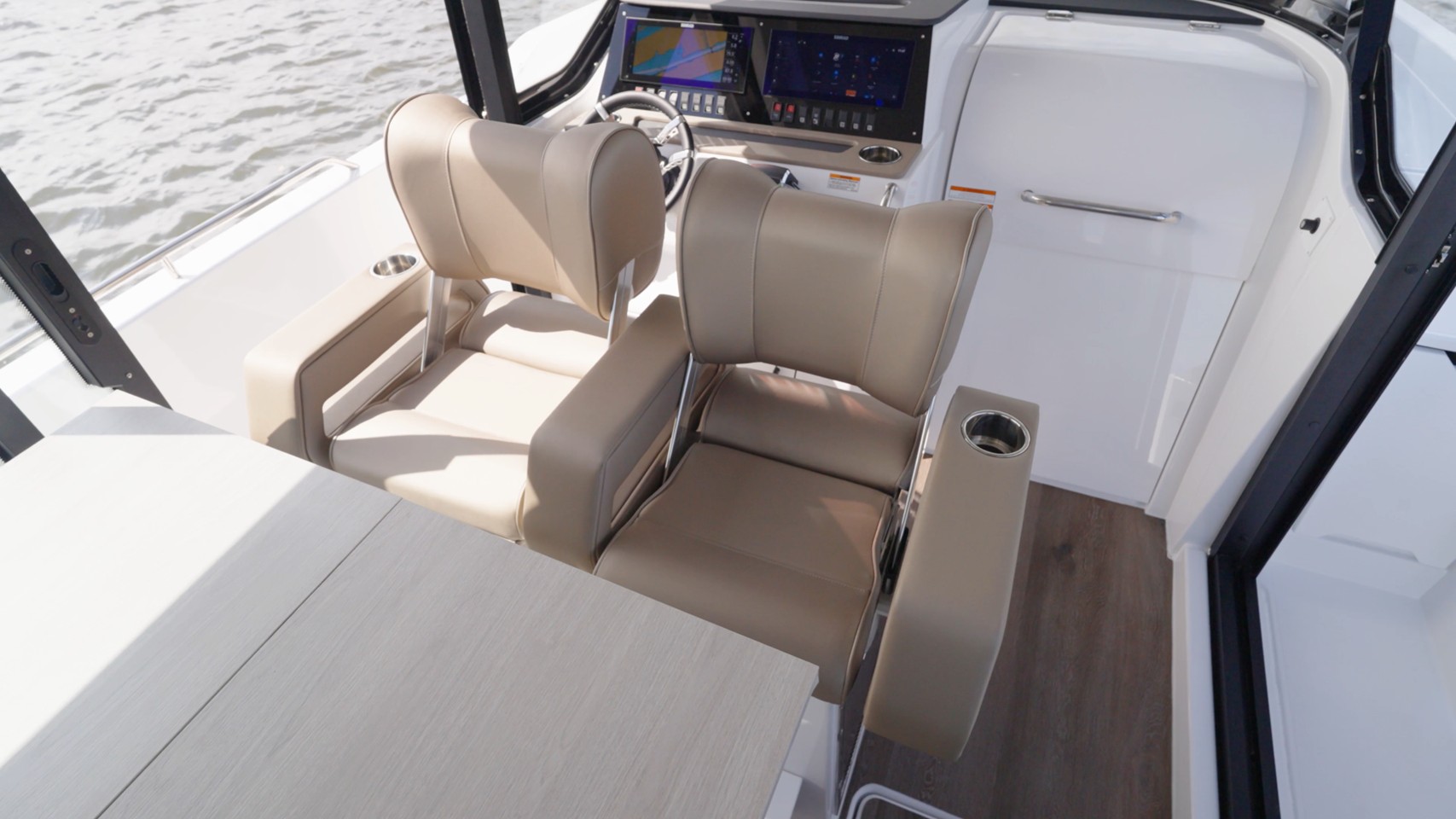
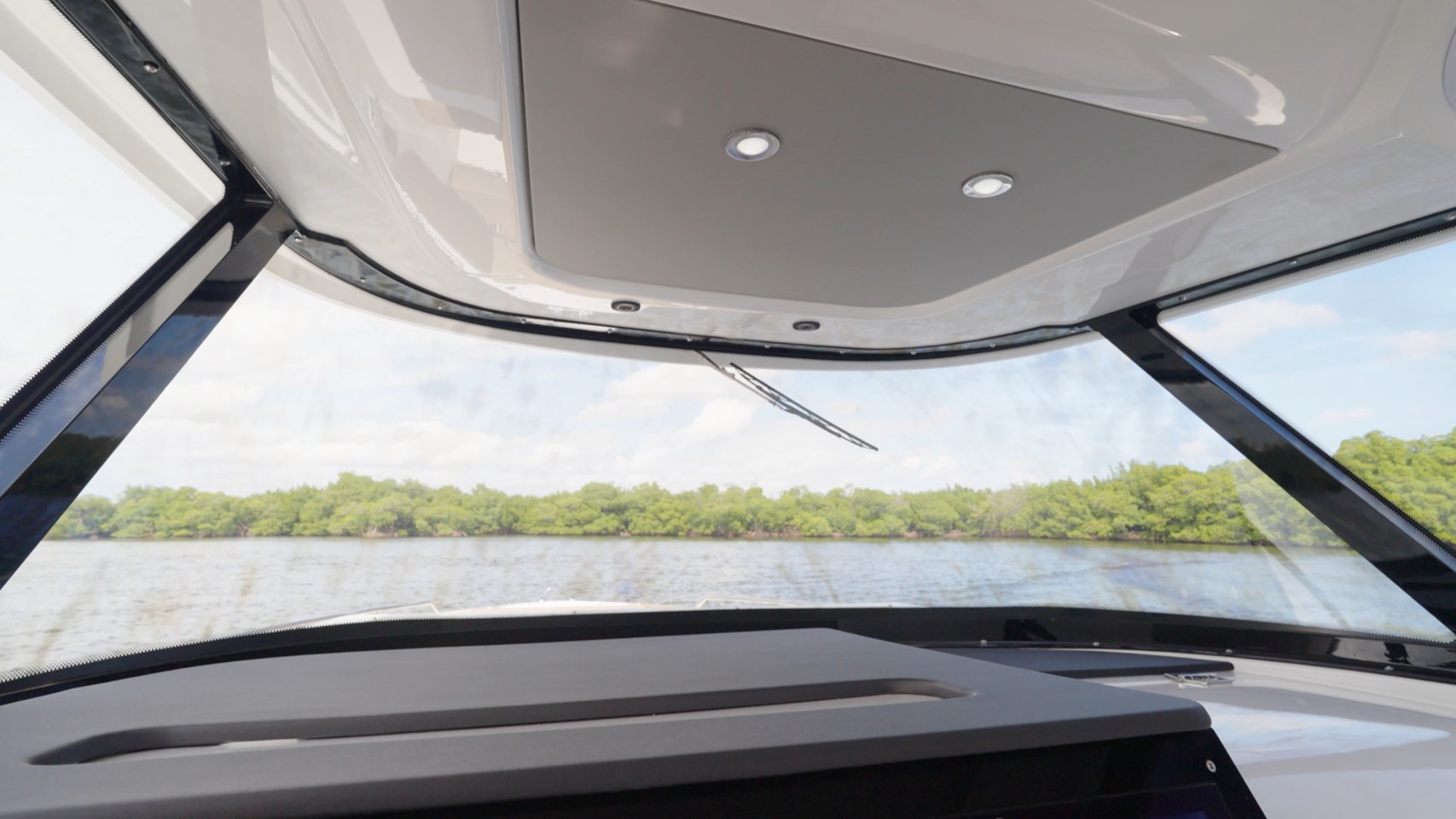
Accessed from either side of the enclosed cockpit via sliding glass doors, the helm is situated to port and with the surrounding large glass windows, excellent views are afforded of the seaway all around.
Forward Quarters
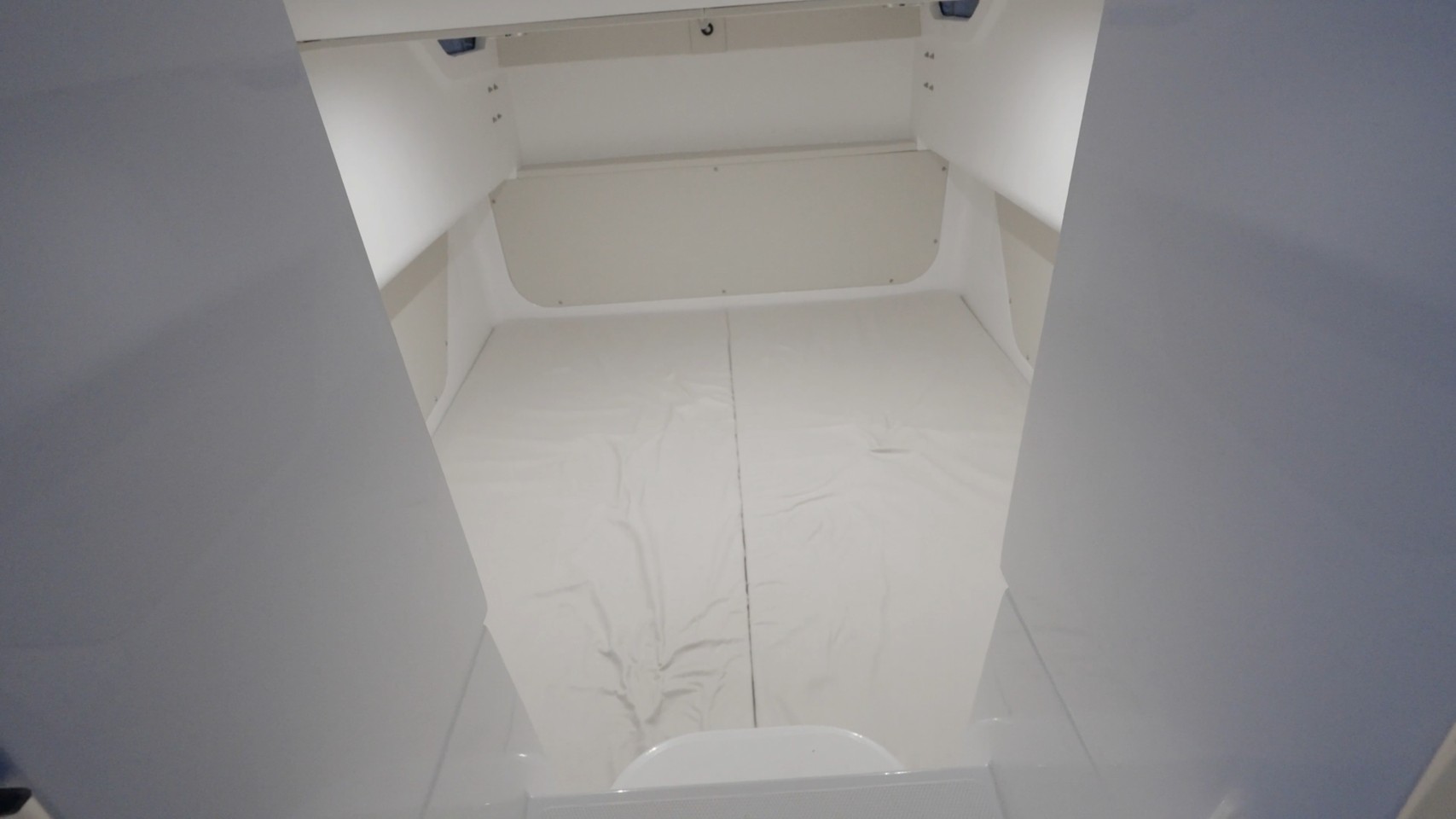
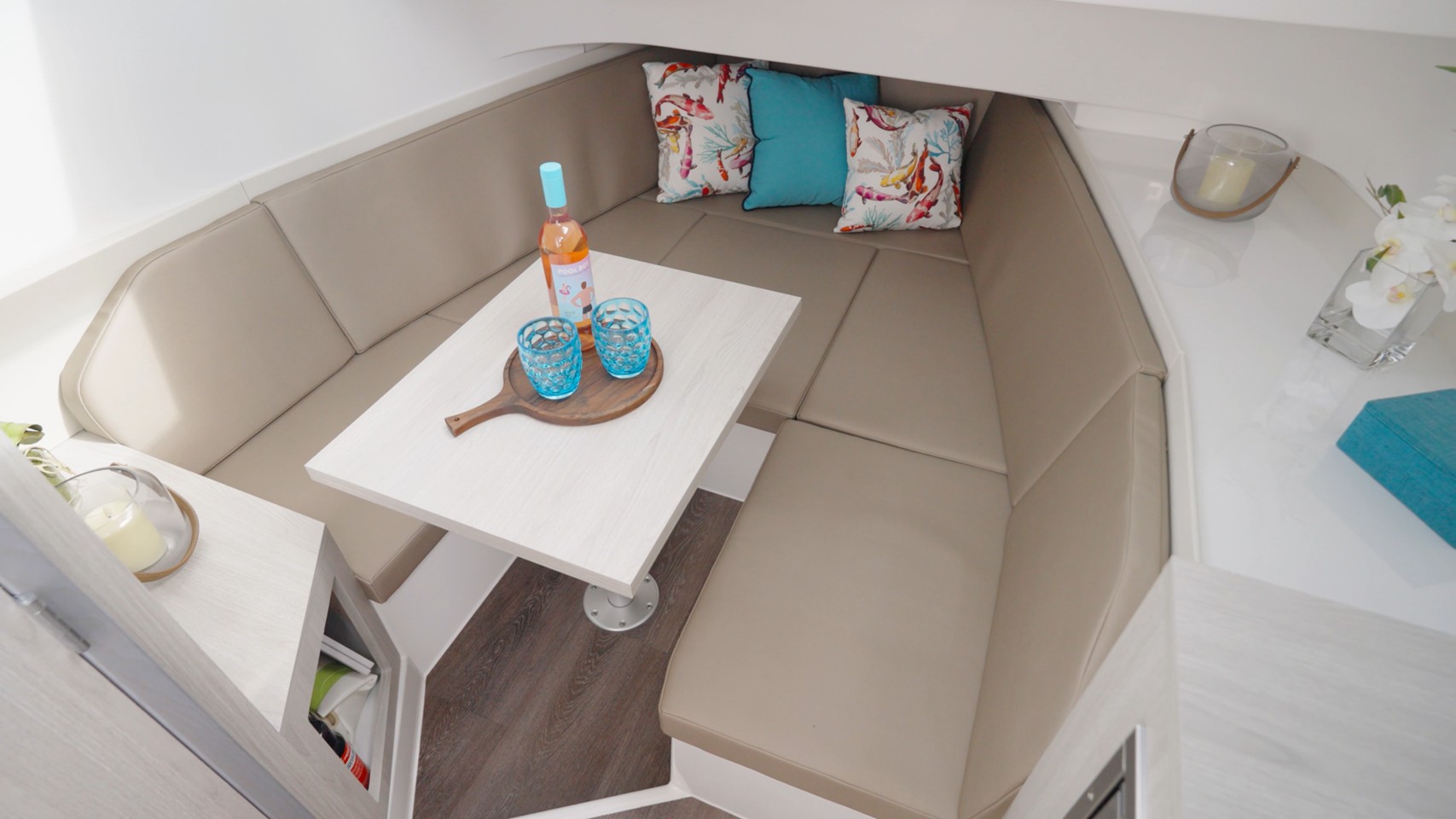
The Cruisers Yachts 38 VTR EC can easily sleep four and with her all-weather profile, can provide extended time away from home regardless of changing weather while traveling.
Aft Section
Providing addition useful space was a priority abord the Cruisers Yachts 38 VTR EC and to that end, with optional configurations available, an owner can layout the space according to individual needs.
A Word About Performance
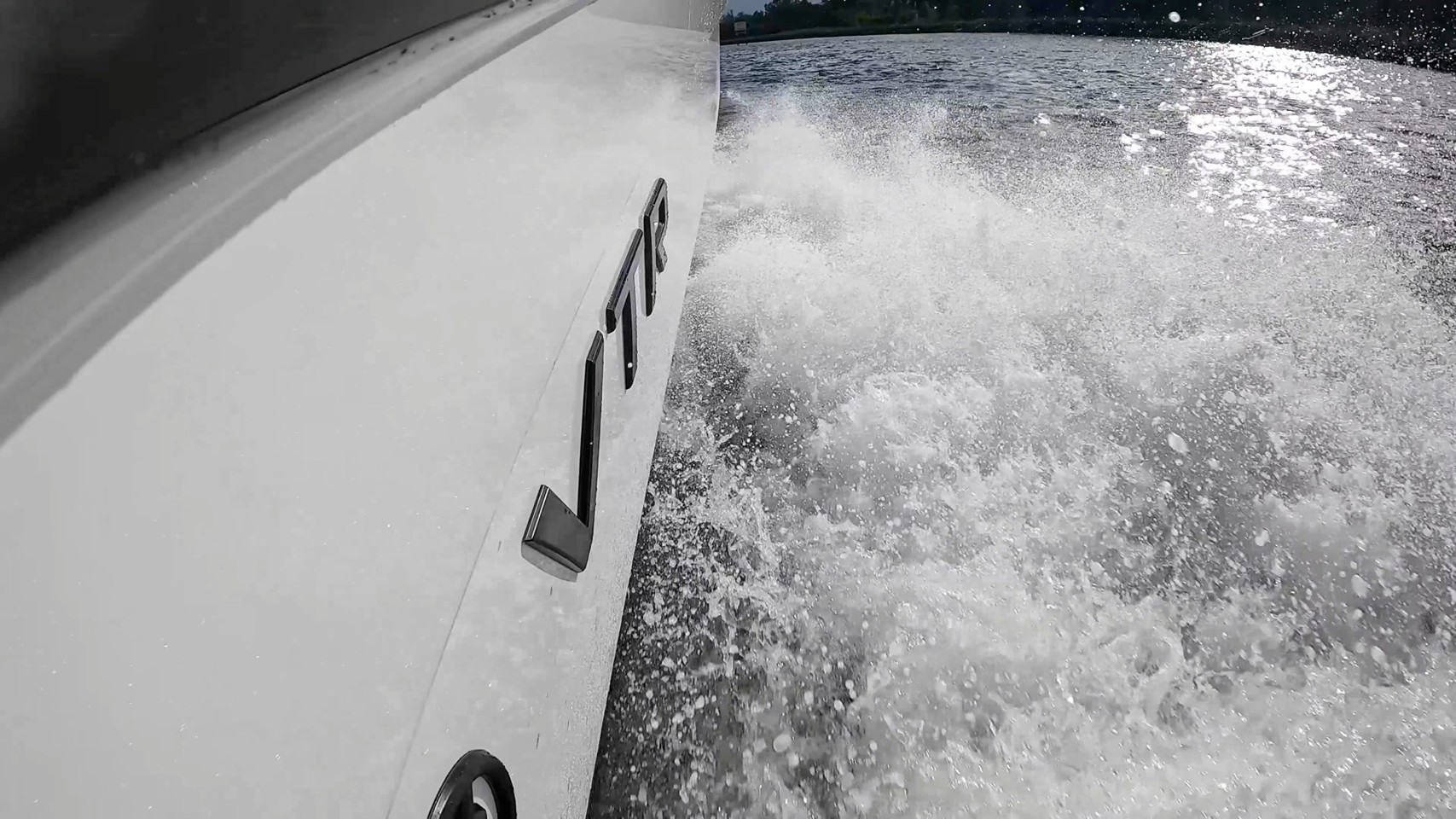
Our test boat, with a test weight of approximately 17,463 pounds, including 90% of her 233 gallon fuel capacity, was equipped with a pair of 300-hp Mercury Verado outboards. Test day saw calm conditions with five knots of wind, an air temperature of 82°, and 62% of relative humidity. The hull runs on a Donald L. Blount & Associates design where the two-step and chine act to aerate the bottom area between the hard chine and the lifting strake. In that space, the deadrise transitions to 23° at the transom resulting in a cushioned ride and reduction in drag. In addition, a flat, horizonal pad on the keel adds to her efficiency and speed. Of course, varying sea conditions will affect how the 38 VTR EC operates across the rpm range.
When we first tested the boat, it was discovered the right props were not installed, and the engines could not reach 6000 RPM. A few days later, when Cruisers Yachts received the correct props, a pair of 16” x 16.5” Inertia Eco XP props, Mercury Marine tested the boat using BoatTEST protocols and reported the test numbers given in the report and in the video.
The engines were able to reach their 6000 rpm rated turn, and achieved a reported top speed of 46.0 mph. The most economical cruise was noted at 4000 rpm and 26.5 mph and an estimated range of 259.0 statute miles with a 10% fuel reserve. With sea conditions permitting, and at 4500 rpm, she turned in a speed of 33.4 mph and an approximate range of 249.0 statute miles.
We found our 38 VTR EC test boat to be a nimble performer, quickly jumping up on plane with little or no bow rise, and answering our helm maneuvers during S- and hard over, lock to lock turns to either side. She tracked straight and true while on speed runs and with all the large windows surrounding the helm, cockpit, and aft section, we had excellent, all around views into the seaway.
Summary
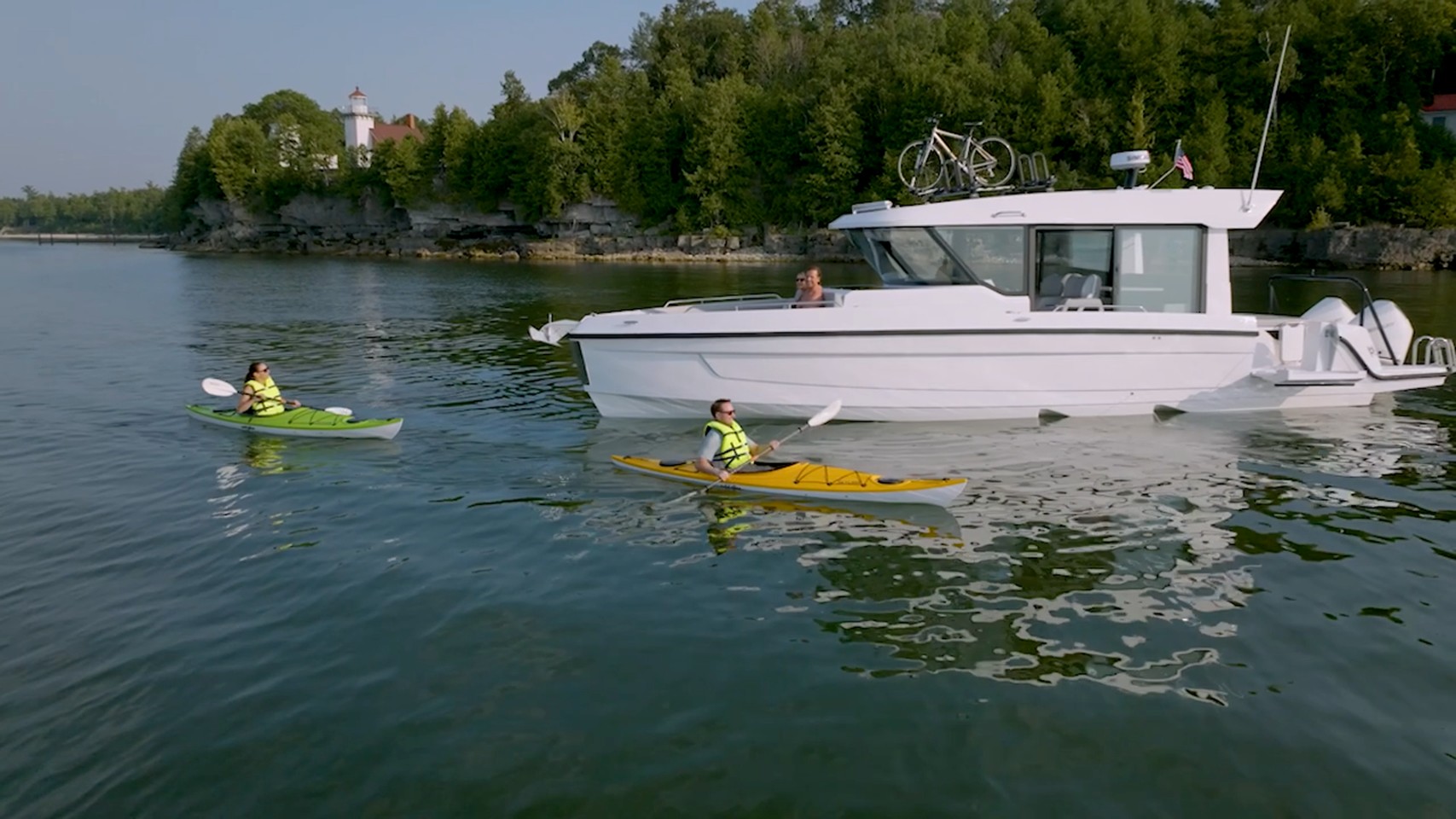
Easily crossing the line between an adventure and a cruising boat, the Cruisers Yachts 38 VTR EC successfully blends the very best of both. With a dramatic exterior profile, a long list of standard and optional equipment, and a variety of deck layouts designed to fulfill the needs of individual owners, she presents a platform capable of providing exciting days out on the water involved in a wide variety of water sports and activities. As well, with her accommodations for four, and air conditioning powered by a bank of lithium ion batteries, and her enclosed cockpit, the opportunity for extended times away from your home dock is always on the horizon.
Remember, life is better on a boat!
Features Video Walkthrough
Overview
Captain Tripp's introduction: "This is an adventure boat where you can adventure your way, and it's also an American-made boat." His initial handling assessment during a maneuvering sequence: "She feels pretty nimble and she reacts pretty well with those 300s, but I can imagine with 400s she'll be even more fun."
Specifications (Test Boat)
- Length overall: 40 feet
- Beam: 11 feet, 10 inches
- Draft: 36 inches
- Test weight: 17,285 pounds, with 90% of the 233-gallon fuel capacity aboard and four passengers
- Engines: twin Mercury 300 horsepower V8 Verado outboards, fitted with Enertia Eco 16 x 16.5-inch propellers (test numbers recorded by Mercury technicians)
Performance Numbers
- Top speed: 45.2 mph at 6,000 RPM
- Best cruise: 33.8 mph at 4,500 RPM
- Range at best cruise: 279 statute miles, with a 10% fuel reserve
On-Plane Handling
Captain Tripp's assessment coming up on plane: "This is what I expected — next to no bow rise. We're already running 30 miles an hour with no time at all. Yeah, it doesn't feel like we need any [trim] tab. The boat is handily perfectly up on step."
Aggressive turning: "The boat turned really well, laid over just on her chine, just as I expected. She's good — no slam, no banging. I like how she's handling so far."
Hull Design
Captain Tripp attributed the ride quality to the hull design: "Everything starts with its hybrid stepped hull developed by Donald Blount and Associates. It's a masterclass in balance, blending the efficiency of a step design with the stability of a traditional running surface. The ride is smooth, quiet and predictable, delivering effortless handling at any speed, and when you push it, the hull comes alive, offering thrilling performance while staying rock solid even when conditions aren't [ideal]."
Wave Handling / Visibility at Speed
Running at 40 mph over a wave, Captain Tripp reported: "Visibility as I'm running is fantastic, just as I expect it to be."
Seating comfort: "I'm comfortable right here. If I flip up my bolster, I can, but really I think I have plenty of room between the seat and me with the bolster down, and I really don't need any extra height."
Wind protection: "I'm well protected by how this windshield wraps around, under the hardtop, not much wind tucked behind me. Everything's quiet."
Hull Shape Philosophy (Plumb Bow)
Captain Tripp's assessment of the bow design tradeoffs: "With its designed plumb bow, a little more narrow than your traditional boat, it's gonna handle better in rougher waters, but it's not too narrow where you sacrifice the interior volume and the cabin space. So I kinda like how this boat is a happy medium between those two designs — narrow versus interior volume."
Engine Options
Twin Mercury 300s performed well in testing; twin 400s are available as an upgrade. Captain Tripp: "That would be pretty exciting."
Reverso System
A freshwater engine-flush system for saltwater operation, tucked under the cockpit.
Water Sports / Swim Platform
Tow bar: Optional, for towing kids or other water sports use.
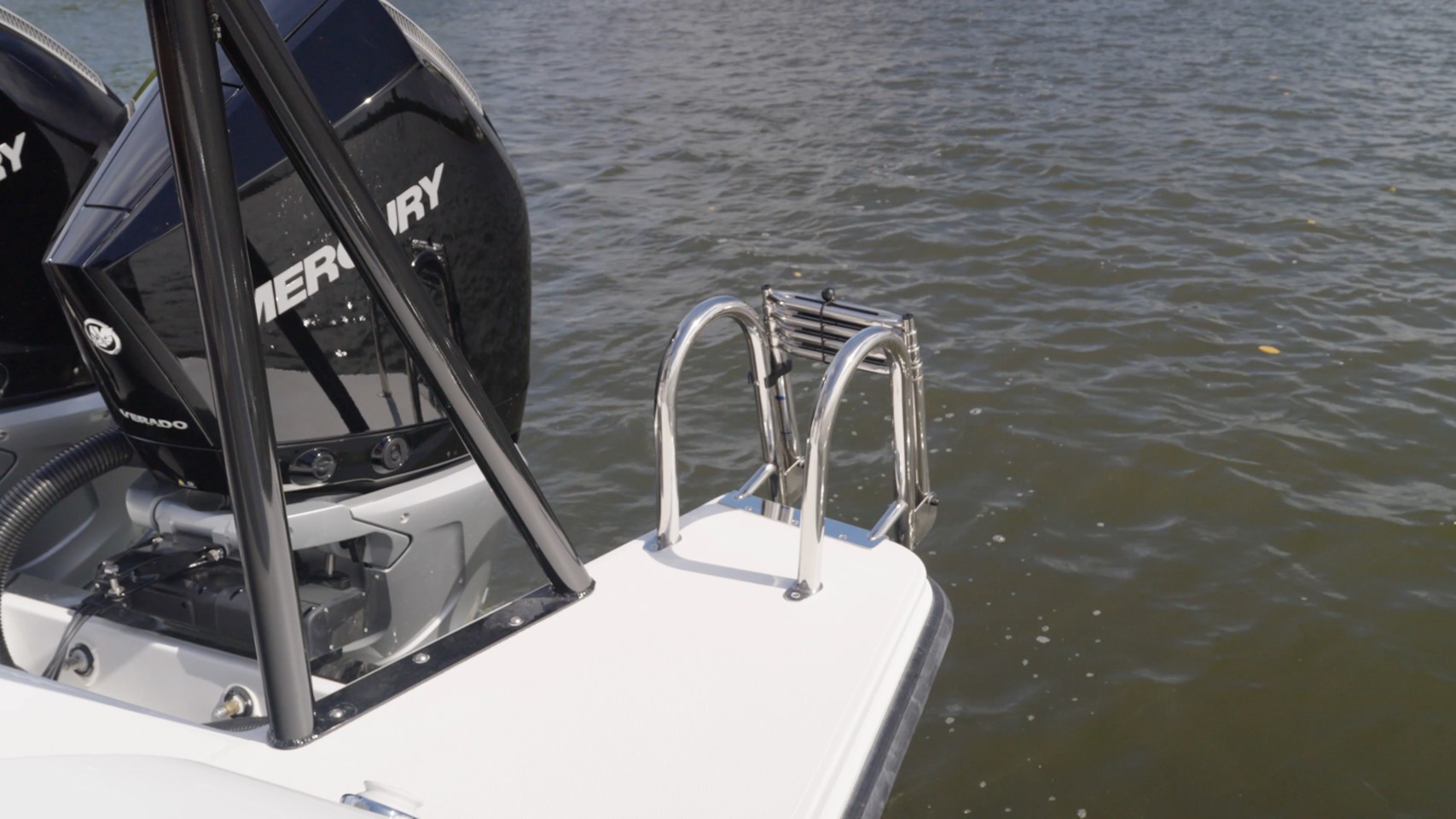
Swim ladder: Fitted with two high bars (similar to a swimming pool ladder) to ease exit from the water.
Freshwater shower: For rinsing off saltwater.
Beach door switch: In the down position, provides more guest space and convenient access for tenders or paddleboards.
Forward storage hatch: Described as offering "an enormous amount of space," suited to water toys and beach chairs.
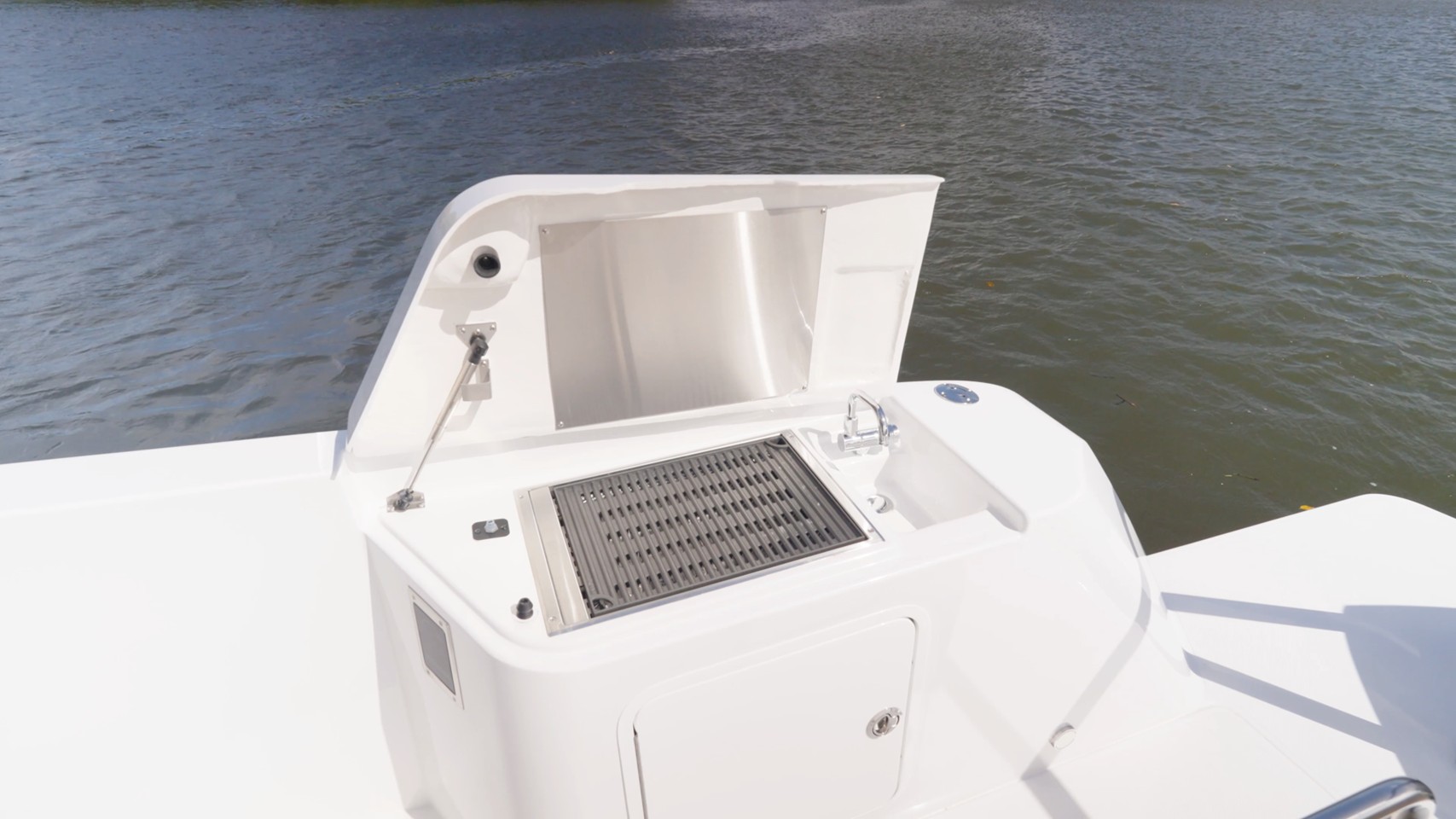
Forward bench seating: With cup holders. An electric Kenyon grill and small sink are located to starboard, with dedicated trash can storage beneath.
Back Deck Layout Options
Four configurations are available. The test boat used the aft bench layout, positioned between the wet bar and beach door. Alternative configurations include an aft-facing sun lounge with storage (which Captain Tripp noted expands sleeping capacity when paired with the aft cabin arrangement), or a more open base layout.
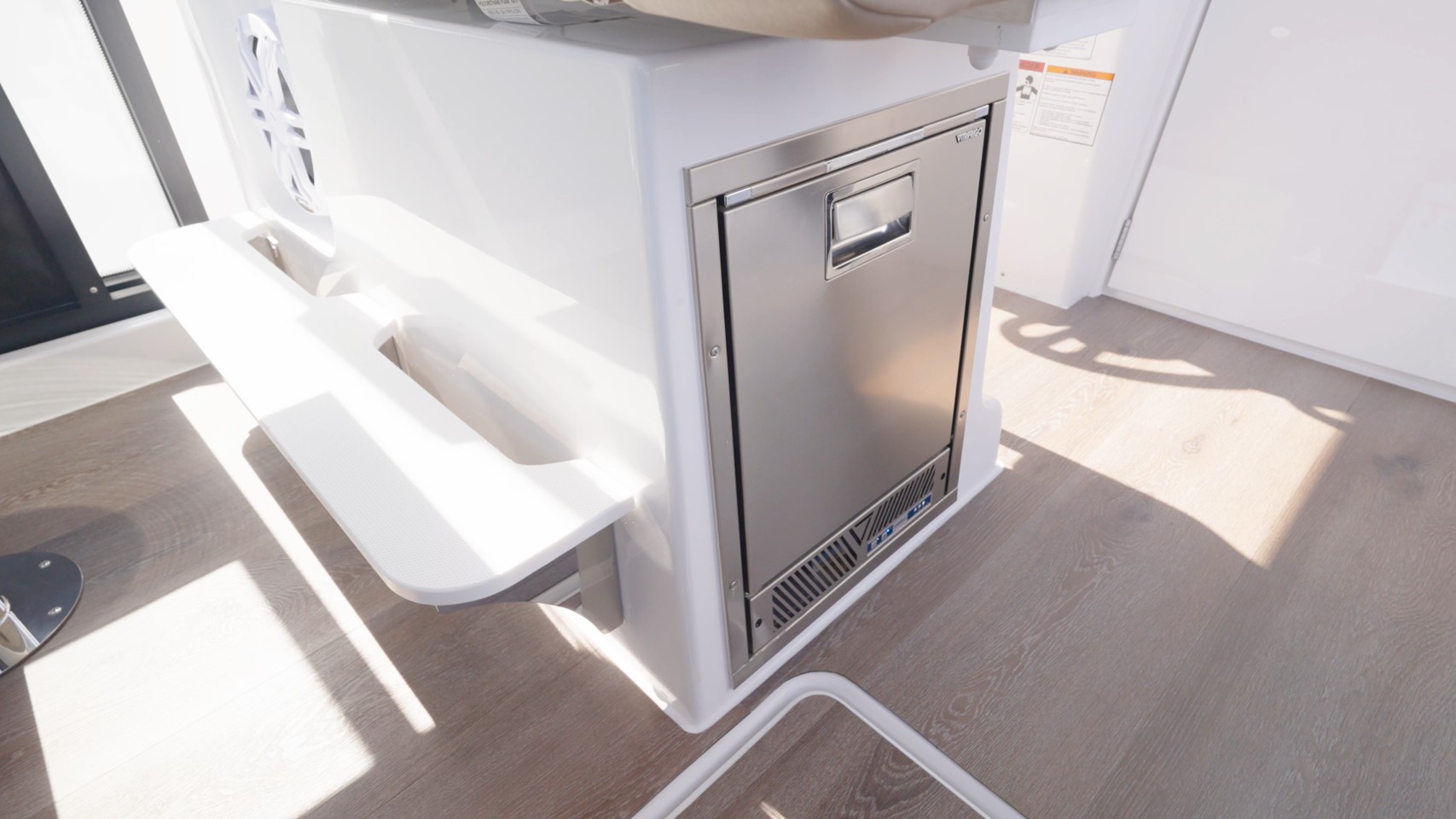
Forward of the aft bench: Ice maker, refrigerator, and additional storage.
Hardtop / Dining Area
Full-beam hardtop, providing shade. Captain Tripp noted Cruisers does all metal work and upholstery in-house.
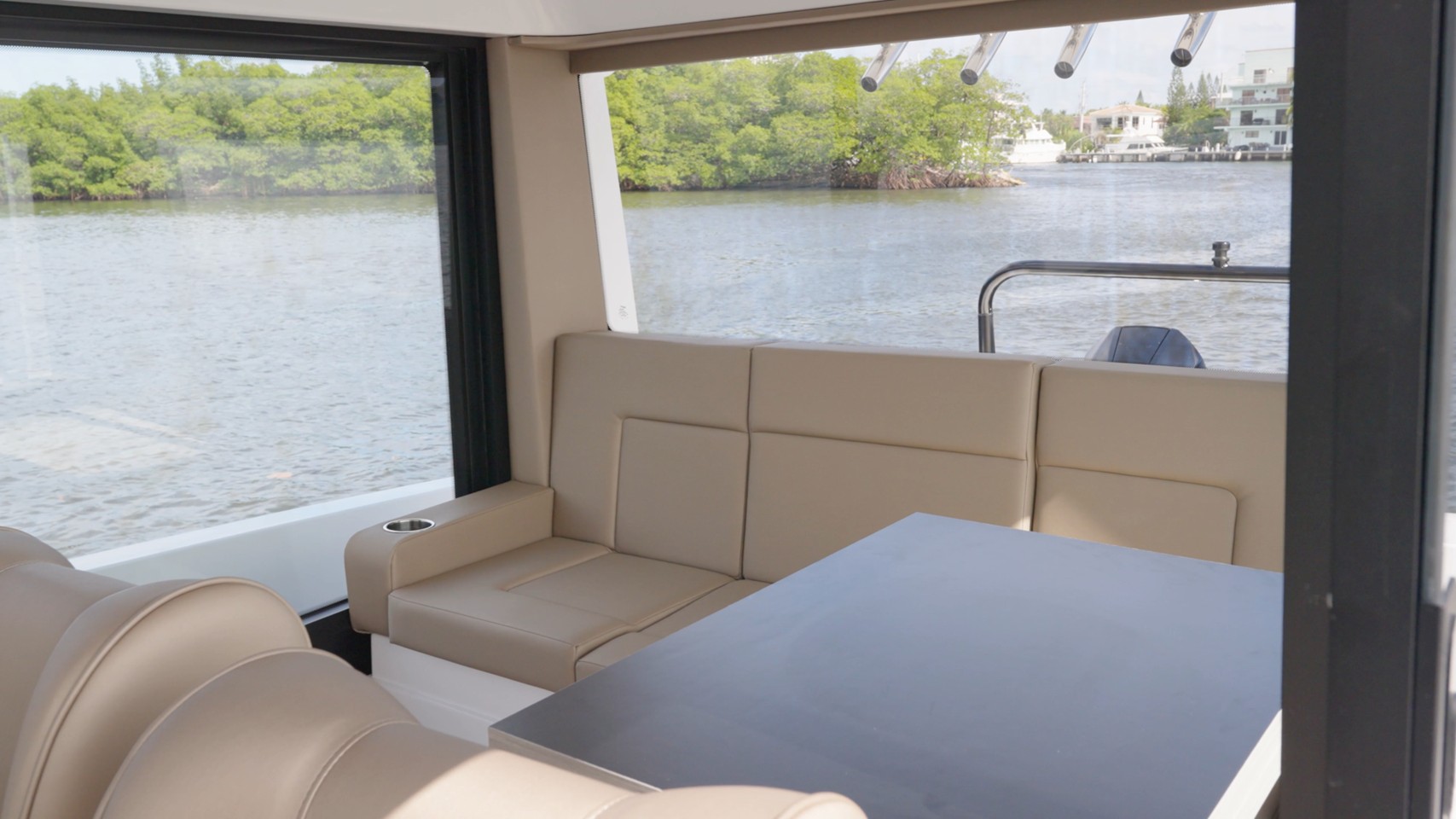
Dining table: Opens up with individual footrests for each seat; the three seats convert quickly to forward-facing configuration for underway use. Captain Tripp praised the armrests specifically: "I really like that 'cause armrests are so handy on long days while underway."
Helm
Captain Tripp's overall assessment: "I like the helm."
Equipment:
- Two large Simrad screens
- Switches for most-used items
- Cup holders and a catchall storage tray beneath the screens
- Port side: VHF radio, joystick (for easy docking), wireless induction phone charger to the right of the wheel
- Linco trim tab controls, engine pinnacle controls
- Rockford Fosgate head unit
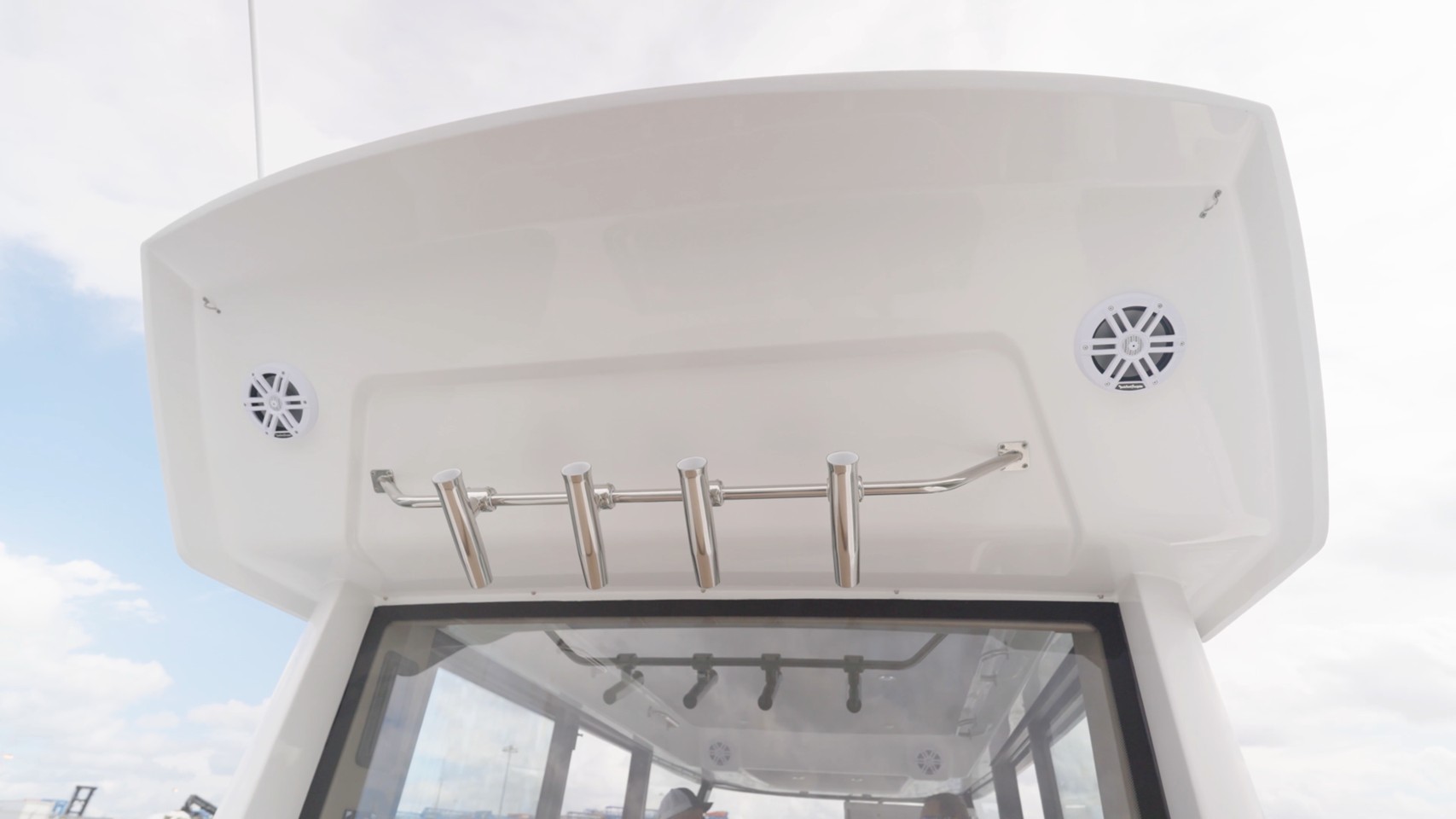
- Hardtop-mounted speakers and LED lighting
Windshield: Large, providing good visibility, with a forward rake — noted to reduce nighttime glare and improve rain shedding.
Shore Power / Gunwale Access
Shore power location doubles as line storage. A gunwale step provides easy boarding at a fixed dock, paired with a hardtop grab handle. This area can also serve as secondary bow access (fitted with EVA foam for secure footing), though the primary bow route is via the port side.
Port-side bow access: Includes another step for higher docks and a grab handle along the cabin top. A spring cleat is positioned for easy solo-docking access.
Gunwale height: Captain Tripp noted this as class-leading: "The gunwales on the 38 VTR are perhaps the highest in class. Building a boat like this adds weight and expense, but I can't think of a better place to spend the money."
Bow Social Zone
Described as a separate zone with its own Rockford Fosgate head unit, allowing independent volume control. U-shaped seating with a pedestal-mounted table option. Dedicated cooler storage beneath the starboard cushion, plus additional storage beneath the seating position. Handrails line the sides for safety.
Anchor locker: Forward-most position, with pole receptacles for installing a sunshade at the bow.
Cabin
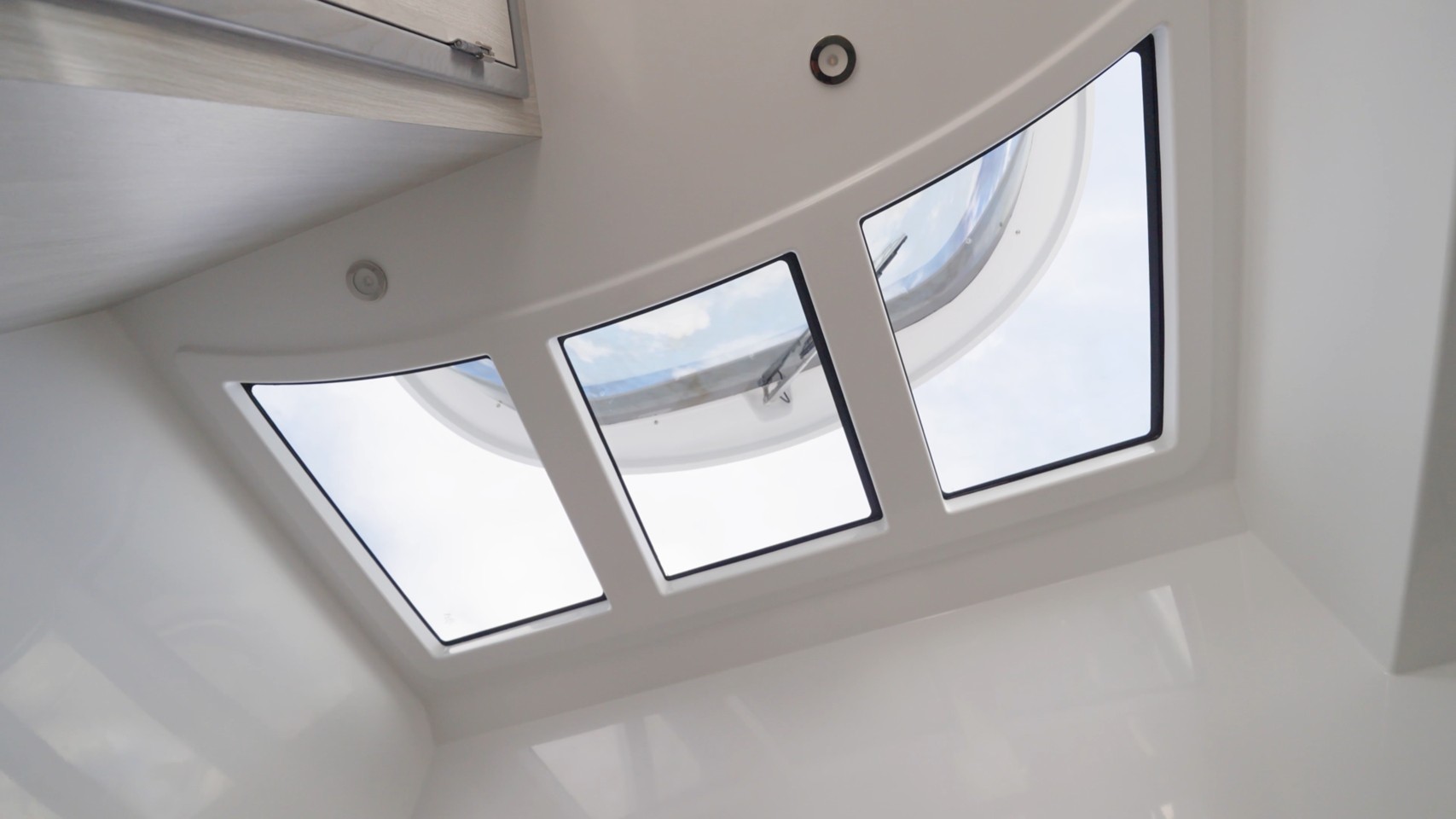
Captain Tripp's assessment: "The cabin down below is fairly spacious. You have a lot of natural light coming in through these three skylights and quite a bit of overhead room. There's a good bit of clearance here." He noted this headroom as a specific differentiator: "This is one of the details of the 38 VTR that sets her apart from some of the other boats of this style."
Climate control: Air conditioning powered by the lithium battery bank, which runs overnight and recharges during the day — the boat has no generator.
Convertible berth: The forward berth converts to a small dinette, suited to a private meal away from other guests.
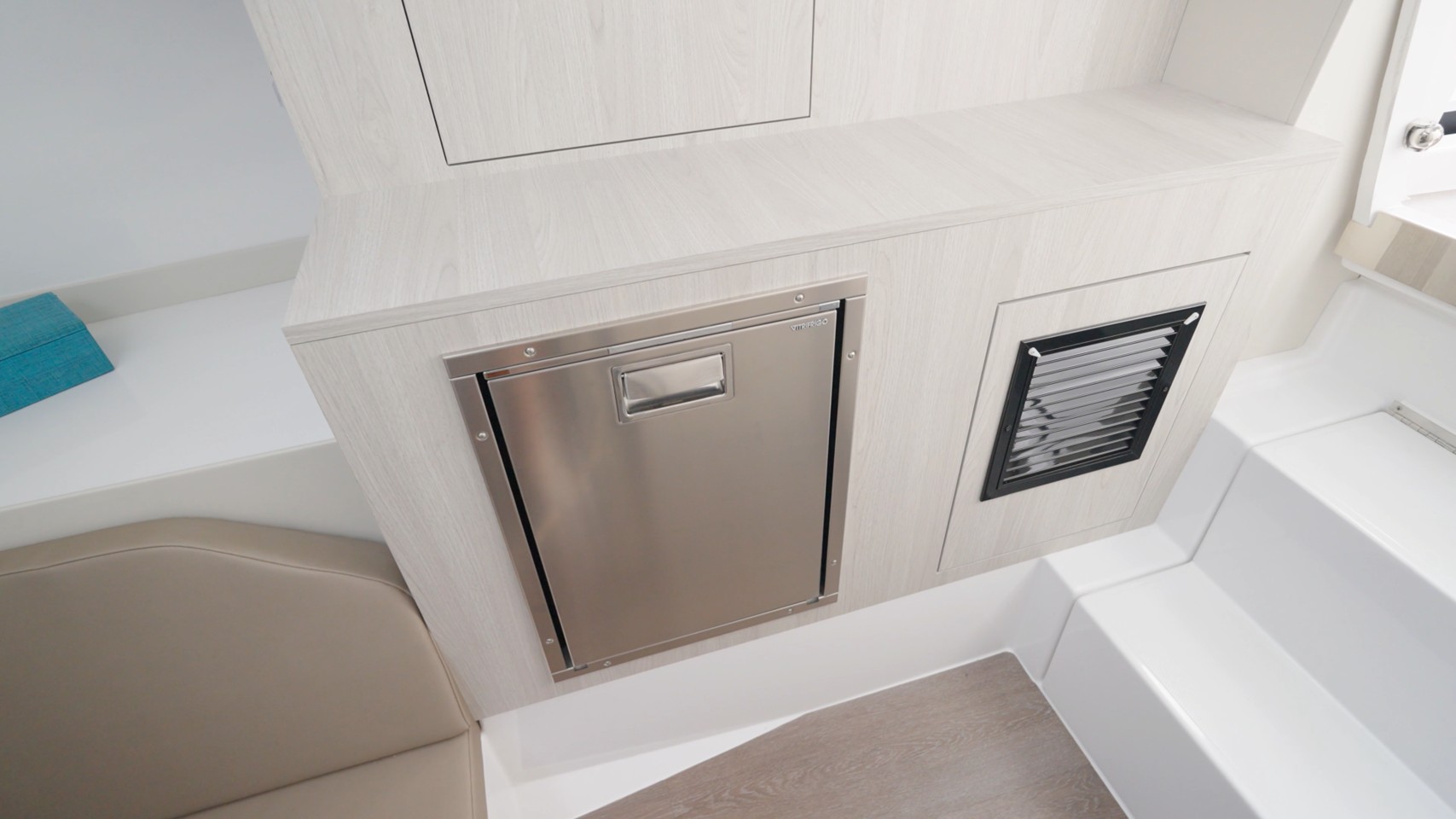
Additional cabin features: A 110-volt outlet, USB charging throughout, storage underneath, and access to the bow thruster and a refrigerator.
Electrical System
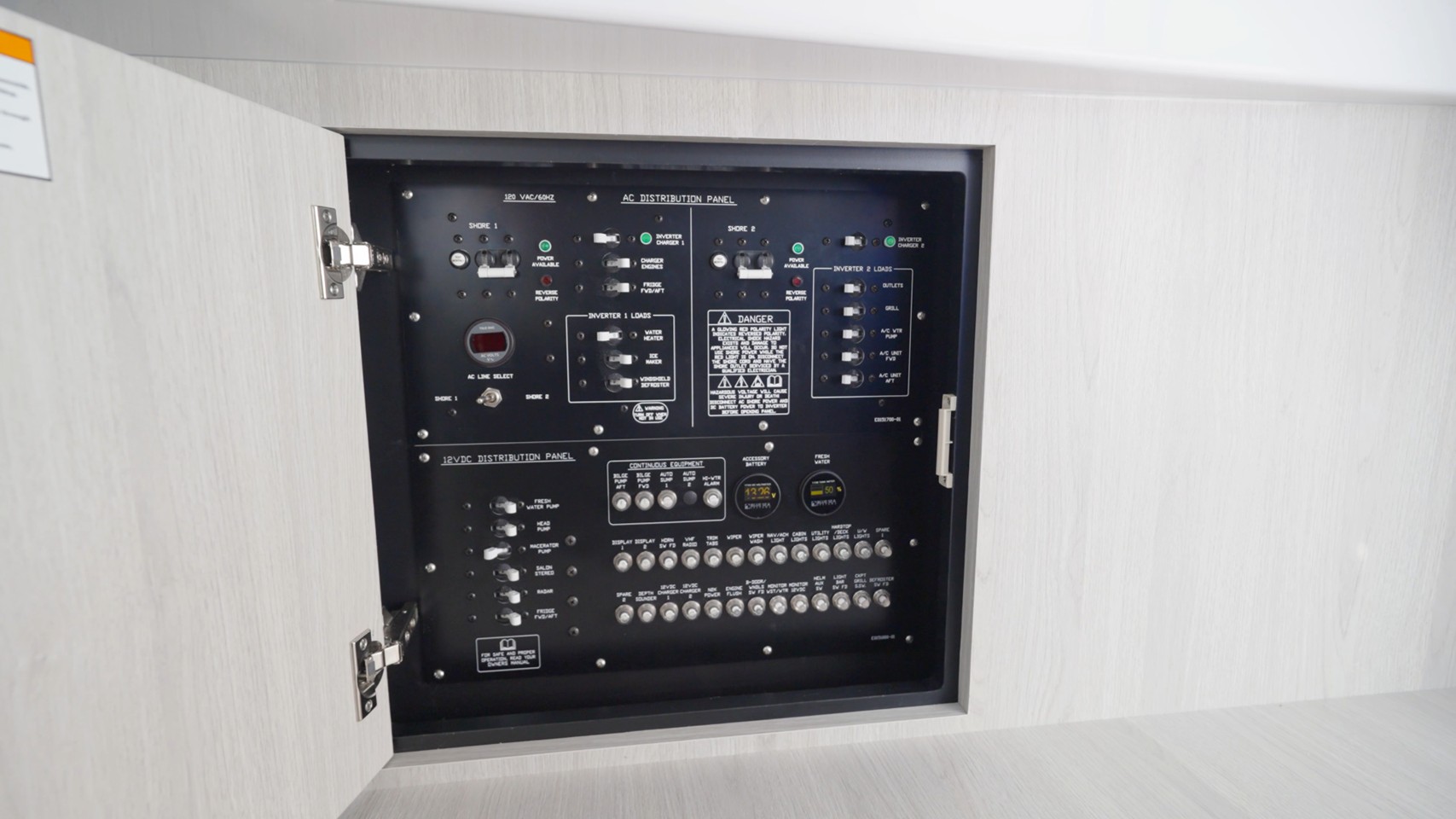
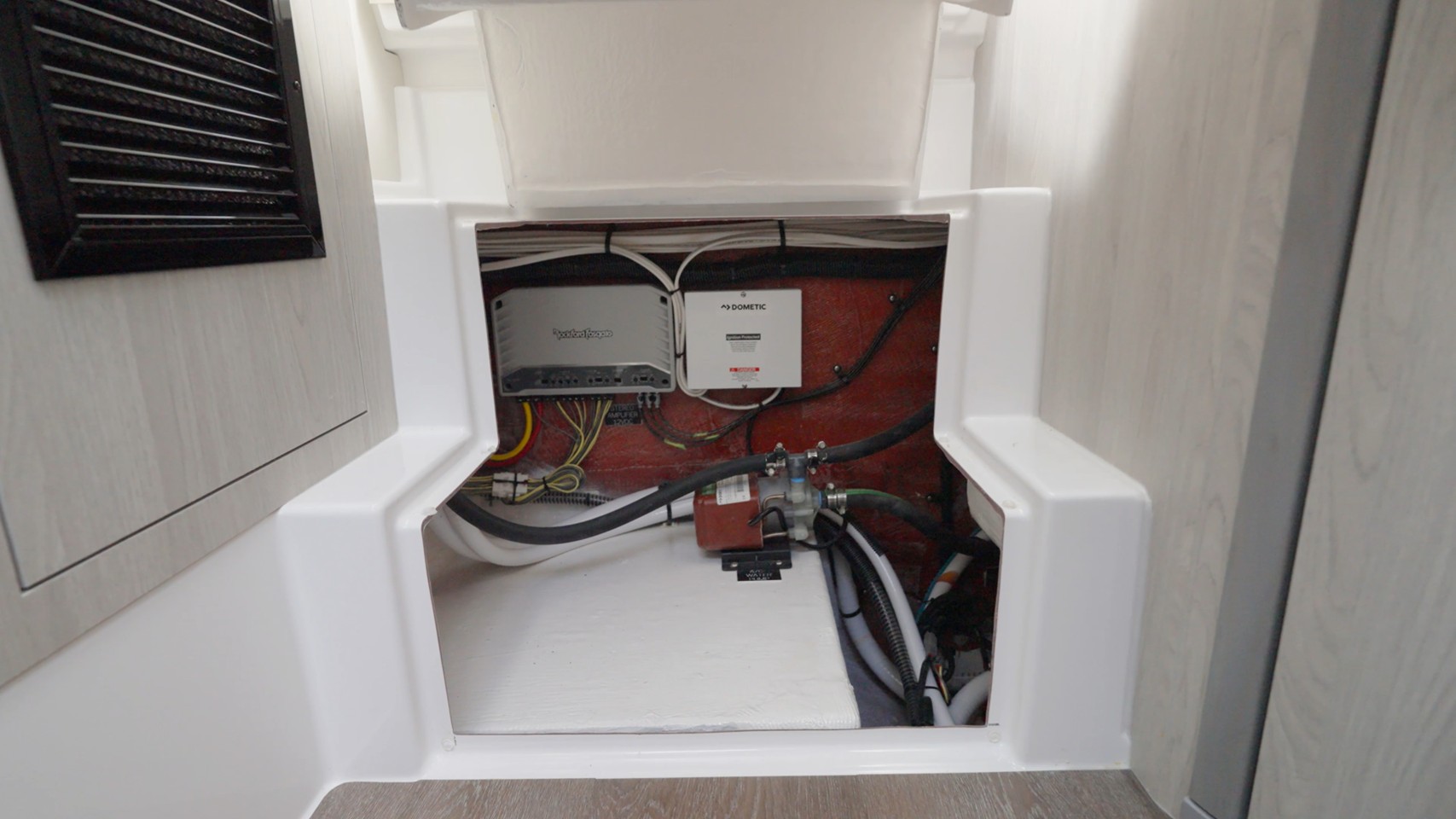
Captain Tripp's broader industry observation: "The biggest headache for any boat is often its electrical system, and it's here where Cruisers Yachts shines. They scrupulously follow ABYC standards." He noted the main panel is positioned for easy access rather than hidden away.
Additional mechanical access (under cabin entry steps): Though the space is fairly cramped, Captain Tripp noted quality details: wire runs kept high and out of the bilge, all hoses double-clamped, bilge coating applied, and standard equipment of two bilge pumps plus a high-water alarm — the latter he specifically endorsed: "Something I think all boats should have."
Beam / Head
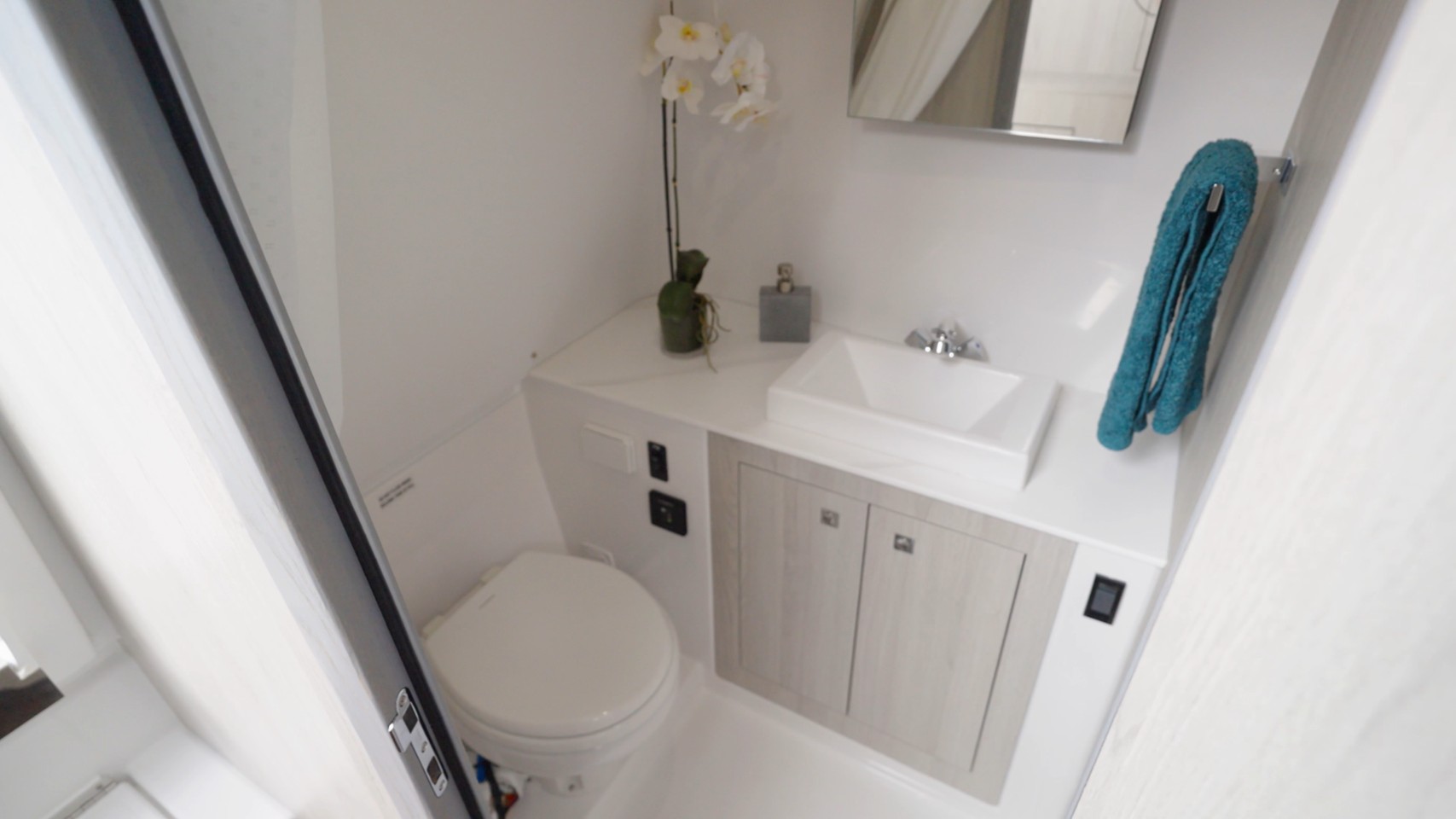
The 11-foot, 10-inch beam allows for a more private head, complete with vanity, toilet, and shower, plus ample overhead room.
Wet head note: Captain Tripp acknowledged this is a wet head configuration but contextualized it appropriately for the boat's category: "Remember the 38 VTR is a day boat or weekender, not a long distance cruiser. So we're happy to have a shower at all."
Closing Assessment
Captain Tripp's summary: "The 38 VTR is a radical departure for Cruisers Yachts from the boats it's been building for the last 70 years, but there's no denying that she's in step with the times and a versatile platform for different water sports."
A companion review of the related 38 VTR EC (described as "a four season adventure cruiser for the whole family") is referenced.
Review Video Transcript
Overview
Opening handling impressions during maneuvering: "Let's see how nimble it is. Kind of give a couple quick little whips here. Woo, this is fun." On the boat's turning response: "If we can get her to cut over on her keel pretty quick, that just means when you're turning the boat's gonna be reactive. I like that."
Captain Tripp's stated review scope: "Today we're gonna be testing the boat, get some performance numbers, see how she handles, and also go through the features inspection on the boat and see just what kind of amenities it has. There are a few things on here that I think will impress you."
Specifications (Test Boat)
- Length overall: 40 feet
- Beam: 11 feet, 10 inches
- Draft: 36 inches
- Test weight: 17,463 pounds, with 90% of the 233-gallon fuel capacity aboard and four passengers
Hull Design
Designed by Donald Blount and Associates. Captain Tripp described three notable design elements:
- Two steps/chines that aerate the bottom area only between the hard chine and the first lifting strake
- In that aerated zone, deadrise warps to 23 degrees at the transom — intended to reduce drag while cushioning the ride in a chop
- A flat horizontal pad on the keel, added for efficiency and speed
Captain Tripp's overall assessment: "This is one of the most sophisticated and complex hulls we've seen in class."
Power
Twin Mercury 300 horsepower outboards, fitted with 16 x 16.5-inch Enertia Eco XP propellers (numbers recorded by Mercury technicians).
Performance Numbers
- Top speed: 46 mph at 6,000 RPM
- Most economical cruise: 26.5 mph at 4,000 RPM, burning 22.5 gallons per hour, achieving 1.18 miles per gallon, for an estimated range of 259 statute miles with a 10% fuel reserve
- Typical operating speed: Captain Tripp noted most operators would run at 4,500 RPM (33.4 mph), giving up "just 10 miles in range" compared to the most economical setting
On-Plane Handling
"The boat gets up on plane really quick and there's almost no bow rise. It's really pretty impressive."
Turn / Wake Test (ICW)
While running the ICW at 40 mph, an aggressive turn was required to avoid a no-wake zone. Captain Tripp's account: "We'll cut it, give a little bit of throttle as we do. She lays over comfortably and picks the ride back up on our reciprocal course as we come through our wake. No crashing, no slamming. The boat handles it fantastic."
Cabin Comfort While Underway
With doors open, Captain Tripp noted minimal wind intrusion: "There's not a lot of wind in here. There's a little bit just enough to kind of keep a good comfortable breeze." Rear visibility was also noted positively: "You see the large window in the back is not interfering with any of my view."
Anchoring
Testing concluded with locating a cove to anchor and review features. Anchor deployment was confirmed successful ("catching there. Perfect.").
Helm — Detailed Review
Displays and controls:
- Two large Simrad screens for engine data and navigation
- Switches for most-used items positioned beneath the screens
- Two cup holders and a small-item tray
- Left side: joystick with Skyhook (for easy docking)
- Ignition/start key switch, wireless induction phone charger
- Linco trim tab controls, Mercury pinnacle controls
- Rockford Fosgate sound system controls
- VHF radio positioned below
Seat/foot positioning: Captain Tripp's assessment: "I've been very comfortable in the helm seat. I have two different positions for my feet. If I wanna prop them up a little bit forward and really lounge back because I'm cruising slow down the ICW, I can do so." A small deployable step allows an elevated standing platform, secured by a magnet when stowed. Standing at this raised position was noted to provide "easy access, quick on and off the boat" for docking or line handling.
Companion seating: Two aft-facing helm seats, bolstered with large armrests. Captain Tripp's stated rationale: "That's gonna ensure a lot of comfort while you're underway, maybe on a long crossing over to the Bahamas or something like that."
Optional ice maker: Located nearby, described as handy for keeping drinks cold.
Convertible companion seating (dinette use): Footrests are built in; opening the table creates what Captain Tripp called "a decent dining experience right here in the protection of the enclosed cockpit."
Visibility: "I can really see how much visibility you have on this boat no matter where you're sitting is pretty impressive with all the glass around."
Below-Deck Access (Center Seat)
Flipping up the center seat and lifting the footrest reveals access down below. Captain Tripp noted comfortable sleeping space for two, aided by air conditioning running during the walkthrough. This space can alternatively serve as storage, accessible either from the enclosed cockpit or from the aft deck beneath the sun pad.
Forward Cabin
Captain Tripp's assessment: "The cabin down below is fairly spacious. You have a lot of natural light coming in through these three skylights. There's a good bit of clearance here. This is one of the details that sets her apart from some of the other boats of this style."
Climate control: Air conditioning powered by the lithium battery bank, running overnight and recharging during the day — no generator aboard.
Convertible berth: Converts to a small dinette for a private meal away from other guests.
Additional features: 110-volt outlet, USB charging throughout, underneath storage, and access to the bow thruster and a refrigerator.
Electrical System
Captain Tripp's broader assessment: "The biggest headache for any boat is often its electrical system, and it's here where Cruisers Yachts shines. They scrupulously follow ABYC standards." The main panel is positioned for easy access rather than concealed.
Additional mechanical access (beneath the entry steps): Though described as fairly cramped, Captain Tripp noted quality construction details: wire runs kept high and out of the bilge, all hoses double-clamped, bilge coating applied (referred to as "white" in the transcript), and standard equipment of two bilge pumps plus a high-water alarm — which he specifically endorsed: "Something I think all boats should have."
Head
The 11-foot, 10-inch beam allows extra room for a more private head, complete with vanity, toilet, and shower, with ample overhead clearance. Captain Tripp acknowledged this is technically a wet head but was satisfied nonetheless: "We're happy to have a shower."
Hardtop Storage Rack
Equipped with a bike carrier and kayak cradles. Captain Tripp's summary: "All of your sporting goods adventure equipment, you can store it right up there out of the way."
Windshield
Forward-raked design, noted to reduce glare and shed rain more effectively.
Starboard Locker / Gunwale Access
A locker on the starboard side stores dock lines and also houses two shore power ports. A gunwale step provides easy boarding at floating or higher docks, paired with a grab rail.
Port side (mirroring layout): Another gunwale step for dock access, plus a spring cleat positioned near the helm — described by Captain Tripp as convenient for solo docking: "You're right here by the helm, you can access that cleat, which is your most important cleat, easily."
Bow Seating
Tucked into the gunwale for security, with grab handles running the perimeter, cushions, bolsters, and underneath storage. A filler cushion converts a section into a raised dining table. Also fitted with a second Rockford Fosgate head unit and speakers (independent volume control), plus courtesy lighting at deck level.
Anchor Locker (Bow)
Positioned at the very forward point, alongside two of four total pole receptacles used to mount a bow sunshade for additional weather protection.
Aft Starboard Features
Electric Kenyon grill, small sink, underneath storage, and a trash can. Further aft: twin Mercury 300 V8 outboards, described by Captain Tripp as "plenty of power for this boat." The swim platform includes an optional tow bar.
Port Side (Swim Platform Area)
Freshwater shower and a four-step telescopic ladder, fitted with two high bars (pool-ladder style) to ease water exit.
Back Deck Layout Options
Four configurations available. As tested: a large sun pad with easy access to the aft cabin beneath it. Alternative options include an aft-facing sun lounge with storage, a forward-facing bench, or a fully open deck — the latter noted by Captain Tripp as well suited to fishing use.
Hardtop (Aft View)
Rod holders, speakers, and small eyelets for attaching a sunshade, connected to poles fitting into the receptacles noted earlier.
Reverso System
Located just below deck, allowing the engines to be flushed with fresh water easily.
Beach Door
Push-button operated, dropping down quickly to open additional aft space and direct water access.
Closing Assessment
Captain Tripp's summary: "The 38 VTR EC is a radical departure for Cruisers Yachts from the boats it's been building for the last 70 years, but there's no denying that she's in step with the times and a versatile platform for different water sports."
Related Boats
Cruisers Yachts 338 OB (2019-)
2 x 350-hp Mercury Verado
Cruisers Yachts 38 GLS (2020-)
3 x 300-hp Mercury Verado
Cruisers Yachts 38 GLS (2020-)
3 x 300-hp Mercury Verado