Access More Boat Tests
Already have an account? Login
Cruisers Yachts 48 Cantius (2014-)
2 x 435-hp Volvo Penta D6 IPS600

Brief Summary
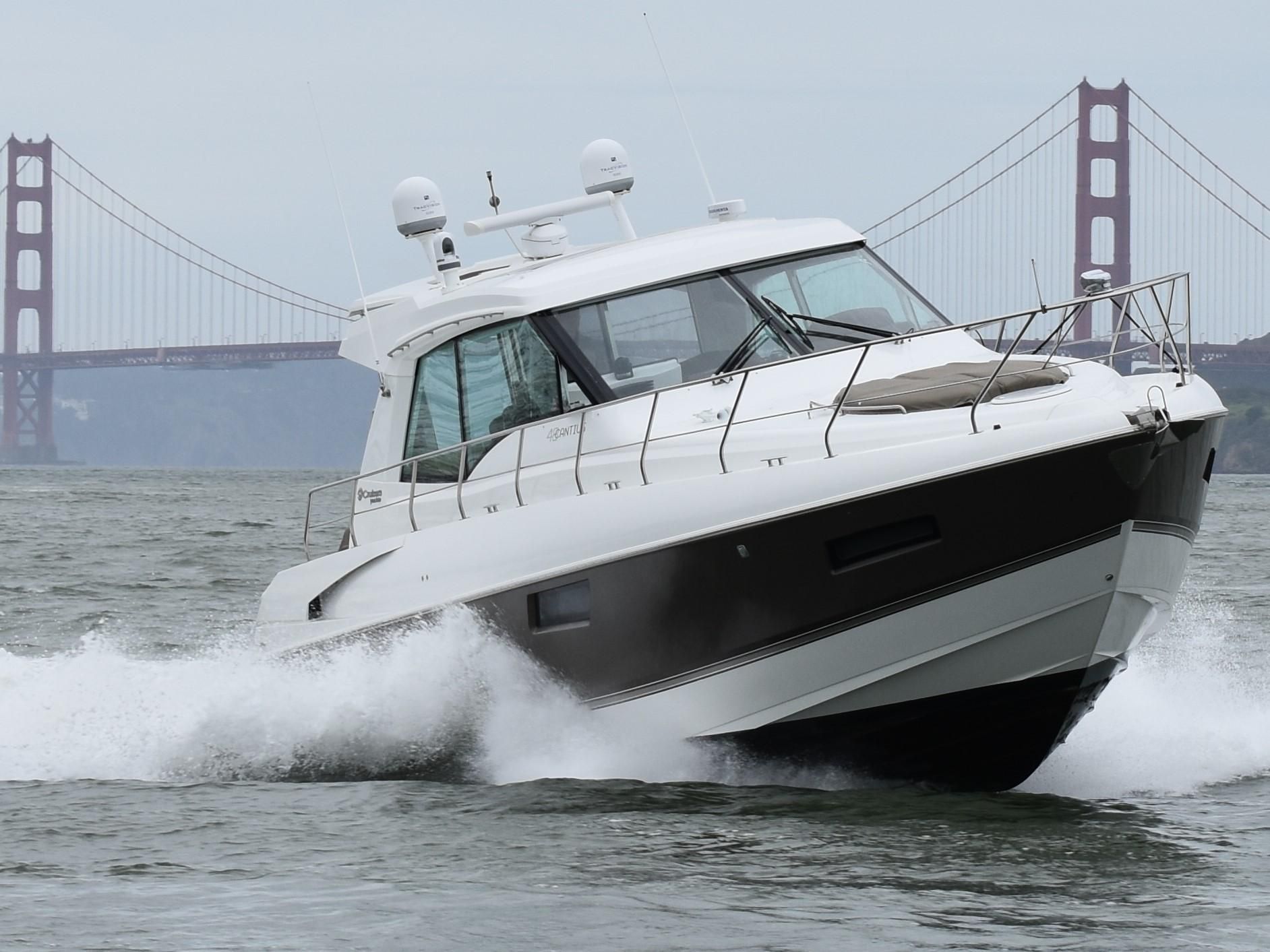
The Cruisers Yachts 48 Cantius is a boat that has been designed for the 21st century with a focus on providing its owners the maximum amount of usable space, while at the same time, providing an attractive modern design. During our review we discovered that Cruisers Yachts offers a large number of choices when ordering the 48. These include not just color options for interior spaces, but also types of materials and surfaces.
Test Results
| RPM | MPH | Knots | GPH | MPG | NMPG | SM | NM | dBa |
|---|---|---|---|---|---|---|---|---|
| 600 | 3.8 | 3.3 | 1 | 4 | 3.48 | 1260 | 1096 | 64 |
| 1000 | 6.5 | 5.6 | 1.8 | 3.69 | 3.2 | 1161 | 1010 | 68 |
| 1500 | 9.3 | 8.1 | 6 | 1.56 | 1.36 | 492 | 428 | 71 |
| 2000 | 11.7 | 10.1 | 12.5 | 0.93 | 0.81 | 294 | 255 | 75 |
| 2500 | 16.3 | 14.1 | 23 | 0.71 | 0.61 | 223 | 194 | 79 |
| 3000 | 24.6 | 21.3 | 31.5 | 0.78 | 0.68 | 246 | 213 | 81 |
| 3500 | 34.3 | 29.8 | 42.5 | 0.81 | 0.7 | 254 | 221 | 82 |
| 3620 | 35.9 | 31.2 | 43 | 0.83 | 0.72 | 263 | 228 | 81 |
Specifications
| Length Overall | 48' 6'' / 14.8 m |
|---|---|
| Beam |
14' 6'' 4.4 m |
| Dry Weight |
32,700 lbs. 14,832 kg w/eng |
| Draft |
42'' 1.07 m |
| Deadrise/Transom | N/A |
| Max Headroom |
6' 6'' 2.0 m |
| Bridge Clearance | N/A |
| Fuel Capacity |
350 gal. 3,125 L |
| Water Capacity |
80 gal. 303 L |
Acceleration Times & Conditions
| Time to Plane | N/A |
|---|---|
| 0 to 30 | 20.8 sec |
| Ratio | 1.82 : 1 |
| Props | T4 |
| Load | 4 person, 3/8 fuel, full water, 75 lbs. of gear |
| Climate | 48.2 deg.; 66% humid.; wind: 12-20 MPH; seas; moderate chop |
Engine Options
| Tested Engine |
2 x 435-hp Volvo Penta D6 IPS600 |
|---|---|
| Std. Power |
2 x 435-hp Volvo Penta IPS600 D6 |
| Opt. Power |
Not Available |
 Learn More
Watch Our Video
By Captain Rob Smith
To Read the "Back Story" about KCS International and the 48 Cantius...
The Mission
The 48 Cantius is clearly targeted to veteran boaters who intend to go cruising: maybe with another couple or their children for weekend outings; a possible two week or longer cruise in the height of the season; or a couple of other cruises in the "shoulder" months. In addition, the boat will always be capable of providing pleasant day trips where it serves as more of a swim platform and cabana, or evening cruises when it becomes a bistro afloat with the best table on the water. We say that it is targeted to "veteran" boaters, simply because there are a number of unique (or, if not unique then rarely seen) aspects of the design which are only likely to be fully appreciated by experienced boaters.
Unique Features
To show what I mean I am going to list a few of them here -- Undoubtedly the most noteworthy feature of the 48 Cantius is its "loft" design whereby the bridge deck overlooks the galley and salon below. The first time we saw anything like it this century was in the Lazzara LSX78 which was introduced several years ago. From below there is a cathedral ceiling effect that brings sunshine and air below. From above it is like looking down from a balcony to see what is going on in the salon. It opens up the whole boat and makes it seem far larger than it really is. We predict that this boat will start a trend in class.
Perhaps the second most outstanding feature is the use of large glass windows in the on-deck cabin. Again, the watchword seems to be, "Let there be light!" Port and starboard side windows are huge and the mullions are the minimum size possible maximizing visibility for both the captain and the guests. Not only does all of this glass give the captain great visibility, it will also go a long way toward reducing mal de mer among guests who can easily feel claustrophobic in conventional, closed-in designs. The aft end of the cabin is enclosed by nothing but glass! There are three large sections of glass, one fixed like a bulkhead and the other two sliding on one another. In this way, Cruisers Yachts has been able to open up the back of the main cabin to the outdoors -- both visually and atmospherically.
In southern climes when the temperature is right, the two-part door can be opened up to bring in the air. That, together with the large sunroof, opens up the cabin to the outdoors. In northern climes or in inclement weather, the sliding doors can be latched shut to keep everyone toasty inside. (Or closed when the A/C is cranking!)
Working harmoniously with the glass bulkhead, sliding doors and large windows is the raised platform upon which the settee has been placed. This allows guests to see outside easily without having to crane their necks.
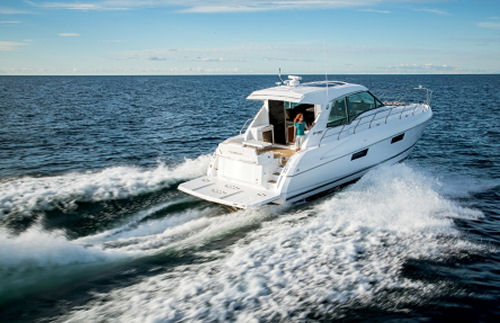
The Volvo Penta IPS system is standard in this boat and, in fact, to a large degree it could not have been built with all of the room and utility without it. The boat is powered by twin 435-hp IPS600 diesels and the engine room is immediately below the cockpit, rather than below the bridge deck where it has been in most express cruisers, sedans and convertibles forever. Access to the engines is through a hatch in the cockpit and down below there is a surprise -- 5’4" (1.64 m) headroom in the engine room. It is not standing headroom for most people, but it is a whale of a lot better than crawling or frog-walking headroom that many express cruisers this size have.
This boat is also quiet. With the sliding cabin doors closed the highest dBA reading I recorded was 82 at 3500 rpm, and most of the time the noise recorded was 81 or less. The range of noise readings we got is good and this speaks volumes about the advantage of getting the engines out from under the enclosed cabin and bridge deck. Cruisers Yachts uses a sound insulation material called "Sound Down" which has a lead lining.
These are the major aspects of the Cruisers Yachts 48 Cantius that set it apart from the other two dozen or so boats in class, in my opinion, but there are many other aspects that are worthy of note. I will mention them as we go through the boat.
Main Cabin and Bridge Deck
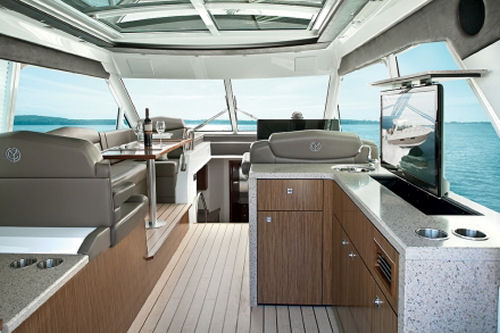
The designers made the main deck the key feature of the 48 Cantius because that is where most people will be spending most of their waking time aboard the boat. The openness is inviting and guests can enjoy the view whether underway or relaxing at anchor. I doubt anyone will feel “stuck” inside while they enjoy this salon. She is also built to entertain. Opening the two-panel sliding glass doors completely allows good traffic flow to and from the cockpit and the cabin. Descend a few steps and guests will be in the galley and at the lower salon. This open "loft" design essentially connects three different spaces, making each inviting, and in the process the host and hostess will be able to easily accommodate as many as 15 guests or so without it being crowded.
Party Time
No matter which area a guest is in, he or she is within easy reach of a refrigerator for ice and beverages. There is a standard wet bar to starboard just inside the main cabin. Outside in the cockpit to the port side is a modular optional cooking station with refrigerator. And, of course, down in the galley there is a huge (for a boat) 8.1 cu. ft. refrigerator/freezer. And all areas have counter space for ice buckets and bubbly. Hors d'oeuvres and other culinary delights can be spotted around the boat easily on the aft deck table, the settee table in the main cabin and on the settee table down below in the salon. The test boat has an optional Sony Bravia hi-low electric lift TV mounted in the solid surface counter just like the megayachts. The surround sound system is mounted in the aft port corner and includes a connection for MP3 players.
Temperature Control
Another good thing about the 48 Cantius is that when it is deathly hot, guests can come inside for the much-needed A/C. The upper salon is cooled (and heated) with a 32,000 BTU unit. Below, there is another 32,000 BTUs to cool the three cabins there and each has its own temperature control device. This is a clever use of cooling as clearly the heaviest concentration of cool air will be in the main cabin where the sun will penetrate the most, and because of the open "loft" design that cool air will waft down into the salon below. A Taylor Made 71” by 71” sunroof with 30” x 71” electric opening and manual shade is carefully tucked in the overhead. (By the way, the skipper does not have to open the sunroof to be able to stand at the helm.)
Walkthrough Windshield
Like most Cruisers Yachts, the 48 Cantius has a "walkthrough" windshield to the port side of the stairs going below. The builder has placed a much-needed handrail to starboard. This walkthrough design has been popularized by Cruisers Yachts as much as any builder. The concept was to make it possible in smaller boats to increase the living space inside the boat by eliminating side decks and to give an added measure of security when having to go forward when the boat was rolling. But the concept has now caught on and while the 48 has wide side decks, she also has the walkthrough.
The Helm
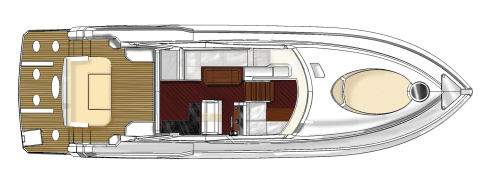
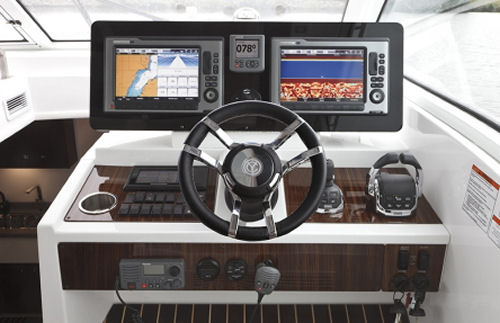
Completing the upper deck is the helm station. A very modern and ergonomic all-glass navigation system is at the fingertips of the helmsman. I found good sight lines from starboard to fully aft. Mullions for the hardtop present the smallest possible obstructions, something at which Cruisers Yachts is expert. The very nature of the walkthrough glass framework to port adds some distraction, but it is not bad. The port-aft support for the hardtop offers the largest obstruction, but that is necessary to hold the weight of the roof plus have room to run wires for electronics. Aft, the visibility couldn't be better thanks to the glass doors and bulkhead, which should make backing into a slip painless.
Cockpit
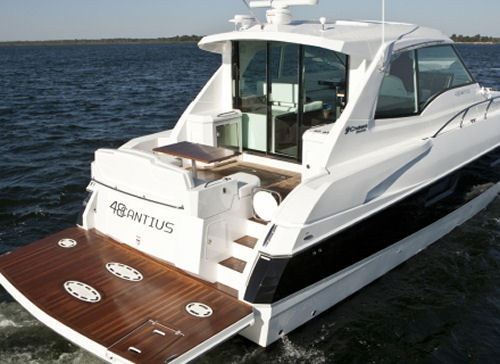
Whether entering the cockpit up the steps from the swim platform from port or starboard, the cockpit is spacious for the size of yacht that one is on. The forward facing aft lounge has a high-low table for al fresco dining or simply a game of rummy at anchor. The stern trunk is beneath this lounge and this one had an electric lift to make access easier to the fenders and lines inside. Another tip of the hat to Cruisers Yachts for their use of modular designs: the optional cooking station and refrigeration units can be installed either to port or starboard. The optional grill and refrigerator was to port on the prototype test boat with the ice maker to starboard.
Swim Platform
The primary entrance to the 48 Cantius is from the standard swim platform. This platform is larger than what is found on most boats in this class as standard equipment. Stern platforms have been getting longer and longer the last couple of years, and while it has taken my eye some time to get used to the looks of them, I am now heartily embracing the concept of long stern platforms. Here is why: there are simply a lot of things the boater can do with all of the deck space. First, it makes a great "teak beach" when on the hook. One can set up chairs and the ladies can sunbathe there.
Second, it is a good place to stand when getting fenders and lines out of the aft locker under the seat. Third, when friends come to call in their dinghies, everyone will have room to stand and hand things aboard easily. And, hey, one can fish from it! Best of all, it is absolutely the cheapest way to get extra square footage of deck space on a boat. The most noteworthy thing about the platform on the 48 Cantius is that Cruisers Yachts has planned ahead for the day when the boater wants an electric lift on it for a yacht's tender or PWC. The mounting and design are such that a Latham electric lift can be mated directly over the standard platform. Voila! There is a lift to launch one's PWC or tender (800 lb lift capacity).
Below Decks Accommodations
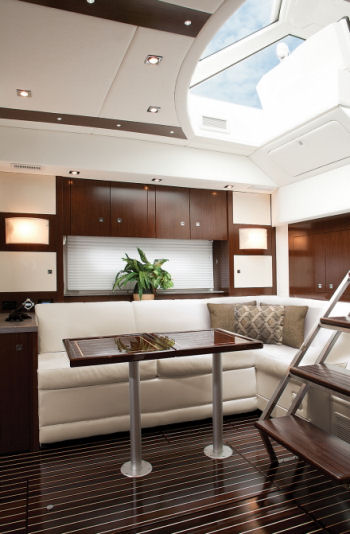
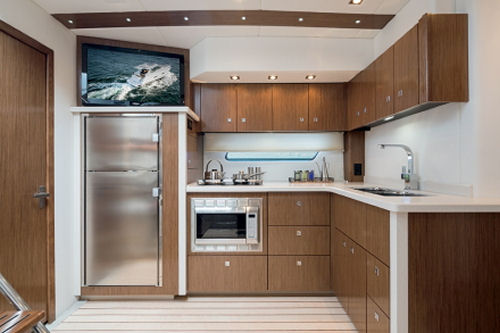
Because of the boat's "loft" design, one doesn’t have to duck when going below from the main cabin or worry about hitting their head. The galley is positioned to port and the lounger and table are to starboard. The cabin sole, both on the main deck and in the lower salon, is teak and holly with a twist. Cruisers has added a rich dark stain and sealer that complements the Wenge cabinetry and joinery throughout. Going forward, the lounge area will be carpeted while the galley will continue to have the wood decking.
The galley is as well equipped as any one will find in this class of boat and has all of the usual appliances. As already noted the refrigerator/freezer is large at 8.1 cu. ft. I have to say, even though the standard cherry cabinetry looks great, I liked the Wenge even better. It didn’t make the area seem smaller as one might think a darker wood might, but it did add an elegant touch. Wenge is the hot designer wood these days, and it can be found on some of the finest large motoryachts coming out of Italy.
Master Stateroom
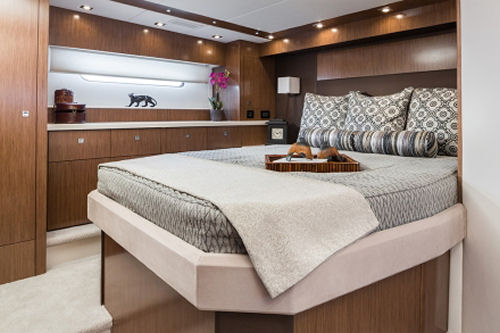
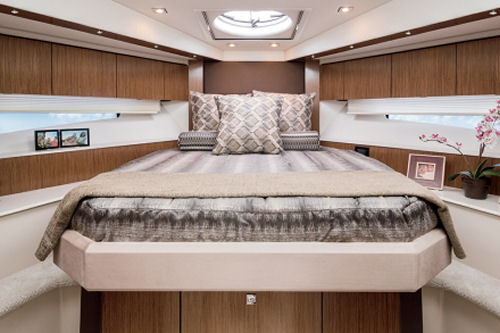
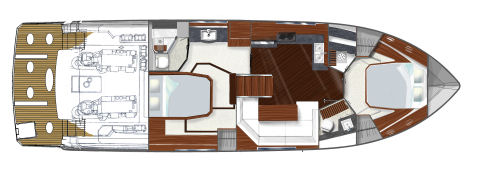
The boater will be the captain of their ship in the master stateroom which is the mid cabin. With a 7’ (2.13 m) entry and 6’6” (1.98 m) headroom at the foot of the bed, it is a huge beam-width stateroom in which to ensconce oneself. A built-in loveseat and vanity like one sees on much larger boats makes extended living aboard this boat more pleasant and comfortable. The upper portion of the port side storage on the test boat had a washer/dryer combination (optional). The island queen berth is easily entered from either side and the mattress is therapeutic foam for comfort. The master head has an enclosed shower and the vanity is outside the head so two can prepare for the day or night at the same time. Separate HVAC controls for the master allows one to decide the comfortable sleeping temperature in their cabin.
Forward Stateroom
The forward stateroom also has a queen island bed with therapeutic foam mattress. Twin hanging lockers and under berth stowage as well as overhead cabinetry gives plenty of stowage space in this area. The head for the forward stateroom is a shared day head with private entry from the stateroom. The split head design for the forward cabin also lends itself to a couple being able to freshen up separately. I found both doors to the head and shower caught the edge of the island bed trim and the port side head door would not open fully due to this.
Handling in Blustery Conditions
I tested the 48 Cantius on both a day with waves up to 6' and a more moderate day with waves reaching only 1' to 2' in Green Bay. Wind speed was anywhere from 20 mph to 40 mph, as recorded on my hand-held Kestrel meter. There was the expected pounding as we made our way through the roughest waters, but I never felt that I couldn't make the boat go where I wanted. I was running at about 2200 rpm most of the time, going about 15 mph or so, which seemed to be about as fast as was prudent given the conditions.
The twin Volvo Penta 435-hp engines and pod drives enhance handling compared to conventional drives, in my opinion. And, why shouldn't they? With pod drives the captain can direct the thrust with the wheel and doesn't have to count on water moving over the rudder blade to turn the boat. When one starts to think about it, the rudder is pretty old technology, so no wonder the IPS pod system is better!
Although one should never take their hands completely off the wheel, I was able to do so even in the roughest waters I encountered -- and on all points of sail -- and still hold a straight course. That includes a quartering sea running about 4' to 5'.
Into Head Seas
Punching into the seas, a couple of waves dumped on the foredeck and swept their way back to the windshield before being tossed overboard. I noted at the time that the "walkthrough" windshield opening did not leak. I kept the windshield wipers on the whole trip as we took fairly constant spray as the wind picked up the bow waves and threw them back at us. Interestingly, when we had the seas on our starboard quarter the boat tracked well and I did not have to add any tab. The boat is heavy enough and the bottom at 14-degrees is flat enough that she didn't lean away from the wind in this blustery stuff.
Going dead down wind was smooth as silk and the bow sliced nicely through the backs of the waves. The 48 carries 350 gallons of fuel in port and starboard tanks under the mid cabin sole. When fully loaded that is about 3,000 lbs. (1,363 kgs.), or about 9% of the boat's weight, amidships in the lowest part of the vessel. This weight in that location is like having a lead keel such as on a sailboat, which adds to the 48 Cantius' stability and I think helps the ride as well.
The boat tracked very well going down wind, and once again I took my hand off the wheel to see what would happen -- essentially nothing. While I will always do my best to stay out of high following seas no matter what boat is under me, if I had a choice I'd want a boat with pod drives in those kind of conditions.
Performance Trials
The following day the winds on Green Bay had backed off to 12 to 20 mph, and the seas were running from one to two feet. These were far from ideal conditions and pushing the boat into lumpy seas takes its toll in speed and more particularly in fuel consumption. Nevertheless we went ahead with our testing so at least consumers would know what to expect in these real-world conditions.
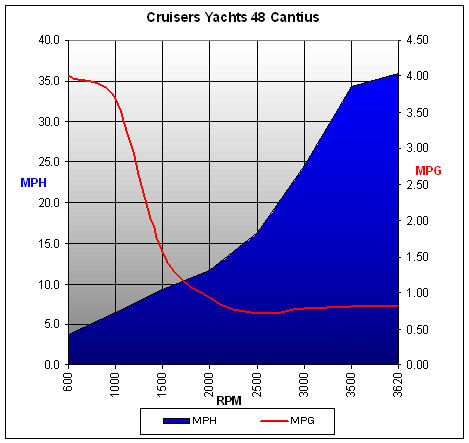
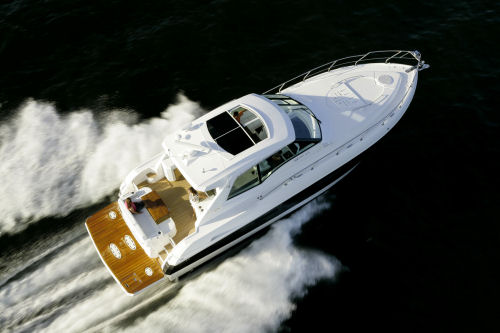
Bow rise on startup was about 14 degrees and hard-over turns were smooth and comfortable. She takes slightly more length to accomplish the starboard hard-over turn versus the port. We recorded a WOT top speed of 35.9 mph at 3620 rpm with four people aboard and light fuel. In speaking to Cruisers Yachts engineers the following week, they told me that they got slightly faster speeds in near perfect conditions, which figures since we were running in a 1' to 2' chop with 12 to 20 mph winds. They also reported better fuel economy at 3000 rpm, something on the order of 1.0 mpg.
It is a little difficult to say exactly what the best cruise would be on this boat based on our trials, because when we tested our best fuel economy on plane was .83 mpg at our top speed of 35.9 mph. At 3000 rpm we recorded 24.6 mph and got .78 mpg. Typically, under near ideal conditions, these engines usually get best fuel economy at about 3000 rpm, or about 80% of max rpm.
Recommendation
The boat we tested in December 2010 was hull #1 and the "prototype." True to form, Cruisers Yachts engineers are still tweaking, so we have no doubt that hull #2 will be slightly different. Only about 23 of the 48 Cantius' will be built in 2011, putting a premium on making a decision sooner rather than later if you are in the market for a boat in this class. Yes, she would be on our short list.
Related Boats
Cruisers Yachts 415 Express - GAS (2002-)
2 x 420-hp MerCruiser 8.1 HO Horizon V drives
Cruisers Yachts 415 Express (2002-)
2 x 420-hp Caterpillar 3126 TA - Diesel
Cruisers Yachts 3970 Express (Not in Production)
2 x 420-hp Crusader 8.1 HO
Cruisers Yachts 370 Express (Not in Production)
2 x 425-hp Crusader 8.1 HO