Access More Boat Tests
Already have an account? Login
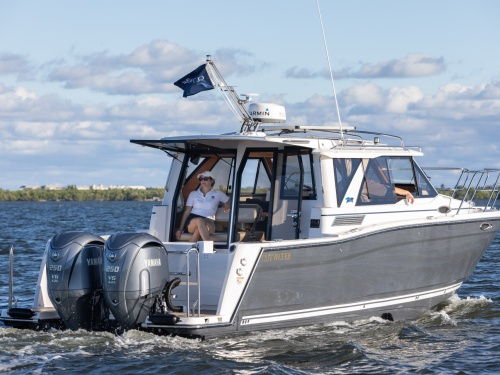
Cutwater C-288 CB (2026-)
2 x 250-hp Yamaha F250 outboards

Brief Summary
Built by Cutwater Boats, a manufacturer celebrated for producing highly adaptable and thoughtfully engineered vessels. The C-288 CB is engineered for the avid explorer and social boater, designed to handle diverse cruising conditions efficiently while providing unmatched comfort and entertainment space. It truly excels as a "do-it-all" boat, perfectly suited for weekend trips, entertaining guests, or making a quick dash to a secluded cove.
Specifications
| Length Overall |
36' 3" 11.05 m |
|---|---|
| Beam |
10' 3.05 m |
| Dry Weight |
10,500 lbs 4,536 kg |
| Draft Up |
23" 0.58 m |
| Draft Down |
33" 0.84 m |
| Fuel Capacity |
200 gal 757.1 L |
| Water Capacity |
41 gal 155.2 L |
Engine Options
| Std. Power |
2 x 250-hp Yamaha F250 outboards |
|---|
The C-288 Command Bridge is more than just a boat; it's a meticulously crafted home on the water. Every dimension has been optimized, from the hull beam that enhances both stability and interior volume to the ingenious features that prioritize ease of use and maximum enjoyment.
Standout Features:
- Twin Yamaha Power: Equipped with a pair of 250 horsepower outboards featuring electric steering for dependable, responsive handling.
- Command Bridge: A second, elevated helm station with full controls (including a second Garmin suite and bow thruster controls) and comfortable seating, offering unparalleled views and a great social space.
- Clear-Path Swim Platform: A unique, full-wrap-around swim platform providing safe and easy access around the outboard engines.
- Off-Grid Capability: Extended time away from the dock is possible with an included 220W bi-facial solar panel on the hardtop.
Key Features:
- Advanced Hull: The double-stepped deep-V hull design with Laminar Flow Interrupters ensures a smooth, stable, and highly fuel-efficient ride.
- Climate Control: Interior comfort is guaranteed in any weather thanks to standard heating and air conditioning.
- Forward Owner's Quarters: A private primary berth for restful nights.
Features Walkthrough Video Transcript
Overview
Captain Tripp's introduction: "Command bridge is indicating there's a flybridge on this boat, and this is a 28 footer, but it is compact — but it's also capable and it's very comfortable."
Bow
Ladder/beach access: An on/off swim ladder access point at the bow. Captain Tripp's stated use case: "You pull up on a beach, you can drop the swim ladder on off the boat with ease."
Additional bow features: Electric windlass, access to the rode, and a handrail running the full perimeter. Two opening hatches are also fitted.
Shallow-water use case (per Captain Tripp): "There is room up here if you want to... you're cruising casually nice and easy through some shallows. Maybe you're crossing the Bahama Bank or trying to find some coral reefs or something to snorkel on — right here will be a good spot to locate that."
Side Decks
Captain Tripp noted the side decks are narrow but fitted with composite tow rails plus a grab rail running the full length of the cabin top. His assessment: "As you are making your way back, you're gonna be on the boat really secure... these are gonna hold me really well, so I'm not concerned about falling off."
Power
Twin Yamaha 250 V6 engines. Captain Tripp's stated performance expectation: top speed around 50 mph, cruising around 30–35 mph.
Swim Platform
- Grab rails/stanchions: Positioned on either side to assist safe boarding
- Telescopic swim ladder: Underfoot
- Additional grab handle, fuel fills, rod holder
- Freshwater shower: Hot and cold, plumbed in on the pole holding the sunshade — for rinsing off saltwater before heading to the cabin
- Livewell: Decent size
- Electric Kenyon grill: Positioned across from the livewell. Captain Tripp's stated use case: "Maybe you just brought in that catch. Maybe you've got some fresh steaks to toss on here. You can do so and kind of keep everything away, all your mess, so to speak, back out of the boat."
- Additional stanchion and small fenders at this location, intended to protect the boat in tight situations (e.g., kayaks coming alongside)
Transom
Features convertible four-and-a-half-facing seating (transcribed as such — likely describing a flexible seating configuration for four-plus occupants).
"Clear Path Transom": Cutwater's term for an open transom design. Captain Tripp noted the appeal: "This is a fantastic place to sit and enjoy an evening, a sunset, or at middle of the day. You're still under the sunshade."
Engineering behind the clear transom: Elbow joints in the rigging allow it to turn and run backward into the boat without binding, providing the clear path. This design also allows the engines to trim all the way up without the rigging binding.
Additional Cockpit Seating
A flip-out bench seat tucked away on the port side. Combined with the aft seat, this provides substantial seating capacity for guests. A window can be opened here to provide additional seating access.
Aft-facing convertible dinette bench: Accessed via a bi-fold window that flips up and secures out of the way on the cabin top; a footrest flips down for use.
Fishing Features
Scotty rod mounts are fitted, with plugs positioned for electric reels. In fishing mode, the cockpit flooring can be pulled up via snaps for cleaning/access.
Build Philosophy (In-House Manufacturing)
Captain Tripp highlighted Cutwater's approach: "Cutwater, they do all this themselves in-house. They order this material and they cut it. They bind it all themselves. They do all their upholstery in-house, all their metal work in-house." He noted the stated benefits: quality control over components, and faster part turnaround for owners needing replacements — "You can get that part quickly, and they're gonna make it for you, not have to order it from an outside source."
Electrical System (Mechanical Space)
- House batteries: 900 amp-hours of lithium
- No generator required: Everything is charged by the outboards. Captain Tripp: "When you're running your air conditioner or warming something up [in] the microwave or running the Kenyon grill, you're running off that lithium, and you have plenty of capacity there to run [the] air conditioner overnight."
- Additional batteries: Lead-acid start batteries for the engines, plus a dedicated battery for the bow thruster
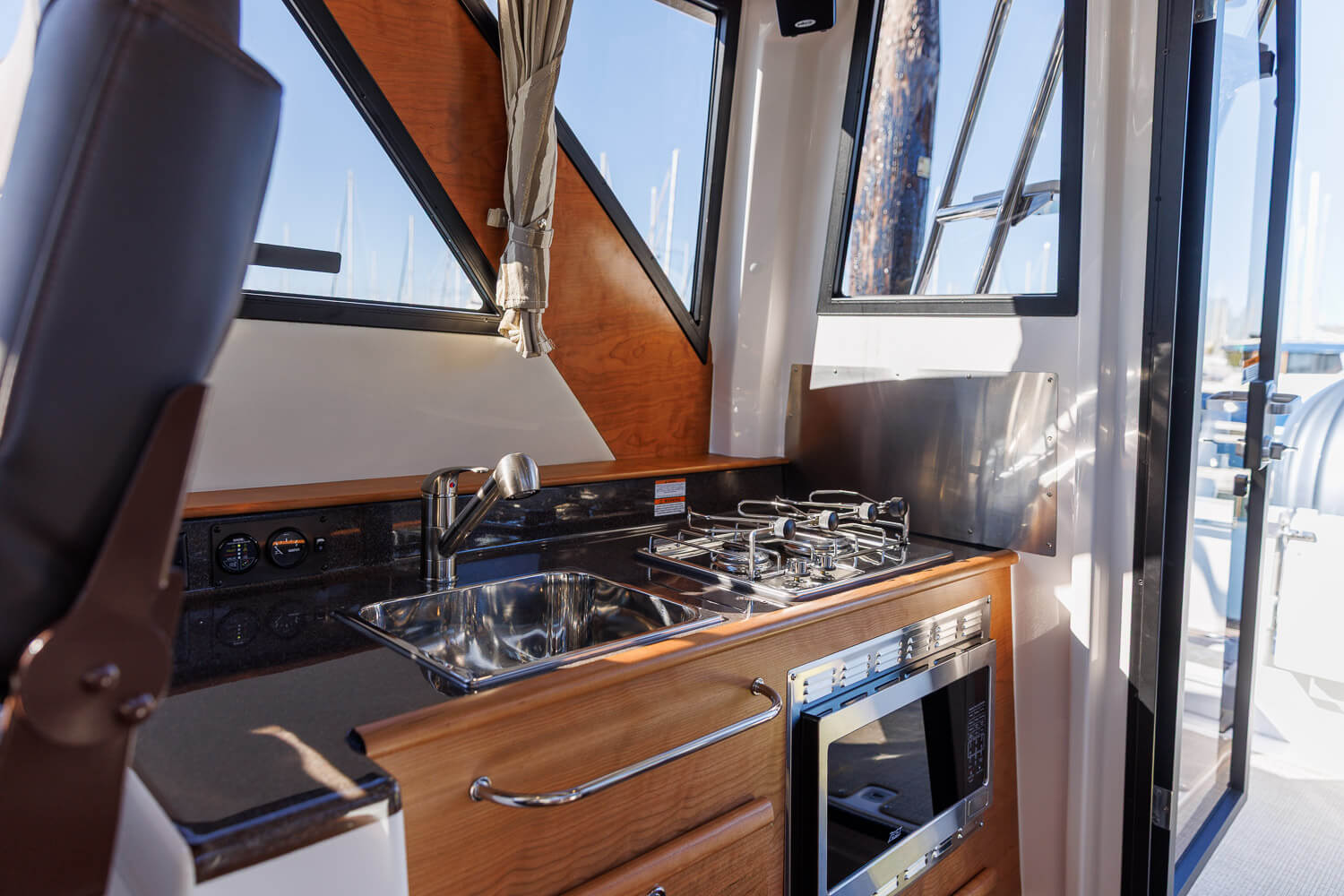
Galley (Starboard)
- Gas burner stove — Captain Tripp connected this to the boat's origin: "This kinda reminds me how this boat is manufactured in Washington state. So this is a totally American-built boat, and since they're used to the cold weather up there, it might be a good reason to have the gas stove."
- Fairly deep sink, grab handle
- Microwave, with drawers underneath and a large drawer beneath the microwave
- Small shelf with fiddle rail (for spices, paper towels, etc.), positioned along the back
- Water tank gauge, 110-volt outlet, USB outlets
Forward of galley (under helm seat): A fairly well-sized 12-volt fridge, described by Captain Tripp as able to hold significant provisions. A wine chiller is positioned across from it.
Dinette (Port Side)
The backrest is convertible — currently aft-facing (as used earlier in the walkthrough as cockpit seating), it flips to forward-facing for dinette use. Two steps up elevate the seated position for visibility through the surrounding windows, and this elevation creates room for a berth underneath (detailed below).
Table: Leafed. Opposing seating is also convertible, flipping to become a forward-facing companion seat while underway — positioned to sit alongside the operator. This seat includes its own AC vent, cup holders, grab handle, and a small shelf with USB charging. Ventilation options include a sliding window or overhead hatches.
High-low table function: The dinette table drops down; with an infill cushion added, it becomes a large berth. Captain Tripp's suggested use case: "This would be great if you have, say, two cruising couples on board for a short weekend. They can sleep here."
Under-dinette berth: A separate, fairly good-sized berth is located beneath the dinette platform, with two windows for natural light — noted by Captain Tripp as well suited for kids: "It'd be fantastic for some kids to get under there and just tuck themselves away."
Electrical panels (same area): Battery switches, inverter controls, and 12-volt system controls, including AC controls. The boat has two independent AC zones — Captain Tripp explained the power-saving benefit: "If you're sleeping in the V-berth, you can only have the AC running up there, and that's gonna conserve that electricity."
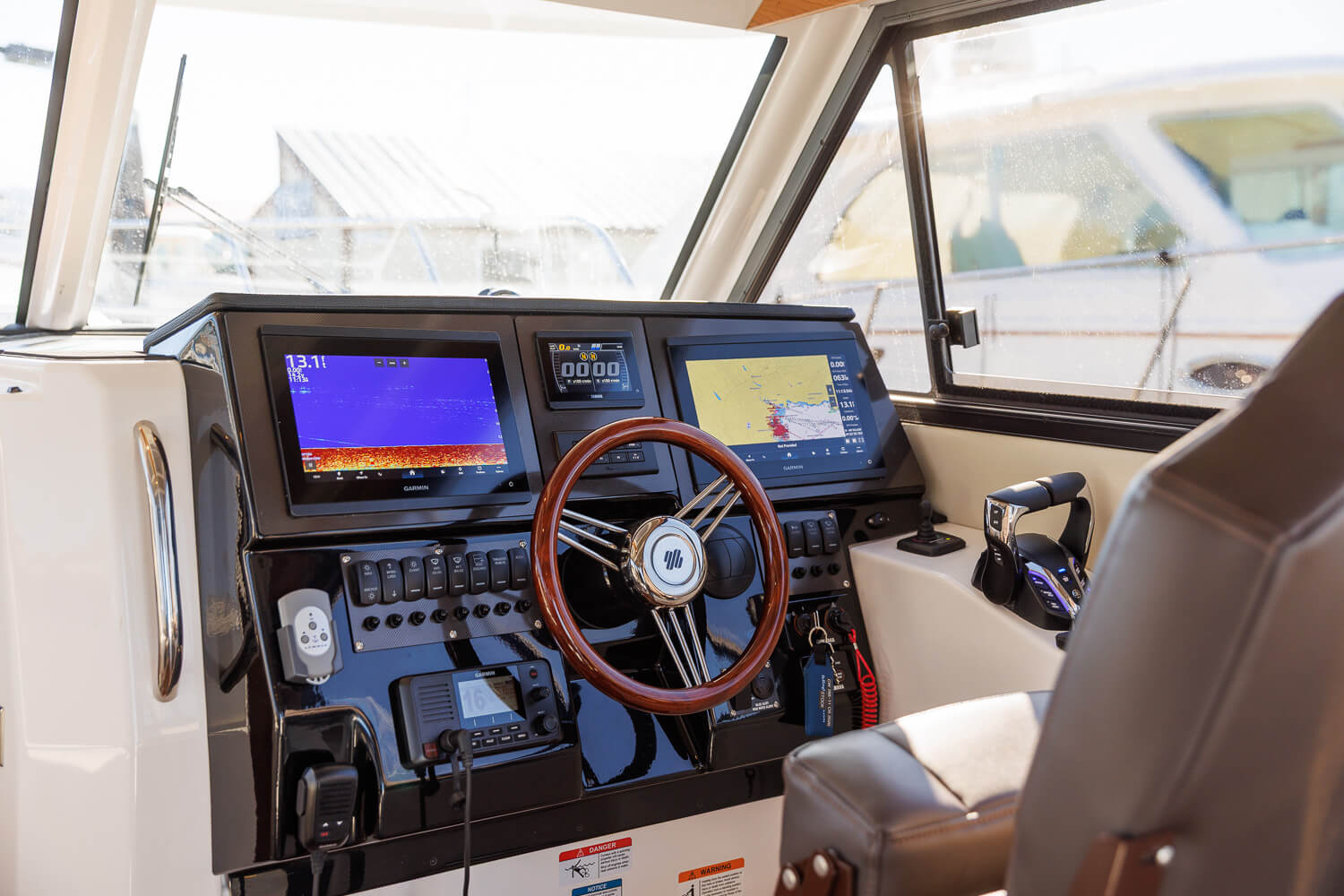
Helm
Captain Tripp's framing: "The command center."
Equipment:
- Two large Garmin screens
- Yamaha engine screens
- Autopilot
- Switches for most-used items
- Bow thruster with wireless remote for easier docking
- VHF radio
- Engine controls
- Joystick, for easy tight-quarters operation
- Trim tab controls
- Additional bow thruster controls
- AC vent, plus an operator-side opening window
- Recessed LED lighting, paired with woodwork, for an elevated finish
- Overhead EVA foam, providing insulation and sound deadening while also contributing to the aesthetic
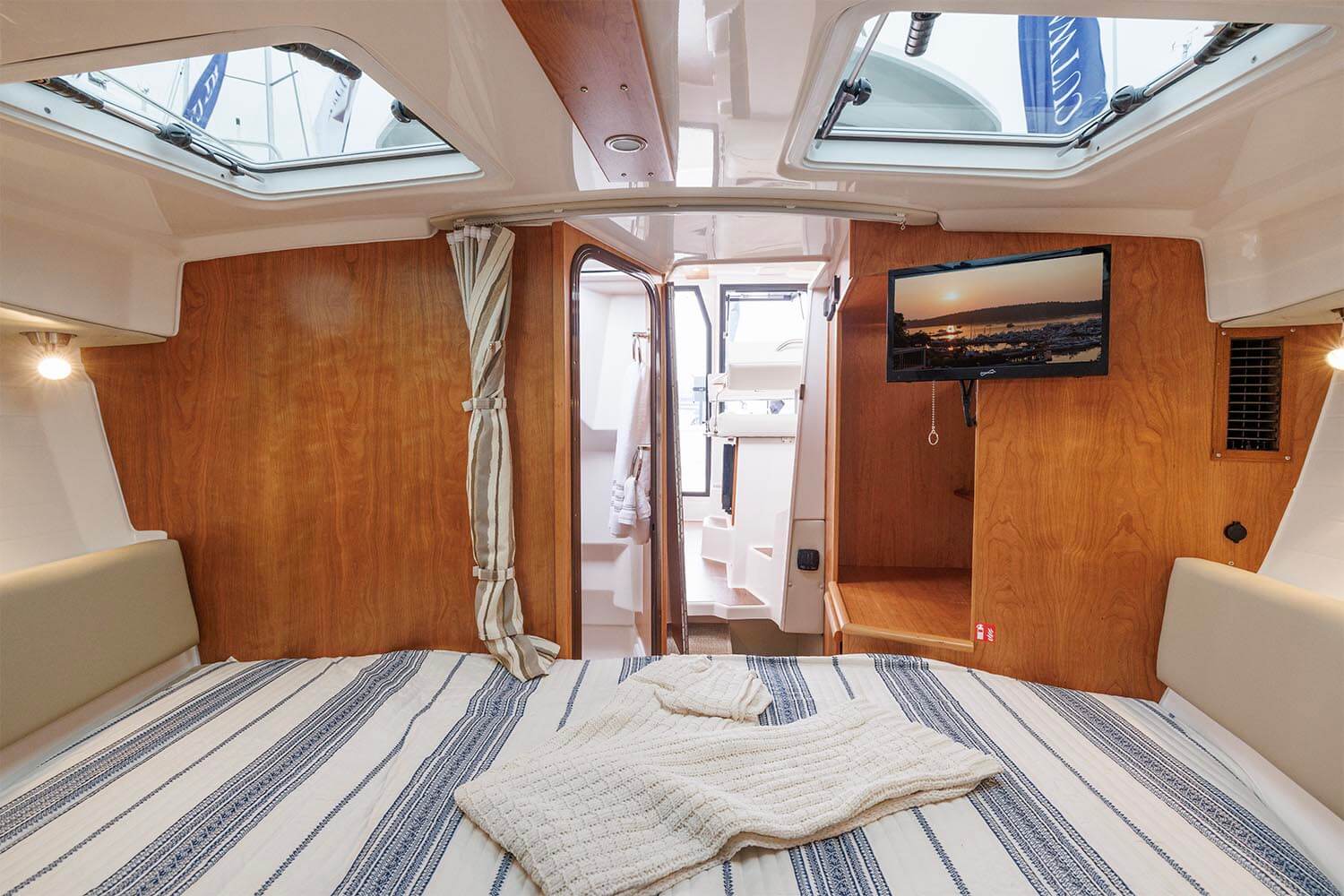
Forward Cabin (V-Berth)
Captain Tripp noted the air conditioning performance directly: "I can really feel the air conditioning pumping down here, and it feels fantastic."
Features:
- Hanging locker (port side) and a TV
- Overhead hatches and additional LED lighting
- Shiplap paneling along the sides — Captain Tripp noted this wasn't required with a fiberglass mold but adds a design touch: "It just looks good and adds that extra little touch."
- Two opening ports for ventilation, in addition to the overhead hatches
V-Berth to Office Conversion
Captain Tripp specifically highlighted this dual-purpose function, demonstrating the conversion: "In less than a minute, I've created my own little space. So if I wanna get away from the distractions, get outta the heat, enjoy the air conditioning, come in here and read a book or do some work. If I'm working remotely, I can do some in comfort."
Head
Captain Tripp's assessment for the boat's size: "For a 28-foot boat, there's actually a decent sized head on board, and the woodwork is absolutely beautiful. It gives a good tone and warmth in there."
Features: Glazed overhead skylight for natural light, 110-volt outlet, toilet, vessel sink, and storage.
Flybridge Access
Reached via a ladder, which Captain Tripp cited as an example of Cutwater's in-house metalwork quality, noting it makes flybridge access easy.
Flybridge
Seating: For three — a half-facing and forward-facing bench seating arrangement alongside the helm.
Helm (flybridge): Captain Tripp's stated preferred use case: "I could just picture myself crossing over to the Bahama Bank, and as soon as I see that shallow water coming, I'm coming up here and this is where I'm gonna sit. Or if I'm trying to scout out a coral head to catch some lobster, something down in the keys, this is where I'm gonna be."
Equipment: Full system controls, including trim tabs, joystick, and bow thruster.
Docking use case: Captain Tripp described a specific scenario using the flybridge with dock hands: "I might could get my bow line up here, my stern line up here, and as I bring myself into the dock, I could just toss my lines to the dock hands and look like a pro coming into the dock."
Flybridge Dash — Trailering Feature
Captain Tripp highlighted a design detail: the entire dash section is hinged and can drop down. His stated rationale: "Where that's gonna help you out is when you're trailering this boat, because it is a trailerable boat — you can drop this down and reduce the height of [the] boat on the trailer, so you can be within more legal limits. Or let's say you're going under a low bridge and [you can] drop it down and get out [under it] a little bit easier."
Solar Panel (Flybridge, Aft-Facing)
A bifacial solar panel is fitted on the back of the command bridge structure. Captain Tripp explained the technology: "It collects solar arrays from the top and the bottom. So anything that reflects up from the water or the gel coat, it's gonna increase the efficiency of the solar panel. That's gonna help keep those batteries topped off." Additional rod holders are located in this area for fishing gear storage.
Closing Assessment
Captain Tripp: "Thanks for joining me on this walkthrough of Cutwater's new 288 Command Bridge. I'd like to see this out on the water."
Related Boats
Cutwater 28 (2011-)
Currently no test numbers
Cutwater C-32 CB (2026-)
2 x 300-hp Yamaha outboards