Access More Boat Tests
Already have an account? Login
Eastern Boats Rosborough 246 Yarmouth (2022-)
1 x 200-hp Honda

Brief Summary
The Rosborough RF-246 is a cruising couple’s coastal cruiser. She has a low bridge clearance making her a capable “Great Loop” cruiser. Her utilitarian design style is one of a working boat and this is, at least in part, what gives the line an almost “cult-like” following.
Test Results
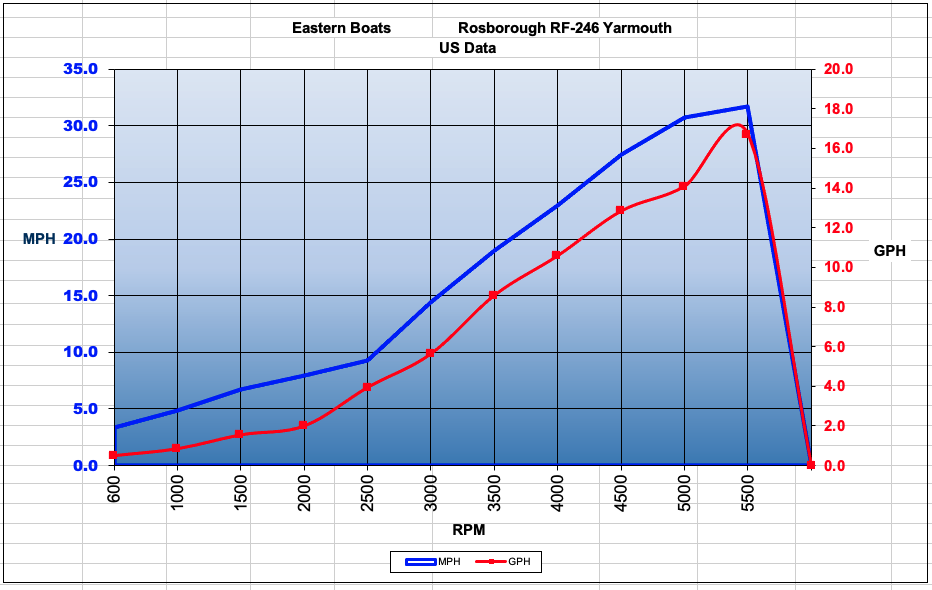
| RPM | MPH | Knots | GPH | MPG | NMPG | SM | NM | dBa |
|---|---|---|---|---|---|---|---|---|
| 600 | 3.4 | 3 | 0.5 | 6.8 | 5.9 | 704 | 612 | 50.9 |
| 1000 | 4.9 | 4.3 | 0.9 | 5.8 | 5 | 597 | 518.8 | 56.3 |
| 1500 | 6.7 | 5.8 | 1.6 | 4.3 | 3.8 | 447 | 389 | 60.1 |
| 2000 | 8 | 6.9 | 2 | 4 | 3.5 | 411 | 357.8 | 67.1 |
| 2500 | 9.3 | 8 | 4 | 2.3 | 2 | 242 | 210.8 | 68 |
| 3000 | 14.4 | 12.5 | 5.7 | 2.5 | 2.2 | 264 | 229.4 | 74.5 |
| 3500 | 19 | 16.5 | 8.6 | 2.2 | 1.9 | 228 | 198.3 | 78.8 |
| 4000 | 23 | 20 | 10.6 | 2.2 | 1.9 | 225 | 195.3 | 78.5 |
| 4500 | 27.5 | 23.9 | 12.9 | 2.1 | 1.9 | 221 | 192.6 | 81.7 |
| 5000 | 30.8 | 26.7 | 14.1 | 2.2 | 1.9 | 226 | 196.3 | 82.8 |
| 5500 | 31.8 | 27.6 | 16.7 | 1.9 | 1.7 | 197 | 171.1 | 82.3 |
Specifications
| Length Overall |
25' 7.62 m |
|---|---|
| Beam |
8' 6" 2.59 m |
| Dry Weight |
7,500 lbs. 3,401.94 kg |
| Tested Weight |
8,240 lbs. 3,738 kg |
| Draft |
18" 45.72 cm |
| Bridge Clearance |
12' 3.65 m |
| Fuel Capacity |
115 gallons 435.32 L |
| Water Capacity |
40 gallons 151.41 L |
| Total Weight |
8,240 lbs. 3,738 kg |
Acceleration Times & Conditions
| Time to Plane | 3.7 seconds |
|---|---|
| 0 to 30 | 6.8 seconds (0 to 20) |
| Props | 15 1/4 x 17 |
| Load | 3 persons; 28.75 gal. fuel; 50 lbs. gear |
| Climate | 64 deg.; 45 humid.; winds: 0-5; seas: 0 |
Engine Options
| Tested Engine |
1 x 200-hp Honda |
|---|
Captain's Report by Capt. Steve
Mission
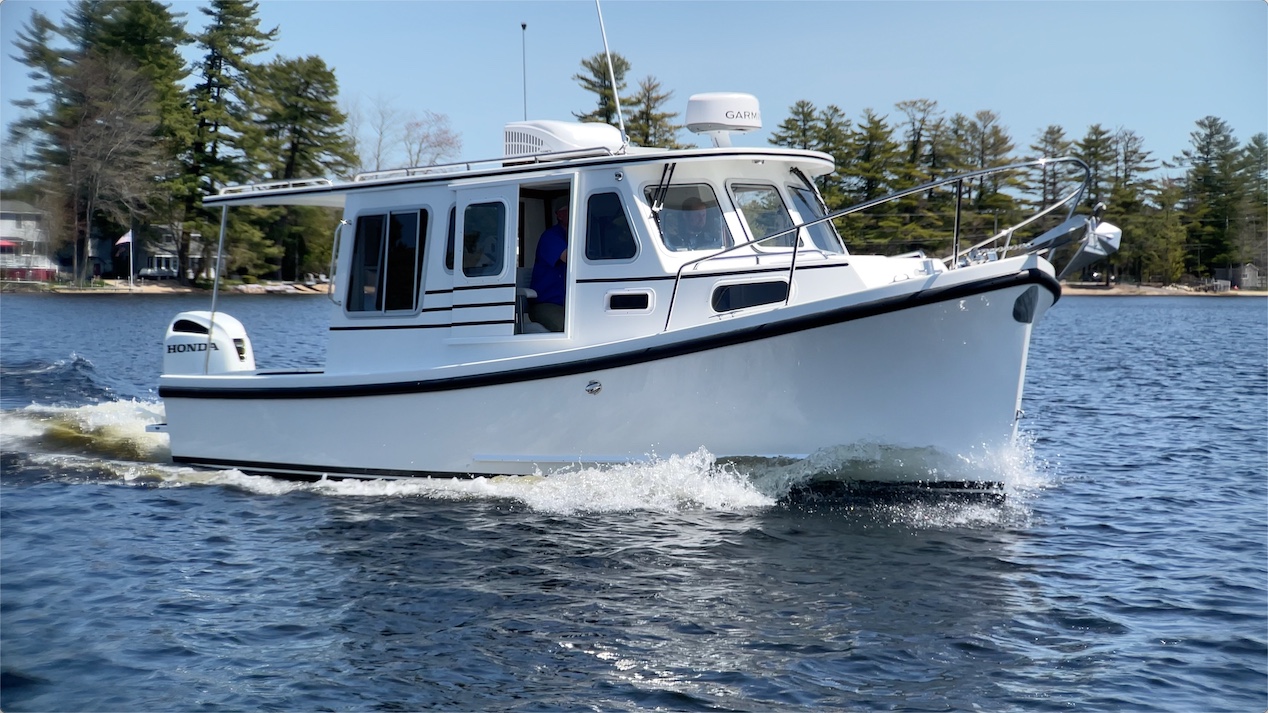
The RF-246 was designed to be a low-maintenance, easy-to-handle coastal cruiser for a single couple. The dining area can be made into another berth in a pinch, but this boat tends to attract those couples who are primarily cruising by themselves. There’s room for more to gather at the anchorage or marina, but for cruising, it’s the empty nesters that are finally able to get out on their own.
Different Versions
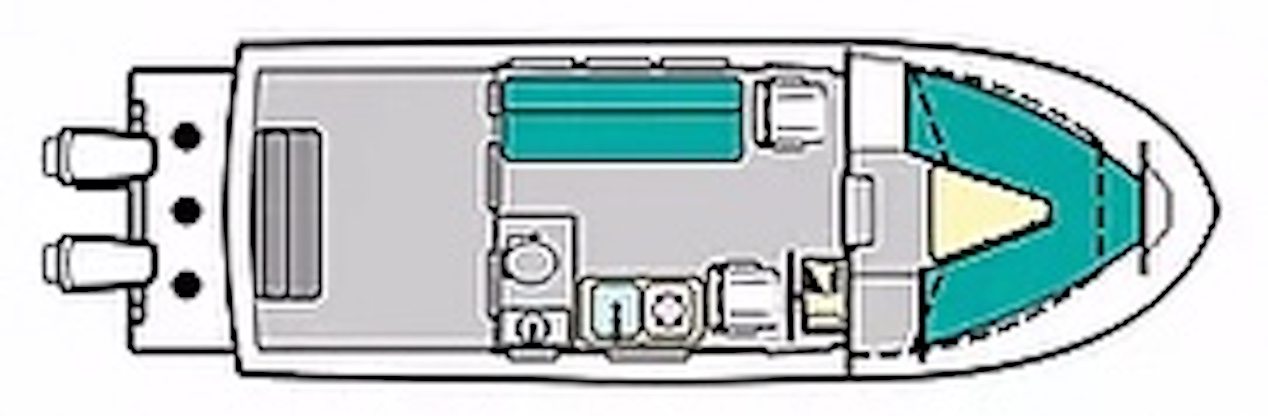
Let’s start with the fact that there are three different layouts for this boat. The Digby, the Halifax and the Yarmouth. The only differences lie in the interior layout. The version we tested was the Yarmouth.
Major Features
- Hand laid fiberglass hull with grid stinger system
- Outboard power
- Interior ventilation with center opening window, side and rear sliding windows.
- V-berth for weekend excursions.
- Hinged dash for ease of electronics installations
- High bow for coastal excursions
Design
Utilitarian is already a word that we used to describe this boat. It’s a working boat with minimal systems that make it easy to handle and easier to manage. For those looking for a boat full of teak decking and Ultraleather upholstery, look elsewhere. Expensive Stidd helm seat... nope. You can get this stuff, but why bother? With this boat, feel free to make a mess, it cleans right up. Don’t worry about catching dinner on the aft deck or even gutting and cleaning it. It all hoses right off. Want to mount an MFD (Multi-Function Display) somewhere? Drill a couple of holes for the bracket and screw it in.
With all that said, we need to be clear that this is a well-built boat. None of this “no frills” design styling implies that this boat was thrown together, and nothing could be further from the truth. She’s all hand-laid fiberglass construction with a bonded grid stringer system laid in. Positive foam flotation is added and she’s as safe as she is strong. Even though there are few frills to the interior, there’s still a fair amount of teak trim to be seen. These will be places such as fiddles to the counters and tables, trim between the overhead and bulkhead joinery and around doorways. Drawers and cabinetry will also be fabricated from teak. It all leads to the bottom line that this is a solid and practical boat without the owner, or the builder, pouring money into useless features that add nothing but costs to the end product. Everything here has value.
Performance
The Rosborough RF-246 has a length overall of 25’ (7.62m), a beam of 8’6” (2.59 m) and a draft of 18” (45.72 cm). With an empty weight of 7500 lbs. (7402 kg), 25% fuel and three people on board we had an estimated test weight of 8240 lbs. (3,738 kg).
With a single 200-horsepower Yamaha outboard turning 15 ¼ x 17 pitch prop and run up to 5500 RPM our speed topped out at 31.8 MPH. Best cruise came in at 3000 RPM and 14.4 MPH. At that speed, the 5.7 GPH fuel burn translated into 2.5 MPG and a range of 264 statute miles. All while still holding back a 10% reserve the boat's 115-gallon (435.32 L) total fuel capacity.
In acceleration tests she reached planing speed in 3.7 seconds and cruised through 20 MPH in 6.8 seconds.
Handling
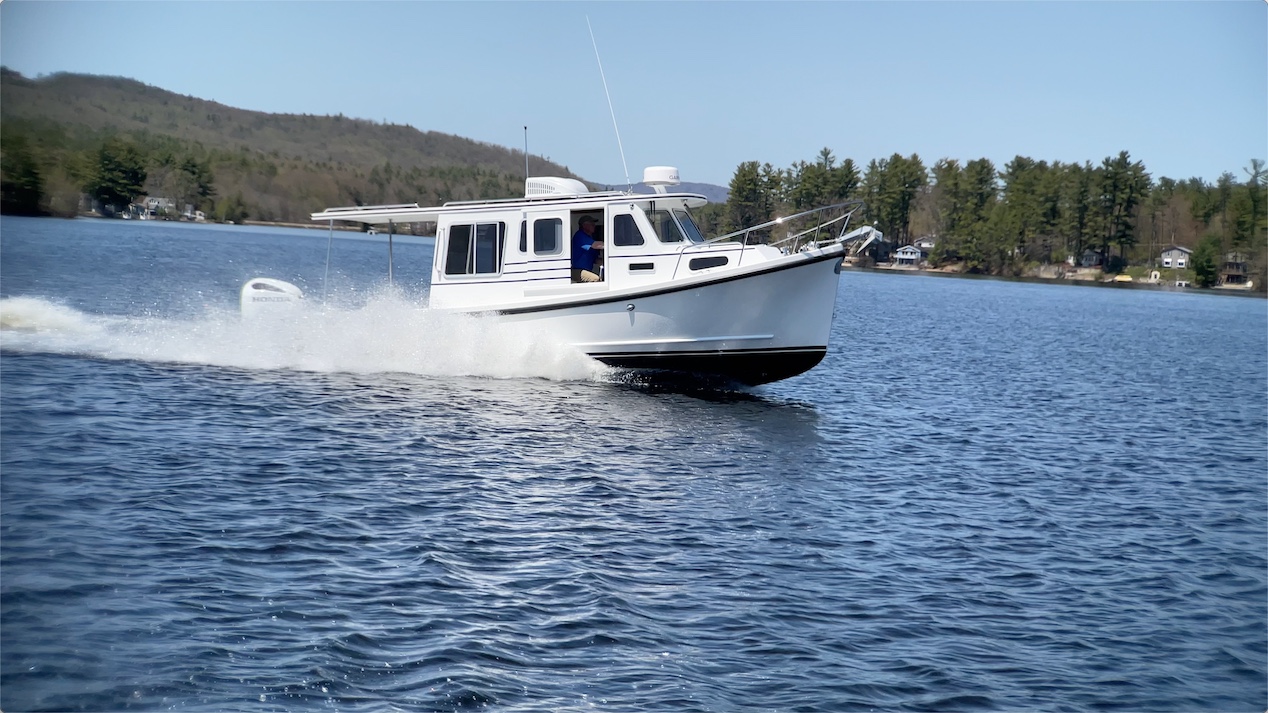
The 246 is a comfortable cruising boat. She'll do 30 miles an hour but when you're at that speed the question becomes why. That's not really the kind of boat this is. She's made for going slow and going for a good distance. Her best cruising speed is about 14 MPH and that's where we will get the best economy as well. It just seems to handle the best at that speed. She makes gentle, comfortable turns and she's settled into the water to the point where she's got buoyancy all around. That means that when you come upon a wake at that speed, you're not getting thrown all over the place like you would be if you were up on plane.
It’s definitely a cruising couple’s boat and I could see a couple really enjoying this and just taking off and having a good time with it. The ride is kept dry thanks to the high bow and the spray rails to both sides.
We’ve said several times that this is an easy boat to handle, but even if there’s a heavy-handed captain at the helm, the 4” (10.16 cm) rub rail will cushion all but the mightiest blows to the dock.
Boat Inspection
We’ll start out inspection of the RF-246 in the interior. Headroom is an impressive 6’9” (2.06 m). An optional 15,000 BTU reverse cycle heater/air conditioner was mounted on our test boat and this requires shore power to function. Otherwise, open the side doors, the front window, the aft and side windows and the aft door to let the air flow through.
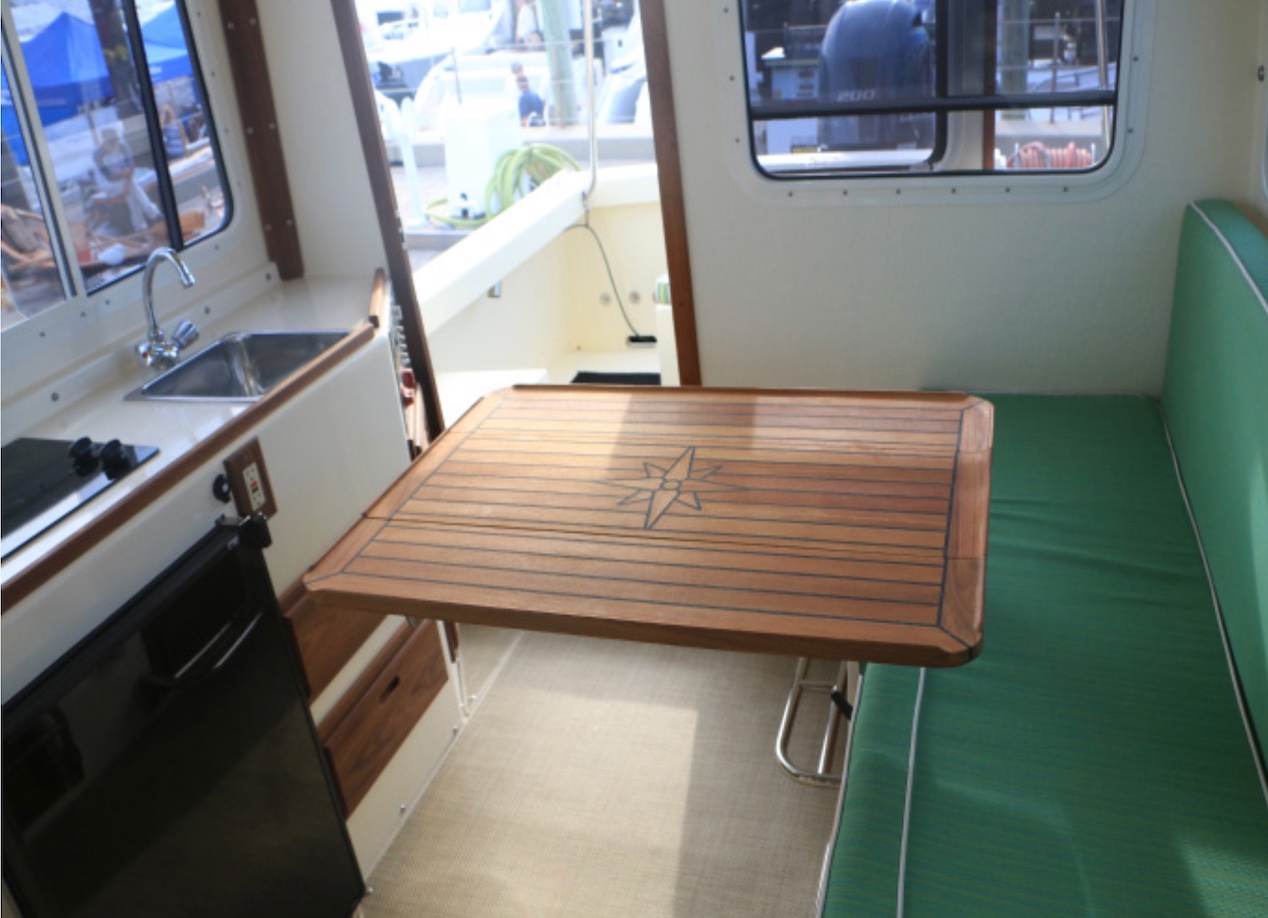
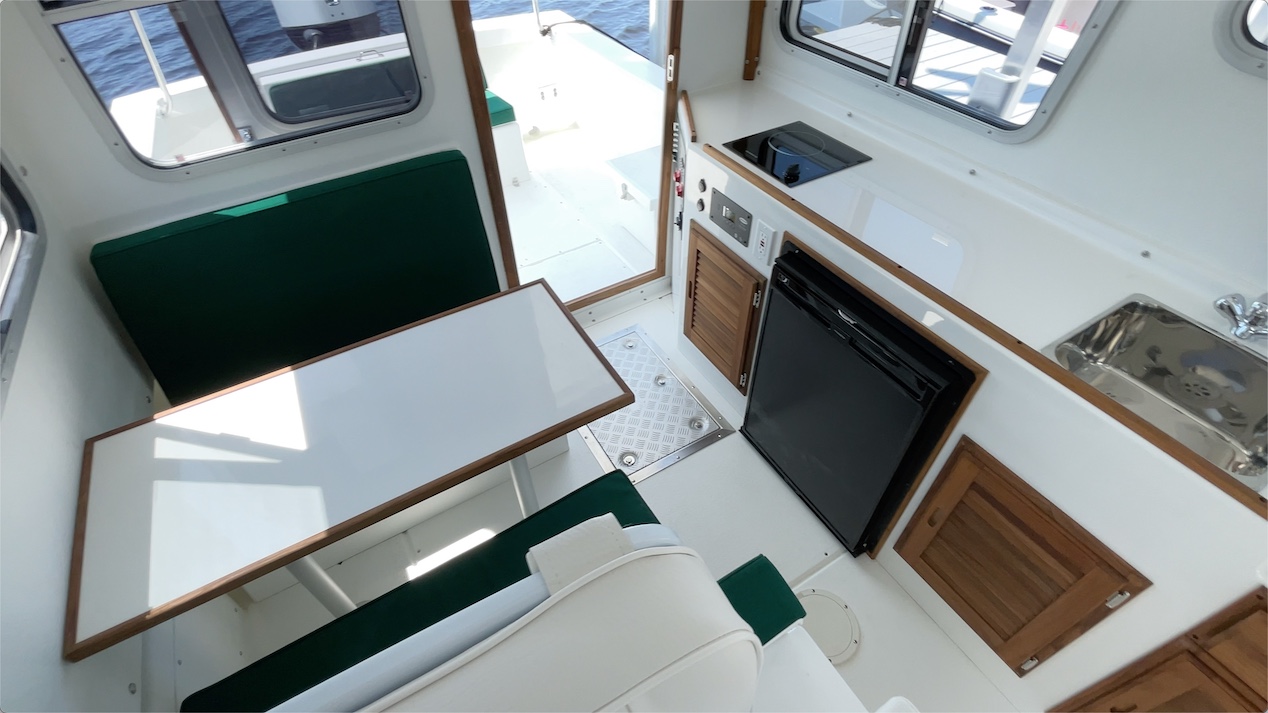
As for the layout, the Yarmouth version has the galley to port and booth-style seating to starboard with 39” (99.06 cm) bench seats to either side of a table on dual fixed pedestals. To the aft side of the galley, right at the entrance, is the main electrical panel and battery switches. Unlock the main door to get to them.
For conversion to a berth, the table can be dropped down, and then the forward seatback is removed and placed under the helm seat making it a length of 6’2” (1.88m). Storage is under the seats in the form of drawers so there’s no need to ask occupants to get up to access the storage.
Between the seating and the galley, there’s 23” (58.42 cm) of walkthrough space. The galley is equipped with a single-burner electric stove and a propane or diesel version is offered. An opening window is just above the stove. Plenty of counterspace is ahead, and teak fiddles are fitted to keep items in place. Fully forward is a recessed single basin sink. Below, there’s plenty of storage along with refrigeration. Also under the counter is the hot water heater. Perhaps a location below decks might be a better place to put this, and that would open up more storage space.
Let There Be Light
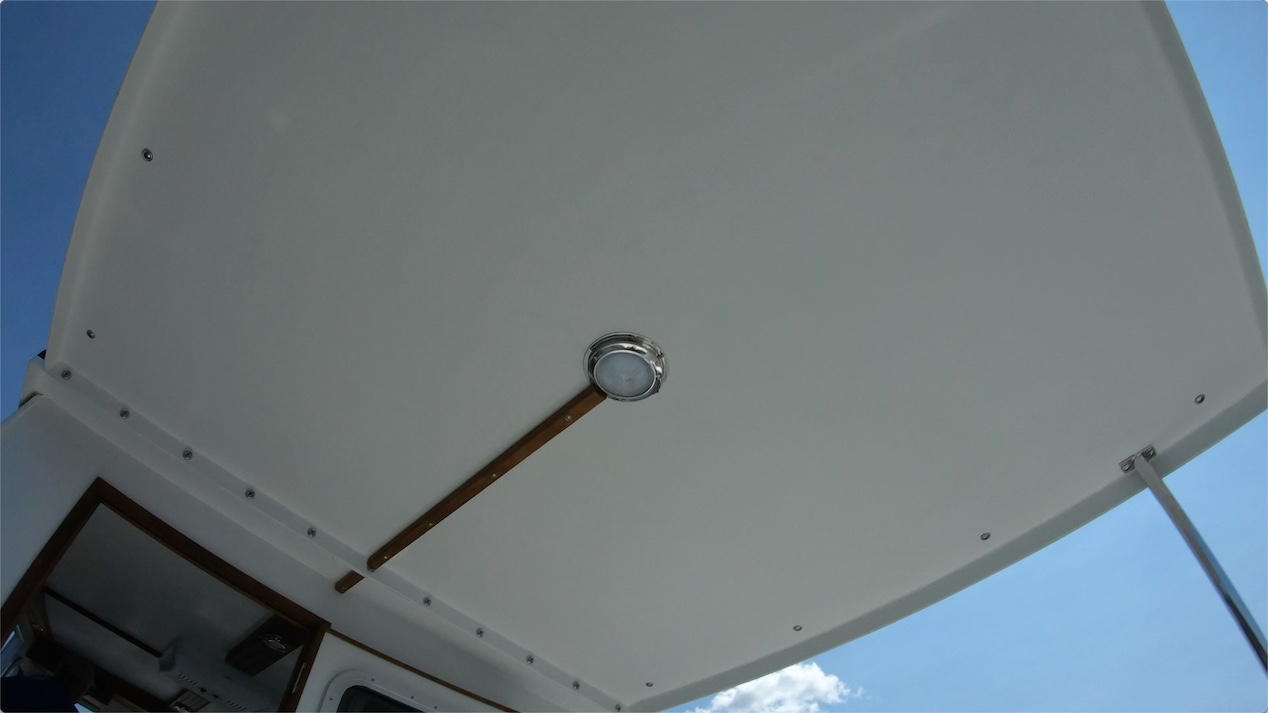
To both sides of the overhead, there are teak strips that contain three LED lights activated from a switch at the helm panel. In the center of the overhead there is a teak wiring channel with two more LED lights, but these are operated from integral switches in the lights themselves. They are red or white and dimmable. All this in addition to the windows that surround the main deck providing all the natural light needed, along with the already mentioned ventilation.
Helm
The helm is cut and dry and that keeps with the utilitarian feel of the 246. It’s a simple console with a vertically mounted stainless-steel steering wheel. Electrical switch panels are off to the side, against the door to the companionway.
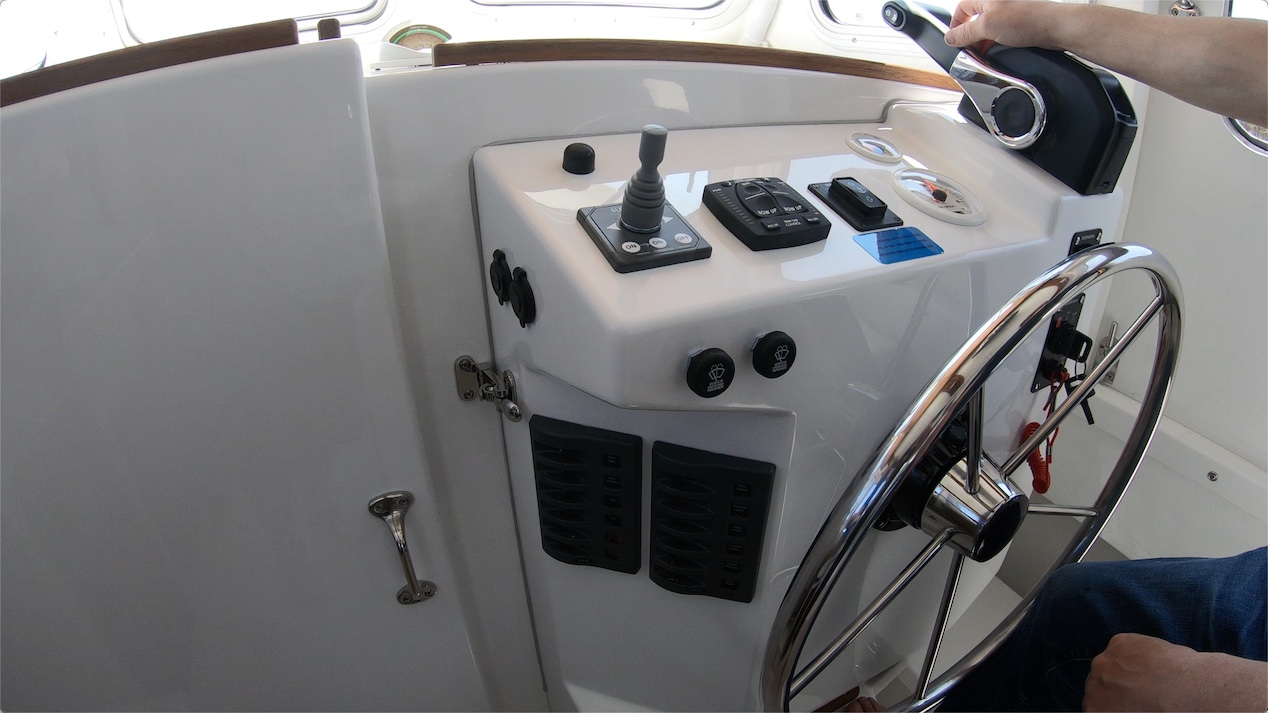
The panel has only two gauges… fuel and RPM. To the left is the joystick for the optional bow thruster, the trim tabs and the windlass control. The engine control is on a raised section to the right. The favorite feature, again…. Is the opening side door providing the ventilation and easy access to the dock, and for that reason, I’d like to see the addition of a midship cleat. Even if it is a tripping hazard to the bow. Inside each door is a storage box that also serves as a step in and out of the doors.
Above is a bracket mounted 12” (30.48 cm) MFD (Multi-Function Display) with a VHF right alongside.
Another thing to like on this boat is the sheer number of teak fiddles seen throughout. At this forward section, they’re at the dash ahead of the helm and then repeated to the opposite side. On top of the sliding companionway door, they’re also present making this a nice workstation for putting chartbooks.
Down Below
While the RF-246 is not set up for long term liveaboards, there are accommodations that make this a comfortable coastal cruiser. The cabin below, with its 5’7” (1.70m) of headroom includes a pair of 6’2” (1.88m) V-berths that can accommodate a filler cushion in between. A manual head is in an enclosed compartment to the aft starboard side and an opening portlight provides ventilation. Privacy is provided via a sliding door to the center-mounted companionway.
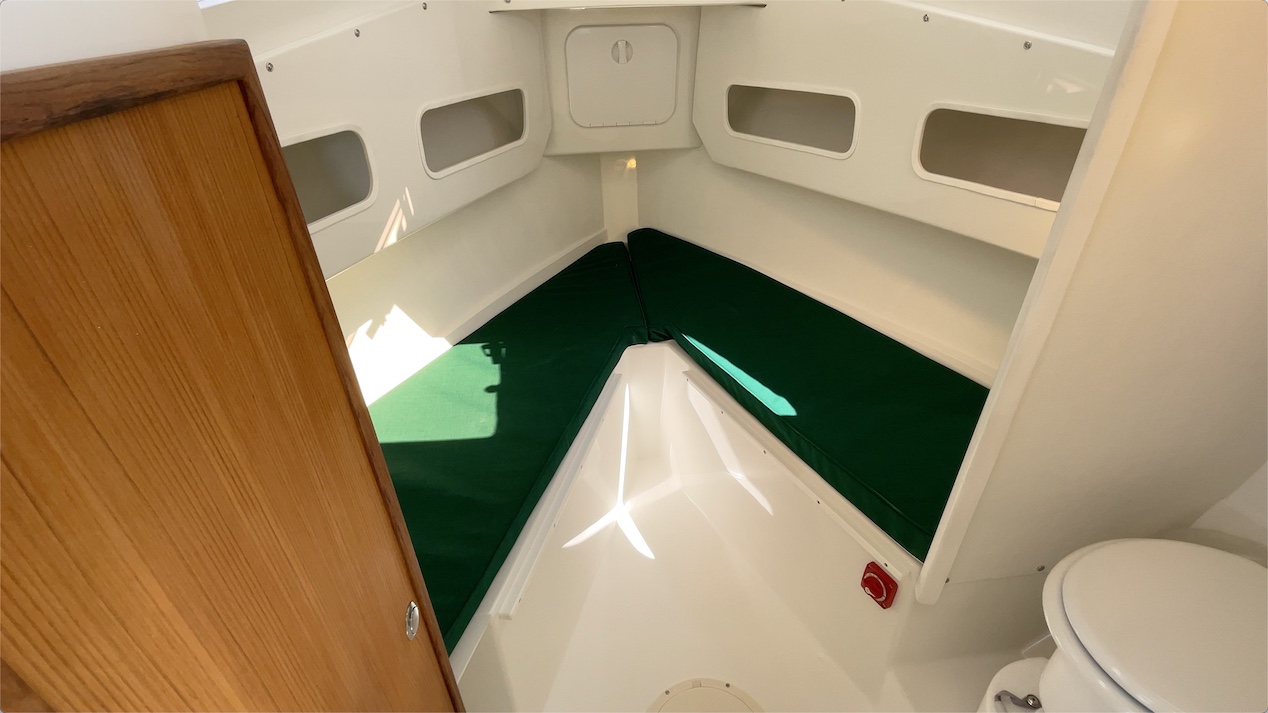
There are storage cubbies to both sides as well as a hanging locker. Side windows provide the natural light in addition to the overhead hatch. Access to the rode locker is fully forward.
Cockpit
The cockpit deck is spacious enough for a comfortable gathering area. It measured in at 7’10” x 4’2” (2.39m x 1.27m) and includes a bench seat at the transom. Certainly, we can add our own deck chairs, or just sit on the wide caprails atop the 24” (60.96 cm) high bulwarks. We can also fit those caprails with grab rails. Storage boxes are fixed to the deck, ahead and to both sides. These also make excellent steps for boarding and disembarking. Also to port is a 30-amp shore power connection and a hot/cold shower. More storage is accessed by pulling the hinged transom seat forward and it runs a full 35” (88.90 cm) under the cockpit deck. This will also allow access to the transom-mounted fuel filter.
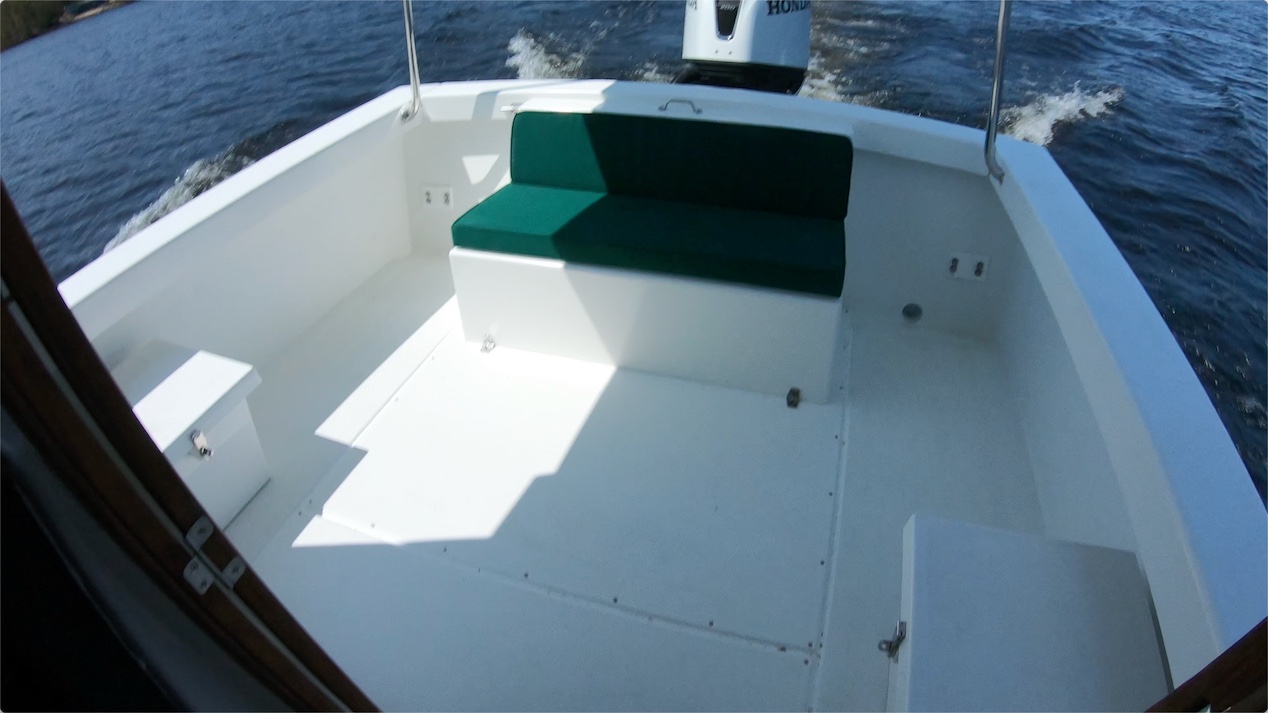
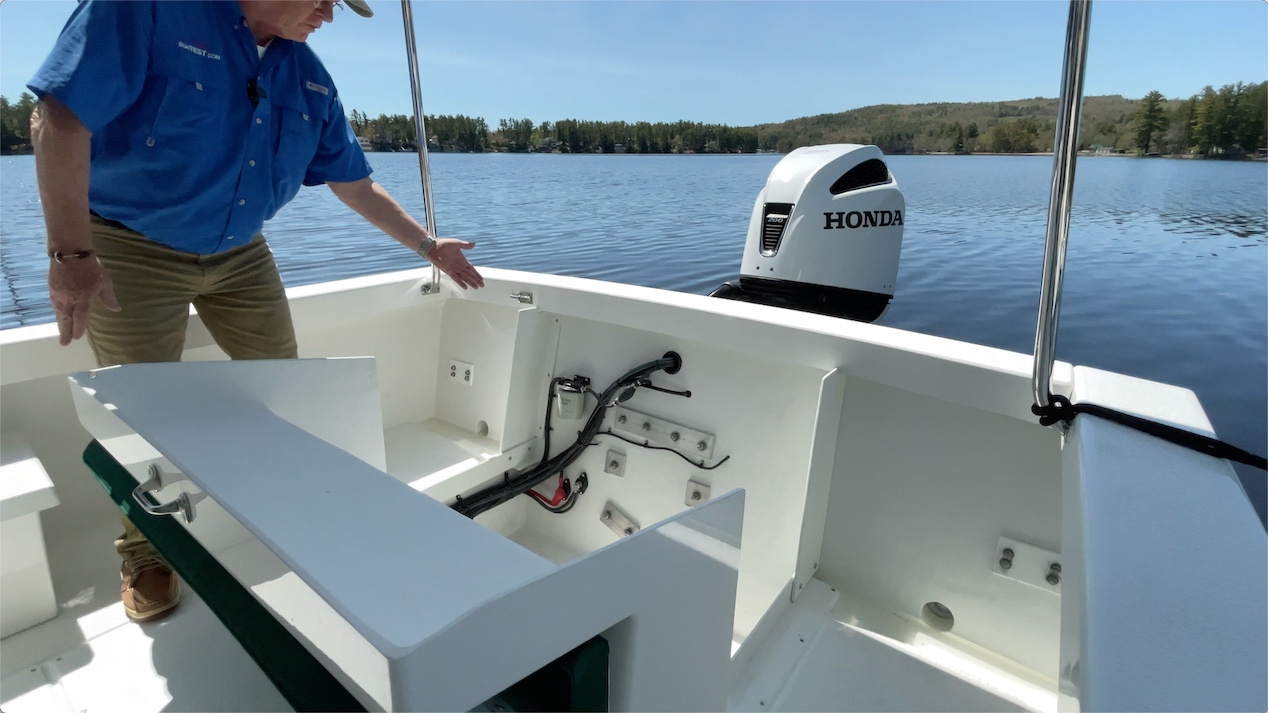
Above all this there’s an optional extended overhead 6’7” (2.01m) off the deck. It’s fixed to the trailing edge of the cabin hardtop and supported by two stainless-steel stanchions at the aft corners. Stainless-steel grab rails run the entire length of the overhead to both sides. If the extended overhead is selected, then take it a step further and get the three-sided enclosure of the aft deck. It effectively makes the 246 a three-season boat.
Need a generator?
If a generator is requested, then one can be added easily enough, and it will store under the transom bench seat. If that is done, then Rosborough USA recommends adding a hull extension to add buoyancy that will offset the added weight. It comes aft to about the same footprint as the current swim platform on the stock model.
Bow
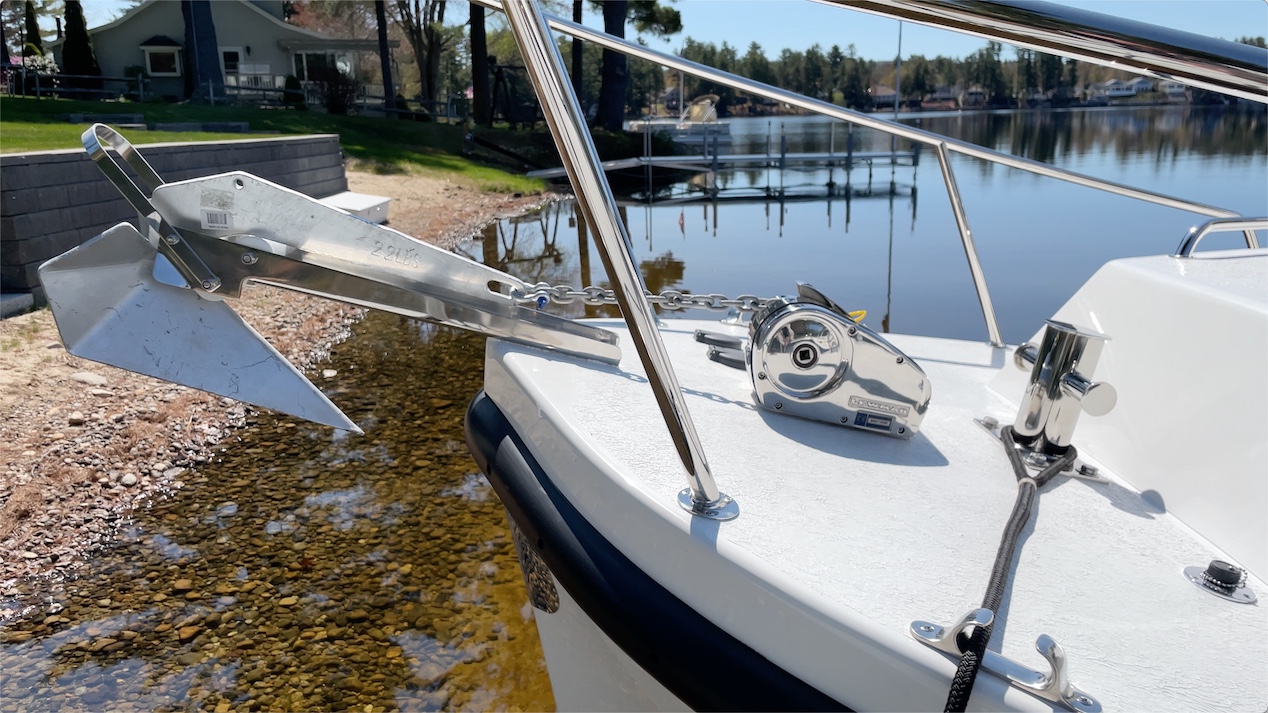
The bow is accessed by stepping along the 7.5” (19.05 cm) wide side decks and this is made safer by the full-length grab rail along the side of the overhead. At the foredeck there’s a Sampson post just ahead of the caprails. Forward of that is an optional anchor windlass leading to a surface mounted anchor roller supporting a 22 lb (9.98 kg) anchor. Foot control switches are to the right-hand side. Rail height at the working end of the bow is 22” (55.88 cm). A freshwater washdown connection is also provided.
Optional Equipment
- Dark Hull Color Upgrade
- Pastel Hull Color Upgrade
- Hull Extension
- Solid Roof Extension Over Cockpit Bow Thruster (Bottom Paint Around)
- Anchor Windless w/ 15’ Chain & 200’ Rode
- Roof Mounted Air Conditioner 15,000 BTU (Requires Shore Power)
- Gray Water Tank
- Electric Marine Head Macerating Overboard Discharge
- 3 Step Bracket Mounted Ladder
- Additional SS Rod Holders (Pair)
- Additional Table Mount in Cockpit
- (2) 13” Roof Hatches w/ Screens
- Transom Door (port side)
- Propane Two Burner Stove
- Wallace Diesel Stove/ Heater
- Dockside City Water Hookup Cockpit Shower
- Raw Water Washdown
- Additional House Battery w/ Switch & Charger
- AGM Battery Upgrade
- Roof Mounted Dash Controlled LED Spotlight
- Additional 6 Gang Electrical Switch Panel
- Additional 12v/USB Accessory Plug
- LED Courtesy Lights (White)
- RGB LED Courtesy Lights
- (2) V-Berth Reading Lights Interior
- Leather Upholstery Up- grade
- Oiled Teak Interior Package
- Rear Canvas Enclosure (Requires Hardtop Roof Extension)
- SeaDek Cockpit Flooring
- Woven Snap in Flooring
- Garmin GPSMAP943XSV w/ Transducer
- Garmin GPSMAP1243XSV w/ Transducer
- Fusion Stereo w/ Four Speakers
- 10,000 lb Dual Axle Bunk Trailer w/ Brakes
In addition to this list, owners can feel free to ask for whatever upgraded equipment they desire. For example, our test boat also had a pair of 100-watt solar panels on the roof. We’d add to that a set of Lithium-Ion batteries and an inverter to keep the electrical system running such as refrigeration and air conditioning. The head on our test boat also has a composting toilet. A digital compass was fitted to the dash.
The point being is that this boat is made by people, not robots, and if something is desired, just pick up the phone and a person will answer.
Price
The Rosborough R246 comes with a base price of $152,250 without motor or freight. Engine choices will be from 150 to 250 hp and from Mercury, Honda, Yamaha or Suzuki. Engine pricing will add another $17K to $26K to the base price. In the case of our test boat, the engine was mounted to the trailing edge of the swim platform and there’s another mount for a kicker motor right alongside.
Observations
Rosborough’s have an almost cult-like following, and I can see why after making my way through this 246. To me, it's an ideal cruising couple’s boat for those empty nesters. Couples where the kids are gone and want to get out of Dodge and get onto the horizon. All it takes is a full tank, pointing the bow in the right direction and moving the throttle lever forward. Everything else seems to take care of itself.
Related Boats
Eastern Boats 248 Islander (2021-)
1 x 150-hp Yamaha Four Stroke
Eastern Boats Coastal 30 (2021-)
2 x 250-hp Honda BF250