Access More Boat Tests
Already have an account? Login
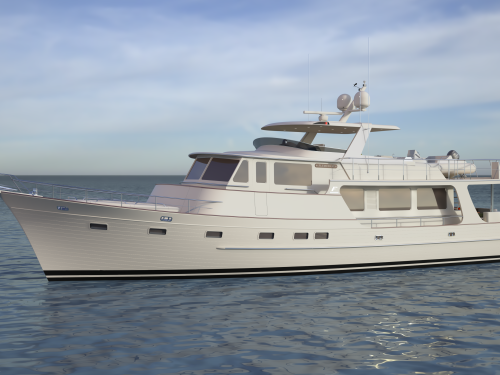
Fleming Yachts 60 (2026-)
2 x 800-hp MAN i6

Brief Summary
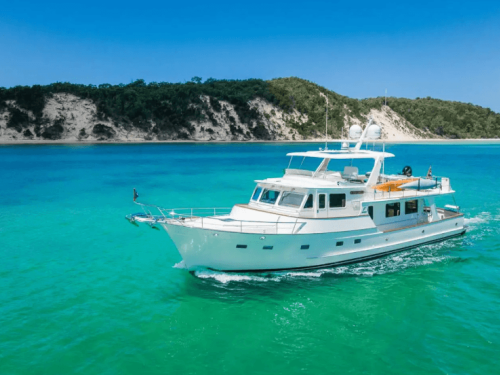
At the intersection of build quality, long range cruising performance, and enduring design, you will find a Fleming Yacht. With the Fleming 60 comes the added benefit of her ability to be handled by a veteran couple whose dreams of long range travel can now be fulfilled.
With a host of features including a three stateroom, two head layout, plenty of storage space, an upper and main deck both sporting helms and control consoles, a pair of MAN i6 800-hp inboard diesels, aft docking station on both the man deck and flybridge, and legendary attention to detail when it comes to comfort and accommodations, along with many other quality highlights and offerings, the Fleming 60 can be matched to any owner’s needs.
Test Results
| RPM | MPH | Knots | GPH | MPG | NMPG | SM | NM | dBa |
|---|---|---|---|---|---|---|---|---|
| 600 | 6.8 | 5.9 | 2 | 3.4 | 3 | 4430.1 | 3849.8 | 58 |
| 1000 | 9.5 | 8.3 | 8 | 1.2 | 1 | 1548.7 | 1345.8 | 58 |
| 1250 | 9.9 | 8.6 | 14.5 | 0.7 | 0.6 | 890.7 | 774 | 60 |
| 1500 | 10 | 8.7 | 26 | 0.4 | 0.3 | 502.5 | 436.7 | 60 |
| 1750 | 12.1 | 10.5 | 38.5 | 0.3 | 0.3 | 409.6 | 355.9 | 62 |
| 2000 | 17.5 | 15.2 | 54 | 0.3 | 0.3 | 422.7 | 367.3 | 63 |
| 2250 | 21.5 | 18.7 | 70.5 | 0.3 | 0.3 | 398.3 | 346.1 | 65 |
| 2360 | 23 | 20 | 82 | 0.3 | 0.2 | 366.3 | 318.3 | 66 |
Specifications
| Length Overall |
62' 9" 19.1 m |
|---|---|
| Beam |
17' 6" 5.33 m |
| Draft |
5' 1.52 m |
| Air Draft |
17' 5.18 m |
| Fuel Capacity |
1,450 gal 5,488 L |
| Water Capacity |
320 gal 1,211 L |
Acceleration Times & Conditions
| Load | Persons & Gear: 1200 lbs (544 kg); Fuel: 4,350 gal (1,973 kg) |
|---|---|
| Climate | 86°; 79% humidity; wind: 15-20; wave: 2'; salt |
Engine Options
| Tested Engine |
2 x 800-hp MAN i6 |
|---|---|
| Std. Power |
2 x 800-hp MAN i6 |
Fleming 60
Horizons Unlimited
By Capt. Ken Kreisler
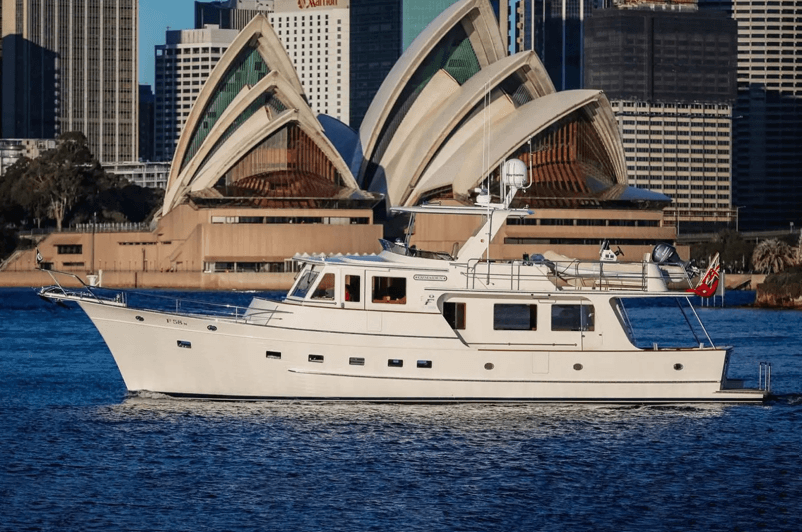
The Fleming 60 is built on the same hull as the 58 which has been in the line for some time, but lengthens the deck in the stern, and raises the center section creating what the company calls a "California" deck. With the aft gun wall moved aft 2' (.60 m), Fleming was able to also lengthen the boat deck above 2' (.60m), creating more room for a tender. Most important, the engine room overhead clearance has grown 14" from 4'6" to 5'8". Otherwise, the Fleming 60 is pretty much the same as the 58.
Like all Fleming vessels, the 60 is built to CE-RCD Category "A" Ocean Standards, as well as meeting all NMMA-required ABYC standards, and exceeding many of them. In addition to meeting USCG and EPA regulations, she also meets Australian 1799.1-2009 and Transport Canada TP 1331E 04/2010 standards.
This vessel has been designed and equipped for an owner/operator. By definition that means single-handed operation. Any extra hands aboard are a welcome bonus, but not a necessity.
Two Type of Intended Buyers
The Fleming 60 is aimed at two types of owners. The first is the experienced owner-operator who has logged years of cruising and recognizes the detailing that distinguishes the boat. The second is the newly retired owner moving into long-range cruising for the first time, for whom the boat's systems and ease of operation lower the learning curve.
In both cases, the design priorities are the same: storage capacity for extended time aboard, accessible maintenance, and safe movement around the boat in a seaway. Because the vessel has critical redundant systems (such as two freshwater pumps), the beginning voyager is spared the difficulty of changing critical parts, and the veteran skipper can rest assured he/she is riding one of the most meticulously out-fitted boats in class.
Major Features
- Extensive use of teak in the interior
- Seatroque M4 Bolt-On Shaft System
- Humphree DC Electric stabilizers with 10.7 sq. ft. (1 sq. m) fins, with at-rest function.
- Sidepower Bow thruster, SE250 15.5 hp (11.4 kW)
- Fleming First Mate Monitoring System with CZone.
- 8' (2.4 m) long SS keel shoe
- Vinylester resin used in outer laminations of deck and superstructure in addion to the hull bottom.
- Teak decking on the aft deck and starboard side deck, and all stair treads
- Watertight collision bulkhead abaft the chain locker
- Two Maxwell 24V DC RC 12 windlasses with 300' 991 m) of 7/16" (12 mm) SS Grade 60 German chain with 100-lb. polished Ultra SS anchor.
- Stidd Helm Seats and both steering stations
- Kahlenberg D-330 Air Horn with twin trumpets
- Steelhead ES 1000 hydraulic davit with electric powered telescopic boom
- Two Delstar 200-Amp heavy-duty brushless aux alternators
- 16,000 BTU engine room air conditioning
- Sight glasses on both fuel tanks with solenoid safety valves
- Fuel tank sumps
- Passarelle
Performance Test Data
We ran her under what we'd call a medium load: 50% of her 1,450-gallon fuel capacity, 60% of 320 gallons of fresh water, and 30% of her 165-gallon blackwater capacity. Conditions were demanding for a fair test — 86°F, 79% humidity, and wind 15 to 20 knots out of the southeast with higher gusts, plus a wind-against-current situation on an outgoing tide. Running inside the bay with keel-protected props, we weren't overly concerned about the shallow work. As always, reciprocal course measurements were made and averaged.
At wide-open throttle she turns 2,360 RPM and makes 20 knots.
Our most economical cruise came at 1,000 RPM, where the Fleming 60 made 8.3 knots burning 8 gph — a range of 1,345 nautical miles with a 10% fuel reserve. Around home with friends aboard, 2,000 RPM brings her up to 15.2 knots.
Extended Range. Back her down to 7 knots and, with the available island fuel stops, she has the theoretical capacity (1,450 gal./5,488 L) for a transatlantic or trans-Pacific passage. However, in challenging conditions, a vessel can use as much as 30% more fuel than in the ideal conditions in which we tested her. For those wishing to make a transatlantic passage via the Azores or a transpacific voyage, we recommend working with the factory to find a way to carry more fuel. Otherwise, she's fine with her current capacity.
The Twin-Versus-Single Fuel Burn Question
Buyers often assume a single engine would be more economical. BoatTEST data collected across multiple vessels over many years at displacement speeds tells a different story: cruising trawlers usually burn less fuel with two engines. The reason is straightforward — two propellers are moving the water instead of one, so neither engine must work as hard.
Even though the twin installation carries more iron and substructure, single-engine rigs usually have a wing engine or two generators, so weight is not a noticeable factor in a heavy, displacement vessel.
Handling, Hull, and Stability
Even in an aggressive turn at speed there's no list — she stays flat. Part of that is the stabilizers, but a good deal of it is the hull: a full keel running the length of the bottom gives the boat a natural tendency to track straight and stay level, which pays off in comfort for guests who aren't seasoned to the water.
Her best numbers land right around 8 knots. Push much past that and you'll get bow rise. In that awkward transition zone — past displacement but not yet on a semi-plane as the boat attempts to climb the bow wave -- the bow pulpit can partially block your line of sight, so plan for it and look off to the side to keep forward vision.
A note on the Twin Disc electronic controls: there is a slight lag between shifting and throttling up. Push the throttle forward and give the boat a moment to catch up. Keep pushing and, when she does catch, you'll feel a lunge.
The Lower Helm: A Command Center
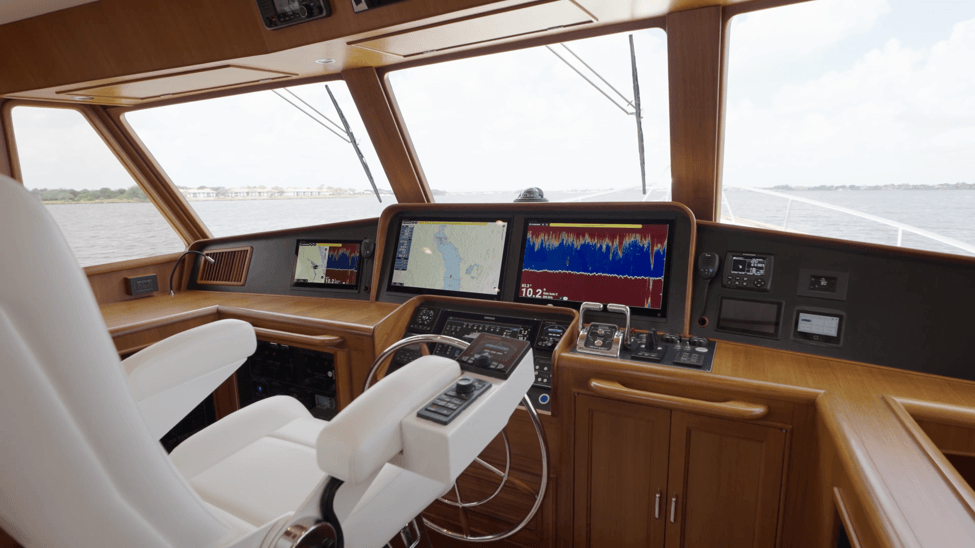
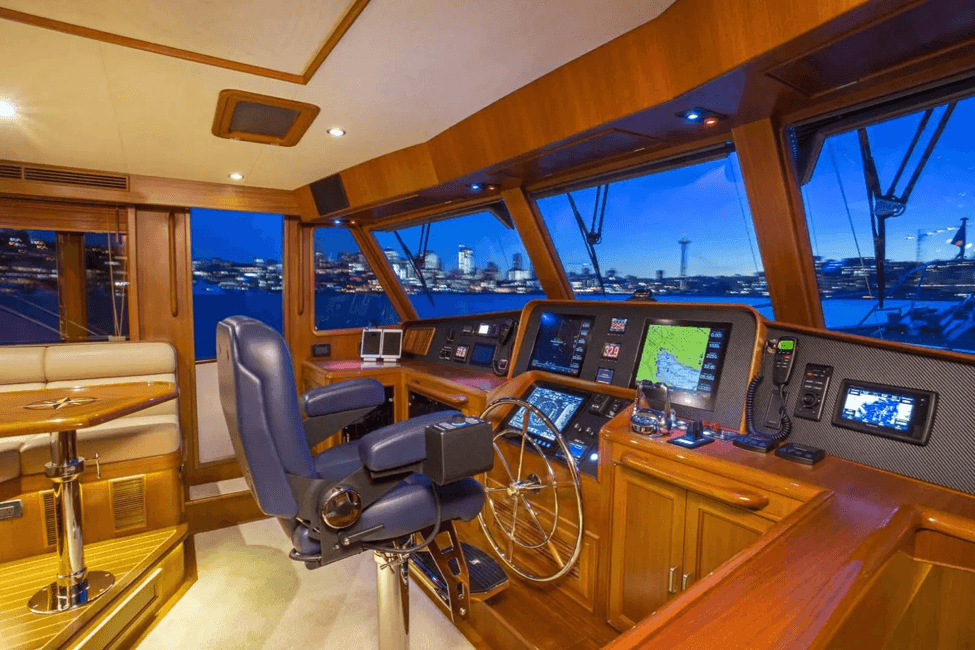
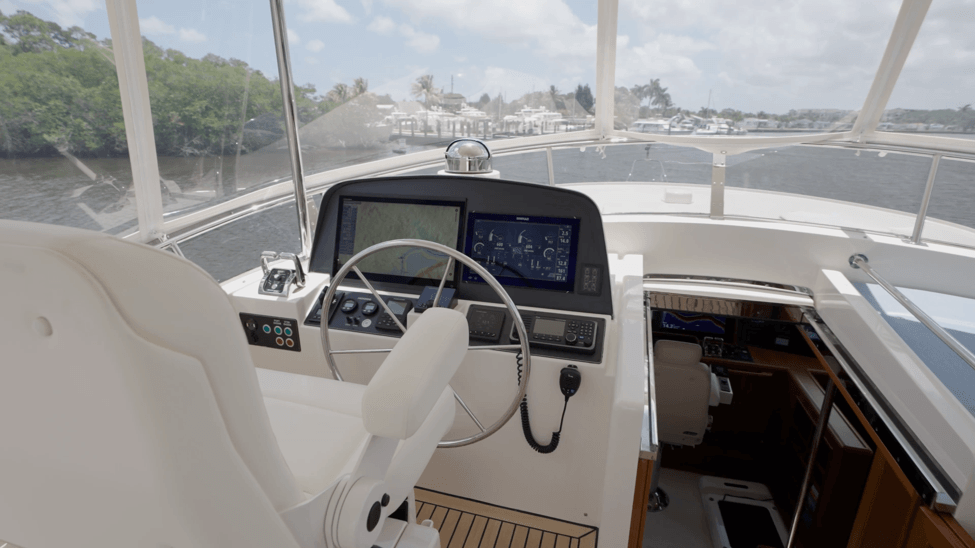
From the lower station you can control every function of the vessel. Visibility is excellent, you're out of the weather and in air conditioning, yet the space never feels closed in. Two large multifunction displays handle GPS and the bottom machine, configurable however you like, and a full system MFD lets you monitor and switch equipment on and off throughout the boat. Electronic engine controls, plus bow and stern thrusters, give you complete docking authority from here — every bit the equal of the fly bridge.
The Fleming 60 comes standard with an iPad loading with full systems information and a detailed owner's manual. On our boat, Burr Yacht Sales (the east coast dealer for Fleming) adds a drop-down door over the helm, concealing the iPad and a contact list of anyone an owner might need to reach underway — a genuinely useful touch when a question comes up mid-passage. This is something that all dealers should do, few take the time to do it.
All helm controls fall to hand, so you can adjust the displays without leaving your seat while the autopilot holds course.
Redundancy and CZone Systems
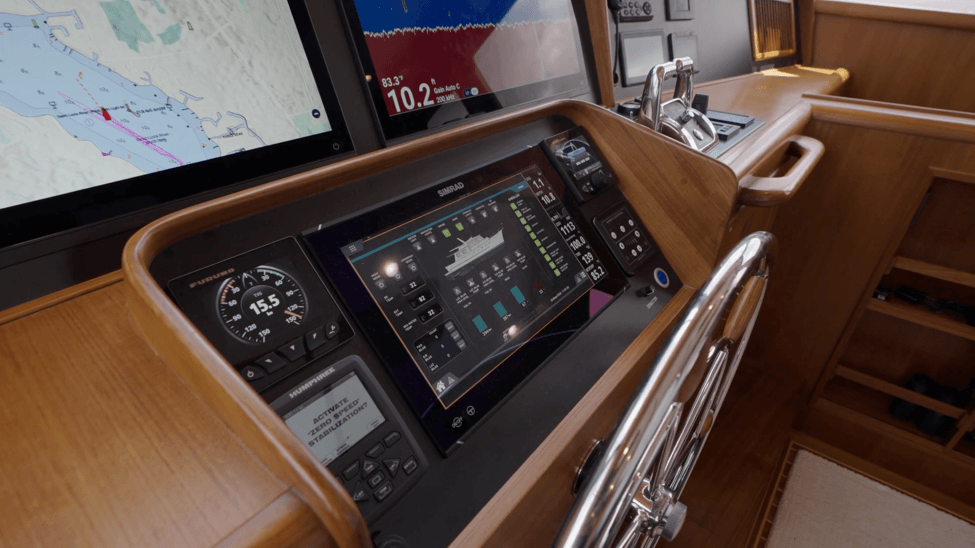
The Fleming 60 runs CZone digital switching for full system control and monitoring. Critically, redundancy is built in behind the two electrical panels you can reach the CZone controllers directly, each with manual on/off.
If a screen stops controlling a circuit while you're offshore, you still have access — exactly what a long-range motor cruiser demands. The electronics feeding the upper helm are equally accessible; run into an issue with the Simrad, the Furuno, or a supporting gauge, and it's right there to service -- if you can figure it out. While the owners manuals have been but on your iPad by Fleming, even better is the list of people to call, that Burr Yacht Sales has prepared.
Basic Helm Design
Fleming's helm on the 60 is about as good as it gets. We like the sunken screens just above the hub of the destroyer wheel, and the Nav screens are also lower than we see on some boats in class -- that's a good thing. The idea is to get the screens as low as possible to maximize visibility forward.
There's counter space to port to put a chart book or cruising guide. They've done it right on the flying bridge with a double seat -- but why not at the lower helm as well?
We know from personal experience that some partners take great umbrage at being relegated to the settee behind the helm. Further, we are great believers in having as many pairs of eyes looking forward as possible.
If that's what you want, we're sure Fleming will make it happen.
The Pilothouse
A settee with a fixed table sits just aft of the helm on the port side, positioned to keep guests in contact with the captain while out of the working area. As noted elsewhere, we'd like to see a dual Stidd helm seat forward for the captain's partner can help with navigation.
The table does not drop down to form a daybed, which would have added flexibility to the space. Our guess is that Fleming has discovered over the years that its owners simply don't use a pilot's berth. This is in fact the place where most boat owners had their morning coffee, and maybe even dinner, too.
Headroom is 6'10" (2.08 m).
A door on the aft bulkhead leads to the day head off the passageway to the main salon down three steps. Handholds are on the bulkhead and overhead. The door is ideal for closing off light from the salon, when piloting at night.
Main Salon and Galley
The layout of virtually all pilothouse trawlers and long-range cruisers is virtually the same. The Fleming 60 is no exception. This is not a boat primarily designed for entertaining, so does not have the galley by the aft bulkhead as is the current rage among builders of motoryachts.
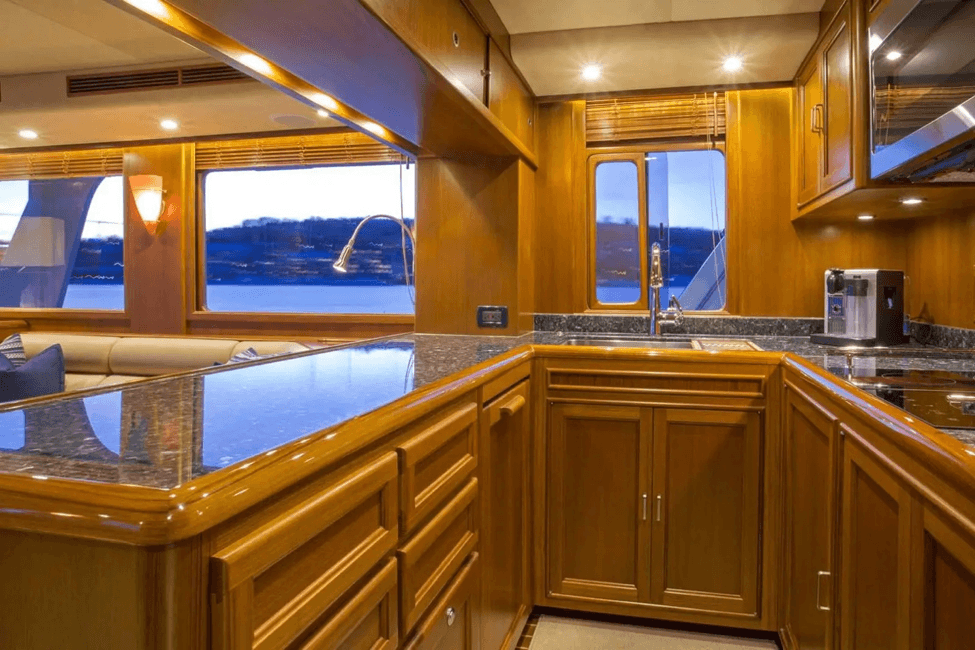
The galley is forward of the salon, so that the immense forward bulkhead can be used for storage and appliances. Since it is open aft and not enclosed as we see on some European vessels, the chef has clear communication with everyone in the salon.
Some motoryachts have a galley down, but we've never seen that in any pilothouse design, no matter how large or small. Here, the galley place between the salon -- which has a large dining table/coffee table -- and the pilot house where meals for two or three might also be served.
Cabinets and drawers use soft-close hardware. Standard equipment includes an oven and microwave, with a two-oven option, an induction cooktop, retaining arms for pots and pans, and dedicated pot storage. The oven is at a perfect height on the forward bulkhead.
The galley has a large, deep double stainless-steel sink and a side window for ventilation and light. There are four hole to accept sea rails for pots and pans.
One layout note: the dishwasher is adjacent to the double sink, so you must be a contortionist to stand close to the sink and load the dishwasher -- or an orangutan. As ergonomically-correct the rest of the vessel is, we are mystified by this layout. We would move the dishwasher to the most inside cabinet, or at least one row over. We imagine that Fleming's inconvenient layout has something to do with water pipes and drainage. There's a solution, even if means they must install two pull-out drawer washers.
The refrigerator-freezer is against the bulkhead on the starboard side of the boat. It is faced in the same teak used elsewhere in the boat, so it blends into the joinery.
The Salon
The salon bulkheads and cabinets are all made out of teak, with exquisite joinery and perfect finish -- matt or high gloss. This is the signature aspect of Flemings interiors, and they continue despite the high price of the lovely, yet remarkably durable wood.
Fleming offers semi-custom choices in seating, layout, cushion design, and color within a defined range of options. We prefer to have the furniture free-standing and not built in. That can permit more storage space in the bulkheads below the windows to starboard and provide a more relaxed atmosphere for the two-barrel chairs to starboard.
Headroom is 6'7" (2.00 m).
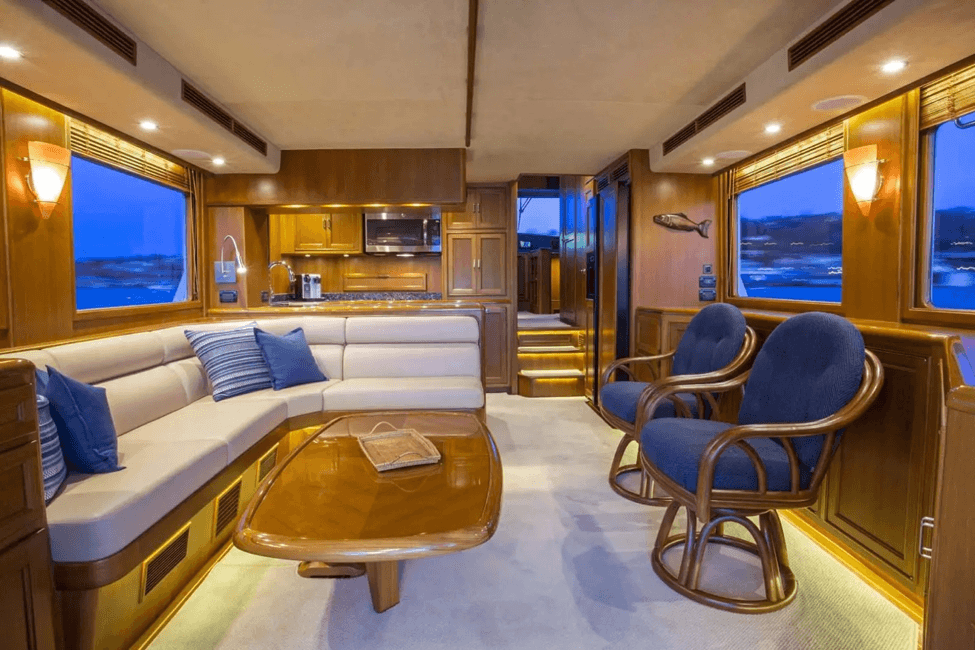
Fleming has done a good job of designing a high/low table, with fold-out leaves, for the L-shaped settee, so it can be raised for dinner, and lowered for cocktails or lounging.
A handhold runs down the center of the cabin. This is another signatures aspect of Fleming, which provides a much-needed handhold when traversing the salon in rolly seas. To port and starboard, extending over one foot from the cabin sides at the overhead are supply plenums for AC and heat. We wonder why they are so large, and think that making them smaller, and creating a more artful grate might open of the feel of the room.
Further aft, a semi-wet bar provides glass storage, wine-bottle storage, and a wine chiller. On the starboard side, a built-in cabinet houses a pop-up flat-screen TV that lowers out of sight to free the counter.
Throughout the interior, the teak joinery carries a hand-rubbed satin varnish. The interior decks above and below are solid teak and holly, not plywood, veneer, or vinyl. A vanity or desk with a pull-out seat is provided in the stateroom and can be doubled as a laptop station.
California Deck and Cockpit
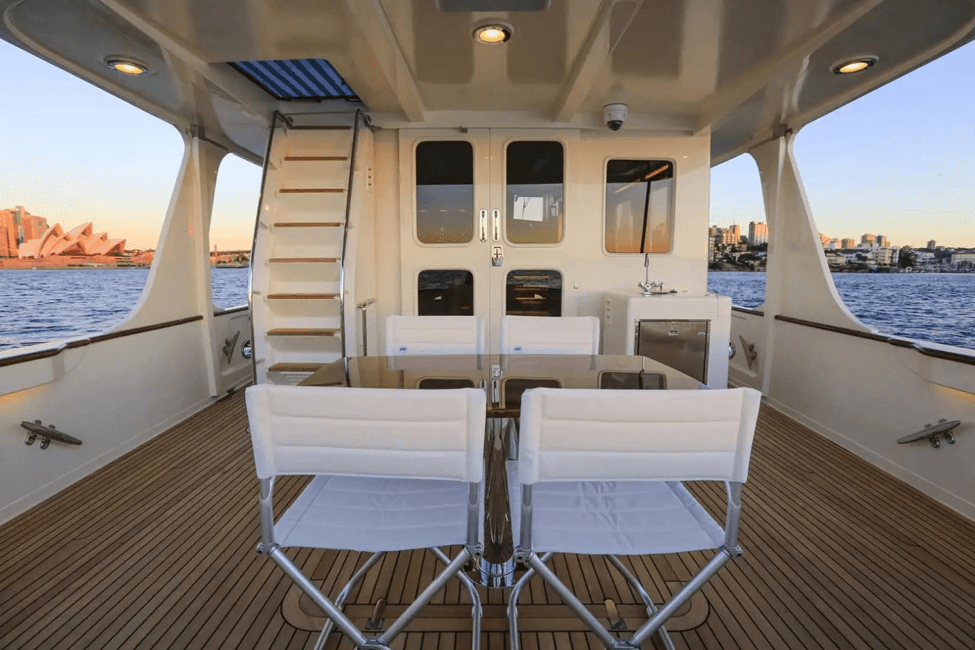
Twin large sliding doors lead into out to the aft deck on the same level. The doors are white on the outside matching the color of the fiberglass, and teak-faced on the inside. They have two vertical rectangular windows with rounded corners, so they match the motif of the side windows. A secondary catch on these doors would help prevent slamming on fingers in rough conditions or with children aboard.
The Fleming 60 Difference
As noted before, the Fleming 60 is nearly identical to the 58 except for this space. The aft deck is a "California" deck, with a step up from the side decks that creates a level transition from the salon. The space has a multi-level table in front of a settee facing forward, as has been traditional for 60 years or more on motor- yachts of all types on the aft deck.
Headroom is 6'3.5" (1.91 m).
This creates an unobstructed deck along the transom which is 2'9" (83.82 cm) wide, with handholds inboard and the rail outboard to hold on to in a rough sea. Like the Portuguese deck forward, it keeps guests out of the way while you work lines and fenders, letting you move side to side without stepping up, around, and back down.
Traversing from side to side on the 58 across the aft deck there is nothing to hold on to except hand-hold overhead on the centerline.
The 60 extends the boat deck of the 58, two feet further aft, producing more shade on the deck below and more usable space for a larger tender above. There's an aft access door to the swim platform in the gun wall. Two steps lead down to a large swim platform with handholds at the transom and the trailing edge — safe footing even underway.
Another important difference between the 58 and 60, are the molded fiberglass staircase that leads from the aft deck to the boat deck above. The treads are teak and there are handrails on either side. Outboard there is a door to the space inside which provides a much-needed repository for mops, brushes and cleaning supplies. The 58 just has a SS ladder to the flybridge.
Cockpit and Secondary Docking Station
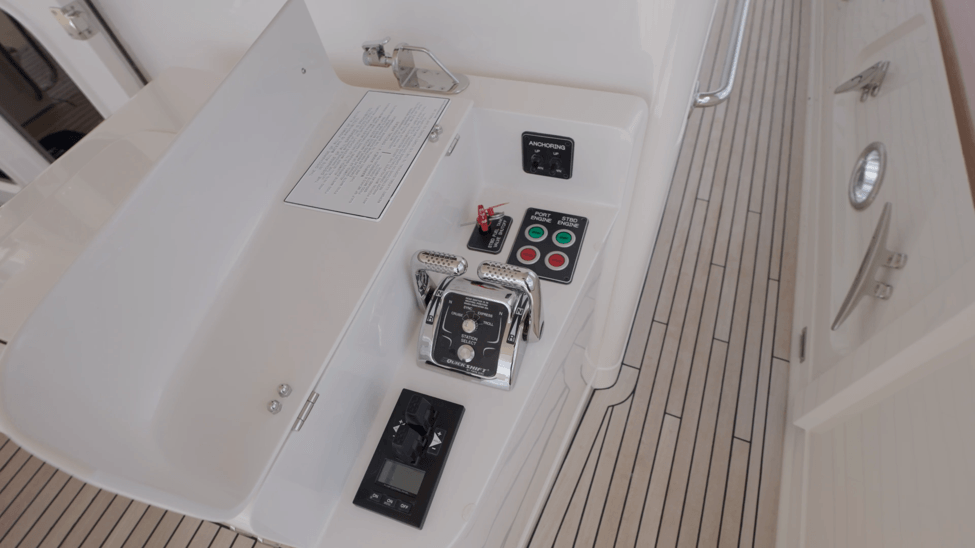
The cockpit carries an additional control station for docking in tight quarters, where sightlines from the fly bridge or pilot house are compromised. It offers the same positive control as any other station — twin engine controls plus bow and stern thrusters. A joystick is optional, but there's an argument that full independent engine control paired with thrusters gives you more command than a joystick would; here it may be redundancy you don't need.
Captain's Quarters and Aft Systems Access
Just forward of the transom door, a hatch drops directly into the captain's quarters, which in turn connects straight down to the engine room — so crew can reach their quarters and the machinery without ever passing through the salon.
The cockpit at the transom is 29" (73 cm) deep.
Foredeck: Dual Windlasses and Ground Tackle
Pilothouse doors on both sides lead straight to the side decks — valuable when you need to get a fender over or hook a spring line in a hurry. Forward, Fleming mounts two large windlasses; the sales team at Burr reports most owners run one as primary and the second as backup. That's more than simple redundancy.
Anchored in a V using two hooks, the boat locks dead into position with no swinging, a real advantage in tight anchorages or when a 3 a.m. squall rolls through.
The ground tackle is heavy stainless-steel chain rather than rode, which means better holding and less scope required. A small mud rail — easy to overlook — traps sand and muck as the chain comes aboard and drains it overboard through two holes rather than onto the deck. (See Major Features for details on the ground tackle.)
There's storage to port, fresh- and saltwater washdowns (conserve fresh water by rinsing tackle with salt, then a light freshwater finish), and to starboard a 50-amp shore power hookup at the bow — a rarity on this class of boat that spares you dragging a cord the length of the vessel when you dock bow-in.
Portuguese Deck and Side-Deck Ergonomics
Grab rails are everywhere on this boat, and Fleming builds a Portuguese deck into all its motor yachts. It earns its keep: in heavy conditions it stops a wave taken over the bow, draining the water overboard before it can run down the side decks into the cockpit. The heavy doors are held open by hydraulic stainless-steel shocks. It also lets you cross from port to starboard without walking all the way forward and back — with a solid handrail the whole way.
The side decks and cockpit are teak as standard and are a generous 23.5" (59.69 cm) wide. The gun walls amidships are 36' (.91 m) high. Moving aft, three steps lead down to the cockpit. The one criticism: a handhold at that transition would be a welcome addition — the only spot on the boat where a grab point is missing.
The Flybridge and Boat Deck
Most owners will run the boat from up here, out in the air with the best all-around visibility. All-important controls and nav screen found below is duplicated on the bridge. One quirk to adjust to: the throttle quadrant sits to starboard at the lower helm but to port up top — a non-issue in practice, since you're working throttles rather than the wheel when docking.
A double Stidd helm seat lets a companion ride alongside, and an aft-facing station with balance and stern thrusters gives excellent sightlines down both sides for backing into a tight slip. With two aboard, one can work lines below while the other drives; single-handed, the lower controls put you close to the dock and your lines.
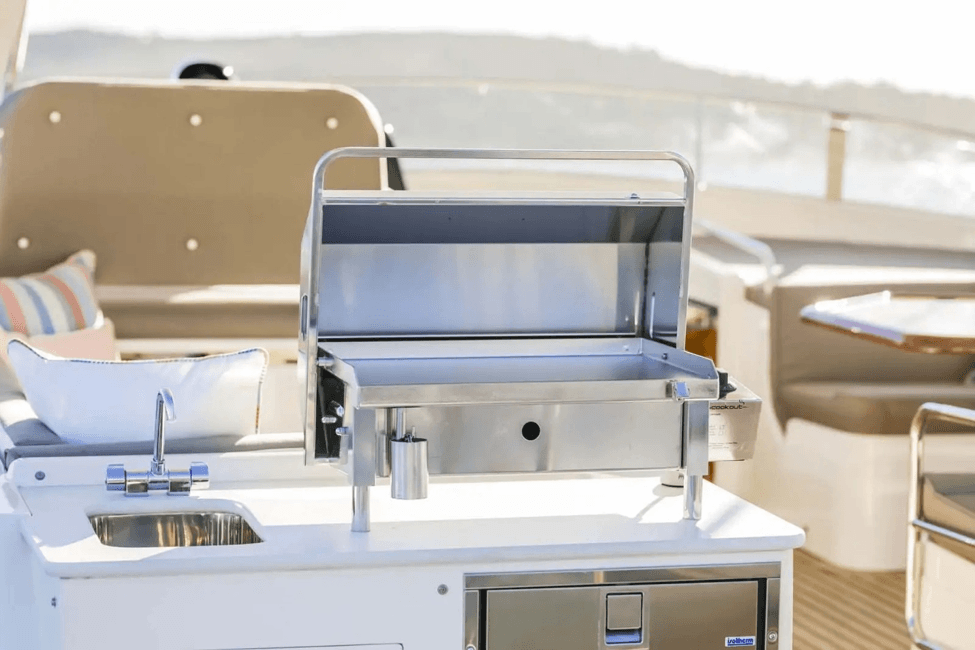
Boat Deck. At the opposite end of the flying bridge is the extended boat deck, one side holds tender storage and the other a crane rated at 1,000 pounds, which sets the practical limit on tender size. With the tender launched, the boat deck converts to an entertaining area or deck-chair space. It includes a grill, a stainless refrigerator, and additional storage.
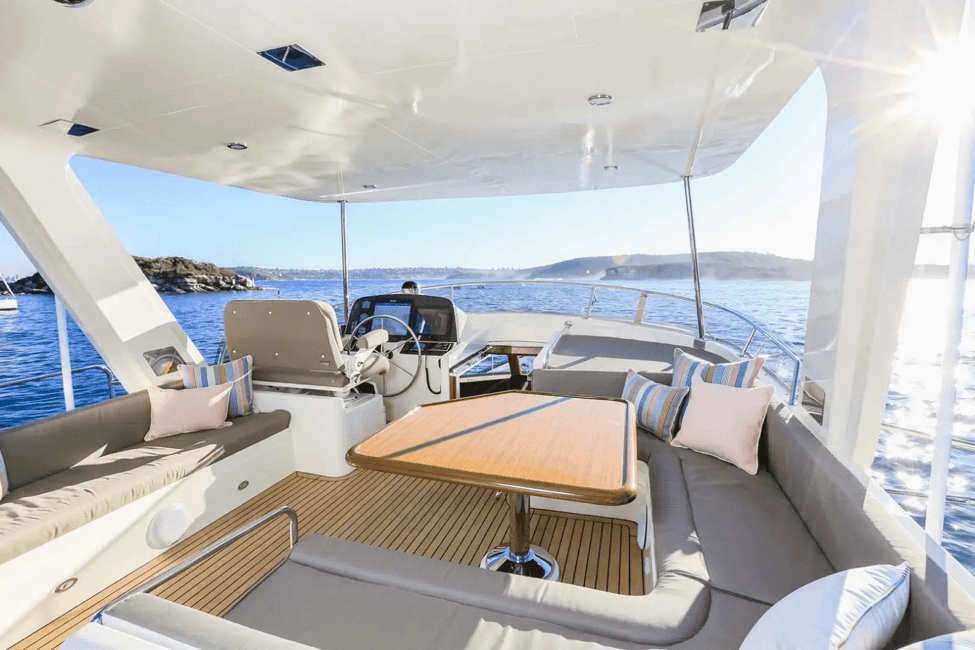
Entertainment Space. Between the helm and the boat deck is one of the most comfortable entertainer areas we've seen on a boat this size. Under the standard fiberglass hard top is a large US-shaped settee with table to starboard.
To port is a large fiberglass console which can handle all of the amenities one might want to plant there, including a grill, icemaker, sink, deep freeze, refrigerator and more storage. The flybridge itself is large for a 60-foot boat.
Three-Season Piloting. Perhaps what we like most about the 60's flybridge are the hip-high bulwarks separate the entertaining area from the boat deck. That allows there to be cruising isinglass all around making this deck a great please to be when it’s rainy too if there's a chill in the air. There's no place on any boat where one can enjoy the day so much, no matter what weather may bring, then a buttoned flybridge.
Below Decks: Accommodations
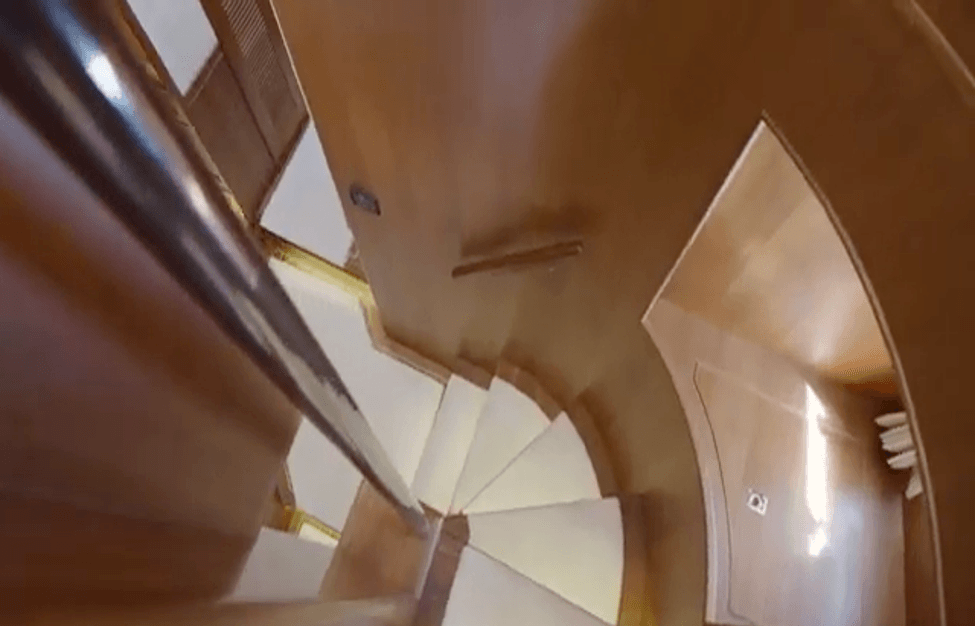
A spiral staircase leads from the helm to the accommodation’s level. Handholds are positioned throughout the descent and continue across the lower deck, which is useful for older owners or in rough conditions.
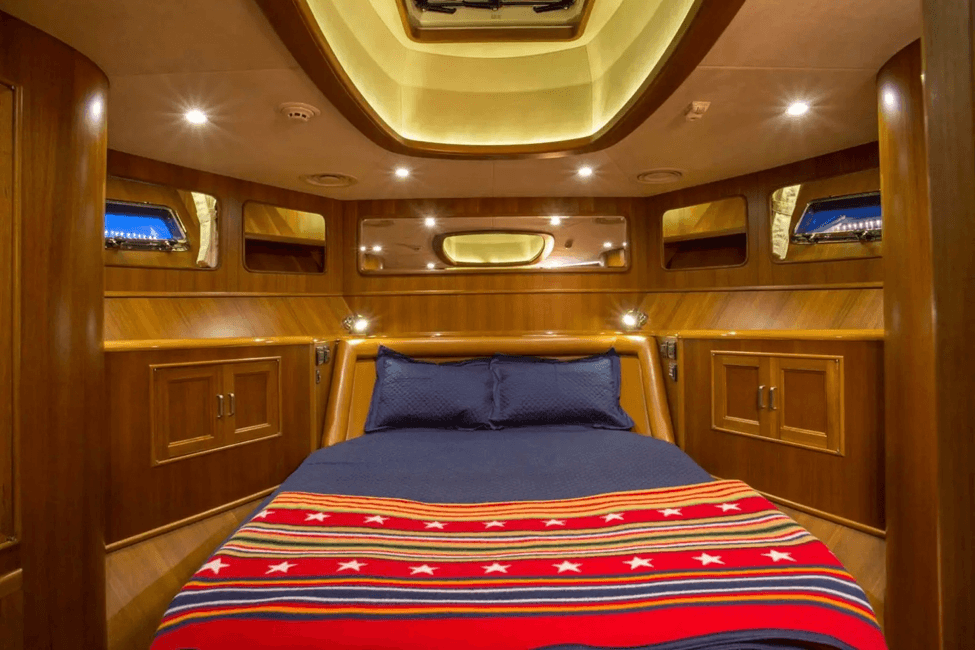
The forward cabin is laid out as a V-berth in this configuration, with an island berth available as an alternative. The V-berth beds each measured 88" x 36". Storage shelves are under the beds and hanging lockers are on both sides. Both reading lamps and ambient lighting are fitted above the two beds.
All port lights carry screens and dead lights to meet CE Class A requirements for ocean navigation. The hull sides above the berths are finished in teak rather than vinyl, a detail that adds cost but is consistent across the boat's interior and is Fleming's signature detail.
Headroom in the forward cabin is 7'11" (2.41 m) under the raised, atrium-style ceiling, which keeps a relatively small cabin from feeling confined, and house the forward hatch.
The forward overhead hatch is required on all cabin boats as an emergency exit by both CE requirements and ABYC standards. On many boats this size, the hatch sits too high to climb through, even over an island berth. Fleming addresses this by stowing an emergency ladder in one of the forward hanging lockers. It is a feature not commonly offered by other builders in the class.
An important difference between the V-berth arrangement and the island berth alternative, is that former has a large open deck space in the middle of the cabin to stand and change clothes.
In the V-berth arrangement of the forward cabin, the occupants must go into the passageway and access a head on the portside. This head also serves the occupants in the port guest cabin.
This head has a full walk-in, separate shower with door, and the shower sump can be opened and cleared of hair and debris.
In the island bed layout, a second door in the cabin provides private access to the head.
Laundry. To port abaft the forward cabin is a stackable washer and dryer behind louvered doors.
The Master Stateroom
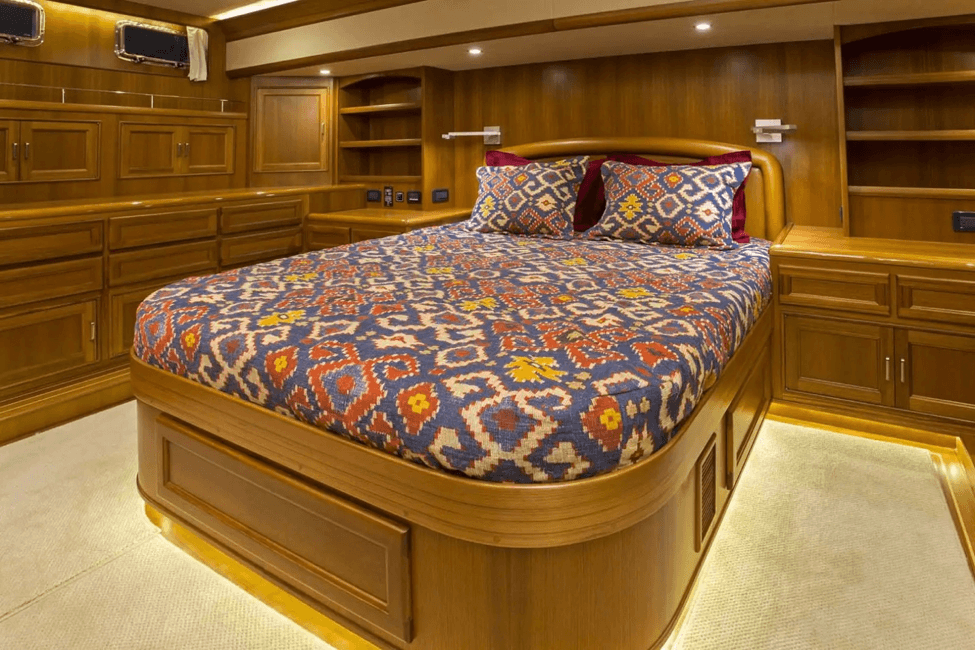
Fleming locates the master amidships to make it as large and as comfortable as possible. It stretches into the full beam. It is fitted with a walk-around full king-size berth (80" x 75") -- one of the few household-size king beds we've seen in most any yacht of any size under 100'. The berth lifts on hydraulic actuators to reach long-term storage underneath. (A great place for suitcases.)
The entire master is swathed with vertical-grain matt teak bulkheads, bookshelves, cabinets, a desk/vanity and a chest of drawers. The boat we tested felt right out of the 1920s, with tasteful sconces port and starboard of the bed, and shelves to hold enough books for a world cruise.
Headroom is 6'5" (1.95 m).
A Simrad display in the stateroom mirrors the helm electronics, allowing the owner to monitor pumps, systems, generator status, and fuel from the cabin.
A private head is forward to port, with a full-size shower stall and two shelves on the bulkhead for toiletries. Electrical outlets are placed inside the cabinets over the sink counter so devices can be stowed out of the way.
The starboard side holds a large walk-in closet finished in teak, with hanging space, shelving for shoes and linens, an air-conditioning vent, and a louvered door.
Two portlights let in light and aid, both port and starboard.
Second Guest Cabin
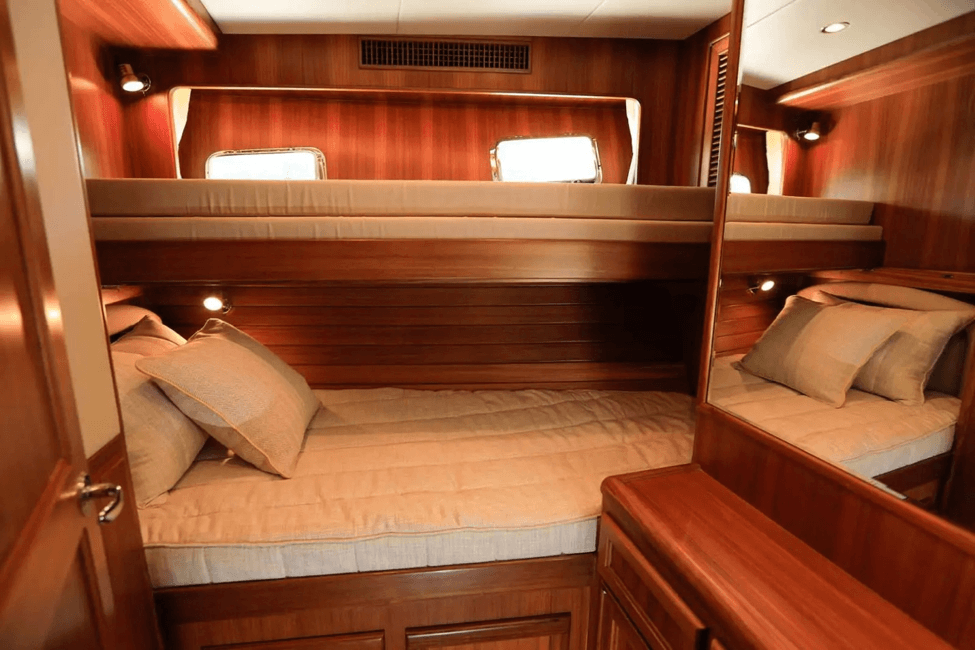
On the port side, a smaller cabin is fitted with double bunks suited to adults, or to children and grandchildren. The lower bunk is easy to access. The upper bunk slides out and locks into position for entry, then slides back when not in use, thus providing more air draft for the lower berth. The bunks are 76" x 32". The cabin also includes a small hanging locker and a counter above.
Headroom is 6'6" (1.98 m).
This cabin can also be made into an office, or laundry room or work area, or just used as additional storage space. The boat is semi-custom, so design it yourself.
Interior Design and Construction Details
Moving aft, from the guest stateroom, a pull-out hamper near the laundry holds dirty laundry before it goes into the washer. The passageway shows Fleming's wainscoting treatment, with teak below the chair rail and vinyl above. Accommodation doorway headers are arched, a more labor-intensive detail that contributes to the boat's traditional look. Both details are small but important because they help give the yacht its traditional ambiance.
All interior bulkheads use sandwich construction with lead-foam sound insulation between the panels. This not only helps make the cabins more private but also absorb and block engine and generator noise.
All decks below are teak and holly as standard.
The Engine Room
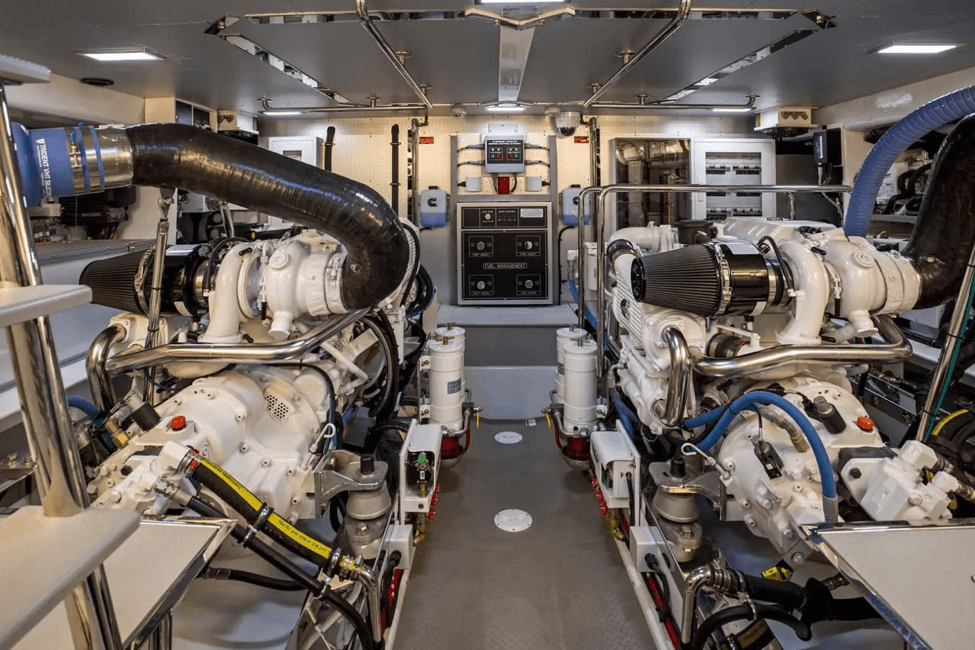
Engine room access is placed off the raised California deck rather than the cockpit — a smart move, since it keeps the descent clean and dry and drops you into an air-conditioned space. A locking bar doubles as a secure handrail and a barrier, so no one steps into the open hatch.
Power is twin 800-hp MAN diesels with single turbochargers. These engines are well like in the marine industry because of their power to weight ratio, which is hard to beat. Many boats in this long-range class run a single engine to be more fuel efficient, but Fleming has found -- and boatTEST has confirmed -- that two smaller engines are more economical than a single engine in most cases.
Headroom is 5'8" (1.72 m). This is a major and important difference between the Fleming 60 and 58, which only has 4'6" (1.37 m) -- 14" (35 cm) less! People 6' tall, or so, can work comfortably with 5'8" headroom. 4'6" Headroom is another matter, making fluid, through hull and strainer checks an uncomfortable chore, rather than an easily accomplished task.
Air-Conditioned Engine Room. Clearly, Fleming wants to make the engine room as hospitable as possible, and 16,000 BTUs of AC will do it. This makes maintenance while underway or in the tropics far less onerous.
Aft sits automatic (or manual) fire suppression to handle a catastrophic event, plus dedicated Snap-On tool storage — essential, because an owner running long passages needs to be handy with hose clamps, pump impellers and filters.
Fuel management is thorough: individual filters for each engine (service one underway or switch over and deal with it in port), and a system that lets you feed either engine — or the generator — from either tank with a single valve, clearly labeled.
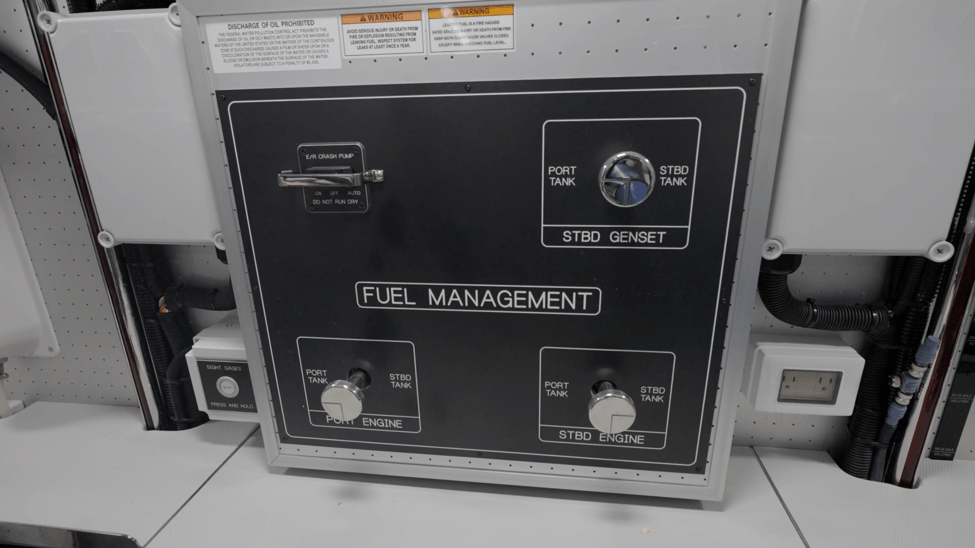
There is an onboard fuel polishing system, which cleans the fuel in the tank and can polish while transferring from port to starboard. Large, easily accessed strainers sit forward of the engines. The Humphree stabilizers are electric and mounted forward of the engines on both sides; because they're electric, they keep working at rest of the lithium-ion battery bank without running the genset.
Throughout the machinery space, good access is the recurring theme.
The seacocks are made from a fiberglass reinforced nylon polymer composite rather than from bronze or stainless steel, reducing the chance of seizing, and being eaten away by galvanic or stray current corrosion. The units meet both CE and ABYC standards, the latter require that the seacock can withstand a 500-lb. (227 kg.) static weight for 30 seconds without breaking.
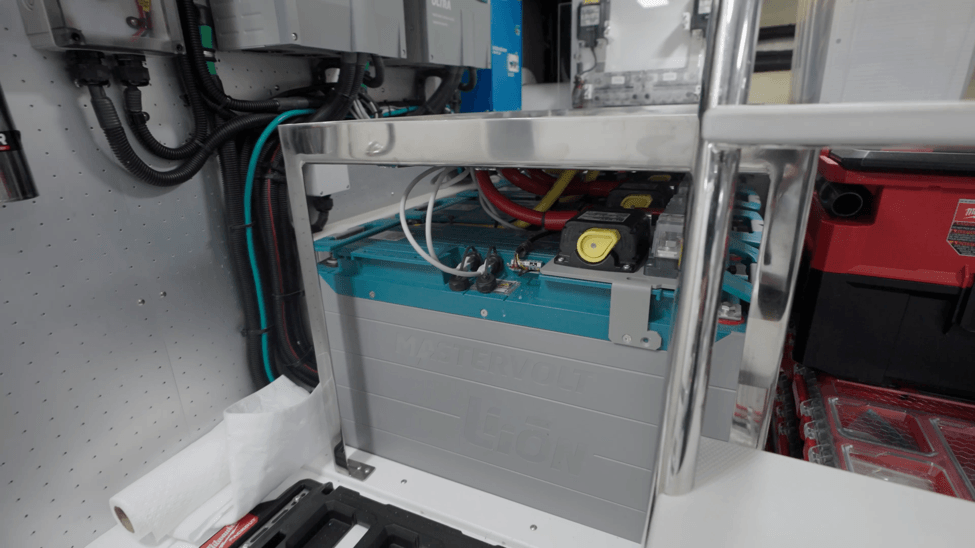
The lithium-ion battery bank supplies the house systems and drives the Humphree stabilizers at anchor. The propeller shafts are connected to the transmission with a Seatorque BOSS coupling that transmits power in an oil-filled tube that keeps the shaft from being connected directly to the transmission. This device greatly reduces vibration and protects the transmission of the props should the vessel run aground. Because of the reduced vibration, cutlass bearings on the strut last longer.
Further aft, the captain's quarters (more likely for a mate) offer a berth, a wet head with shower, and storage on both sides — with still more systems access behind the panels. A ladder and hatch give direct access up to the cockpit, and a final door opens onto the steering systems in the lazarette.
Observations
It is likely that virtually every reader of this report is aware of Fleming's standing in the industry for building what is arguably one of the best trawlers/long range cruisers on the market. They -- you -- have probably dreamed of owning a Fleming for decades because their so beautiful, and in fact, taught us what a world cruising boat should look like.
But what sets any Fleming apart from others in class is not her looks, her machinery, or design -- it is the dedication of the people who own, manage and work on the shop floor.
What people who have never owned a Fleming may not know is that the people who own it also run it. They live it and breathe it every day. They are in touch with their owners and their venders every day, and they are on the shop floor every day.
Fleming’s owner/managers have set the corporate culture, and it is about building an exquisite vessel to fulfil the lifelong dreams of other people who have also worked hard all their lives to be able to afford a Fleming.
A majority of the shop floor personnel have worked at Fleming all their lives, and those that worked there only just some of their lives, previously worked at neighboring shipyards. They are as skilled as anyone in the world building a fiberglass boat today and are better than most. And now, their sons and daughters are working for the company. From the top to the bottom, the people working at Fleming take pride in what they are doing, and the boats they help create -- and it shows.
This might sound corny. But the best boats being produced worldwide today are the ones who have owner/managers on the shop floor, and are working there not to get rich, but because they love what they're doing.
Those that get in the boating business to get rich are fools, and they build boats that might glitter at boat shows, but when the electrical system goes south, they’re nowhere to be found.
Summary
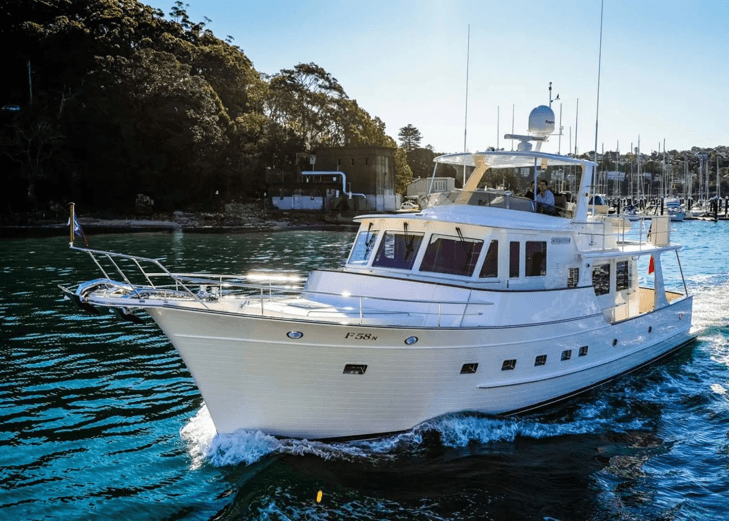
The name Fleming, as with all its long-range yachts, no matter what size, goes a long way. Known for rock solid production methods, using the latest technology has to offer, demanding attention to detail and fit and finish, supplying outstanding accommodations and storage space along with high end electronics and custom features, the semi-custom Fleming 60 is a standout in the industry.
Designed and engineered to be handled by a couple, she offers excellent long-range performance for a semi-displacement yacht including, at trawler speed, close to 1,400 nm of range with a pair of 800-hp MAN i6 diesels. Cut the speed somewhat and the 10% reserve, and that range can be considerably increased. Comfortable and exciting to be aboard, with a three stateroom, two head layouts, and offering the ability for individuals to vary the configuration, the Fleming 60 offers a traditional profile built on exacting construction techniques by veteran boat builders and is a blank canvas waiting for the right owners to complete the picture.
REMEMBER, LIFE IS BETTER ON A BOAT!
About the Reporting Captains
Experts and Boat Owners
What has set BoatTEST apart from the many video-makers currently on the Internet and Social Media is the fact that for 26 years, only USCG-Licensed captains and experienced boat owners have tested and written our reports and made our videos. We believe that to provide boat owners the information they deserve, only other boat owners – who know the challenges of ownership -- can accurately report on it. It is that level of expertise and ownership experience that goes into every video and Captain’s Report that we publish. Because we know what it is like owning and operating a boat, we can pass-on the information that prospective boat buyers need to know.
Dave is a 30-year veteran of the Marine Industry, having started two boat companies, and most recently sold his fishing catamaran brand Eastward. He co-founding Twin Vee and was a designer for several other boat manufacturers and is still a marine industry consultant. He is a former boating magazine editor, and has written hundreds of articles on boats, how-to guides, DIY and safety. For four years, he hosted Florida Sportsman’s Best Boat TV series and tested boats from small flats boats to long range cruising motoryachts. Dave is a lifelong fresh and saltwater fisherman. He is a private pilot with multiple ratings, and is an Open Water PADI-Certified SCUBA diver. He currently lives in Stuart, FL. He feels equally comfortable on anything from a 16’ flats boat to an 85’ long range cruiser.
Capt. Ken Kreisler is a well-known figure in the marine industry, with extensive experience testing boats for major boating magazines. He has held USCG 100-Ton License for 40 years and has served as a delivery and charter fishboat captain, project manager for two small passenger ferry catamarans, making sure every details met USCG build standards. Capt. Ken is an accomplished writer, having received several BWI awards and the John Burroughs Association certificate of commendation for his children's book, "NATURE SPY," published by Macmillan. He resides with his family on the Shrewsbury River in Monmouth Beach, NJ, where he enjoys boating on his 24-foot Grady White Exp
Jeff Hammond is a co-founder of BoatTEST, along with Capt. Chris Kelly, and is a 57-year veteran of the boating industry. Over the years he has owned numerous boats from a 14' sailing board to a 92' motoryacht, and both power and sailboats in between of all sizes. He particularly enjoyed a 55' motoryacht which he cruised on the East Coast from Miami to Nova Scotia for years. He learned about best boat construction practices from the folks at Sparkman & Stephens in the early 1970s. Four years of sailboat ocean racing in both the U.S. and Europe taught him a thing or two about seamanship. He currently owns a 27' dual console and a 29' twin-outboard dayboat, both of which teach him that Murphy's law is alive and well in boating. Because he has owned so many boats, he co-founded BoatTEST to help buyers make the right boat-buying decisions.
Jeff first began testing powerboats as the Publisher/Editor of Boating Magazine in 1979, where he began developing the protocol that has evolved into what BoatTEST does today. Previously he was the Ocean Racing editor of Yachting, Editor of Motor Boating & Sailing, The founder/publisher of both Motorboat, and Motoryacht International. In 1984 he founded Power and Motoryacht magazine which he sold in 1989. He co-founded BoatTEST.com with Capt. Kelly in 2000 and took over as CEO in 2006. He has written three books on boating, including one on the America’s Cup. He currently lives in Newport, Rhode Island and is a member of the New York Yacht Club.
Performance Test Video Transcript
The Fleming 60 is positioned as a long-range cruising yacht, combining trawler design principles with modern technology. Captain Dave's stated assessment of the design intent: "What Fleming has done, they've taken a trawler and combined it with modern technology for the ultimate boat for the owner-operator."
Specifications
- Length overall: 62 feet, 9 inches
- Beam: 17 feet, 6 inches
- Advertised displacement weight: 88,000 pounds
- Fuel capacity: 1,450 gallons (50% aboard for this test)
- Fresh water capacity: 320 gallons (60% aboard for this test)
- Black water capacity: 165 gallons (30% aboard for this test)
- Draft: 5 feet
Test Conditions
- Temperature: 86°F
- Humidity: 79%
- Wind: 15–20 knots out of the southeast, with higher gusts
- Conditions included wind against current on an outgoing tide; test load was characterized as light
Captain Dave noted the prop protection under these conditions: "Our props are protected by the keel. She has a five-foot draft, but the props are up above the keel, so even if we would've gotten a little out of the channel, we'd have been okay."
Controls
The boat is equipped with twin disc electronic engine controls. Captain Dave flagged an operating characteristic: "There is just a little bit of a lag between the time you shift and the time you throttle up. So as you start pushing the throttle forward, just relax for a minute. Let the boat catch up. If not, if you keep pushing, when she finally catches up, you're going to feel a lunge, which is not very comfortable for your passengers."
Performance Numbers
- Most economical cruise: 1,000 RPM, 8.3 knots, burning 8 gallons per hour, for a range of 1,345 nautical miles with a 10% fuel reserve
- Home/entertaining cruise speed: 2,000 RPM, 15.2 knots
- Extended-range speed: 7 knots (stated as capable of transatlantic or transpacific range with available island fuel stops)
- Wide-open throttle: 2,360 RPM, 20 knots
Regarding twin-engine fuel efficiency versus single-engine at displacement speeds, Captain Dave stated: "Boat test data taken on several vessels over the years at displacement speeds indicates that cruise trawlers usually burn less fuel with two engines. One reason for that is there are two propellers moving the water instead of only one. That means the twins don't have to work so hard."
Complete performance numbers, including fuel burn and sound level readings, are noted as available on the Fleming 60 page at boattest.com.
Handling
Testing included aggressive turns at low speed. Captain Dave's observation: "There's no list in this boat. She stays nice and flat." This was attributed partly to the stabilizers and partly to hull design: "I love the design of a boat that has a big, hard keel all the way down the bottom because their natural, inherent attitude is to stay nice and straight and flat."
At the boat's best-performing speed range (just over 8 knots), Captain Dave noted a visibility caveat: "If you go much faster than that, you're going to start getting a little bit of bow rise... If you're going to run at that weird transition speed where you're not really on a semi-plane, but yet you've left displacement, your vision's going to be blocked a little bit by your bow pulpit." He noted this can be mitigated by looking to the side.
Pilot House
Captain Dave's characterization: "This isn't a pilot house. It's a command center."
Equipment includes twin large display screens, GPS, a bottom machine, and a full-systems MFD for monitoring and control of onboard systems below. Controls are electronic, with bow and stern thruster operation available from this station, providing full docking/maneuvering control equivalent to the flybridge station.
Captain Dave's assessment of the visibility from this station: "Running this boat earlier today, you never really had the sense that you were closed in inside a pilot house. All wide open, great visibility."
Burr Yacht Sales exclusive feature: A drop-down door housing an iPad loaded with the full owner's manual and a contact list for support while underway.
SeaZone system: Provides full control and monitoring of onboard systems from the multifunction displays. In the event of a screen failure, manual on/off access to SeaZone controllers is available behind two electrical panels, providing built-in redundancy. Captain Dave: "This is what you need in a long-range motor cruiser."
Access to electronics beneath the upper helm on the flybridge (Simrad, Furuno, and supporting gauges) is described as easy.
Pilot house doors: Doors on both port and starboard sides lead directly to the side decks for immediate access when docking (fenders, dock lines, spring lines).
Ground Tackle / Bow
Two windlasses are mounted at the bow — per Burr Yacht Sales salespeople, most owners use one as primary and one as secondary, providing built-in redundancy.
Captain Dave's rationale for dual anchors, drawing on personal preference for extended anchoring: "If you've ever anchored a boat in a V shape using two anchors, you'll know that it locks the boat dead on position. You don't have to worry about the swing. You don't have to worry about being in tight quarters with other boats near you."
Ground tackle uses stainless steel chain rather than rode, reducing the scope required due to chain weight and holding power.
A dedicated rail collects sand, mud, and debris from incoming chain and channels it through two drain holes rather than depositing it on deck.
Additional bow features:
- Port-side storage with fresh and saltwater washdown
- Starboard-side storage with a 50-amp shore power hookup at the bow, described by Captain Dave as uncommon on boats of this type: "That's something you rarely see on boats like this, but there are times when you're going to want to come to the dock and be bow in. This keeps you from having to run your power cord all the way down the side of the boat to get to your shore power hookup in the back."
- A large upper deck with storage for fenders, dive equipment, or water toys
- Handrails throughout this area
Portuguese Deck
Fleming builds a Portuguese deck into all of its motor yachts. Captain Dave described its dual function: first, to block water from a wave taken over the bow from traveling down the side deck into the cockpit (water is directed out drains instead); second, to allow crew to cross from port to starboard without walking to the bow and back, supported by a handrail. Deck access doors are large, heavy, and held open by hydraulic stainless steel shocks.
Side Decks and Cockpit Access
Side decks and aft decks are teak as standard. Additional doors from the pilot house lead to the side decks (port and starboard), plus a further door aiding entry/exit at a finger pier. Handholds are present throughout this route aft, including at each of three steps down toward the cockpit. Captain Dave noted one suggested improvement: "The only thing I would like to see, I'd like to see another handhold here, just like they have on the inside of the cabin... as a transition to be able to go from here down to here."
Cockpit
A secondary docking control station is located in the cockpit, providing the same positive engine and thruster control as other stations, described by Captain Dave as harder to see from the flybridge or pilot house than from this position directly. An optional joystick is available. Captain Dave's stated preference: "You've got a lot more control, in my opinion, when you've got both engines at as much power as what you need, and you've got your bow thrusters. A joystick might just be redundancy that you don't necessarily need."
California deck: Identified as the main design difference between the Fleming 58 and Fleming 60. It allows crew to move side to side without stepping up, around, and down while handling lines and fenders in tight docking conditions, without obstructing people using the deck itself.
A hatch just forward of the transom door provides direct access to the captain's quarters and, through them, to the engine room — allowing a person staying in the captain's quarters to access their space without passing through the salon.
Swim platform: Accessed via the transom door, two steps down. Multiple handholds are present, including one at the transom and one at the trailing edge of the platform.
Flybridge
Most operation is expected to occur from the flybridge. Captain Dave's assessment: "You're out in the air, you're out in the environment. You do see a lot more. You feel like you're in more control of the boat, at least I do." All redundant systems available below are also present at this station.
One layout difference from the lower helm was noted: the throttle quadrant is positioned to starboard downstairs and to port on the flybridge. Captain Dave stated this is not operationally significant for docking, since the wheel is not used during close-quarters maneuvering — only the throttles.
A double helm seat is fitted, allowing two people to ride together. A second throttle control station further aft on the flybridge, with bow and stern thruster controls, provides visibility of both sides of the boat when backing into a tight slip. Captain Dave noted this arrangement supports two-person docking (one at the flybridge controlling the boat, one below handling lines) or single-handed operation using the lower controls.
Engine Room Access (via California Deck)
Engine room access is located on the raised California deck rather than in the cockpit, which Captain Dave noted keeps the access point cleaner, since the cockpit "tends to get wet, nasty." The engine room itself is air-conditioned.
A safety bar locks in place over the open hatch, serving two functions: providing a secure handrail for entering/exiting the engine compartment, and preventing someone exiting the cabin from stepping into the open hatch.
Engine Room / Mechanical Systems
- Engines: Twin 800-horsepower MAN diesel engines, single turbocharger each
- Captain Dave noted most long-range cruising trawler-style boats typically use a single engine, and stated his preference for the twin configuration: "I like the fact that they went redundant and put a pair of screws in this boat rather than a single, and the redundancy of knowing you're going to get back home because this boat is not a one-legged duck on one engine. Should perform just fine running on a single engine."
Fuel system (1,450-gallon capacity):
- Two individual fuel filters, one per engine, allowing maintenance underway or filter-switching in the event of an issue
- Fuel management system allowing either engine to draw from either tank, and the generator to draw from either tank, with valve controls described as well-marked and easy to operate
- A fuel polishing system, described by Captain Dave as uncommon: "Something that you rarely see... It will polish the fuel in the tank. You can also transfer fuel from the port to the starboard side, and you can polish it while you're transferring the fuel."
- Large strainers forward of the engines, noted as easy to access
Captain Dave's general assessment of maintainability: "Everything about this boat is owner-operated maintainable, and that's a big deal because a boat like this, she's not a marina queen. She's not going to make little short trips to the restaurant and back. This is a boat that has over a 2,000 nautical mile range."
Stabilizers: Two electric Humphree stabilizers, mounted forward of the engines on both sides. Being electric, they can run off the lithium-ion battery bank at rest without requiring the generator.
Seacocks: Constructed of nylon rather than brass or bronze, reducing freezing risk.
Air conditioning (engine room): Three separate chillers on one side, with an additional chiller on the other side, air-conditioning the engine room space for maintenance comfort.
Fire suppression: Automatic system, with manual operation also available.
Tool storage: A dedicated storage area for owner-supplied hand tools is provided, positioned near the lithium-ion battery bank.
Propeller shaft: Encased in oil via a shaft seal system (referred to in the transcript as a "gold tube"), described as reducing maintenance, extending life, and reducing friction.
Captain's Quarters (Aft)
Located near the stern. Includes a berth, privacy, a head with a wet head shower, and storage on both sides — the storage in this area doubling as system access points for maintenance. Captain Dave explained the rationale for including crew quarters on an owner-operator-focused boat: hiring a full-time or temporary mate/captain for specific legs (e.g., unfamiliar waters, reefs, tricky inlets) or general assistance with dock lines. A ladder and hatch from this space provide direct access up to the cockpit; a separate door provides access to the steering systems for maintenance.
Captain's Closing Commentary on Maintenance
Captain Dave emphasized system accessibility as a design philosophy: "If it's hard to access, human nature, you're probably not going to take care of it as you should. Fleming has designed in all of the systems where they're labeled, they're right there in your face, and you can get to them. You can maintain them. That's going to make you take much better care of your yacht."
Summary Assessment
Referencing a line from the film Captain Ron, Captain Dave stated: "That's why I love the fact that the Fleming 60 has twin engines. Built-in redundancy, you know you're going to get this boat back to port safely if you have any kind of a mechanical breakdown."
Features Video Transcript
Overview
This report covers the features, craftsmanship, and layout of the Fleming 60, a long-range cruiser. Captain Dave's characterization of the design: "The Fleming 60 is a perfect blend of old-style yacht design and modern technology. Makes it a super comfortable and easy boat to operate for the owner-operator."
Below-Deck Access
Access from the helm to the lower accommodation spaces is via a spiral staircase. Captain Dave noted the presence of handholds throughout: "If the owner is a little older, or maybe the conditions are rough, even worse than they are today, you're still very secure. Everywhere you look, there's a place to grab onto a handhold."
Forward V-Berth Cabin
The configuration shown includes two berths, with a queen-size berth available as an alternative configuration.
Storage/features:
- Storage shelves on both sides
- Hanging lockers on both sides, plus an additional forward hanging locker
- Reading lamp lighting and separate ambient lighting
Portlights: All portlights on the 60 include screens to meet CE Class A standards for ocean navigation.
Hull-side finish: Teak (rather than vinyl) above the berths — noted by Captain Dave as more expensive but a detail that: "sets Fleming apart from most other builders in class."
Headroom: Described as an "atrium ceiling" — approximately 8 feet (95 inches). Captain Dave: "Even though you're in a smaller cabin, it certainly doesn't feel confined up here."
Emergency egress: A forward overhead hatch is standard on all cabin boats as an emergency exit. Fleming additionally equips all its boats with an emergency ladder stowed in a forward hanging locker. Captain Dave's stated rationale: "Most forward hatches in boats this size are too high to climb out of, even with an island bed. Fleming is the only builder we know of that equips its vessels with a ladder."
Laundry and Starboard Head (Forward Area)
- Stackable washer/dryer, with louvered doors to prevent humidity buildup from the dryer inside the cabinetry
- Starboard head with a full shower (a second door/access point is added if the queen-size berth configuration is chosen)
- A lift-out floor hatch provides access to plumbing fixtures. Captain Dave: "They've made maintaining the Fleming 60 super easy."
- Door constructed of solid stainless steel, described as heavy, with a positive lock
- A lift-out hatch in the shower floor allows clearing of drain clogs (hair, etc.) directly into the sump
Captain Dave's summary of this maintenance design: "What they've done is they've made maintaining and taking care of this boat a really, really easy job for the owner-operator."
Guest/Kids' Cabin (Port Side)
Double bunks intended primarily for children, grandchildren, or guests. The bottom bunk has easy access; the top bunk position slides and locks into place when in use, and slides back out of the way when not needed — intended to prevent head-strikes during entry/exit. Includes a small hanging closet and a small desk with storage underneath.
Fiddles (raised edges) are fitted throughout to prevent small items such as cell phones from sliding in rough conditions. Captain Dave's broader comment on this class of detail: "This is one of the hundreds of little things that Fleming has done because they understand what a cruising boat is. They know what you're going to run into as you take the boat on long-distance cruises... They've addressed all that in this boat."
A pull-out laundry hamper door is located further aft, ahead of the washer/dryer.
Passageway / Construction Details
- Bulkhead treatment: Classic wainscoting with teak below the chair rail and vinyl above
- Bulkhead construction: Sandwich construction with lead foam sound insulation between layers, throughout all interior bulkheads
- Doorway headers: Arched throughout accommodation doorways — described by Captain Dave as expensive to execute but contributing to "an elegant old-world yachting look"
Aft (Owner's) Cabin
Referred to by Fleming as the aft cabin, intended for the owner-operator.
Bed configuration: Island bed, allowing walk-around access. Captain Dave's stated rationale: "If you've ever been on a boat that's had a bed slammed up against the bulkhead and you go to make the bed, it's hard. This way, something simple as making the bed, something you're going to do every day, it's easy because you can walk all the way around the bed." The bed also lifts on hydraulic actuators, revealing long-range storage underneath.
Private head (forward of the berth):
- Man-sized shower stall
- Two bulkhead shelves for soaps, lotions, and conditioners
- All electrical outlets located inside cabinets, allowing appliances such as an electric toothbrush or Waterpik to be stowed out of sight
Port-side storage: Extensive, with fiddles fitted to prevent items sliding. A Simrad display duplicate of the helm unit is located here, allowing monitoring of pumps, systems, generator status, and fuel level from the cabin — Captain Dave noted: "Anything that you can do at either helm, you can also monitor down here."
Starboard-side walk-in closet: Described by Captain Dave as large — "This thing rivals a walk-in closet that you see in some homes." Finished entirely in teak, air-conditioned via a dedicated vent, and includes hanging storage plus dedicated space for shoes, linens, and clothes. The door is louvered.
Woodwork finish: All teak joinery has a satin varnish, hand-rubbed finish. Captain Dave: "The woodworking in this boat is just incredible. Everywhere you look, the woodworking, it's all in teak. It's all smooth. The joining is perfect."
Decking: All interior decks (above and below) are constructed of solid teak and holly timber — explicitly not plywood-covered vinyl or veneer.
Vanity/desk area: A combination vanity/desk space, optionable with a lighted mirror in some configurations, and a pull-out seat. Captain Dave noted its dual use as a laptop storage spot to reduce clutter when not in use as a vanity.
Refrigerator/freezer (aft cabin area): Faced with the same teak accenting used throughout the boat rather than exposed stainless steel, so that it visually blends into the surrounding cabinetry.
Captain Dave's general observation on storage throughout the boat: "Storage everywhere because they've built this boat to address the long-range owner/operator who's going to be at sea for weeks or months at a time. They can take everything they need, and they have a place to put it."
Configuration Options
Fleming offers owners semi-custom choices — not full custom, but variation within a defined set of options — covering seating configurations, layout, and cushion design/color.
Main Salon
- Center-cabin handrail for moving fore and aft in rough conditions
- Dining table with fold-out leaves for expansion; adjustable height (raises and lowers)
- Semi-wet bar further aft, with glass storage, wine bottle storage, and a wine chiller
- Starboard-side built-in cabinet with fiddles, housing a flat-screen TV that raises via push-button control and lowers out of the way when not in use, freeing counter space
Note on pilot house access: A door separates the pilot house/helm from the salon, allowing the captain to shut off salon activity and focus on navigation without distraction. A day head is located off to this side. Three steps lead down into the main salon, fitted with two handholds for safe transit in rough conditions.
Captain Dave noted (regarding the helm/pilot house specifically): "This isn't a pilot house. It's a command center." Detailed helm functionality is covered in the companion performance/operating systems video.
A comfortable settee is located just aft of the helm on the port side, allowing passengers to remain in contact with the captain while underway without being in the way. Captain Dave noted one suggested improvement: "This table is fixed. It doesn't drop down, which I think it would've been a nice touch if this could drop down with a filler cushion and maybe this would become a day bed... But the way it's set up now, very functional."
Flybridge access from below: Two routes are available — a stairway with a sliding hatch (to prevent head-strikes) from the pilot house, or a second set of molded steps from the aft cockpit (detailed further below).
Galley
Positioned "galley up," adjacent to the salon, rather than "galley down." Captain Dave's stated rationale: "So many boats like this have a galley down configuration, so when you're down in the galley, you're kind of disconnected from everything. With this configuration... you're still in contact with everybody else who's on the boat. Doesn't sound like much, but makes a big difference if you're the one stuck in the galley."
Features:
- Soft-close doors and drawers throughout
- Oven/microwave, with a two-oven configuration available as an option
- Induction cooktop, fitted with restraining arms (rather than fiddles) to keep pots and pans from moving in rough conditions
- Dedicated pots-and-pans storage
- Double stainless steel sink, described by Captain Dave as full-sized rather than a "bar sink": "Most yachts, and a lot that I see, they've got little bitty sinks, almost like a bar sink... I like the fact they have a great big sink."
- A side window, providing additional airflow and natural light. Captain Dave: "When you are here in the galley, you're not confined."
- Suggested improvement noted by Captain Dave: "I would like to see the dishwasher swap places with the cabinet next to it so you can stand by the sink and easily swing around to load up the dishwasher."
California Deck (Exterior, Aft of Salon)
Fleming's term for this deck area. A step up from the side deck creates what Captain Dave described as a seamless transition from the salon to the exterior deck. Features a multi-level table and a couch. Captain Dave noted the elevation change itself as a functional benefit: "That little bit of separation the higher you get, it makes a big difference."
Fleming extended the boat deck above (relative to the Fleming 58), creating additional shade below and additional space above.
Cockpit
Stepping down from the California deck into the cockpit, grab rails are present throughout. Captain Dave's assessment: "This is a very safe boat in rough conditions."
Salon entry doors: Twin doors described as solid and easy to slide, with a positive lock. Captain Dave's suggested improvement: "The only thing I would change, I would have put a secondary lock here. That keeps the door from slamming on little fingers in case you're in rough conditions or you have kids aboard."
Secondary flybridge access (from cockpit): An upgrade from the Fleming 58 (which uses plain stainless stairs) to a molded unit with teak stair treads and handles on both sides. Storage and a mop cabinet are built into this stairway structure.
Flybridge Deck Area (Aft Extended Deck)
- Storage for the tender
- A crane rated for 1,000-pound capacity, which Captain Dave noted sets the practical size ceiling for the tender carried: "I don't know why you would need a tender any bigger than this for this boat. Plenty large."
- When the tender is deployed and tied off at the stern (at anchor or in a marina), this deck area converts to an entertaining space, fitted with a grill, stainless fridge, and additional storage
Captain Dave's general observation: "Everywhere you look on this boat, you'll find that they have designed it around the cruising owner-operator."
Flybridge (Upper Helm Area)
Described as a massive flybridge for a 60-foot boat. The configuration shown includes a built-in deep freeze, a stainless steel sink, and additional storage. A double helm seat is fitted, allowing a companion to ride alongside the operator. To starboard, a dinette settee is present, with a table that adjusts up and down.
Target Buyer Profile (Captain's Closing Analysis)
Captain Dave identified two buyer profiles for this boat:
1. The experienced long-range owner-operator: "He's been through the islands, maybe done the Great Loop up and down the East Coast, down through the Dry Tortugas. He's owned several of these long-range cruising boats, and he knows what the deficiencies are in every boat he's ever owned. For that guy, it's just one of those things when you know, you know. When he steps aboard this Fleming 60 and does a thorough inspection, he's going to see the hundreds of little things that I've been calling out that separate this boat from the rest of the long-range cruising industry, and he'll be sold."
2. The newly retired, novice owner-operator: "He and the wife, they're empty nest. Their dream has always been to head out on the horizon and leave behind the rat race. They get a boat like this, they can make serious distance, not going to have any issues taking care of it. Their confidence is going to build. They're going to be able to go from port to port without any issue whatsoever. They won't know why. It's just they'll be able to do it because you know what? Fleming has already thought through the design for them. They've made it extremely easy to operate this boat. And for the novice captain, that's everything."
Related Boats
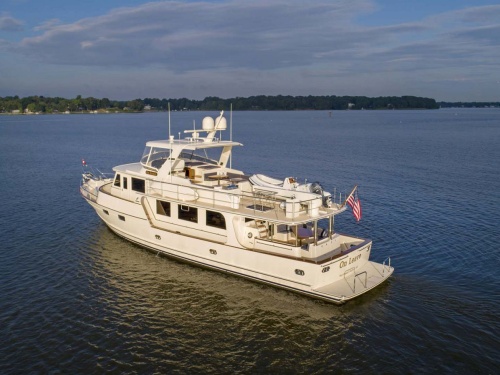
Fleming Yachts 78 (2021-)
2 x 1,550-hp MAN V12
Fleming Yachts 65 (2026-)
2 x 800-hp MAN i6

Fleming Yachts 85 (2026-)
2 x 1,550-hp MAN V12