Access More Boat Tests
Already have an account? Login
Galeon 480 FLY (2025-)
2 x 600-hp Volvo Penta D8

Brief Summary
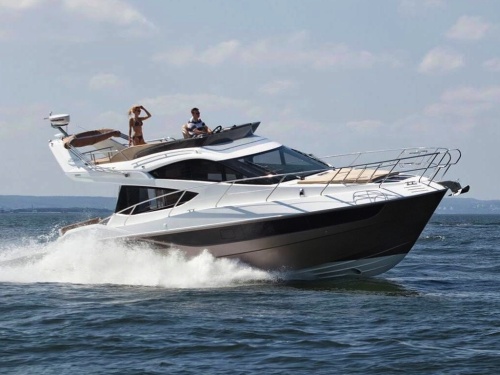
Galeon’s 480 Fly is the latest in Galeon’s Yacht Line of flybridge yachts, filling a nice gap between the 440 Fly and 500 Fly models. Designed by Tony Castro and built in Galeon’s manufacturing facilities in Poland, the 480 Fly offers a contemporary design with a focus on large amounts of natural light and open areas. She packs a great deal of flexible space into a 48’ platform with excellent seating on the bow, in the cockpit, and on the flybridge. The three-stateroom interior is also very spacious and flooded with natural light.
Her construction is sturdy and well-suited to her purpose as a near-shore cruiser. She has good performance and handling and was a joy to operate.
Test Results
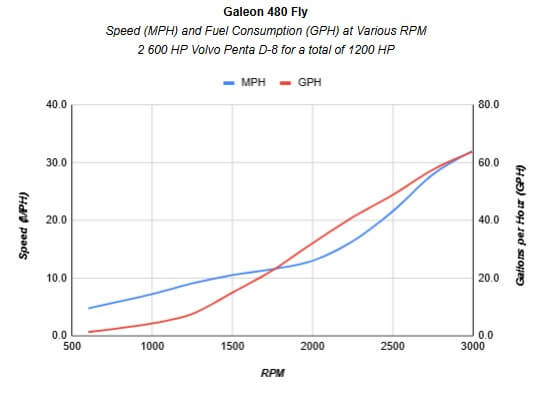
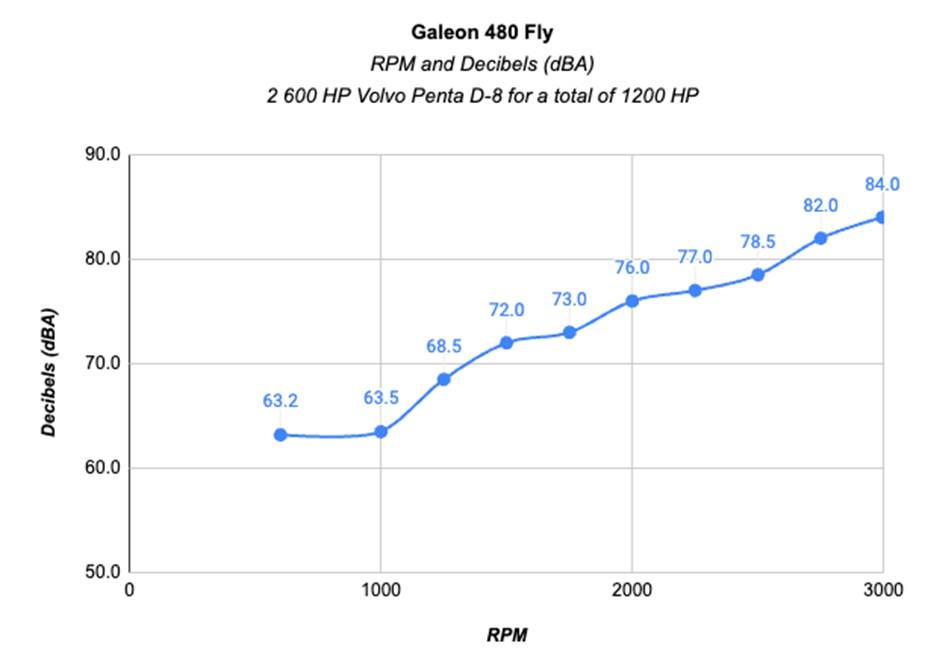
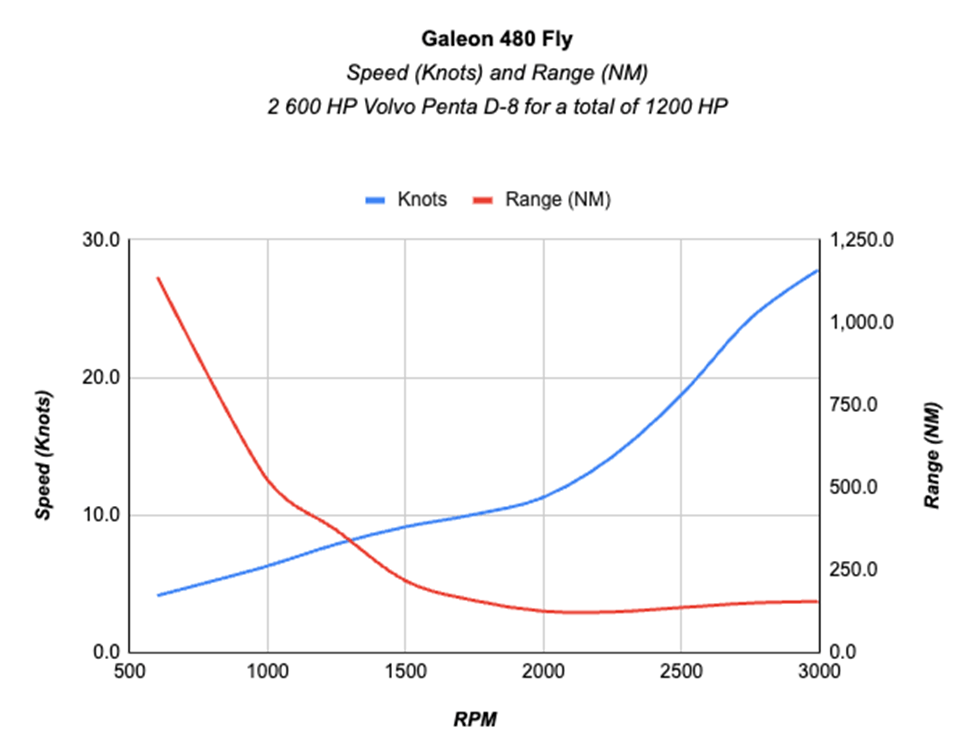
| RPM | MPH | Knots | GPH | MPG | NMPG | SM | NM | dBa |
|---|---|---|---|---|---|---|---|---|
| 600 | 4.8 | 4.2 | 1.3 | 3.7 | 3.2 | 1309.3 | 1137.7 | 63.2 |
| 1000 | 7.2 | 6.3 | 4.3 | 1.7 | 1.5 | 600.9 | 522.2 | 63.5 |
| 1250 | 9.1 | 7.9 | 7.6 | 1.2 | 1 | 426.3 | 370.5 | 68.5 |
| 1500 | 10.5 | 9.2 | 15 | 0.7 | 0.6 | 250.2 | 217.4 | 72 |
| 1750 | 11.6 | 10.1 | 22.7 | 0.5 | 0.4 | 181.6 | 157.8 | 73 |
| 2000 | 13 | 11.3 | 32.1 | 0.4 | 0.4 | 144.4 | 125.5 | 76 |
| 2250 | 16.4 | 14.3 | 41.1 | 0.4 | 0.3 | 142.2 | 123.6 | 77 |
| 2500 | 21.6 | 18.8 | 48.9 | 0.4 | 0.4 | 157.4 | 136.8 | 78.5 |
| 2750 | 28 | 24.3 | 57.6 | 0.5 | 0.4 | 173 | 150.4 | 82 |
| 2995 | 32 | 27.8 | 63.8 | 0.5 | 0.4 | 178.7 | 155.3 | 84 |
Specifications
| Length Overall |
47' 1" 14.35 m |
|---|---|
| Beam |
14' 2" 4.33 m |
| Dry Weight |
35,274 lbs 16,000 kg |
| Tested Weight |
39,032 lbs 17,705 kg |
| Draft |
4' 3" 1.3 m |
| Fuel Capacity |
396 gal 1,500 L |
| Water Capacity |
143 gal 650 L |
| Total Weight |
39,032 lbs 17,705 kg |
Acceleration Times & Conditions
| Load | Persons & Gear: 555 lbs/252 kg; Fuel on board: 2,249 lbs/1,020 kg; Water on board: 954 lbs/433 kg; Total Load: 3,758 lbs/1,705 kg |
|---|---|
| Climate | 90°F; 75% humidity; wind: 6-8 knots, West/SW; wave: <1'; salt |
Engine Options
| Tested Engine |
2 x 600-hp Volvo Penta D8 |
|---|---|
| Std. Power |
2 x 600-hp Volvo Penta D8 |
Captain's Report Galeon 480 FLY
by Capt. Gregg Clark

Mission
The 47’ 1” (14.35 m) LOA 480 Fly is designed to be a multi-purpose yacht serving cruising and entertaining intentions. She is an excellent boat for a couple who likes to bring along guests or perhaps extended family. She is an excellent step up to the yacht category from someone coming out of a smaller cruiser or perhaps even a center console. She has a fuel capacity of 396 gallons (1,500 L) giving her a 137 nm range at a cruise speed of 18 knots and a 371 nm range at a displacement speed of 8 knots.
Performance Review
Test Conditions
Test day brought light conditions with winds from the southwest at 8-10 knots and seas less than 1’. The test area was in the Gulf of America, just west of Naples, FL.
Test Results
Once offshore, our first tests were a series of runs focused on getting the speed, fuel burn and noise level (measured in decibels, or dBA) at specific RPM.
Acceleration Times & Conditions*
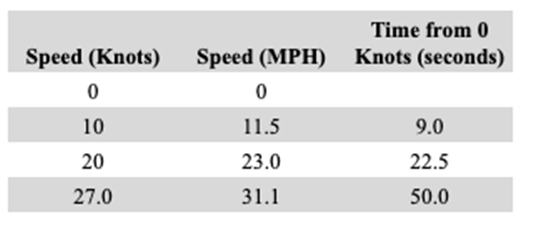
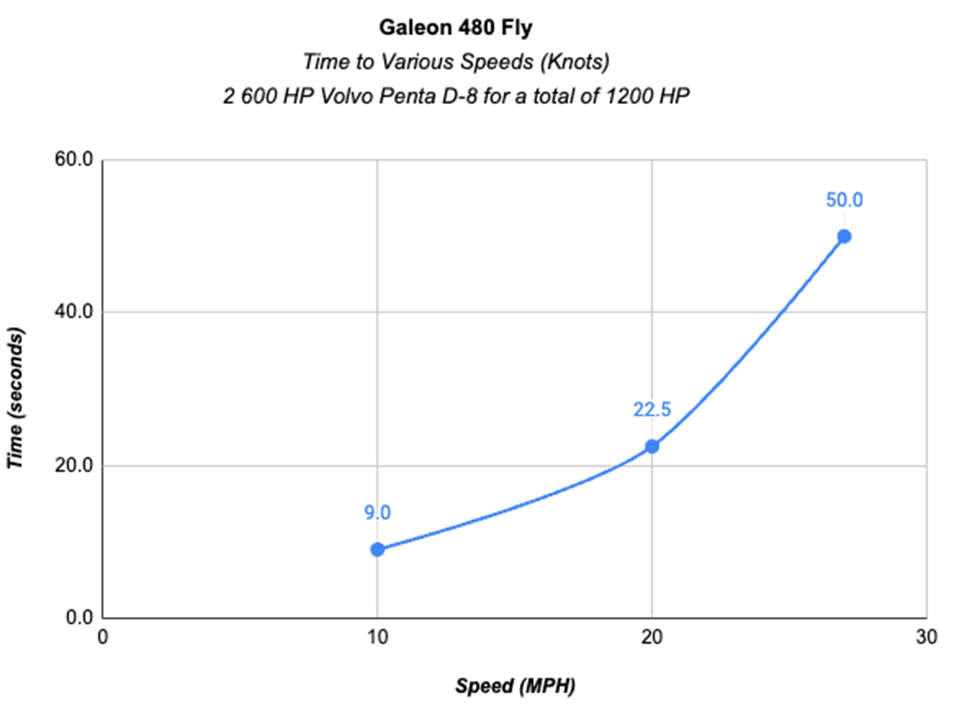
The next tests were the acceleration runs. Here, 3 tests were conducted and then averaged to get the time from 0 knots to select speeds.
Range and Optimal Cruise
The Galeon 480 Fly has an effective range between 137 nm and 371 nm with a 10% fuel reserve. At a cruise speed of 18 knots, she has a range of 137 nm and at 1,250 RPM or 8 knot displacement speed she has a range of 371 nm.
Handling
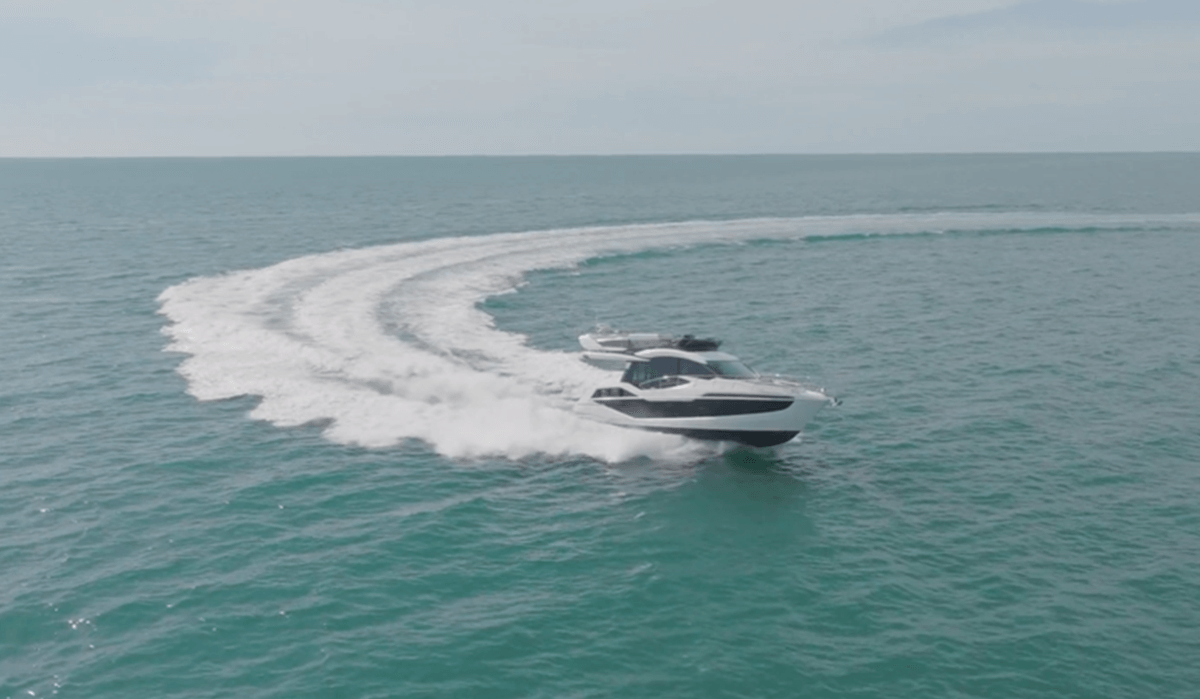
The Galeon 480 Fly handed well helped by her straight shaft coming off V-Drives from the D8-600 motors. She handled well at both low and high speeds. Quite a bit of helm input was required at slow speeds, so I found myself using the autopilot some even when operating at idle speeds. Given the light conditions, I was unable to evaluate the performance in a sea way, but she did seem to handle the waves well when I doubled back through my ~2-3’ wake.
Docking
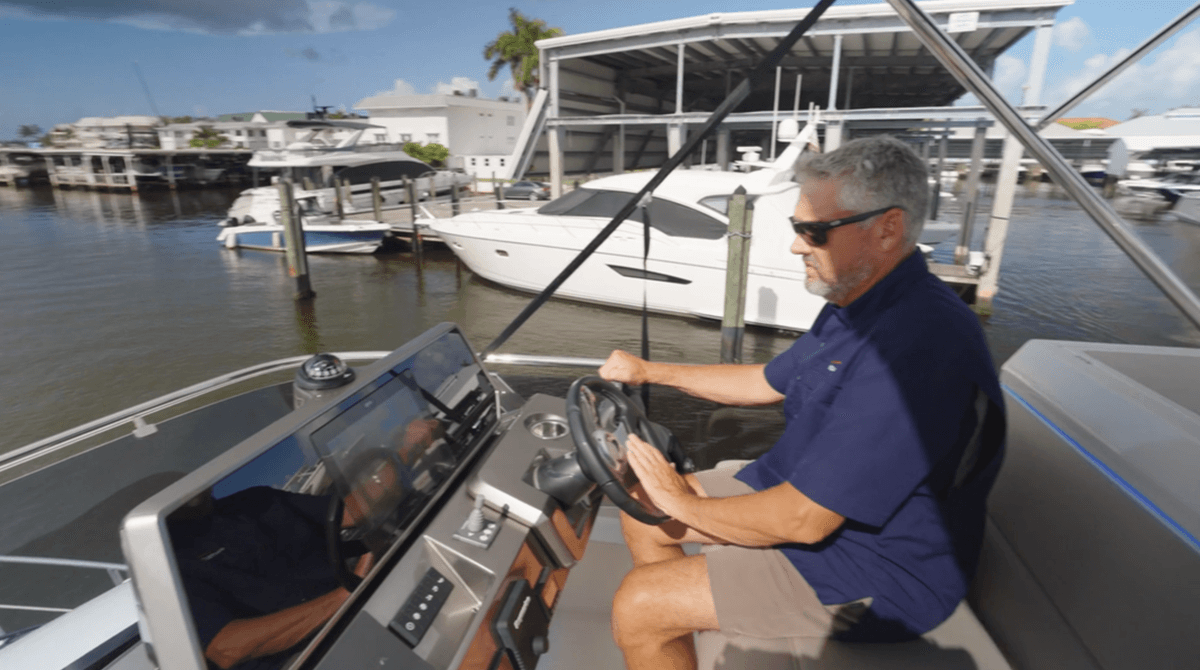
I personally am a fan of straight shafts, especially when augmented with bow thrusters as this boat was configured. Our slip was quite challenging given a 68’ cruiser off our bow. We only had about 2’ of room off the bow when our stern was clear to turn. Her slow idle speed allowed me complete control when bumping the throttles in and out of gear. Despite the tight quarters, it was a low stress situation where I felt completely in control. I docked and undocked from the flybridge, which afforded great visibility to both port and starboard and especially forward. I needed a hand to call the stern as the platform wasn’t visible from the flybridge.
Features Review
Highlights
- Solid construction designed for coastal cruising
- Three levels of space
- Well thought-out and functional design features
Exterior
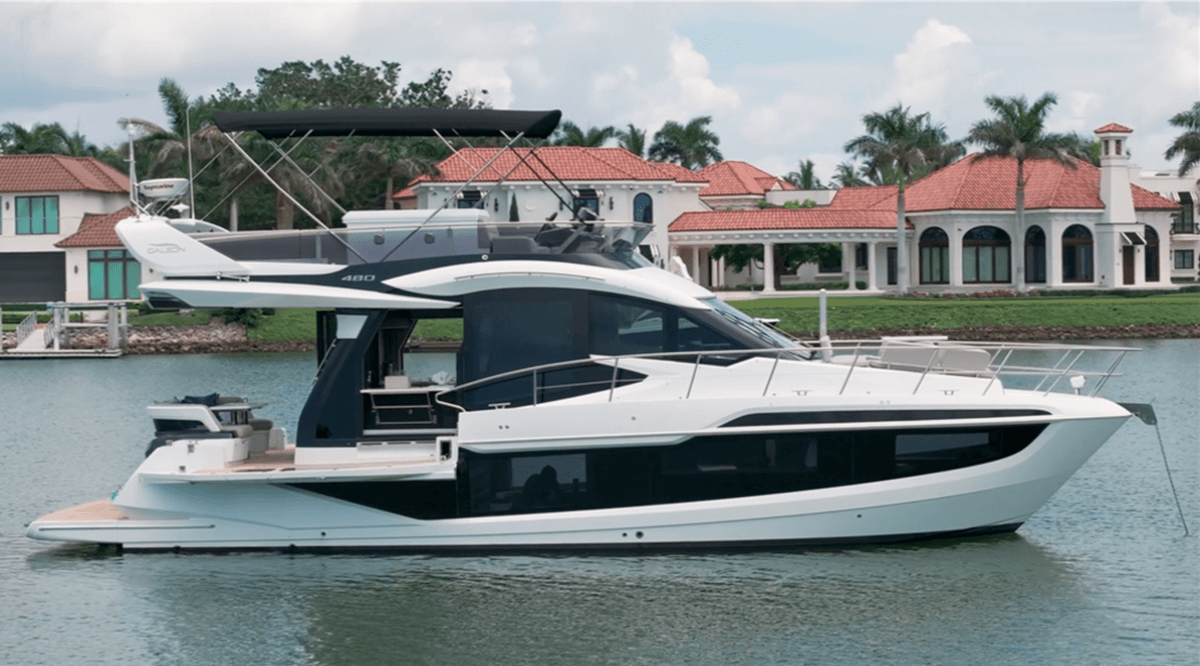
The Galeon 480 Fly is a sleek looking yacht with contemporary lines. To my eye, she looks like she is ready to go even when sitting at anchor. She has contrasting white fiberglass with dark windows and accents. Her exterior proportions look natural and in line with other models in Galeon’s flybridge line of yachts.
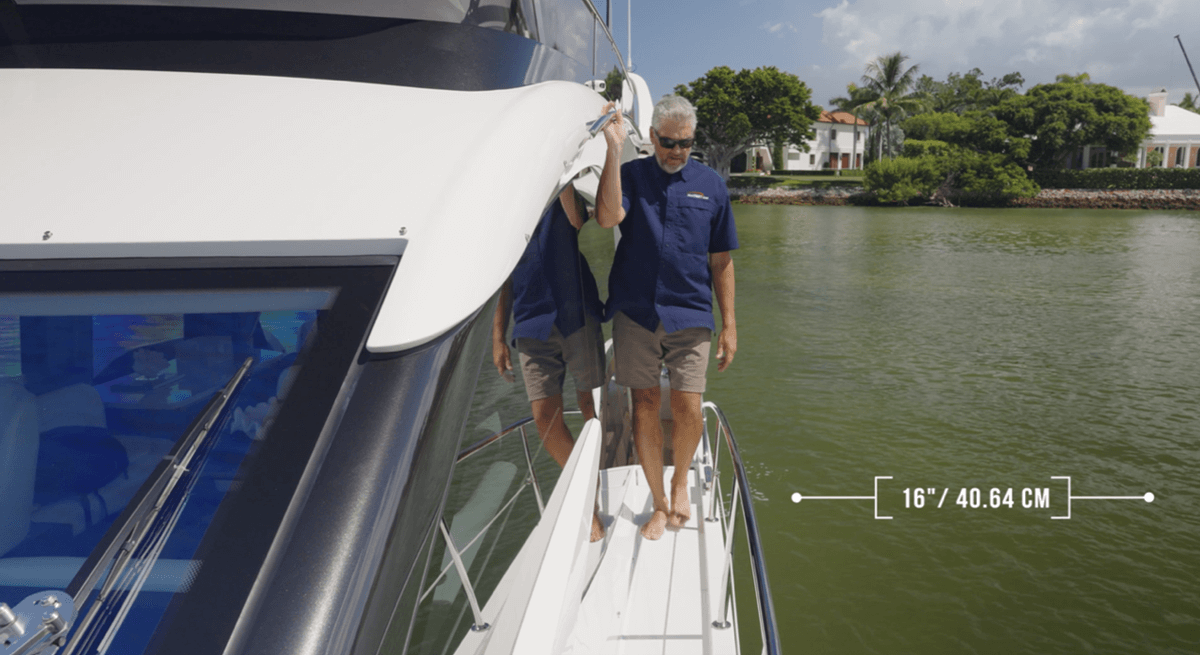
The walkway is 16” wide at hip level with a sturdy stainless-steel rail that is between 30” and 34” high along the walkway where the handrail isn’t present.
Layout
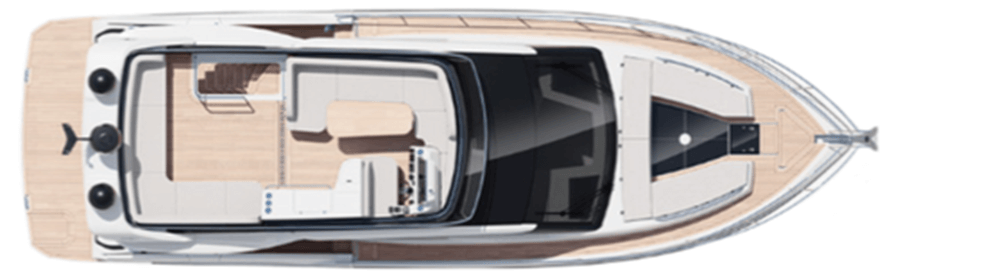
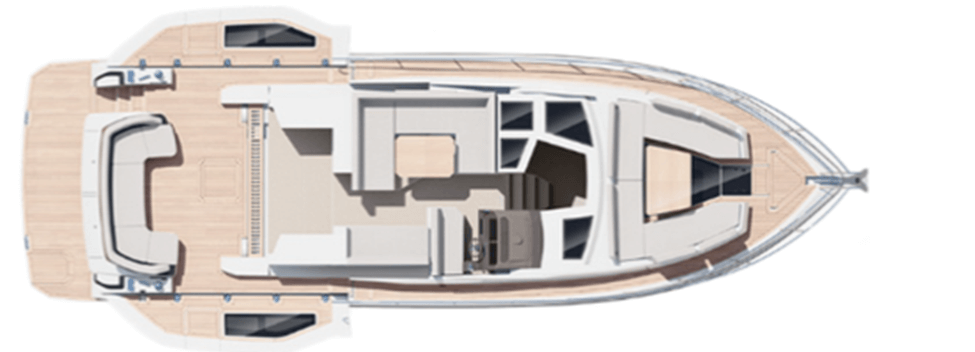
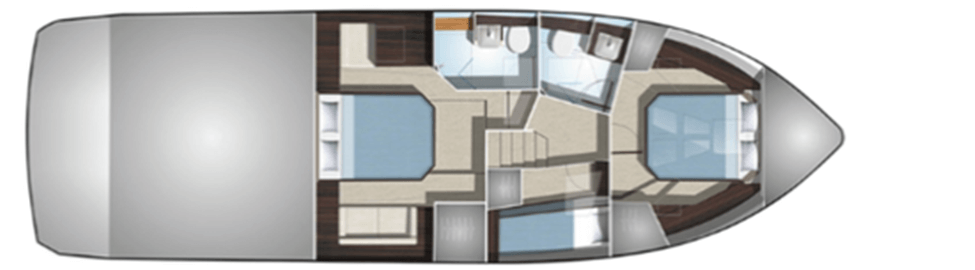
The 480 Fly has three levels of space.
Flybridge
There are three distinct seating areas on the flybridge.
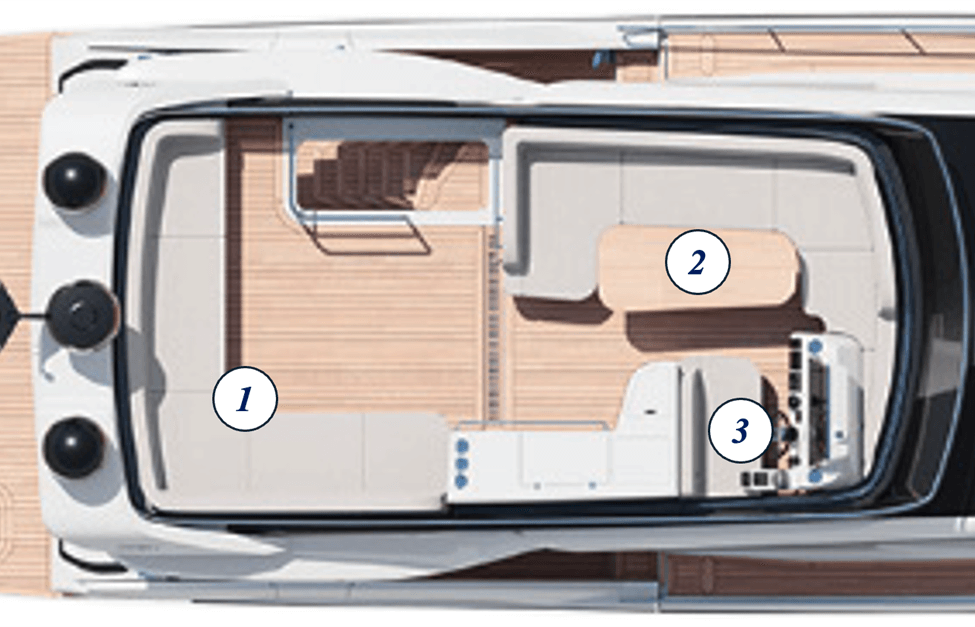
Access to the flybridge is via a seven-step ladder to port. The flybridge has 2 distinct sitting areas plus the 2-person helm seat. There is also counterspace that covers a sink and an optional flybridge grill. Under the cabinet is a refrigerator, freezer and storage space.
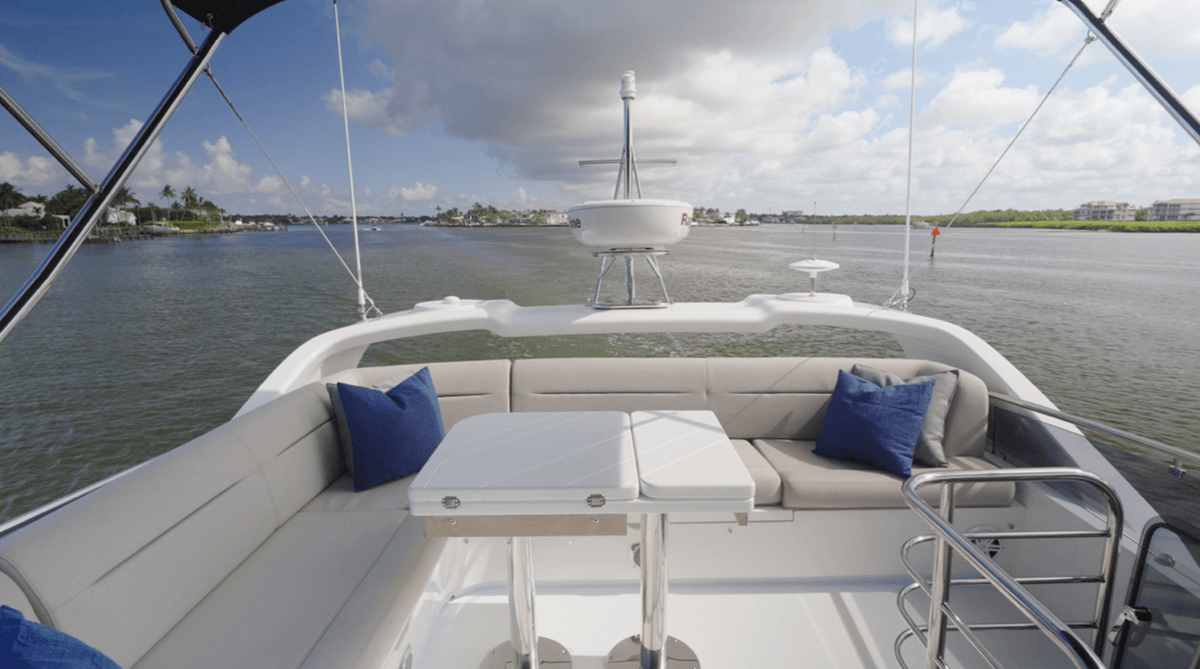
1) Aft L-Shaped Seating
Around the aft section of the flybridge is large L-shaped sitting around a table that accommodates 8-10 people.
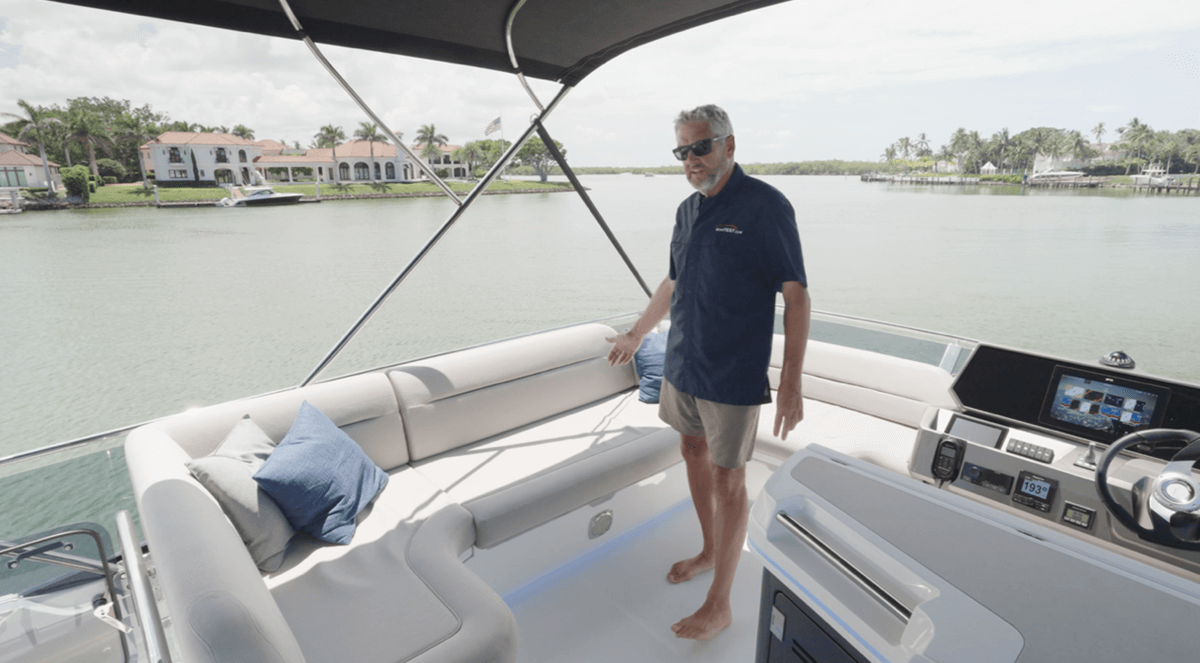
2) Port U-Shaped Seating
Forward to port is a U-shaped seating area that can accommodate 4-5 people.
3) Flybridge Helm
To starboard is the flybridge helm. Our test yacht had a single 12” Raymarine MFD but there is easily space for two. Visibility from the flybridge helm is excellent. All required controls are within easy reach.

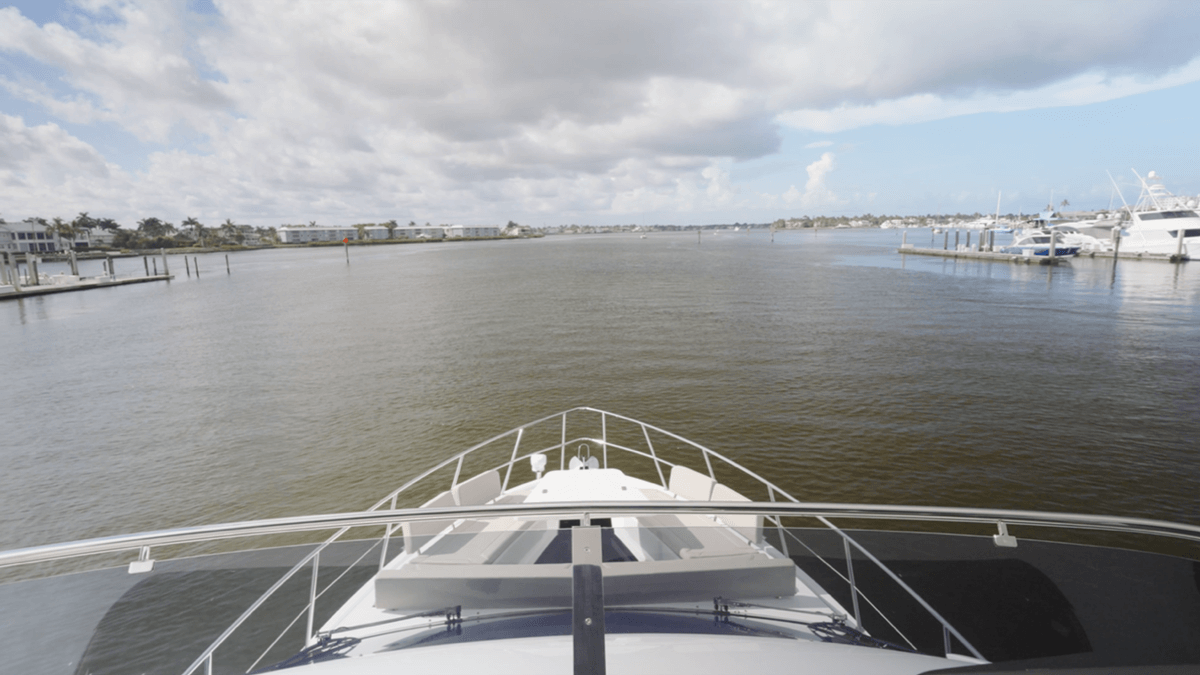
Bow
Beginning with the deck forward, there is a 55-pound (24.95 kg) Ultra stainless-steel anchor. The rode is galvanized. Access to the anchor locker is to starboard. The windlass is recessed in the port bow locker. There is a cleat inside the port locker so that a snubber line doesn’t need to be run back to a bow cleat.
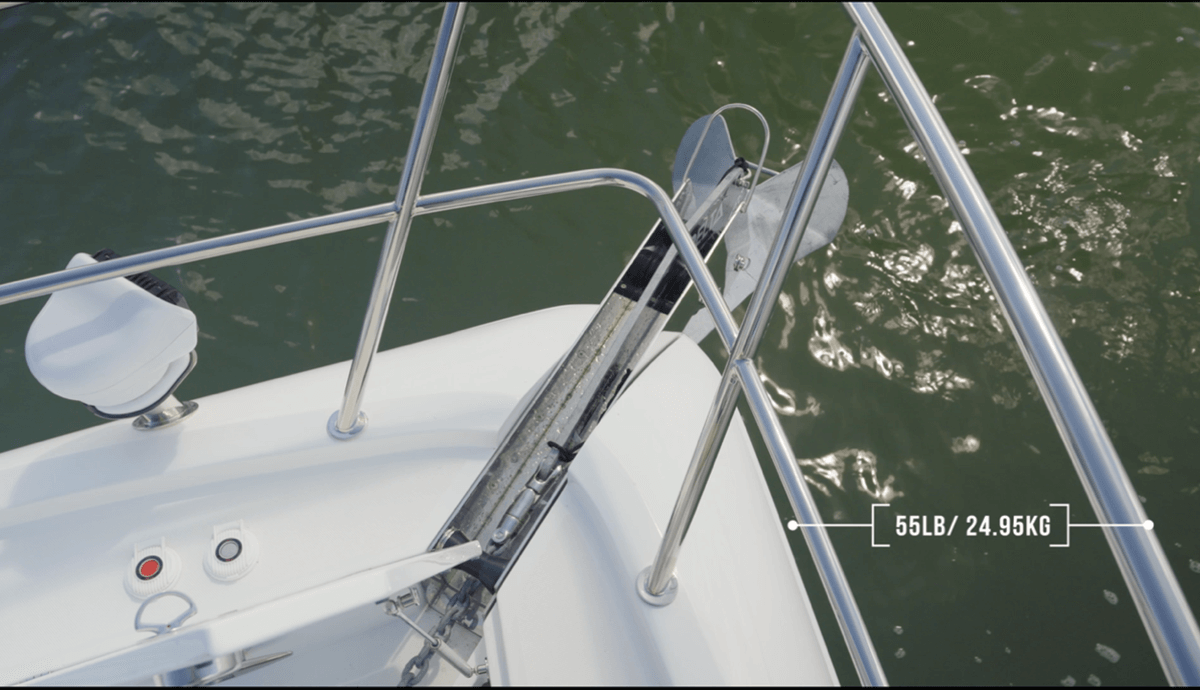
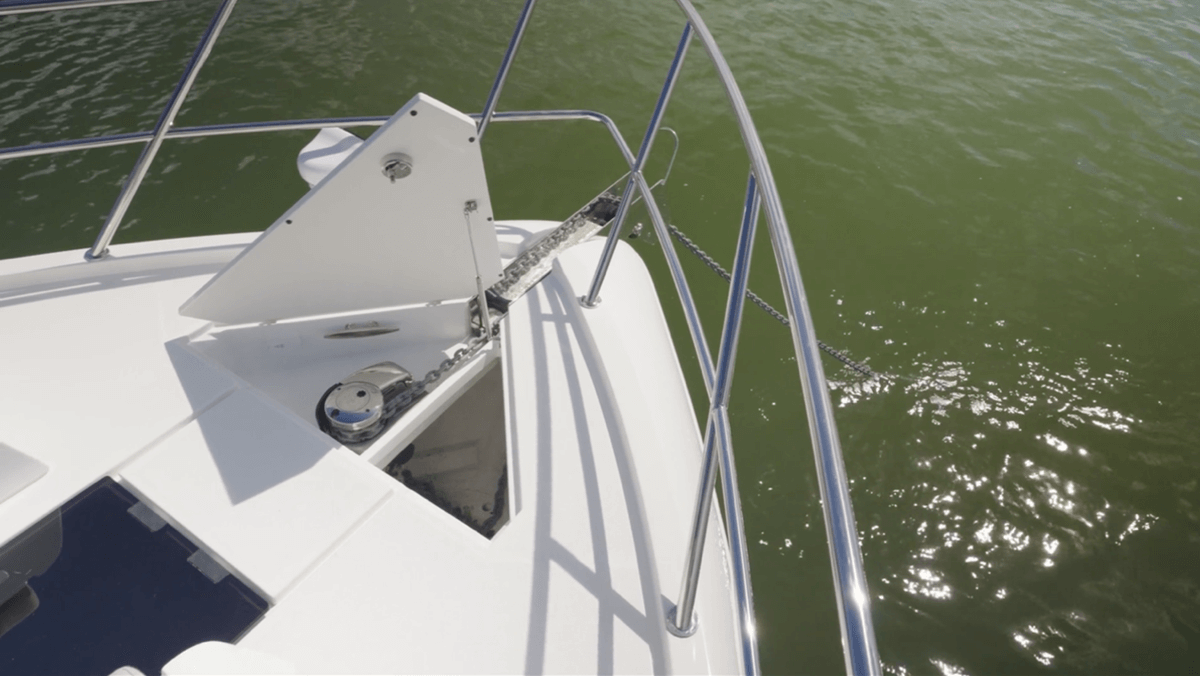
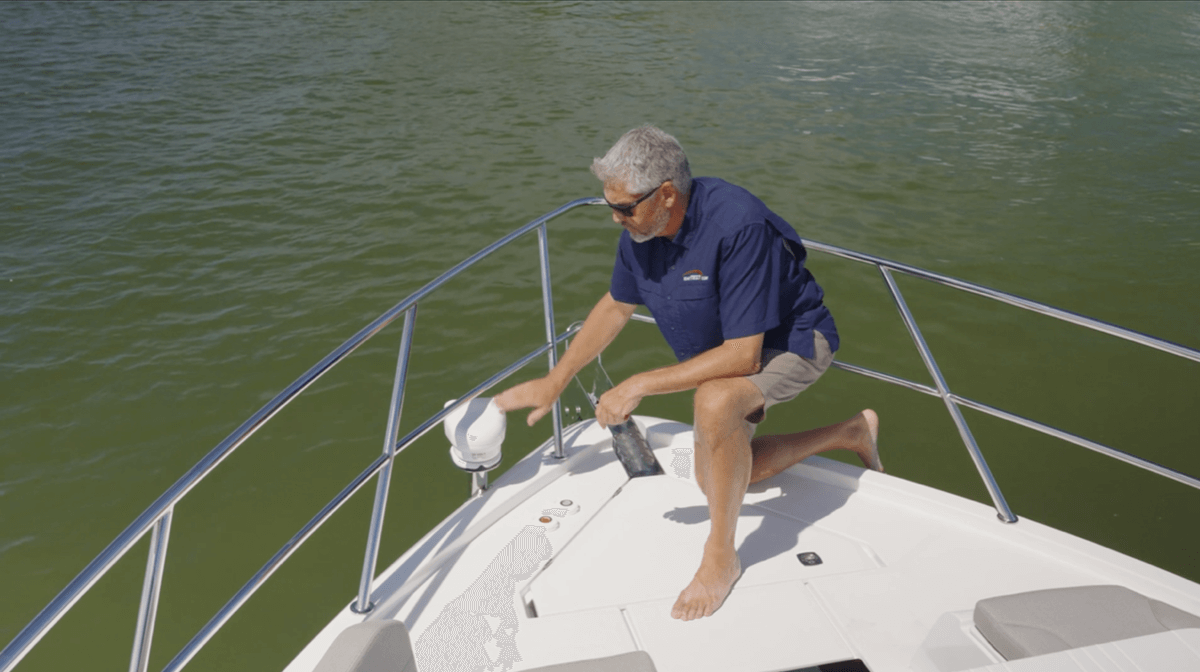
There is a search light mounted on the bow to port.
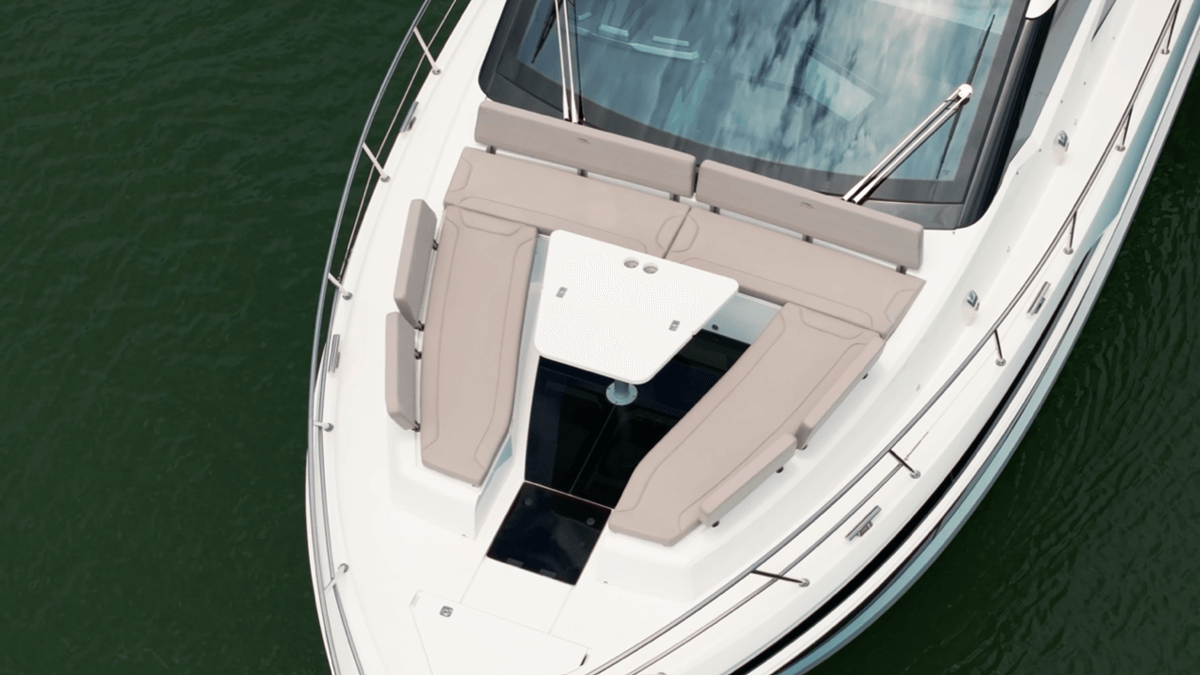
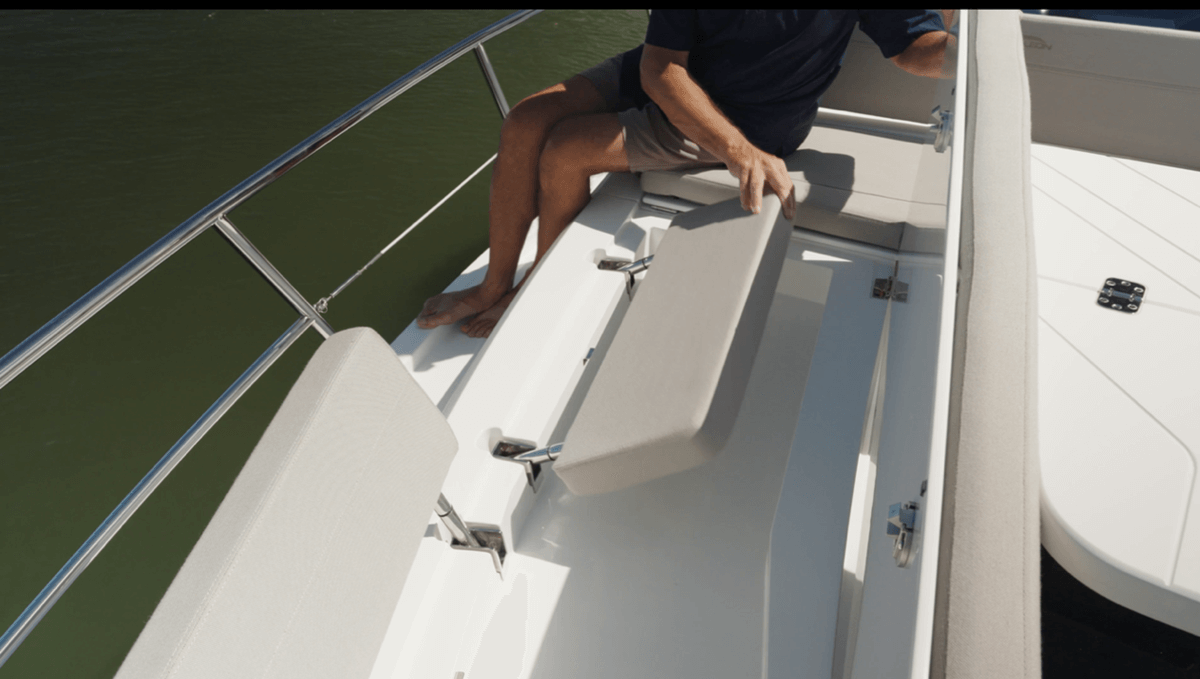
The forward seating area is spacious with room for 9-10 people. The backs fold down under the seats when running.
Cockpit
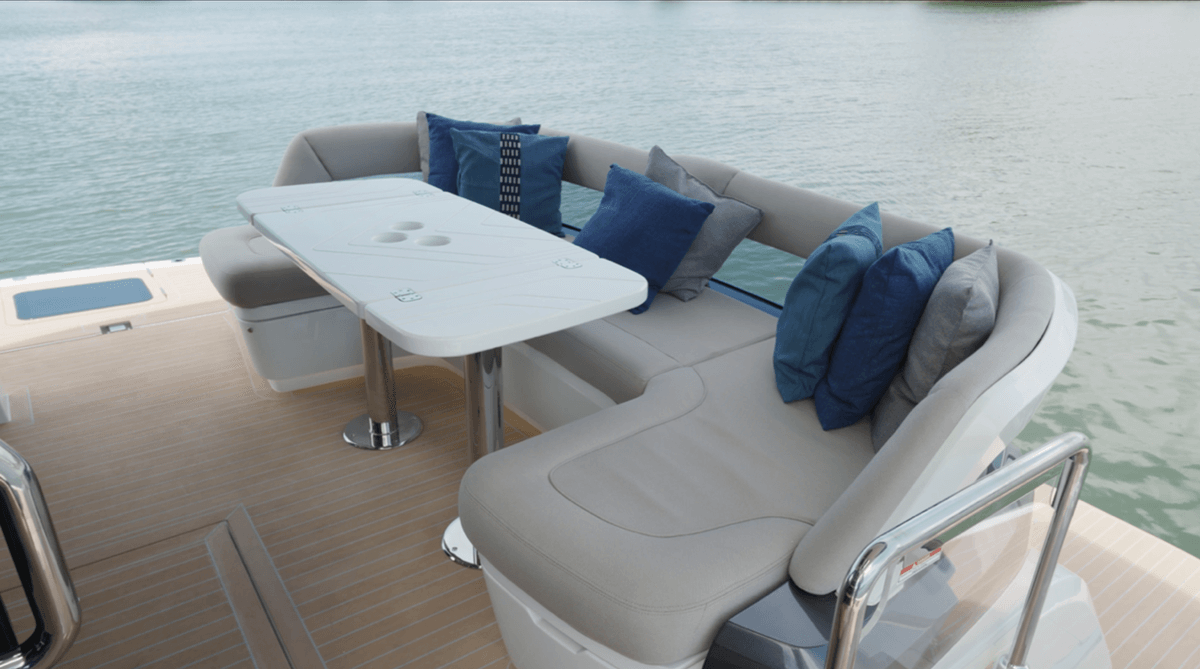
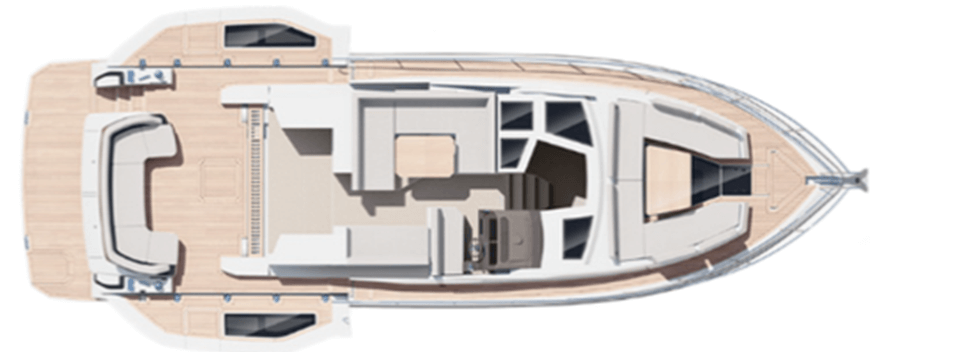
The aft covered cockpit of the 480 Fly measures 84 SqFt (25.5 SqM) and encompasses wrap-around bench seating aft around a folding table.
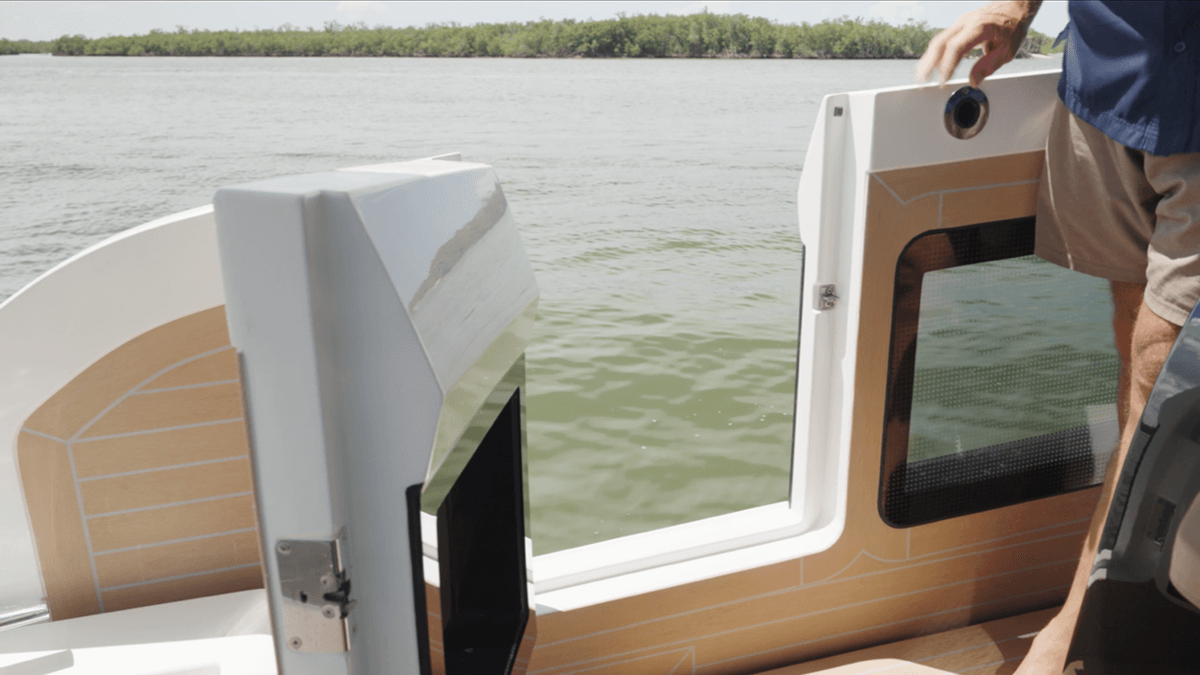
There are boarding doors in the balconies to both port and starboard.
Swim Platform
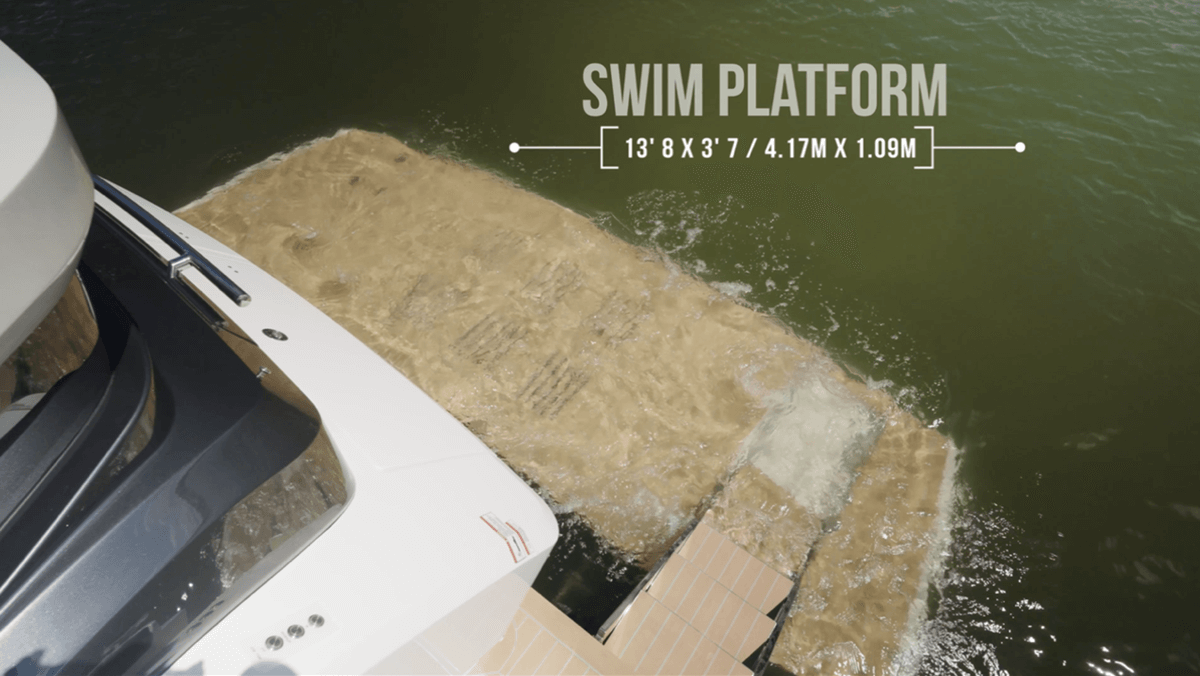
The swim platform measures 13’ 8” (4.2 M) wide at its widest point and extends 3’ 7” (1.1 M) abaft the stern. The swim platform lowers creating four steps into the water. This is perfect for allowing guest access to the water or for deploying the tender.
Access to the cockpit is via four steps to port.
Stern
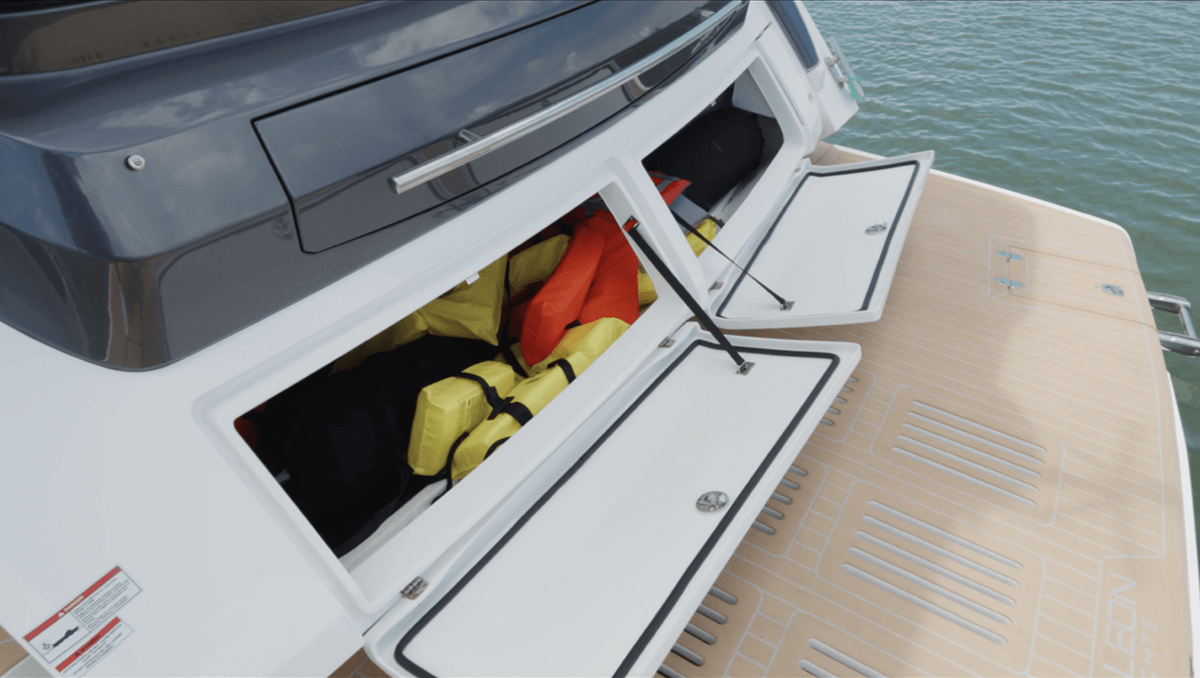
At the stern are two storage compartments that measure just over 6’ deep. In addition to the storage of stanchions and stools for the balconies, there is enough space for water toy, fender and line stowage.
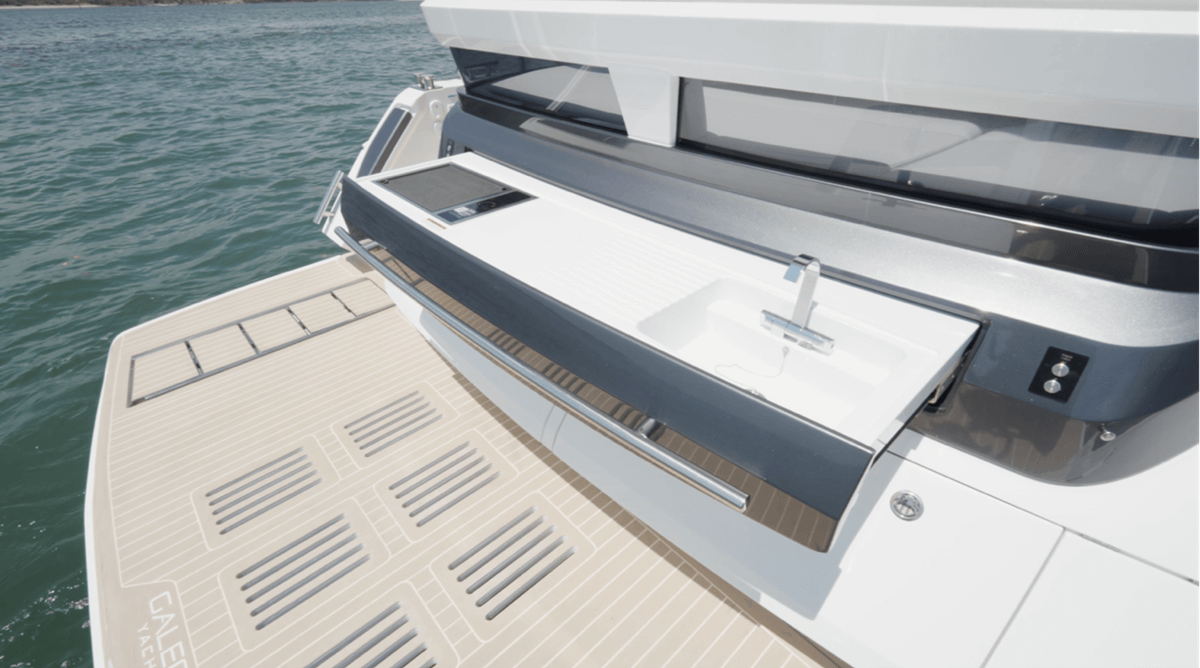
On the stern above the swim platform is a retractable grill station with sink.
Exterior / Interior Transition
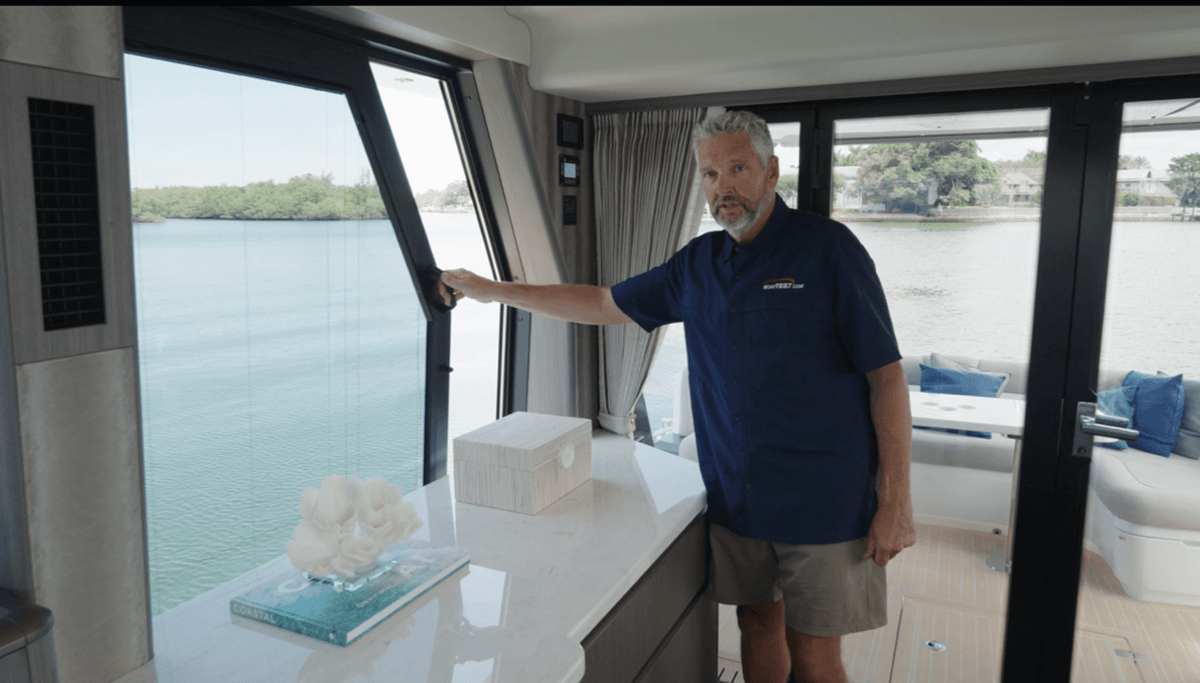
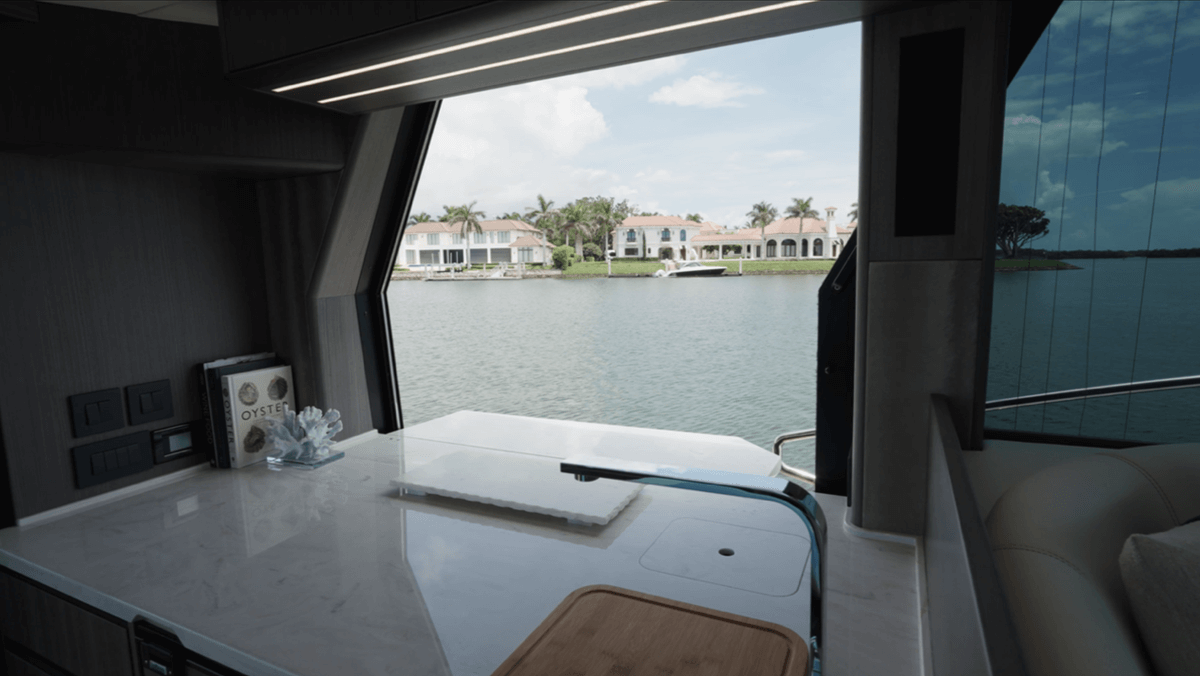
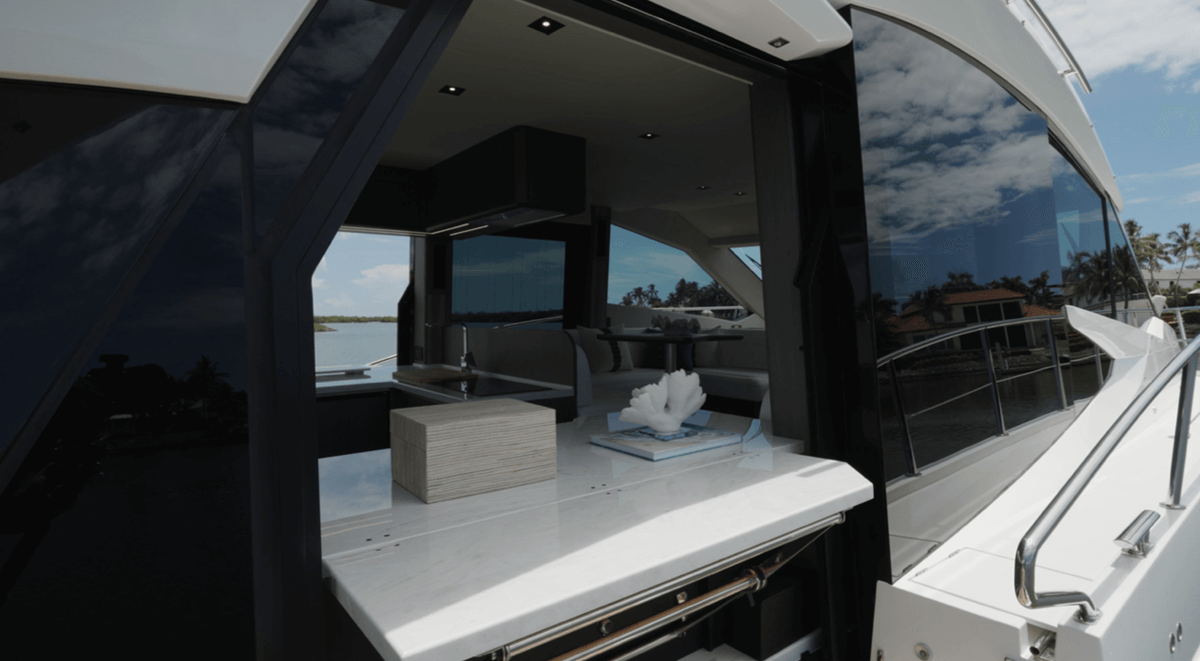
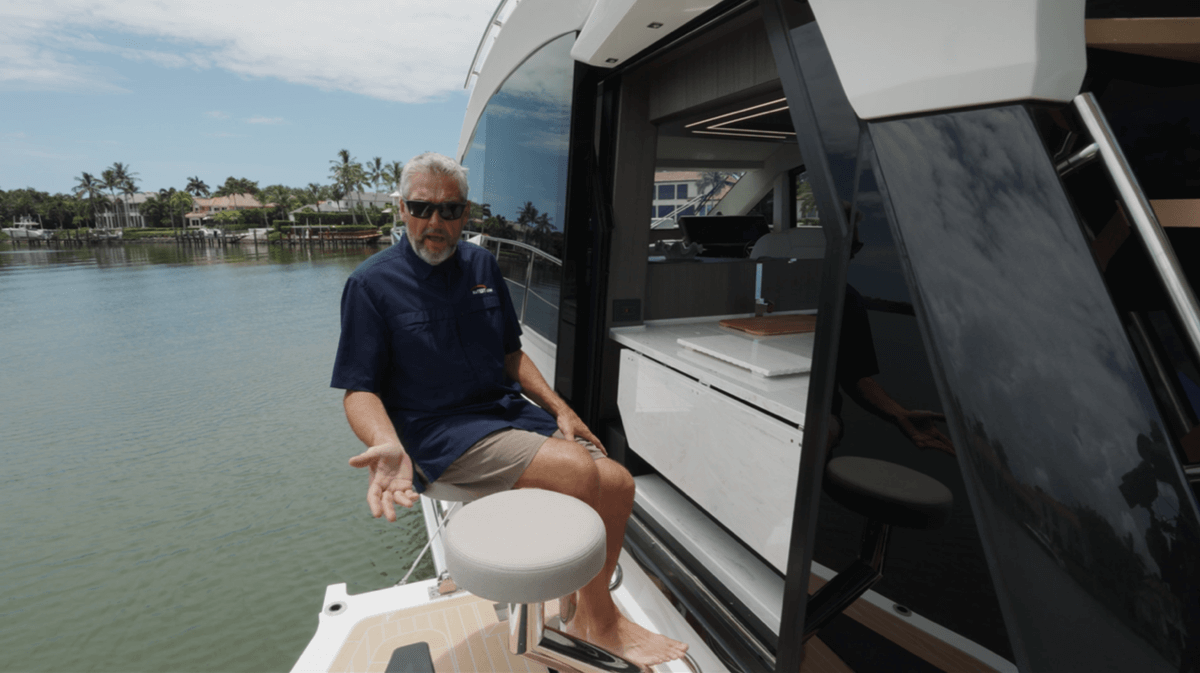
A unique aspect of the Galeon 480 Fly is the transition from exterior to interior. When at anchor, several elements of the yacht transform to create a shared exterior / interior space from midship aft.
There are six steps in the conversion:
- Open the accordion doors connecting the cockpit to the main deck
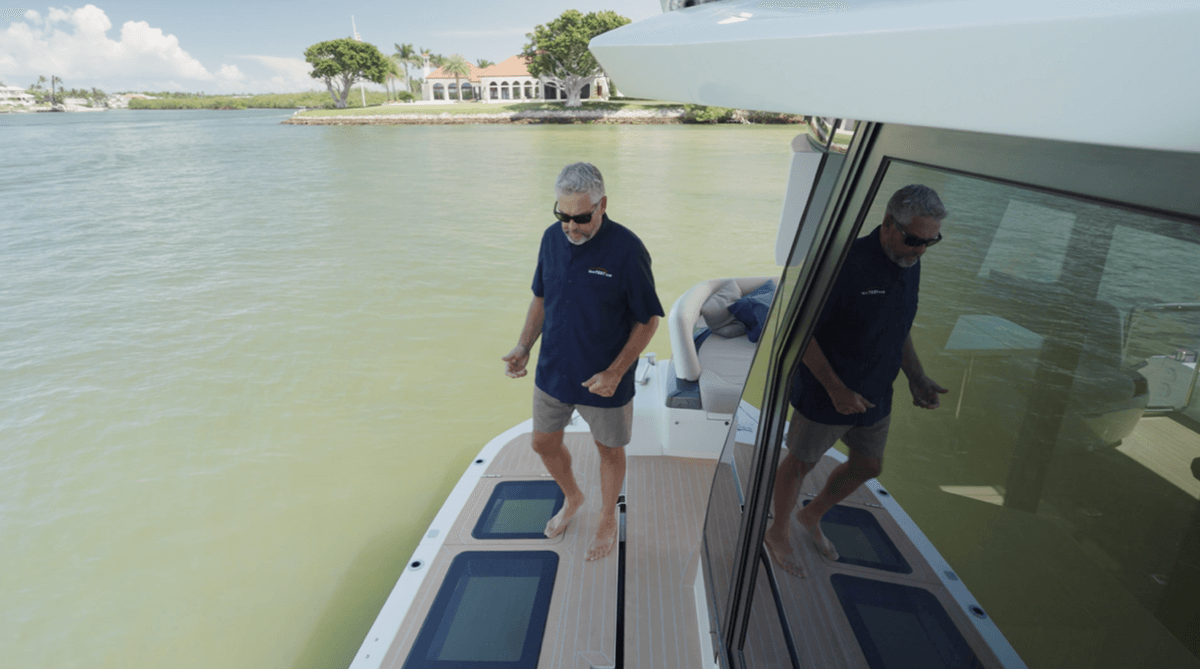
- Drop the balconies
- Open the sliding windows to both port and starboard
- Fold up leaves outside of the port and starboard
- Install bar stools or protective stanchions / lifelines
- Enjoy the space!
The conversion can happen in minutes. The flow and airiness of the reconfigured yacht is amazing for a platform of this size. It truly is like your own floating island.
Interior
Main Cabin
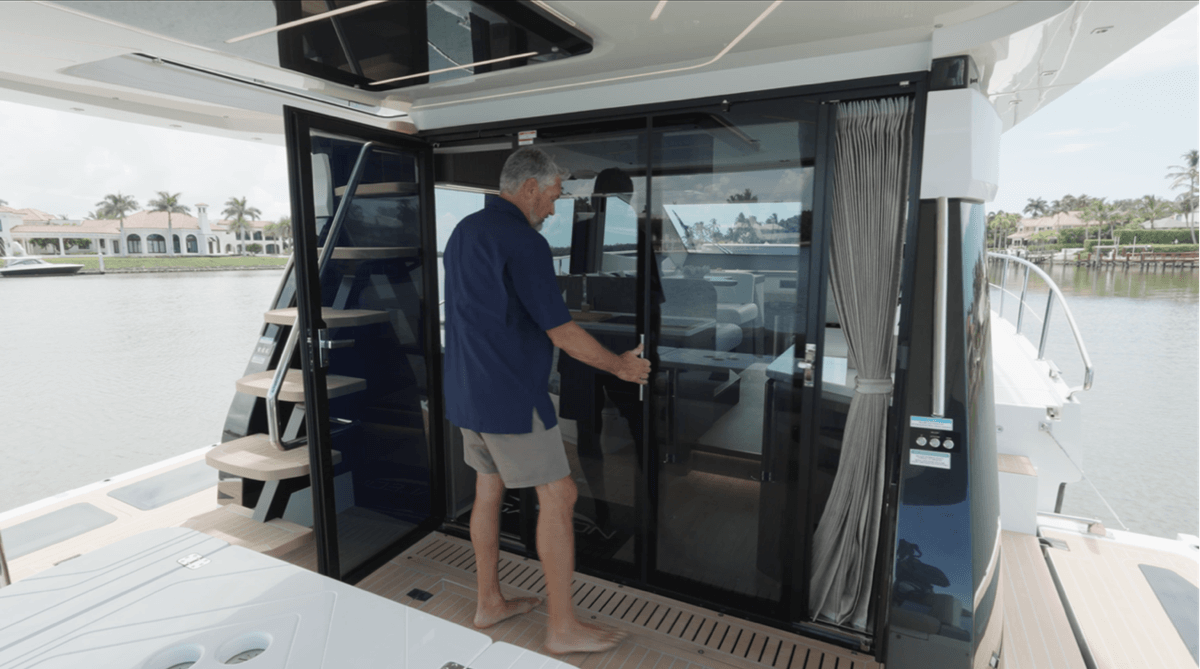
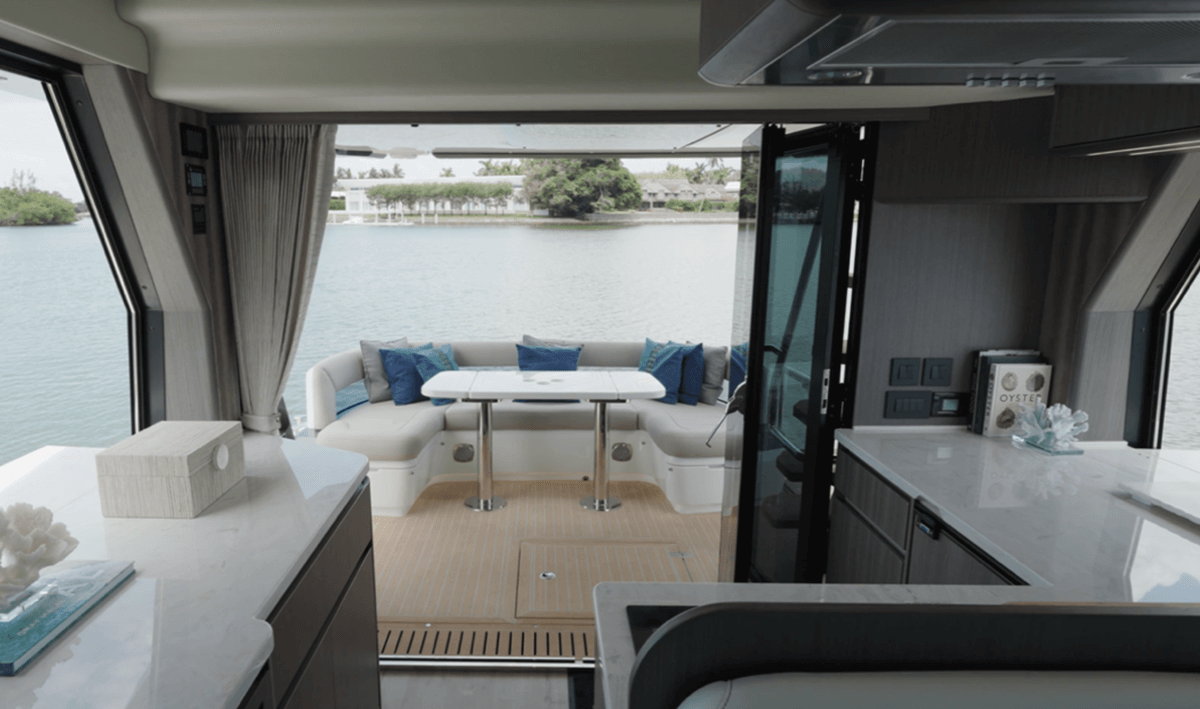
Entrance to the main cabin is through a large accordion door that opens into the galley.
Main Deck
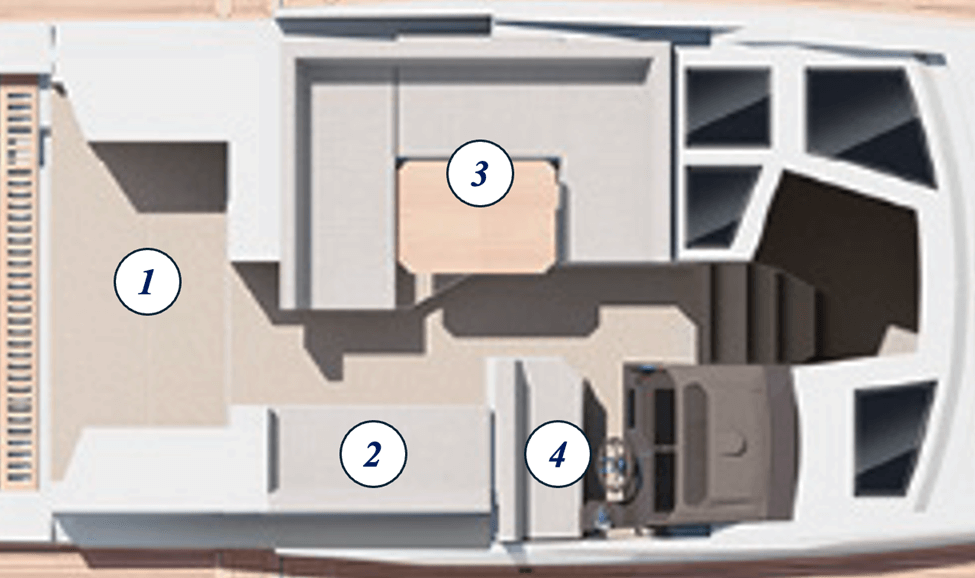
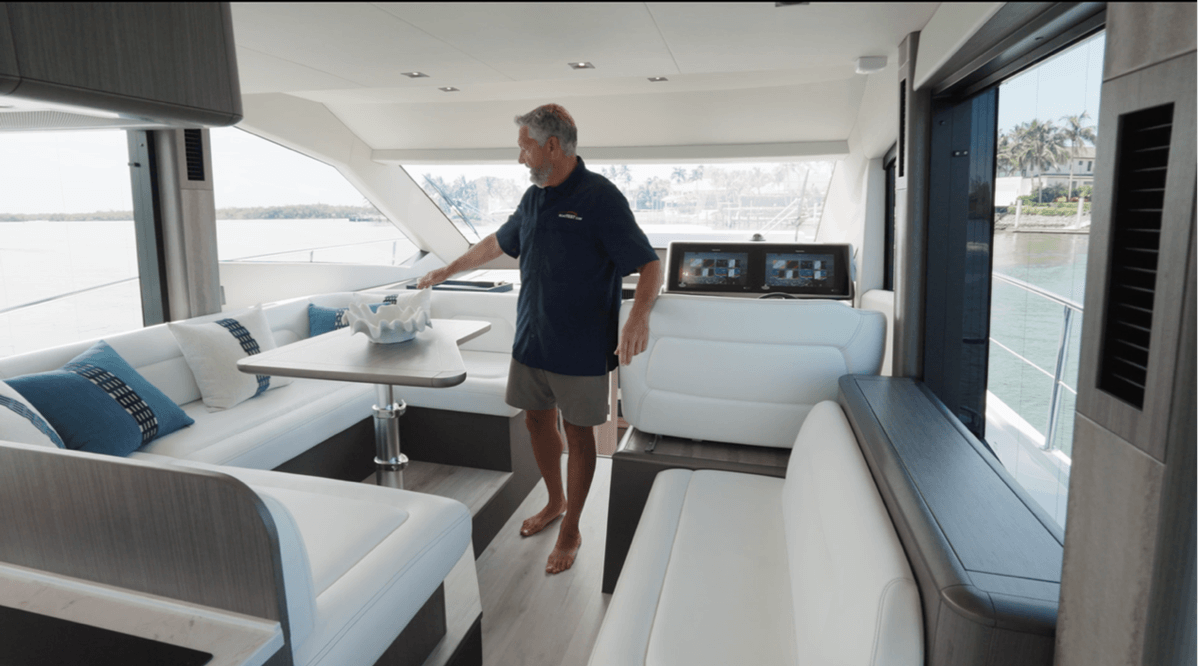
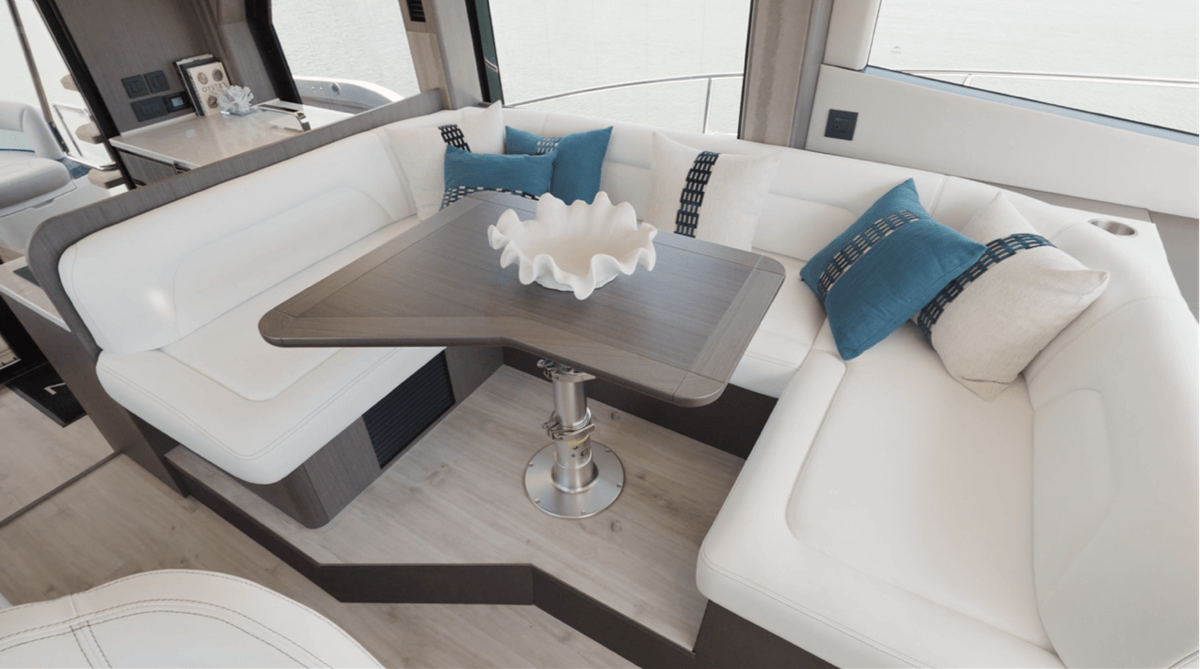
The main deck has four distinct spaces. These include: 1) the galley, 2) a 2-person bench seat, 3) a U-shaped seating area around a telescoping table, and 4) the helm station. There is a minimum of 6’ 6” (2.0 M) of headroom throughout. The main deck sole is the same level as the cockpit making walking from one to the other easy.
1) Galley
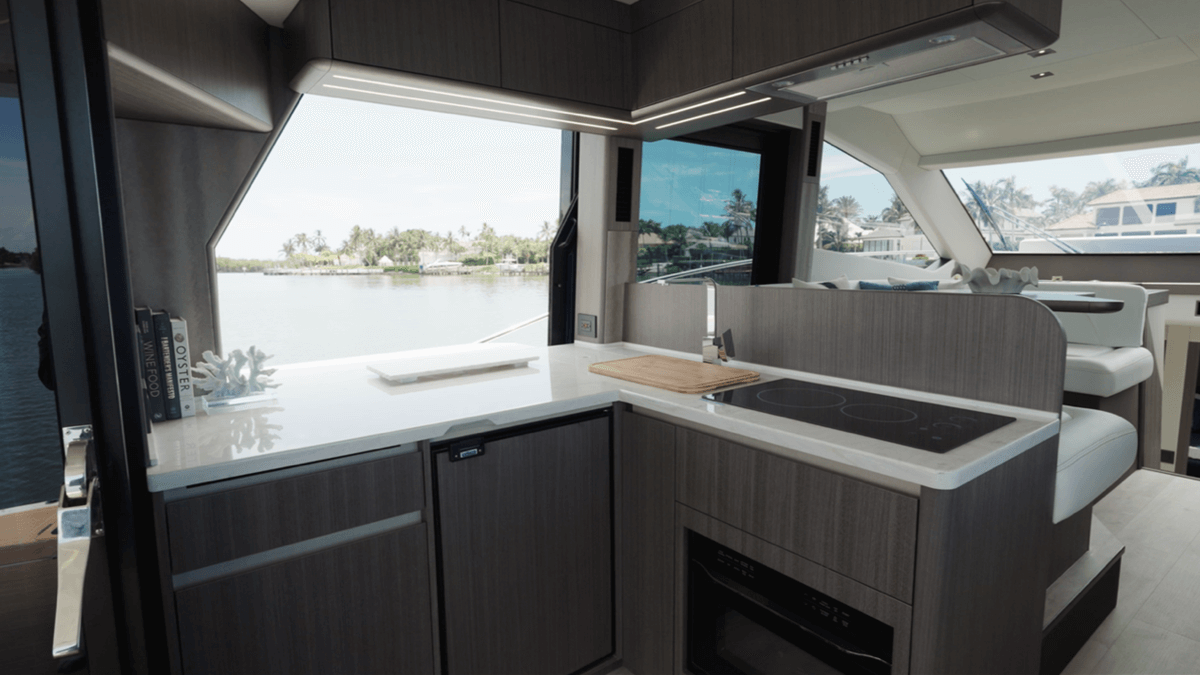
The aft section of the main deck contains a two-part galley with 6’ 6” (2.0 M) of headroom throughout. Our test yacht had grey beach wood cabinetry throughout.
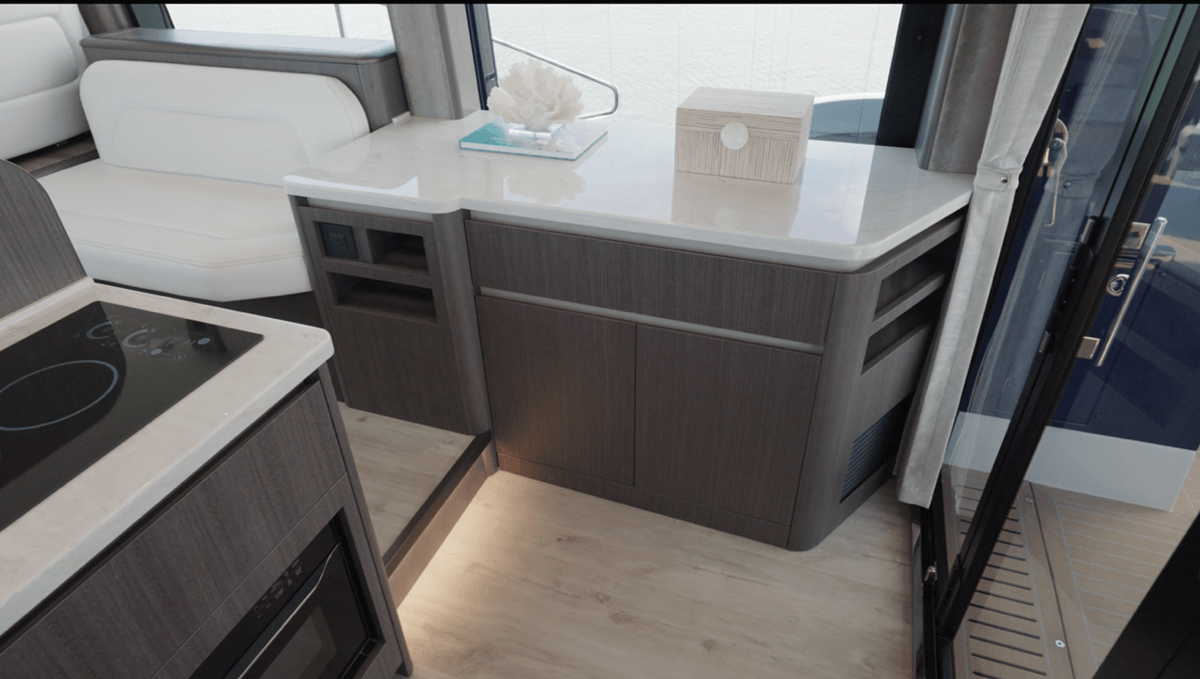
To port is an L-shaped galley area. The countertops are Corian. There is a 2-burner convection cooktop, 2-basin sink, refrigerator and microwave/oven.
2) Bench Seat
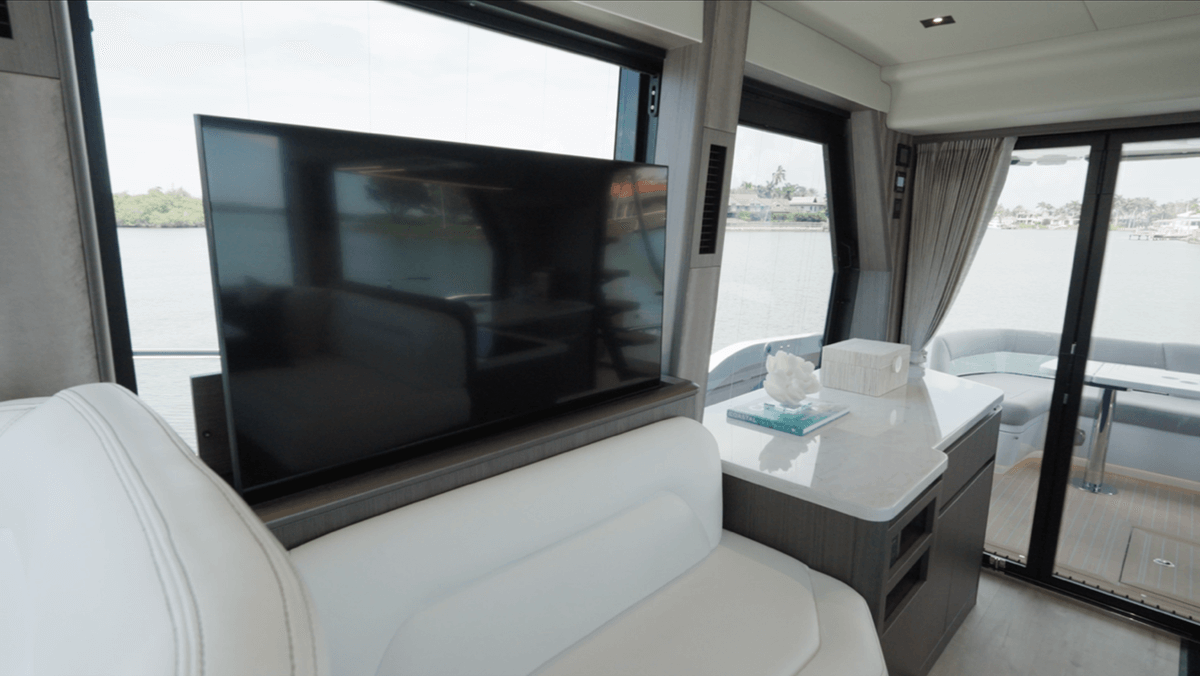
Forward of the galley to starboard is a 2-person bench seat. Behind the seat is a 50” retractable TV.
3) U-Shaped Seating Area
To port is a U-shaped seating area for 5-6 people. The table is telescoping so this area can be converted into an additional berth.
4) Helm
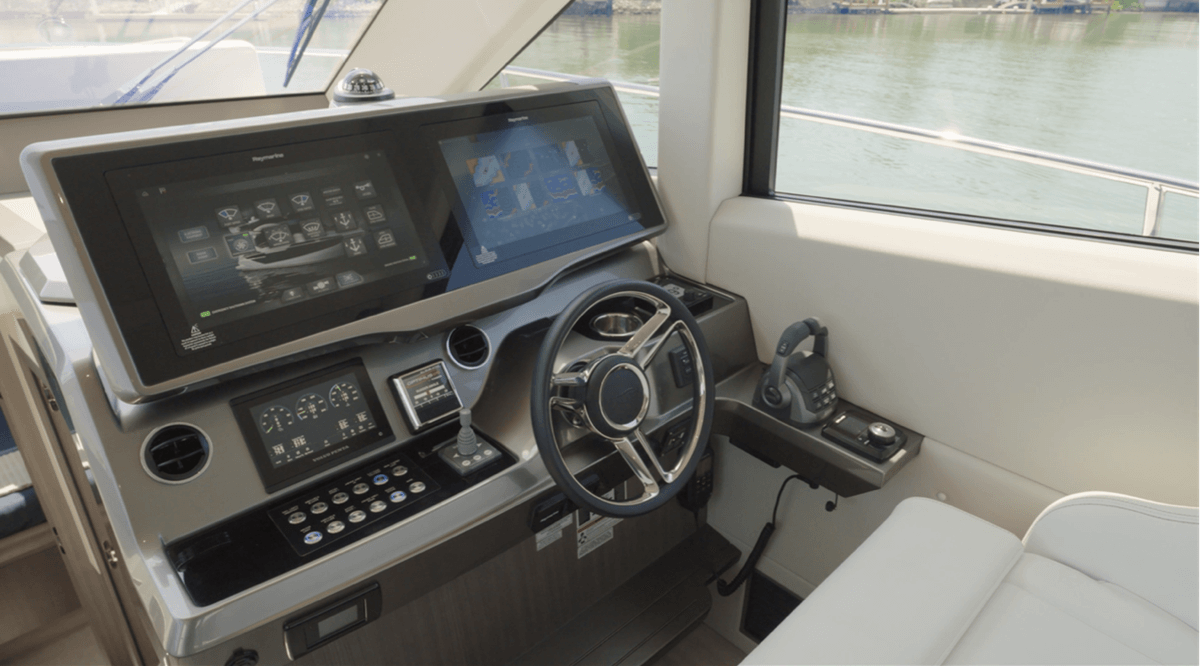
The helm of the 480 Fly is located on the starboard side of the main deck. There is good visibility given the large, single-piece (therefore mullion-free) windshield and side windows. The starboard side window electrically retracts giving good communication and visibility to starboard. The helm is outfitted with twin Raymarine 15” multi-function displays.
Accommodations
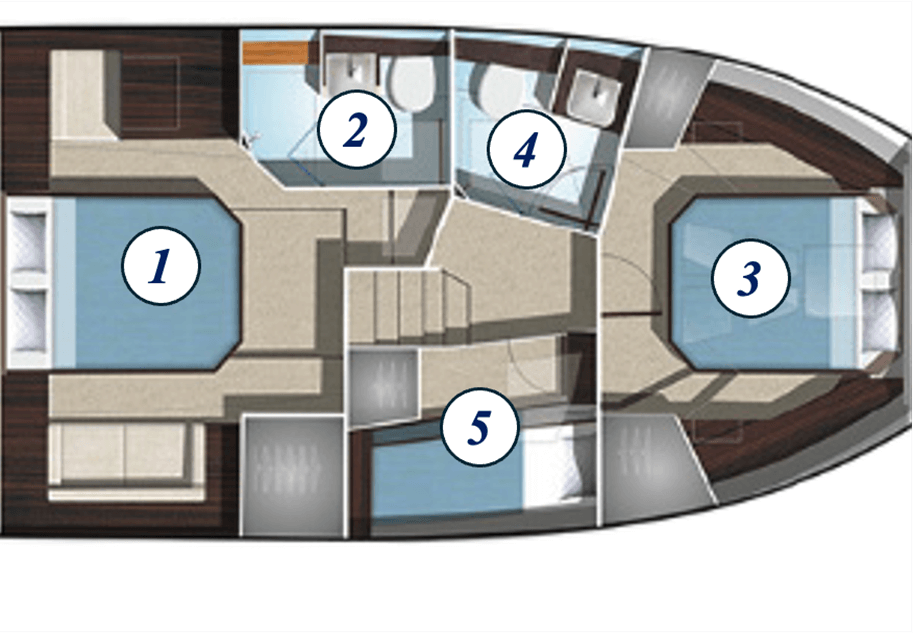
The 480 Fly comes in a standard three-stateroom configuration. Forward is a VIP with an ensuite that doubles as a day head / head for the starboard guest. To starboard is a guest stateroom with over/under bunks. Aft is a full-beam master with ensuite.
Accommodations Atrium
Down five steps from the main deck is the accommodations atrium that serves as the point of entrance to staterooms and the day head.
1) Master Suite
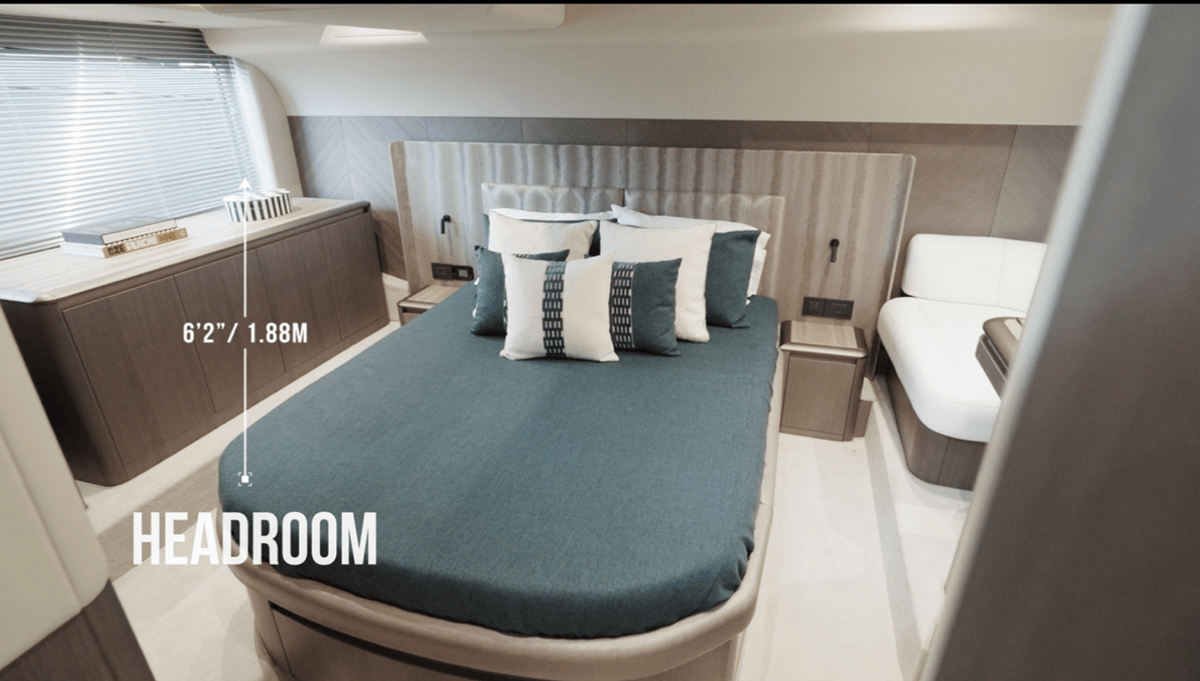
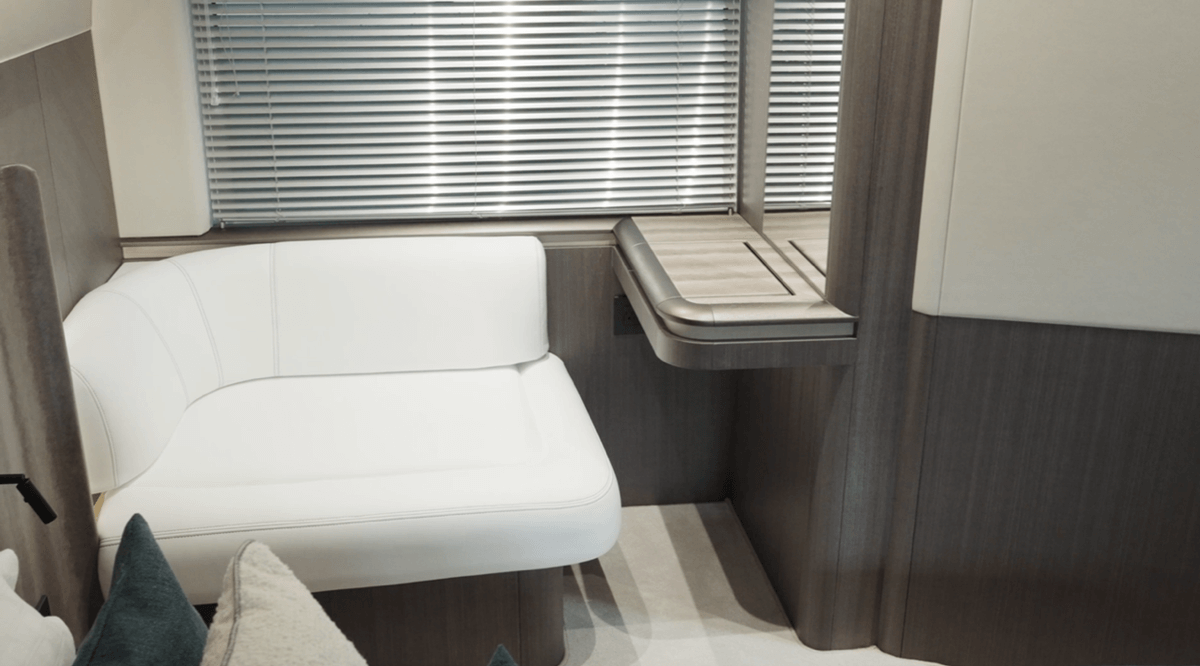
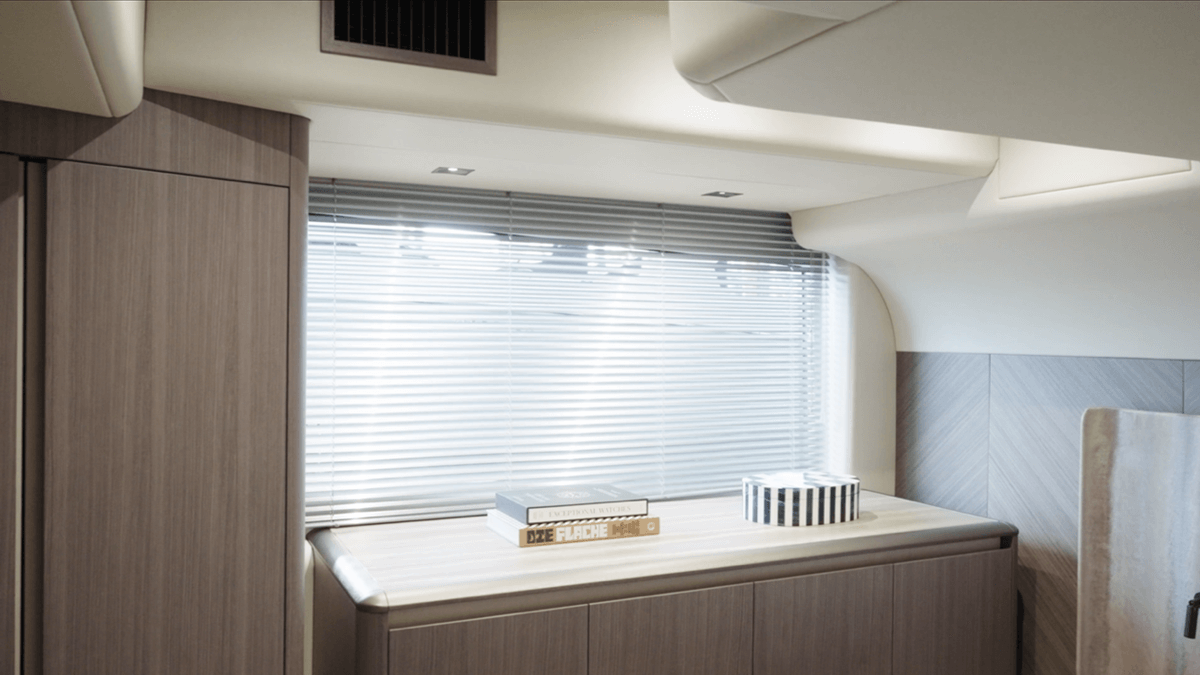
The master suite is 111 SqFt (33.8 SqM) with 6’ 2” of headroom throughout. The berth measures 72” W x 74” L. There is a full-length vanity to starboard and a lounge to port with a vanity and mirror. Full-length windows that are just above the waterline provide expansive views. There are outlets and charger ports on nightstands to both port and starboard of the berth as well as reading lights on both sides.
2) Master Ensuite
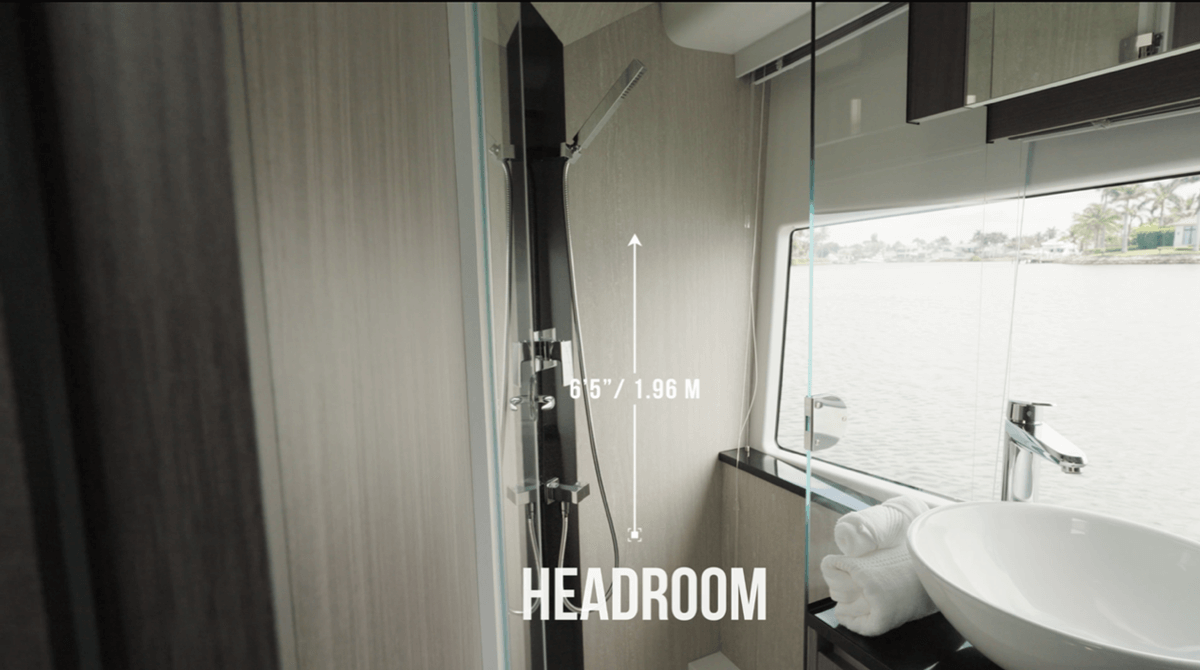
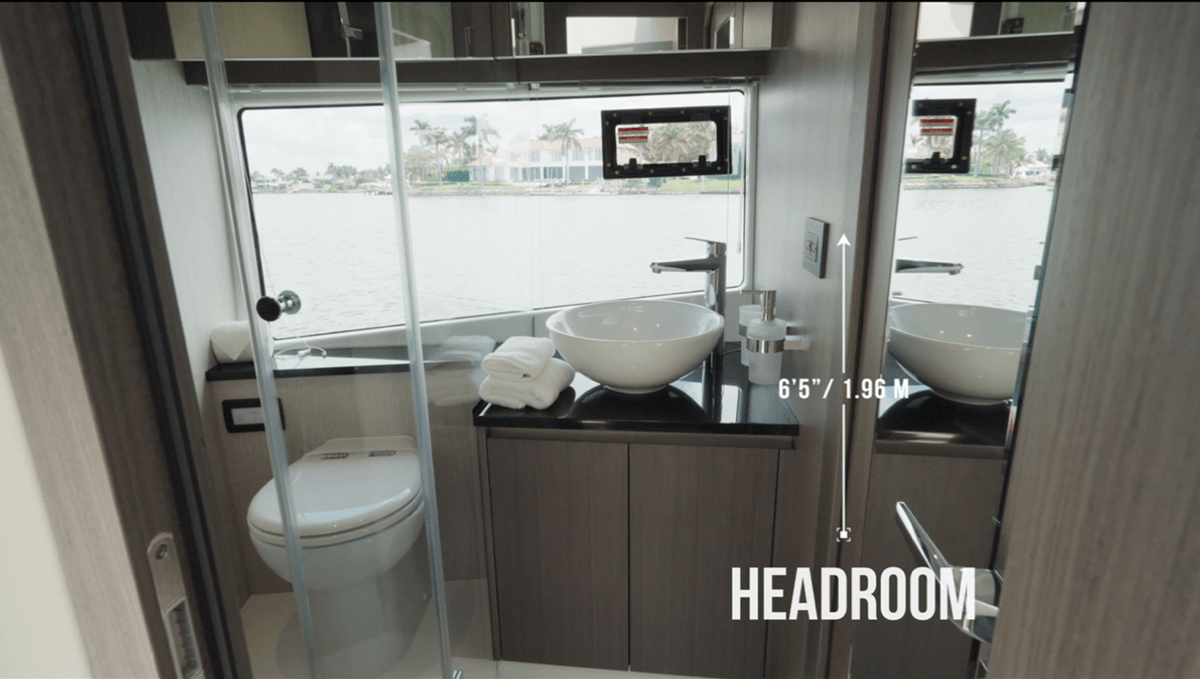
The ensuite head is 24 SqFt (7.4 SqM) with 6’ 5” of headroom throughout. The shower in the ensuite has 6’ 6” of headroom.
3) Forward VIP
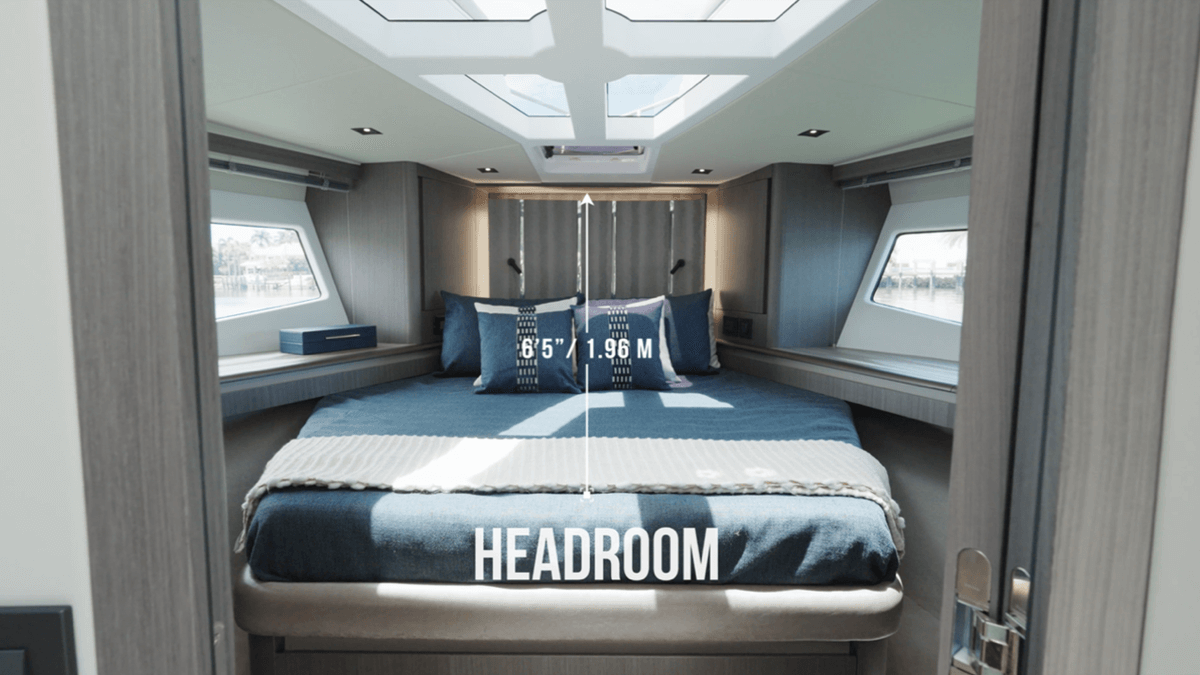
The 70 SqFt (21.3 SqM) forward VIP guest stateroom has 6’ 5” of headroom throughout.
4) VIP Ensuite/Day Head
The VIP ensuite doubles as a head for the starboard guest as well as a day head. It measures 20 SqFt (6.2 SqM) with 6’5” of headroom.
5) Starboard Guest
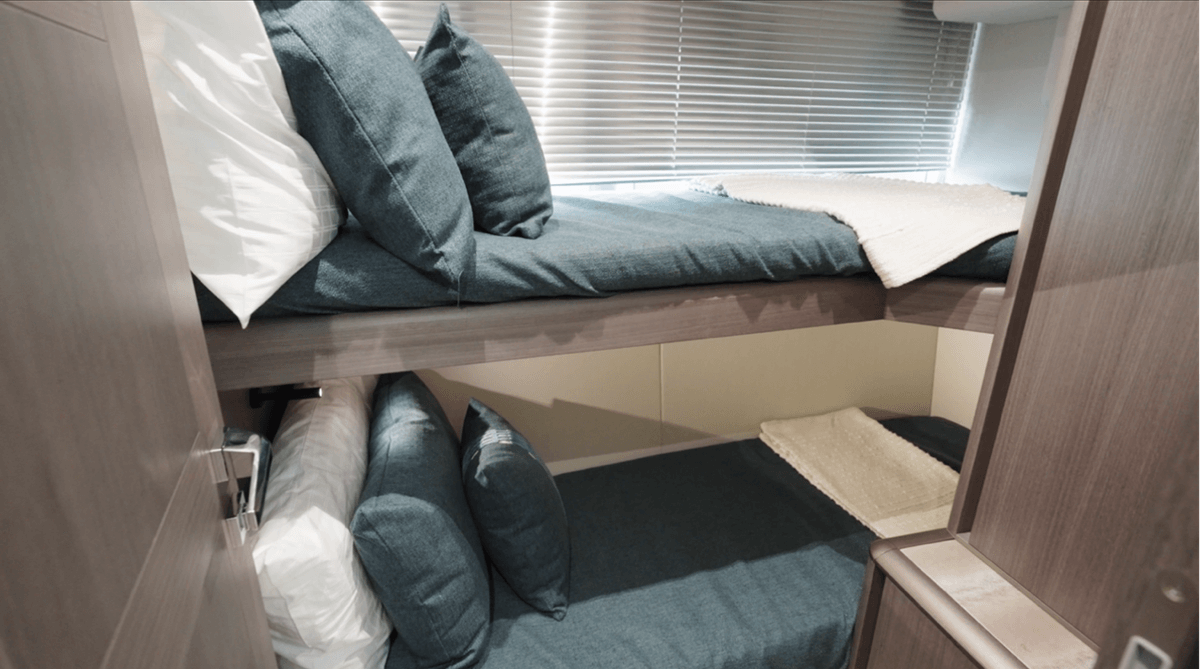
The 36 SqFt (10.9 SqM) starboard guest has bunks that measure 74” in length.
Engine Room
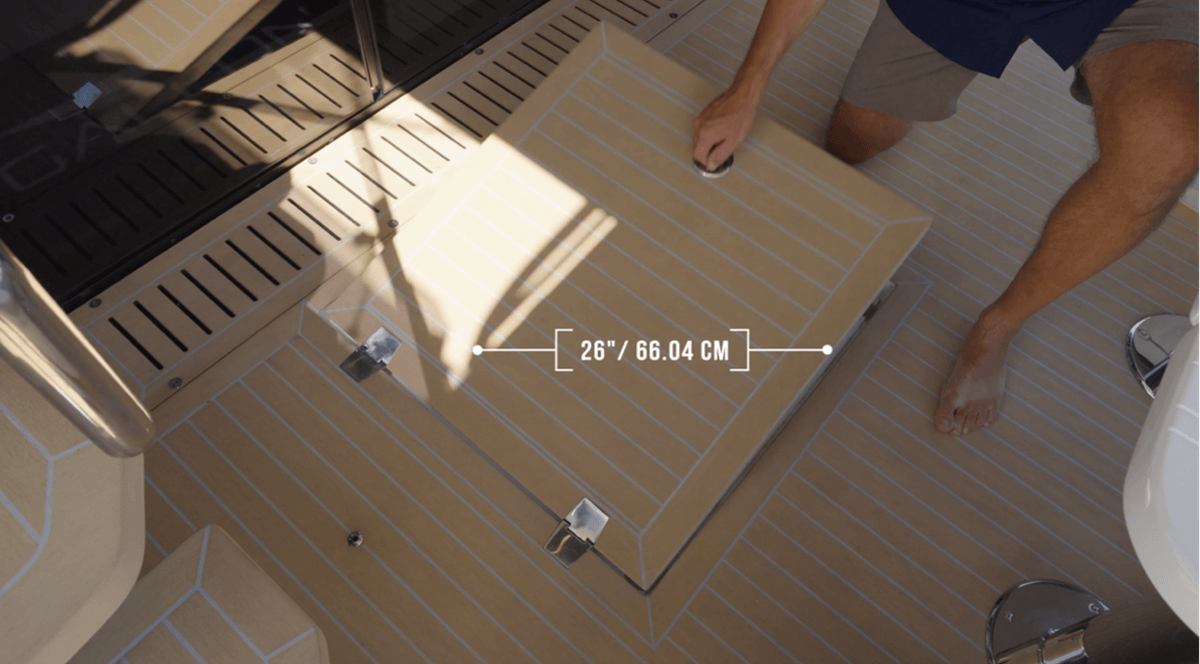
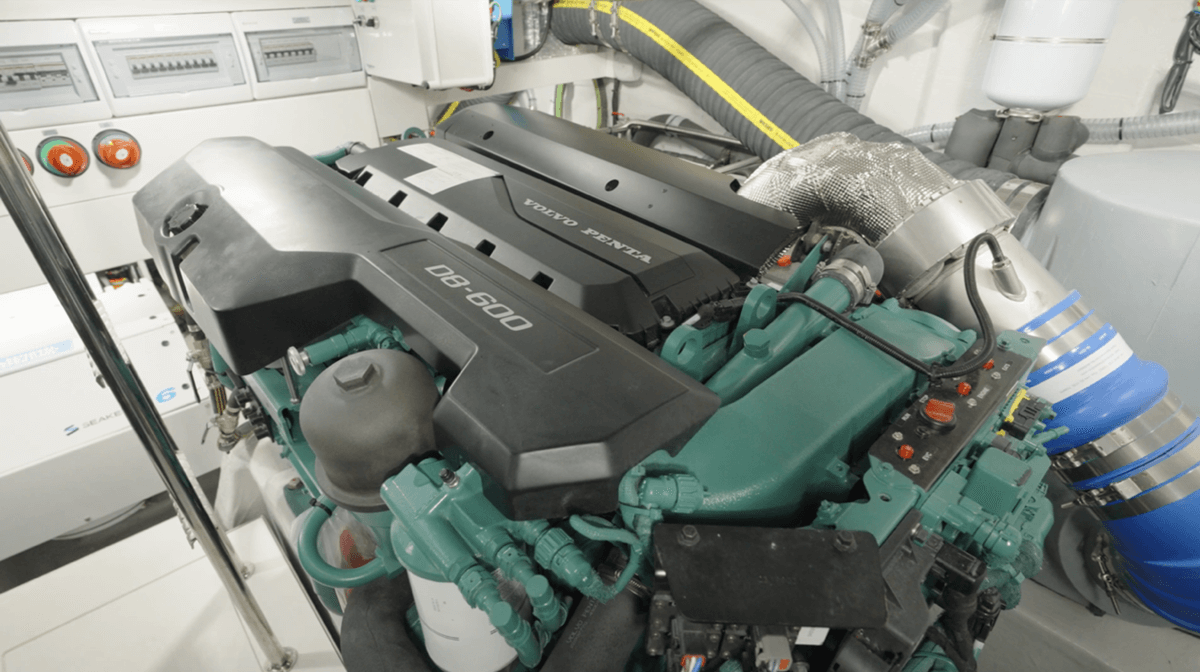
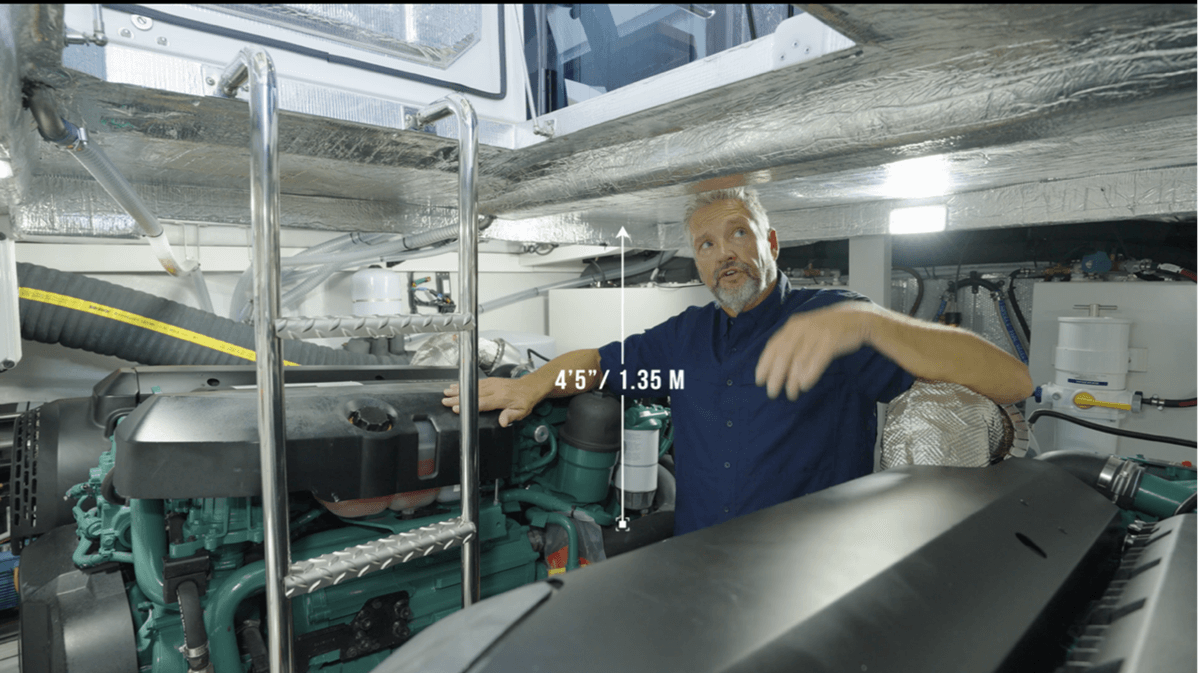
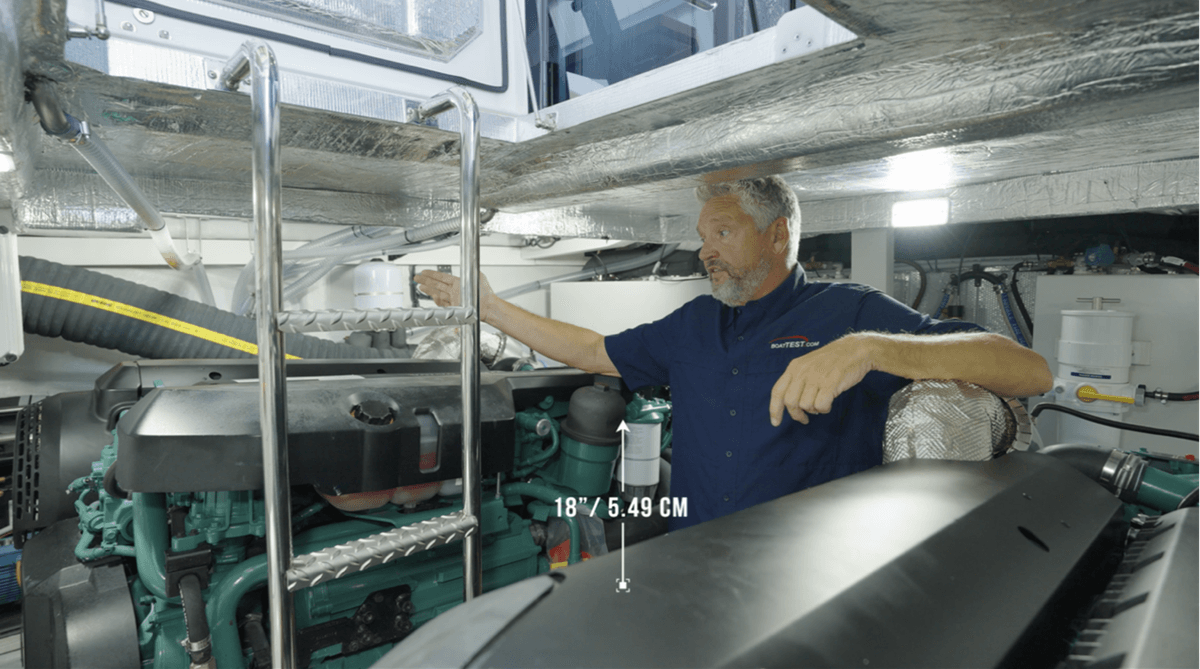
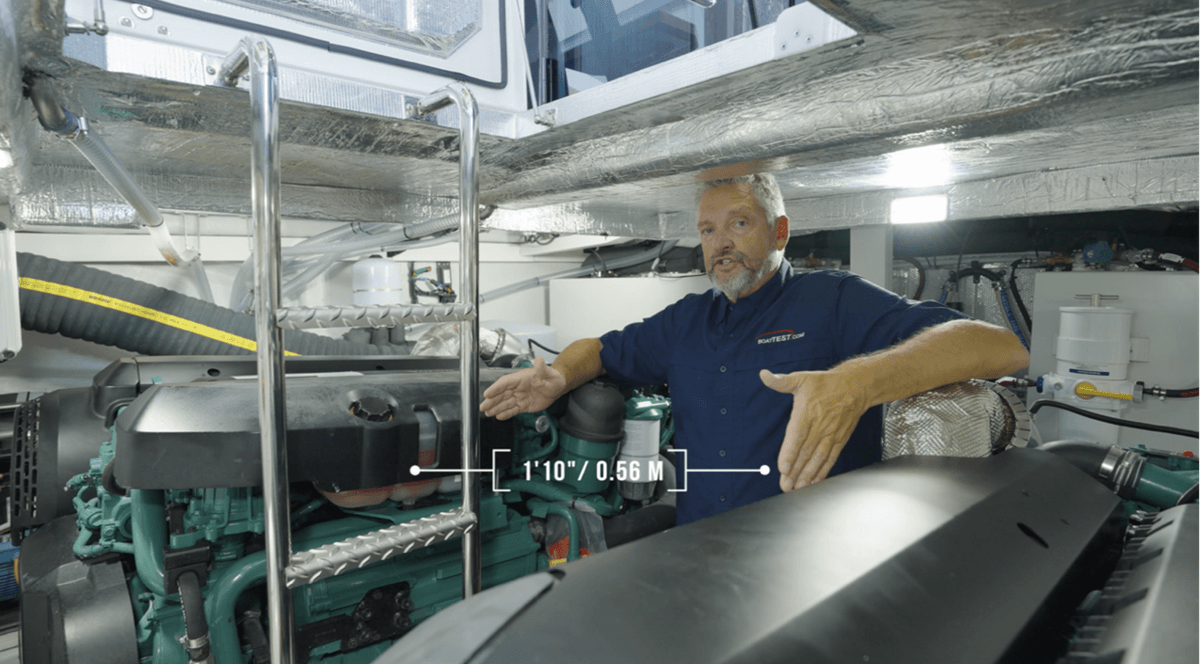
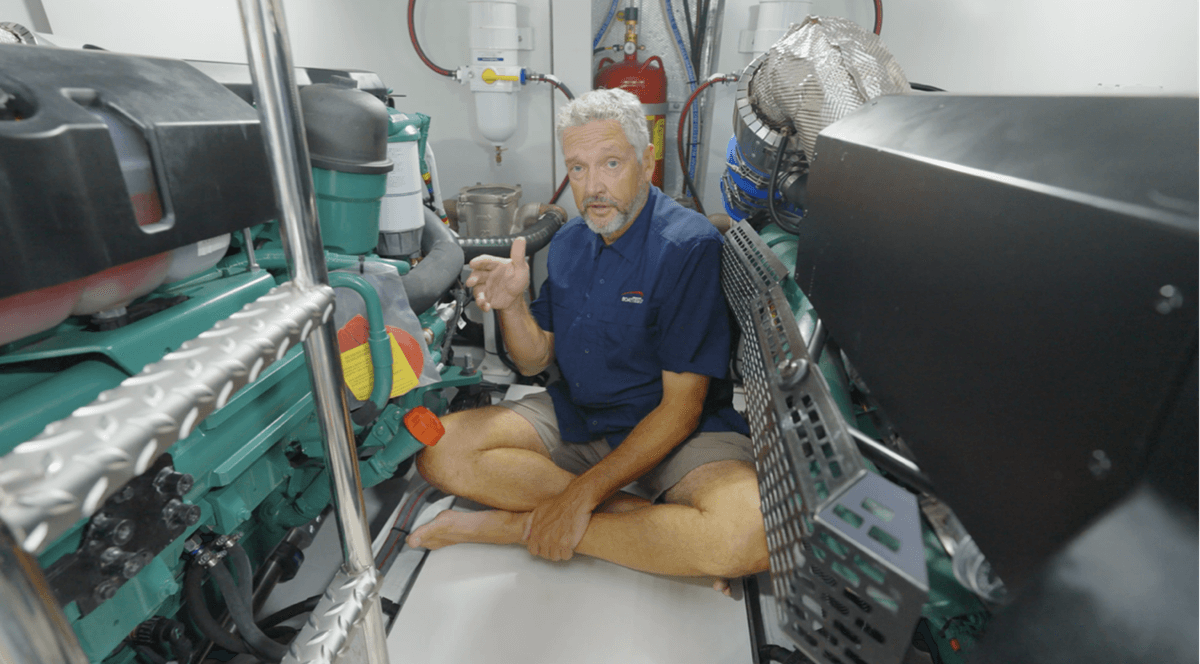
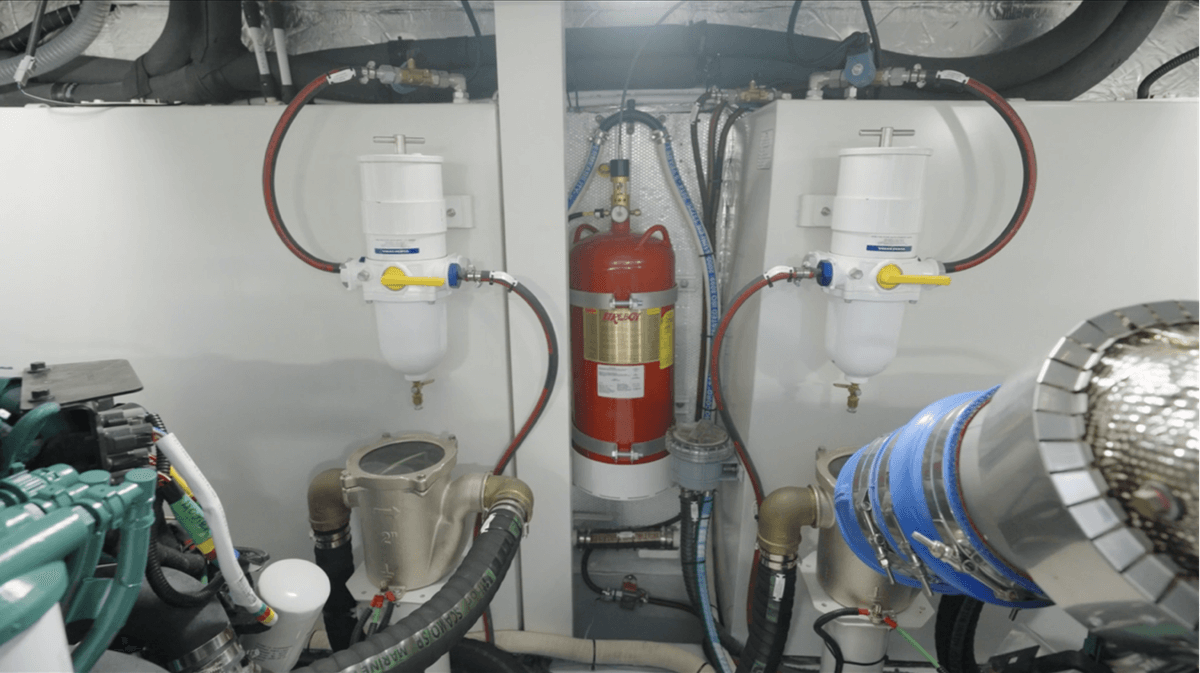
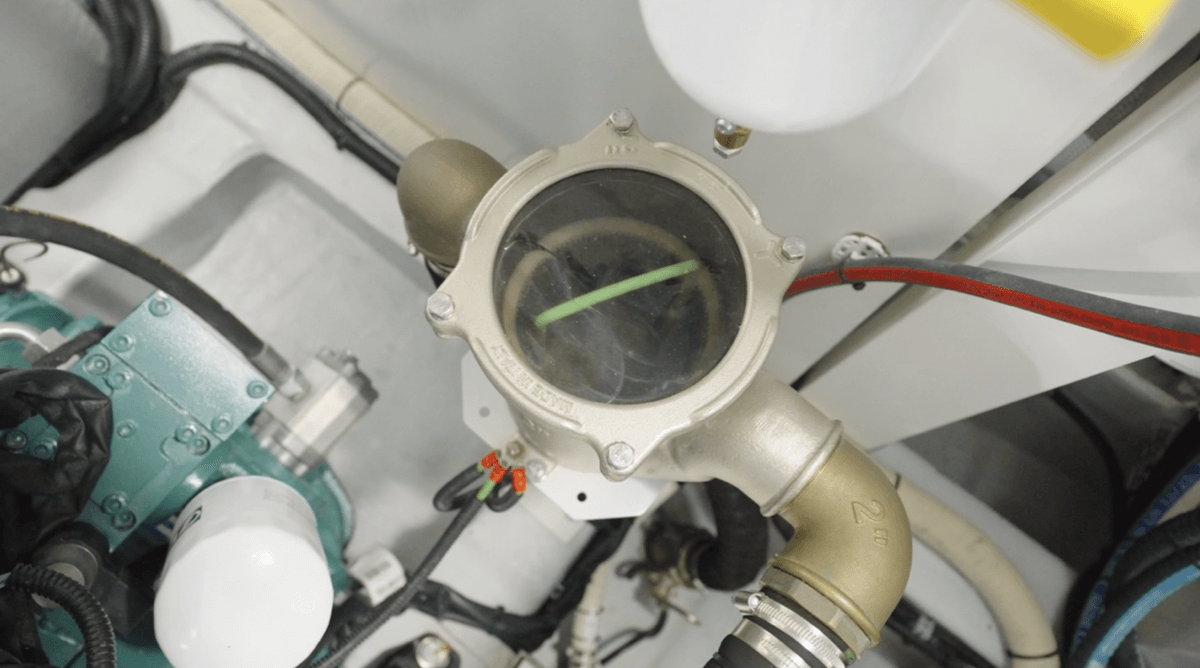
Access to the engine room is through a 26” hatch in the cockpit. The engine room measures 148 SqFt (45.0 SqM) with 4’ 5” of headroom between the main engines. There is 18” of space above the main engines with 1’10” of space in between.
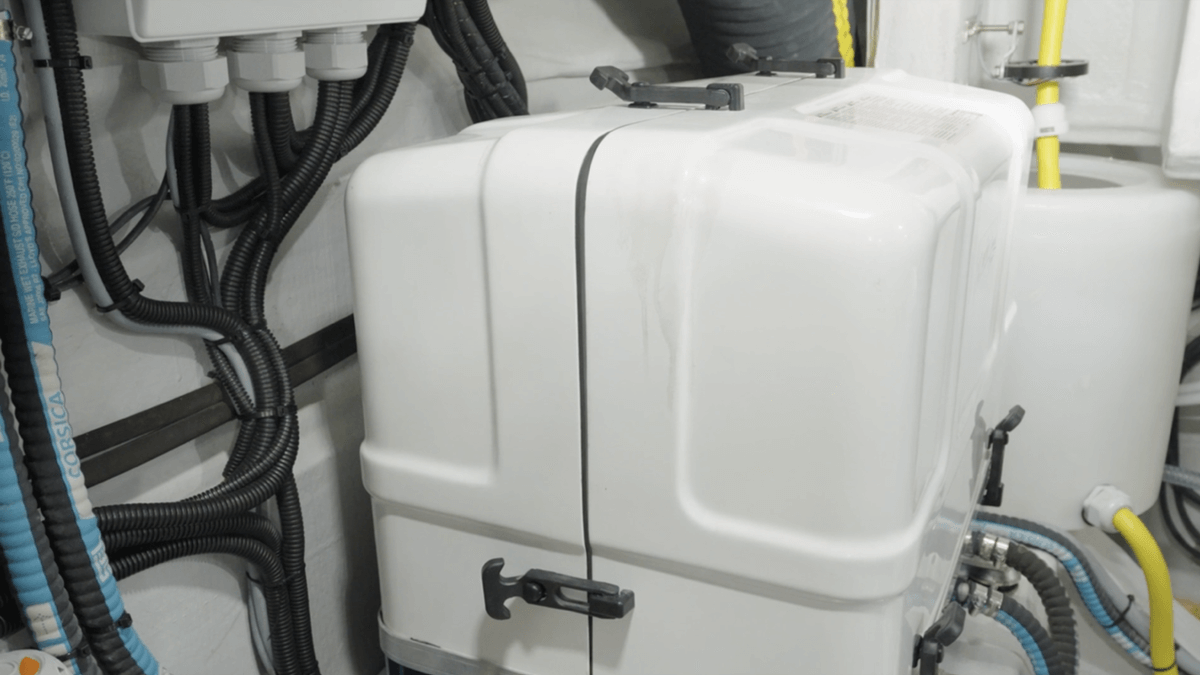
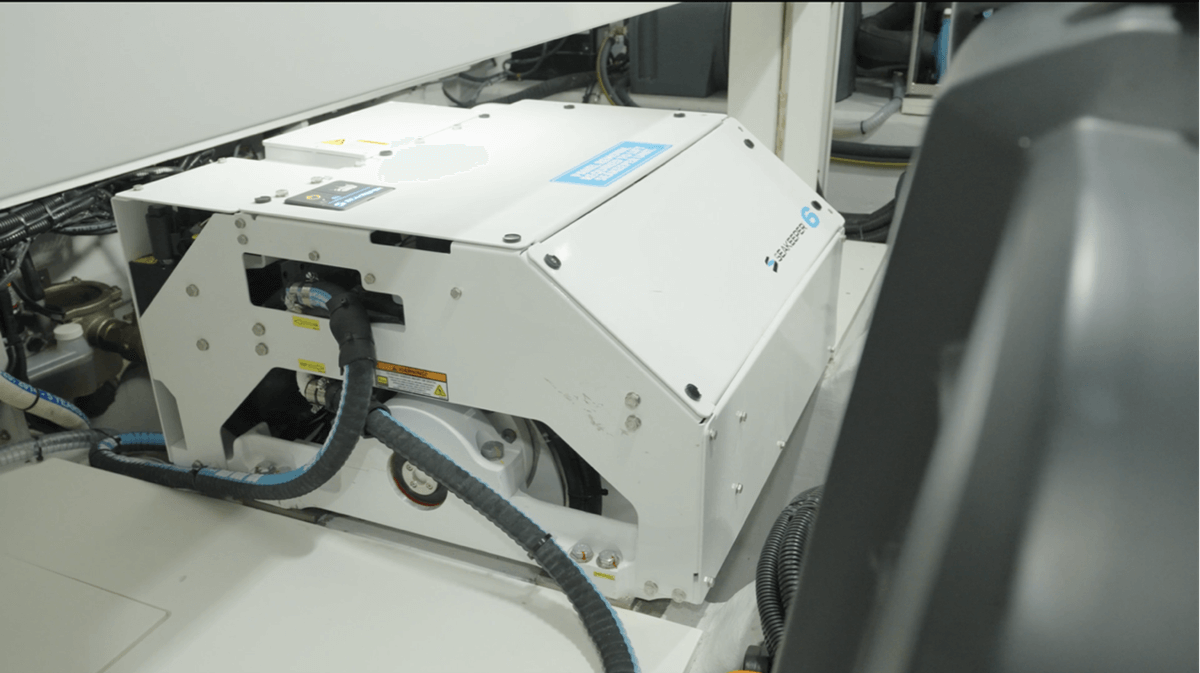
There is a Fisher-Panda 12.5 kW generator, a Seakeeper 6 gyro stabilizer and one AC chiller.
Observations
Galeon builds solid yachts designed to be excellent coastal cruisers, packing a lot of features and usable space into their platforms. The 480 Fly is no exception.
The Galeon 480 Fly is full of features and functions, especially for a 48’ platform. She is well equipped, and Galeon has considered just about everything one could want for an owner/operator cruiser. She is a very capable yacht performance wise with sufficient speed and near-shore cruising range.
The multitude of living and entertaining spaces across her three decks make her an excellent family or family plus friends cruiser. She is a great candidate for a step-up from a smaller cruiser or center console.
Any owner / operator who is looking for a yacht that performs well and has a multitude of features should have a look at the Galeon 480 Fly. One would be hard pressed to find another 48’ yacht on the market with everything available on the 480 Fly.
Remember, life is better on a boat!
Captain Gregg
[email protected]
Performance Test Video Transcript
Overview
Testing was conducted departing MarineMax in Naples, Florida. Captain Greg's stated propulsion preference upfront: "I'm kind of old school. I love straight shafts with a bow, or a bow and stern thruster. This one has just the bow thruster, and I gotta tell you, it's not an issue at all for somebody who's moving up from a smaller boat into a larger boat." He elaborated on his reasoning: "I actually think it's much more relatable to somebody who's coming out of a smaller boat to be able to operate straight shafts with a thruster, as opposed to going directly into pod drives. Pod drives are awesome, don't get me wrong, I love pod drives, but just for me — I learned to drive on straight shafts, and I really liked the feel of the straight shaft."
Slip Departure
Departure conditions were tight: a 68-foot boat sat directly off the bow with only about two feet of clearance. Captain Greg's assessment: "This boat had no issue being able to maneuver exactly like I wanted it to."
Weather Conditions
Approximately 85°F, forecast to reach 90°F, with an easterly breeze and building cumulus clouds as the sea breeze developed — described by Captain Greg as favorable filming conditions.
Low-Speed Handling (Intracoastal)
Idling at 600 RPM. Captain Greg's assessment of speed control at idle: "Sometimes when you get into the larger boats, they've got really big props on, sometimes a motor at six, six-and-a-half knots might not be making a wake, but might be just a little fast in a channel that's got a five-mile-an-hour no-wake zone. This one — very easy to stay within a no-wake constraint at, uh, five knots of motor at idle. Overall, great — feel very comfortable, boat to run while we're going here at low speeds."
Helm responsiveness: "The helm is very responsive — it takes quite a bit of control input to keep the boat going straight, so I find myself running on autopilot. I would rather have a more responsive helm than a less responsive helm, so for me it's okay, it just does take a little getting used to."
Controls/dash: Compass on centerline, engine control panel to the left, Raymarine 12-inch display — with room noted for an optional second MFD.
Anchoring (Port Royal Cove)
- Anchor: 55-pound Delta anchor on chain
- Captain Greg's assessment: "It should be more than enough to hold in any kind of condition that you'd want to see. And all the controls you need are right here."
Walkway/handrail construction: 16 inches wide, supported by a sturdy stainless steel rail plus an additional rail on the coach top — described as "really good place[s] to hold onto as you move about the boat."
Anchor locker cleat: Positioned so the snubber line doesn't need to run to a bow cleat. Two foot pedals control anchor up/down.
Bow searchlight: Positioned just off the port side of the anchor. Captain Greg framed this as a design tradeoff: "It's really nice to have this up forward, so when you turn the searchlight on, you're not painting the foredeck and damaging your night vision. I think the drawback to having this here is if you take on serious waves, it runs the risk of being submerged. It's a very sturdy structure, but hopefully it'll be safe."
Bridge Deck Helm
Layout assessment: "Well laid out." Compass on centerline, twin Raymarine 15-inch MFDs — "literally everything that you want to control is on one of the dashboard screens."
Controls: Bow thruster controller (left), push-button system controls, Volvo Penta engine controller, rudder angle measurement device, autopilot control, shifter controls, Zipwake trim tab controller (aft of shifter/throttle), and a 14-inch steering wheel.
Forward visibility (contemporary hardtop design): Captain Greg raised a general critique of this boat category before praising this model specifically: "One of my main complaints with these contemporary-style boats is the lack of visibility forward, particularly in the safety zone where you need to be mindful of other boats, because of the support structures. But the way this one is tapered, the visibility is actually very good. Out of this side window, you've got visibility up to probably just 10 degrees abaft the bow — you can see everything very well throughout the entire safety zone, and it just takes a slight movement to see through this side window." The large side window opens electronically via the Raymarine MFD controls.
Engine Room Access
Accessed through a 26-inch square hatch, opening to port. Captain Greg's noted suggested improvement: "One thing I'd like to see is actually have it open on the starboard side — the reason is, with the hatch open, this door can swing into it. Someone's not paying attention and you could easily do some damage to the door."
Engine Room
Space: Described as pretty good for a 48-foot boat; engine room beam exceeds 13 feet.
Engines: Volvo Penta D8, 600 horsepower each.
Clearances:
- Between engines: 1 foot, 10 inches
- Headroom: 4 feet, 5 inches
- Space over the top of the engine: 18 inches — "enough room for a mechanic to get in and do any kind of work that needs to be done"
Access assessment: "You've got accessibility, both inboard and outboard, to be able to get to all the critical components that you need."
Filter access: Port engine filters accessible inboard; starboard engine filters positioned outboard — "a little bit more of a challenge."
Oil fill ports: Positioned low, described as easy to access at a good angle without an awkward funnel position.
Dipstick: Located just forward of the aft engine mounts — port side access noted as somewhat challenging due to the ladder, though reachable by getting down low.
Drive configuration: Straight shafts with a V-drive system. Captain Greg's noted benefits: "Keeping the engine aft balances the weight to the designer specifications, but it also opens up a large amount of interior volume, which this boat certainly has for a 48-footer."
Fuel system: Dual fuel tanks (one per engine), each with a Racor filter. Captain Greg raised a specific question: "One thing I do question is whether there should be a second filter. I like to run two filters on a boat, so that if you have a filter issue, you can switch from one to the other."
Generator strainer: Located further forward; main engine strainers noted as easy to lift and inspect for debris.
Starboard side: Exhaust system for the starboard engine, then a Fischer Panda 12 mini compact generator (12 kW output).
Air conditioning: One chiller, positioned outboard — Captain Greg's assessment: "Given the fact that it's not that big a boat, one chiller probably is sufficient."
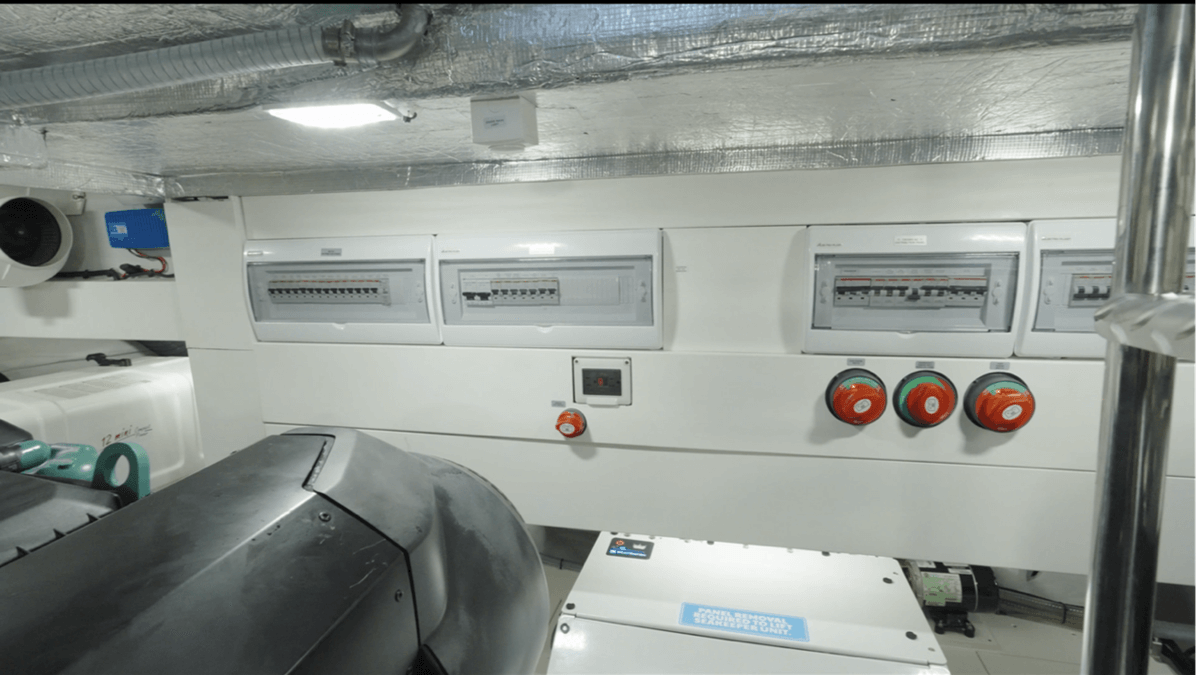
Electrical: AC and DC distribution panels plus battery switches, all described as "really easy access."
Stabilization: A Seakeeper 6, positioned below the AC/DC distribution systems — noted for providing stability underway or offshore.
Test Conditions (Performance Runs)
Captain Greg moved inside for the performance runs due to heat, noting the air conditioning "feels quite nice."
- Temperature: 90°F
- Humidity: 75%
- Fuel/water: 80% aboard, plus three passengers
- Total tested weight: 39,132 pounds
Acceleration / Trim
Max RPM on the D8 engines is approximately 3,000. Bow rise during acceleration: approximately 5–7 degrees. The Zipwake system automatically controls both pitch and roll, keeping the boat level.
Bimini Top — Performance Impact
Testing was conducted both with the Bimini up (as it would typically be used in Florida sun) and down, since — per Captain Greg — "the Bimini top acts as a huge sail, which will slow the boat down and cause it to burn more fuel."
Bimini down:
- 21.7 knots at 2,600 RPM, burning 45.9 gallons per hour, range 167 nautical miles
Bimini up:
- Top speed 29.4 knots at 3,060 RPM — approximately 2 knots faster than with the Bimini up (transcript states this comparison somewhat ambiguously; the practical takeaway per Captain Greg is that removing the Bimini improves range at cruise: "If you want greater range, then put the Bimini down and you'll get over 167 nautical mile range at 2,600 RPM, going 21.7 knots.")
Turning / Wake Performance
At cruise, the boat maintained 15–16 knots through a hard-over turn. Crossing its own wake at 14.5–15.5 knots, Captain Greg reported: "Yeah, takes 'em just fine."
Range Summary
- 167 nautical miles at 21.7 knots
- 300 nautical mile range at 9 knots, with a 10% fuel reserve
Seakeeper (optional): Allows comfortable running at trawling speeds, with the ability to jump up on plane to outrun a storm if needed.
Practical range context (Captain Greg): "For Americans, that means all The Bahamas, or the Inside Passage to Alaska, can be comfortably cruised between fuel stops. It also means that on a reasonable weather day offshore, the boat has enough fuel for a seven-hour run at over 18 knots."
Closing
A companion features and full inspection video is referenced.
Features Review Transcript
Overview
Captain Greg's framing: "This boat is ideal for the owner operator, perhaps someone who's stepping up from a slightly smaller boat. This boat has a lot packed into its platform."
Indoor/Outdoor Transformation
Captain Greg described this as the boat's standout feature: "Probably the most exciting thing about this yacht is how it transforms to completely bring the outside in from the interior."
Process (as demonstrated):
- Both port and starboard windows fully open
- An accordion door leading back to the cockpit opens (secured by a pin and latch mechanism)
- With balconies already lowered, two bar stools pop into place and a leaf creates a bar space with direct galley access
Captain Greg's assessment of the resulting flow: "I think the thing that makes this boat most unique is how open this is and the amount of deck space that it opens up. Once you have the balconies down, once you have these side windows open, it creates a flow that I've actually never experienced on a yacht of this size... because the inside is so airy, and the aft deck is covered by the aft end of the flying bridge."
Bow Seating
Captain Greg's prediction: "What will prove to be a very popular spot on this boat is the bow seating area." Rated to seat nine people around a table that folds out to expand seating capacity.
Convertible seats: Each seat bottom folds up and the back folds down and stows for running.
Windshield: Single-pane design, without mullions — Captain Greg noted this as a trend in contemporary boats that removes visual obstruction looking forward.
Swim Platform
Retractable. When lowered, a five-step ladder provides water access. Described as a good spot for dinghy storage.
Additional stern features: A Cablemaster on the starboard side; two storage compartments approximately 6 feet deep, suited to water toys or general storage.
Grill: A push-button-deployed drawer exposes a grill and cutting space.
Boarding Doors
A contemporary-style boarding door from the swim platform, plus side boarding doors on both port and starboard balconies for safe dockside access.
Balcony Deployment Procedure
Captain Greg walked through the process: release the aft and forward latches, then press and hold the activation button and down button simultaneously to lower the balcony.
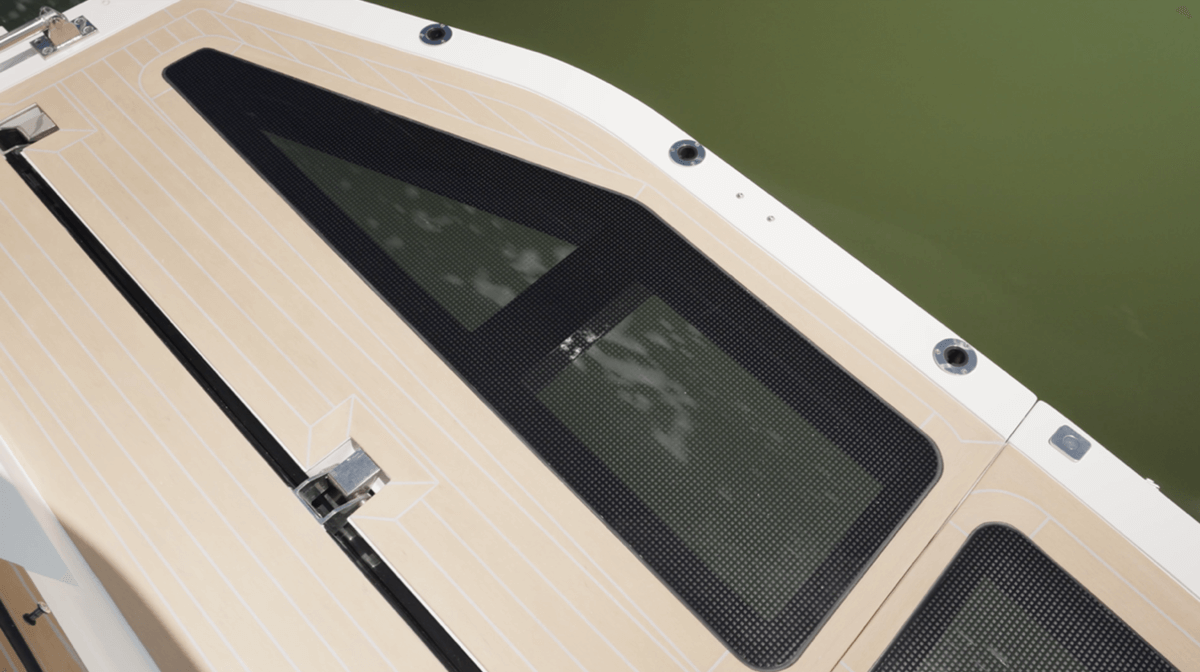
Safety features (lowered balcony): Stanchion mounting holders create a safety perimeter around the balcony edge; a hydraulic ram plus forward/aft cabling allows the platform to stop at its exact intended position. The balcony floor incorporates glass, giving the sensation of standing directly over the water.
Aft Cockpit Seating
Wraparound seating for six, with a table featuring fold-up wings for easy access when seated.
Flybridge Access
Reached via a seven-step ladder to port.
Flybridge
Aft seating: Large wraparound seating, rated by Captain Greg to fit 10, perhaps 12 people. The table folds out into an L-shape, providing table space in front of everyone seated.
Radar tower: Folds down — Captain Greg noted this provides a "very manageable bridge clearance."
Weather protection: A forward hatch allows the flybridge to be completely sealed off in inclement weather.
Starboard flybridge amenities: Wraparound seating area, an optional grill location, a sink with a storage area that also drains (usable as either trash storage or an ice box). Continuing aft: a refrigerator, storage space, and a freezer.
Port flybridge seating: Wraparound seating for four to five people. Captain Greg noted a likely favorite spot while underway: "A couple of cushions propped behind your back, looking forward — absolutely perfect place for the mate to sit while the captain runs."
Cushion cover retention: Captain Greg specifically praised a design detail addressing a common problem: "One thing that always seems to create issues on a boat are cushion covers — they tend to blow away, snaps break... One thing the Galeon has done, which I've liked, is they put these posts in, and so the covers have a little loop that goes over these posts. They're sturdy and really keep the covers in place."
Galley
Testing was conducted with the boat closed up, using air conditioning — Captain Greg noted it was "quite good."
Port side (aft): Wraparound countertop with a storage drawer, freezer below, and an Isotherm refrigerator. A trash area and cutting board cover a twin stainless steel sink, plus a Kenyon two-burner convection cooktop. Below: a microwave that also functions as a convection and conventional oven.
Starboard side: Additional counter area (all countertops are Corian), with a storage drawer and two under-cabinet storage units below.
Bulkhead controls: Dometic air conditioning control, Fischer Panda generator control, and an AC monitoring system.
Salon
Starboard: Seating for two to three people, with a pop-up flat-screen TV.
Port: Large wraparound seating for five to six, potentially seven people. The table telescopes and drops down, converting this area into a berth as well.
Accommodation Overview
Captain Greg summarized the intended buyer flexibility: "This boat can be used by a couple who have a large family, a couple who likes to cruise with another couple, and it's ideal for grandparents cruising with adult children and grandchildren. They'll love the side cabin."
VIP Cabin (Forward V-Berth)
Wood finish: "Gray beachwood" — Captain Greg's assessment: "It's very aesthetically pleasing to my eye." Other wood options are available.
Bed: 74 inches in total length, with nice headroom above.
Natural light: Skylights positioned in the center of the forward bow seating floor bring light into the cabin below.
Features: Light switches, AC outlets, and USB outlets on both sides; reading lamps; backlit counters outboard of the berth on both sides (one side fitted with a vanity). Captain Greg specifically praised the faux leather finish: "I think it accents the wood very nicely, and I like the feel of it as well." Closet space is provided on both port and starboard.
Head access: En suite, shared as the head for both the VIP and the other guest stateroom.
VIP / Guest Head
Captain Greg, at 6'1", reported "plenty of headroom" — estimated at four to five additional inches above him. Even more headroom in the shower itself, which is set roughly three-quarters of an inch lower than the bathroom floor — a design Captain Greg praised for containing shower water: "Any water that you have will pull in the shower as it drains, as opposed to coming into the floor of the actual bathroom."
Additional features: The head is located inside the shower on this unit. Black Corian countertop with a floating sink. Full-length mirrors on both doors, providing good visibility.
Starboard Guest Stateroom
Over-under single bunk configuration, with a closet providing storage for the room's occupant(s). Good headroom, and — consistent with the rest of the boat — large windows providing views to the water.
Master Stateroom
Wall covering: Captain Greg praised the tone relative to the gray beachwood, and the material's feel/texture, calling it "very aesthetically pleasing."
Port side seating: A chair suited to reading, vanity access, or laptop work.
Windows: Large on both sides, positioned just above the waterline, providing what Captain Greg called "a really nice view."
Bedside amenities: Nightstands on both sides with electrical outlets and USB ports for device charging.
Berth size: 72 inches wide by 74 inches long — described as plenty of space for a couple.
Additional features moving forward: A flat-screen TV; a large double-door closet on the starboard side; an additional cabinet with storage below.
Master En Suite
Captain Greg's assessment: "This is a really good size head for a boat of this size." At 6'1", he reported at least three to four inches of headroom above him, noting headroom is "an area that's frequently compromised" on boats generally. The shower has approximately a half-inch step down. Finishes include a black Corian countertop with a floating sink, and a Dometic head.
Closing Assessment
Captain Greg's summary: "The interior aesthetics are very pleasing to my eye, and I like how much space there is, how much seating there is in so many different areas. The thing I probably like the most, though, is how open this boat becomes when you have the balconies down, the barstools in, the leaf up, and these windows open. It is a unique space that I've actually never experienced in a boat of this size."
Related Boats
Galeon 500 Fly (2016-)
Currently no test numbers
Galeon 430 Skydeck (2017-)
Currently no test numbers
Galeon 420 Fly (2018-)
2 x 435-hp Volvo Penta D6
Galeon 380 Fly (2017-)
Currently no test numbers