Access More Boat Tests
Already have an account? Login
GranOcean W72 (2026-)
2 x 1150-hp CAT C18s

Brief Summary
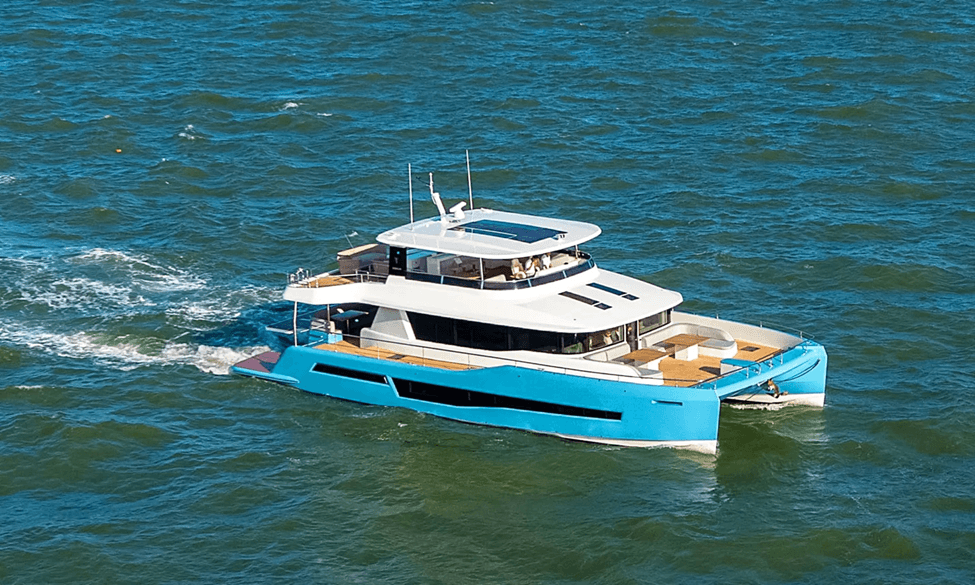
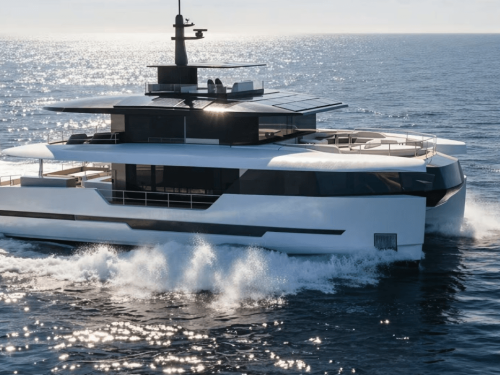
The impressive, fully customizable GranOcean W72, with naval architecture by Howard Apollonio, engineering, advanced composites, and materials from Gurit SP, and custom interiors by Vripack, is a big, bold luxurious powercat offering massive exterior deck space combined with equally significant interior space, all this and more running on a stable platform designed to spend significant time away.
Test Results
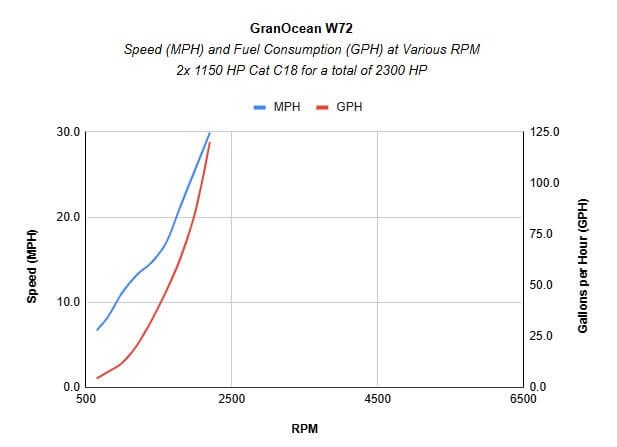
| RPM | MPH | Knots | GPH | MPG | NMPG | SM | NM | dBa |
|---|---|---|---|---|---|---|---|---|
| 650 | 6.7 | 5.8 | 4.4 | 1.5 | 1.3 | 2169.5 | 1885.2 | N/A |
| 800 | 8.3 | 7.2 | 7.6 | 1.1 | 0.9 | 1550.8 | 1347.7 | N/A |
| 1000 | 11.2 | 9.7 | 12.1 | 0.9 | 0.8 | 1316 | 1143.6 | N/A |
| 1200 | 13.2 | 11.5 | 20.6 | 0.6 | 0.6 | 916.4 | 796.3 | N/A |
| 1400 | 14.7 | 12.8 | 32.8 | 0.4 | 0.4 | 638.1 | 554.5 | N/A |
| 1600 | 17 | 14.8 | 47 | 0.4 | 0.3 | 515.2 | 447.7 | N/A |
| 1800 | 21.3 | 18.6 | 63.6 | 0.3 | 0.3 | 478.8 | 416.1 | N/A |
| 2000 | 25.6 | 22.3 | 85.8 | 0.3 | 0.3 | 425.7 | 369.9 | N/A |
| 2200 | 29.9 | 26 | 120 | 0.2 | 0.2 | 355.7 | 309.1 | N/A |
Specifications
| Length Overall |
72' 21.95 m |
|---|---|
| Beam |
32'8" 10 m |
| Draft |
4'27" 1.30 m |
| Fuel Capacity |
1,585 gal 6,000 L |
| Water Capacity |
264 gal 1,000 L |
Acceleration Times & Conditions
| Load | Persons & Gear: 1,110 lbs (503 kg); Fuel: 5,062 gal (2,296 kg) |
|---|---|
| Climate | 70°; wind: 15-25; wave: .6'; salt |
Engine Options
| Tested Engine |
2 x 1150-hp CAT C18s |
|---|---|
| Std. Power |
2 x 550-hp Cummins Diesel Inboards |
| Opt. Power |
2 x 715-hp Cummins Diesel Inboards |
GranOcean W72
Have it Your Way
By Capt. Ken Kreisler
Major Features
- Lewmar V6 24V electric windlass w/chain counter, foot switches, chain wash
- 2 hot/cold transom showers
- 2 teak cockpit dining tables
- Cockpit bar to port w/stools, storage, sink
- Flybridge wet bar, two teak dining tables, hardtop mast, two helm chairs, head
- Triple leaf sliding Lewmar salon door w/flip up window
- Fisher & Paykel 36" Panel built-In French Door refrigerator in salon galley
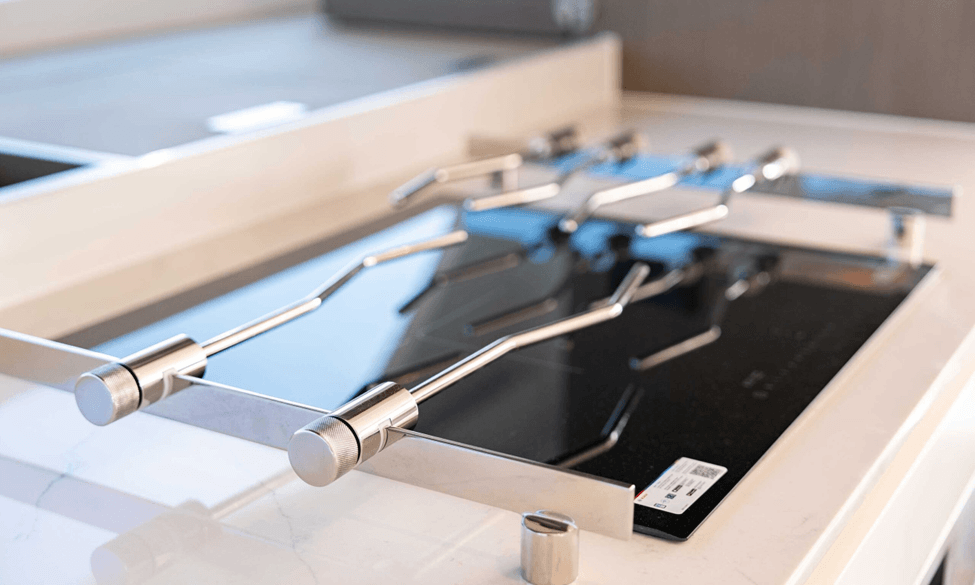
- Bosch Benchmark Series 30" black frameless induction cooktop in salon galley
- Three guest suites w/heads to port
- Two VIP suites w/heads to starboard
- 2 x 550-hp Cummins QSB 6.7 diesel inboards
- Fuel transfer pumps between fuel tanks
- Kohler 20.5 kW or 21kW w/sound guard, silencer, fuel filter and separator
- Garmin electronics including 12” touchscreen at main helm, 20 nm Radome radar, VHF, autopilot, wind meter, two rudder indicators
Notable Options
- Enclosed flybridge w/day head and air conditioning
- Forward bow crew cabin w/head
- 2 x 715-hp Cummins QSB or 2 x 1,150-hp CAT C18 diesel inboards
- Tenderlift hydraulic platform in 1,433 lb or 2,024 lb capacities
- 2 x 150 gph Reverso fuel polishing systems
- Teak decks
- Steelhead flybridge extendable crane w/lift capacities in 1,499/2,204 lbs and reaches in 11.9 ft/13.9 ft models
- Second Kohler 9kW/20.5kW/24kW generator
- Wireless docking control system
- Lewmar electric 10.8kW bow thruster and 6kW stern thruster
- 26.4 gal/hr Schenker water maker
- Additional Garmin touchscreens in 12” and 16” sizes
- Separate Bosch 24” front loader washer and dryer units
- 6 person Plastimo canister life raft
Vessel Inspection
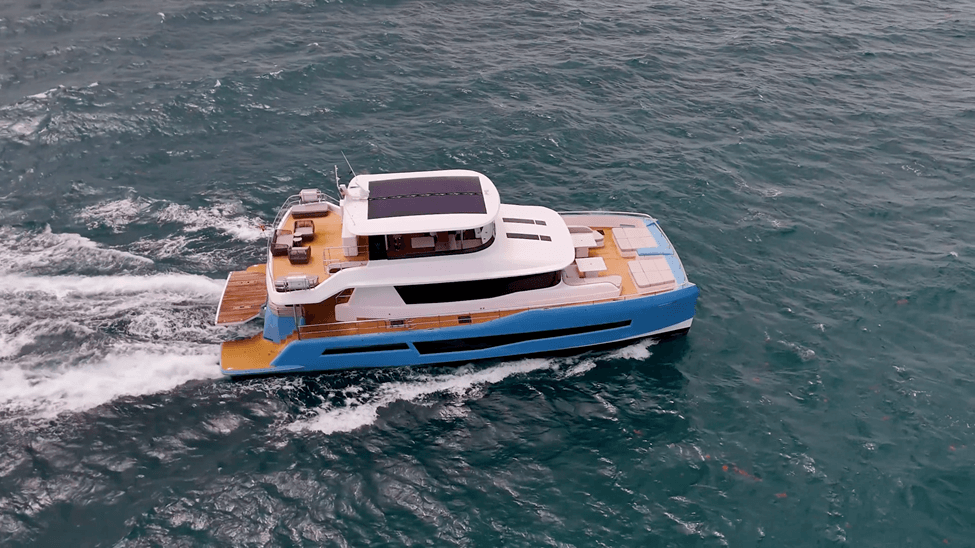
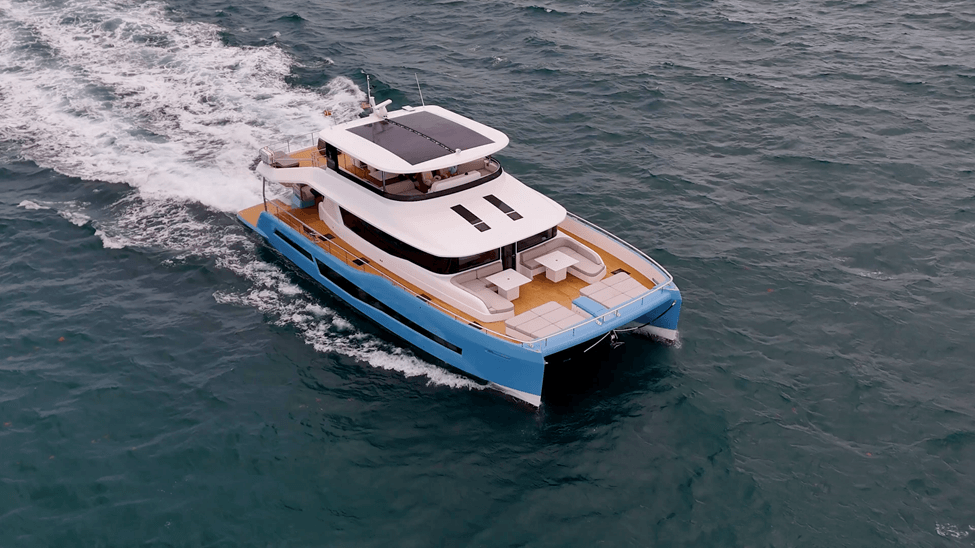
Taken at face value, that it is quite obvious the larger the boat, the larger the usable space, is especially true aboard the GranOcean W72. Enhancing that is her catamaran hull, not only supplying a stable platform, but enabling her impressive beam of 32.8’ to be carried fully forward and resulting in a blank nautical canvas upon which to create a fully customizable yacht to fit any owner’s vision.
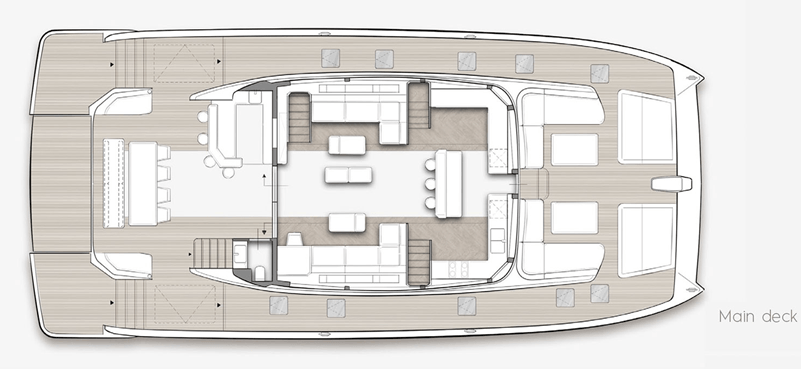
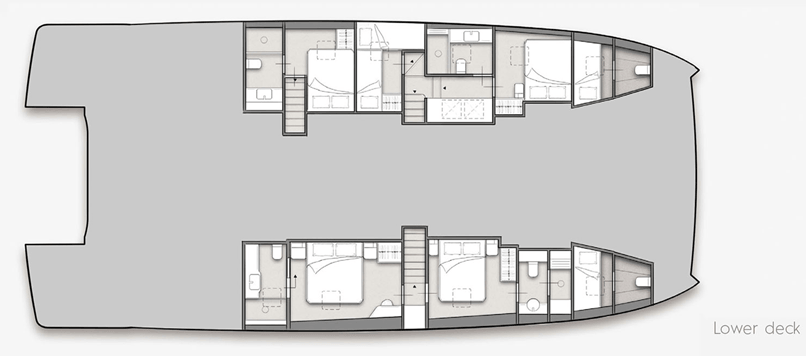
Bridge Deck
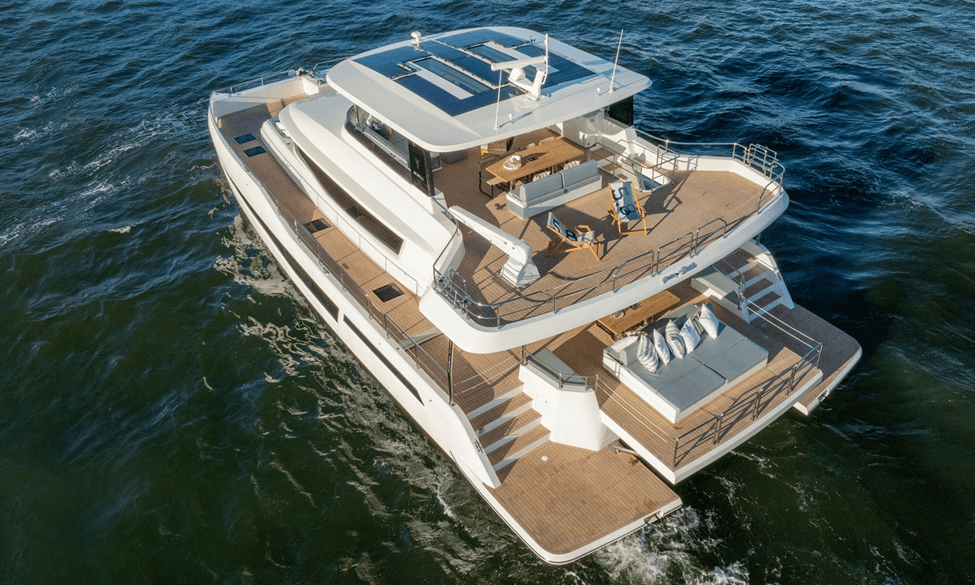
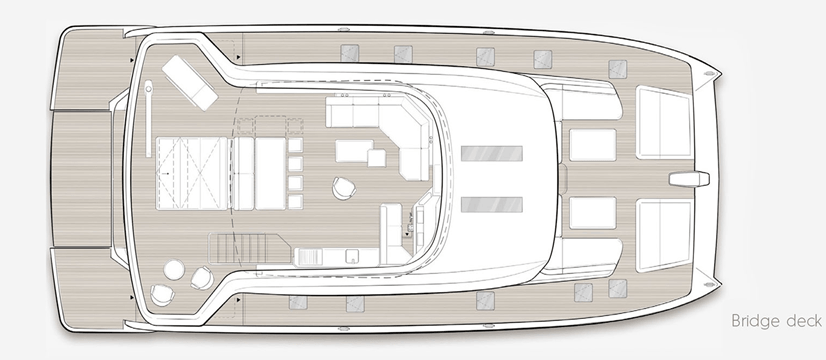
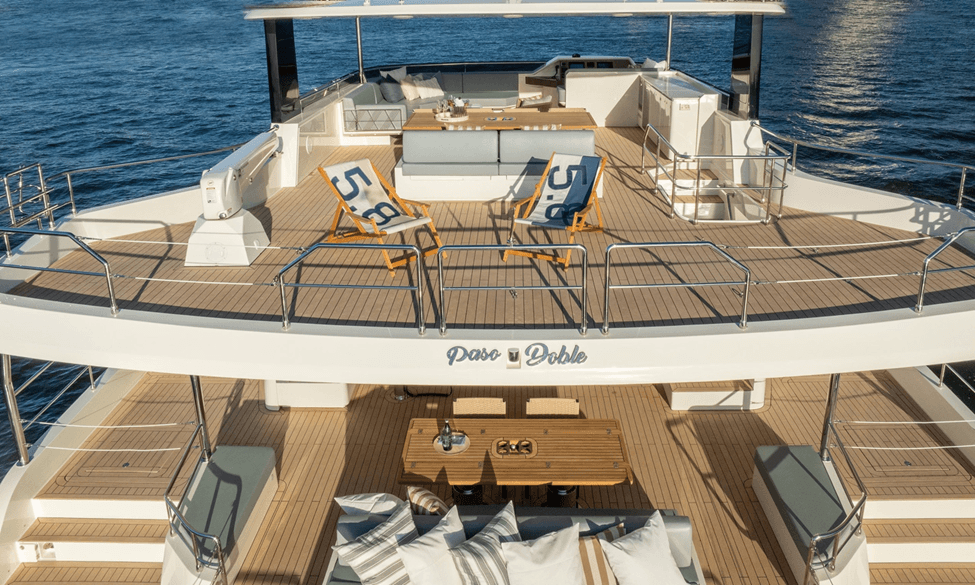
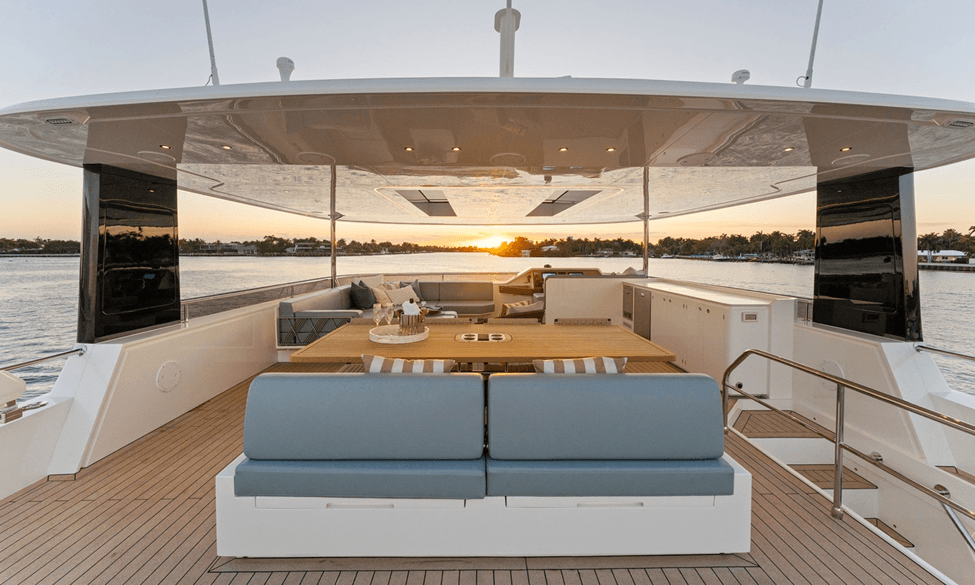
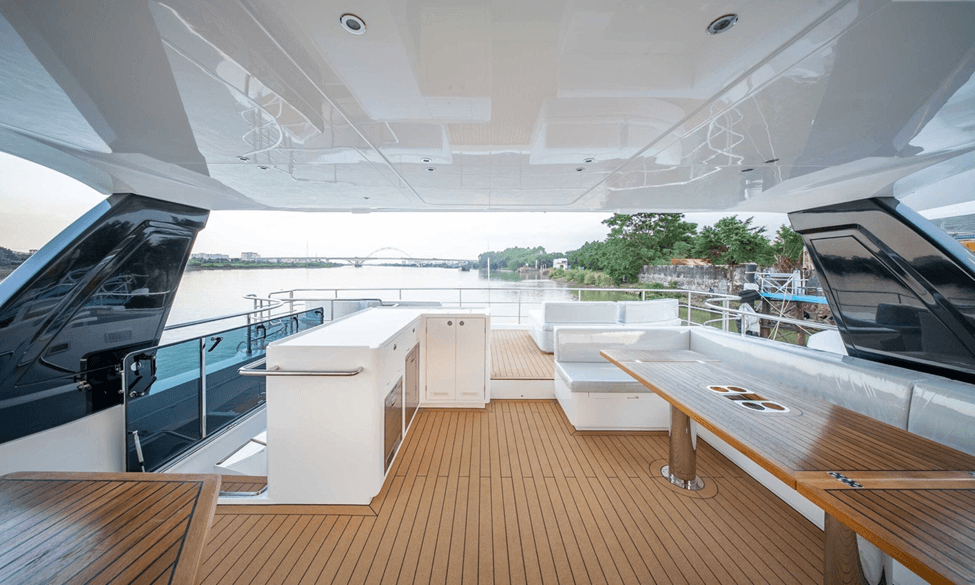
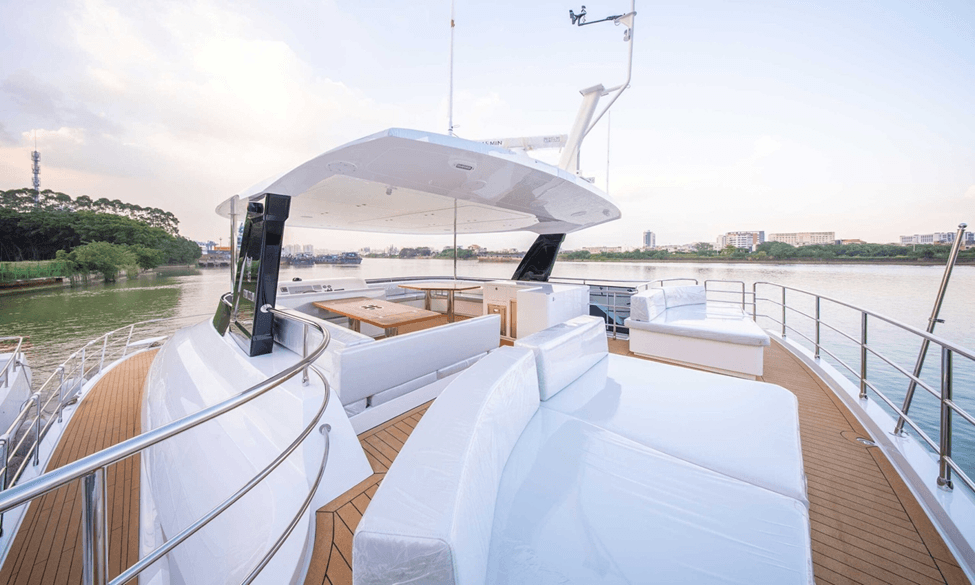
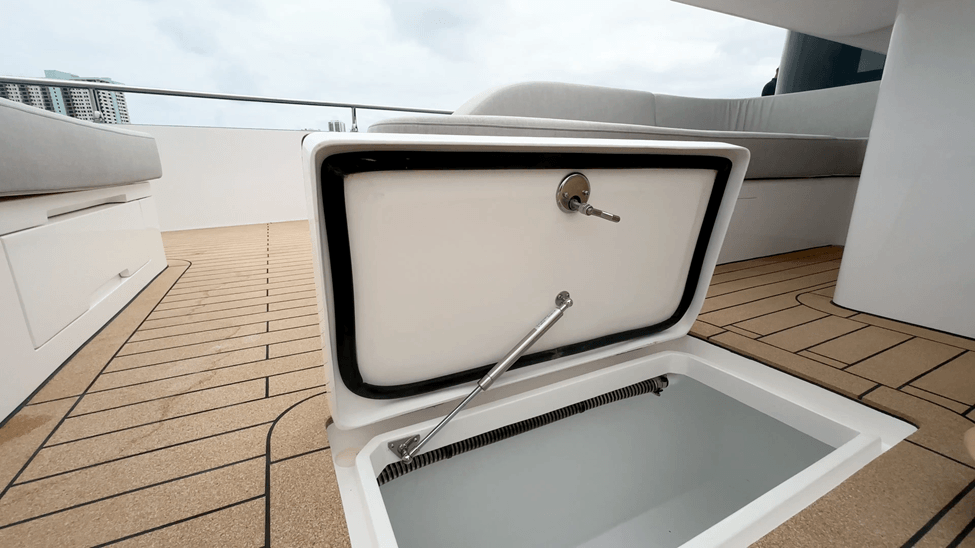
Topsides, the GranOcean W72 offers a really special area in which to entertain and enjoy the wide-open spaces both inside and out; that’s because the bridge deck can be ordered as an enclosed or open space. As everywhere aboard, there are options designed to enhance the experience of travel.
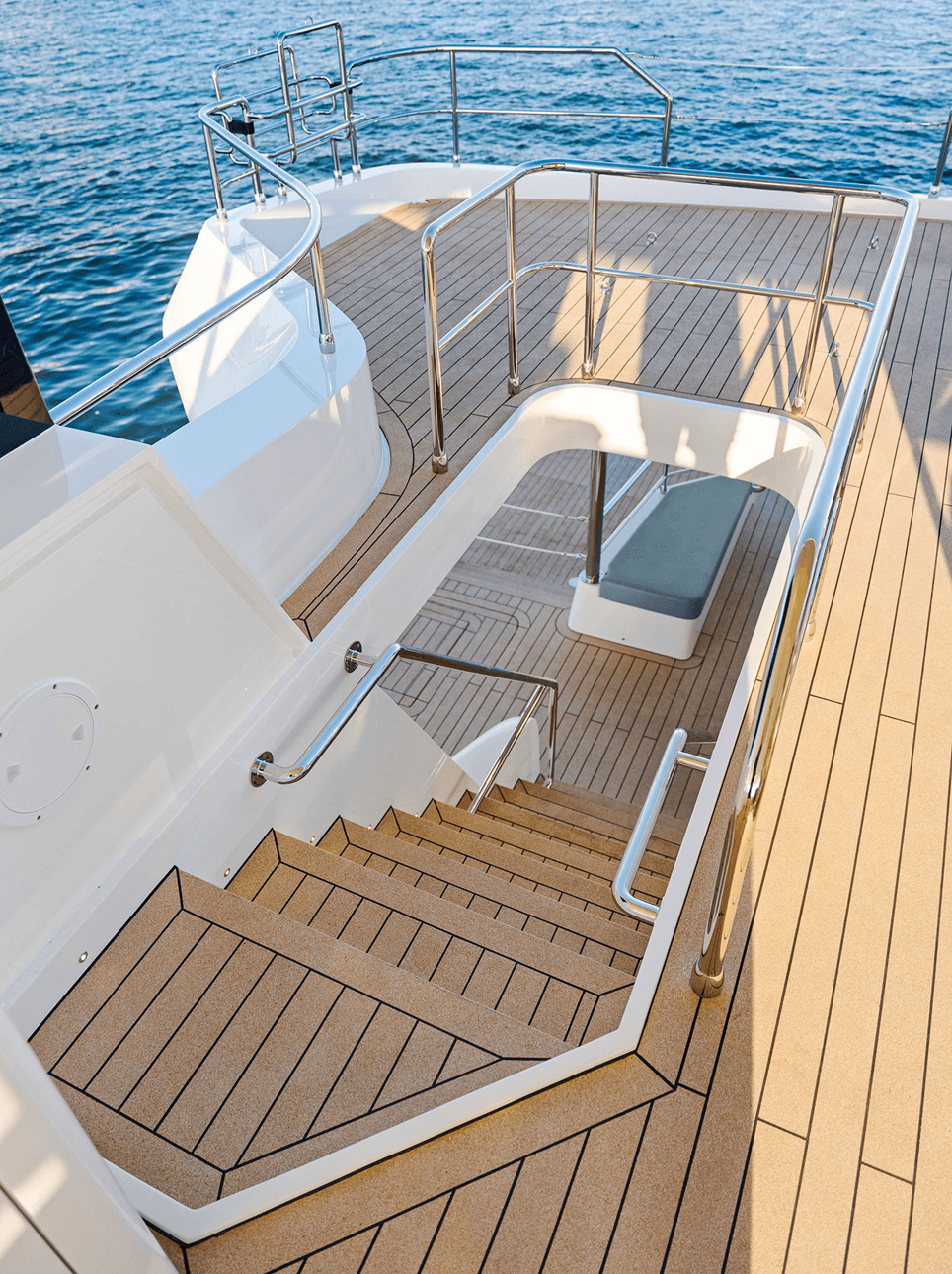
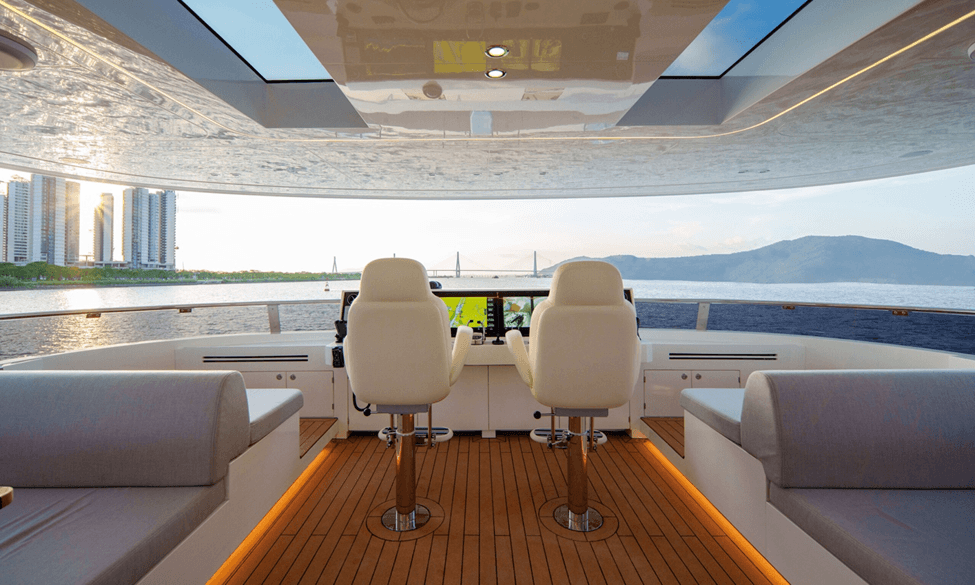
Bow
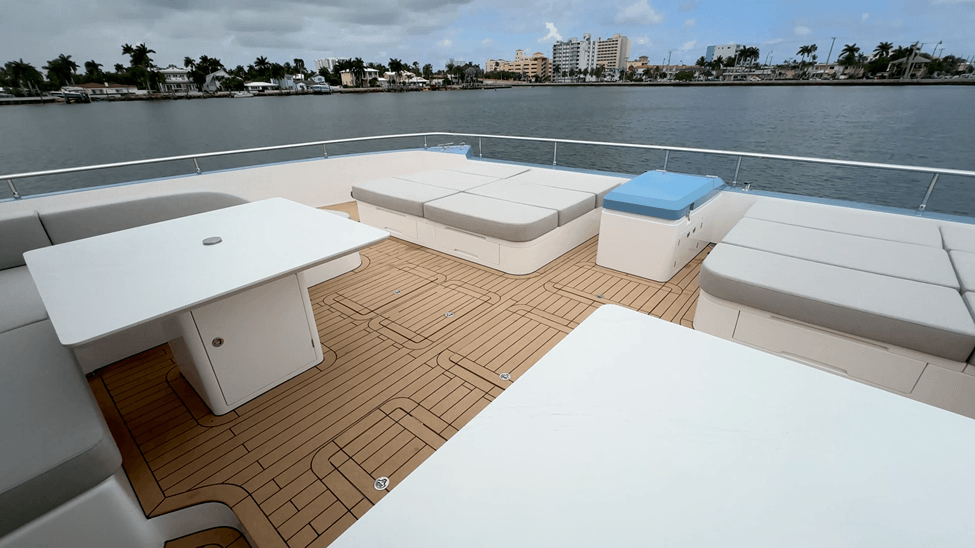
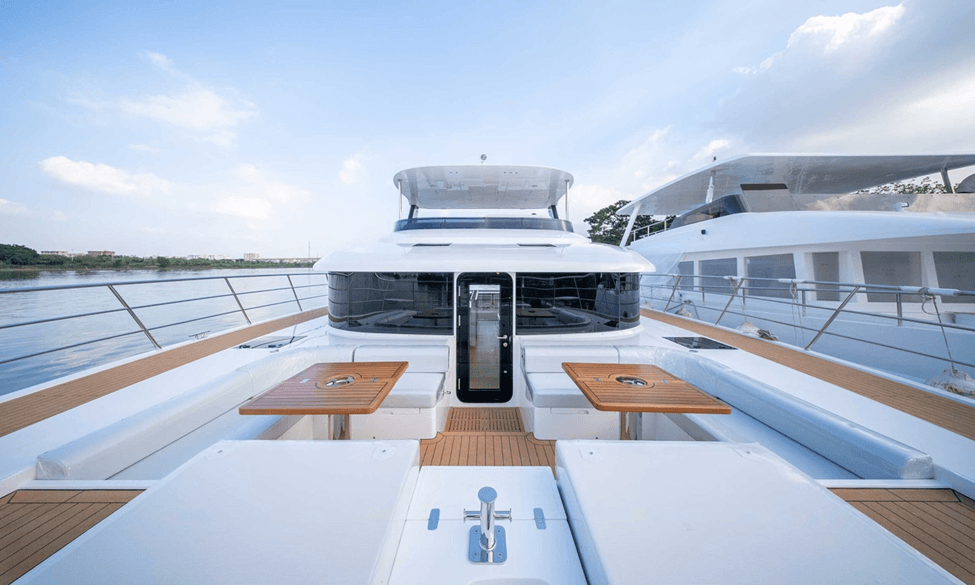
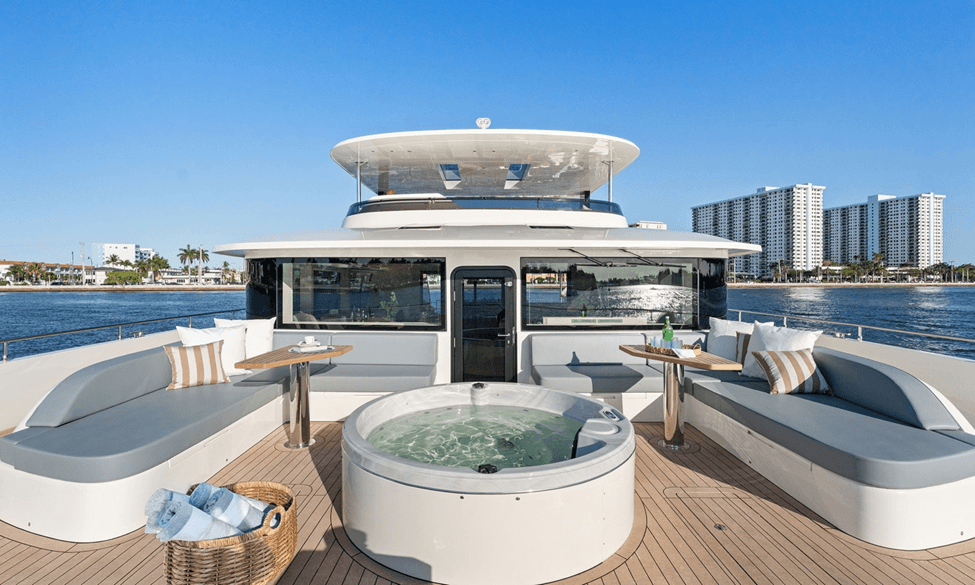
With her massive beam of 32’8” carried fully forward, the GranOcean W72 presents a bow space offering the kind of area designed for optimizing seating, casual dining, and taking in the sights while cruising. The fact that, as is almost everywhere aboard, the bow can be customized, adds yet another dimension to this yacht’s gathering and entertaining decks.
Main Deck Salon
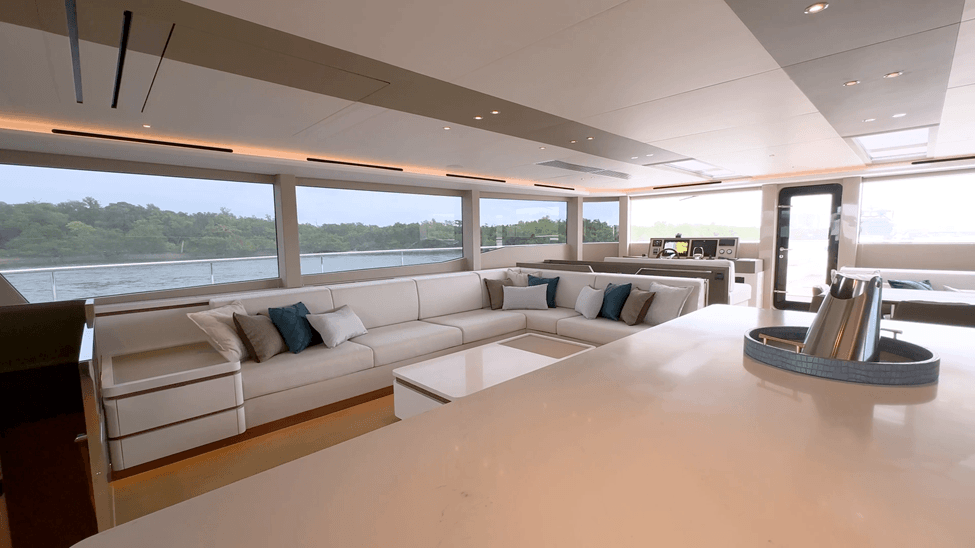
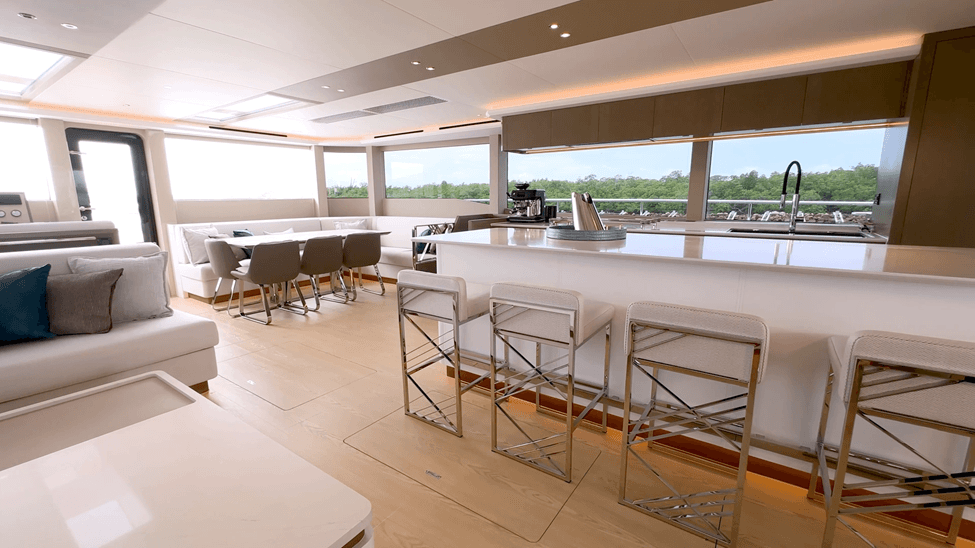
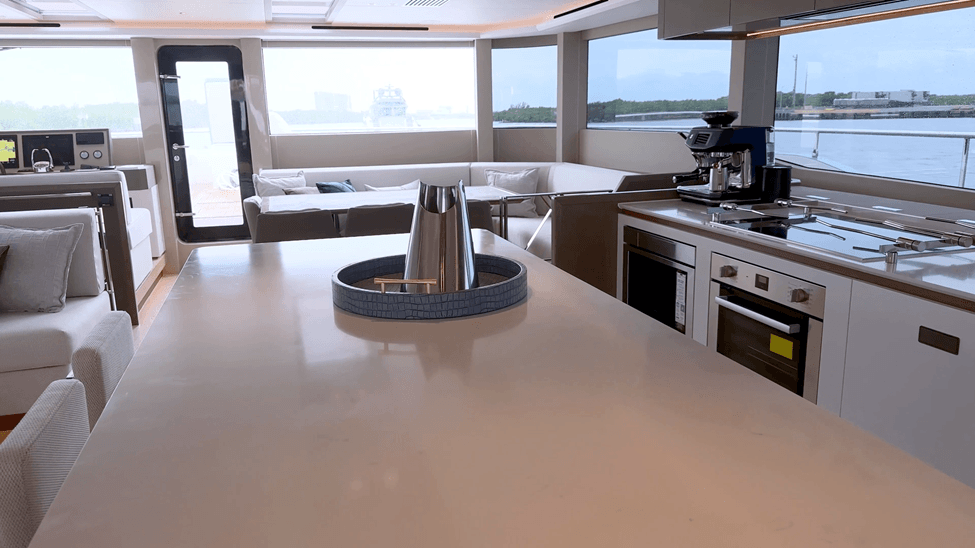
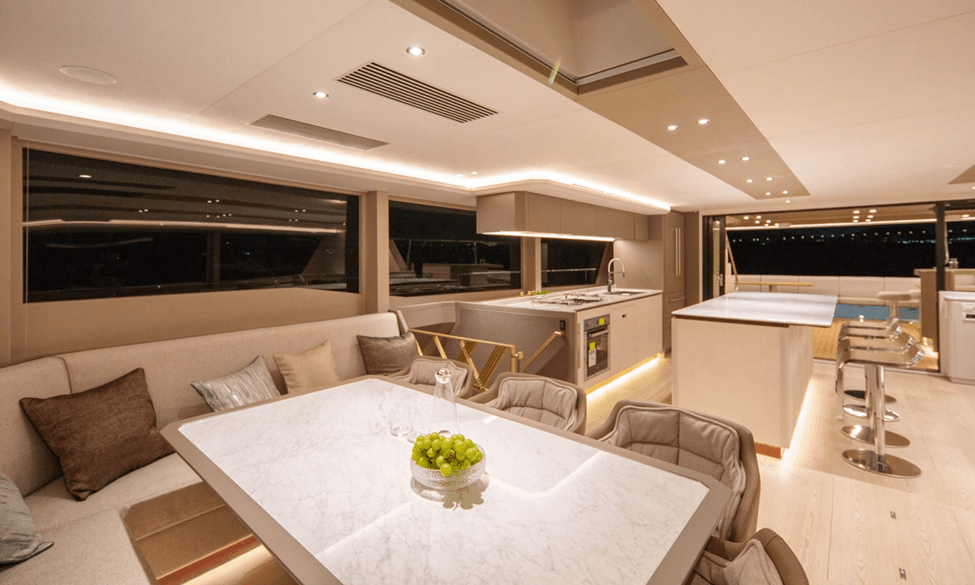
Comfort while underway, or relaxing during a sunset anchorage, are all provided in the main deck salon. Surrounded by elegant décor, luxurious finishes, and attention to detail and fit and finish, anything from a leisurely gathering to elegant dining is for the asking especially with the GranOcean W72’s customizable options.
Living Accommodations
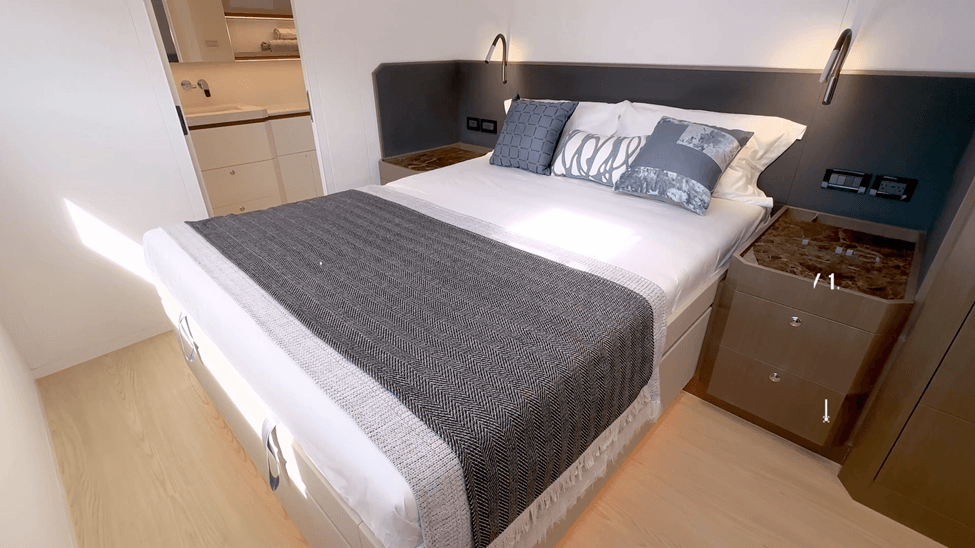
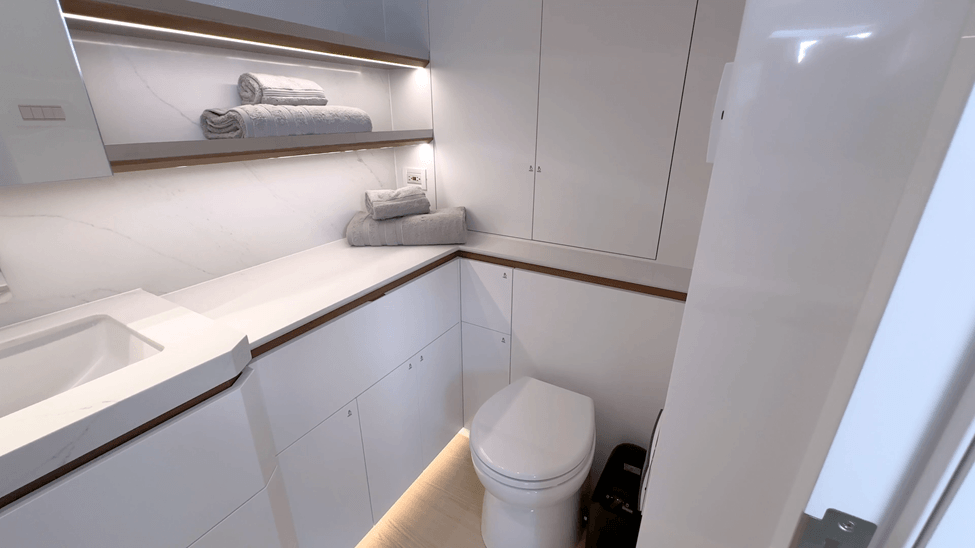
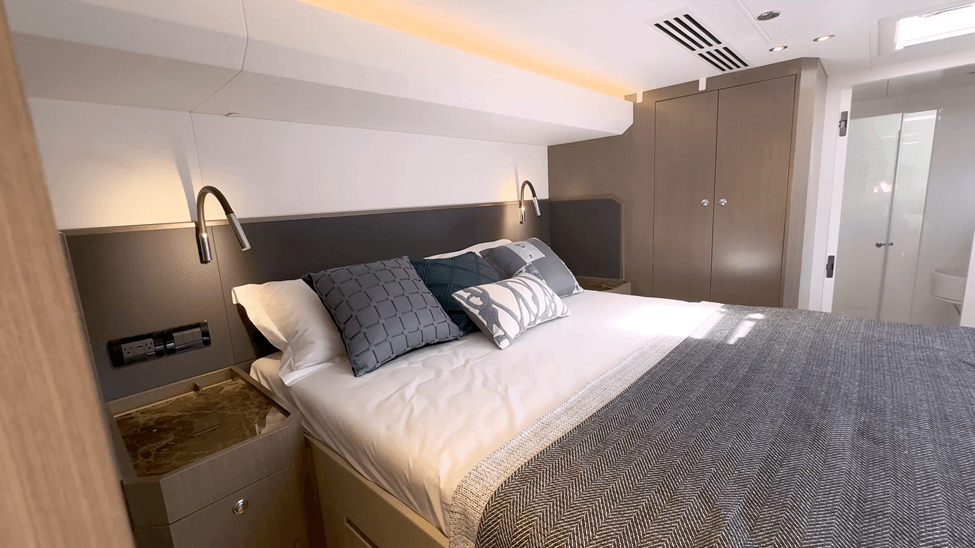
Having the dimensions the GranOcean W72 possesses means the staterooms and heads will be sizable with lots of storage space, headroom, and again, with the company’s vision of customization, able to deliver special, elegant spaces in which to spend overnight and longer stays while traveling.
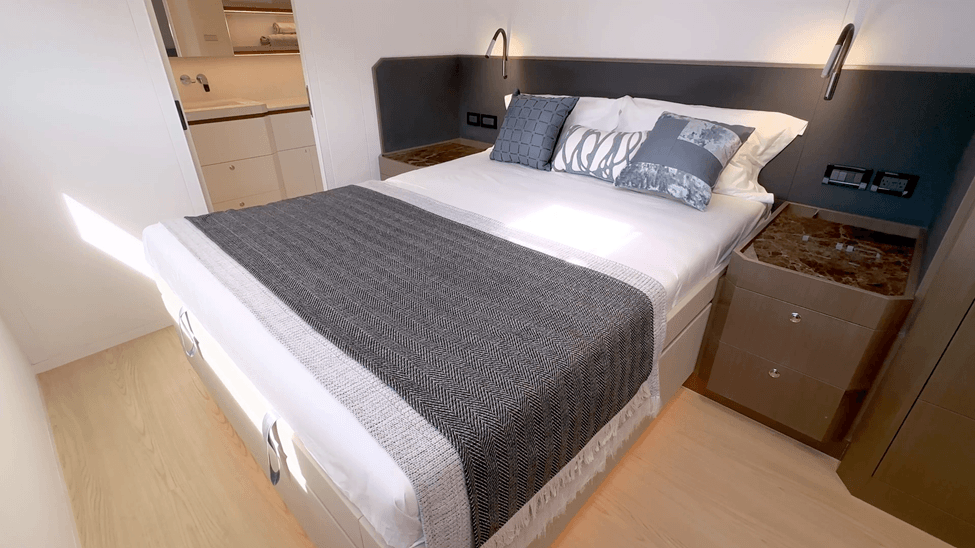
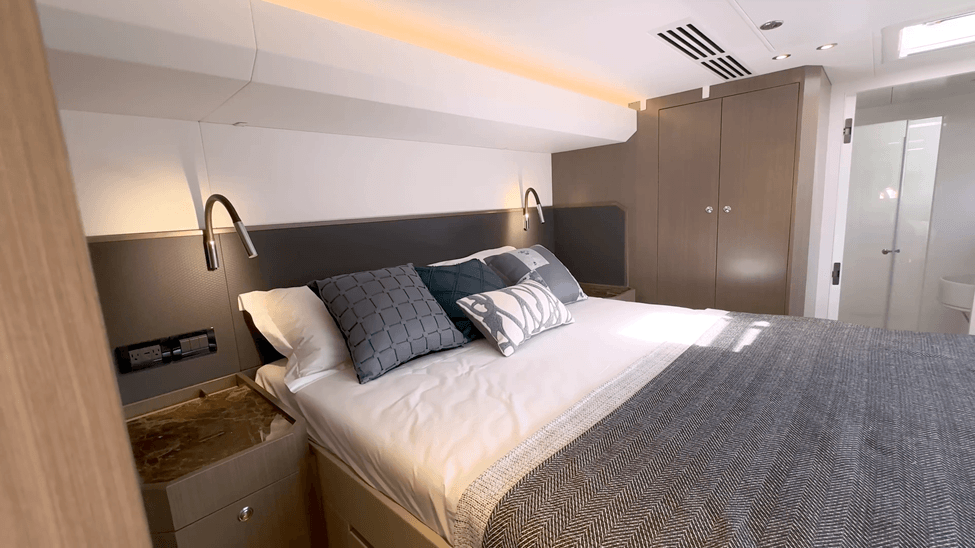
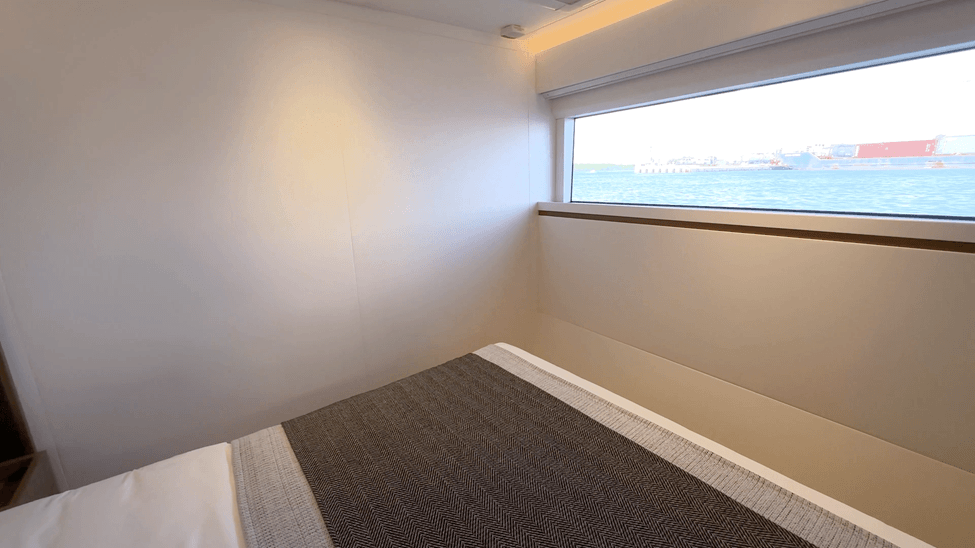
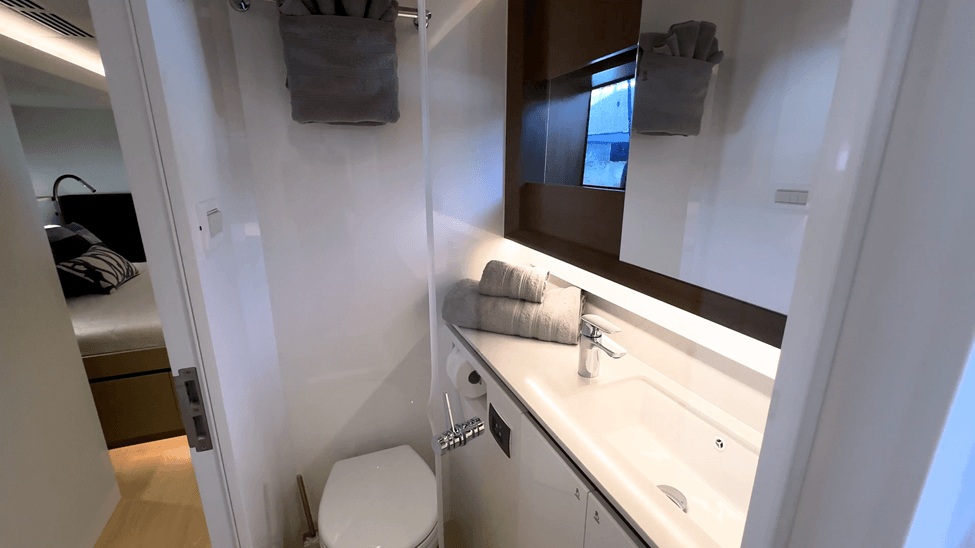
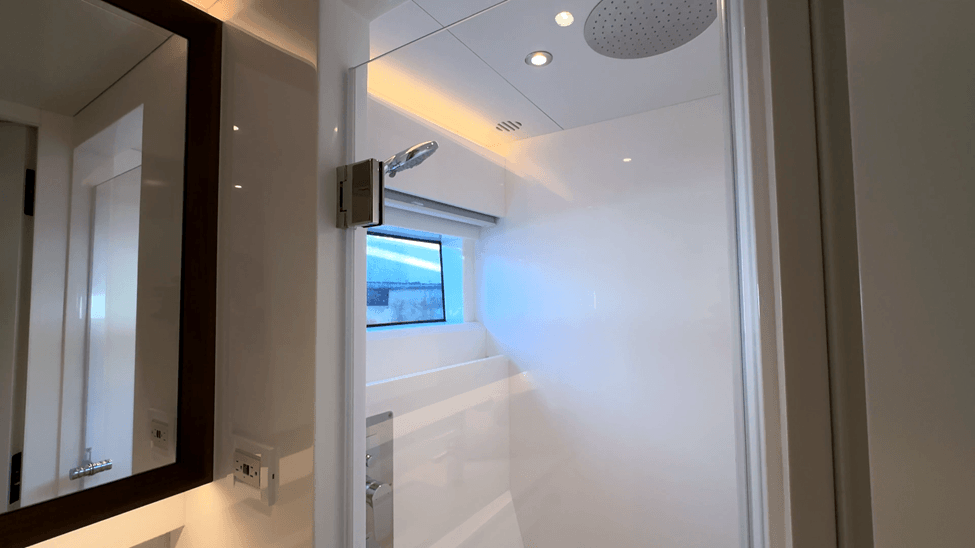
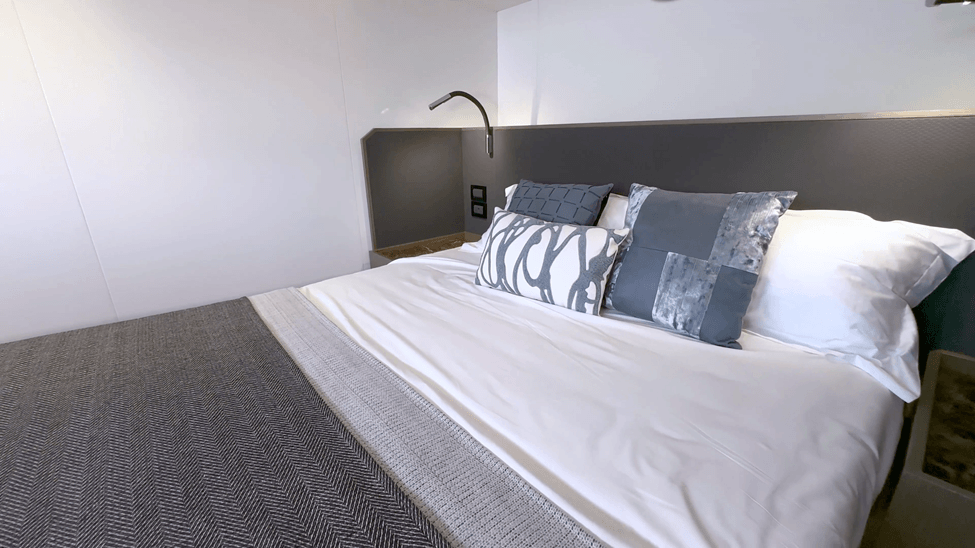
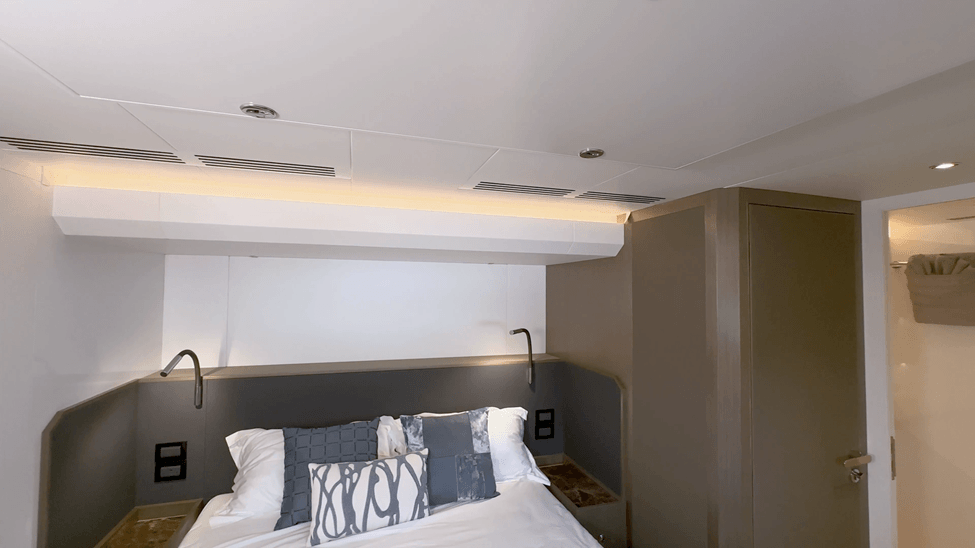
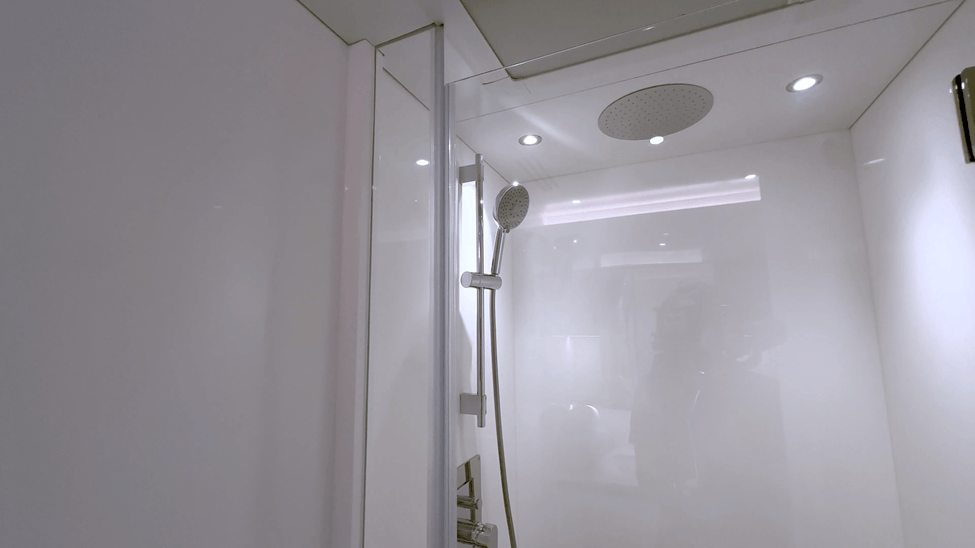
Figure 1 The aft starboard quest quarters are accessed via the same companionway as is the owner's suite. Also, a full walkaround, there is plenty of storage space, a large closet.
Aft
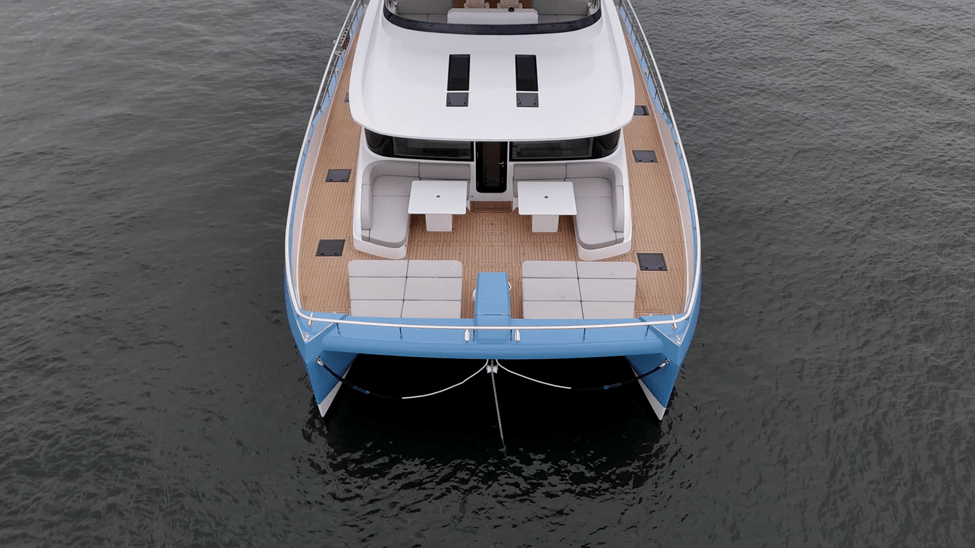
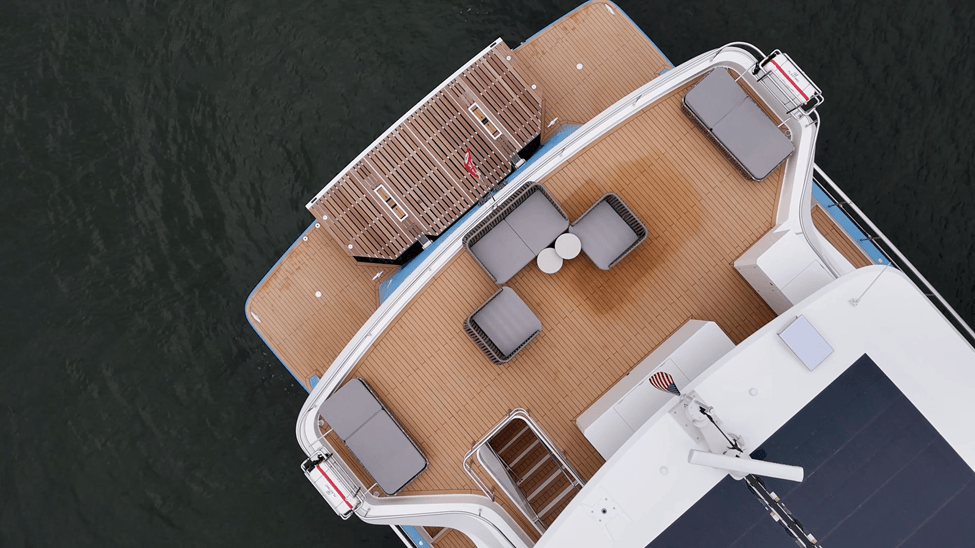
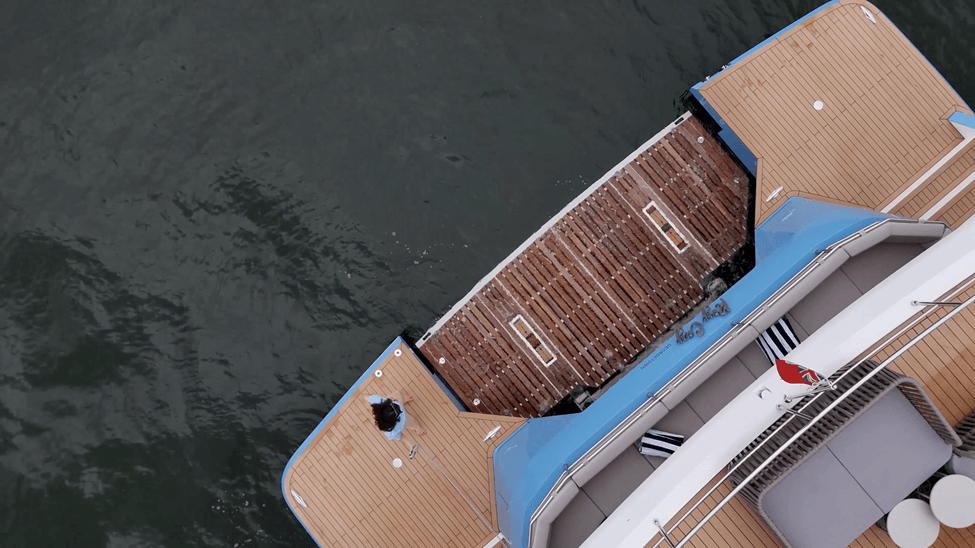
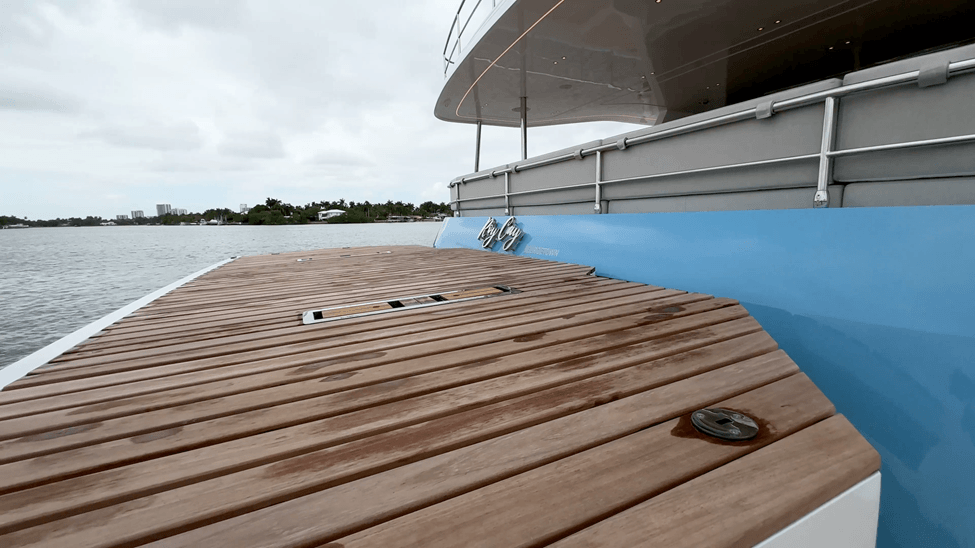
Providing yet another spectacular gathering and entertaining space aboard the GranOcean W72, and with the ability to utilize this yacht’s dimensions, the aft section offers lots of opportunities for enjoying the unique opportunities that can be experienced when traveling.
Engine Space
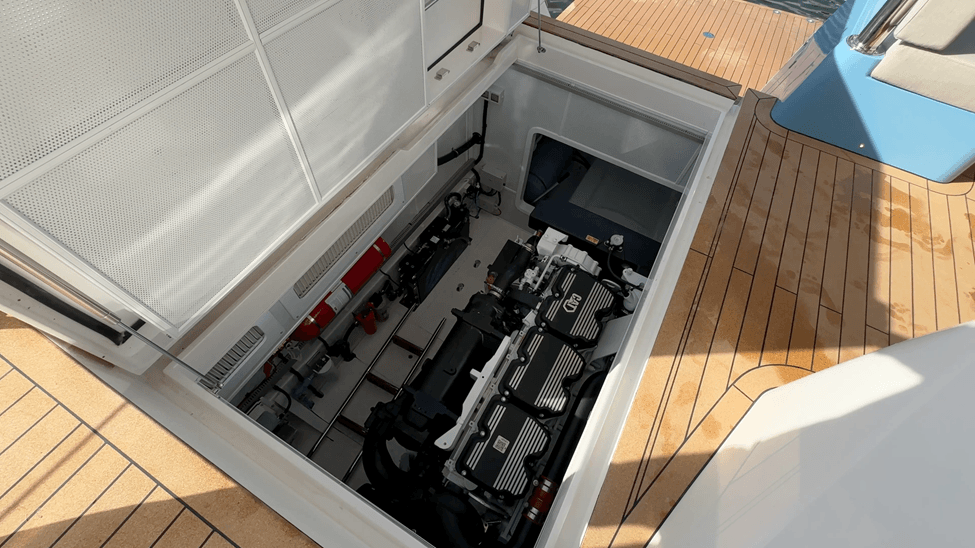
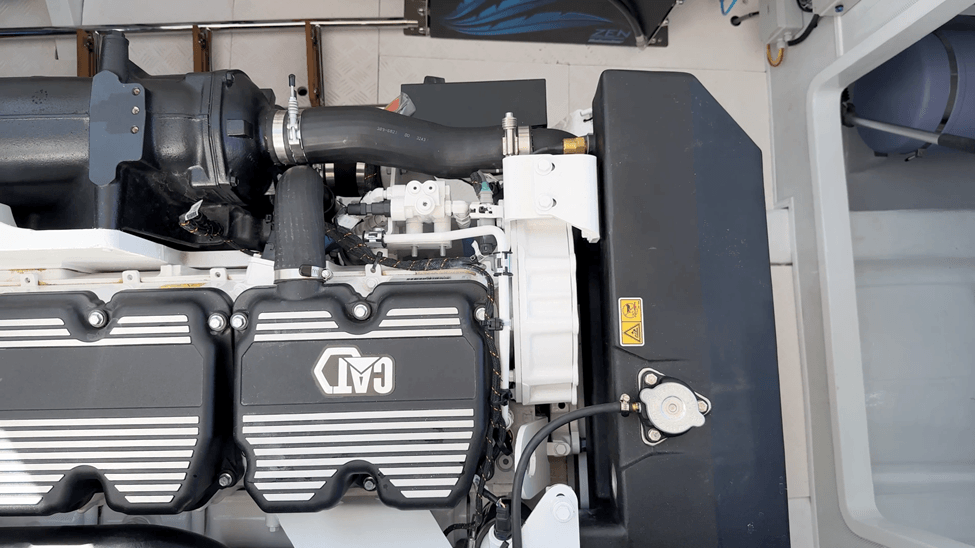
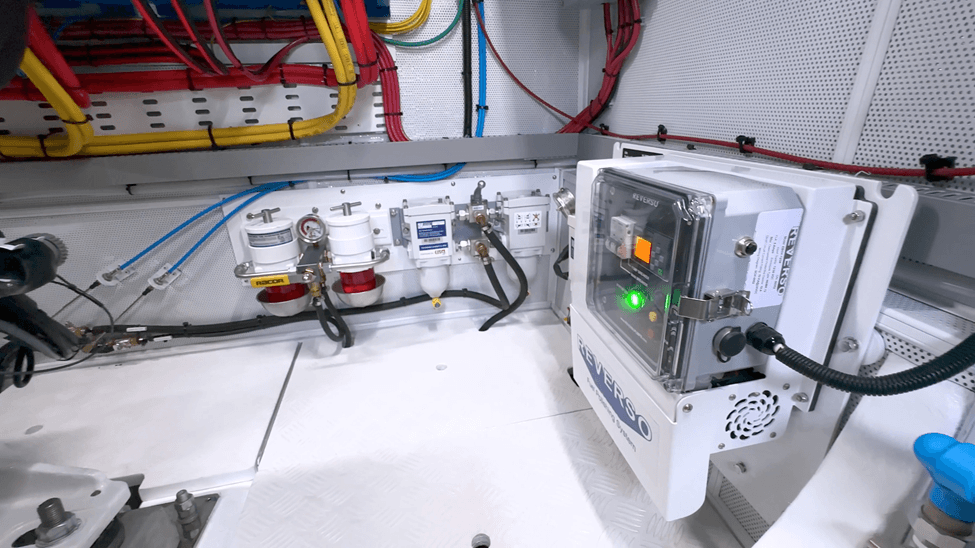
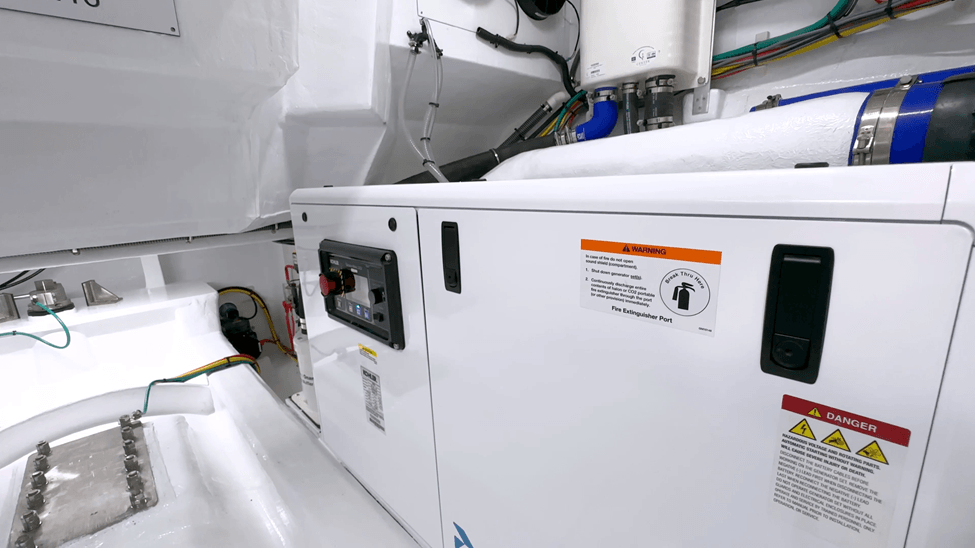
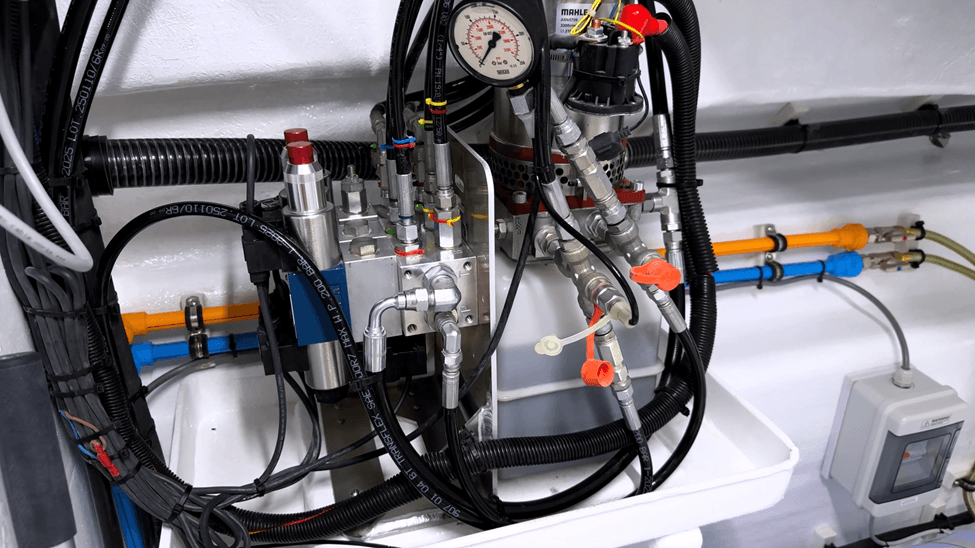
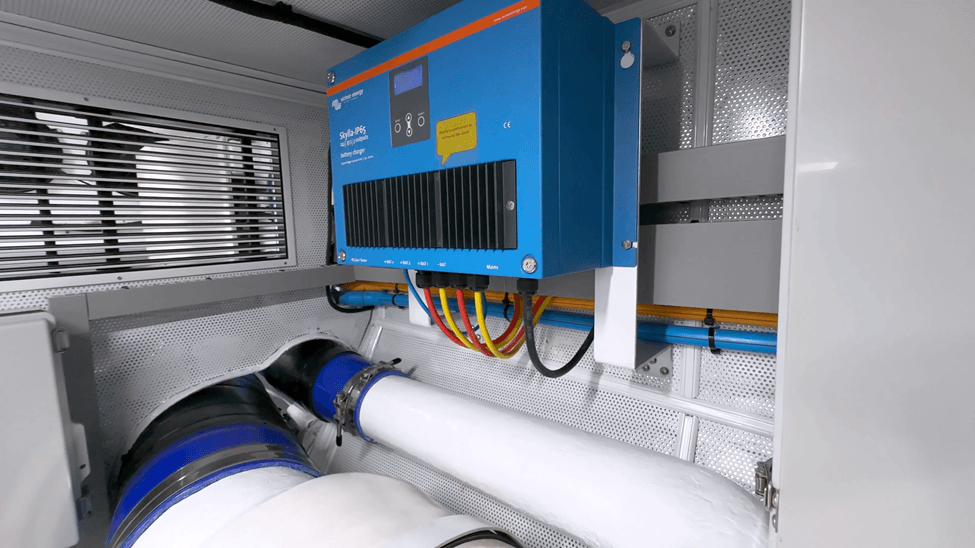
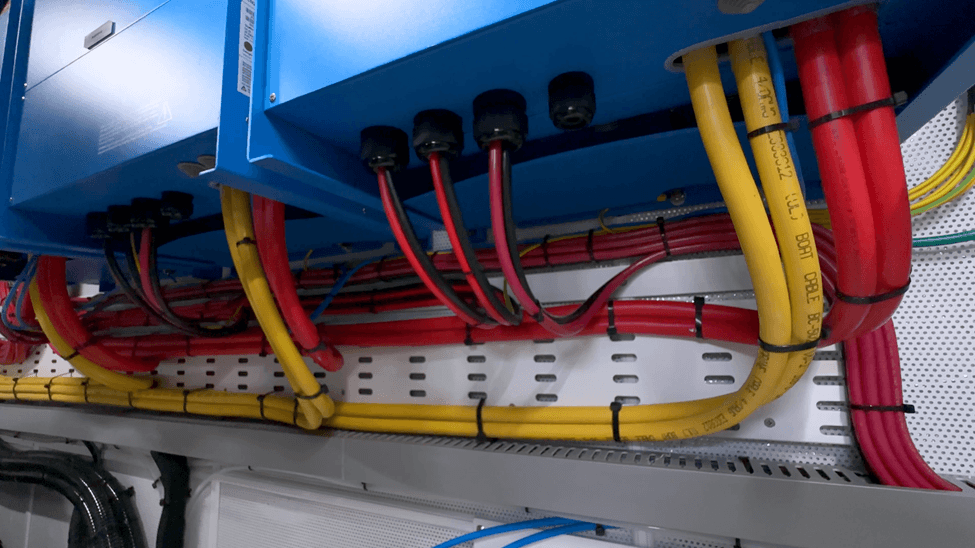
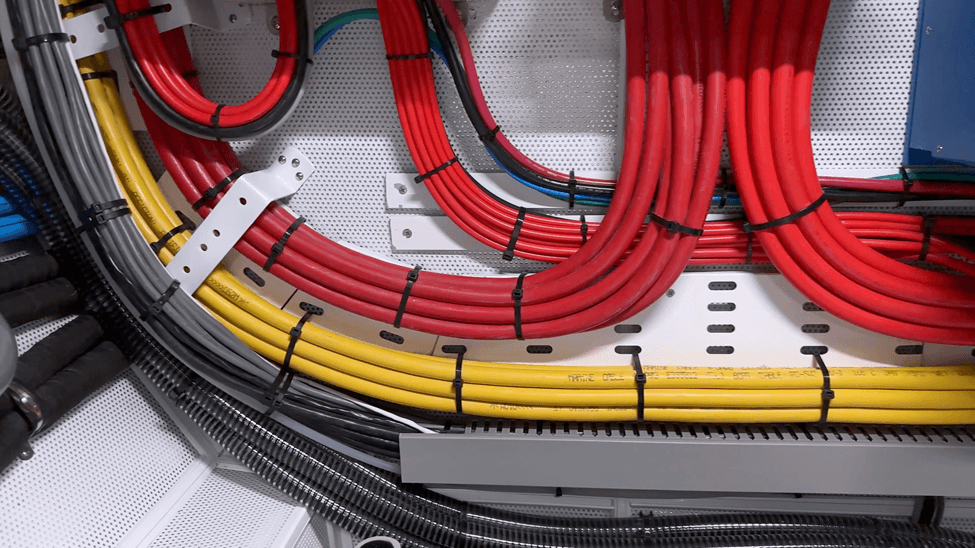
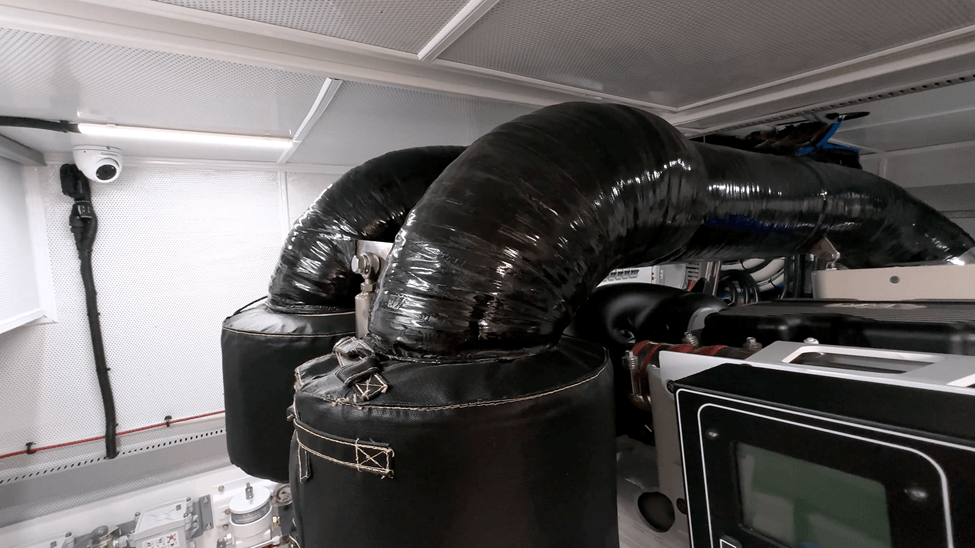
For the hands-on owner, or if a captain and crew are needed, GranOcean paid special attention to the engine space and provided all the necessary access to all critical equipment and maintenance checks. In designing the space, GranOcean utilized its strong mechanics experience and vision to make sure a long range cruising yacht, such as the W72, had more than enough allotted room to do any and all work while under way or at a stopover.
A Word About Performance
With her profile as a long-range cruising yacht, the GranOcean W72 is not a vessel that has no need to break any speed records. However, getting there and back is more a choice of safety, comfort, and the knowledge that her owners have a dependable platform under their control with all the equipment necessary to complete the mission.
To that end, and with a dry weight of 110,231 lbs, and a test day that saw winds up to 18 knots, an air temperature of 71°, and relative humidity at 78%, our test boat was equipped with a pair of 1,150-hp CAT C-18 diesel engines and reached a top speed of 26.0 knots turning 2200 rpm. We noted her best, and most economical cruise speed at 11.5 knots at 1200 rpm. Her calculated range at that rate came in at 796.3 nm with a 10% reserve of the yacht’s 1,585 fuel capacity. We likewise noted her planning speed at 18.6 knots at 1800 rpm, translating into a range of 416.1 nm, also with a 10% fuel reserve. While our test day saw fairly windy conditions along with a sea state running almost six feet, she proved her seaworthiness and ability to muscle through the waves. The prudent skipper will not head out in other than reasonable conditions but it’s reassuring to know that should something untoward come your way, that you have a boat ready and able to take it.
Summary
Time aboard the GranOcean W72, whether out for a day, long or extended weekends, and especially on lengthy travel, is an event which caters to the individual tastes and needs of her owners. With a wide range of configurations available in both living accommodations, seating, entertaining, relaxing, and dining spaces, optimization and utilization of this yacht, while surrounded in luxurious décor and attention to detail, as well as an extensive listing of standard and premium optional equipment, is limited only by the imagination. Most areas are fully customizable and each and every W72 can be a personal statement of ownership. Designed and engineered for long distance travel, this is a big power cat that will deliver memorable times while aboard.
REMEMBER, LIFE IS BETTER ON A BOAT!
About the Reporting Captains
Experts and Boat Owners
What has set BoatTEST apart from the many video-makers currently on the Internet and Social Media is the fact that for 26 years, only USCG-Licensed captains and experienced boat owners have tested and written our reports and made our videos. We believe that to provide boat owners the information they deserve, only other boat owners – who know the challenges of ownership -- can accurately report on it. It is that level of expertise and ownership experience that goes into every video and Captain’s Report that we publish. Because we know what it is like owning and operating a boat, we can pass-on the information that prospective boat buyers need to know.
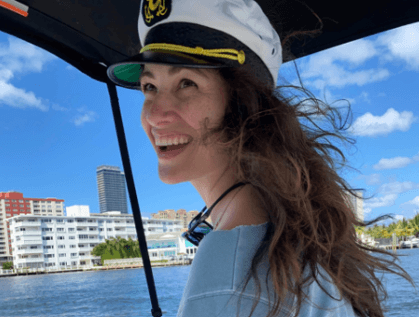
Captain Boomies (aka Capt. Kate) holds a 200- ton USCG license and worked on superyachts for 20 years, captaining vessels up to 150’ before retiring several years ago. She now is a delivery skipper of all manner of vessels. When not testing boats for BoatTEST, she often can be found taking new yachts off their cargo ships in the port of Baltimore, getting them operational, then delivering them to dealerships. Unbeknownst to dozens of boat owners in the Chesapeake Bay, Capt. Boomies was actually the first skipper of their boats, because she actually delivered them to the dealerships. She is also active in boat instruction and making videos for her personal website. Capt. Boomies believes boating is fun,, and people doing it should not take it too seriously, she always inserts a bit of humor and theatricality into many of the tests she does. But don’t be fooled by that, Capt. Boomies has wrong more saltwater out of their socks than most people every sail over.
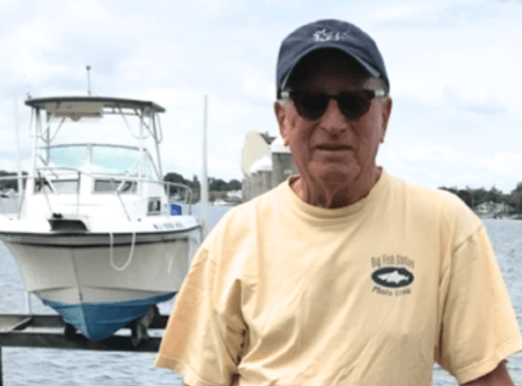
Capt. Ken Kreisler is a well-known figure in the marine industry, with extensive experience testing boats for major boating magazines. He has held USCG 100-Ton License for 40 years and has served as a delivery and charter fishboat captain, project manager for two small passenger ferry catamarans, making sure every details met USCG build standards. Capt. Ken is an accomplished writer, having received several BWI awards and the John Burroughs Association certificate of commendation for his children's book, "NATURE SPY," published by Macmillan. He resides with his family on the Shrewsbury River in Monmouth Beach, NJ, where he enjoys boating on his 24-foot Grady White Explorer.
Features Video Transcript
Overview
The Grand Ocean W72 is built by a 25-year-old company introducing this boat to the US market for the first time. She has a 33-foot beam, which the reviewer states gives her more square footage of living space than most 150-foot monohull megayachts. She is semi-custom, built to CE Class A standards, and constructed of 100% vinylester resin composite — described as "almost unheard of in class."
Captain Boomies' framing of this review: "So much of this boat is about choosing the options you want to have as features on board." Much of the boat is described using "options" language throughout, reflecting its semi-custom build program.
Bow
The bow is fully customizable in layout. On the boat reviewed, the owner specified a large sunning area with limited dining space.
Cushion identification system: Every cushion carries an identifying tag (e.g., "Forward port side number seven") indicating its correct placement location. Captain Boomies: "You always know where all of your cushions go. It's not a big mystery. That is so wonderful."
Rail: A single continuous piece of stainless steel rail, stated at 180 feet in length, running the perimeter of the bow area.
Bow configurability: Per Captain Boomies, the space can be configured for uses including a hot tub, ping pong table, or dance floor, at owner discretion.
Additional detail: Pop-up lighting fixtures are fitted in this area.
Cockpit
Layout is owner-configurable. The boat reviewed was fitted with a bar and seating. Captain Boomies noted the bar's function beyond serving: "The bar gives me a place to hold onto."
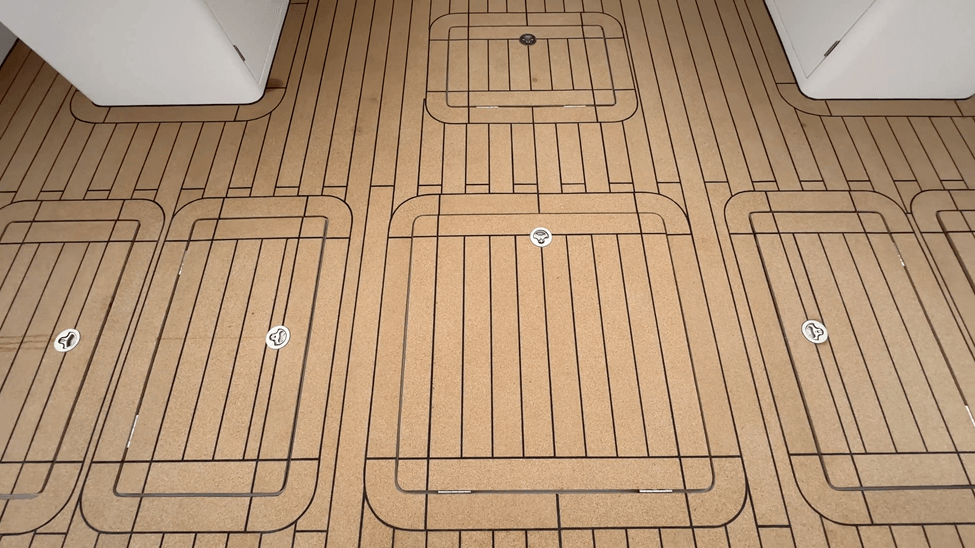
Scupper drain detail: Scupper drains are etched with a "W" (denoting the W-series model); the X-series model uses an etched "X" in the same location. Captain Boomies characterized this as: "such an unnecessary detail, and I love it."
Aft deck bar rationale (Captain Boomies' stated reasoning): "I always love an aft deck bar because you're going to be doing all your swimming and your water sports over here. You don't want to be walking through the boat damp to get a cocktail. This is smart. I would pick this layout."
Alternate cockpit layout options: Larger dining tables, or L-shaped table configurations, are available as alternatives to the bar/seating layout shown.
Day Head
Not offered as an option — standard on all configurations. Captain Boomies' stated rationale: "A day head is so useful to people who are coming and going from the tender, for your crew that is running up and down to the sundeck... I love a day head."
Swim Platform / Tender Lift
Both port and starboard sides provide access to the swim platform. The reviewed configuration includes a remote-controlled lift (referred to by the builder as the "tender lift"), custom-designed for the specific tender to be carried. An alternative configuration is available in which this area becomes a full deck extension, with seating relocated aft.
Additional swim platform features:
- Rain shower
- Custom swim ladder that inserts into the swim platform
Side Decks
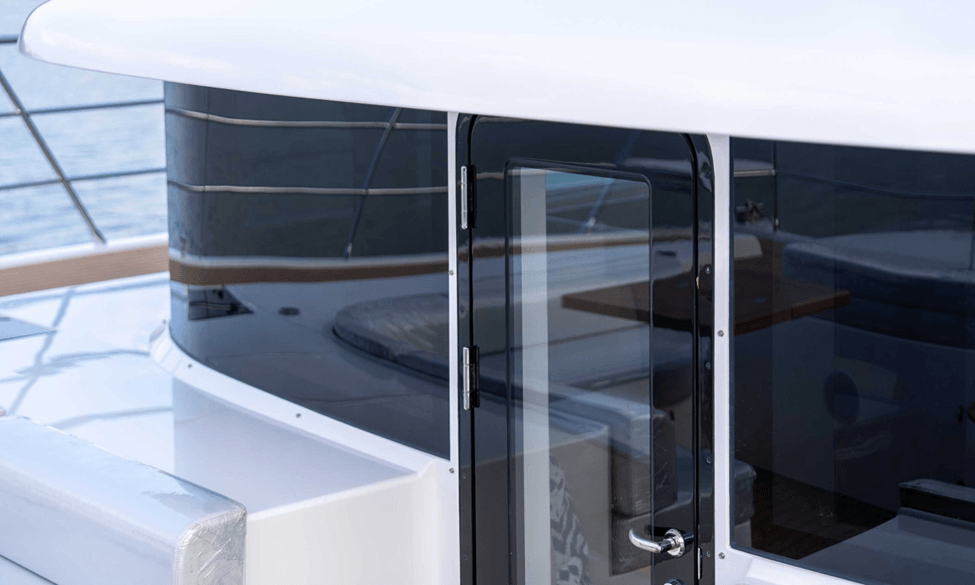
Captain Boomies noted the side deck windows are curved, a detail not apparent from inside the boat: "I was surprised when I came outside to notice how curved this window is. From inside, it seems so flat, but aesthetically, this is so pleasing as you're walking along these side decks."
Opening window mechanism (side deck): Tested directly on camera by Captain Boomies, who assessed the engineering: "It's just the right amount of heft. And it locks in in a way that is cleverly engineered, but still heavy enough that it works, but not so heavy that I can't do it pretty easily... She goes up soft and then locks into place." She further noted the resulting opening size: "I could fit that boat through this window."
Main Salon
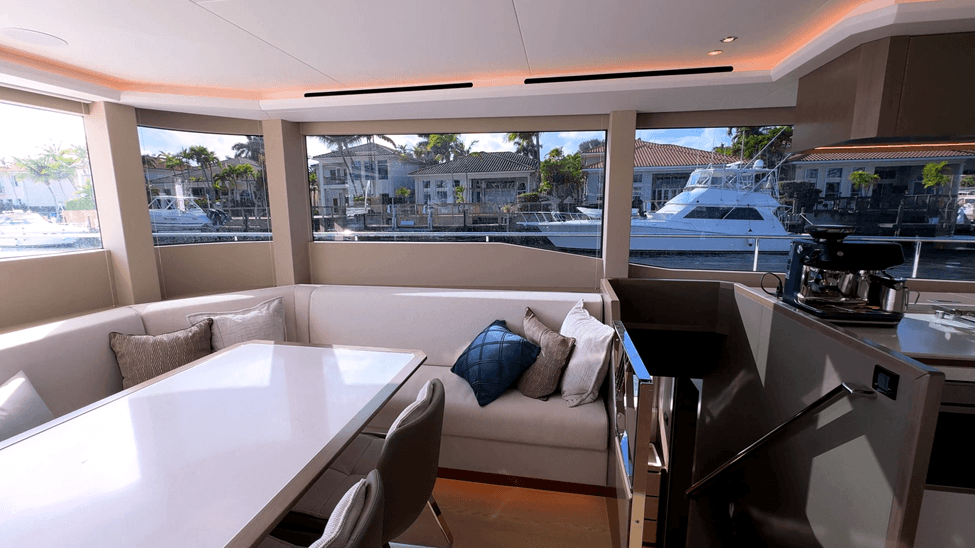
Semi-customizable, but Captain Boomies noted a constant design element across configurations: a "window-to-window, beam-to-beam" sightline.
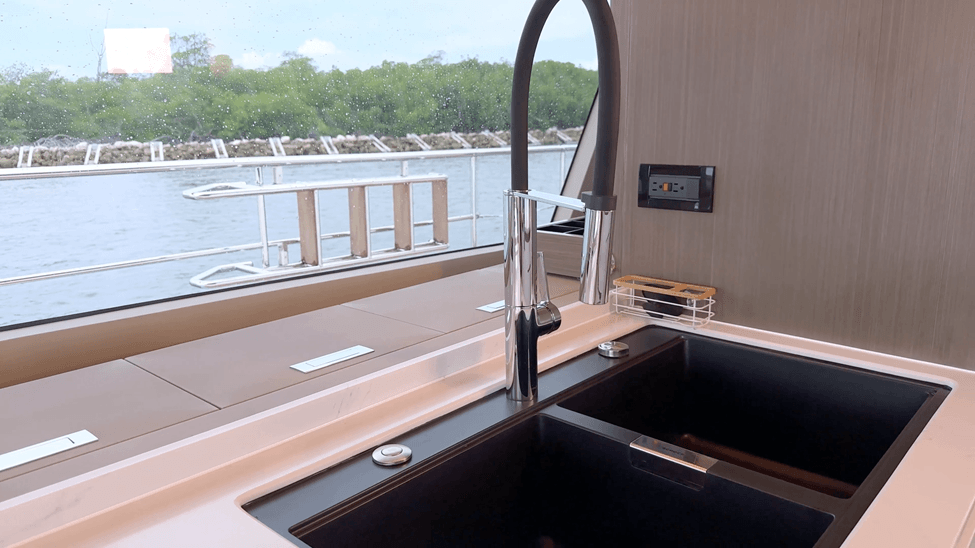
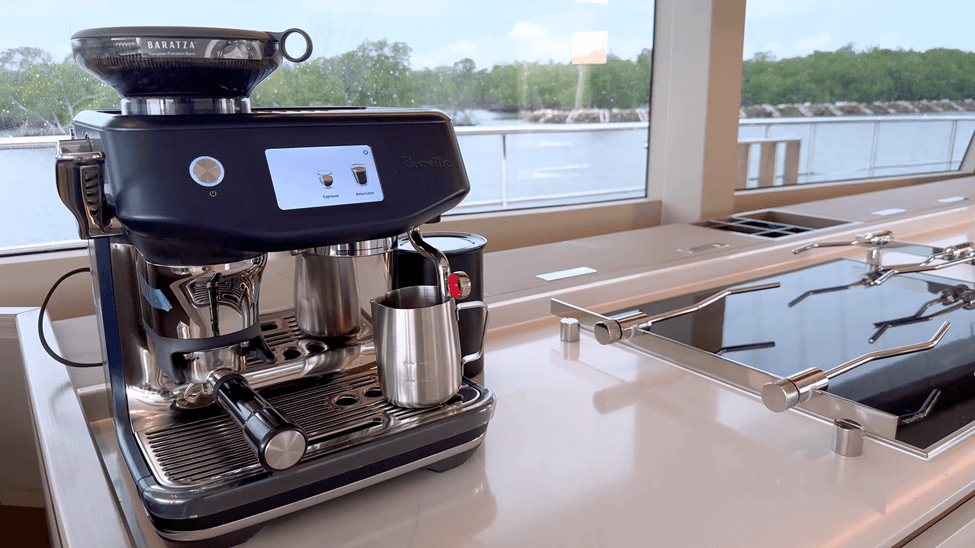
Galley (positioned in the salon): Placement rationale per Captain Boomies: "Putting the galley up here means anybody cooking is part of the show. It also means everyone has easy access to the refrigerators."
- Induction cooktop
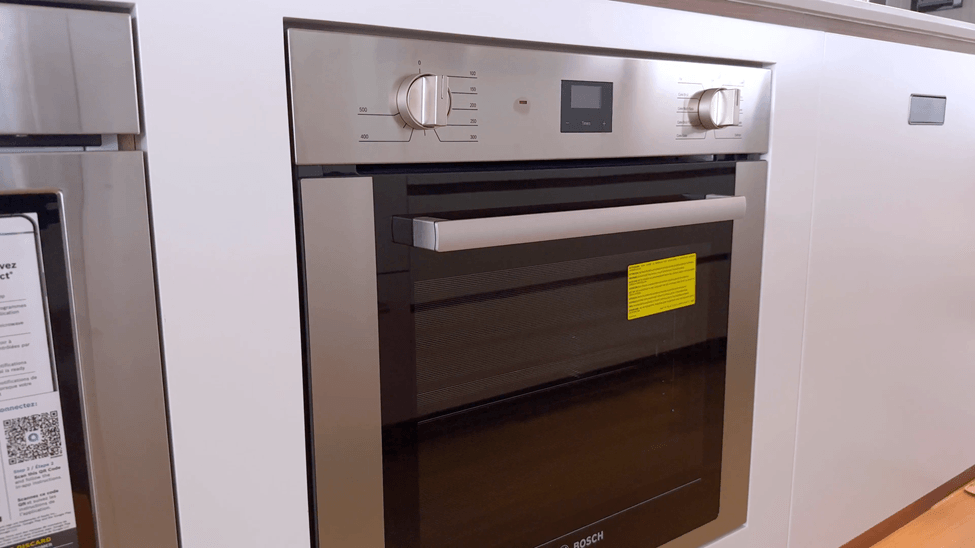
- Bosch microwave
- Oven positioned below the cooktop
- Large kitchen island, which Captain Boomies noted provides the person cooking with a sense of separation from other activity on the boat, and additional storage with inset compartments
- Refrigeration units noted specifically for their "clickie" closure hardware
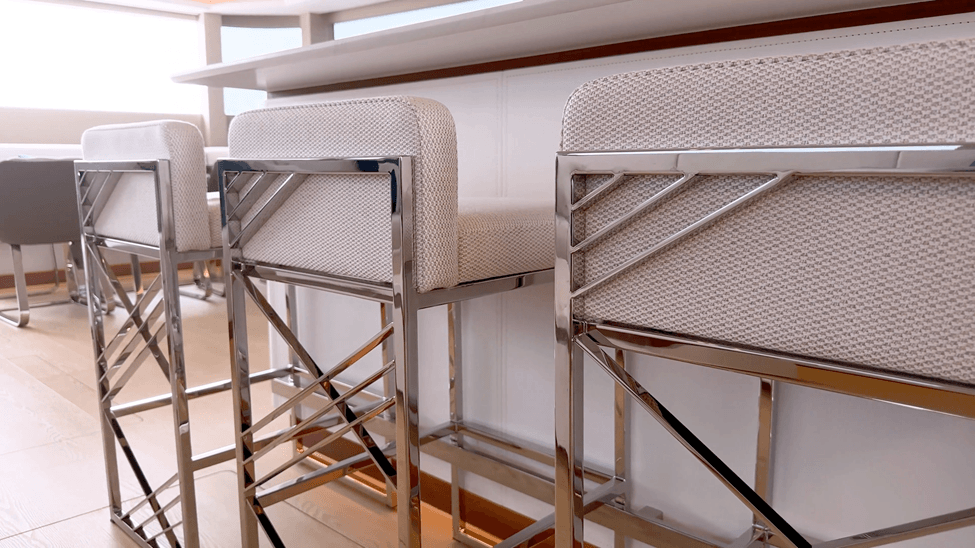
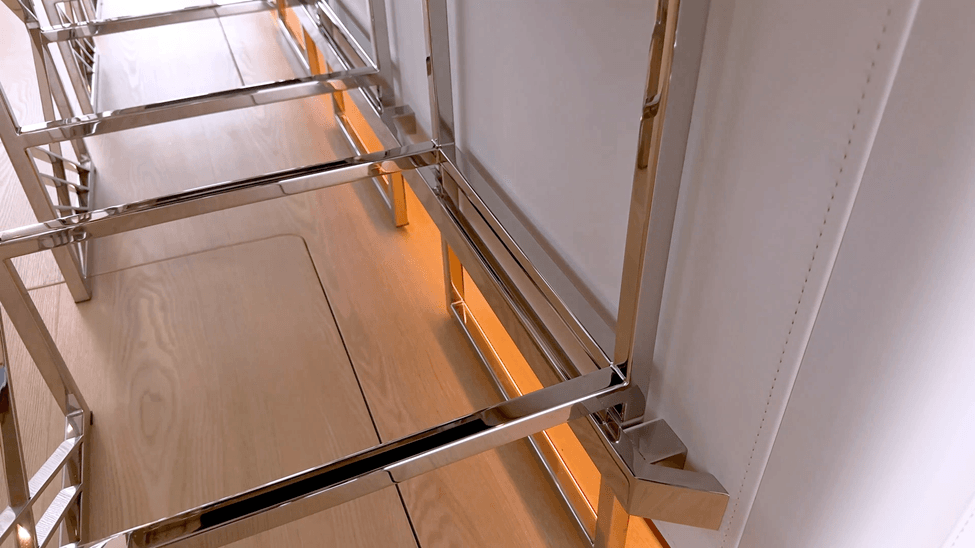
Seating (island side): Fitted with a lock-in feature to prevent sliding in rougher sea states; Captain Boomies confirmed this held during testing: "These seats were not sliding around when we were in bigger sea states because they have a little lock-in. It's even padded on the inside."
Settee upholstery: Captain Boomies' assessment: "You can tell it's made of something different. I'm so supported on them, and the fabric choice, I'm a fan."
Coffee table: Includes underneath storage.
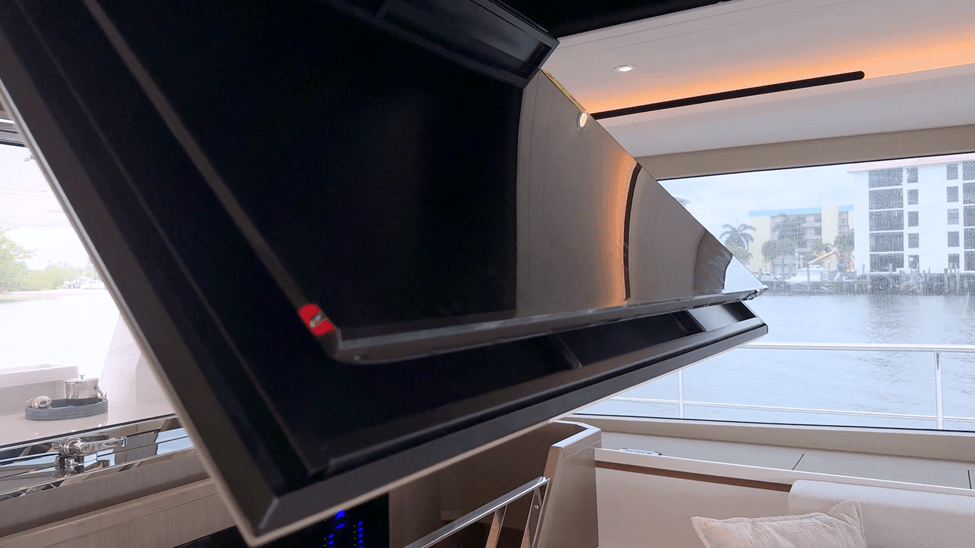
TV: Drops down from a concealed position and swings around, allowing viewing from the outdoor bar/cockpit area as well as the salon.
Dining table: Described as a "big formal dining table" seating 10 people.
Lighting: Captain Boomies noted variation in natural light by zone within the open salon space, citing light from the windshield at the dining table position and additional light from overhead skylights.
Crew Quarters / Guest Suite Layout (Port Side)
Accessed via a companionway just behind the helm. On the boat reviewed, the owner specified two guest cabins and two crew cabins on the port side, with an adjacent laundry room. The aft guest cabin has its own private entrance. The full accommodation plan is configurable — options include repurposing a guest cabin for children or a nanny, or reconfiguring for additional crew. Captain Boomies noted a general guideline: "Typically, for charter work, four nearly equal cabins are best."
Midship port guest cabin:
- Full walk-around bed access
- Nightstands on both sides (noted as "a little small") with individual reading light, outlets, USB, and USB-C ports
- TV that swings down for in-bed viewing
- Hanging locker with extra linens and a full-length mirror
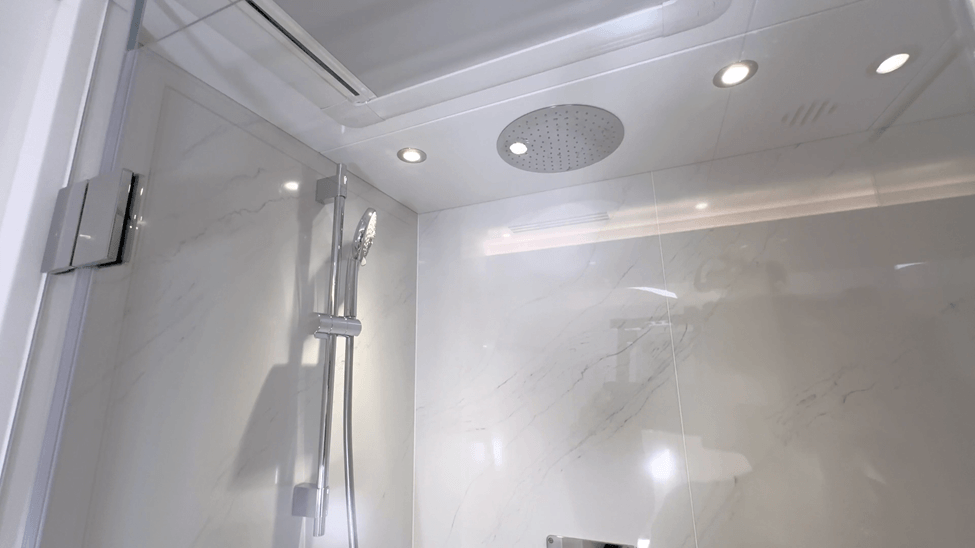
- En suite with a full stand-up rain shower, wood grating on the floor, and a window
- Door-locking mechanism: doors push into recessed circles to lock open, and push again to unlock
Aft port cabin:
- Also a full walk-around design; Captain Boomies noted it requires "a little bit of a shimmy" but accommodates two people
- Indirect overhead lighting; three on/off light switches (non-dimmable) — Captain Boomies noted this as a minor drawback: "They don't dim. They don't do anything fun."
- En suite with rain shower
Starboard Side Cabins
Forward guest cabin: For two people, with en suite.
Owner's suite (aft, midships):
- King-size bed available as an option (requires smaller nightstands on both sides as a tradeoff)
- Individual reading lights and outlets
- TV that swings down from overhead for in-bed viewing
- En suite described as the largest on board
- GFCI outlet included — Captain Boomies noted this as a positive detail specifically for a foreign-built boat: "I want to be able to plug my hair dryer in and do my hair while it's still wet from the shower."
Forward Starboard Guest Cabin
The bed position is elevated relative to other berths on the boat. Captain Boomies attributed this to hull shape: "That's because of the shape of the hull and how far forward we are. In order to have enough room to put a bed athwartships, she has to be a little higher up. That has to do with the hull shape being very pointy as we go forward." The elevation allowed for storage space beneath the berth.
- Hanging locker with a deep pocket, cedar-lined (Captain Boomies noted cedar lining is used throughout multiple cabins on the boat)
- TV that swings down
- Emergency hatch, which doubles as a skylight (noted as standard across all cabins)
En suite: Cited by Captain Boomies as her favorite en suite on board, due to the vanity placement and an adjacent window providing natural light for grooming tasks.
Climate Control (Cabins, General)
Every cabin is fitted with its own independent air conditioning unit, allowing individual temperature control per cabin.
Flybridge
Layout is owner-configurable. The boat reviewed included tables, a bench seating arrangement, a grill with underneath storage, and multiple storage lockers.
Wet bar area: Includes refrigeration and an ice maker, positioned to allow service to bar-seated guests.
Captain Boomies' general comment on documenting this boat: "It's kind of tricky to do a features video on a boat where the features can totally change depending on what you want as an owner."
Pricing
Captain Boomies stated the W72's price is competitive for a boat of this size, directing viewers to a separate resource for specific pricing information.
Performance Test Video Transcript
Overview
This performance test was conducted in adverse weather — six-foot seas gusting to 35 knots. Captain Boomies stated her enthusiasm upfront while noting her intent toward objectivity: "I'm a little unfairly excited about this boat. I'm going to do my best to be super objective, but it's the closest I've come to getting on board an America's Cup boat." She attributed this to the builder's design approach: "She's designed by the people who think about the materials that are going to make a boat light and fast, the hull shape that's going to slip through the water the best... This is a marvel of hull design."
Engine Room Access
The engine room includes a small day hatch for routine checks (oil, belts) and a larger hatch for major work, avoiding the need to cut into the decks. The larger hatch uses dogs (fasteners) allowing the entire section to lift. During construction, this larger hatch permits a simple crane-swing installation of the engine.
Captain Boomies relayed input from the builder's engineers and designers: "They created this engine room with a mechanic as their head guy, and that mechanic made sure that you had easy access to the things that you're going to put your hands on a lot." She confirmed this in practice regarding the fuel filter/polisher: "Look how much room I have to get at this polisher. That never happens."
Engine Options
- Test boat engines: Twin Caterpillar C18, 1,150 horsepower each (largest engine currently offered by the builder)
- Alternative engine options: Caterpillar C15 (referred to in the transcript as "715," likely a transcription variance) or Cummins 550
Captain Boomies noted engine choice materially affects the type of cruising the boat is suited for.
Generator and Tender Lift
The generator is located just behind the main engine compartment and is available in multiple configurations. On the starboard side, the pump for raising/lowering the swim platform — referred to by the builder specifically as the "tender lift" due to its robustness — is also located in this area.
Shaft Tunnel / Interceptor Design
The shaft tunnel terminates with a small lip that functions as an interceptor at speed, eliminating the need for a separate interceptor system.
Fresh Water System
- Capacity: approximately 1,000 liters (roughly 260 gallons)
Captain Boomies contextualized this capacity based on personal chartering experience: "When I think about a 50-foot sailing catamaran that I've chartered with eight adults, it ended up being plenty, especially with water makers."
Watermaker: Described as capable of producing large volumes of fresh water — an upgrade selected by this boat's owner.
Electrical System
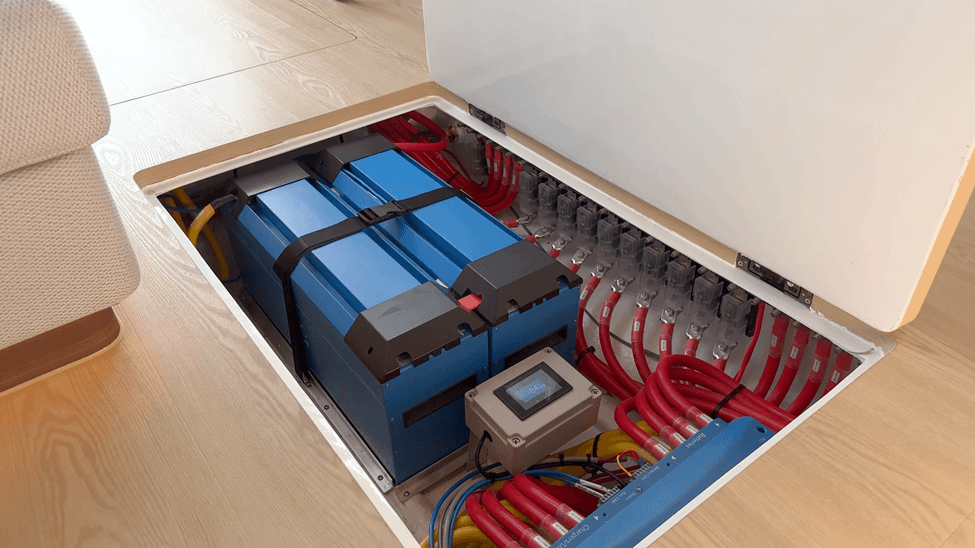
Power management: Victron Energy system, tracking all onboard batteries.
Inverters: Three inverters fitted, required due to the owner's selection of a more robust, upgraded air conditioning system.
Battery/AC runtime observed: With the three-inverter setup and upgraded battery pack, the air conditioning system ran for 48 hours on battery power alone (with batteries being topped up during that period via engine/solar charging). Captain Boomies' assessment: "That's pretty good for just inverter."
Wiring and Mechanical Detailing
Captain Boomies highlighted build-quality details in the engine room wiring: "Each of these zip ties are soft to the touch, meaning they used the twist-off method rather than cutting a nice sharp edge that you'll find as you're snaking your hand around. You're going to see this everywhere in the guts of this boat."
Exhaust manifolds: Custom, described by Captain Boomies as robust and unusually large for a boat of this size, built to meet the owner's specification.
Exhaust smell mitigation: Despite running engines with the breeze blowing toward the test area, Captain Boomies noted the custom exhaust runs reduced smell intensity relative to expectation for engines of this size, while cautioning: "Don't do what I'm doing right now. It's very bad to be hanging out near exhaust, but I want you to understand what they have achieved here."
Diesel Tender Fuel Fill
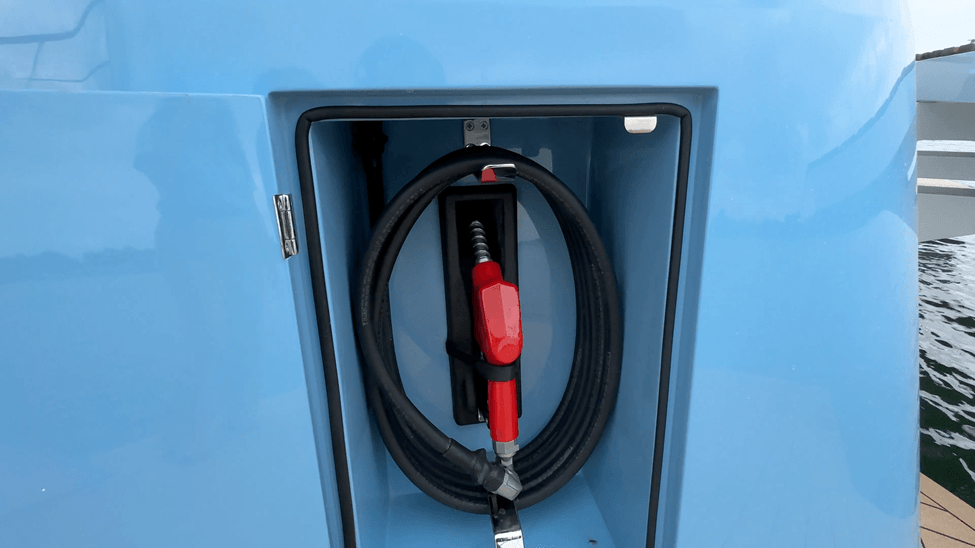
A dedicated diesel fuel fill is provided for the boat's diesel jet tender, allowing it to be fueled directly from the main tanks. Captain Boomies: "That's such a cool idea."
Shore Power
Shore power connections are located underneath each step; Captain Boomies noted their compact size ("They're so little").
Remote Docking Control
No dedicated wing station is provided at a locker Captain Boomies expected one to be behind (described instead as "just a little rag locker"). Grand Ocean's stated recommendation is to equip the boat with a third-party remote system such as DockMate, which the builder installs across most of its line.
Captain Boomies characterized this as effectively essential given the centerline helm configuration: "I literally cannot see my sides at all, and I know I've got an extra eight feet to go on either side before I get to the edges of the boat. This makes it so that I can just take a little walk and look. This can also double as my anchor up and down, so I could be anchoring all the way from up here on the fly."
Specifications
- Length overall: 72 feet
- Beam: 32 feet, 11 inches
- Empty weight: 110,231 pounds
- Test engines: twin Caterpillar C18, 1,150 horsepower each
- Fuel capacity: 1,585–1,586 gallons (stated both ways in the source)
- Freeboard height at bow: 98 inches to the waterline
Performance Numbers
- Top speed: 26 knots at wide-open throttle, 2,200 RPM
- Economical cruise: 11 knots, burning approximately 20 gallons per hour, range approximately 800 nautical miles with a 10% reserve
- Planing cruise: 18 knots, burning just over 60 gallons per hour, range 416 nautical miles with a 10% reserve
- Plane threshold: approximately 1,700 RPM
- Long-range/displacement speed: 7.2 knots, burning 7.6 gallons per hour, range 1,347 nautical miles, all with a 10% fuel reserve
Sea Trial Conditions and Dryness Assessment
Testing was conducted in six-foot seas with gusts to 35 knots. Captain Boomies noted this was an unfair test relative to the builder's stated dry-boat claims: "One of these things this boat says in their documentation is that it's a very dry boat. This is an unfair test of how dry this boat should be under more reasonable circumstances."
Despite conditions, she assessed the seaworthiness positively: "Anytime any of these waves hit, you'll notice that it's just a spray back. It's not a full wave coming. So she is doing what she's designed to do, and that is cut into the wave, let it splash off the hull, and then that splash is being lifted by the wind and blown into my face. Bravo, boat."
She distinguished this from a specific failure mode common to catamarans: "While the wind is blowing the spray back from the hull sides as it would on any boat, including monohulls, there is no sneezing with spray coming up from between the hulls and back into the windshield."
Handrails / Crew Movement Note
Captain Boomies noted a lack of handholds for moving fore/aft over long distances on deck, though she stated this was manageable for her personally: "I happen to have decent sea legs, so traveling from one spot to another is not too bad for me, but no, there's no real place to grab onto for large distances. You probably have to keep a good eye on your crew."
Overhang / Drip-Edge Design
Every overhang on the boat includes a lip (curl-over) to prevent drip runs from reaching areas meant to stay dry. Captain Boomies cited the engine room hatch specifically: "This engine room hatch, I could get in here, and it'll stay totally dry in the rain, even if I leave the hatch open because engine rooms are hot."
Lower Helm
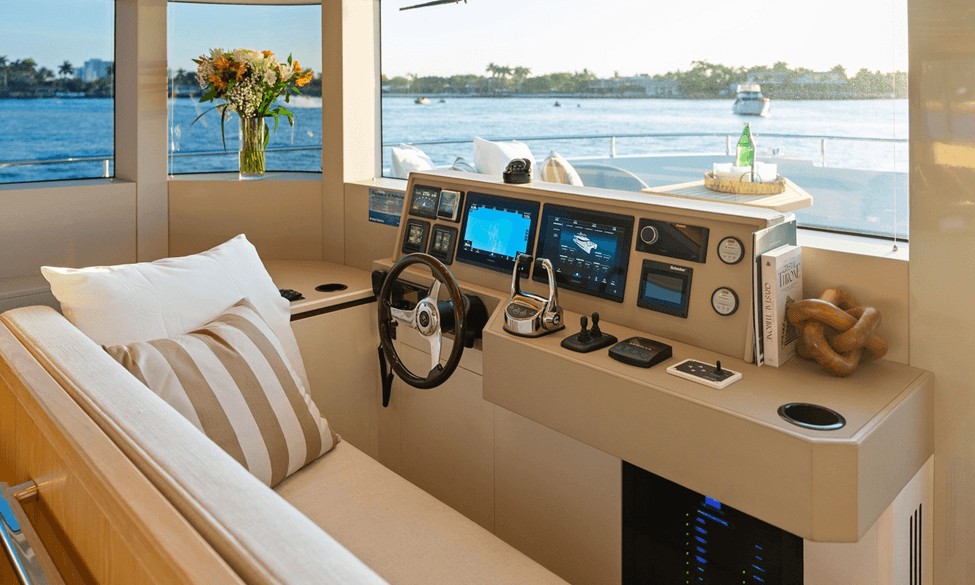
Described by Captain Boomies as: "absolutely dreamy with the skylights there, the full windows everywhere around. It's great." She noted the window placement suited her eye line for passage-making, with full visibility around the boat for traffic checking.
Hull Slap / Structural Design (Catamaran-Specific)
Captain Boomies explained the general catamaran engineering challenge: "One of the things that any designer has to think about is what happens with a wave hitting each hull differently, and a wave swiping up and smacking the centre line of the boat. For power cats in particular, it's important because flexion means less speed. You can't allow that centre line to wiggle about on you and create even more weird wave action and hull slap."
This yacht's solution: Full-beam bulkheads — described as running one side to the other as a single structure, rather than separate hull sections connected only at a bridging platform, repeated at multiple points along the boat's length. Captain Boomies' assessment of the result: "That leads to lots of rigidity, lots of structure, no flexion, so you can get the kind of speeds we were seeing. We were seeing 26 knots on here, and it's a disgusting sea state. That is wild to me."
Crew Quarters (Port Forward Hull)
A companionway just behind the helm leads to crew quarters and the guest suite on the port side. This layout includes a mate's cabin (with storage and an en suite) and a captain's cabin further aft. Captain Boomies noted she limited her inspection here out of respect for personal crew belongings present at the time of filming.
Electrical Switching Panel (Companionway, Port Side, Aft Salon)
Houses switching for the boat's 24-volt and 230-volt systems. Notably, a press-button panel conceals a manual inverter override switch, allowing manual switch-over to the generator set if the inverter fails — operable from inside the boat. Captain Boomies noted this as an improvement over typical designs: "So many boats, you have to crawl around somewhere in the engine compartment to get that done. This is much better."
Noted drawback: Backlighting on this panel is blue LED, which Captain Boomies found uncomfortable at night: "If there's one thing I don't like, it's that these backlights are blue, LED blue, and at night, that can be very uncomfortable to your eyesight. Not my favorite. Why aren't they going red?"
Battery Monitoring (Victron Energy System)
Positioned along the centerline of the boat (for weight-centering purposes and ease of cabling to management systems). At time of filming:
- Solar yield: approximately 1,000 watts
- Battery charge: 88% (with an estimated 1 day, 7 hours of remaining runtime "if everything stayed exactly the same")
- A second reading elsewhere showed 84% charge while running full air conditioning off the inverter, with partial charge contribution from solar and engines, but primarily battery-powered
Captain Boomies' assessment: "It's nice to be able to see what's happening with my batteries and how long I actually have of perfect temperature control."
Anchor / Bow Systems
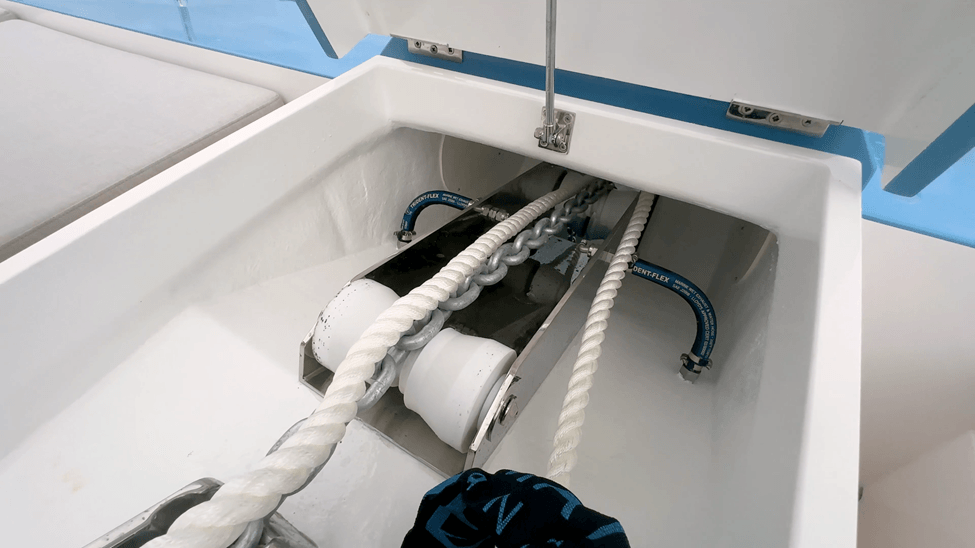
- Windlass: Lewmar, fitted with anchor wash (described as powerful, "full jets")
- Chain locker access: Located and confirmed accessible, despite other systems in this area being concealed
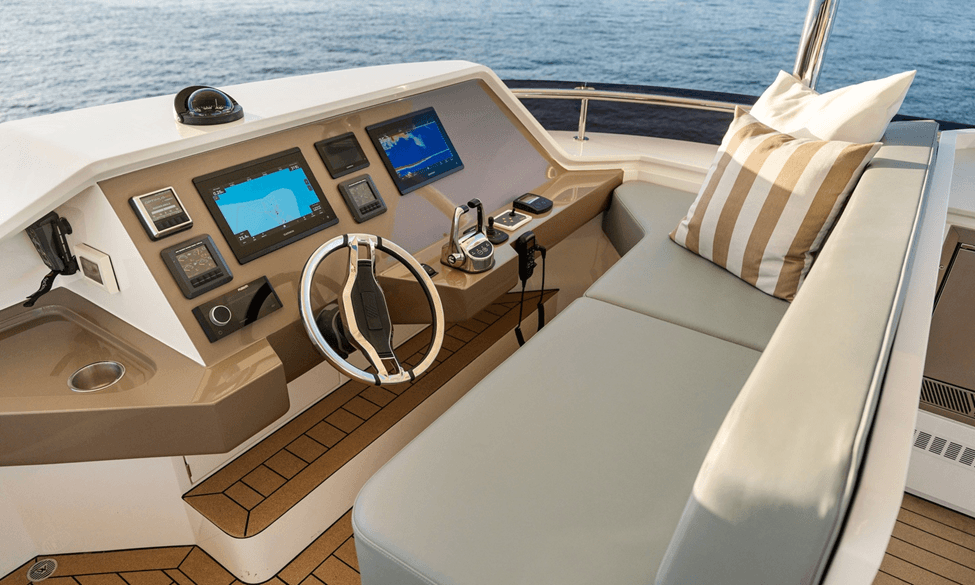
Flybridge (Master Helm)
Described by Captain Boomies as the primary driving station for most operation.
Equipment:
- Three 22-inch Garmin MFDs, plus a dedicated catamaran monitoring MFD
- Garmin trackpad control, eliminating reliance on the touchscreen
- Spotlight control
- "Empire Bus" display panel controlling ship systems (e.g., navigation lights) from a single interface
Helm chairs: Owner-selectable; the test boat's owner chose a white chair option. Captain Boomies' assessment: "They're white, they're pretty, they'll work."
Hull Construction Material
The boat is built from the keel up, including the superstructure, using infused vinylester resin — described by Captain Boomies as light and highly capable, and referenced back to her opening comparison to America's Cup-level composite construction.
Captain's Closing Performance Assessment
Following testing in what she described as extreme weather, Captain Boomies stated: "Everything they said about the hull shape being able to cut through waves was absolutely true... I understand how that translates into getting up on plane, and quickly being able to shoot this boat across the top of the water. We did 26 knots in a power cat on 72 feet, and her fuel burn wasn't that bad at that rate. You could make it to Bimini very quickly in this boat."
A companion features and layout inspection video is referenced for further detail on this vessel.
Related Boats
GranOcean W-86 (2026-)
2 x Caterpillar C32 Diesel