Access More Boat Tests
Already have an account? Login
Sea-Doo Switch Cruise 21 (2026-)
1 x 300-hp Rotax Jet Engine

Brief Summary
Sea Doo has always been known for its innovative design and engineering when it comes to its exciting PWC line up. With its Switch boats, the company takes the best of its thrilling, performance-based PWC’s and combines that with a pontoon-style platform where the result is an inventive watercraft delivering outstanding performance with multi-person roominess.
Test Results
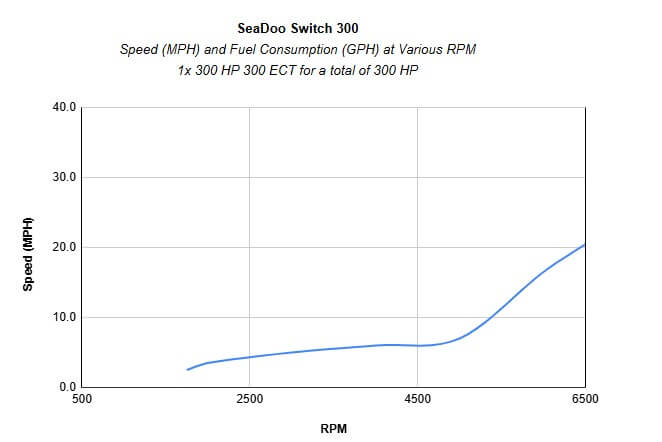
| RPM | MPH | Knots | GPH | MPG | NMPG | SM | NM | dBa |
|---|---|---|---|---|---|---|---|---|
| 1750 | 2.5 | 2.2 | N/A | N/A | N/A | N/A | N/A | 58 |
| 2000 | 3.5 | 3 | N/A | N/A | N/A | N/A | N/A | 58 |
| 3000 | 5 | 4.3 | N/A | N/A | N/A | N/A | N/A | 66 |
| 4000 | 6 | 5.2 | N/A | N/A | N/A | N/A | N/A | 74 |
| 5000 | 7 | 6.1 | N/A | N/A | N/A | N/A | N/A | 75 |
| 6000 | 16.5 | 14.3 | N/A | N/A | N/A | N/A | N/A | 79 |
| 7000 | 25 | 21.7 | N/A | N/A | N/A | N/A | N/A | 81 |
| 8000 | 39 | 33.9 | N/A | N/A | N/A | N/A | N/A | 84 |
Specifications
| Length Overall |
20' 5" 6.22 m |
|---|---|
| Beam |
7' 8" 2.34 m |
| Dry Weight |
2,675 lbs 1,213 kg |
| Tested Weight |
3,780 lbs 1,714.6 kg with 3 persons and 90% fuel capacity |
| Draft |
19" 5.79 m |
| Person Capacity | 10 |
| Fuel Capacity |
46.5 gal 176 L |
| Total Weight |
3,780 lbs 1,714.6 kg with 3 persons and 90% fuel capacity |
Acceleration Times & Conditions
| 0 to 30 | 13.0 sec |
|---|---|
| Load | Persons & Gear: 740 lbs (336 kg); Fuel: 240 lbs (109 kg) |
| Climate | 79°; 70% humidity; wind: <10; wave: flat; salt |
Engine Options
| Tested Engine |
Rotax 1630 ACE 300-hp ECT |
|---|---|
| Std. Power |
Rotax 1630 ACE 230-hp ECT |
| Opt. Power |
Rotax 1630 ACE 300-hp ECT |
SEA DOO SWITCH CRUISE 21
PWC Meets Pontoon Boat
By Capt. Ken Kreisler
Vessel Inspection
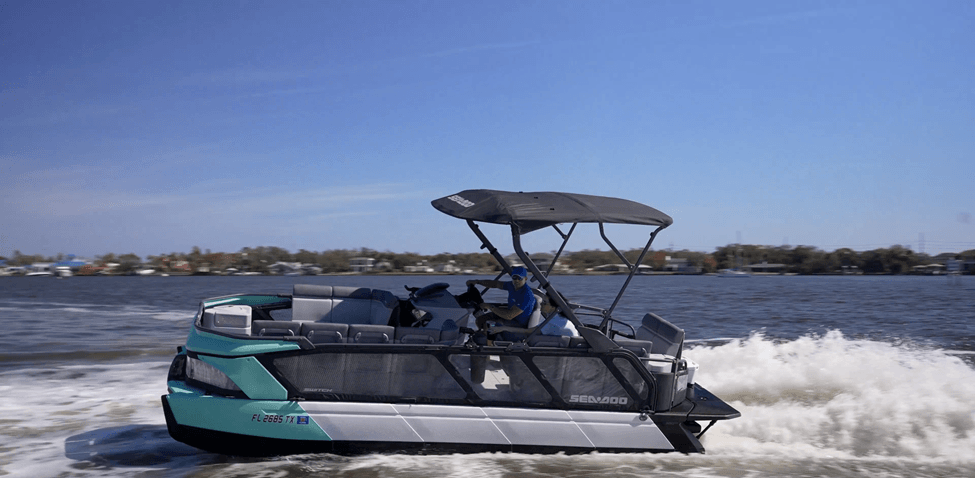
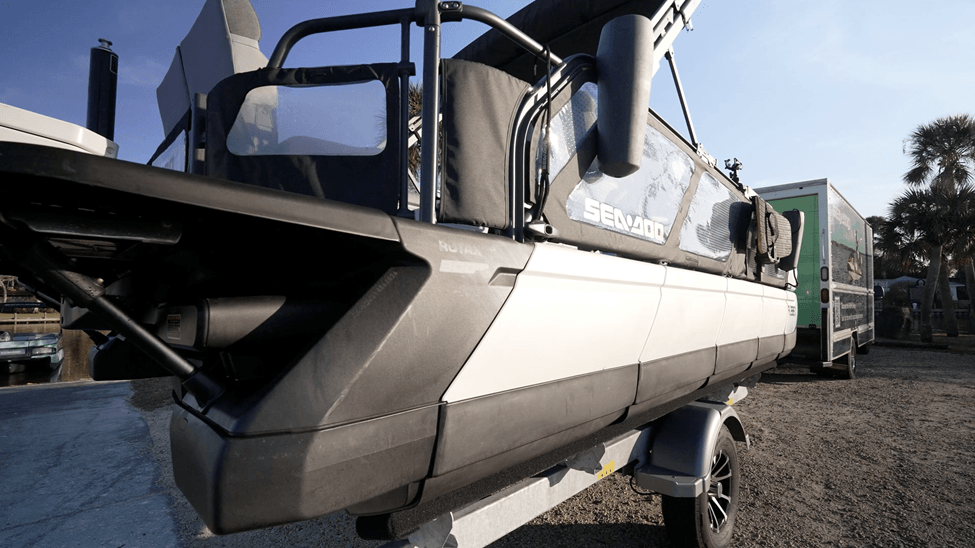
As with every watercraft it designs and engineers, Sea Doo made sure its lineup of Switch PWC’s meets every standard of quality and safety the company has built its foundation on. With its pontoon-like platform, the Switch takes on a different profile and ability to entertain several guests.
A Word About Performance
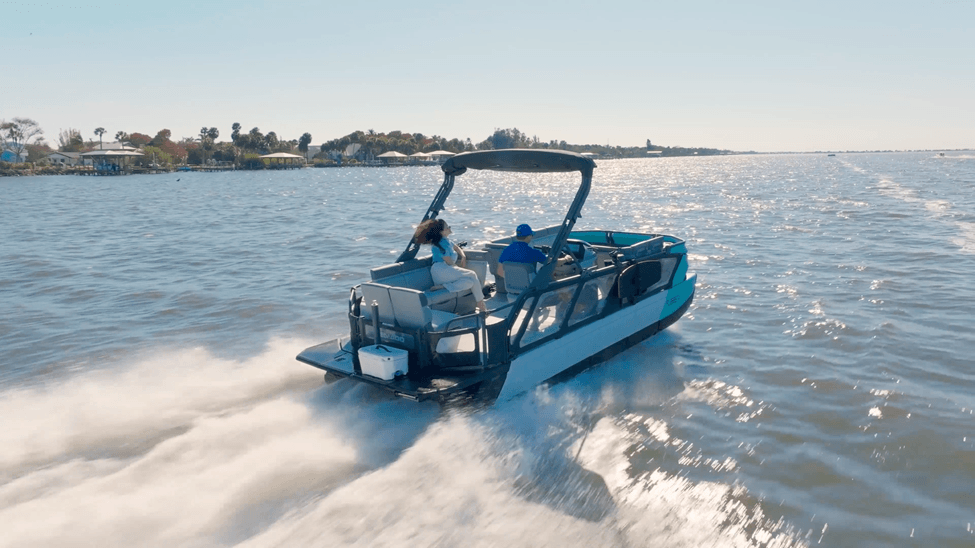
The DNA of Sea Doo runs deep into providing exciting and outstanding performance across its entire model lineup. With the Switch models, available in 17-, 19- and our 20’5” test boat, that same exhilaration is a major part of the experience once you take the wheel and set out for a day of fun on the water. Whether tubing, skiing, or just zipping along, a memorable time out for all is guaranteed. Our test Switch was powered by a 300-hp Rotax jet engine and the day saw air temperatures at 79° with 70% relative humidity. Wind was mild at a gentle 5 knots.
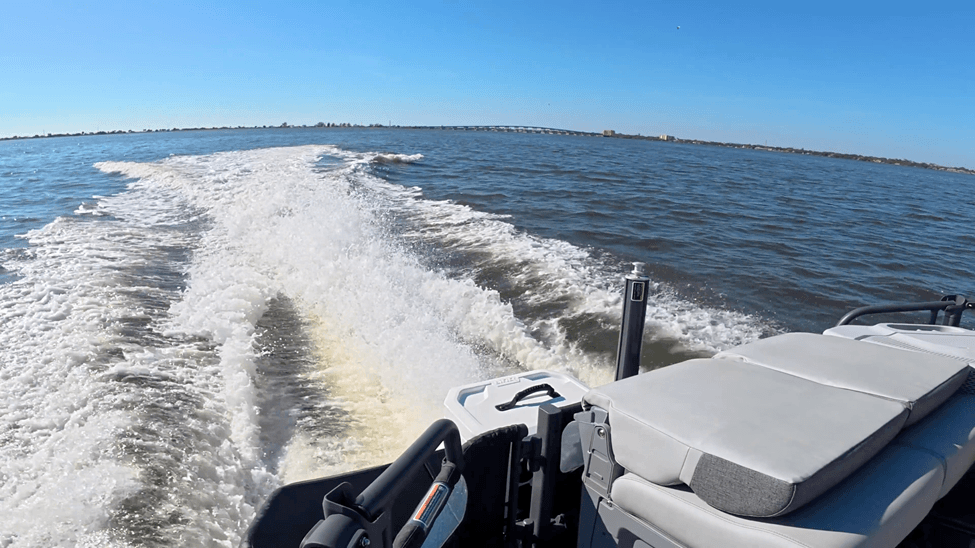
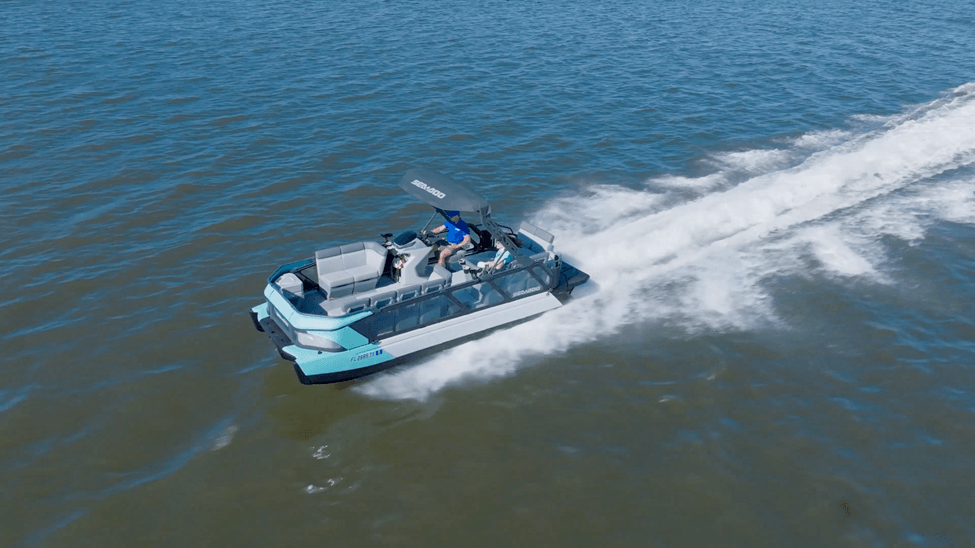
Using the appropriate controls on the handlebars, we hit a WOT speed of 39 mph at 8000 rpm. During hole shots, we noted 0-10 mph in 2.5 seconds, 0-20 mph in 8.5 seconds, and 30 mph in 30 seconds. Tight turns at speed were adrenaline-charged and under control as were straight speed runs. Past PWC experience is beneficial but with its short learning curve, confidence in all operations of the Sea Doo Switch will quickly find any operator enjoying the thrills and on-water activities to the max.
Summary
Exciting on-water experiences, from in-your-face activities, including tubing and skiing, to a cruising day out aboard a unique, sensational PWC by way of a pontoon platform, is all available at the touch of a button on the motorcycle-like handlebars. With deck and seating space for plenty of guests and participants, the Sea Doo Switch offers opportunities like no other PWC can. Rugged construction, sparkling performance powered by a 300-hp Rotax jet engine and supplying nimble and controlled operations, and with accessories such as a 5.3 gallon semi-rigid cooler, adjustable table, aft floating mat holder, double Bimini top sleeve, and rod holders, among many others, will make any Sea Doo Switch a personal statement of ownership.
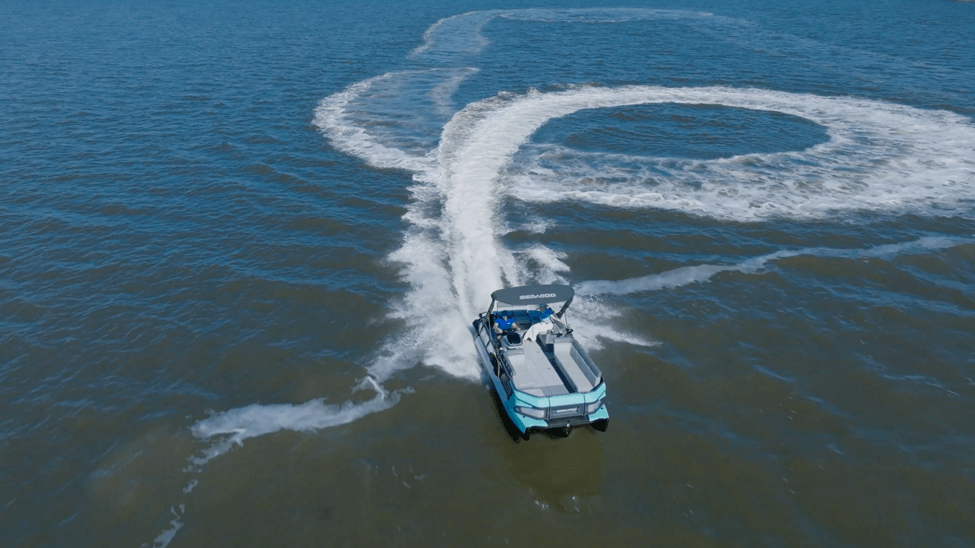
Remember, life is better on a boat…especially if it’s on a Sea Doo Switch!
About the Reporting Captains
Experts and Boat Owners
What has set BoatTEST apart from the many video-makers currently on the Internet and Social Media is the fact that for 26 years, only USCG-Licensed captains and experienced boat owners have tested and written our reports and made our videos. We believe that to provide boat owners the information they deserve, only other boat owners – who know the challenges of ownership -- can accurately report on it. It is that level of expertise and ownership experience that goes into every video and Captain’s Report that we publish. Because we know what it is like owning and operating a boat, we can pass-on the information that prospective boat buyers need to know.
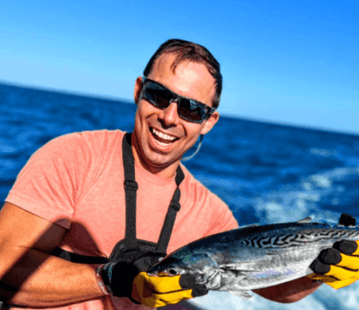
Capt. Trip Smith holds a USCG 100-Ton license and has 22 years of experience navigating various types of boats, such as center consoles, runabouts, wake boats, and cruisers. He now owns a 22’ C-Dory. At 36 years old, he is living the dream of escaping the typical 9 to 5 job and has become a popular boat adventure video creator with over 75,000 YouTube subscribers. Capt. Trip Smith's expertise is evident in his 434 videos, where he shares his experiences spearfishing, collecting scallops, cooking fresh grouper on his boat’s grill, and planning his next adventure. Capt. Trip has an impressive background as a firefighter, outboard engine mechanic, boat rigger, fiberglass repair and restoration expert, and kayak safety teacher.
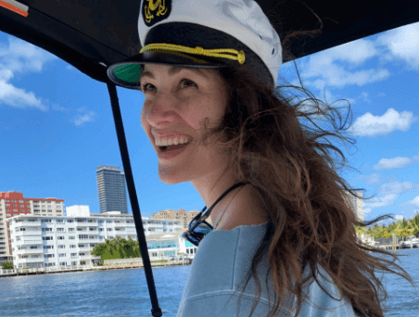
Captain Boomies (aka Capt. Kate) holds a 200- ton USCG license and worked on superyachts for 20 years, captaining vessels up to 150’ before retiring several years ago. She now is a delivery skipper of all manner of vessels. When not testing boats for BoatTEST, she often can be found taking new yachts off their cargo ships in the port of Baltimore, getting them operational, then delivering them to dealerships. Unbeknownst to dozens of boat owners in the Chesapeake Bay, Capt. Boomies was actually the first skipper of their boats, because she actually delivered them to the dealerships. She is also active in boat instruction and making videos for her personal website. Capt. Boomies believes boating is fun,, and people doing it should not take it too seriously, she always inserts a bit of humor and theatricality into many of the tests she does. But don’t be fooled by that, Capt. Boomies has wrong more saltwater out of their socks than most people every sail over.
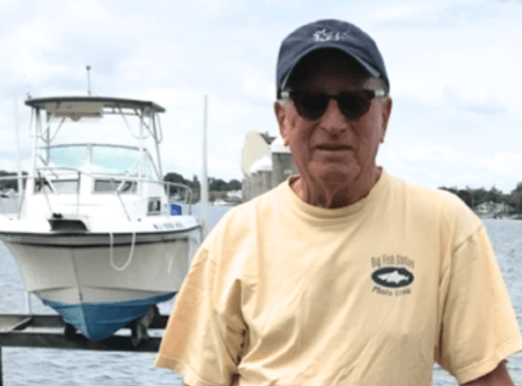
Capt. Ken Kreisler is a well-known figure in the marine industry, with extensive experience testing boats for major boating magazines. He has held USCG 100-Ton License for 40 years and has served as a delivery and charter fishboat captain, project manager for two small passenger ferry catamarans, making sure every details met USCG build standards. Capt. Ken is an accomplished writer, having received several BWI awards and the John Burroughs Association certificate of commendation for his children's book, "NATURE SPY," published by Macmillan. He resides with his family on the Shrewsbury River in Monmouth Beach, NJ, where he enjoys boating on his 24-foot Grady White Explorer.
Performance Test Video Transcript
Overview
The 2026 Sea-Doo Switch 21 is a pontoon-style vessel powered by a 300-horsepower Rotax jet engine. The review's opening framing: "If you've been thinking about buying a pontoon boat, but you didn't want to go slow motion around the lake like your grandfather... there's no boat on the planet like her."
Captain Trip's introductory characterization: "This is certainly a different animal. You can see I have handlebars instead of a wheel, and we're running somewhat of a pontoon platform."
Construction
The hull is made of a recently developed injection-molded composite material, formed into a tri-hull configuration. Captain Boomies' assessment: "She's called a pontoon boat, but she's really quite different... She's actually made of a recently developed composite material that has been injection molded and made into a tri-hull boat that drives more like a personal watercraft than a floating raft."
Propulsion
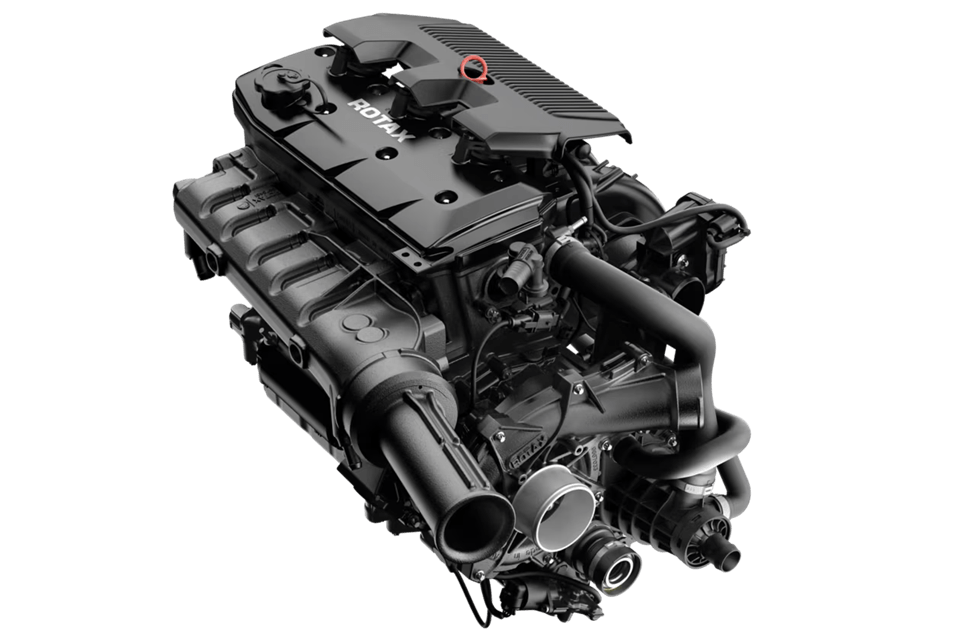
Powered by a single inboard Rotax waterjet engine — the same engine platform, per the reviewers, used by the military for drone reconnaissance flights. This is not an outboard-powered vessel.
Engine specification: Supercharged 1.6-liter, four-stroke, 300 horsepower — new for 2026, delivering 30% more power than the previous model.
Helm / Controls
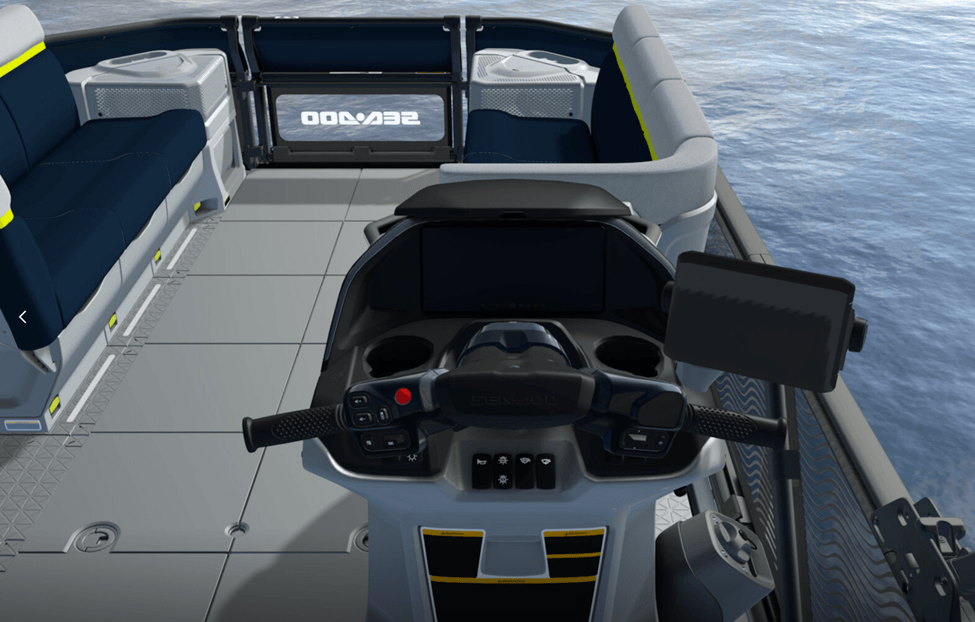
Described as substantially different from a traditional pontoon boat helm, using handlebars rather than a wheel. Captain Trip's assessment of the ergonomics: "It's going to make this boat feel very sporty, but I think most importantly, it's going to be easy to maneuver this boat in and out of tight spaces."
Handlebar-integrated controls: Though the primary display is a touchscreen, physical controls are also mounted on the handlebars. Captain Trip's stated safety rationale: "When underway, I can keep my hands on the handlebars and safely operate the boat and not be distracted by messing with the screen up there. That's a pretty good safety feature as well."
Display: 10.25-inch customizable Garmin screen, with digital readouts for RPM, speed, fuel, battery, and a depth sounder. Pairs with BRP's free Bluetooth Go app, which can display a Navionics GPS moving map.
Intake Debris Management (IDF System)
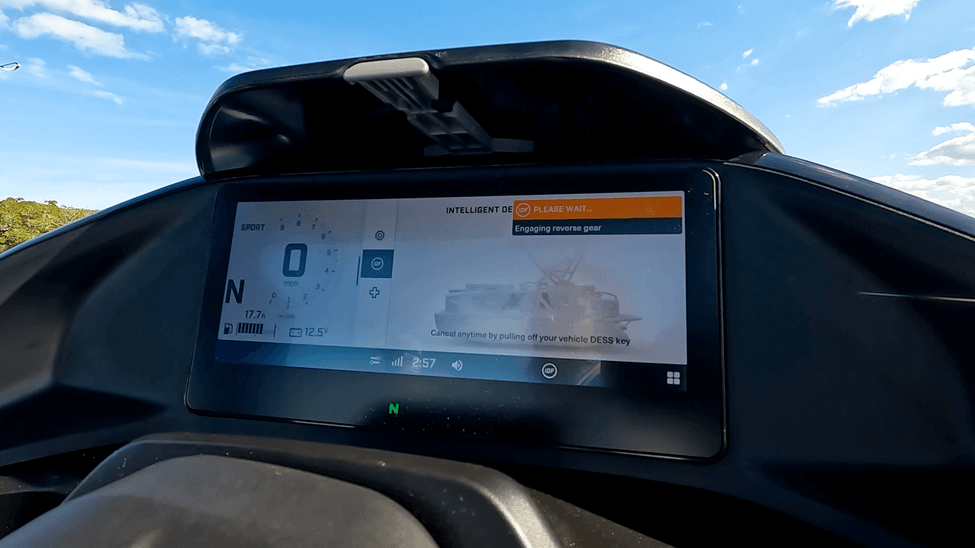
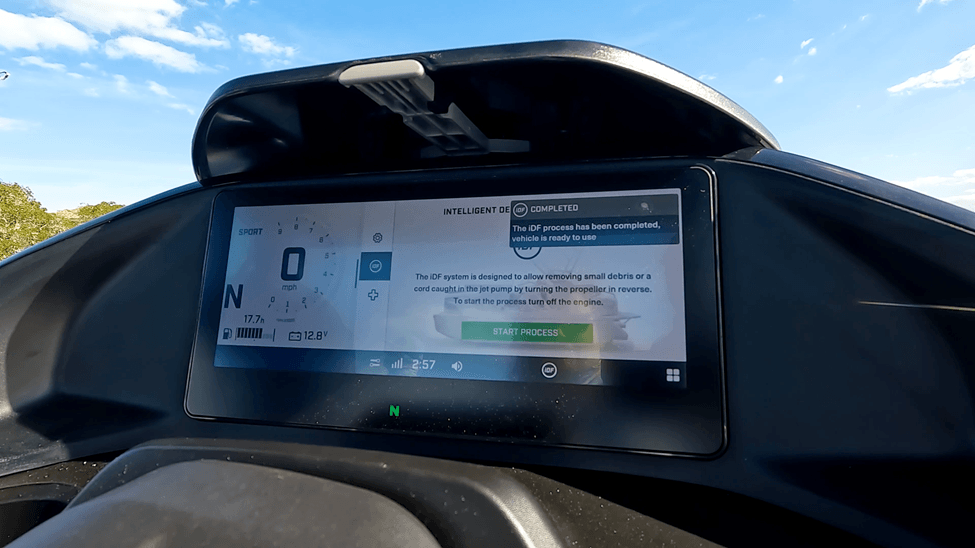
Because the boat is jet-powered, its intake can become clogged with debris such as seagrass. Sea-Doo's solution is called IDF (Intelligent Debris Free pump system).
Operation, as demonstrated by Captain Trip: Turn on the system; it beeps when ready, then the engine starts. During this process, the system runs distinctly differently than normal operation — pushing water in reverse to blast out any seagrass ingested — after which the subsequent engine start operates normally.
Engine / Maintenance Access
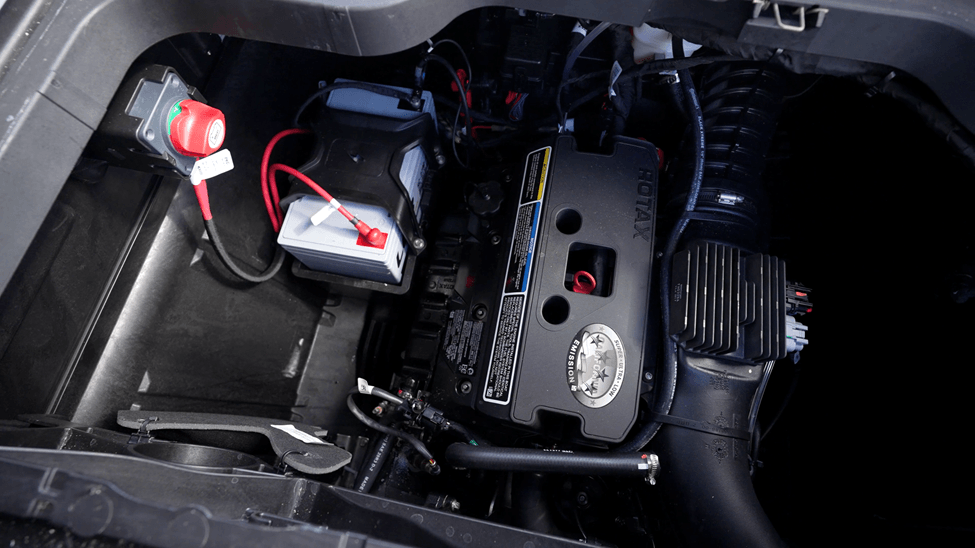
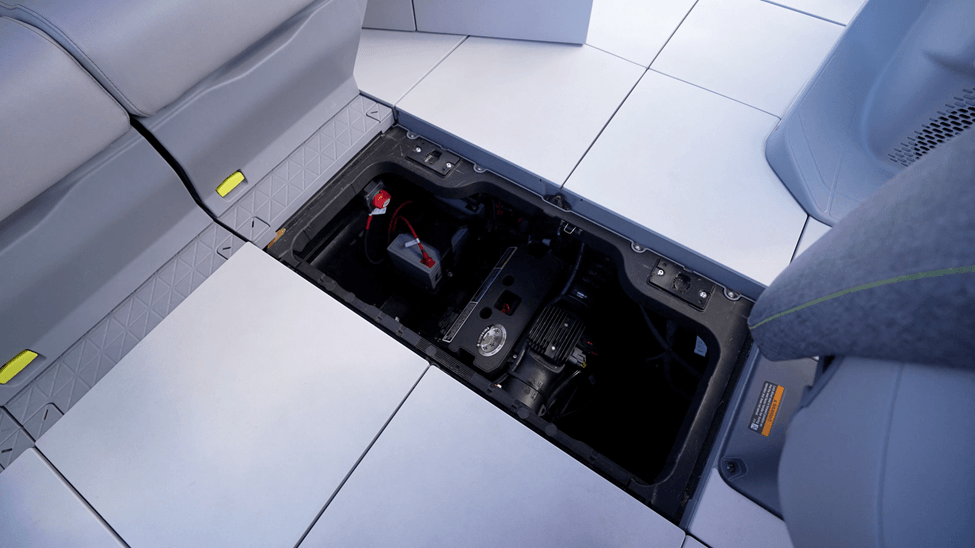
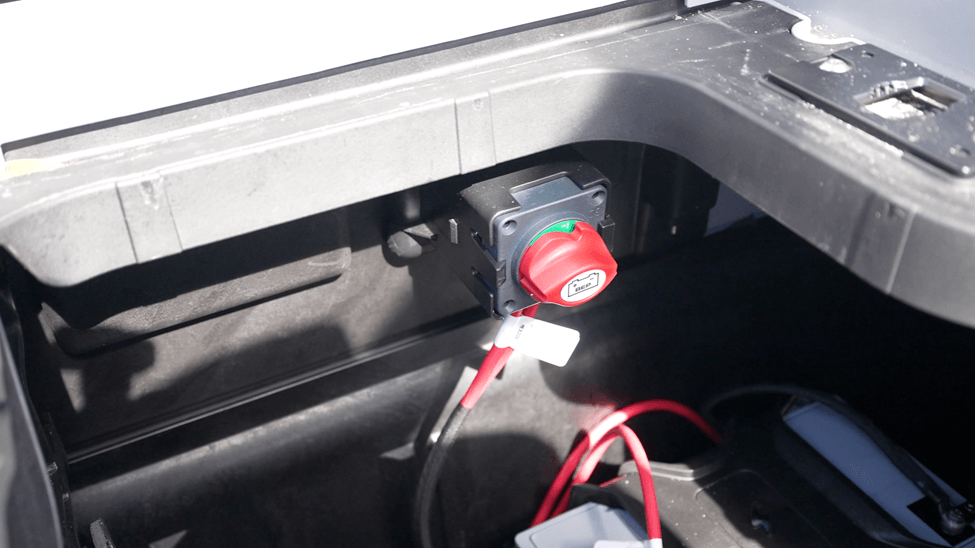
Located midships beneath a deck hatch: the 300 hp Rotax engine, battery, and battery switch — all described as easily accessible for maintenance. Other deck hatches require somewhat more effort to open.
Frame material: Polytech — Captain Trip noted this material's durability: "There's nothing on this boat that is going to rot, so it's going to last quite a while."
Oil changes: Performed by pumping out old oil and replacing with new; the oil filter is also easily accessible, avoiding the need to crawl into the bilge.
Specifications
- Length overall: 20 feet, 5 inches
- Beam: 7 feet, 8 inches
- Empty weight: 2,675 pounds
- Test weight: 3,780 pounds, with 90% of the 46-gallon fuel capacity aboard and three passengers
Performance Numbers
- Wide-open throttle speed: 39 mph at 8,000 RPM
- Hole shot 0–10 mph: 2.5 seconds
- 0–20 mph: 8.5 seconds
- 0–30 mph: 13 seconds
Captain Trip's reaction to these numbers relative to his prior expectations of the category: "I'm having to readjust how I think on this because a pontoon boat, in my mind, is just a slow putter. This is not that. This is everything a personal watercraft is, which is ridiculous, ripping fun."
Handling / Turning
During on-water testing, Captain Trip demonstrated a tight turn, remarking: "That is a tight, ridiculous turn." He characterized overall handling as smooth: "Running the boat is smooth. Everything's comfortable. We're having a great time. You can put anyone behind the helm of this, and they're going to have fun, and they're going to be able to control everything on the boat with all the buttons right here on the handlebars. Sea-Doo's really just made it easy for first-time boaters. And if you're used to a PWC, you can run this boat all day long."
Onboard Features (Underway)
- Cruise control: Fitted, allowing the operator to remove a hand from the throttle while remaining on the handlebar
- Navigation: Controllable directly from the handlebar-adjacent screen, including zoom
- Audio: Controllable from the same interface
- Drive modes: Sport, Normal, and Eco (testing was conducted in Sport mode)
Stopping System — IBR (Intelligent Brake and Reverse)
Captain Boomies characterized this capability as unique in the category: "This boat can do something that virtually no other pontoon boat can do. From a high speed, she can come to a fast stop."
Mechanism: Squeezing the left-hand lever drops a bucket behind the water jet, redirecting water flow forward to slow and then stop the boat. Captain Boomies contrasted this with outboard-powered boats: "You simply can't jam an outboard engine into reverse to come to a quick stop, but you can on a Switch because of its water jet drive."
Safety consideration: Due to the stopping force, passenger placement matters to avoid throwing guests forward. Sea-Doo addresses this by placing an onboard diagram showing proper loading for safe operation.
Hull Design vs. Conventional Pontoons
Captain Trip explained why the Switch handles differently from a conventional twin-toon: "A conventional twin-toon can only mush along because its two running surfaces are round, not flat. They are designed to be stable, and they are. That's why they can't lean into a turn like the Switch. All powerboats need flat-ish surfaces to run on in order to be efficient and get on plane quickly."
The Switch's tri-hull design: Four V-shaped flat surfaces, which Captain Trip stated enable the boat to "quickly plane, go fast, then crank and bank."
Weight distribution / leveling: On a conventional pontoon boat, uneven weight causes the affected toon to sink deeper into the water. The Switch instead uses a pair of trim tabs to maintain level running regardless of weight distribution.
Captain Boomies' summary characterization: "It's more like a blend, of course, between a Sea-Doo or a PWC and a pontoon boat. So it makes it fun, but it's also very usable and user-friendly for your average family."
Hull Material (Polytech)
Each hull section is made of Polytech and can be individually replaced. Captain Trip noted this as lightweight and easily repairable.
Material composition, per Captain Boomies: BRP's proprietary mixture of polypropylene with long-strand glass fibers, constituting 30% of the composite by weight. The color runs consistently through the material (not just surface-applied). The fiberglass content provides structural strength; the polypropylene content makes the material moldable, saving weight and cost.
Docking / Close-Quarters Maneuvering
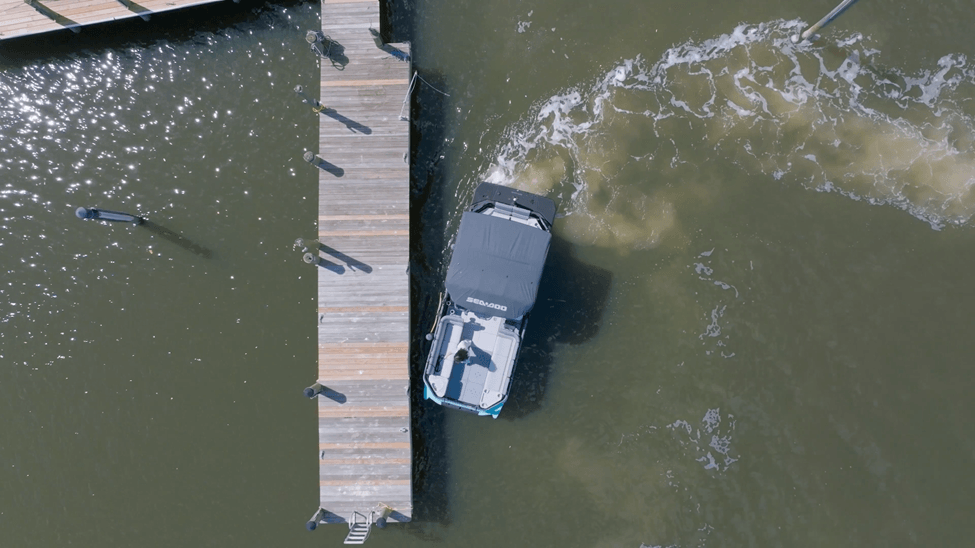
Captain Trip's assessment based on hands-on operation: "Close quarters, you do have a lot of control. But to learn that control takes a little bit of adjustment time, maybe, I don't know, 10 minutes, and I pretty much had it down. You have the handlebars, and you have reverse and forward, and they all work together, so you can spin the boat on a dime and put it right where you want it. So I think an average owner, it's going to come natural to them and just be very intuitive."
He also compared this to a conventional single-outboard pontoon boat: "The maneuverability of this boat compared to your average pontoon boat with a single outboard... that's going to be a little trickier. But this, you really have a good handle on the handling of the boat."
Captain Boomies attributed this handling characteristic to the boat's underlying design lineage: "The very center line is a personal watercraft, and Sea-Doo makes really fabulous personal watercrafts."
Sponson / Center Hull Design
Captain Boomies described the sponsons as sharp, vertical-blade-shaped, cutting through the water rather than pushing waves upward (which produces excessive splash in conventional designs). A 25-degree cut on the outboard side of the sponsons and on the center hull is intended to prevent pounding/chopping typically associated with round-bottomed pontoon boats.
Additional note (trailering): Because the boat is jet-powered (rather than outboard-powered), there is no need to trim an outboard up before trailering.
Closing Assessment
Captain Boomies: "We hope you enjoyed this performance review of the Sea-Doo Switch 300 as much as we did. This was a blast. It was fun."
Following the formal review, additional unscripted remarks were captured: "The strangest part of this whole thing was treating this boat unlike any boat ever. We treated it rough, right? And it handled it. I got to say
Features Inspection Video Transcript
Market Background
The Sea-Doo Switch was announced to the public in August 2021. Per the review, orders arrived so quickly that the entire 2022 production run sold out within months, described as "the hottest boat introduction on record." The following year, Sea-Doo sold over 5,000 units and became the third-largest-selling US boat brand in the pontoon boat category. At times, the 400 employees at Sea-Doo's Wisconsin plant could not keep pace with demand.
Design Philosophy
Captain Boomies' framing: "This boat is your canvas. Use your imagination... They've designed this boat to be completely modular so that you can add and subtract whatever features you want when you're out boating. It also means that as you change and grow throughout the lifetime of your boat or yourself, you can add and subtract fishing gear, seats, less seats. It's whatever you want."
Five Design Criteria (Sea-Doo's Stated Development Goals)
1. Safe, stable platform that remains fun to drive. The review states that a water jet is the only safe propulsion choice when children are swimming near the boat. The tri-hull design, with a deeper center hull, allows the boat to "crank and bank her like a personal watercraft," which the review states is what makes her fun to drive.
2. Affordability. The review notes that conventional pontoon boats, once a low-cost family boating option, now often exceed $100,000. Because Switch hulls, decks, and structures are injection-molded Polytech modules, Sea-Doo can build efficiently. The smallest Switch starts at $24,799.
3. Versatility across use cases. Sea-Doo engineers designed the platform to perform well at entertaining, water sports, cruising, and fishing. Example: the Switch Fish variant can be optioned with fish finders, trolling motors and stowage for them, a lockable rod rack, swiveling pedestal seats, and rail rod holders — then converted back to a cruising configuration when fishing is done.
4. Structural strength comparable to fiberglass boats. Because Polytech consists of 30% long-strand glass fiber by weight, and Sea-Doo's engineers designed robust stringers, frames, ribs, and knees, the review states Switch boats are built tough — and repairs are compared to "taking your car to a body shop."
5. Modular, expandable design ("like a giant Lego boat"). Because so many Switch boats are on the water, economies of scale allow Sea-Doo to offer over 130 options for the boat.
Modular Deck / Furniture System
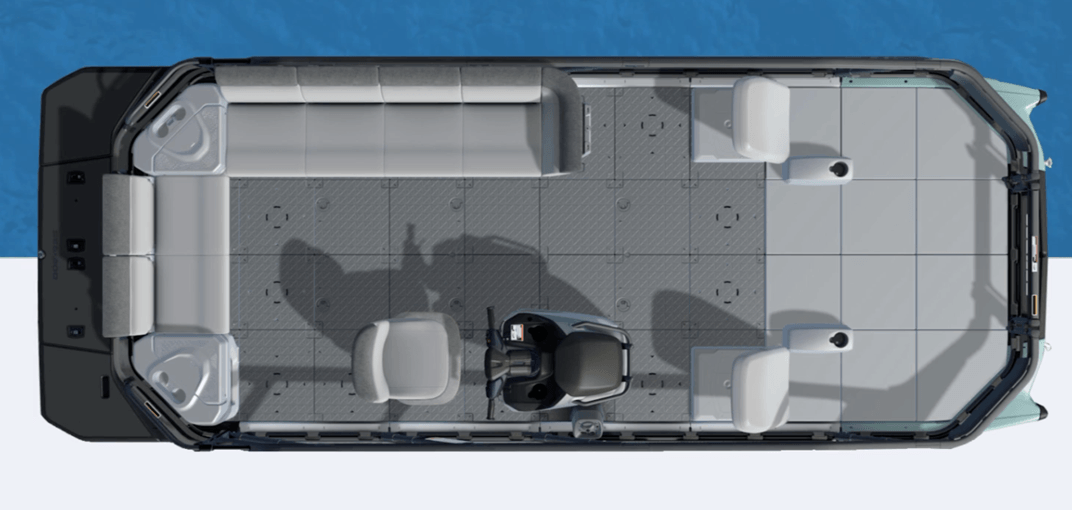
The deck is designed to accept furniture and accessories that lock in via a lever mechanism. Reconfiguration is demonstrated as a simple process: locate a bright yellow latch, pull the accessory out, then lock a replacement in.
Demonstrated reconfiguration examples:
- Repositioning a seat to create a spotter position for towing water sports
- Fully opening the deck layout to create what Captain Boomies called "a dance floor": "So now I've opened this all up. It's a dance floor. Pow. Get me a DJ."
LinQ Accessory System
LinQ (Locked-in Quarter-turn) is part of the broader Sea-Doo product family (also used on ATVs and personal watercraft), allowing tool-free attachment and removal of accessories.
Examples demonstrated:
- Relocatable cup holders — Captain Boomies: "I particularly like the cup holders that I can relocate anywhere that I want them to be."
- Larger accessories such as coolers, which lock securely: "Voila, that's not going anywhere."
Structural note: The rail that supports LinQ-mounted accessories is described as an integral part of the boat's overall structure, itself serving as a feature since items can be added or removed along it.
Swim Platform
Given expected time in the water (towing or swimming), the swim platform is highlighted as a key feature. LinQ clip points are present here as well, allowing mounting of accessories such as a cooler.
Additional features:
- Telescopic swim ladder, concealed beneath the platform
- Grab handles for boarding assistance
- Fold-down seats: with a lever lift, these flip into an upright position facing aft at the swim platform — useful, per the review, when anchored at a sandbar
- Storage beneath these seats for ski ropes and other gear
Audio System
- Large JL Audio speaker unit on the port side, with a matching unit at the starboard bow, linked together
- Four 6.5-inch speakers with Bluetooth LED lighting
- Two amplifiers providing 100 watts of power
- 10-inch subwoofer
Anchor / Ground Tackle (Optional)
The review notes this as an uncommon feature in the category: "There is one important thing that every boat should have but virtually no conventional pontoon boat is equipped with: an anchor." The Switch offers an optional dedicated bow locker with a ground tackle accessory package, including a lightweight Danforth-style anchor suited to carrying ashore for beach anchoring. Captain Boomies' recommendation: "I'd recommend that you choose this optional package."
Additional LinQ Accessories Demonstrated
- A slot-in portable cooler, cited by Captain Boomies as "one of my absolute favorites"
- Relocatable cup holder (previously noted)
Attachment point marking: All LinQ/attachment points are marked in bright yellow for easy identification — demonstrated by using these points to lower/reconfigure a deck section, concluding successfully ("Success! Give me five.").
Weather Protection Options
- Extended bimini top: Provides UV and rain protection
- Cruising canvas with isinglass surround: Converts the Switch into what the review calls "a three-season boat"
- Ready-made screens: Available for buggy environments
Additional Accessories Catalog
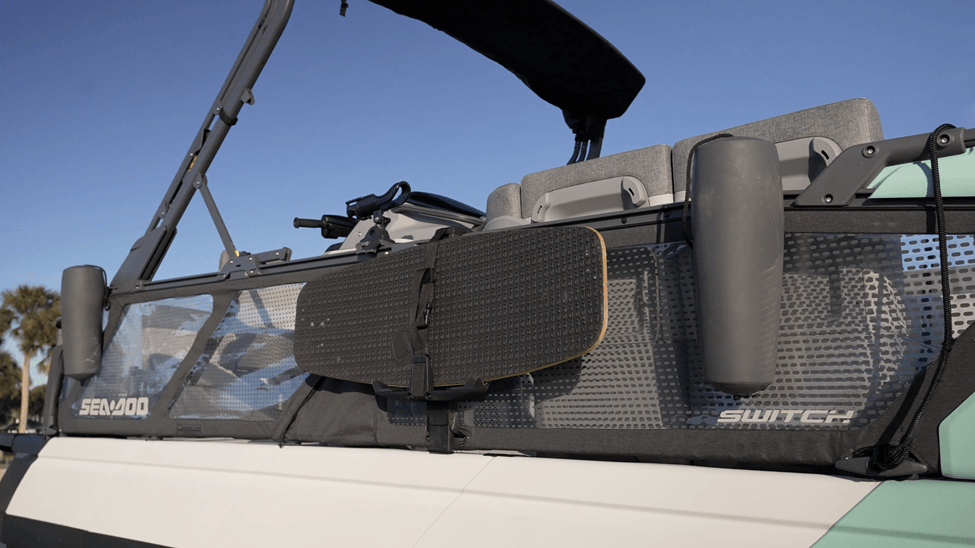
Per the review, Sea-Doo offers: paddles, coolers, towels, storage boxes in multiple sizes, various bags, adjustable-height fenders (with dedicated stowage), a specialized wakeboard holder mounted on the boat's side, and under-deck storage for other accessories.
Beyond the boat itself: Sea-Doo also offers a modular dock accessory for the Switch, allowing owners to clip in seats and audio equipment dockside.
Closing
Captain Boomies: "I had a lot of fun today switching it up on the Sea-Doo Switch."
A companion performance video is referenced, covering the Switch Cruiser Limited 21 and its 300-horsepower Rotax waterjet engine performance.
Related Boats
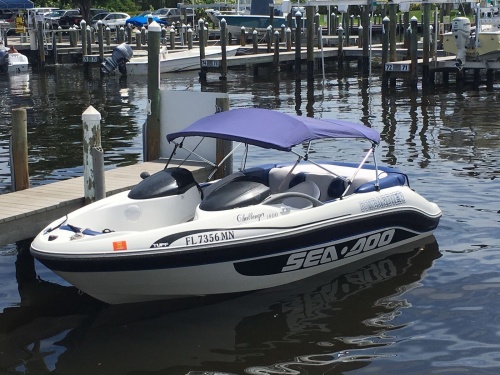
Sea-Doo Challenger 1800
2 x 110-hp Bombardier Rotax
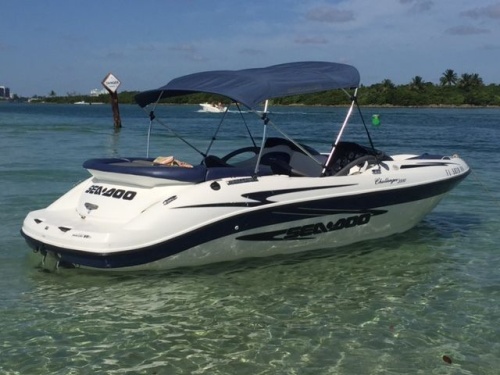
Sea-Doo Challenger 2000
1 x 240-hp Mercury M2 jetdrive
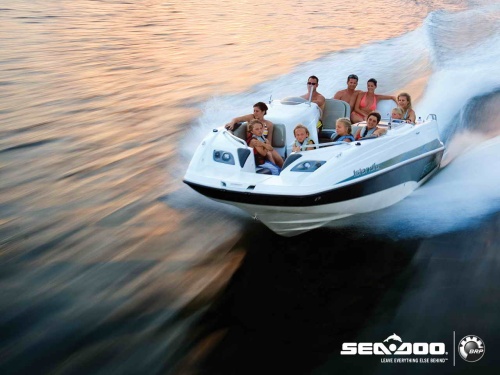
Sea-Doo Islandia
1 x 240-hp Mercury M2 EFI Jetdrive
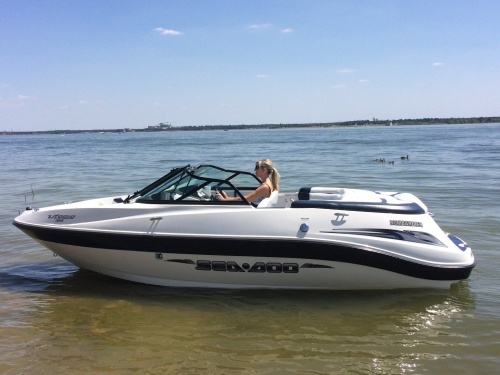
Sea-Doo Utopia 185
1 x 200-hp Mercury M2 Optimax jetdrive