Overview
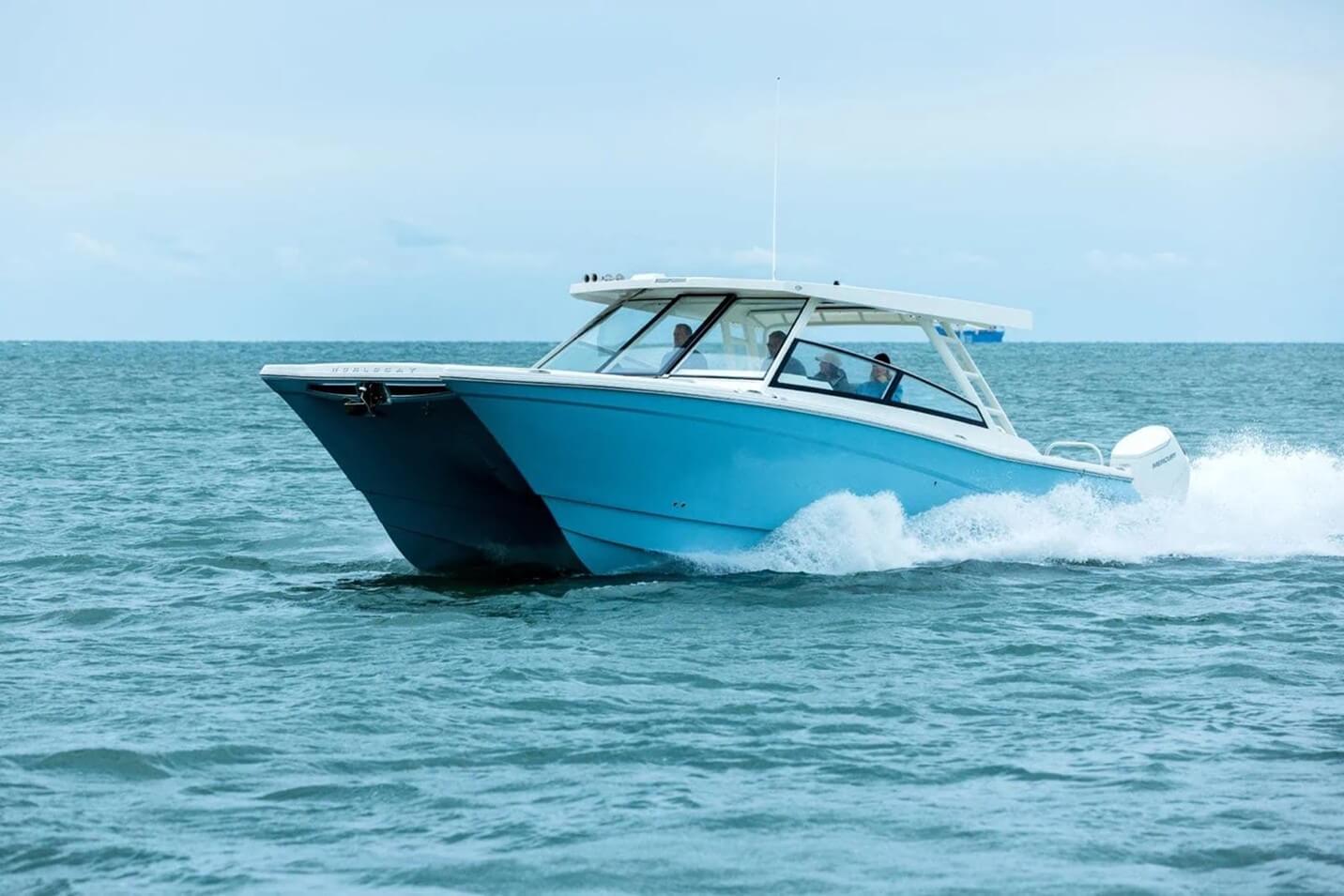
Captain Shelly's framing: "WorldCat claims its new 400 DCX Island has best-in-class range. So we're going to test her out and see if it's as great as they say, and if so, then with what engines." She noted WorldCat's additional claims that the dual console is "a world-class fishing platform, an entertaining venue ready for big fish or a sandbar party."
Transom / Swim Ladder
Captain Shelly, describing herself as an avid diver who dives off a WorldCat regularly, named this her favorite feature: "Every WorldCat comes with a substantial ladder... this feature, when you're climbing back on board still laden with your tanks and all of your catch for the day, this makes such a huge difference." The ladder is nestled between the twin engines.
Engine options: The test boat carried optional Mercury 600 horsepower engines. Standard power is twin Yamaha 450s, with several other options available.
Transom workspace: Approximately 12 feet of working space, 32 inches at its narrowest and 56 inches at its widest (up to the ladder). Both motors are easily accessible, with a freshwater washdown shower also located here.
Cockpit
Beam: Notably wide, providing a large cockpit space.
Convertible aft seat: Currently forward-facing; a lever releases it to slide fully aft, providing a seat facing the water/action behind the boat.
Sole storage: Two very large storage compartments for fenders, shore power cords, etc. A boarding gate is located to port, with battery switches below. Additional storage is located under the combing pad to starboard.
Additional cockpit hardware: High gunwales, rod holders, and cup holders in strategic locations.
Starboard Storage Compartment — Summer Kitchen
Lifting the lid reveals dedicated storage for cutting boards and paper towels, cup holders, and a fresh water sink. A second lid reveals a Kenyon electric grill, with additional storage and an extra refrigerator below.
Port Storage Compartment
Insulated fish box (also usable for ice and drinks) and a livewell. Captain Shelly noted the finish quality: "I like how the underneath side of all of the hatches are nicely finished, and they're resin-infused." All the way to port: a cup holder/rod holder combo (also present on the other side) and sturdy pop-up cleats.
Main Seating Configuration
With the aft seat returned to its forward position, Captain Shelly counted the total seating capacity: "There are 16 possible comfortable seating positions for people in this configuration." She noted the summer kitchen and livewells can be swapped for additional seating if preferred, but stated a personal preference: "I kinda like this setup a little bit better."
Starboard seating: Additional seating with cup holders and a USB charging port. A refrigerator (the boat's main dedicated fridge) is located below, with a large storage compartment underneath.
Port L-shaped seating: Includes one of three tables set up, with integrated cup holders and a non-slip pad. Additional cup holders fore and aft, and a cubby underneath for small items.
Seat Redesign (2025 Model Year)
Captain Shelly relayed information from WorldCat regarding a prior configuration: "This actually used to be a C-shaped seating configuration, and like the aft seat, this backrest moved forward and aft as well, but it was much lower seating. So when you were underway and wanted to be facing forward, you were basically just staring at the dash. So in the 2025 model, they've lifted it up so that when you're in this seat — and it's a comfy seat, even though you're not the operator — you've still got great visibility up and over the dash, and you can get that breeze moving over to the helm."
Audio: A subwoofer is located below, with speakers throughout — Captain Shelly noted the boat has "a great sound system."
Helm Seating
Bolstered helm chair with flip-down armrests and a raised, angled footrest, which Captain Shelly specifically noted liking.
Helm Controls
- VHF radio, all the way to starboard
- Digital throttle controls
- Joystick piloting for outboards
- Air conditioning — one vent at the helm, two more at the companion seat, allowing cooling while underway if it gets too warm
Power System — Generator-Free Design
Captain Shelly highlighted this feature: "A cool feature about this model and a couple of other WorldCat models is they've actually turned the generator into an option [rather than] standard. The air conditioning, the grill, all of your kind of house items runs off of a big lithium battery bank." She relayed WorldCat's estimate for battery duration: "Depending on your usage, you're gonna get at least six to eight hours, especially if you put in some time on the motors [to recharge]."
Helm Electronics (Detailed)
- Two 16-inch Garmin displays
- Center Mercury display
- Retained physical push buttons across the top (illuminated when active) — Captain Shelly's assessment: "I think this is a really aesthetically pleasing helm station."
- Four cup holders in the captain's area
- A notable feature Captain Shelly said she doesn't see on many boats: the VHF speaker is mounted up above, supplemented by an additional satellite speaker for better audibility
Moon Roof
Located over the helm area; kept closed during testing due to heat, but can open fully for fresh air while running.
Starboard Console — Head Compartment
Headroom: 6 feet, 4 inches at maximum.
Features: Electric flush toilet, pedestal sink with storage below, additional storage areas, and an AC vent. A large shower space is included, with a removable wand. Behind the mirror: access to helm station electrical panels and DC switches.
Port Console — Cabin/Berth
Captain Shelly relayed a design change from WorldCat: "They originally had just a static bed in here." The current setup functions as a couch, with a cushion and mechanism underneath that folds out into a sizable bed — Captain Shelly noted: "Maybe not ideal for two, but in a pinch it could fit." Additional features: storage, a microwave (running off the lithium battery), some natural light, a Fusion stereo, AC power, and AC vents on the aft bulkhead.
Forward Walk-Through
Width: 29 inches. An air dam is fitted to block the elements when desired.
Forward pass-through window: Captain Shelly noted WorldCat's distinct approach compared to a typical hinged door design: "Most boats out there use a hinged kind of door, and that glass ends up sitting and usually bouncing on this other window. WorldCat has [more of] a slider approach" — lockable in the open position and easy to slide fully open.
Bow Seating
Captain Shelly identified this as the boat's primary social hub: "This is where everybody's gonna hang out on this boat... this is where I'm always at, if I'm not off the back diving."
Beam translation forward: The boat's 12-foot, 8-inch beam carries forward, providing significant deck space. Captain Shelly cited a comparison: "When comparing the square footage of a 40-foot monohull dual console to the 400 DCX, the WorldCat has about 35% more usable space on deck."
Seating capacity: At least eight guests comfortably. A second table is deployed on the port side; a third is stored under the starboard seating. Charging power is built into the cubby/cup-holder area.
Finish: Diamond-stitch upholstery pattern carried forward; armrests praised specifically; combing pads that don't extend too high, paired with stainless steel grab rails set into the gunwales for safety and comfort.
Catamaran Ride Characteristics (Bow Seating)
Captain Shelly explained the ride benefit specific to the catamaran hull at the bow: "Typically when you're underway, especially if you're in any kind of larger sea state, then the bow is kind of an uncomfortable spot to be. But in a catamaran, because you're funneling that air and that water through the center of the hull, essentially that air at speed becomes a bit of an air cushion. So the ride for your guests in the bow of the boat is gonna be a completely different experience than they would have on a traditional monohull."
Turning behavior (guest comfort): "When you're at speed and you make a significant bank, your guests that are sitting up here [on a monohull] are definitely gonna lean hard over. But in the catamaran it's so much less — it more feels like you're turning a car, and then the boat stays on the same plane as you come around, versus a monohull that tends to keel over."
Anchor System
Port-side storage houses the electric windlass controls. Captain Shelly noted the smart routing of the anchor chain: "The anchor, obviously you want it to be centerline, but it comes in and then takes a direct 90-degree turn to starboard, and you have your windlass in the starboard compartment... there's ample space below the windlass for the chain to drop, and we can avoid tangles, but there's also space for fenders and lines in this area."
Hardtop / Shade
Described as expansive, spanning side to side. An optional SureShade can be added to extend coverage over the entire back area.
Specifications
- Length overall: 39 feet, 8 inches
- Beam: 12 feet, 8 inches
- Empty weight: 16,500 pounds
- Test engines: dual 600-horsepower Mercury V12s
- Fuel capacity: 464 gallons
Performance Numbers
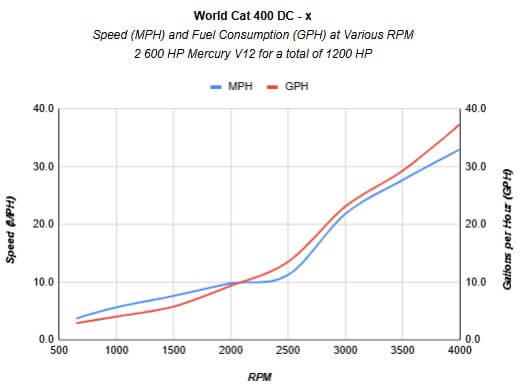
- Top speed: 54 mph at 6,150 RPM (wide-open throttle)
- Best cruise: 28 mph at 3,500 RPM, burning 29.3 gallons per hour, achieving 0.9 miles per gallon
- Range at best cruise: 395 statute miles, with a 10% fuel reserve
- Plane threshold: approximately 3,000 RPM, 12–14 mph
- Hole shot 0–10 mph: 3.5 seconds
- 0–20 mph: 5.5 seconds
- 0–30 mph: 8 seconds
- 0–40 mph: approximately 10 seconds
Comparative Range Analysis
The review states: with the Mercury 600 package, the 400 DCX stretched its fuel range 32% further than a monohull of the same size and weight running the same Mercury 600 engines. With the standard twin Yamaha 450 V8 XTO engines, the boat showed approximately a 30% range improvement over the Mercury setup on the same hull. The buyer tradeoff was framed as prioritizing top-end speed (Mercury) versus extended range (Yamaha).
Sea Trial — Ride and Handling
Conditions: 1–2 foot chop on the test side, with closer-together wave spacing on the Gulf side due to wind direction. Captain Shelly noted the ride quality despite conditions: "We are getting bounced around a little bit, but I mean, you really can't tell, because of the beam of this boat. We're so wide, it's such a stable platform in the water."
Hole shot: "She hops up on plane with those 600s — it feels like almost immediately... it's like a split second that just, she just pops right up outta the water. That was really fun to experience."
Turning behavior (from the helm): Captain Shelly described initial hesitancy driving the boat (noting she typically dives off a WorldCat rather than drives one), gaining confidence with larger, faster, sharper turns: "They told me that those engines were gonna bite, with the dual hulls in the water, and you can really feel it as you really start to hook around — you can feel, especially that inward hull, really bite into the water." She monitored speed loss through turns: "Maybe a half a knot as I made those bigger, sharper turns, so she doesn't really bleed off speed in those turns."
Heel/stability underway: "Because it's the catamaran, you really don't get that serious heel when you make those sharper turns... if you have a whole bunch of people, if there's a dolphin or something to look at on that side, everybody moves over there — [on] a monohull, the whole boat is gonna tip; [on a] catamaran, it's just gonna stay nice and stable."
Closing Assessment
"There are a lot of things to love about catamaran, and WorldCat has done a pretty good job putting it all together."