Safety Best in History in Minnesota
Last year’s boating fatalities were
the lowest in Minnesota in the 47 years since records have been kept. With 900,000
registered boats, that means fatalities were only 1.38 per 100,000. Officials at
the Minnesota Department of Natural Resources attribute the decline in deaths in
their state to more people wearing life jackets and taking boating safety classes.
Tougher alcohol laws, more rigorous law enforcement and larger, more stable boats,
also contributed to the good safety record the officials said.
|
|
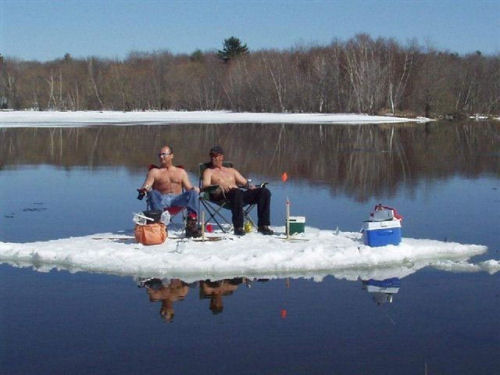
In 2008 there were only 12 boating fatalities in Minnesota. These two fishermen survived with a mild sunburn. |
By MARY LYNN SMITH, Minneapolis Star Tribune January 23, 2009
Of the 12 deaths last year, 11 of them were single-boat accidents. Half of the boats
were non-motorized canoes or paddle boats.
Three of the accidents involved boats that were anchored or next to a dock. Ten
victims weren't wearing life jackets. Alcohol was a factor in five of the deaths
and cold water contributed to five fatalities.
Boating fatalities have declined for the last several years, with 12 people dying
last year, 15 in 2007 and 14 in 2006. In comparison, 57 boaters died in 1961, 30
died in 2002 and 23 died in 2005.
"Most fatal boat accidents aren't collisions or big flaming crashes," said Tim Smalley,
DNR water safety specialist.
"It's most often a single- boat accident with one person in the boat and for some
reason they fall overboard and drown. They're not wearing a life jacket. They fall
into cold water and they suddenly gasp, they aspirate water into their lungs and
they drown."
DUI Laws Being Inforced
Alcohol has become less of a problem, Smalley said. Less than 15 years ago, 50 percent
of the boating fatalities involved alcohol use. Now less than a third of them do,
he said. "People are being smarter," Smalley said.
High fuel prices
may have kept some boaters off the water last summer, but not enough
to be a major factor for the decrease in fatalities, Smalley said.
An aerial survey in the Brainerd area last summer showed little difference in boat
traffic compared to surveys done in 1998 and 1985, he said.
Despite the fatalities, boating is a very safe sport, Smalley said. "While 12 fatalities
are too many, you have to consider that we've got almost 900,000 registered boats
in this state," he said. "People have to realize that it can happen to them even if they're a good swimmer. If you fall into cold water, it doesn't matter. You can
die if something happens and you're not careful."