Fleming 65 Makes It to the Galapagos Islands
This week we join Tony Fleming as
he makes his way to one of the most unique places on the face of the earth. Not
only did these islands give rise to the theory of evolution, during the period from
1977 to 1982 it was actually observed for the first time, in real time, among ground
finches. Today penguins from Antarctica play there, as well as sea lions from California,
albatross, flightless cormorants, and of course the giant Galapagos turtles.
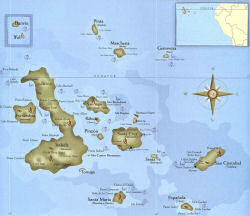 Charles Darwin spent five weeks in these islands and got the idea of evolution. Tony Fleming spent eight days there on his 65’ Fleming, Venture. 35,000 people live on the islands and immigration is strictly controlled. |
Tony Fleming Writes--
It is 440 miles from Cocos Island to the Galapagos Islands which are about
600 miles west of the South America coast. We crossed the Equator at 3 AM on the
morning of May 6th, 2008, and we were all in the pilothouse to record the event.
We arrived at Puerto Ayora at the southern end of the Island of Santa Cruz six hours
later.
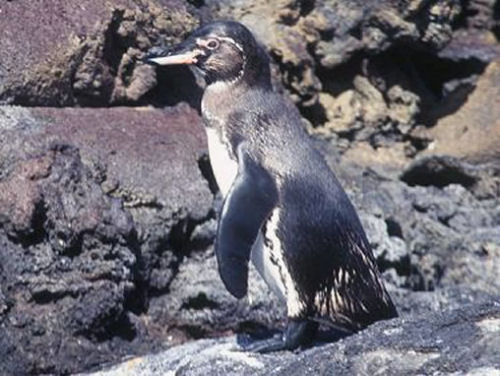 About 1500 penguins live in the Galapagos. They were brought north by the Humbolt current which keeps the islands relatively cool. |
The harbor is quite crowded and exposed to the ocean swells so all the boats were
anchored fore and aft with two anchors. The agent came out to the boat in a water
taxi to handle our paperwork. Later went ashore to the small town which had a quite
a few shops, including a supermarket, and a number of restaurants. Here we met our
agent, Johnny Romero and our naturalist guide Patricia Stucchi who went over out
itinerary and lent us a bunch of marine charts of the islands.
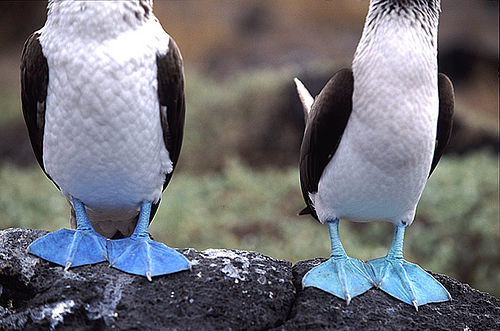 Blue-footed Boobies are all over the islands and are one of the islands' biggest attractions. |
The Tour Starts
We started our tour of the islands the following morning and over the next eight
days cruised 327 miles among a number of islands. There is no space here to cover
the trip in detail but we were lucky enough to see most of the indigenous flora
and fauna unique to these special islands. (An article about our visit appeared
in the August, 2008 issue of Yachting magazine.) About 3% of the land in the Galapagos
is inhabited or cultivated by humans and less than 1% of the remainder is open to
tourists.
A strict itinerary is arranged for visits and must be adhered to. For example, you
cannot linger in a spot because you like it. If you are scheduled to visit it in
the morning then you must be gone by the afternoon. No one is allowed to visit any
place without a guide and there can be no more than 16 persons per guide. When you
are ashore, the trails are clearly marked with black and white posts and signs saying
STOP. You cannot deviate from the marked trail.
Shore Landings
Getting ashore can be a challenge: most landings are accurately described as "wet"
meaning that you should be prepared to get wet up to your waist. Even for landings
described as "dry" you can expect to get your feet wet. Tenders cannot be dragged
up onto the beach or tethered in any way to the shore so usually someone has to
stay behind on the tender and take their turn later - but still has to be accompanied
by the guide. Anchoring the yacht can be a challenge as many of the anchorages are
exposed and/or have rocks on the bottom. We bent two anchors in two days so you
need to carry extra ground tackle if you go.
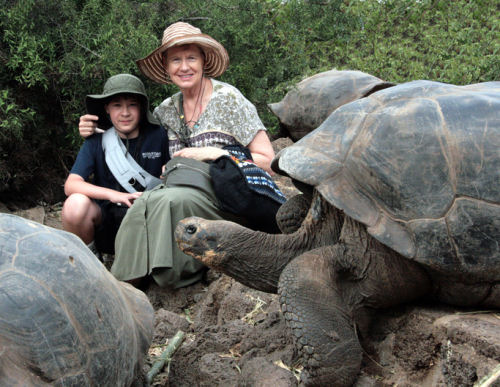 Some giant tortoises are over 300 years old. Whalers nearly made them extinct by taking them aboard ships for food in the 1800s. The tortoises could live up to one year without eating or drinking. |
Other thoughts on the Galapagos are that the islands are much more widely dispersed
than I had expected - tour boats always relocate at night - and most of the creatures
for which the Galapagos are famous are smaller in reality than you might expect
from having seen them on documentaries. My films will be no different because there
is nothing in the frame to give an indication of size.
Having traveled all the way from Costa Rica to Cocos and then to Galapagos where
we cruised for eight days among the islands, Venture's fuel tanks were getting low
and we took on 1550 gals of diesel at Baltra Island close to the main international
airport. Fuel has to be arranged in advance by your local agent.
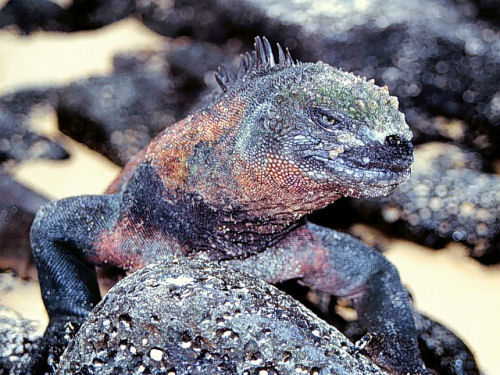 Lava iguanas eat moss off rocks when the tide goes out and are otherwise tranquil and not at all as fearsome as they look. |
On to Panama
We had 900 miles of open ocean ahead of us before arriving at Panama City at the
southern entrance of the famous canal. This was the longest passage any of us had
undertaken in a powerboat and there are of course no ports of refuge between the
destination and the point of departure. In the event we covered the distance in
four days and six hours at an average speed of 8.7 knots burning 1.2 gallons per
mile.
For the most part the weather was fair although we did have one day in which we
had swells and wind-blown waves on the beam which caused us to alter course to make
the ride more comfortable. Honesty causes me to confess that the stabilizers failed
on the outward journey so we had 2,000 miles without their benefits. I should say
that the failure was not the fault of the stabilizers nor of the crew of Tung Hwa
who built the boat but was due to changes made to Venture as she serves her role
as a test bed for trying out new ideas - not all of which, I have to admit, have
been successful. But then, unless we tried we wouldn't know.
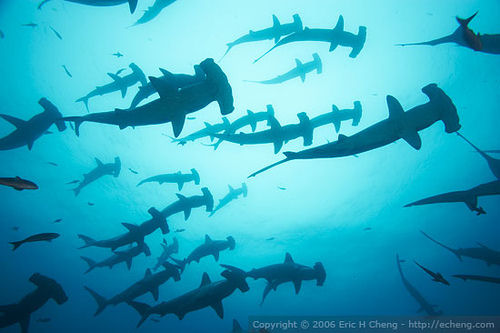 The Galapagos Islands are famous for their hammerhead sharks. Many dive boats go out to find them for their paying guests. |
However, the innate stability of the Fleming hull kept the ride tolerable although
cooking dinner would have been much more of a challenge without the potholders on
the cooktop. When I see so many boats on the market without them I do wonder how
they get along without them in rough weather. Sandwiches I guess.
Venture has now carried us 15,000 miles - 4,200 of them in the five weeks since
we left the La Paz area on April 12th - and I am writing this latest update as we
await our turn to enter the Panama Canal.