Around the World in 2011 Powered by Solar Panels
If funding holds out and construction remains on schedule she will be launched a year from now. The 97’ 6” (30 m) vessel “Planet Solar” will be powered exclusively by 4,964 sq. ft. (470 sq. meters) of photovoltaic cells mounted on deck driving two electric motors in her two hulls attached to multi-blade props. Her designers claim that she will have a WOT (not warp) speed of 14 knots. We look forward to testing this boat as soon as she is launched. We're told that the concept of the project is to draw the attention of the world to the reality of using alternative sources of energy in order to preserve the planet.
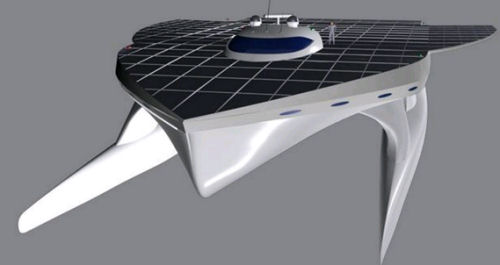 She looks like the starship Enterprise, but this 97’6” (30 m) vessel is designed for ocean crossings and is currently under construction in Kiel, Germany. |
The futuristic-looking "Planet Solar," which is 100 percent powered by sunlight, is the brainchild of Swiss engineer Raphael Domjan, a former paramedic with a passion for innovative design and renewable energies.
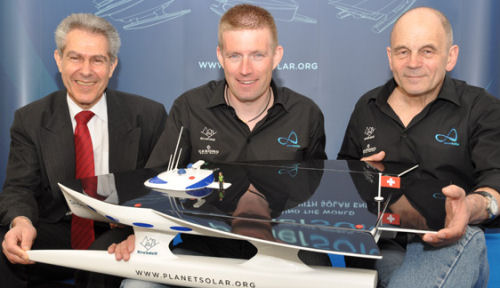 Raphael Domjan (center). The boat will be skippered by him and famous French sailboat skipper Gerard D’aboville (right). |
The 30-meter (97’ 6”) vessel is currently being built in Kiel, Germany, and will be finished early next year. If all goes according to plan, the boat will begin operation the summer 2010 -- first in European waters and then around the world. The following year it will make its around the world cruise.
The boat is expected to travel at up to 14 knots (26k/m) and would be the first solar-powered boat to travel at such high speeds. It is projected to be able to cross the Atlantic in just two weeks. Domjan hopes his ambitious, $11.5 million (€8 million) project will prove that boats can travel at high speeds without emitting any carbon dioxide.
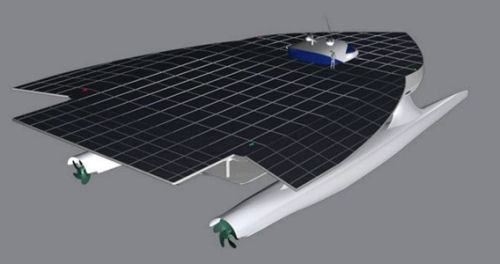 The boat is large but will be exceptionally light and will only have a crew of two, we’re told. |
"I want to show that we can change, that solutions exist and that it's not too late," Domjan writes on his Web site. "Using technology and our knowledge to better promote renewable energies is the way towards a lasting world."
Planet Solar will be covered in 470 square meters (4,964 sq. ft.) of solar panels -- the equivalent of two tennis courts. Twenty-three percent of absorbed sunlight will be converted into energy that the boat can run on, compared with 17 percent for average panels, according to Planet Solar's project manager, Danny Faigaux of Grand Chelem Management.