CO from Engine Exhaust Can Kill
We publish “Accident of the Week” from time to time to inform our readers about dangers in boating or improperly using a boat in hope that it will help prevent accidents in the future. Boating safety starts with understanding what can happen. We also hope that our readers will pass on what they have learned to their boating friends. Our duty is to inform. So it is with a deep feeling of regret that we relate the following news item of an accident that occurred last Monday in northern Indiana.
Boat motor fumes fatal for 8-year-old
Carbon monoxide cited in death; girl fainted, fell in water
By Holly Abrams
 Jesslynn Gustin |
An 8-year-old Garrett girl pulled from a Huntington County lake Monday died after breathing in exhaust from the boat she was a passenger on, the Allen County Coroner’s Office said.
Jesslynn “Jessy” Gustin had been sitting on a swim platform on a boat at J. Edward Roush Lake in Huntington County. She apparently passed out and fell into the water, according to Indiana conservation officers.
Officers were called to the lake in response to a possible drowning about 4:30 p.m. Monday and found Jesslynn. She was flown to Fort Wayne’s Parkview Hospital, where she died shortly thereafter.
She died as a result of a lack of oxygen to her brain caused by carbon monoxide poisoning, an autopsy Tuesday revealed. The coroner’s office ruled her death accidental.
“We’re going to miss her,” said her grandfather, Robert Gustin of Woodburn. He said his granddaughter enjoyed the lake, boating and tubing. She attended J.E. Ober Elementary School in Garrett.
Jesslynn Gustin is survived by her parents, Fredrick John Gustin of Garrett and Jessica Middleton of Portland. She is also survived by four siblings.
The funeral service will be at 3 p.m. Thursday at E. Harper & Son Funeral Home, 740 Indiana 930 E., New Haven, with visitation from 1 to 3 p.m. Thursday.
 |
Our heart goes out to the bereaved family. Although we did not know this lovely young child, we are publishing this article and her beautiful picture so that boaters everywhere will know that they must take the simple precaution of turning off the engine when people are enjoying watersports off the transom or swim platform of a boat. Our prayers are with this lovely child.
--The BoatTEST.com Staff
Below is material from the USCG Boating Safety website. The USCG has been working for years to publicize this important safety message--
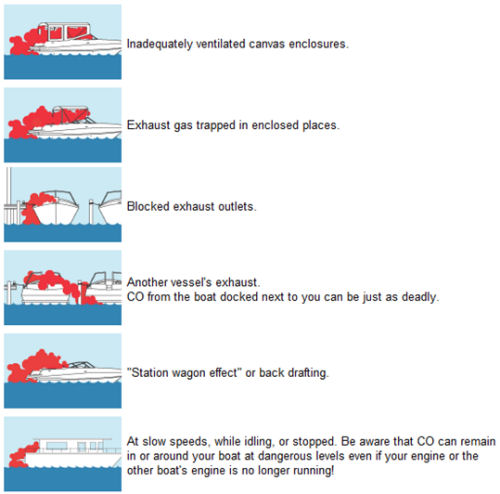
Where CO May Accumulate
Carbon monoxide can accumulate anywhere in or around your boat.
How can it accumulate?
 |
The Dangers of Carbon Monoxide
What is Carbon Monoxide?
Carbon monoxide (CO) is a colorless, odorless, and tasteless gas. It is produced when a carbon-based fuel such as gasoline, propane, charcoal, or oil burns. Sources on your boat may include engines, gas generators, cooking ranges, and space and water heaters.
Why is it so dangerous?
Carbon monoxide (CO) enters your bloodstream through the lungs, blocking the oxygen your body needs. Prolonged exposure to low concentrations or very quick exposure to high concentrations can kill you.
Early symptoms of CO poisoning include irritated eyes, headache, nausea, weakness, and dizziness. They are often confused with seasickness or intoxication, so those affected may not receive the medical attention they need. Altitude, certain health-related problems, and age will increase the effects of CO. Persons who smoke or are exposed to high concentrations of cigarette smoke, consume alcohol, or have lung disorders or heart problems are particularly susceptible to an increase in the effects from CO. However, anyone can be affected. Another factor to consider is that physical exertion accelerates the rate at which the blood absorbs CO.
Emergency Treatment for CO Poisoning
CO poisoning or toxicity is a life-threatening emergency that requires immediate action. The following is a list of things that should be done if CO poisoning is suspected. Proceed with caution. The victim may be in an area of high CO concentration, which means you or others could be in danger from exposure to CO.
- Evaluate the situation and ventilate the area if possible.
- Evacuate the area and move affected person(s) to a fresh air environment.
- Observe the victim(s).
- Administer oxygen, if available.
- Contact medical help. If the victim is not breathing, perform rescue breathing or approved cardiopulmonary resuscitation (CPR), as appropriate, until medical help arrives. Prompt action can mean the difference between life and death.
- Shut off potential sources of CO, if possible. Correct ventilation problems and/or repair exhaust problems as appropriate. Investigate the source of CO and take corrective action, such as evacuating and ventilating the area or shutting off the source of the CO, while at the same time evacuating and ventilating the area.
How to Protect Others & Yourself
You're in command of your boating safety. Follow these simple steps to help keep carbon monoxide from poisoning you, your passengers, or those around others.
- Know where and how CO may accumulate in and around your boat.
- Maintain fresh air circulation throughout the boat at all times. Run exhaust blowers whenever the generator is operating.
- Know where your engine and generator exhaust outlets are located and keep everyone away from these areas.
- Never sit, teak surf, or hang on the back deck or swim platform while the engines are running. Teak surfing is NEVER a safe activity.
- Never enter areas under swim platforms where exhaust outlets are located unless the area has been properly ventilated.
- Although CO can be present without the smell of exhaust fumes, if you smell exhaust fumes, CO is also present. Take immediate action to dissipate these fumes.
- Treat symptoms of seasickness as possible CO poisoning. Get the person into fresh air immediately. Seek medical attention-unless you're sure it's not CO.
- Install and maintain CO alarms inside your boat. Do not ignore any alarm. Replace alarms as recommended by the alarm manufacturer.
- Follow the checklists provided on this website.
- Get a Vessel Safety Check. A VSC is a free bow-to-stern safety examination.
Helpful Checklists
Print and use these checklists, and do not operate your boat without doing the following:
Each Time You Go On a Boat Trip
- Make sure you know where CO exhaust outlets are located on your vessel.
- Educate all passengers about the symptoms of CO poisoning and where CO may accumulate.
- When docked, or rafted with another boat, be aware of exhaust emissions from the other boat.
- Confirm that water flows from the exhaust outlet when the engines and generator are started.
- Listen for any change in exhaust sound, which could indicate an exhaust component failure.
- Test the operation of each CO alarm by pressing the test button.
Print and use these checklists, and do not operate your boat without doing the following:
Once a Month
- Make sure all exhaust clamps are in place and secure.
- Look for exhaust leaking from exhaust system components. Signs include rust and/or black streaking, water leaks, or corroded or cracked fittings.
- Inspect rubber exhaust hoses for burned, cracked, or deteriorated sections. All rubber hoses should be pliable and free of kinks.
Once a Year
Have a qualified marine technician:
- Replace exhaust hoses if cracking, charring, or deterioration is found.
- Ensure that your engines and generators are properly tuned, and well maintained.
- Inspect each water pump impeller and the water pump housing. Replace if worn. Make sure cooling systems are in working condition.
- Inspect all metallic exhaust components for cracking, rusting, leaking, or loosening. Make sure they check the cylinder head, exhaust manifold, water injection elbow, and the threaded adapter nipple between the manifold and the elbow.
- Clean, inspect, and confirm proper operation of the generator cooling water anti-siphon valve (if equipped).
TRIP CHECKLIST
- Make sure you know where exhaust outlets are located on your vessel.
- Educate all passengers about the symptoms of CO poisoning and where CO may accumulate.
- When docked, or rafted with another boat, be aware of exhaust emissions from the other boat.
- Confirm that water flows from the exhaust outlet when the engines and generator are started.
- Listen for any change in exhaust sound, which could indicate an exhaust component failure.
- Test the operation of each CO alarm by pressing the test button.
BOATER’S MONTHLY MAINTENANCE CHECKLIST
- Make sure all exhaust clamps are in place and secure.
- Look for exhaust leaking from exhaust system components.
- Signs include rust and/or black streaking, water leaks, or corroded or cracked fittings.
- Inspect rubber exhaust hoses for burned, cracked, or deteriorated sections. All rubber hoses should be pliable and free of kinks.
ANNUAL CHECKLIST
HAVE A QUALIFIED MARINE TECHNICIAN:
- Replace exhaust hoses if cracking, charring, or deterioration is found.
- Ensure that your engines and generators are properly tuned,
and well maintained. - Inspect each water pump impeller and the water pump housing. Replace if worn. Make sure cooling systems are in working condition.
- Inspect all metallic exhaust components for cracking, rusting, leaking, or loosening. Make sure they check the cylinder head gasket, exhaust manifold, water injection elbow, and the threaded adapter nipple between the manifold and the elbow.
- Clean, inspect, and confirm proper operation of the generator cooling water anti-siphon valve (if equipped).
Visit the USCG Safe Boating website