Sea Tow Rescues Skipper From Burning Powerboat
At 5:30 PM last Wednesday Channel 16 in the Miami, Florida area crackled with “Mayday, Mayday, Mayday, I have a boat on fire.” The USCG station at Government Cut immediately responded with, “Where is your location?” Happily for all concerned, Dan Trumble, the owner/skipper of the burning vessel knew exactly where he was and radioed his location, then quickly said, “I am abandoning ship.” With that his radio went dead. Sea Tow Captain John Bennett was two miles south of the stricken vessel at Dinner Key, heard the Mayday on his VHF and immediately cast off the lines from his 17-footer and was off to the rescue.
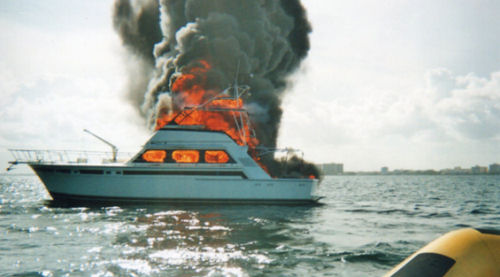 This picture was taken just a few seconds after Key Biscayne Sea Tow captain John Bennett hauled aboard from the water the owner of the burning vessel aboard his 17’ rescue RIB. |
In less than 5 minutes Sea Tow Capt. Bennett arrived at the burning vessel and radioed to the Coast Guard that he was on the scene and would make rescue of the one person in the water. Dan Trumble was in the water but just a few feet off of the bow of the burning boat. The heat from the fire was intense as Bennett moved in alongside the survivor and hauled him aboard, Bennett reported in an exclusive interview with BoatTEST.com.
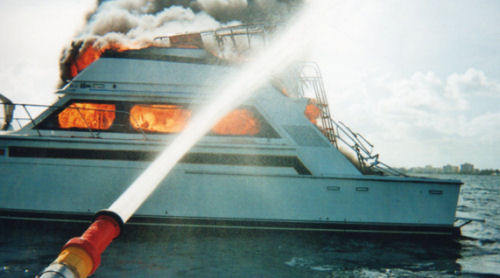 After the rescue Capt. Bennett attempted to put the fire out with his onboard saltwater fire pump. (All pictures taken aboard the Sea Tow boat are courtesy of Capt. John Bennett.) |
Bennett then turned on his onboard saltwater fire pump and approached the burning vessel once again in an attempt to put out the blaze. Unfortunately, the intensity of the resin and diesel fuel blaze – which had already sent billowing black smoke over a mile into the air -- was simply too much for Bennett’s equipment. Within minutes he could see two fire rescue boats headed for the inferno and withdrew his vessel for safety.
“While I thought it was a diesel fire and not gasoline, on a boat you never know what could explode,” said Bennett. “There could have been a propane tank aboard.”
Within 10 minutes two fireboats were on the scene and quickly extinguished the fire. Later the boat was towed into the marina in the Miami River from which it had just come. The boat, named K-Sea, is what we believe to be a Bertram 58, although it has been variously described as a Bertram 54 and Bertram 46 in some reports. Neither the owner nor the marina manager could be reached for comment.
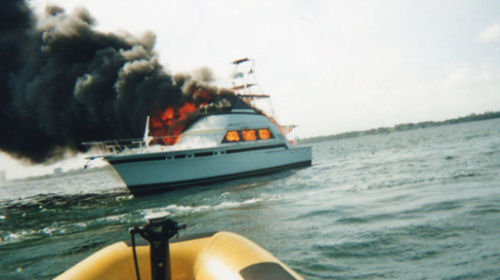 Eventhough the breeze was blowing the flames and smoke to leeward the fire was so intense that the heat radiating to windward was unbearable for some distance. |
The Rest of the Story...
According to Capt. Bennett, Dan Trumble had recently purchased the boat used and was taking it from the Hurricane Cove marina down the Miami River to refuel the boat. When he was just south of the Key Biscayne Bridge, Trumble noticed that one of his engines unexpectedly lost RPMs and when he looked behind he saw a cloud of black smoke coming from his exhaust.
Alone on the boat, Trumble went to the cockpit, opened the engine room hatch and discovered a “blaze of fire being emitted from one of the engine’s turbos.” Bennett says that Trumble told him that he rounded up three fire extinguishers and emptied them into the blaze only to see it undiminished. It was then that Trumble headed back to the flying bridge and called the Coast Guard with his Mayday.
Dan Trumble was transferred to the Miami Dade Fire Boat #1 and was taken to the Biscayne Bay hospital which was less than one-half mile away. He is reported to have suffered from smoke inhalation, but is in good condition.
 Professional fire and rescue boats arrived quickly and put the fire out saving the hull. |
What Can We Learn From This Accident?
Because neither the owner nor the marina will answer BoatTEST.com’s requests for information, we can only suggest some possibilities of the cause of this fire. The last year that Bertram built the 58 was in 1985, which means that the newest this boat and engine could be is 24 years old, and it might be over 30 years old. A few questions occur: How was it maintained and did it have an automatic engine room fire extinguishing system, and if so, when was the last time it was certified?
Secondly, during the period that this series of Bertrams was built, the standard engine installed was the 675-hp Detroit Diesel 12V71TI. We do not know if this boat had that model of engine. However, we have had an experience exactly like the one Dan Trumble related to Capt. Bennett – with the absence of the unhappy ending.
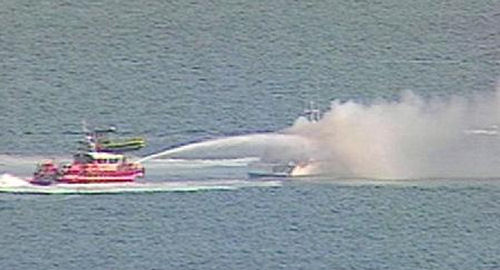 Note that all rescue boats are keeping their distance. Capt Bennett’s Sea Tow rescue boat can be seen in the background. |
Driving a similar size and vintage convertible at 18 knots or so a few years ago, we too, felt the speed drop off all of a sudden. The tach for one engine read 1100 rpms instead of 2000, and we turned around to see clouds of black smoke coming from the exhaust. When a turbocharger fails (the 12V71 TIs have four), that side of the engine (six of the 12 cylinders in the case of a DDA 12V71TI) does not get enough oxygen to burn all of the fuel that is being pumped into the engine. As a result, that unburned fuel is blown out the exhaust causing the black smoke. In our case, the turbo had failed and the turbo blades were frozen in place.
Since owner Trumble says that he saw flame emitting from the turbo, we assume that something similar happened to his engine (whichever one it was) and the turbo housing cracked or the exhaust hose connection next to it let go, and the hot turbo ignited the exhausting unburned diesel fuel. At least that’s a possibility.
Turbos can fail for many reasons. One of the causes can be a blown injector tip that is sucked into the turbo. Please read the article in this issue about turbocharger maintenance.
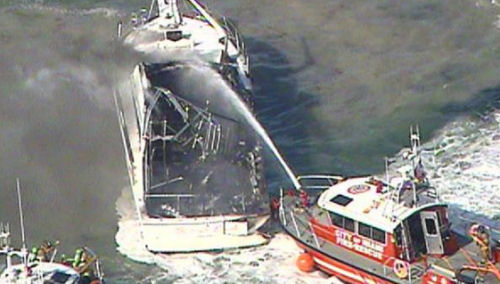 Once the fire was out the fire boats moved in close to the gutted hull for closer inspection. |
Automatic Fire Extinguishing Systems
Clearly K-Sea needed a functioning and robust automatic extinguishing system in the engine room. But that is not enough. Boats should also have louvers on their air intake ports that automatically close when the system discharges.
Why not start your research on this topic at Kidde’s website...
General Observations
As the pictures of this fire demonstrate, someone caught forward in this boat would need to exit the hatch in the foredeck. In a tri-cabin, there would need to be a hatch in the aft cabin.
Fires of this type can occur on even well-maintained boats for scores of reasons and that is why the ABYC (American Boat and Yacht Council) has set standards of emergency egress from enclosed cabins in boats. In a nutshell they require that any cabin which requires egress past an area susceptible to fire, such as a galley or engine room, must have alternate paths of exit. That generally means a hatch in the cabin large enough for a body can get through.
ABYC requires (H-3.5.1 to H-3.5.2.1) that if the hatch is round it have a diameter not less than 18 inches/45.7 cm, and if it is a rectangular-shaped hatch it should be no less that 14.5”/ 36.8 cm on the smallest side and at least 270 sq. in./1766.34 sq. cm. Our suggestion is that you measure the most portly member of your crew and make sure they can get through all of your appropriate hatches.