Russia’s Northeast Passage Traversed by Commercial Shipping
The German merchant ships MV Beluga Fraternity and MV Beluga Foresight arrived this week in Yamburg, Siberia, their owner Beluga Shipping GmbH said Friday. They traveled from Ulsan, South Korea, in late July to Siberia by way of the Northeast Passage, a sea lane that, in years past, was avoided because of its heavy ice floes. They have traversed the fabled Northeast Passage almost exactly one year after a Canadian supply ship traversed the Northwest Passage through the Canadian arctic archipelago.
 The German commercial vessel MV Beluga Fraternity is the first non-ice breaking, non-military vessel to make across the Northeast Passage. |
A First Across Russia’s Arctic Sea
Niels Stolberg, the president of Beluga, which is based in the German city of Bremen, called it the first time a Western shipping company successfully transited the Northeast Passage.
First Commercial Vessel through the Northwest Passage
The first commercial vessel to make it through the Northwest Passage to Cambridge Bay, Nanavut occurred last September and this passage was confirmed by the Canadian Coast Guard. The MV Camilla Desgagnés, owned by Desgagnés Transarctik Inc., transported cargo from Montreal to the hamlets of Cambridge Bay, Kugluktuk, Gjoa Haven and Taloyoak in September.
"We did have a commercial cargo vessel that did the first scheduled run from Montreal, up through the eastern Arctic, through the Northwest Passage to deliver cargo to communities in the west."
"That was the first — that I'm aware of anyway — commercial cargo delivery from the east through the Northwest Passage" said Brian LeBlanc of the Canadian Coast Guard last year in an interview with CBC News.
 Last year the Northern Sea Route along Russia’s Arctic coast and the fabled Northwest Passage over Canada were both navigable in early September 2008. This map shows open water (blue) on Sept. 5. (Credit: National Ice Center/NOAA)
|
Last year the Northern Sea Route along Russia’s Arctic coast and the fabled Northwest Passage over Canada were both navigable in early September 2008. This map shows open water (blue) on Sept. 5. (Credit: National Ice Center/NOAA)
Global Warming Melts Ice
Scientists report that the Arctic Ocean ice cap has been shrinking to unprecedented levels in recent summers, because of global warming, opening up many passages that were ice-choked in earlier times. In July, new NASA satellite measurements showed that sea ice in the Arctic was not just shrinking in area, but thinning dramatically, as well.
"To transit the Northeast Passage so well and professionally without incident on the premiere is the result of our extremely accurate preparation as well as the outstanding team work between our attentive captains, our reliable meteorologists and our engaged crew," Stolberg said.
 For all of our readers who think that there is no such thing as global warming we offer this chart printed in the September 3, 2009 issue of the New York Times. |
An Alternative to the Panama & Suez Canals
He said the shipping company was planning more voyages through the area in coming months. Traditionally, shippers traveling from Asia to Europe have to go through the Gulf of Aden and through the Suez Canal into the Mediterranean Sea and, pending their destination, into the Atlantic Ocean.
Journey from South Korean to the Netherlands, for example, is about 11,000 nautical miles (12,658 miles). By going northward and using the Northeast Passage, approximately 3,000 nautical miles (3,452 miles) and 10 days can be shaved off. That means lower fuel costs
No Doubt About Global Warming
Researchers said the ability to navigate the route showed climate change.
"We are seeing an expression of climate change here," said Mark Serreze, director of the National Snow and Ice Data Center in Boulder, Colo. "The Arctic is warming; we're losing the sea ice cover. The more frequent opening of that Northeast Passage is part of the process we're seeing."
"The Arctic is becoming a blue ocean," Serreze told The Associated Press.
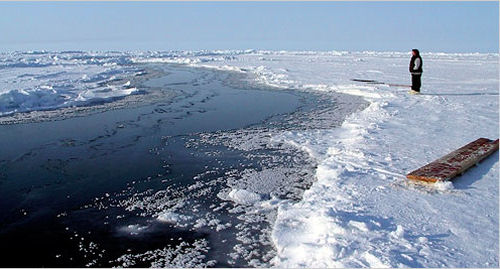 This photo was taken in April of 2003 near the North Pole. It show what is called and “ice lead” a channel in the ice that opens up and closes. They were one of the obstacles that early arctic explorers had to overcome. |
For the last few years, including this year, navigator Roald Amundsen's famous Northwest Passage has been navigable. Then in 2007, the more crucial deep water channel called McClure Strait opened up and now the Northeast Passage, Serreze said. The passage "is the traditional choke point," Serreze said.
This year is shaping up to have the third lowest amount of Arctic sea ice on record, just behind the worst year set in 2007 and in 2008. But just because 2009 is slightly up from the past two years, it is not an upward trend or a recovery, Serreze said. It reflects a change in local weather patterns that occurred in August, he said.
"It's certainly part of the overall decline of sea ice that we've been seeing," Serreze said.
Both ships, which carried cargo for a power plant project in Surgut, Siberia, were escorted by a pair of Russian icebreakers during portions of their journey. The Beluga Fraternity left South Korea on July 23, followed by the Beluga Foresight on July 28.
They arrived at the Novy Port, a major Russian shipping one on the west side of the Ob Gulf, an open body of water that stretches from the Ob River delta in the south to the Kara Sea in the north.
Verena Beckhusen, a spokeswoman for Beluga, said the Beluga Fraternity had already hoisted anchor and left Novy Port on Thursday. The Beluga Foresight is scheduled to cast off Saturday after its departure "was postponed due to bad weather."
Russia has long used its northern coast for shipping fuel, supplies and other goods to its remote Arctic settlements, though funding for such shipments dwindled after the Soviet collapse.
Russian Red Tape Worse than Ice
An article in last Friday’s New York Times quoted Lawson Brigham, a professor at the University of Fairbanks who has written a report on Arctic commercial commerce the Russian maze of permits and regulations was now more restrictive than the ice itself. Dr. Brigham is a former USCG ice breaker captain said that the run was as much a test of the Russian bureaucracy as for the ships.