21’ Flats Boat Crosses the Atlantic
Florida residents Ralph Brown, 50, and his brother Robert Brown, 52, crossed the
Atlantic in just one month this summer in a flats boat built by Dream Boats, which
is owned by Ralph. They left Labrador on July 28th and arrived in the Orkney Islands,
just north of Scotland on August 28th. The Brown brothers say that their boat is
the smallest powered boat to have ever crossed the Atlantic, and that their 21-footer
will enter the Guinness Book of Records. Their trip – intended to raise money for
military charities and to publicize their boat’s seaworthiness so that the brothers
could raise capital for their boat-building business – actually started in Tampa,
FL and took a total of 76 days, ending Sept. 10th in Landstuhl, Germany. Their course
took them up the eastern seaboard to Labrador, Canada, where they powered 593-miles
to the southern tip of Greenland, then to Iceland, the Shetlands, the Orkneys, Scotland,
England, France, Holland and finally Germany.
 Dream Boats Intruder C-21. |
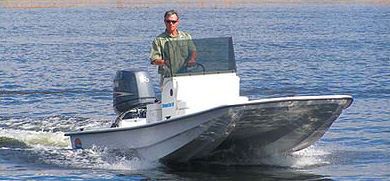 Dream Boats Intruder C-18. |
The Brown brothers remarkable trip in their Intruder C-21 was chronicled nearly
every day by sat phone and by computer on their website, www.crosstheatlantic.com.
We urge you to go there and read 76 days worth of blogs, see all of their pictures
and enjoy many videos which have been up loaded to YouTube.
Trying to Start a Boat Company
About five years ago Ralph Brown started the Dream Boats company and has built 23’,
21’ and 18’ boats. He quickly discovered that it took more capital than he had to
get a company up and running, so in 2007 he and his brother, Robert, took an Intruder
C-21 from Morehead City to Bermuda and then to New York City, over 1500 miles and
two crossings of the Gulf Stream. Evidently the publicity created by this trip did
not generate sufficient investment in the firm, so the Trans-Atlantic trip was cooked
up. The brothers readily admit that they have spent more time trying to raise capital
than trying to sell boats.
In addition to generating publicity about their 21’ cat flats boat, they are also
promoting their two sponsors which are “I Am Second”, a new non-denominational faith-based
Christian movement, and Interstate Batteries. The trip was called the “I Am Second,
Wounded Hero Voyage” in honour of three U.S. Marines who were comrades of Ralph’s
killed in action.
The brothers were strapped for money while making the trip and slept most nights
in their boat. Donations along the route also went to buying fuel and other necessities.
 Getting ready for the trip from Morehead City to Bermuda then on to New York City in 2007. |
Boat Description
The Intruder C-21 that made it across the Atlantic weighed about 2,500 lbs. (dry)
and had about 2’ of freeboard before adding the extra fuel tanks. It was powered
by a 140-hp Suzuki engine and had a 9.9-hp Suzuki outboard as a kicker. The boat
also had foam flotation and Brown says the boat will not sink. The brothers carried
with them for communications and safety two sat phones, an EPIRB, a VHF radio, life
vests and two survival suits.
To give our readers some insight into what it must be like to take a 21’ flats boat
across the Atlantic we are reproducing below highly edited out takes from the Brown
brothers blogs that appear on their website.
 Wakeboarding off Labrador behind the Intruder 21. |
Tuesday, July 28, 2009 – Cartwright, Labrador, Canada
When we woke up this morning [They were anchored just offshore.— we
we
were surrounded by whales, which is kind of neat. We saw a few seals and several
whales blowing and eating fish not too far from us. Then we also got surrounded
by mosquitoes...So we were glad to fire the engine up and get moving. This is our
last night in North America. We will be ending up in a Nuuk Greenland, about 600
miles away.
Wednesday, July 29 –In the Atlantic
Once we were about 30 minutes off shore we started putting on our ‘cold-weather’
gear, which is long underwear and boots. Also we are rearranging our sleeping area.
It may not be much but it is an improvement. We are sitting much deeper in the water
because we are carrying a lot more fuel.
Video of what it
is like in the Atlantic in a flats boat…
Thursday, July 30 – In the Atlantic
11:36 AM: Last night was the most miserable night we have had yet. It was wet all
night and very, very cold. But we are moving along, moving steadily. Always when
we load the boat with gasoline, the first 100 miles we get terrible fuel (economy)
and terrible performance. It has been about 6 foot seas out of the east most of
the way. Not good. It is cold and windy. Hopefully the sun will come out today.
We counted 21 icebergs yesterday and named 5 of them.
We are about 150 to 200 miles off the coast of Canada. Not making very good time
thanks to glaciers and fog, and occasionally 8 to 10 foot waves.
3:20 PM: The waves are steadily been getting bigger and bigger, coming closer and
closer, and that means they are building, and are not going in our direction...we
are going very, very slow, we are not going to make Nuuk Greenland at our predicted
time.
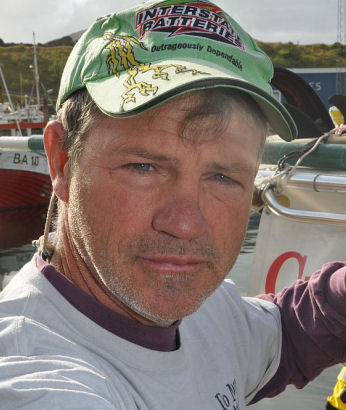 Ralph Brown, owner of Dream Boats. |
Saturday, August 1 – 152 miles from Nuuk, Greenland
At 3 AM this morning we picked up our sea anchor and started moving forward about
90 miles before the wind/seas picked back up again. It is still against us, but
not really bad, we could easily go on but we are very concerned about our fuel consumption
and because of that we are dropping the sea anchor and are going to wait for calmer
seas, or the wind at our back, otherwise we can sit for a couple of days if we have
to.
When we left Cartwright Labrador we had 310 gallons of fuel on board which is more
than enough to go 900 miles under normal conditions. However we are only going 600
miles and the wind and waves were supposed to be out of SE at 3-4 feet. Unfortunately,
instead we had waves about 5-9 feet, a little bigger than that in some cases and
strong winds out of due E, right in our faces the whole time which ate our fuel,
so now we are very conscious of the fuel left and are waiting for the right weather
to burn it. We have our sea anchor out to minimize our drift and we are going from
there.
Sunday, August 2 – Moving Again
We are now using our 9.9 horsepower kicker which is running well and giving us good
gas mileage. It burns about three quarters of a gallon per hour and we are moving
at 4 knots. When we started this process we had 60 gallons on board. That was enough
to go for 100 hours at 4 knots or 400 miles. We don’t want to go that far at 4 knots
per hour, we have around 100 miles to go.
Tuesday, August 4 – Arrived at the Greenland Coast!
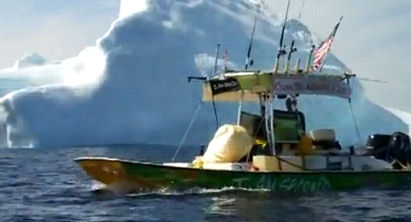
5:00 AM in Greenland which is part of Europe! Every which way you can look are icebergs
and rock islands. Unfortunately gas is almost 20 miles inland, reachable by water.
 |
Thursday, August 6 – With the Greenlanders
Icebergs sink boats. They won't sink this Intruder 21, but they might damage the
prop. That is why we are dodging these icebergs, and growlers, small chucks of Ice.
You have to realize how few Greenlanders there actually are. But they all seem so
friendly. We met them today on our way from Qaqortoq to Nanortalik. (Population
300.)
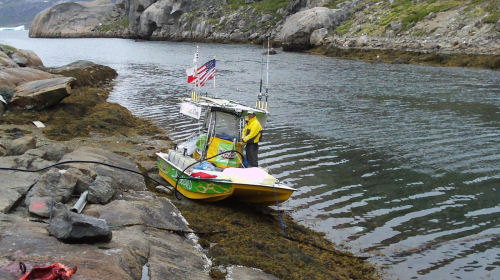
Everyone seems to have a hard time believing that we came from Florida in this flats
boat, it is only 4,400 miles. What is the problem?
 |
Saturday, August 8 – It Is Getting Cold!
Last night Bob and I were on our way to Aappilattoq, an Island on the Way to our
last stop in Greenland, Tasiilaq. It was dark and the wind was blowing hard. Driving
at night is very dangerous because of the small icebergs. If you don't see them
they could break your motor or sink some boats, not an Intruder.
After a while we took shelter behind an Island. We put out two anchors. We went
to sleep. Bob on top of the bean bag wedged behind the helm. Me, on the back of
the boat in the surf board bag. It is semi waterproof and semi warm. I was sleeping
with two pairs of socks, a survival suit, the Interstate Battery Jacket, a separate
jacket liner, three pairs of pants, gloves, my Interstate Battery Hat, a hood, and
a shirt on. I completely zip it up around me except for a tiny air hole. I am sawing
logs, sound asleep.
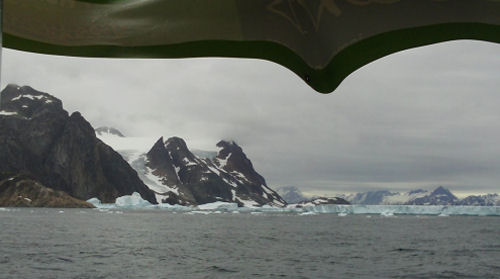 |
Wednesday, August 12 – Last Day in Greenland
Tasiilaq, Greenland is a town of about 1000 people located on the east side of Greenland.
The whole east side of Greenland is uninhabited with a few exceptions. It is one
of the most beautiful places on earth. Giant mountains come to the sea, with glaciers
becoming Icebergs.
Seals, birds and whales roam while the thousands of icebergs float by. It is a 400
mile run between the town of Prince Christianson (Population 5) to Tasiilaq. On
the 400 mile run from Prince Christianson we got rained on several times. It is
a fine mist of rain that covers everything, our hands and feet were frozen. At that
point it is very hard to sleep on the boat.
Thursday, August 13 – Only 147 Miles to Iceland!
12:49 PM: As we left Tasiilaq Greenland yesterday afternoon a whole bunch of kids
gave us a standing ovation and some of them jumped into the 35 degree water with
icebergs floating everywhere and the kids were swimming in the icy waters to say
good bye to us.
We had some hot Quaker oatmeal for breakfast/lunch and we are approx. 147 miles
northwest of Reykjavik Iceland.
Thursday August 20 -- Off to the Faroe Islands, 250 Miles Away
2:30 PM: We just left Westmen Island full of gas, going very smoothly, weather is
beautiful, rolling breeze, four footers, calm seas, absolutely gorgeous. We also
know we are just ahead of the big storm. It’ll take us a couple of hours burning
off enough gas before we can go faster, we will be putting along at 8-9 mph heading
toward Faroe Islands. We’ll get there tomorrow around noon give or take; it depends
on how we beat the storm. We should be seeing some big seas.
10:36 PM: We are 250 miles from the Faroe Islands, black as all get out, trying
to outrun the storm. We cannot see where we are going.
Watch Video-- Head into the Storm
Friday, August 21 – 104 Miles from the Faroe Islands
We are 104 miles northwest of the Faroe Islands. We are still trying to beat the
storm. The waves have kicked up to about 10 to 12 feet! They are still coming out
of the southwest while we are going southeast. They are not helping us any at all.
As a matter of fact they are hurting a little bit. We have to go slow. Bob and I
are both soaking wet from head to toes from both rain and waves. It is raining off
and on. Waves are splashing over the front of the boat.
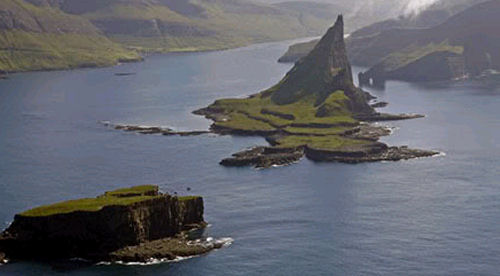 Faroe Islands. |
Saturday, August 22 – “It Can’t Sink, It Can’t Sink, It Can’t Sink.”
[Written at a computer after the fact.—Ed.] It can't sink, it can't sink,
it can't sink were the words going through my mind along with help us Lord Jesus,
and trust your equipment. Bob is saying don't panic. He did not remember saying
those words to me, but it actually helped me to remember not to panic.
Huge waves are breaking into the boat, we are being pushed up on a shoal among the
Faroe Islands. The boat is full of water and if it is not tied down it is gone.
The antenna has fallen, the T top dry box just bounced open and all my important
papers are falling, the waves are pushing us up to the rocks that we can't see,
it is pitch black out with a cloud cover, our spotlight is only good for a few feet
because of the fog. We are scared, I am scared both for my life and for the mission,
especially the mission.
The waves are over 10 foot and it is black out. We see a couple of light houses
in the distance, and Bob wants to tuck in behind an Island.
I want to get out to the open sea. I will take my chances with the bigger waves,
but not the rocks. Bob, let me take the helm, gladly. It won't sink, it won't sink,
it won't sink. Don't panic. Don't panic, Help me Lord, help us Lord, please, Trust
your equipment. Trust your equipment. I set a course back out. The boat is full
of water, more waves are breaking.
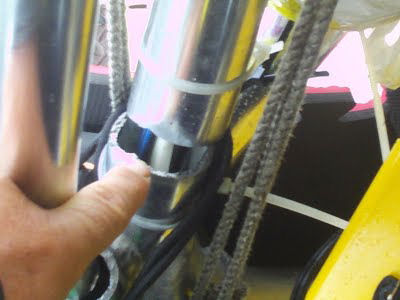 Aluminum pipes holding the T-top broker in numerous places. |
We are talking to search and rescue, we only want directions, they want information,
and I don't want to change screens to give them the coordinates.
Can't get the boat straight, Bob climbs out to fix the antenna, waves are still
breaking into the boat. It is pitch black out and it is hard to drive by GPS only.
It is slow to respond, hard to starboard, hard to starboard, why won't this heading
change, too far, hard to port hard to port. Waves are still breaking into the boat.
Suddenly there is a bright star or a planet. We lock in on our bearing. We get the
boat straight, trust your equipment. Bob wants me to do something, can't take my
eyes off the screen, suddenly we are spinning around again, don't know where the
rocks are. There is the star, keep it on the right, starboard.
We are back out to open sea. The waves stop breaking. We get in the shelter of some
islands. Wow, we are still going. The mission is still on!!!!
Tuesday, August 25 – Making Repairs
After 6000 miles and over 50,000 times slamming a 350 pound fuel tank on the deck
we had some damage. We spent most of the day scrounging up some resin and glass.
The repairs are basically completed.
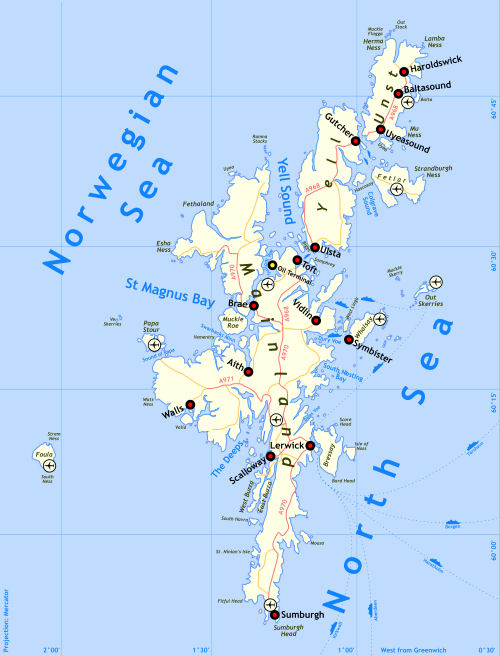 Shetland Islands. |
Wednesday, August 26 – Casting off for the Shetland Islands
5:46 PM: We will be heading out momentarily and driving all night. We want to be
in the Shetlands early in the morning and off to Orkney Islands later. There is
a low pressure over Ireland now that will be moving over across Scotland then out
to sea. We want to get to the coast of Scotland before the storm.
Bob and I decided not to wait for perfect weather and jump from Island to Island
down to London and get there hopefully on or before September 2.
Friday, August 28 – Caught By the Storm, 15’ Seas!
After we left Scalloway, Shetland Islands, the weather started getting rough right
away. Soon after we left the Islands it became apparent that the weather report
we saw was not going to give us the eight hours we expected to make the crossing
to the Orkney Islands. The winds picked up to about 40 mph and the waves picked
up to about 10 -12 ft with an occasional 15 ft wave. They were coming out of the
North West and we were heading South West. They were on our beam, coming at our
side. (The most dangerous direction they could come from to our tiny little boat.)
But the Intruder did well. A flats boat in breaking 15 foot seas! I have always
said 12 foot was my max, before I threw out the sea anchor.
Out there the boat seemed to handle it well. Yes, there were about three close calls,
Bob says about six. I only remember three where we could have flipped extremely
easily if I did not turn the boat just right. One time we launched way up in the
air and the wind caught the boat it came down on its tail and twisted sideways,
well that was an eye opener. I wasn't going that fast; we just hit that wave just
right. God was smiling on us. Let’s face it he has been smiling on us this whole
trip.
Our T-top has just about had it and all the pipes are cracking. I don't understand
it, the T-top is a super expensive one made with extra and larger aluminum pipes.
The guy that built it and installed it says it is the best one made by anyone and
he charges a lot for it. I am not sure what the problem is. It may have something
to do with the 50,000 times we have slammed the boat down. By the way that number
50,000 times is not an exaggeration, it is probably low.
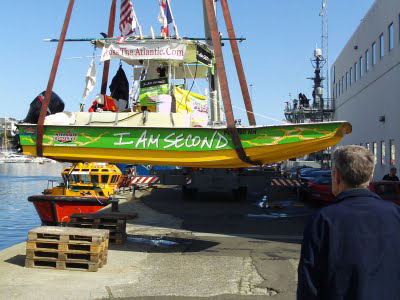 Trying to get the boat air shipped back on U.S. military transport. |
A Search and Rescue Helicopter came and checked on us. We stayed at it, soaking
wet from head to toe, literally. I did not feel cold at all and it was actually
fun. Yet, I was glad when we finally slipped past the first Island. Then I realized
I was cold, real cold.
By the time we got to Kirkwall, I was freezing, so was Bob. I could not get warm.
While we were crossing I did all the driving. I was on the side getting the wind
and the waves. Don't get me wrong, Bob got plenty of wind and water. I think the
continuous soaking of me sucked out some heat.
We still have more than six hundred miles before London. We hopefully can get as
far as Edinburgh tomorrow.
[In the next couple of weeks Bob and Ralph Brown made it down the east coast of
Scotland, England, stopping in at London, the across the English Channel to Holland
and Germany, arriving at their final destination on September 10th.—Ed.]