The Story Behind the Givens Life Raft Endorsement
Last week we received a letter from a reader who seems to have an affiliation with Revere Life Rafts, asking if the Givens Life Raft company had paid us for the recommendation of their product that we published two weeks ago. Since we test boats and other products and charge for our service, we thought the question was a legitimate one and we are happy to answer it. The answer is no. We don’t sell endorsements or recommendations; we sell testing, sponsorships, and information distribution services. We’d like to have Givens as a sponsor because we hold its product in such high regard, but in fact we’ve never received a dime from them. On the contrary, we have spent our money buying their product.
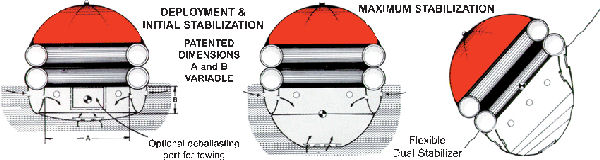
 Givens Buoy Life Raft showing the ballast bag underneath that keeps the raft from blowing over or turning over in all but the roughest circumstances. |
Back in the early 1970s BoatTEST’s editor, Jeff Hammond, was the offshore racing editor for Yachting magazine. In the course of four years at the magazine he racing over 40,000 miles offshore and came in contact with sailors from all over the world. In the process he began to hear about life rafts not inflating properly or at all when tested, and sometimes when they were needed. He started keeping a file of letters he received from yachtsmen from around the country who either had life rafts fail or knew of friends who had them fail. Interestingly, all of the letters sited one brand as being a problem.
 The Avon Life Raft, made in England, was for many years the best on the market and the brand has saved many sailors over the years. Not surprisingly, UK maritime authorities have taken life raft construction seriously for generations. |
The Investigation
One day young Hammond was on deadline and needed to write a story for Yachting and was out of ideas. That was when he remembered the life raft file. He pulled it out and began to investigate. Back in the early 1970s there were only a few life raft brands being sold to the yachting public – Avon, Zodiac, and Switlik were the three most prominent brands at the time, and Avon had by far the largest market share of these three brands that were all considered “high-priced.” But the most popular brand of all, and the largest seller, was the brand that had been mentioned in the letters as being a disaster.
Remember kind readers that all of this occurred in the early 1970s, long before the Internet was even a gleam in Al Gore’s eye. Nevertheless, it only took a couple of days of digging and a dozen phone calls to find out what nearly everyone in the marine life raft business already knew – the most popular brand of life raft in laissez faire America was not only the cheapest, but also the most slipshod, incompetently manufactured, and in large part made with World War II Army/Navy surplus materials (making them nearly 35 years old already).
 Switlik made parachutes for the U.S. Army during WWII and earned a good reputation for quality and reliability. Its latest offshore life raft, the SAR-6 MKII has what it calls a “Toroidal Stability Device (TSD) Ballast System.” It probably comes as close to the Givens ballast bag as patents will allow. |
Finally, the Truth Discovered
The owners of one life raft inspection station after another told the Yachting editor about how this brand did not do well when inspected, and often did not work, or properly work, and in some cases could not even hold its rated capacity.
In order to be fair to the accused brand – which is still in business, but with a new generation of both management and product – Hammond traveled to Florida where the factory was and interviewed both the owner and the 65-year-old woman who ran the life raft factory. The interviews were all tape recorded. The story was published in the next issue of Yachting, and finally what amounted to a “code of silence” was broken. The truth of what was going on was out.
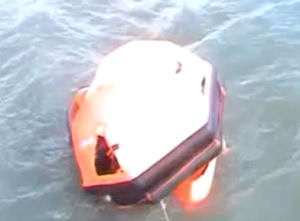 Yachting Monthly’s staff tested 6 rafts for inflation, righting, and ease of boarding. All rafts tested had small ballast bags, some of which hardly stabilized the raft when one person boarded. The results were published in its January, 2009 issue. |
See UK’s Yachting Monthly video testing 6 life rafts...
Life Rafts in America Come of Age
We heard later from insiders at Avon and other life raft companies that they had been trying for years to convince the boating public that buying the cheapest life raft wasn’t the way to go. Essentially they had gotten nowhere with the general public and years of advertising and hundreds of thousands of dollars spent had made some, but not much progress.
Hammond followed up his first article with several more on the subject, both at Yachting and at Motor Boating & Sailing, where went to become the editor in the fall of 1975. Within a couple of years the life raft industry had completely changed, with the well-made, “high-priced” brands making huge market share gains and brand-X relegated to customers who were out of the information loop, or who were simply too cheap to buy a good product.
 The Givens Buoy Life Rafts are approved by the USCG, SOLAS, and ABS, according to the companies website. |
The Givens Buoy Life Raft Discovered
Along the way our editor researched all of the major life rafts on the market, visited inspection centers and spoke with experts on life rafts, including a couple who had lived for three months in an Avon before being rescued, and others who had survived a gale offshore in a raft.
Hammond came away from that investigative experience convinced that the patented buoyancy bag under the Givens life raft made all of the difference. In speaking with people who had been in life rafts offshore he learned that high winds and topping seas tend to turn life rafts over. Once upside down they are hard, sometimes impossible to right again. The Givens huge ballast bag looks ugly in the pictures, but in fact that is what makes it the best raft on the market in the minds of many impartial observers.
 When boats disappear at sea an no is ever found, one often wonders if the life raft failed to work. Dead men tell no tales. |
Not A Subject to Take Lightly
And that’s the story. We just think our readers should have the benefit of our experience, our testing and research, and – yes – our biases. We plead guilty to having some pretty strong feelings about some things.
As for the name of the company making miserable life rafts in the early 1970s, we’ll keep that to ourselves simply because we can not speak with authority about their new line of products or the attitude of their new management, and at this point it would be unfair to tar them with a brush which is now ancient history.
Today there are a number of apparently well-made life rafts on the market. Many of them are probably suitable for work within five miles from shore, where most people do their boating. Nevertheless, beyond five miles or so, we know what we’d carry aboard.
The fact that most small powerboats going offshore do not have life rafts aboard at all is another story for another day.