3 Men Rescued after 8 Days on Capsized Catamaran
The miraculous rescue of three fishermen in the Gulf of Mexico made headlines around the world in August, but what has not been discussed is why the boat capsized in the first place and why the USCG rescue choppers flying over them could not spot them. The owner of the boat says that there was a foot of water in the boat when he discovered that it was leaking and then the boat quickly tipped and capsized as the three men aboard struggled to save the boat. But what did these three men do wrong? What did they do right? And why were they almost invisible in the sea?
Reportedly the boat that capsized was a 23’ Sea Chaser catamaran. In interviews the survivors say they didn’t realize the boat was taking on water until Tressel Hawkins put his foot down from the bean bag seat he was sleeping in. Phillips was sleeping in the bow of the boat on a bean bag seat and reported that the port bilge pump wasn’t working and the boat first tilted to one side and then quickly capsized when a wave hit it.
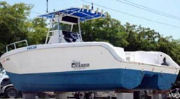 The men were reportedly in a 23’ Sea Chaser catamaran which capsized after taking on water. |
Where Was the Leak?
It would seem that either a thru-hull fitting, hose, or hose clamp most likely let go during the pounding as the men powered for over two hours offshore to get to their fishing location. What was at first a slow leak could have become faster as time went on, overcoming the bilge pump and shorting out the circuit. But we wonder if the bilge pump worked at all since on a small boat one can usually hear them running. In any case, the bilge pumps in most boats are not up to any serious dewatering.
The boat was not new and one wonders what kind of condition the boat was in. Owner Phillips says that he spent a “week and a half building it” before they went on their overnight fishing trip.
 |
Free Surface Effect
Clearly the boat succumbed to the “free surface effect” which makes a boat unstable once sufficient liquid starts moving around in a boat. If a boat’s bilge or cockpit is empty or full there is no change in the loading of the mass as the boat rolls from side-to-side. However, if the bilge, the cockpit, or even a fuel tank is half full, the liquid will respond to the boat’s heave, pitch, roll, surge, sway, or yaw and move the boat’s center of mass and center of moment toward the side of the movement, making the boat unstable and eventually capsizing the boat in extreme conditions.
When a boat is underway and a serious amount of water accumulates in the bilge the boat will move differently, a change which is usually apparent to a boater familiar with the movements of his vessel. However, the three anglers were sleeping and apparently oblivious to the altered roll or pitch of their boat.
No matter how the water got into the Sea Chaser 23' catamaran, it was the free surface effect which caused her to capsize. Evidently, it all happened too fast for the three anglers to respond.
PFDs and Flares
The men reported that after the capsize they retrieved PFDs, flares, food, beer, gum, and most importantly discovered a hose connected to their freshwater wash down tank that provided them with water in the days ahead. One of the survivors said that after the boat capsized they set off the flares. It seems likely that they set off all of their flares while no one was around to see them.
 Tressel Hawkins, one of the survivors, first sounded the alarm about rising water in the boat. |
As to why the boat was not seen by the USCG rescue aircraft which searched an area the size of Montana, we can only speculate. However, it seems likely that with the flares already used up, and the blue bottom paint on the boat, there was little that they could do to draw attention to their little up-side down cat. When searching such a large area, finding a speck on the ocean, is to a great degree, a matter of luck. Perhaps if they had had more flares aboard and waited until they saw a rescue craft to use them, the emergency devices would have been more effective. (Don’t shoot until you see the whites of their eyes.)
 (l to r) Curtis Hall, 28,James Phillips, 30, Tressel Hawkins, 43. |
The Ordeal
After four days the men reported that they began hallucinating, a phenonom which would evidently hit one and then another. Reportedly black tipped sharks circled under their boat at one point. The sun was their worst enemy, but otherwise when found, all three men were in good condition. They were not even hospitalized.
There were many news accounts of the accident and rescue. Below is one of the best that we have read--
Channel 11 News in Houston, TX reported--
Three Texas boaters who were missing at sea for more than a week were reunited with their families Saturday night.
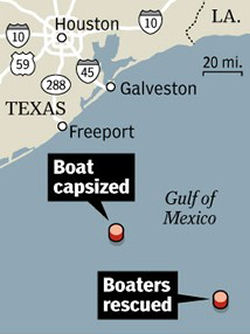
A passing pleasure boat found Curtis Hall, 28, Tressell Hawkins, 43, and James Phillips, 30, sitting on top of their capsized catamaran 180 miles from land.
The men were found a day after the Coast Guard called off its official search, having scoured approximately 86,000 square miles of ocean with no sign of the boaters.
The men had set out for an overnight fishing trip on Phillips’ boat last Friday.
Wake-Up Call
The men said they woke up in the middle of the night to find that their boat was taking on water and tipping over.
“I was moving around on the bean bag and it just started floating out from up under me and I really didn’t think anything about it because I thought was just on a boat and it was shaking around,” Hawkins said. “Once I put my leg down and the water actually reached up to my knee, I just kind of jumped up.”
Hawkins alerted the others, and they immediately attempted to remove the water from the boat, but it was too late.
“We tried to extract the water out as fast as we could. Once we tried to start the boat up and just move it, to have the water just surge out the back,” Hawkins said. “In just like 5 seconds, it just started tilting and just rolled right over.”
The three fisherman jumped ship as the boat flipped. They scrambled back on top of the capsized hull, terrified but unharmed.
The boaters were found sitting on top of the capsized 23-foot-Sea Chaser Catamaran owned by James Phillips of Blessing.
Where are the Flares?
“It’s just shock. You gotta go through the motions, and we’re like, ‘Where’s the flares?’ And Curt just jumps out and jumps back in the water, swims under the boat, comes back out with a bag of life jackets and flares, you know. And we went to shooting flares off, just trying to get people’s attention. And the sun came up, and the journey began,” Phillips said.
It would be a long journey.
The men said they survived by sharing peanut butter crackers, bubble gum and fresh water they’d stored on the catamaran. They used floating debris to shield themselves from the sun.
Hall said that day after day, they tried to flag down other vessels for help, to no avail.
“We seen a ton of boats, we seen some helicopters and we tried flagging everybody we could, and it was just like, I guess not our time to go home yet. I mean, they’d come straight at us, and we’d by like, ‘Hey!’ … And there they’d go. I was like, well, you know, the good man above – either He’s teaching us a lesson or showing us something” Hall said.
When help finally did arrive, the men knew it was a miracle.
Affordable Rescue
Their rescuers came Saturday on a pleasure boat called the Affordable Fantasy.
A small Coast Guard crew met the Affordable Fantasy about 50 miles offshore, where Hall, Phillips and Hawkins were transferred.
They were reunited with their families at Coast Guard Station Port Aransas Saturday night.
Phillips said anyone that really knew them knew they would make it.
“Everybody pulled together. Everybody in this world that pulled together for us, we’re just grateful. My wife, I mean, when [the Coast  told her they was calling [the off, I’m just glad I wasn’t there to see that day, because I know he got an earful. She knew we was alive. Everybody that knew us, they knew we was still alive. We was coming home,” Phillips said.
Down Home Cooking
Once ashore, the men were treated to a hearty welcome-home meal of rib-eye steaks, potatoes and salad.
“It was a miracle. It was a long eight days. I mean, it was just every day, me and Curt and Tressell, we would just sit there and just pray. I kept telling them. I said, look, about after the sixth day I said God must be fixing some people onshore because I know we’re fixed out here. I said, but they need to hurry up. Whatever He’s teaching them at the house, they need to hurry up, because we were ready to come home,” Phillips said.
After their ordeal, Phillips said the three men will be friends for life.
But will they ever go back out on a boat again?
“Absolutely,” Phillips said.
EPIRB Anyone?
On Monday, a spokesperson with the U.S. Coast Guard said a reunion could have come sooner if the fishermen had a device known as an EPIRB on board their boat. EPIRB stands for Emergency Position Indicating Radio Beacon. Since this happened, there’s been a run on them all over town.
“There is a search and rescue satellite system here in the U.S. and it monitors for distress signals,” said Officer Rick Hamblet with the U.S. Coast Guard station in Houston. “It monitors for 406 EPIRB and the satellites will orbit about once an hour. So when a signal is being emitted, it will be picked up about once an hour.”
The device can be activated manually or is automatically activated under certain conditions. The U.S. Coast Guard highly recommends it.
“It really would have eliminated eight days of searching. When the Coast Guard receives a signal of a 406 EPIRB, it will dispatch a resource like the helicopters here at Coast Guard Station Houston and we will fly to the EPIRB position. It is accurate from about one mile to two and a half miles,” Officer Hamblet said.
EPIRBs are sold at most fishing stores. They cost anywhere from $200 to $1,500.