Fish in 50% of U.S. Lakes Have High Levels of Mercury
Last week the EPA released the results of a four-year study of 500 lakes in 47 lower states in which tissue samples were taken of predator fish and bottom dwellers. Levels of mercury deemed to be unsafe for human consumption were found in fish in 48.8% of the lakes tested, and therefore, the EPA assumes by projection, the same is true for the 147,000 lakes and reservoirs in America. The burning of coal accounts for nearly half the mercury emissions in the air which ultimately end up in water and in fish tissue, the EPA says, is the primary problem. What the study does not say is specifically which lakes are contaminated and which are not, and specifically which fish are over-loaded in mercury and which are not -- yet the EPA knows the answer at least in the 500 lakes it studied. Would you like to know the answers to these two questions? Please let us know at the end of this article.
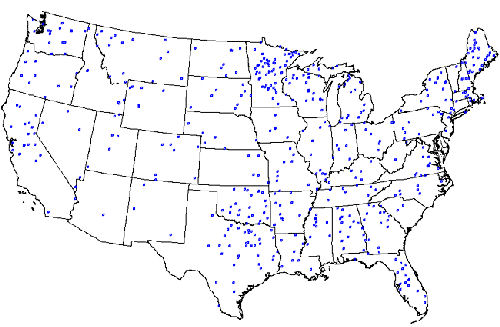 Map showing the 500 lake and reservoir locations from which the fish tissue samples were taken during the 4-year study. The EPA recognizes 147,000 lakes and reservoirs. |
The highlights of the 4-year study are as follows. Total numbers of lakes given have been projected by the EPA, based on their 500-lake sample.
*48.8% of the sampled population of lakes had mercury tissue concentrations that exceeded the 300 ppb (0.3 ppm) human health SV for mercury, which represents a total of 36,422 lakes.
*6.8% of the sampled population of lakes had total PCB tissue concentrations that exceeded the 12 ppb human health SV, representing a total of 12,886 lakes.
*7.6% of the sampled population of lakes had dioxin and furan tissue concentrations that exceeded the 0.15 ppt [toxic equivalency or  human health SV, which represents a total of 5,856 lakes.
*1.7% of the sampled population of lakes had DDT tissue concentrations that exceeded the 69 ppb human health SV, which represents a total of 1,329 lakes.
*0.3% of the sampled population of lakes had fish tissue concentrations that exceeded the 67 ppb human health SV for chlordane, which represents a total of 235 lakes.
EPA Press Release issued on 11-10-09--
WASHINGTON – A new EPA study shows concentrations of toxic chemicals in fish tissue from lakes and reservoirs in nearly all 50 U.S. states. For the first time, EPA is able to estimate the percentage of lakes and reservoirs nationwide that have fish containing potentially harmful levels of chemicals such as mercury and PCBs.
“These results reinforce Administrator Jackson’s strong call for revitalized protection of our nation’s waterways and long-overdue action to protect the American people,” said Peter S. Silva, assistant administrator for EPA’s Office of Water. “EPA is aggressively tackling the issues the report highlights. Before the results were even finalized, the agency initiated efforts to further reduce toxic mercury pollution and strengthen enforcement of the Clean Water Act – all part of a renewed effort to protect the nation’s health and environment.”
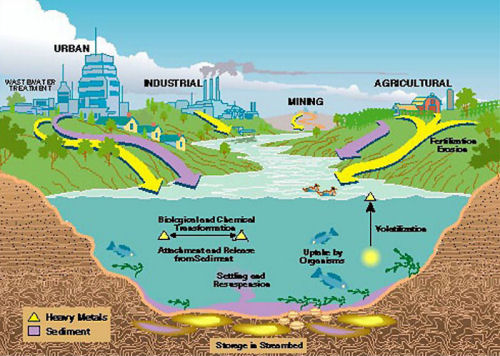 Much of the mercury pollution comes from the fallout from smoke from electricity-generating plants. |
The data showed mercury concentrations in game fish exceeding EPA’s recommended levels at 49 percent of lakes and reservoirs nationwide, and polychlorinated biphenyls (PCBs) in game fish at levels of potential concern at 17 percent of lakes and reservoirs. These findings are based on a comprehensive national study using more data on levels of contamination in fish tissue than any previous study.
Burning fossil fuels, primarily coal, accounts for nearly half of mercury air emissions caused by human activity in the U.S., and those emissions are a significant contributor to mercury in water bodies. From 1990 through 2005, emissions of mercury into the air decreased by 58 percent. EPA is committed to developing a new rule to substantially reduce mercury emissions from power plants, and the Obama Administration is actively supporting a new international agreement that will reduce mercury emissions worldwide.
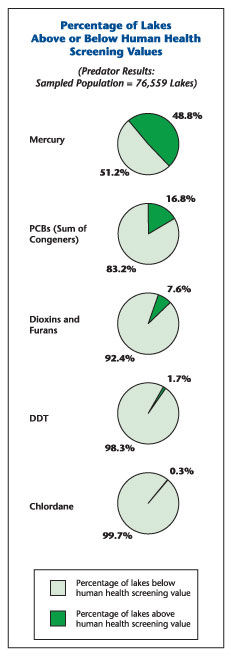 Pie charts showing the percent of U.S. lakes which have contamination of several chemicals above healthy levels. |
The study also confirms the widespread occurrence of PCBs and dioxins in fish, illustrating the need for federal, state and local government to continue efforts to reduce the presence of these harmful chemicals in our lakes and reservoirs and ensure that fish advisory information is readily available.
It is important that women of child-bearing age and children continue to follow the advice of EPA and the Food and Drug Administration on fish consumption as it relates to mercury. This study is also a strong message to state and local governments to redouble their efforts in looking for opportunities to reduce mercury discharges, as well as developing fish advisories, especially to reach those in sensitive and vulnerable populations.
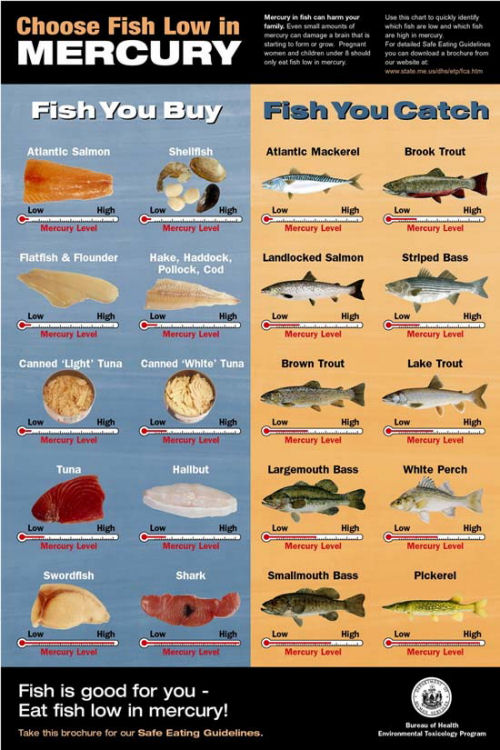 Poster showing levels of mercury in fish. These are general guidelines NOT related to the recent EPA study which seems to indicate that fish taken at half the lakes do not have dangerous levels of mercury. |
Results from the four-year National Study of Chemical Residues in Lake Fish Tissue show that mercury and PCBs are widely distributed in U.S. lakes and reservoirs. Mercury and PCBs were detected in all of the fish samples collected from the nationally representative sample of 500 lakes and reservoirs in the study. Because these findings apply to fish caught in lakes and reservoirs, it is particularly important for recreational and subsistence fishers to follow their state and local fish advisories.
EPA is conducting other statistically based national aquatic surveys that include assessment of fish contamination, such as the National Rivers and Streams Assessment and the National Coastal Assessment. Sampling for the National Rivers and Streams Assessment is underway, and results from this two-year study are expected to be available in 2011. Collection of fish samples for the National Coastal Assessment will begin in 2010.
More information:
http://www.epa.gov/waterscience/fishstudy
More information on local fish advisories: http://www.epa.gov/waterscience/fish/states.htm