Enemy At The Locks! Great Lakes Under Attack!
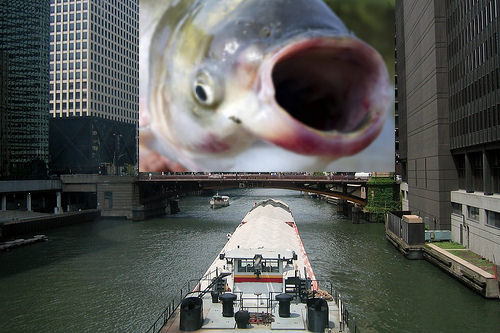 |
| The Asian carp enemy is literally at the gates – the Chicago Sanitary and Ship Canal Locks. Why aren’t the locks locked? Guess who runs them? |
North American freshwater game fish species are on the verge of the greatest mass extinction since the dinosaurs disappeared 60 million years ago. Last week it was widely reported that “genetic material” from the Asian carp had been found in the Chicago Sanitary and Ship Canal beyond an $18 million electrified fence it erected to stop the march of the voracious carp. The carp are literally only a few miles from Lake Michigan with nothing in the way – except a lock – to stop them. The five Great Lakes are the largest body of fresh water in the world and an annual $4.5 billion fishery, to say nothing of being the gateway to most of Canada’s rivers and lakes east of the Rockies. It seems that it will be only a matter of days until the invaders reach Lake Michigan. The U.S. Army Corps of Engineers – the organization charged with protecting New Orleans from flood -- are the folks who erected the electrified fence and who control the Chicago canal locks. We are sorry to report that probably the greatest tragedy to hit North American sportsmen is about to begin. To see videos and read about what is happening and about to get far, far worse.
See what the Asian Carp invasion has been doing;
part I:
part II:
The United States Environmental Protection Agency (EPA) is also concerned about the possibility of Asian carps migrating to the Great Lakes. In 2002, the U.S. Army Corps of Engineers completed an experimental electric fish barrier in the Chicago Sanitary and Ship Canal, the only aquatic link between the Great Lakes and the Mississippi River drainage basins. The initial fish barrier was used as a demonstration project to study the design's effectiveness. Following positive results, construction began on a second, permanent barrier in 2004.
A National Emergency
But this month genetic material from the carp was detected beyond the electric barrier, leaving only a single lock on the Calumet River between the detected presence and Lake Michigan. "This is absolutely an emergency," Joel Brammeier, acting president of the Alliance for the Great Lakes, was quoted as saying, referring to the ecological threat, and also mentioning the threat to recreational boaters.
"Mr. Brammeier and some others called for the immediate closing of the lock ... though others doubted it was feasible to stop shipping traffic  . 'All options are on the table,' said Jacqueline Y. Ashmon, a spokeswoman for the Corps of Engineers. 'We don’t have any specifics.'"
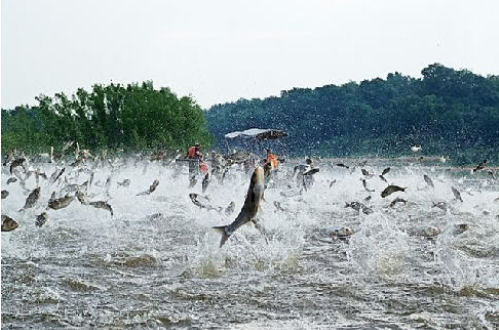 |
| Jumping silver Asian carp are so numerous and dangerous that Fish & Wildlife boats have to have chicken wire to protect the occupants. The few boat in the background has introduced a little electricity into the water in order to count the carp. |
Flying Carp are Dangerous
Silver carp have become notorious for being easily frightened by boats and personal watercraft, which causes them to leap high into the air. The fish can jump 8–10 feet (2.5–3 m) into the air, and numerous boaters have been injured by collisions with the fish. According to the EPA, "reported injuries include cuts from fins, black eyes, broken bones, back injuries, and concussions."
Silver carp can grow to 40 pounds (18 kg) in mass. This behavior has sometimes also been attributed to the very similar bighead carp, but this is apocryphal information. At least one Fish & Wildlife Service officer has said that it is only a matter of time until someone is killed, much like the woman was killed last year in the Florida Keys by a flying ray.
Link the U.S. Fish & Wildlife Service Bulletin about the carp...http://www.fws.gov/midwest/News/documents/AsianCarp.pdf
Asian Carp Invasion: Prepare for the Worst
BY ERIC SHARP
FREE PRESS OUTDOORS WRITER
Anglers in the Great Lakes watershed better fish as much as possible in the next decade. Chances are that yet-another monumental government screw-up has let Asian carp into the world’s biggest freshwater reservoir, auguring a potential disaster for many of our sport fisheries.
New tests let scientists detect the DNA of fish in a river or lake without actually seeing them. Fish have to pee and poop, too, and epithelial cells sloughed off from their bodies showed that Asian carp were in the Chicago Sanitary and Ship canal last month above an electrical barrier that was supposed to keep them out of the Great Lakes.
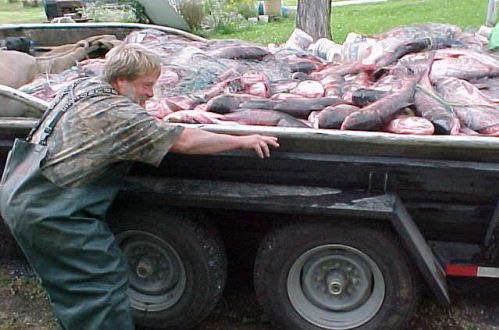 |
| Tons of Asian Carp have overwhelmed American rivers in the midwest. |
The carp were 8 miles below Lake Michigan with only one upstream lock between them and the big lake, but the lock opens regularly. So there’s no reason to believe the fish detected above the barrier are the first to reach that spot, especially since they were discovered the first time that area was tested, or that others didn’t pass through months or even years earlier.
Killed a River
Truthfully, no one knows what will happen once Asian carp reach the Great Lakes. But looking at the Illinois River, where they’ve become the dominant fish species in a mere 10 years, I’d plan for the worst.
We also have the experience of zebra and quagga mussels, invaders from the Baltic that reached the Great Lakes 25 years ago in the ballast of oceangoing ships.
They caused a bottom-up collapse of the food chain in Lake Huron by sucking nutrients out of the water, and many biologists believe the same thing could happen in Lake Michigan.
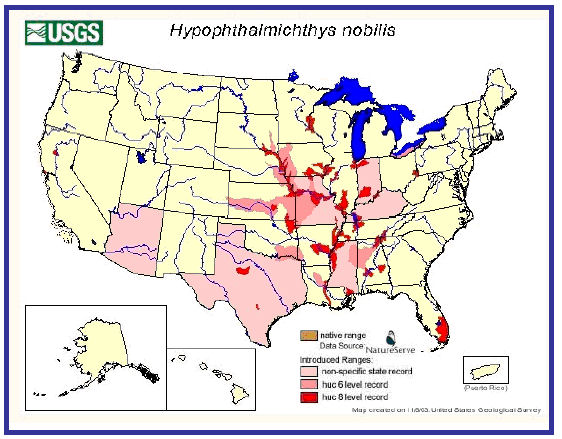 |
| There are several different species of Asian carp. The most destructive are now threatening the Great Lakes. |
Worse Than Zebra Mussels
Huge amounts of potential energy in Lake Huron that used to go into creating rice-sized plankton that fed pea-sized creatures at the low end of that chain is now locked up on the lake bottom in the form of trillions of mussel shells.
Zebra and quagga mussels are about the size of the nail on your index finger. Imagine the mussels scaled up to 40-50 pounds and you’ll understand the kind of damage that can be done by Asian carp, which also make their living by swimming with open mouths and filtering plankton out of the water (up to 40% of their own weight each day).
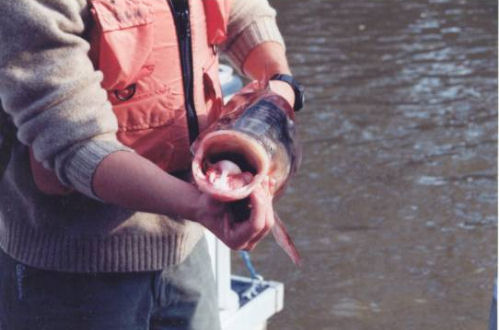 |
| That sucking sound you will hear will not be jobs going to Mexico, but Asian carp Hoovering the Great Lakes. |
Carp Eat Anything
But wait, as they say in the TV infomercials: There’s more! Even if Asian carp suck most of the available nutrients out of the water, that doesn’t mean they’ll die off (although many bait and sport fish will). When plankton get scarce, Asian carp switch to a diet of detritus, the rotting mix of plant and animal matter that lies on the bottom of most rivers and many lakes.
An EPA official told reporters that it was possible the carp wouldn’t fare as well in the colder waters of the Great Lakes as in the Illinois River. He needs to read his own government reports.
Carp Diem
Asian carp have been found living happily under the ice in their native waters, and the Pennsylvania Sea Grant was among several U.S. agencies that concluded the carp “are well-suited to the cold water climate of the Great Lakes region, which is similar to their native Eastern Hemisphere habitats. It is expected that they would compete for food with the valuable sport and commercial fish. If they entered the system, they would likely become a dominant species in the Great Lakes.”
Another government study found that bighead and silver carp prefer water temperatures “similar to those preferred by yellow perch, salmon, trout ... and seem well-suited to invade cold water, including the Great Lakes ecosystem.” Isn’t that lovely?
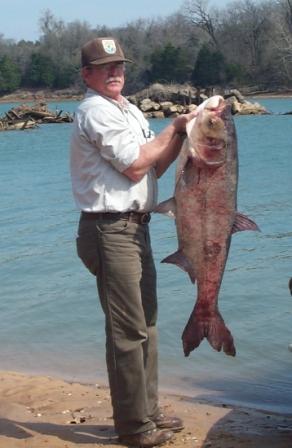 |
| Asian carp can grow to 110 lbs. |
How Did This Happen?
But all this begs the basic question: How did they get here?
Three species of Asian carp – black, silver and bighead -- escaped from Arkansas fish farms and sewage lagoons in the 1970s, and silver and bigheads have literally taken over much of the Mississippi, Missouri and Illinois rivers. And while they’re called carp, they are about as closely related to a common carp as a horse is to a cow.
Conventional wisdom says Asian carp were imported by Arkansas fish farmers to eat algae in ponds and escaped into the Mississippi River during floods. That’s partly true, and it’s a concise way to explain their arrival in the tight space allowed in a newspaper story.
But as the Milwaukee Journal-Sentinel found in a careful investigation of this mess, the hands of the Arkansas and federal governments are as dirty as those of the fish farmers.
More EPA Rocket Science
The Arkansas Game and Fish Commission, backed by funds from the Environmental Protection Agency, made the carp available to municipal water treatment plants to eat algae in sewage lagoons. The Journal-Sentinel said the concept was that carp raised in the sewage lagoons could be sold as food to people to defray some of the costs of treating the sewage.
You probably won’t be surprised to learn that the U.S. Food and Drug Administration didn’t think this was a good idea. The program died out, but the State Journal said there were many escapes of Asian carp from the sewage plants before it did.
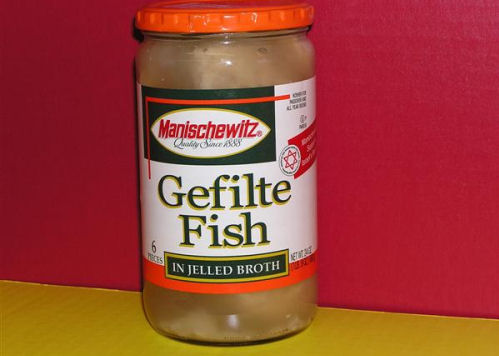 |
| Gefilte Fish is made from Asian carp, as well as other white fish. Asians have been eating them for millennia. Maybe North Americans will develop a taste for them smothered in Tabasco. |
Government at its Best
I found a story I wrote nearly 10 years ago about Jerry Rasmussen, a U.S. Fish and Wildlife biologist who by 1990 was trying desperately to warn people about the potential threat from the carp.
But he was called on the carpet by his bosses and told to shut up after the fish farmers complained to their friends in Congress, the “Arkansas mafia” of politicians allied with the Clinton administration. When Rasmussen refused to be muzzled, the USFWS tried to eliminate his job.
Prophetically, Rasmussen wrote then that there was a real danger the invaders would eliminate numerous native aquatic animals.
“All of the Asian carps will thus likely be thought of by our grandchildren as ‘natives’; and even worse, our grandchildren may never see or know that species such as the paddlefish, buffalo(fish), and others ever existed — all because of selfish, self-serving decisions made for the benefit of a few people in the late 1900s!” he said.
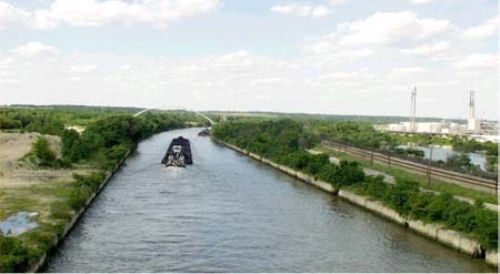 |
| This is the yellow brick road for Asian carp to reach Lake Michigan. It is the only waterway between the Great Lakes and the Mississippi river system. |
Where’s Brownie?
We may have to add a number of Great Lakes game fish to his litany, because the carp are almost certainly poised to invade the Great Lakes in large part because the Corps of Engineers bungled the effort to build an electrical barrier to keep them out.
The barrier was finally put into operation this fall, years behind schedule, with far less electrical power than it was supposed to operate with and for way more than the original budget.
Oh, and it turned out it didn’t work to repel the small carp and has to be shut down twice a year for a week for maintenance, which the corps didn’t realize until the thing was virtually finished.
Other than that, it was fine.
Canadians Will Suffer, Too
Here’s something else to think about – if Asian carp become established in the Great Lakes, they aren’t going to be confined there. Like invasive mussels, it’s only a matter of time before they show up in inland lakes and reservoirs. The mussels were moved to the inland lakes mostly by anglers transporting boats from place to place. The Asian carp most likely will be moved by anglers as well when juvenile carp get mixed in with bait minnows.
While it’s probably another case of a day late and a dollar short, the feds have come up with a plan to poison a chunk of the Chicago canal and essentially sterilize it
We better hope it works.