Rogue Fishermen Slaughter Dolphins
In a world where tuna fishermen go to extraordinary lengths and expense to make sure that dolphins are not caught in nets meant for tuna, there are fishermen who make their living catching and slaughtering them. 26 fishermen in the small fishing village of Taiji, Japan are breaking an international taboo against killing the most intelligent aquatic mammal alive. The fishermen and the town’s fathers have long kept the truth hidden from the Japanese people and their media, but recently an enterprising and courageous film maker has captured the aquatic holocaust on video tape.
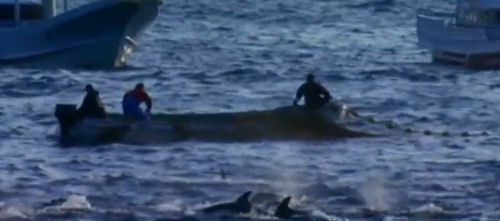 Flipper is on the menu in a small Japanese village that has been keeping a terrible secret for years. |
By Robert Gilhooly — Special to GlobalPost
Published: December 10, 2009 06:33 ET
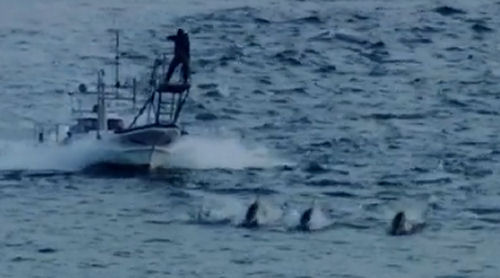
Taiji is a picturesque fishing town on Japan's Kii Peninsula. It is also the site of one of Japan's annual dolphin slaughters, that occurs during a six-month hunting season. Twenty-six of the town's 500 fishermen will catch up to 2,300 dolphins, which is just more than one-tenth the national quota.
 |
Flipper on the Menu
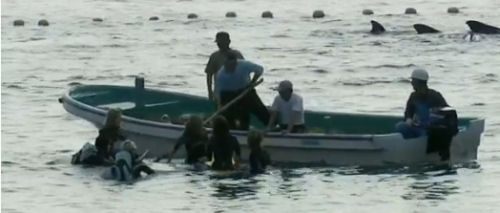
Some of the dolphins caught, including the misleadingly named pilot whales, will end up in the freezers and fridges of the town's only supermarket, where a 200-gram block of the meat is priced at about $13. Other, more prized varieties, such as the better-known bottlenose dolphin, are sold to aquariums and dolphinariums in Japan and China and are reported to fetch as much as $150,000 per head.
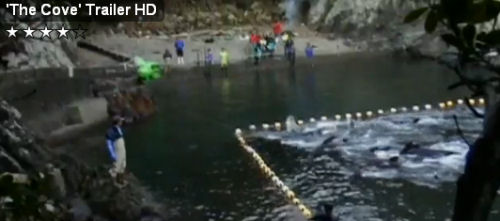
Although there are several other catch sites around Japan, the international spotlight has fallen on Taiji mainly due to the release of the documentary film “The Cove,” which shows in graphic detail the notoriously brutal catch-and-slaughter method that is practiced by fishermen in Taiji and their efforts to cover it up.
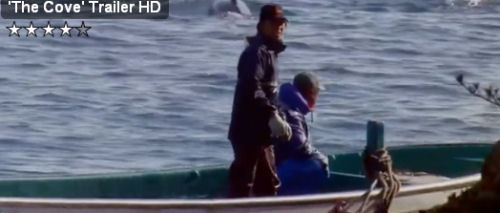 |
My efforts to photograph the first cull of the season in early September were hampered by neurotic fisheries officials and police who seemed intent on misleading and distracting. Apparently they were worried that I might try and sabotage the cull as Sea Shepherd activists had done in 2003.
One of those fisheries officials, a woman who claimed to be a dolphin trainer, followed me up a path leading up a steep cliff and instructed me that I could not take photos, even though I was standing in what was part of a national park. I eventually got away and although I could hear the goings on below it was almost impossible to find a vantage point from which to shoot.
 |
Crawling gingerly along a narrow ledge thick with trees and other vegetation, I peeped down over an almost sheer drop and caught a brief glimpse of the bloody waters below. Grabbing a thick branch with my left hand, my camera at the ready in the right, I leaned out to get a better view, my right foot wedged between two rocks sticking out from the cliff face.
The Killing Cove
It was from here that I was able to see the deep crimson waters that formed a stark contrast with the blue and green tarpaulin that had been drawn across the cove in an attempt to hide from public view what was going on beneath. Yet, momentarily a figure dressed in a wetsuit, his shaven head and upper torso clearly visible above the water, comes into view between the tightly drawn sheets. I could see that in his right hand he clutched what looked like a large metal meat skewer, and in his left hand he had the fin of a dolphin.
 |
About the photographer:
Robert Gilhooly is a freelance photojournalist based in Japan. His work has appeared in publications around the globe, including Newsweek, Time, the New York Times, L.A. Times, International Herald Tribune, The Times and the Guardian. He was formerly a staff reporter at the Japan Times. He has also contributed to numerous TV documentaries and books.