10 Years of Streaming Video Pioneer Work
BoatTEST.com’s first videos of boat tests were shot 15 years ago in 1996 by Capt. Chris Kelly for his weekly TV program “Sea Trials” which aired on the Speedvision cable channel. When Kelly and co-founder Jeff Hammond started BoatTEST.com in 2000 nearly 100 “Sea Trial” videos were re-purposed for streaming on the Internet. On Sept. 15, 2000 these boat test videos became the first recreational marine videos to be streamed on the Internet to a world audience. At the time, BoatTEST.com was on the cutting edge of the technology and one of the few websites in the world streaming video 24/7.
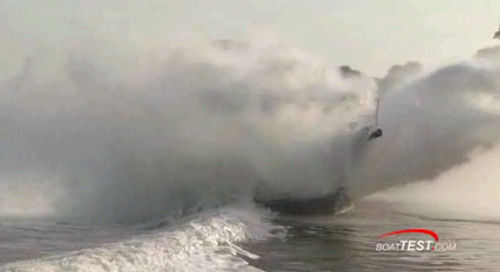 Still pictures just can’t capture the handling and feel of a boat and how it actually performs in a seaway, but streaming video can do a pretty good job of it. |
Virtually everything that BoatTEST.com does is to help boaters do meaningful research on new boat buying, and videos have always been an important aspect of that process. It is only with video that our captains can effectively show how things work, spacial relationships, handling characteristics, and demonstrate the ergonomics involved with the specific boats they are testing. Further, most people – particularly young people – prefer to get their information by video rather than any other way. It is for that reason alone, that BoatTEST.com has been such a success and a highly utilized and prized resource by people actually in the market to buy a new or used boat.
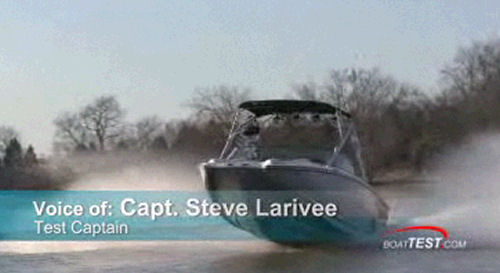 This picture is neat, but it doesn’t tell us if the boat will chine-walk, come down on one side or the other, or get squirrely – only video or actually being aboard can do that. |
High-Quality Video
Because our videos were first made for cable TV and not the Internet they had to be of very high-quality resolution which meant that they couldn’t be shot with low-cost home video handicams pointed by amateurs. Right from the beginning our videos where shot on large-format beta cameras used by local TV stations for their news broadcasts. We next put together a team of professional videographers around the country with years of experience shooting for TV production that could shoot our boat tests no matter where we might do them in the country.
Grabbing the High Ground
When co-founders Hammond and Kelly started BoatTEST.com in 2000 they knew that they were ahead of the curve when it came to streaming video because only 4.4% of the American households had broadband and only roughly 25% of American businesses had it. Yet, they knew that in order for BoatTEST.com to be the world’s leader in powerboat buying research they would have to be pioneers not only in the new field of Internet publishing, but also in the even newer field Internet video broadcast, which was at the time just starting. By having the videos ready and waiting, they knew that when the consumers were ready to buy they would come to the website.
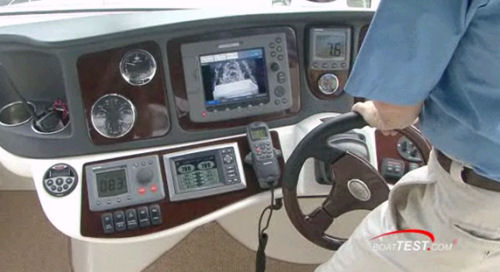 How hard is it to turn this wheel? You’ll never know in a still photo, but in a video you can see exactly how long it takes the Captain to turn the wheel lock-to-lock. |
BoatTEST.com became one of the very first legitimate, family-oriented (i.e. not porn) websites in the world to stream video 24/7 as an integral part of its website offering. Local TV news channels, CNN, Fortune 500 company product commercials, YouTube, and virtually everything else was years away, when the concept of watching video on a computer was accepted and proven.
Blazing a Trail with Streaming Video
In the beginning BoatTEST.com encoded its videos at two delivery speeds: 56 kbps for dial-up and 175 kbps for broadband. In the beginning, buttons were next to each video test so that users could select what streaming speed they wanted – “dial-up” or ”high-speed” -- based on their modem. The video picture size in both cases was small simply because in 2000 and 2001 the amount of data that could be transmitted and handled by the both the Internet and computers’ CPUs were limited.
Because BoatTEST.com was on the cutting edge of streaming videos much of what we did in the early days was expensive and labor intensive. For example, in 2000 and 2001 all of our videos were Fedex’d to the west coast for encoding. Only a couple of companies were in business to stream video, located next to Internet “backbones” and had the horsepower to deliver streaming video flawlessly and quickly all over the world. All of this was expensive and everyone was learning at the same time, including the experts.
In 2003 BoatTEST.com transferred its massive files and pages to a small company in nearby New Canaan, CT, which was started by one of the early wiz kids of video streaming, and our video product took a jump to the next level of sophistication. Roughly half of the BoatTEST.com audience now had access to broadband, mostly at their place of employment. We knew that because our servers could detect not only how many people were on the website at any one time, but also at which speeds our member-users were seeing our video.
“Access” to Broadband was Critical
Each Monday morning we saw a huge spike in viewership as our members arrived to work where they had access to broadband. Our video plays skyrocketed each Monday and we had to pay for the bandwidth to accommodate the spike, which was also expensive.
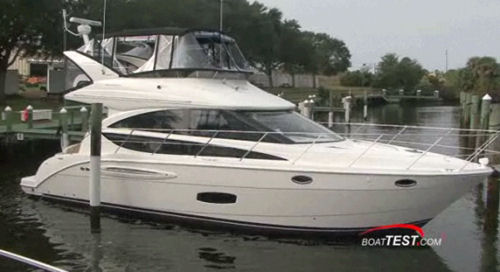 This looks like a boat leaving a slip, or is backing into one? Only video can show you what the boat is doing and how easy – or hard – it is to maneuver. |
In 2003 only 20% of the American households had broadband and our technical people were working hard to improve their video experience. That year we were able to install software on our servers which instantly detected at what bit rate each member logged on could stream. Not only that, but the new software could automatically send to their individual computer the largest and fastest file that their computer could stream at any given time. In many cases that was the smallest file, but it also insured that our videos played.
BoatTEST’s Multi-Rate Delivery System
To do that, all of our video files were re-encoded at four bit rates: 10 kbps, 25 kbps, 49 kbps, and 300 kbps. Three of the four new speeds were for the 80% of the households that still had dial-up, many of which still had old modems that were only 14.4 kbps or 28.8 kbps and couldn’t even handle 56 kbs.
Now more of our members could enjoy our video tests no matter how old their computer and modem at home in the evening and on weekends without having to wait to get to the office. Our traffic soared during 2003 as nearly all of our members were able to stream our video at one rate or another. No other website in the marine field had that capability
YouTube Changed Everything
Two years later, the most important event in the process of Internet video development occurred – it was called YouTube. The first YouTube video was uploaded on April 23, 2005, beta testing of the site was done for six months before the official launch in November 2005. The site grew very rapidly, and in July 2006 the company announced that more than 65,000 new videos had been uploaded. The site was receiving 100 million video views per day. In November 2006 Google bought YouTube for $1.65 billion. (In 2009 there were over 6 billion video plays on YouTube and the cost of its bandwidth alone was $1 million per day!)
For the marine industry, the success of YouTube turned on the light bulb on more effectively than the BoatTEST.com’s staff ever could. Almost immediately boat builders who had never quite understood why simply testing the boat for performance numbers and providing a written Captain’s Report to boat buyers was not enough – to make the investigative experience truly informative and compelling – it had to have well-executed 3rd party video. Finally, what BoatTEST.com had been doing with videos on the Internet for six years made sense.
Today, there are over 700 BoatTEST.com boat test videos and reviews on YouTube.
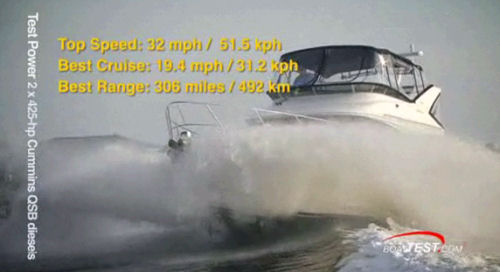 Will the deck get wet, will the skipper? Video shows it all and you’ll see how the boat behaves in a seaway as well. |
An Educated Consumer...
And in 2006 and 2007 our captains were busier than ever making boat test videos and reviews. Boat buyers were going to BoatTEST.com, seeing the videos, the performance numbers, the Captain’s Reports and walking into dealer’s showrooms better educated, better informed than ever before. That year we were told again and again by boat dealers around the country that often the customers knew more about the boats than did the salesmen.
Videos became the hot ticket. Boat builders – who had always had videos made of their new boats but had nowhere to show them except on TV monitors at boat shows -- started making their own videos with their own sales managers going through the boats. The Internet video age had arrived in the marine industry.
Boat Videos Galore
Now in its 10th year, BoatTEST.com has over 4,000 videos available on demand on all sorts of marine subjects, with hundreds on engines, and about 1300 on boat tests or reviews. In addition to our own videos which we make, we have also encoded and make available on BoatTEST.com hundreds of boat, engine and product videos from boat and engine manufacturers and other OEMs as a convenience for our members, for education and as a courtesy for our industry partners.
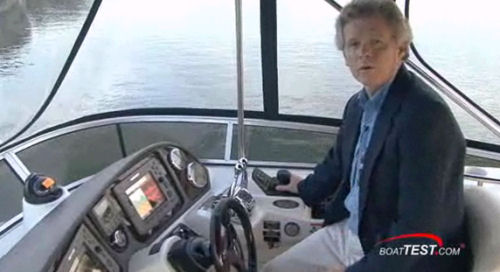 Video captures more than what a boat looks like and how it behaves, you also find out if the captain can look you in the eye, and you hear the tone of his voice.
|
Today, nearly 100% of businesses in the world with more than a handful of employees have broadband access and over 50% of the households in the U.S. have broadband, ranking it 17th in the world for broadband household penetration. South Korea ranks first, with Scandinavia second, and western Europe third, Canada third, followed closely by Australia – all way ahead of the U.S.
BoatTEST Videos Today
Currently, we stream videos in three different formats: 320 x 240 in Windows Media, 400 x 300 at 492 kbps in Flash, and 640 x 360 in Flash V.8. The size of the videos depends on at what point in time they were made or updated over the last 10 years. The smaller bit-rate videos are the older ones which have not been updated as yet because the process is labor and cost intensive. By sometime next year we expect to have all relevant boat test videos updated to the large format – but of course by that time there will undoubtedly be a new technological advancement. We are already shooting new video exclusively in HD, and we have our eye on the latest developments in 3-D. Stay tuned.