Will the Supremes Stop The Impending Carp Disaster?
In an attempt to prevent the Asian carp from entering the Great Lakes, the state of Michigan filed a brief on Dec. 21, 2009, with the U.S. Supreme Court which will hear the petition in two days. This is not a lawsuit, but rather a petition for a decree to enforce the closure of Chicago-area locks. Ohio and Minnesota have also joined the lawsuit as plaintiffs. Asian carp could fundamentally destroy the Great Lakes ecosystem and already their DNA has been found north of an Army Corps of Engineers electric “barrier” fence.
 The 9 men and women in black can stop the onslaught of rapacious Asian Carp from devouring the Great Lakes’ flora and fauna simply by waving five of their nine right hands. But will they? |
As it stands, some 7,000 Chicago area boaters would be adversely affected by the closure of the locks connecting Lake Michigan to the canal and river system which is infested with Asian Carp. It seems to us that these boaters can find alternative ways to pursue the sport, and that is a small price to pay for the protection of the largest freshwater lake system on the planet.
Local Boating Federations Whine
“Without a workable solution to access to the river from the lake, boaters will be unable to continue using the river system that they have utilized for decades recreationally and for storing their boats. Boaters would like to help protect the Great Lakes from the Asian carp, and to know what solutions are available for them to participate in this endeavor,” said F. Ned Dikmen, chairman of the Great Lakes Boating Federation. “Shutting the locks permanently could jeopardize the $80 million economic impact that flows into Chicago’s economy. The Chicago Park District continues to depend on the $15 million in mooring fees it derives from Chicago boaters to subsidize the cost of creating and maintaining jogging tracks, tennis courts and other recreational amenities that Chicago citizens enjoy,” he added.
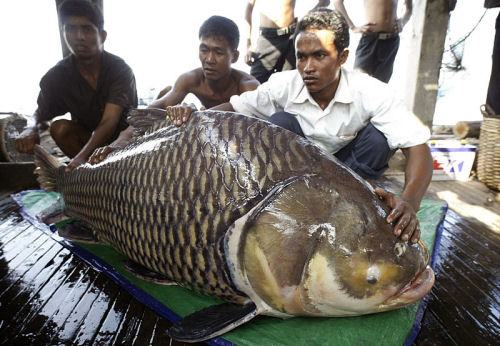 Asian carp can easily grow to well over 100 pounds. |
Readers’ Comments Invited
$80 million? $15 Million? This is chump change compared to the destruction the Asian carp will have on our ecosystem by hoovering up all of the flora and fauna in the Great Lakes, thus starving out other fish in time.
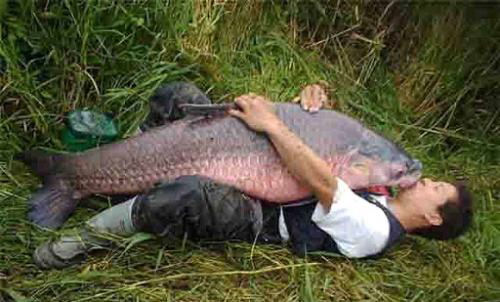 We don’t know exactly what is going on here, but we don’t like the looks of it. This guy is a little too fishy for us. |
Following is a blog by Professor Noah Hall, who is on the faculty of Wayne State University Law School and is a frequent visiting professor at the University of Michigan Law School. He is also the founder and Executive Director of the Great Lakes Environmental Law Center and this material appeared first on his blogsite called “Great Lakes Law”--
Michigan Attorney General Mike Cox has filed suit in the U.S. Supreme Court on behalf of the State of Michigan against the State of Illinois for allowing Asian carp to potentially invade the Great Lakes through the Chicago Canal and other managed waterways. Technically, this is not a new lawsuit, but a petition for a new Supreme Court decree (basically an order) under the old Chicago diversion case, Wisconsin v. Illinois. That case, which has gone on for nearly a century and primarily involves Chicago’s diversion of Lake Michigan water out of the Great Lakes basin, expressly allows the parties (including Michigan) to petition the Supreme Court for a new decree.
What This Petition Actually Says
The State of Michigan is filing a petition for a Supplemental Decree declaring that the current condition of the Chicago Canal and other related waterways that link the Mississippi River with the Great Lakes, as maintained by State of Illinois (along with the Metropolitan Water Reclamation District of Greater Chicago and the US Army Corps of Engineers) are unlawful. Michigan is asking the Supreme Court to declare:
“that to the extent the facilities created, operated, and maintained by [the State of Illinois and the Army  in connection with the diversion now allow the introduction of harmful aquatic invasive species into Lake Michigan and other connected waters, they constitute a public nuisance. Those facilities create a threat of irreparable injury to natural resources held in trust by the State of Michigan, as well as riparian and other rights of Michigan and its citizens.”
Michigan makes clear in its petition that it is not seeking to alter the quantity of water being diverted from Lake Michigan for Chicago’s public water supply, but rather “modification of the means created and maintained by and the Corps to accomplish the diversion.”
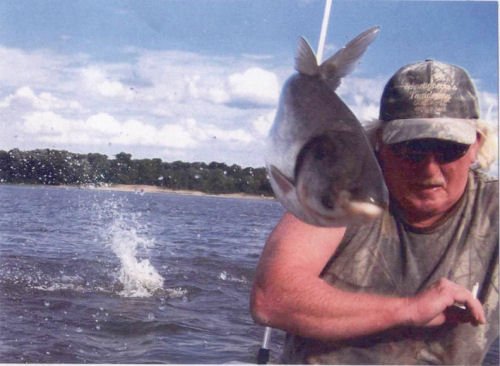 This boater almost got beaned by the flying Asian carp seen here. Sooner or later a boater will be killed. |
Enjoin the Corps
Michigan has also filed a motion for a preliminary injunction to (1) close some of the locks on the Chicago Canal and connecting channels, (2) operate electric barriers in the canal at full strength, and (3) monitor for Asian carp and eradicate any Asian carp found. Several passages from Michigan’s motion for preliminary injunction explain perfectly what’s at issue in this litigation:
“The states and Canadian provinces bordering the Great Lakes, and everyone that uses the Great Lakes for recreation or commerce, face a dire threat to this unique and irreplaceable resource, the largest freshwater system in the world. It is well documented that silver carp and bighead carp – huge by freshwater standards, voracious and prolific – pose a real potential to wipe out native species of fish in any waterway that the carp, each a species of Asian carp, comes to inhabit. These fish, near the end of an unrelenting march up the Mississippi River from Mississippi and Arkansas – are literally at the threshold of Lake Michigan, swimming in the rivers and canals near Chicago.
The urgent need for action cannot be overstated. Partial measures are no longer an option. The remaining obstacles between the carp and Lake Michigan are the navigational locks and other structures operated by the Corps and the [Metropolitan Water Reclamation District of Greater . If [Illinois and the other continue the current operation of these structures, particularly the locks, Asian carp will pass through these structures, and inevitably enter the Great Lakes system.
Other Potential Carp Routes to the Great Lakes
Further, there are additional potential pathways provided by the Des Plaines River flooding and the Grand and Little Calumet Rivers. Given the rapid advance of these fish up the Mississippi River, there is no reason to believe that this invasion is not imminent.
If the carp make it to Lake Michigan, the environmental and economic disaster to follow may take some time to develop, but is virtually certain.”
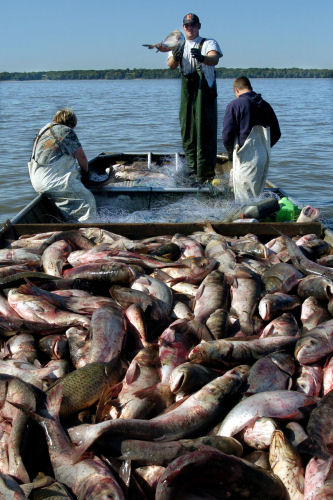 Asian carp reproduce quickly and have no natural enemies in U.S. waters and will quickly take over the ecosystem. |
Previous Case History
While the implications of this case are tremendous, the background legal issues involved are fairly well-settled. Under the U.S. Constitution (Article III, Section 2, Clause 2), the U.S. Supreme Court has original jurisdiction to hear disputes between states. The Supreme Court has exercised this jurisdiction in the ongoing case over the Chicago diversion, Wisconsin v. Illinois, to which Michigan is a party and the U.S. federal government is an intervenor. Since Michigan is seeking new relief involving the waterways and canals that Illinois and the other defendants operate pursuant to the Wisconsin v. Illinois decree, Michigan is on very solid legal ground to bring this case directly to the U.S. Supreme Court.
The Supreme Court will be faced with a classic interstate nuisance dispute. This is nothing new...The Supreme Court will make a fact-specific inquiry (aided by a special master) to balance the competing interests of Illinois in keeping the Chicago Canal open against the interests of Michigan (and other Great Lakes states that may join the action) in protecting the Great Lakes fisheries from invasive Asian carp.
“Irreparable Harm”
Based on Michigan’s brief, it seems that Michigan can clearly demonstrate that the potential harm from the Asian carp invading the Great Lakes far outweighs the costs and burdens of closing the canal locks. While closing the canal locks will cost the shipping industry and its customers substantial money (tens of millions of dollars), letting the Asian carp in could cost Michigan and other states far greater sums (billions of dollars) in harm to the Great Lakes fisheries. Michigan’s motion for a preliminary injunction also makes a compelling case, especially with regard to the “irreparable harm” from allowing the Asian carp to enter the Great Lakes while the litigation is pending.
Cox Cares About Ecology, Too
I know that Michigan’s Attorney General, Mike Cox, is currently running for the Republican nomination in the 2010 election to decide Michigan’s next governor. Mike Cox is no political novice, and it would be simple to dismiss this lawsuit as a political move to gain support from Michigan’s many fisherman and boaters who are terrified of Asian carp invading the Great Lakes. But Mike Cox has a strong record of legal action to protect the Great Lakes from invasive species. And more importantly, the petition and other filings demonstrate that the Attorney General has a through, well-researched, and persuasive legal argument. Mike Cox and his staff are doing the right thing, in the right way, at the right time. While some politicians are sending letters, pointing fingers, or doing nothing at all, Mike Cox should be commended for taking reasoned, decisive legal action to protect the Great Lakes.