BoatTEST.com Invented for Boat-Buying Research
Since the 1950s there have been so many boat models available to the public and they were so complex, publishers of marine magazines have long realized that there needed to be one archival source for consumer research. As an editor or publisher of numerous marine magazines over more than 30 years, co-founder Jeff Hammond had long struggled with the challenge of bringing a large body of information to consumers in print in a meaningful way. Then, in 1999 a college co-ed who was doing a strip-tease in her room and sending jumpy video the size of a postage stamp of the performance over the fledgling Internet made coast-to-coast news. This young gal changed more than just her clothes.
 A boat is usually the second most expensive thing people buy. That’s why most boat buyers are hungry for solid information and 3rd-party commentary they can use for serious research. BoatTEST.com's captains have been giving product guidence to a whole new generation. |
At about the same time as the first sketchy videos were being transmitted on the Internet through low baud-rate modems, Capt. Chris Kelly who had been producing “Sea Trials”, a weekly 30-minute cable TV program since 1996, contacted Hammond, the retired founder of Power and Motoryacht. Kelly asked him to invest in expanding his 30-minute program into an hour on Speedvision. His format was four 3 to 4-minute videos of boats being tested, something that Kelly had done for years as a magazine writer for Hammond’s magazine.
“The future is the Internet,” Hammond responded, “and everyone will have their own TV channel on it, just like the strip-tease co-ed. Let’s put your TV program on the Internet where people can do research whenever they want. Buyers don't use TV for research.”
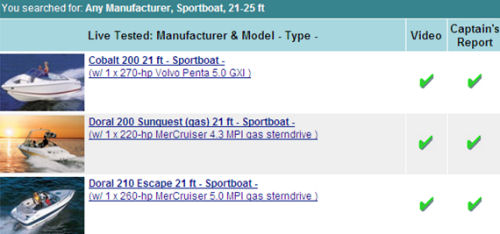 From the beginning BoatTEST.com has encouraged researchers to view many boats in the type and size range they are considering to make sure they are getting the best boat on the market for their specific application. |
The Trouble with “Old Media”
Hammond was of the opinion that TV and magazines were “old media,” and the “coming thing” would be a combination of text research which was the founding reason of the Internet in the first place, and short-clip videos which had been popularized by MTV in the 1980s.
He had observed that his children had been captivated by the short music videos on MTV and 20 years later that generation was now beginning to graduate from college. That phenomenon of short video clips had been imprinted on peoples’ minds as a pleasant experience, Hammond reasoned. That, together with the high readership of “short bursts” of text information pioneered by the newspaper USA Today, all coalesced to form the concept of BoatTEST.com – a place where consumers could do research quickly, finding short, meaty bursts of easy-to-read text and also see short, informative videos.
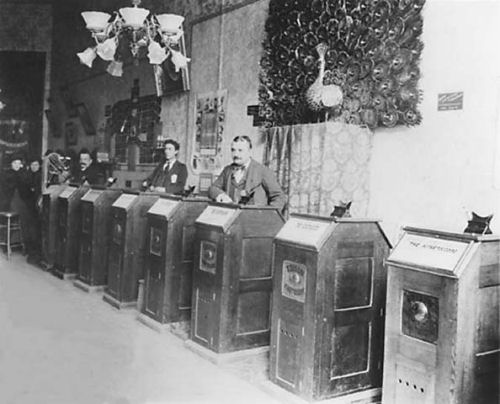 In 1893, Thomas Edison patented the first efficient motion picture viewer, the kinetoscope. A customer could drop a penny into the kinetoscope, turn the crank, look through the viewfinder, and enjoy a short "movie" loop. Early Internet streaming video was little different. |
Fly in the Ointment
The trouble was that in 1999 Internet technology and the CPU capacity of most peoples’ computers would not permit streaming a video that was much better than the “card-flip motion pictures” that were popular in the late 1800s in amusement arcades. Indeed, most people had 14.4 kbps computer modems connecting them to the Internet that could hardly load still pictures much less stream video.
The focus of BoatTEST.com would not be video, but rather the actual test results – WOT speed, fuel consumption, best cruise settings, range, noise readings, boat handling, and other aspects of performance – together with the captains’ written reports. These elements would be the meat for information-hungry boat consumers. Videos would be the sizzle for the people who could watch them.
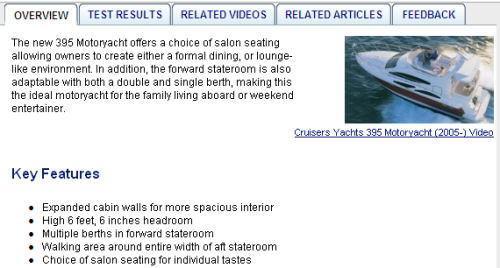 The five-tab format pioneered by BoatTEST.com has become widely copied in the marine industry. Now, consumers can easily access related videos and articles during their research. |
No “Force-Feeding” of Information
BoatTEST.com would differentiate itself from both monthly boating magazines and boating cable TV programs, both of which “force-feed” information about boats to its readers that the publishers have selected. Rather, BoatTEST.com would adopt the “information-on-demand” model that allowed consumers to pick and choose what they wanted to research-- when they wanted it. Finally, after over 50 years, there was a way for boat buyers to access information on their terms and timetable.
Power to the People
The fact was obvious that magazines and television were not invented for research, but rather for communication of one entity (a publisher, editor, or advertiser) to many people. The TV producer or magazine publisher had the “power” and the audience had to take or leave what was offered.
But with the Internet, BoatTEST.com could turn this paradigm upside down, giving the “power” of selection to the people to select what they wanted to know about, and at the same time take that decision-making authority away from the publisher. Not surprisingly, the boat buying public loved being able to read about the boats they were interested in at any given moment rather than being told what they had to watch or read.
In one, bold stroke, the Internet took away the power of publishers and producers to regulate available boating content. At the same time the Internet permitted serious comparison boat-buying research that had never been possible before, and certainly not from the comfort of one’s home.
 |
Comparison Features
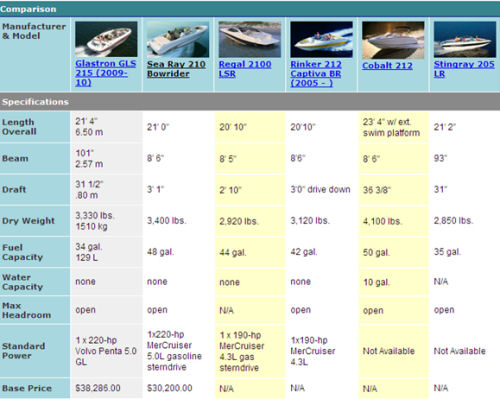
One of the most popular research tools developed over the years was the comparison tables. This device was introduced by BoatTEST.com in 2002 and is how BoatTEST is able to compare up to 75 different aspects of a boat's basic specs, performance, standard and optional equipment and other important details.
This together with used boat prices linked to the tests, owners comments and full owners reports bring in other elements to help buyers more fully consider their purchase. Finally, one of the most well-used functionalities of BoatTEST.com is the breadth of its engine information – text, tables, comparisons, and videos. After the hull, the most important aspect of a boat is its engine and consumers need to research them as well to determine which brand and horsepower will best serve their needs and pocketbook.
Now in its 10th year, BoatTEST.com is still a work in progress. There are many places where it needs improvement and there is still more functionality that would be valuable. We doubt that our development work will ever be done.