10 Years of NMMA Certification
We think that one of the most important developments to transpire during the last
decade in recreational boat building has been NMMA Certification of pleasure boats.
Before it was instituted 10 years ago, builders were only required to meet a few
basic requirements laid down by the Coast Guard. But today’s recreational boats
must meet standards that span hundreds of pages of detailed standards in order to
be "NMMA Certified." These requirements have added to the cost of boats, but they
have also made them much safer.
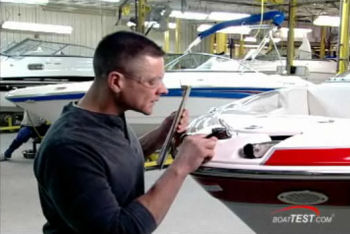 Ten years ago the NMMA started certifying that its members actually built boats to ABYC standards. The program has had the obvious benefits for the consumer. |
Ten years ago the NMMA (National Marine Manufacturers Association) began certifying
that its boat-builder members met selected standards laid down by the American Boat
and Yacht Council (ABYC). With hundreds of builders, thousands of boat models and
hundreds of standards that had been promulgated over nearly 50 years by the ABYC,
it took several years for the certification to reach virtually all boats built in
the U.S. and now foreign boats sold in the U.S. and Canada, as well.
In our opinion, this is perhaps the most important single development in recreational
boat building since the introduction of fiberglass.
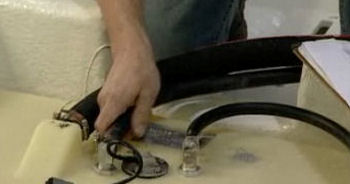 NMMA inspectors check compliance with hundreds of standards, including regulations about the installation of the all-important fuel tank connections as shown here. |
Boat Builders Asked For Regulation
Ironically, the institution that is responsible for the instigation of tougher standards
for boat construction was a small group of boat builders themselves. To anyone who
recalls the screams of outrage and whining that issued from Detroit automobile builders
in the 1960s and ‘70s when Washington required a few basic safety features such
as seat belts, and later air bags, this might be puzzling. Can you imagine Chrysler’s
Lee Iacocca or GM’s Roger Smith asking for tough new car safety standards?
Well, that’s exactly what happened in the American boating industry. It occurred
because several of the independently-owned builders as well as two of the largest
builders asked the NMMA to impose ABYC standards on all builders. Not surprisingly
their boats were being built to the standards and cost more than did the boats built
by companies not following the standards, making it harder for them to compete.
Further, the less than optimum build by some manufacturers, they feared, were giving all boats a bad name.
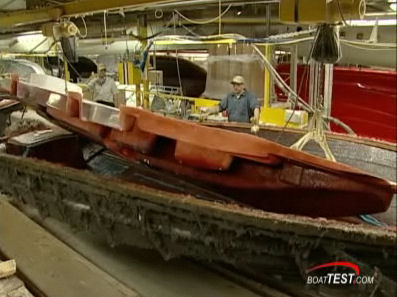 NMMA-Certified boats are 7 times less likely to be recalled than ones that are not certified, says the NMMA. |
Cream Always Rises
For the most part, the small builders wanting higher building standards were family-owned
and they cared about the reputation of their brands because their livelihood depended
on consumers trusting their products. They also wanted consumers buying entry-level
boats to have a positive boating experience, because they knew that eventually these
boaters would gravitate up to the boats they built. If boaters got out of the sport
because of too many problems with their boats, these builders would never get a
chance to sell them.
The large boat builders who wanted certification were being responsible manufacturers,
good corporate citizens, as well as wanting protection from lawsuits.
This small cadre of quality builders were also influential in the NMMA and they
sold its board of directors on the notion of requiring certification for all members’
boats to ABYC standards.
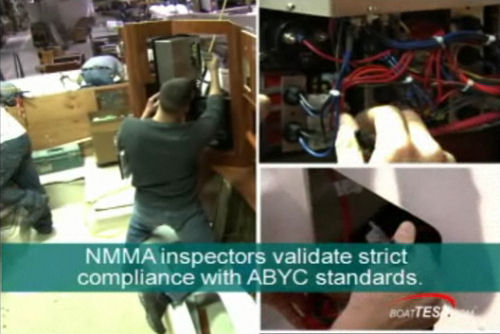 Perhaps the most important impact of NMMA certification has been in boat's electrical systems. |
Association Regulation
It all sounds like the fox guarding the hen house, but the program has worked out
pretty well, in our opinion. In fact, such self-regulation is not unprecedented.
In the post-Renaissance period in Europe, guilds were formed in many trades to make
sure that the crafts’ “best practices” were followed by all people plying those
trades. An elaborate ritual of apprenticeship was developed to pass on the crafts’
knowledge and technology to new generations of tradesmen.
As a result of the NMMA’s efforts – which incidentally flew in the face of the laissie
faire attitude pervading most businesses at the time -- virtually all certified
boats, from the cheapest to the most expensive in any given class are better than
they were ten years ago. The most dramatic improvements have been in the lower price-point
boats – boats that are now built to higher standards but are still lower-priced.
The downside of NMMA certification is that it has made all boats somewhat more expensive.
Not All Boats Are Certified
NMMA certification didn’t put any boat companies that we know of out of business,
per se, and that was not its intention. Rather, like the European guilds, it made
some builders better ones by forcing them to adopt best practices in many areas
of construction. Nevertheless, it has made life more difficult for very small builders
who were making good boats all along, but in low units. These boats are usually
custom boats or highly customized and often built to ABYC standards even though
they are not certified as such. For these builders to be NMMA-Certified, the paperwork,
staff time, and in some cases the testing procedures, made meeting the standards
impractical.
The last several years small builders have found life difficult, but more because
of the economic times than because of the lack of NMMA certification or because
of the added cost of it, we think. Large boats, those say, over 100’, are also often
not actually NMMA-Certified because the ABYC standards were written for the mass
market of recreational boats from 12’ to 45’ for the most part. Usually these large
motoryachts are built to even higher standards, such as ABS, MCA, Lloyds or others.
In many cases builders of these boats utilize several standards so as to be recognized
for charter in the Med or to be universally accepted by all governing authorities.
 Consumers should look for the NMMA certification plaque on a boat before they buy it. |
CE Certification in Europe
Concurrently with the implementation of NMMA certification in North America has
come CE standards in the European community. You will notice that most electrical
appliances now have “CE” printed on them which means that they meet the applicable
standards in Europe. Usually this mark is right next to the “UL” mark for the Underwriter
Labs certification used in the U.S. There are CE standards for recreational boats
as well.
ICOMIA (International Council of Marine Industry Associations) works on the CE standards
which cover much of the same subjects as do the ABYC standards. ICOMIA is working
with the NMMA to create one single set of standards which will be accepted world-wide.
This will make boat building more efficient as today boat builders must build to
two standards – ABYC for North America and to CE standards for Europe and other
parts of the world.
 NMMA certification has been responsible for getting swim ladders moved away from the prop. |
Which Are Better?
A commonly asked question is which organization has a tougher set of standards?
The answer is that in some areas CE requirements are more exacting and in other
cases the ABYC standards are more demanding. There are several reasons for this,
but paramount are a country’s local boating conditions.
For example, if you go boating in the UK, chances are you will do it in the North
Sea, Irish Sea, or in the English Channel. The UK has few inland lakes and rivers
for recreational boating as Americans know it. As a result, the UK has historically
had stringent building requirements that would add beef and features that just are
not necessary for boating in protected water, and only add to the cost to the vessel.
For this reason, in Europe boats are rated for the conditions they are built to
be operated in, spanning the range from ocean going to calm lakes and rivers.
After ten years the NMMA certification program is working well and the goal of the
builders who brought the plan into existence was fulfilled: low price-point boats
are better built, and safer, and no matter what certified brand a boater buys, he
is likely to have a better ownership experience.