BoatTEST.com’s Independent 3rd-Party Tests
In a survey of BoatTEST.com members, 77% of the people polled said they had greater confidence in BoatTEST.com’s performance numbers than those offered by boat builders or engine makers. Such sentiment is not surprising in a world wracked by the likes of Enron, Lehman Brothers, and Bernie Madoff – all cases where effective independent 3rd-party scrutiny was lacking or non-existent. Happily for boat buyers, many boat builders understand human nature and skepticism, and because they are confident in the products they build they welcome BoatTEST.com’s scrutiny. Then, there are the builders who would rather stick with the old ways of providing information to the public – sticking glorious praise and performance claims on their websites and in their advertising.
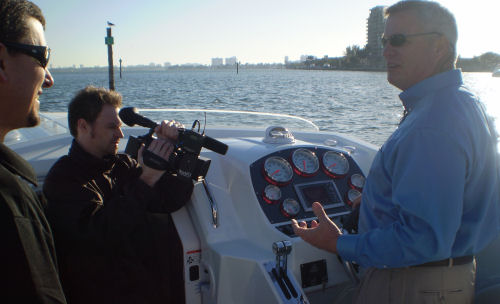 Capt. Rob explains the pros and cons of a helm design. |
Over the last ten years BoatTEST.com’s tests have always rested on the bedrock of their performance numbers. These digits in table form tell the tale about the capabilities of the boat without the eyewash and spin of marketing babble. The numbers speak for themselves. And because they have been recorded by an independent 3rd-party, these are the numbers that consumers put their faith in.
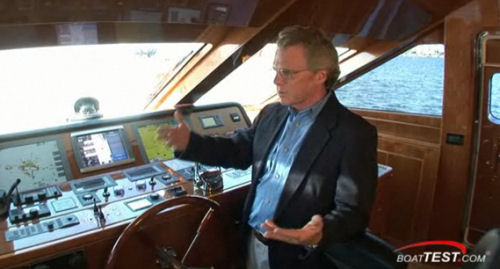 Capt. Steve takes a look at the systems and close-quarter handling of a multi-million dollar motoryacht. |
It is here that a perspective buyer can discover how fast a boat will go and how far, how much it will cost to operate and how noisy it will be at speed. Here one can determine its towing ability and nimbleness. By comparing the performance numbers of one boat with those of another, a buyer may discover defining issues that eliminate one model or another from consideration when looking to buy a new boat. Or, the consumer might discover that there is very little difference in performance between two competing brands, despite what the salesmen have been saying.
But the performance test is only the beginning of the complex matrix that has evolved over the last 10 years in BoatTEST.com’s sea trials and reporting. It is our degree of detail that separates our tests not only from the builders’ website promotions, but also from the articles published online by boating magazines migrating to the higher ground of the Internet.
The Captain’s Report
A second most important part of the BoatTEST.com scrutiny is the Captain’s Report. Here a USCG-licensed captain who has undergone BoatTEST.com’s course of procedures and is armed with a copy of the ABYC Standards approaches each boat based on its “intended mission” and price-point. The first thing the captains are trained to do is to answer the question, “How well does the boat fulfill its intended mission?”
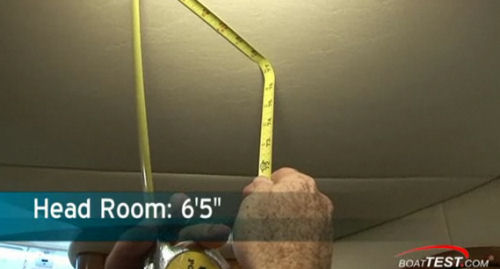 Headroom could make the difference between a comfortable boat and one that is no fun. Our captains measure so you won’t have to waste your time on boats that are too small. |
Is its mission freshwater fishing, saltwater cruising, big game fishing, lakeside entertaining, crossing oceans, crossing lakes, tubing, wakeboarding, exploring rivers, blasting around or whatever? It would be unreasonable to expect a boat designed for waterskiing in a small lake to be able to go cruising around Cape Horn. So our captains first ask how well does the boat actually fulfill its intended purpose?
Price-Point Matters
Likewise, boats are built to a price point. Some boats are loaded with amenities, equipment, and many man-hours of work, and others are popped out of injection molds and have had their interiors and equipment bolted on as quickly as possible. Not everyone can afford an expensive boat, and not everyone needs an expensive boat.
Thankfully, there are many good boats built at relatively low price points. Our job is to point them out when we find them, and to help buyers recognize good value at any price point.
Further, our captains calibrate their expectations to the price-point. For example, they expect everything to be done well on high price-point boats. On low price-point boats they carefully inspect to see if the important things are done right and if major ABYC standards have been met. In this regard, NMMA Certification has been a great help.
Subjective Areas
One of the most difficult areas to test and one of the least well defined comes under the heading of “boat handling.” This is probably one of the most subjective aspects of a test. How does the boat land after leaping a wave or another boat’s wake, or how does she steer in a following sea? How hard is the boat to maneuver at the dock? What is the boat’s turning radius, how smoothly do the gears shift, and are there any bad manners exhibited at high speed? All of these issues and many more are addressed by exception by the testing captain during the course of his inspection.
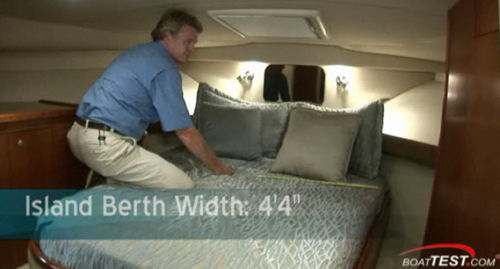 Is a 52” (1.33 m) wide master bed large enough for you and your honey? We don’t know, so we give you the facts. |
Often the testing conditions are optimal for maximizing speed, which means flat water and little wind. Unfortunately these are not good conditions for rough-water boat handling exercises. So in such a case the captain will report on what he can, and save rough water handling for another test.
The converse also happens: test day is windy and rough, so the captain can get a good feel for how the boat handles in sloppy conditions, but the speed numbers will be far from the vessel’s best. All he can do is note the conditions at the bottom of the performance tables. Savvy researchers will always check the testing conditions and the weight aboard before making a judgment on the test numbers presented.
Other Important Information
There are other aspects of the information presented that should bear strongly on a buying decision. Those include the list of major standard and optional equipment and the warranties on the boat. BoatTEST.com attempts to give enough information on these two subjects to guide the consumer. Boats with lots of “O”s on the equipment list, are boats trying to keep their MSRP down, obviously.
Not so obvious is the quality of the boats’ warranties. There are only a handful of builders that have what we call “stem-to-stern” warranties. They are generally the builders of high price-point boats. Some boat builders have warranty programs that are miserable, and are right out of the 1960s. Alert consumers can read BoatTEST.com test reports and get a good feel for what is going on, in most cases.
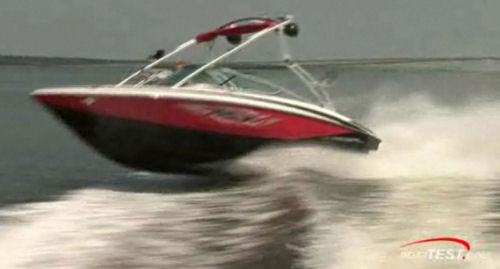 There is nothing like video to show how a boat really behaves underway. |
The Video Reports
The video reports are the aspects of the BoatTEST.com program that get most of the attention, but it is often misunderstood. For example, a number of well-intentioned builders have made what we call “video walk-thrus” figuring with these on their websites, consumers’ hunger for information will be slaked.
These builders obviously fail to grasp the relevant distinction between having their sales manager open and close all of the boat’s drawers and a having a professional independent 3rd-party captain going through the boat with the consumer in mind, not the person signing his pay check.
The builders in-house videos are little more than long video advertisements, and how can they be anything else? And don’t hold your breath waiting for the builders’ sales manager to point out things that are done wrong or are inconvenient, or a waste of space. Most magazine publishers videos’ do little more than the builders’ own commercials because they are part of an advertising program.
More Research Sources
Finally, there are several tabs at the top of the test that refer the researcher to “Related Videos”, “Related Articles,” and “Feedback.” These resources often cover construction, interviews with the company president, new engines installed by the brand or other subjects. These related materials are designed to give a potential buyer doing research a better picture of the builder. “Feedback” are comments added by visitors most of whom have owned the boat or brand.
To the right of the tests is a red rectangular button that says: "Owners Reports on...” Here is a repository of information from members gathered over seven years where actual owners of the boats answer 20 detailed questions and give their experiences with the boat, builder and dealer.
Taken together this is a tremendous body of information presented in one place for people doing boat-buying research. Today, it is generally regarded as being the most comprehensive independent 3rd-party bating material available.
FAQs...
Q: Are the boat tests paid for?
A:Yes, just like Underwriter Laboratories (UL), BoatTEST.com charges builders to test their boats. Our Captains' Reports and video scripts are written independently by the testing captain and BoatTEST.com’s editors. Performance data is obtained and recorded solely by BoatTEST.com personnel.
Q: Most of your tests are favorable. Why is that?
A: Our tests are focused on performance, handling, utility, and how well the boat’s “mission” was accomplished. We do not test to destruction, nor are our tests intended to be a survey of the boat. Our captains point out areas or aspects of any boat that they deem to be unsafe, or which don’t meet important ABYC Standards. Our Captains' remarks are always in the context of the boats' price point.
Q: Do any boats ever “fail” your testing?
A: Yes. If at any time during the test a captain deems a boat to be unsafe he is instructed to automatically and immediately terminate the test. In the last 10 years a number of tests have been terminated, mostly due to being overpowered. In some cases the tests were terminated because the boats handled so poorly that in our captain’s opinion it should not be offered on the market even though it was probably “safe.”
These boats and any video or written reports are not put on the website. Boats appearing on the website are ones our captains and BoatTEST.com judge to be appropriately functional and serviceable for their intended purpose. If we publish a test, we feel that boat is safe to use for its intended purpose so long as it is operate properly in normal boating conditions. We do not publish tests of boats we deem to be unsafe.
Q: Why are some brands not tested?
A: They are not tested because the builders refuse to have them tested. Clearly, many builders are afraid to have their boats tested for one reason or another. Remember, when they commission a test by BoatTEST.com they lose control of information given out to the boat-buying public. They lose control of the published performance numbers and over the Captain’s Reports. Some builders prefer to restrict information about their products that they can't control.
Q: Who owns BoatTEST.com?
A: It is owned by Jeff Hammond who has been in the marine business for 40 years in the publishing field. Over those years he has sailed and cruised over 60,000 miles offshore, and owned a number of powerboats from 19’ to 91’. He has fished everything from sunfish to black marlin, and has cruised everywhere from Long Island Sound to the Red Sea. He is well aware of the problems that boat buyers and boat owners face and is dedicated to helping improve boat owners’ enjoyment of their vessels no matter what size they are or how they are used. As he has gotten older, he reports that his tolerance of nautical bologna has been greatly reduced.