Chicago Gives Asian Carp a Pass
Yesterday the U.S. Supreme Court “took no action” for the third time relative to the State of Michigan’s petition for an injunction to close the Chicago Sanitation and Ship Canal, thus keeping an invasive specie (read: voracious Asian carp) from entering Like Michigan. Michigan has now been joined by the states of Wisconsin, Minnesota, Ohio, Pennsylvania, and New York – every state boarding the Great Lakes – except Illinois, which is already up to its eyeballs in carp. The U.S. Supreme Court has original jurisdiction over the Chicago Sanitation and Ship Canal, with precedents going back to 1922. This means that Supreme Court has immediate jurisdiction – no lower courts and no legislative bodies need be involved first! That means that just five of the Supremes could save the Great Lakes if they wanted to! Sadly, they are sitting on their hands.
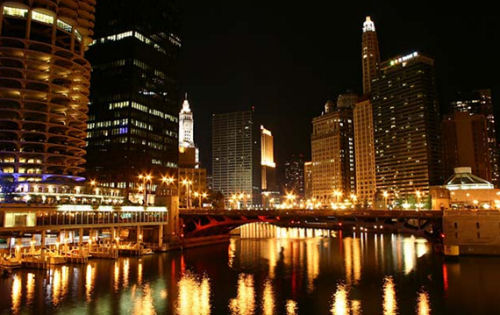 Mammon’s (aka Chicago) governmental and business establishment would rather see Asian carp swimming up this river to Lake Michigan than disrupt its economic money machines. Prepare to say so long to the Great Lakes as we knew them. |
Chicago and Illinois politicians have lined up to fight against closing the canal system that will be the carp route to Lake Michigan. Officials in the Obama administration are also defending the vested interests of Chicago-area businesses to keep the water flowing from Lake Michigan into the Chicago Sanitation and Ship Canal.
In a weird reversal of usual roles, Republicans (Michigan's Attorney General, Mike Cox, is a Republican) are the advocates of conservation and protection of the environment and Democrats are fronting for big business.
What is this world coming to?
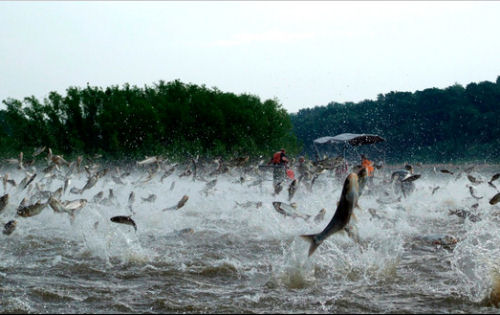 Carp being shocked out of the water by F&W wardens so they can be counted. Note F&W staff in boat in the background. |
The Carp Are Coming!
Unfortunately, it looks like that part of the world around the Great Lakes may be coming to carp. If what has happened elsewhere is prelude, Asian carp in the Great Lakes will kill off the fishery in time and devastate recreational boating in the American Midwest which accounts for 25% of all boating in America. Within a decade, maybe less, not only will the Great Lakes fishery be ruined by the hordes of Asian carp migrating around the lakes, but they will then attack the Canadian river systems flowing into the lakes.
Another Blow to a Devastated Industry
Without gamefish, anglers will stop buying boats in the Great Lakes region. And because of the specie of Asian carp (silver carp) which jump out of the water at passing boats, cockpits in small boats will have to be covered in chicken wire. Officials of the Federal Fish and Wildlife department have already said it is just a matter of time until someone is killed by flying carp. With these missiles shooting through the air it won’t be long until people just give up boating altogether.
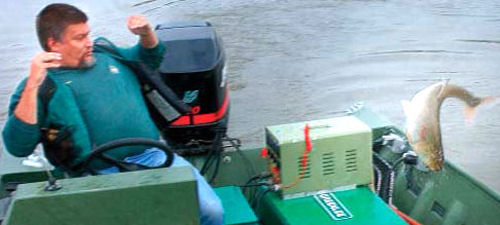 Boats need chicken wire to protect against flying carp. |
We are afraid that the cumulative effect of the demise of a huge fishery, the Great Recession, high fuel prices, and general shifts in lifestyle and recreational pursuits could level the boating industry to a mere shadow of what it was just a few years ago. We feel that this is the last chance society will have to stop this invasive specie from killing Great Lakes boating as we know it.
Vested Interests Control the Pols
The New York Times has reported that that on at least two occasions Carp DNA (sometimes called carp crap) has been found beyond the Army Corps of Engineers’ electrical fence in the canals leading to Lake Michigan. It also reports that Illinois Senator Richard Durbin as well as “federal and  state officials” are opposing the closing of the canal system. The Obama administration is supporting the local pols and business, and not those favoring protecting the environment.
 Rham Emanual, Valerie Jarrett, and David Axlerod are Obama’s closest advisers and all are from Chicago. |
It is a strange new world where people trying to do something to stop global warming, air pollution, and improve water quality and health care in the face of entrenched economic big business interests, would roll over like a lap dog when saving the environment doesn’t fit neatly with Chicago-area business interests.
Could it be that President Obama, his chief of staff Rham Emanual and many of his other advisers – including David Axlerod, Valerie Jarrett, and Michelle -- are all from Chicago?
Our friends in Washington, D.C. say this is not a matter of politically powerful Chicago residents, government officials and business interests opposing the canal, but rather government and the Supremes not wanting to precipitously close a canal system which is intertwined with a complicated sewage and transportation infrastructure without first discovering all of the consequences.
That sounds reasonable until you consider who is involved. It sounds reasonable until you realize that trying to divine unintended consequences of executive or legislative action has never stopped decisions from being made before if powerful people wanted them made.
 Chicago’s Mayor, Richard M. Daley, is one of the most powerful men in the country. |
Chicago’s Kingfish Isn’t Carp
We say to our friends in Washington that they are drinking the same Kool-Aid as the Obama administration, and it is being ladled out by the mayor of Chicago, Richard M. Daley. At the end of this year Daley will be the longest serving mayor of Chicago in history – longer even than his father who ruled the city with an iron hand for nearly 20 years. In 2005 Time magazine said Daley has "imperial style and power.”
In other words, nothing happens in Chicago without Daley’s approval. And when Daley says jump, people ask how high. Recall that just recently Daley wanted Chicago to get the 2016 Olympic Games, and President Obama hopped on Air Force One to plead Chicago’s case before the IOC – the first American president ever to do so. Now, that is a man who has influence.
Daley is the iconic reigning machine politician who runs the city in concert with influential Chicago business interests. It is from Mayor Daley’s benevolence that all blessings flow, be they votes, government contracts, political donations, permits, or most anything else of serious consequence in Chicago or in the state of Illinois.
 Jack Nicholson plays a private eye who stumbles onto California’s first big water scandal in the 1920s when government officials steal water to help their land developer chums. |
A Chinatown Rerun
It seems to us that this is all right out of a Hollywood movie – and that movie is Chinatown. This time the Chicago Sanitation and Ship Canal is taking the place of the Los Angeles Aqueduct. Mayor Daley is playing the role of Hollis Mulwray (played by John Houston in the original movie) diverting the water to serve Chicago business interests instead of Los Angeles land developers, and the Great Lakes will suffer devastation instead of the farms of California’s Owens Valley and Mono Basin after having its water stolen.
Drilling Down into the Carp Fiasco
We are also told that typically in cases like this the U.S. Supreme Court appoints its own investigator to dig into the matter and report back. To date, there has been no report of such an appointment. If that is true, time is now being wasted by the Supremes when they could at least be getting the facts about the impending invasion from their own trusted agent.
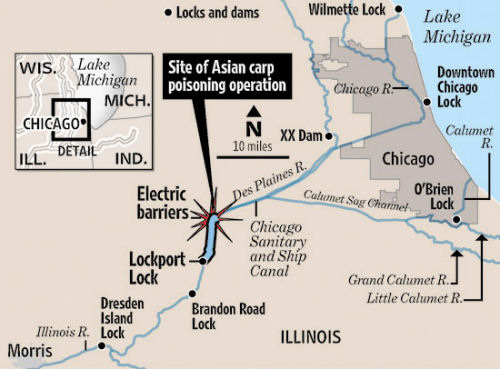 Asian carp DNA has been found as far north as Wilmette, Illinois, well past the electrical barrier. |
More bad news: It turns out that the Army Corps of Engineers is not even using its electric “barrier” fence on its highest setting! Rather, it is only putting in to the canal a moderate charge of electricity, one calculated to stop the carp migration, but not one so strong as to interfere with commercial and pleasure vessels transiting the “barrier.” In other words, the electric barrier “fence” could be far more “carp proof” than it is now.
We’re told that the US Coast Guard doesn’t want more juice going into the canal because it could harm vessels in transit.
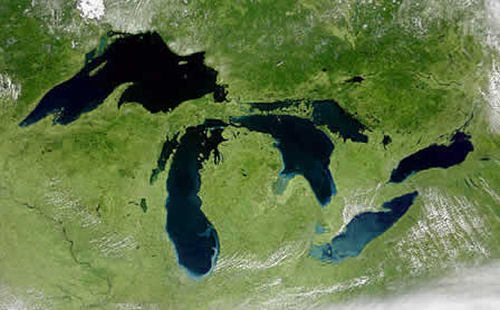 It won’t take long for the largest body of freshwater in the world to be ruined. |
The Pols Speak
Michigan’s attorney general, Mike Cox, a Republican, said he was disappointed that Illinois officials appeared more concerned with local interests than the health of the Great Lakes. “It is distressing that inaction on the part of a state with only a few miles of shoreline is threatening the economy and ecology of Michigan and every other state in the Great Lakes basin,” Mr. Cox said in a statement.
Senator Richard J. Durbin, Democrat from Illinois, said the lawsuit was unhelpful. “Let’s not meet in the courtroom,” he said. “Let’s meet in the halls of Congress to find a way to come up with a solution.”
The halls of Congress? The home of pork sausage?
Because the U.S. Supreme Court has original jurisdiction and it is also the ultimate arbitrator, this whole matter could be quickly put to rest. We don’t know why the Supremes are not doing something within their power about the Asian carp invasion, but we must do something to get the attention of these nine good men and women focused...
What You Can Do Now--
We can think of two organizations that should have a vested interest in protecting the Great Lakes fishery – 1) Canada, and 2) the National Marine Manufacturers Association (NMMA).
1. Canada. Canada and most particularly its province of Ontario stand to not only lose their Great Lakes fishery, but also it will only be a matter of time before Asian Carp start swimming up stream in the scores of rivers that drain into the Great Lakes. We urge our Canadian readers to beg their appropriate governmental representatives to petition the U.S. Supreme Court asking for injunctive relief. If the Supremes won’t listen to six U.S. states, perhaps it they will listen to a foreign country.
To help expedite the matter, here is a link to the U.S. Supreme Court’s website page where the petitions have been filed. Read it to get the full legal fill-in--
2. NMMA. The NMMA is usually vocal and litigious about threats to the interests of boat manufacturers and boaters in general in the U.S., yet in this matter it is strangely quiet. We realize that because its home office is in downtown Chicago it is undoubtedly being besieged by local boating interests to defend the status quo, nevertheless we urge the NMMA to represent its members all across the U.S. which will be economically devastated if the Great Lakes fishery is lost to carp.
We urge all members of the boating industry to contact Thom Dammrich, President of the NMMA, and ask him to throw the full resources of the NMMA into petitioning the U.S. Supreme Court for injunctive relief.
Thom’s email address is: [email protected].
Thom is very good about answering his mail, so we urge you to contact him.
To shed some light on the background of the situation, we reprint a recent article that appeared on the NPR website --
January 8, 2010 --
The U.S. Supreme Court decided Friday not to hear a dispute between Illinois and some of its neighboring Great Lakes states — but it could still take it up as early as next week. [And it did on Jan. 15. Because the Court has original jurisdiction, it may take up the issue at any time.—Ed.]
That dispute is over a big, ugly fish that the states and conservationists want to keep from getting into the Great Lakes — the Asian carp.
With the huge, voracious invasive species of fish getting ever closer to entering Lake Michigan through Chicago, Michigan — with the support of six other Great Lakes states — is asking the Supreme Court to order the closure of navigational locks between Lake Michigan and the Chicago and Calumet rivers.
The petition asks the Supreme Court to reopen an 88-year-old lawsuit over Chicago's diversion of water from Lake Michigan.
History of the Lawsuit
In 1900, the city of Chicago reversed the flow of the Chicago River.
It was a remarkable engineering feat for its time, utilizing canals dug by man, mule and dynamite so the city could send its sewage and industrial pollution away from its drinking water source in Lake Michigan.
The man-made waterways also established a vital shipping connection between the Mississippi River and the Great Lakes.
But other Great Lakes states cried foul and sued in 1922 over concerns the diversion would reduce Lake Michigan water levels.
After decades of squabbling and negotiations, the state agreed to a consent decree in which the Supreme Court ruled Chicago could continue to flush Lake Michigan water out of the Great Lakes watershed, but limiting Chicago's diversion to no more than 2.1 billion gallons a day.
But the high court left open the possibility that the states could reopen the case if they could show that the Chicago water diversion is causing harm.
Michigan Attorney General Mike Cox says that harm is arriving in the form of Asian carp, a prolific, invasive species of fish that can grow to be 4 feet long and weigh up to 100 pounds.
"They devour plankton, algae and other material on such a large volume that they have the potential of destroying every Great Lakes fishery, whether it's Lake Michigan, Superior, Erie, Ontario or Huron," Cox says.
Carp Vs. Cargo
Cox filed a petition Dec. 21 asking the Supreme Court to force Illinois, the Army Corp of Engineers and Chicago's Water Reclamation District to at least temporarily close the locks between Illinois' waterways and Lake Michigan.
All the other Great Lakes states — Wisconsin, Minnesota, Ohio, Indiana, New York, Pennsylvania and the Canadian province of Ontario — are supporting Michigan's legal action, which also asks that long-term action be taken to permanently separate Illinois' carp-infested waterways from the Great Lakes watershed.
Cox and the other states worry that if the Asian carp get through those Chicago locks, they will crowd out native species of fish in the Great Lakes, causing an ecological and economic disaster.
"Fishing and tourism is a $7 billion industry the eight states and two provinces that make up the Great Lakes," Cox says. "And clearly, hundreds of thousands of Michigan jobs are dependent on fishing and tourism and all that is related to the fact that we are the Great Lakes state."
But nearly 17 million tons of cargo is shipped through those locks each year, according to the industry group The American Waterways Operators, adding an estimated $1.5 billion to the regional economy.
"Coal, steel coils and rods, salt for the roadways, sand for mixing concrete and aggregate rock," are just some of the materials shipped through Chicago's locks, said Bill Russell of Lemont, Ill.-based Illinois Marine Towing.
His company's nine tow boats operate 24 hours a day, all year round, even on these bitterly cold and blustery days of January.
Shipping those materials over land would add more than 1 million trucks and tens of thousands of rail cars, increasing pollution and congestion.
Closing the locks could cost hundreds, if not thousands of jobs — including the 125 at Illinois Marine Towing.
"Without this river system being open and without the locks, our company would cease to exist because we wouldn't have anything to move if these barges couldn't travel in and out of Chicago," Russell said.
An Upcoming Decision
The state of Illinois and the Obama administration, defending the Army Corp of Engineers, cite these and other economic, health and flooding concerns in their briefs opposing the Michigan petition to close the locks.
But Illinois and federal officials say they do agree with Michigan and the other states that the Asian carp threat is real and imminent.
Scientists say Asian carp DNA has been detected just seven miles from an entryway to Lake Michigan, though some other scientists question the accuracy of the DNA sampling method.
Local, state and federal agency officials along with experts and advocates for the lakes will discuss all options for keeping the invasive species out of the Great Lakes in a meeting in Chicago on Tuesday [Nothing was decided. - Ed.] as they wait to find out if the Supreme Court will consider ordering a preliminary injunction to shut the Chicago locks.