Carp Summit Results: U.S. to Spend $78 Million
On Monday Federal officials announced plans to a group of Great Lakes governors in Washington D.C. to spend $78 million on several programs to stop the migration of Asian carp to Lake Michigan. The plans include erecting additional electric shock barriers, putting in fish nets, using chemicals to kill fish if eDNA evidence is found, take 120 eDNA samples a week, the change the way locks, dams, sluice gates, and pumping stations operate to “impede” Asian Carp migration, and to spend $3 million to promote the eating of Asian carp. Michigan Gov. Jennifer Granholm said that the measures were inadequate. Michigan attorney General Mike Cox said they were “half-measures and gimmicks” inclined toward Chicago’s wishes.
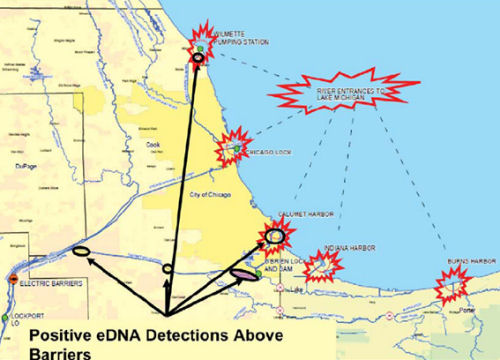 There are five rivers through which Asian Carp can get into Like Michigan. Government agencies plan action in March, April and May. |
See local TV news report on Summit
Gov. Granholm said she and other Great Lakes governors insisted on Monday during the summit at the White House that Chicago-area locks must be closed quickly, even if short-term, to deal with carp.
Although federal officials included intermittent lock closures in their plans—as much as three weeks per month—as a potential solution, that is not enough, said Granholm. “I think there’s enough DNA evidence now to shut them down,” said Granholm, who added that she does not support the idea of part-time lock closures.
Following is the report on programs to be implemented as they appear on Asiancarp.org--
Asian Carp Control Strategy and Framework
Short-term Actions
The following actions are either underway or are expected to commence by May 15, 2010.
1. Operations to confirm and reduce carp populations
2. Increased fish collection effort for confirmation of eDNA results and carp populations
applications where feasible and coordinate efforts with eDNA sampling to increase likelihood of successful collection.
3. eDNA indicator refinement
4. Modified structural operations
Implement an approach with three phases
i. Phase 1: Concept Development – Integrate agencies’ efforts to develop methods to suppress Asian carp population growth while USACE and U.S. Coast Guard (USCG) simultaneously determine how to optimize/reduce the number of lock openings, and the Metropolitan Water Reclamation District (MWRD) considers how to operate the Wilmette Pumping Station to impede Asian carp movement. This will occur after engaging the navigation industry. The goal for this phase is to complete concept development and recommended actions by early March 2010;
ii. Phase 2: Initial Implementation – Execute modified structural operations as quickly as possible once methodologies are ready, with initial elements underway by April 30, 2010;
iii. Phase 3: Additional Implementation – Adjust initial methodologies based on field results to sustain longer term operations. In conjunction with continued population suppression, continue to field new methodologies as they become available, such as acoustic bubble barriers or electric barriers, as well as addition of screens at sluice gates and bulkheads for use during flood damage reduction operations with goal of full implementation by the
end of 2010.
5. Construct emergency engineering measures to block passage of water and fish between (1) Des Plaines River and CSSC and (2) Illinois and Michigan (I&M) Canal and CSSC.
6. Increased biological control efforts
7. Barrier operations
Long-term Actions
The Long-term Actions are also integral to the success of preventing Asian carp from establishing a self-sustaining population in Lake Michigan. Examples of actions are shown below in five sub-categories; however the set of proposed actions, listed later in this document, is more comprehensive.
1. Structural:
2. Chemical:
3. Biological:
4. Operational:
5. Other:
White House Press Release, Feb 8, 2010 [Bold type by BoatTEST.com.—Ed.]--
EXECUTIVE OFFICE OF THE PRESIDENT COUNCIL ON ENVIRONMENTAL QUALITY WASHINGTON, D.C. 20503
FOR IMMEDIATE RELEASE:
February 8, 2010
Federal Officials Unveil Aggressive Strategy to Reduce Threat of Asian Carp in the Great Lakes
WASHINGTON, DC – Federal officials from the U.S. Army Corps of Engineers, the Environmental Protection Agency, the Department of the Interior, and the U.S. Coast Guard today unveiled a strategy that outlines over 25 short and long-term actions and $78.5 million in investments to combat the spread of Asian carp. The draft Asian Carp Control Strategy Framework (Framework) is an unparalleled effort to control the invasive species, unifying Federal, state, and local action, and introducing a multi-tiered defense of the Great Lakes to prevent Asian carp from developing self-sustaining populations while longer term biological controls are being developed.
“As with many great eco-systems across the country, invasive species have harmed the Great Lakes, and an invasion of Asian carp threatens to be particularly ecologically and economically damaging,” said Nancy Sutley, Chair of the White House Council on Environmental Quality. “Today, we have an opportunity to work together to prevent environmental and economic damage before it happens. This Framework utilizes the best available science and its multi-tiered strategy will ensure coordination and the most effective response.”
“EPA has helped to develop this coordinated strategy on such an urgent issue and assisted in building a coalition to act to keep Asian carp from becoming established in the Great Lakes,” said EPA Administrator Lisa P. Jackson. “The combined resources and expertise of the interagency partnership are our best tools for protecting the Great Lakes ecosystem and economy.”
“The Army Corps of Engineers remains committed to aggressively using all available authorities to protect the Great Lakes from this invasive species,” said Jo-Ellen Darcy, Assistant Secretary of the Army for Civil Works. “We cannot do this alone. All parties must bring the full force of their resources to this challenge. We are working intensively with its Federal, State, provincial, bi-national, and municipal agency partners to achieve this goal.”
“Interior and its bureaus are committed to working in partnership with the States of Illinois, Michigan and Wisconsin, the affected communities and other Federal agencies to tackle the complex threat posed by Asian carp to the ecological and economic health of the Great Lakes,” said Tom Strickland, Assistant Secretary for Fish and Wildlife and Parks. “We are providing immediate financial, technical and research assistance for Asian carp control efforts in South Chicago waterways, and will continue to do everything we can to keep carp out of Lake Michigan.”
In the near term, the Framework focuses on keeping carp from establishing populations in the Great Lakes. It calls for reduced openings of Chicago’s navigational locks to prevent carp movement. In addition, Federal agencies will deploy enlarged field crews for physical and sonar observation, electro-shocking and netting operations within the waterway. Turnaround times on eDNA verification will be expedited and testing capacity will be doubled to 120 samples per week.
In March, 2010, a $13.2M contract will be awarded for construction of barriers between the Chicago Sanitary and Ship Canal and Des Plaines River, which will prevent fish passage around the electric barrier in the event of flooding where the two water bodies mix. A $10.5M contact will also be awarded for construction and operation of a third electric barrier (IIB). The Framework expedites a U.S. Army Corps of Engineers’ study of the feasibility and impacts of permanent lock closure, the effectiveness of lock closings to block carp movement, the risks and costs associated with closure, and a discussion of alternatives.
The Framework identifies a variety of longer term Asian carp management techniques for the duration of 2010 and beyond. This includes $3M in funds for commercial market enhancements and $5M for additional chemical treatments in the case of barrier failure. It also puts forth over $1.5M in new research funding. Several research efforts will receive significant funding in the coming months to help inform decision makers of additional tools that might be available for Asian carp management, including development of biological controls like Asian carp-specific poisons, methods to disrupt spawning and egg viability, sonic barriers, and assessment of food sources and potential habitats.
The Framework also identifies educational and enforcement tools to prevent Asian carp from being sold or purposefully transferred, and an investigation of Asian carp transfer in ballast and bilge water. The Framework will be updated as new partners and new action options are identified to help stop the spread of Asian carp. Federal agencies will continue to work together and in collaboration with state and local agencies to fight the spread of Asian carp into the Great Lakes. The entire Framework is available at www.asiancarp.org.