The Big Shift in Boat Buying
In case you haven’t noticed, boaters are not buying boats the way they used to. We don’t mean that sales numbers are lower (although that is certainly true), rather we mean that boaters are going about the “buying process” in a new way – we call it the “Big Shift.” And it is not just the way people are buying boats, it’s also the way they are now buying most every big ticket item. Not only are the old days of the “hard sell” long past, but the days of nearly any type of “pushy” selling is over. Consumers have tuned out of the barrage of advertising dumped on them. They no longer want to be told what to buy, and are unimpressed with pretty pictures and claims of heaven-on-earth and world’s-best-performance. Consumers now want hard information and knowledge. With that in hand, they’ll reach out and select the products they’re interested in – when they’re ready!
In most categories of boats there are a lot of choices, and it is very easy to pick the wrong one for a specific application and circumstance. These days consumers know that. They also know where not to look for advice. Who’s going to tell you if a particular brand or model is cycling out of favor, or if a product is on the wrong side of its life cycle, or that the crusty old boat builder of the brand you love just sold out to a quick-buck slickster? Consumers are now looking for the insights that will give them mastery of the art of boat buying. Have you made the shift, or are you still buying the old-fashioned way?
 The new consumer isn’t buying anything the old-fashioned way. Now he wants to carefully compare his apples and separate them from oranges. |
The Beginning of Change
The World-Wide-Web is less than 20 years old and already it is beginning to change some basic ways that consumers go about their buying. How could it be any different? Just as the telephone changed how people began to communicate in the early part of the 20th century, discarding the written letter or telegram for a phone call, so, too, is the modern world now beginning to change the way it buys expensive things – and even relatively cheap, but technical things. Just as the telephone was a new tool for communication, so too, is the Internet a new “tool” for research, knowledge acquisition and, ultimately, product consumption.
But that is not all that is changing. There’s more...
 |
“Intrusive” Advertising is Dying
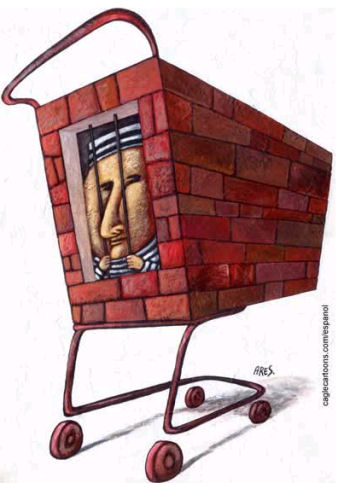
The old ways of learning about products is dying fast (and most companies selling those products will be the last to figure it out). Historically, companies with products to sell “pushed” the “information” about them onto potential consumers. They did this with newspaper, magazine, radio, and TV ads and commercials. They did it with door-to-door salesmen, billboards, junk mail, and airplane sky writers – and more recently on the Internet with Spam.
This method of advertising is called “intrusive.” You didn’t ask for it but you got it whether you wanted it or not.
 |
Escape from “Captivity”
Man was born free, but everywhere he is a “captive audience.” Conventional “sales messages” are omnipresent, annoying, shrill and -- until very recently -- had to be tolerated. But slowly things are changing. Now there is Tivo and DVR TV and Sirius Radio which can eliminate unwanted hucksters. But the biggest change is the Internet, where the consumer is free to read and watch what he wants, when he wants it. The old media gate-keepers of information are in the throes of an agonizing death at the hands of the Internet.
What Are “Modern Buyers” Doing Differently?
 |
1. Brand loyalty is ERODING fast. In virtually all product categories consumers have become incredibly fickle as customer service, warrantees, product quality and even design has increasingly become more standardized. Also-ran companies are imitating the leading brands, making product differentiation exceedingly difficult. Now buyers en mass are looking for greener pastures or the excitement of the new, exotic and mysterious lady.
 |
2. Consumers are looking for VALUE. Whether or not this was coming anyway before the financial meltdown is now a moot point. It is here now in spades. This means that marquis names have to be more than just status symbols, they also have to deliver for the dollar. At the other end of the spectrum, it means that just being cheap is no longer enough – a product must now be cheap, good and have tip-top service, too.
 |
3. Consumers are looking for CHOICES. With brand loyalty out the window, how do you get the boy back on the farm once he has seen Paris? The world is a big place and buyers want to know about all of their options and they are digging deep to find them. The Internet and Google make that task a snap. Sales are now spread over more brands. This trend is making life difficult for market leaders, but much more rewarding for buyers.
 |
4. Buyers are no longer limited by GEOGRAPHY. Buyers will fly halfway around the world to buy a 35’ boat. With shipping rates dropping by the day due to the global recession, even small boats are being bought and shipped trans-oceanic by reliable freight forwarders sight unseen. Buyers with strong currencies, often find that they are ahead of the game buying even relatively small boats from countries with weak currencies even after freight bills are paid.
 |
5. Buyers are looking for product information on the INTERNET. Generally consumers do not go to newspapers, magazines, books, or classified ad listings to seek product information. These media were not designed to give product information and were never good at it, even when they tried. Conventional media is simply not designed to operate 24/7 in an archival format. Today consumers all over the world go to one place to research product information – the Internet.
 |
6. Prospects go to company websites for product facts, NOT TO BUY. If a customer wanted to buy, he’d go to a dealership. Since he has come to a website instead, it means that he isn’t ready to buy, rather he is coming for information. During the early days of the Internet most companies thought all of their web traffic would mean a bonanza of new buyers. It didn’t happen. Visitors were simply looking for information. These researchers were looking for facts and specifications, pictures and drawings. Once they had seen what they wanted, they went on to the next company, and the next.
 |
7. Buyers seek out INDEPENDENT 3rd PARTY Internet websites for GUIDANCE. Having visited the company sites, consumers then look for independent 3rd parties to verify information, and to impart knowledge that will help them make the right decisions and product selections. The more product intelligence they can get from expert 3rd-party sites the better – product reviews, tests, videos, owner reports, comparisons and general advice is the meat buyers need to make a decision. They devour it and are thankful to get it when it is knowledgeable and not thinly-disguised sales pabulum.
 |
8. Buyers are more likely to consider products from SMALL BUILDERS. To a great degree the Internet has leveled the playing field for small companies who have been savvy enough to figure out how to wisely use it. By building good, or low-cost, or innovative, or niche products that fill a need, small companies have been able to capture the attention of buyers looking for very specific solutions. In more than a few examples, clever Internet marketing has created not only the “Mouse that Roared” phenomenon, but added sales, as well – sales that have gotten them through the recent economic downturn.
 |
9. Internet researchers seek RELATIONSHIPS with 3rd party product evaluation providers. Because nearly everyone selling a high-ticket product has an ax to grind or a conflict of interest, consumers naturally look for an on-going flow of information from a trusted provider before, during and after buying a product – just as an investor would want with a financial consultant. These relationships do not begin and end with a sale, rather are on-going for many years at a time. The 3rd-party information-supplier establishes a bond of trust with the consumer over the course of years and dozens of contacts.
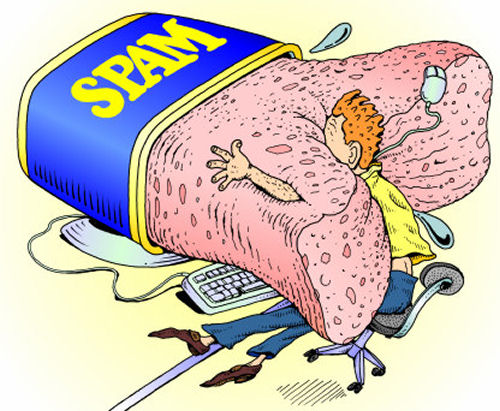 |
10. Consumers don’t want sales contact until they are READY. To a great degree this has probably always been true but the advent of Internet “sales leads” and “hot prospect” email addresses pushed down on dealers for follow-up has soured many of America’s 5,000 boat dealers as effectively as salt on a plowed field. Consumers have learned that if they leave their contact information on a company site they will be Spamed or called -- and they don’t want contact until they are ready. So, increasingly, consumers don’t fill out the questionnaires, and increasingly dealers don’t respond when they get inquiries from most sources.
 |
11. When consumers are ready to sign a contract, they expect serious ENGAGEMENT. Buyers want to be assured not only that the dealer and factory will be around tomorrow but that both will take an active interest in the customer’s product satisfaction. That means that dealers must convince the potential buyer that warrantees are substantial and product service will be provided quickly and with competence. How does a dealer know when the customer is ready? He will call or walk in the door. It’s that simple.
 |
12. Buyers now KNOW WHAT THEY WANT before they get to the dealership. We have been told boat dealers for the last several years that buyers know more about the product and the competitors’ products than many of their salespeople. Consumers have more confidence in their knowledge, and in their decisions, and rely far less on the recommendations of sales people. Today, when customers walk through the front door of a dealership, they are far more likely to have done their research, seen the boat at a boat show, and now they are ready to “be sold” and make a deal.
 |
13. Today’s buyers are taking a LONGER TIME to decide. Obviously the recent economic trauma has added a measure of caution to virtually everyone’s high-ticket buying decisions. But there are a number of other reasons why buyers have extended their decision-making time-line as well: a) with more information comes the discovery of more choices, b) with more choices the number of details to be examined grows exponentially, c) and with new knowledge, long-held beliefs are often revised, which takes time. Desperate dealers, impatient for quick sales will become quickly disappointed and are likely to break-off client contact prematurely. Buyers should take note and look for dealers who take an interest in them as boaters, not as a payday.
 |
14. A lot of future buyers are SITTING OUT this season. This is pretty much all due to the economic meltdown. Roughly 25% of our reader mail singles out this reason specifically for their being out of the market, and we suspect that the real percentage is far higher. These boaters are aware that prices are as low as they are going to get so it is a good time to buy. However, their fear of their own economic situation has overcome their desire for a new boat. With economic recovery, these boaters will begin entering the market as they have in the past. It’s called “pent-up demand.”
In every high-ticket or high-tech category of product over the last 10 years or so, one Internet website has risen up to engage the world’s buyers in the new cyber age. In computers it is Cnet.com. In automobiles, it is Edmunds.com. And in other categories each of us has our favorite site to give us an authoritative window into a specialized world. If our mail is any indication of boater sentiment, in power boating, it is BoatTEST.com. We are happy to have been part of the “Big Shift” and in some small way, to have helped along the new consumerism in the boating community.