Go Trans-Oceanic with a Single Engine
Would you drive cross-country without a spare tire? What about cross an ocean with just one engine? Twenty years ago, maybe even 10 years ago their were boat builders that steadfastly held to the ideal of single-engine long range cruising, but now almost all have caved into most yachtsmens’ desire for redundancy in propulsion. But the rationale of the single engine is compelling for long range displacement cruising, and with the Chinese buying 900,000 new cars a month, how long can fuel stay at even $80 a barrel? Happily there is a middle ground. It is called the “wing” engine, and a number of builders of LRC’s offer it as alternative to the devil (twin engines) or the deep blue-sea (a single engine).
If you are thinking about making a Passage to the Marquesas someday, this is a subject you need to investigate.
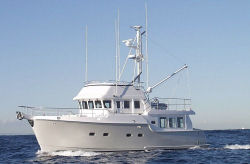 The Nordhavn 47 is PAE’s most popular model and several of them have made circumnavigations on a single engine. It’s wing engine is a 40-hp Yanmar diesel. 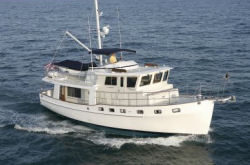 The Kadey-Krogen 48 is one of this builders most popular models and she has a single main engine with a wing engine option or a genset get-home capability. |
Mike Smith Reports--
Long-range cruisers operate at low speeds relative to their size, usually between 10% and 20% faster than the square root of the waterline length, in knots. It takes little horsepower per ton to push a hull at this speed, so there’s rarely a need for multiple engines from a propulsive standpoint. Sufficient power can be delivered by a large displacement, naturally aspirated diesel turning a big propeller. When properly installed, maintained and operated, such engines will give thousands, maybe tens of thousands, of hours of trouble-free service between overhauls – enough for a circumnavigation, with lots of life to spare.
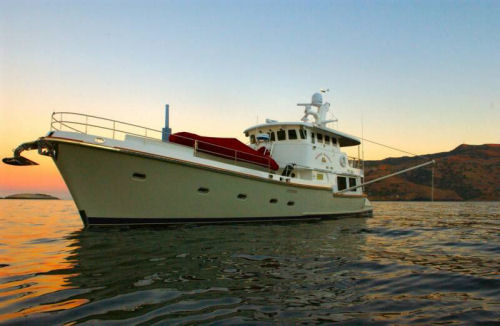 The Nordhavn 62 is the iconic style that has been copied by many larger, custom-built megayachts. She also has a wing engine for get-home power. |
The GenSet Solution
However, nobody likes belt and suspenders more than bluewater cruisers, so many single-screw trawler yachts have “get-home” power to push the yacht at reduced speed should the main engine die. Some get-home systems connect a genset to the main prop shaft via a hydraulic motor or a mechanical drive. This sounds like an ideal solution, but the horsepower necessary to propel the yacht even at reduced speed is usually much greater than that needed to provide electricity.
If the genset is powerful enough to double as a get-home engine, when it’s simply generating electricity (99%, maybe 100% of the time) the load is way too light for engine health and longevity. Diesels are most efficient and longest-lived when running at a high percentage of maximum load, and therefore producing a high percentage of rated horsepower. (This is why many long distance cruisers have two generators – one 20 kw, and another that is 10 or 12 kw, or maybe even less, or a similar ratio, depending on the draw of the boat. The big generator is for when you are in the Bahamas and you have the A/C blasting, and the small one is for the reduced load at night. You can also induce an artificial load on the generator to make it, but that is another story.)
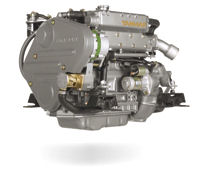 This 4JH5E 52 mph Yanmar diesel may be all you need as a wing engine. |
A “Wing” Engine
There’s a better way: Experienced cruisers opt for a wing engine with its own shaft and propeller, usually a feathering model to cut down drag. (The blades on a feathering prop automatically turn in-line with the water flow when the shaft stops turning.) The wing engine is smaller than the main diesel, but can still push the boat fast enough to reach port before the food runs out, and has sufficient oomph to drive through headwinds and head-seas. Its horsepower, reduction gear and propeller match the boat’s needs at whatever get-home speed the designer chooses, so the engine’s always operating at its optimum load rating.
In many installations, the wing engine also powers a hydraulic system, so it pays its way by running the windlass, thrusters and so forth – maybe even a high-capacity crash pump. The wing engine has its own electrical system, so it provides redundancy there, too.
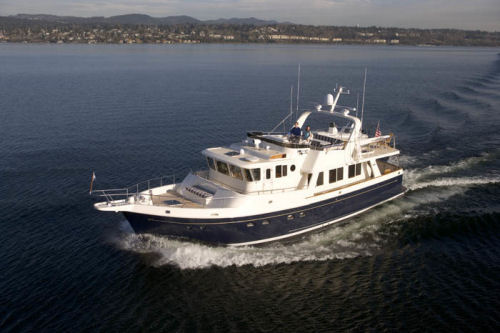 The Selene 57 comes with a single John Deere main engine and a wing engine back up. |
Other Considerations
How big does the get-home engine have to be? The 85,000-lb Nordhavn 47, for example, uses a 173-hp Lugger as primary power; it pushes the boat at a cruise speed of 8 knots (1.2 x sq. root of the 43’4” waterline). Get-home power is a 40-hp Yanmar with its own propeller; my calculations suggest the get-home speed will be around 5 knots, maybe a bit more. Forty horsepower equates roughly to a 30-kW generator – twice as much juice as needed, even with everything turned on, so this is a more efficient set-up than using a genset to turn the main shaft when necessary. (A 16-kW genset is standard aboard the Nordhavn 47.)
On some passagemakers, the stars align so the genset/hydraulic motor system works fine, and adding get-home power is feasible. But in most cases, it’s problematic and, therefore, expensive because of mismatched power needs. If you want to determine which camp your boat falls into, consult with the naval architect who designed your boat, its builder, the engine manufacturer.
We are quite sure that this will not be the end of your consideration of a long range propulsion system, but rather just a waypoint along the journey. But as you go, keep in mind one thing: most large tankers and freighter by the oceans of the world do so on a single engine, most with no back-up power.