Last Call for the Great Deals
Late last month MarineMax, the world’s largest retail boat dealership with 56 locations in 19 states issued its 2nd quarter sales results along with public description of its current inventory situation. William H. McGill, Jr., Chairman, President, and Chief Executive Officer, stated, "With our successful efforts to substantially reduce our inventory levels behind us, gross margins returned to more typical levels.” How is that for a double-whammy of bad news for deal-seeking consumers? Non-current boats have been pretty much sold off, so now prices can go back up where they need to be for both dealers and builders to stay in business.
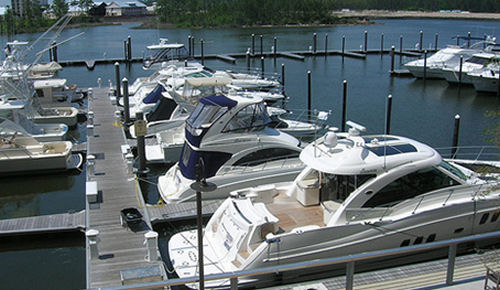 If you are quick you may find some of the last good deals. The lingering overhang of non-current boats seems to be mostly in the larger sizes. |
Judging by our reader mail, there are still some very good deals out in the marketplace on boats that are non-current. Our advice is that if you drive by a boat dealership selling the type boat you want and you see a lot of boats in his lot, you might be wise to pull in and see what is going on.
One of the most frequently asked questions we get is “...am I better off buying a new 2010 model or a new 2008?”
That is a hard question to answer because boat ownership is a very personal decision and there is a lot of emotion in it as well as dollars and cents. Ultimately, buyers have to answer that question themselves.
Gotta Buy New!
Our surveys indicate that about 26% of boaters usually only buy new boats. This has to do with their personality, maybe even their genes, but it is not about money. They pathologically have to have something new, clean, perfect and totally unspoiled.
If you are one of those people, admit it to yourself and buy new. You have had a rare opportunity the last year to buy a unused boat for used boat prices. But that window is almost closed now. So if you’ve been putting off making a buying decision, hoping that boat builders would continue to over-produce, we’re here to tell you that isn’t likely to happen anytime soon.
Only Buy Used
Our surveys also tell us that about 33% of boat buyers will only buy a used boat. Again, it is their personality and general approach to life that is at work, as much as anything. They want to get the most for the least. It’s not that they want to buy an old boat – they don’t. But what they want to do is to make sure that every bit of dealer margin and profit for anyone has been squeezed out of a sale. Only then do they feel good, and feel that they have gotten a good deal.
The same thing is occurring in the used boat market as in the new. Used boats last year were going at prices far below what anyone could have predicted a few years ago. After all, a boat – like most things in life – is worth only what someone is willing to pay for it. Prices dropped until owners were unwilling to take any less and simply resigned themselves to owning the boat longer than they intended.
By this time most dealers who took trades and could not sell them, have either taken the loss, gone out of business, or have enough income from other sources to hold on. Trade sources tell us that about 1400 dealers have gone out of business the last two years. With sales now coming back this spring, fewer dealers will fail, mostly because only the strong ones are left.
If the general economy is coming back, then used boat prices will also begin to slowly move higher. So, again, this it the time for the used boat buyer to make his move.
Go Both Ways?
About 41% of boat buyers are open-minded and will buy either new or used. Obviously they have fewer hang-ups when it comes to squeaky clean, or beating a seller down. Our guess is – and it is only a guess – that these people are “value” shoppers. We think they carefully balance ratios with price on one side of the scale and important attributes on the other. For example, price vs. utility, price vs. reliability, price vs operating expense, price vs. safety, price vs pride of ownership.
For this group of boat buyers – the largest – they are open to more options, and also looking at boats more critically than the other two groups, in our opinion. For the last year we at BoatTEST.com have been astounded by how willing owners are to jump categories. We see wake dudes buying pontoon boats, motoryacht people buying go-fast chargers, fishboat owners buying fancy cruising boats, and so forth. A large number of boaters are searching for their personal next new boating experience – and it could be nearly anything.
Perhaps these buyers are having the toughest time of all finding a suitable boat. The reason is that most boat builders produced relatively few, and in some cases no, boats the last 12 months. That means that the boat that a buyer might be willing to buy new is just not available. It will have to be ordered, and the buyer will have to wait. We don’t see availability getting better anytime the next couple of years, so for these people to get what they want, they will have to step up and order.
Press Release From Marine Max--
Further Reduces Inventory And Debt Improves Gross Margins Significantly Reduces Its Reported Loss
CLEARWATER, Fla., Apr 28, 2010 (BUSINESS WIRE) --MarineMax, Inc. (NYSE: HZO), the nation's largest recreational boat retailer, today announced results for its second quarter ended March 31, 2010.
Revenue was $110.1 million for the quarter ended March 31, 2010 compared with $129.6 million for the comparable quarter last year. Same-store sales declined approximately 5% compared with a 41% decline in the comparable quarter last year. Revenue from stores recently closed that were not eligible for inclusion in the same-store sales base was $13.4 million. The net loss for the second quarter of fiscal 2010 was $6.3 million, or $0.29 per share, compared with a net loss of $20.3 million, or $1.09 per share, for the comparable quarter last year.
Included in the second quarter fiscal 2009 net loss was approximately $900,000, or $0.05 per share, associated with store closing costs. Additionally, during the same quarter, the Company incurred losses and increased its inventory reserves for expected losses associated with brands that it no longer represents, which reduced gross profit by $4.1 million, or $0.22 per share.
At March 31, 2010, inventory was $173.7 million compared with $399.1 million at March 31, 2009, a $225.4 million or 56% decline. Short-term borrowings declined 82%, or $241.0 million, to $53.0 million compared with $294.0 million as of March 31, 2009.
Revenue was $210.6 million for the six months ended March 31, 2010 compared with $229.8 million for the comparable period last year. Same-store sales increased approximately 3% compared with a 46% decline in the comparable period last year. Net income for the six-months ended March 31, 2010 was $3.8 million, or $0.17 per diluted share, compared with a net loss of $34.6 million, or $1.87 per share, for the comparable period last year. The Company's results for the six-month period ended March 31, 2010 included a tax benefit of approximately $19.3 million, or $0.86 per diluted share, primarily related to the recognition of fiscal 2009 tax net operating loss carry-backs realized through the recent change in tax laws which increased the number of historical years that companies can carry back losses. Without the tax benefit, the Company would have incurred a net loss of $15.5 million, or $0.71 per share. The Company's results for the six-month period ended March 31, 2009 included $1.3 million, or $0.07 per share, of costs associated with store closings, as well as $4.9 million, or $0.27 per share, for incurred losses and the increase in its inventory reserves, as noted above, for brands the Company no longer represents.
During the quarter, the Company operated with 56 stores, which is 18 fewer stores than in the prior year. MarineMax closed 26 stores in fiscal 2009 as a key component of its efforts to better match its fixed costs with the decline in business it has experienced because of the weak economic conditions.
William H. McGill, Jr., Chairman, President, and Chief Executive Officer, stated, "With our successful efforts to substantially reduce our inventory levels behind us, gross margins returned to more typical levels. The margin expansion, combined with the initiatives we implemented to streamline our store base and to significantly lower our overall cost structure resulted in a greatly reduced quarterly loss when compared with the comparable quarter last year. However, our same-store sales decline is indicative of the challenging industry and economic conditions that we continue to face, reminding us that the industry recovery may likely be gradual. Poor weather also adversely affected our business during the quarter in key markets."
Mr. McGill continued, "We are optimistic about the future. The steps we have taken to reduce inventory and its related financing as well as our improved working capital position have resulted in a balance sheet with very strong ratios and increased flexibility. This financial position and the failure of other boat retailers provides us with a competitive advantage and should allow us to capitalize on opportunities as they arise. There are signs the economy is generally improving. In addition, retail sales in many industries appear to be increasing, although the improvement has yet to be felt in the high-end, big ticket segment. We remain convinced that, as industry conditions rebound, we will start to see the pent up demand from those customers who have delayed their first or next boat purchase. Boaters remain passionate about the benefits of the boating lifestyle, and MarineMax is well positioned to serve their needs."
About MarineMax
Headquartered in Clearwater, Florida, MarineMax is the nation's largest recreational boat and yacht retailer. Focused on premium brands, such as Sea Ray, Boston Whaler, Meridian, Cabo, Hatteras, Azimut Yachts and Grady White, MarineMax sells new and used recreational boats and related marine products and provides yacht brokerage services. MarineMax currently has 56 retail locations and operates within Alabama, Arizona, California, Colorado, Connecticut, Florida, Georgia, Kansas, Maryland, Minnesota, Missouri, New Jersey, New York, North Carolina, Ohio, Oklahoma, Rhode Island, Tennessee and Texas. MarineMax is a New York Stock Exchange-listed company.
Use of Non-GAAP Financial Information
In this release, the Company discloses pro forma or non-GAAP measures of net income and earnings per share. The Company believes that this pro forma information provides greater comparability regarding its ongoing operating performance. These measures should not be considered an alternative to measurements required by accounting principles generally accepted in the United States (GAAP), such as net income and earnings per share. These pro forma measures are unlikely to be comparable to pro forma information provided by other
Companies.