Could the Gulf of Mexico Become the Dead Sea?
Everyone in the world knows about the BP disaster but what most didn’t know until last Sunday night was why the well blew. That was explained on the American investigative journalism TV program 60 Minutes. In an interview Mike Williams, the head of electronic operations on the doomed oil rig, explained what happened and you can figure out who was to blame. (Want to take bets that no heads roll?) Now the oil -- both on the surface and under the surface -- is beginning to circulate in the relatively closed-in Gulf of Mexico, threatening to turn it into the ecological crime of the decade. And once it hits the Gulf Stream itself, it will go on a 6-knot ride right through North America’s fishery and on to Europe.
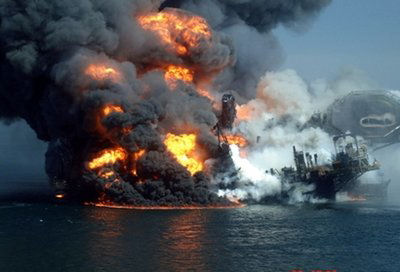 Scene of the crime: 11 dead, untold environmental disaster. A riveting 60 Minutes interview explains why it happened. |
60 Minutes interview with Mike Williams...
Into the Gulf Stream
A researcher said last Sunday that computer models showed the oil may have already seeped into a powerful water stream known as the Loop Current, which could propel it into the Atlantic Ocean. A boat is being sent later this week to collect samples and learn more.
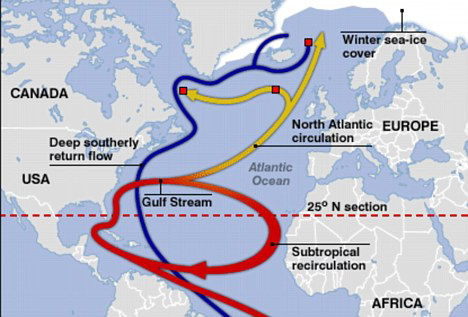 The Gulf Stream flows northeast and across the Atlantic to Europe with eddies that peel off in other directions. |
William Hogarth, dean of the University of South Florida's College of Marine Science, said one model showed oil had already entered the current, while a second showed the oil was three miles from it - still dangerously close.
The models are based on weather, ocean current and spill data from the US Navy and the National Oceanic and Atmospheric Administration, among other sources. Mr Hogarth said claims by BP that the oil would be less damaging to the Keys after travelling over hundreds of miles from the spill site 'can't be passed off as, "It's not going to be a problem".
'This is a very sensitive area. We are concerned with what happens in the Florida Keys'. Conservationists in Florida said oil could wreak havoc in the Keys or the environmentally fragile Everglades.
Turning the Gulf of Mexico into the Dead Sea?
From an AP news story, April 17--
NEW ORLEANS - The oil spill in the Gulf of Mexico has already spewed plumes over ecologically sensitive reefs, some of them part of a proposed marine sanctuary that would restrict drilling in a large swath of the northern part of the vital waterway.
In the Florida Keys
Marine scientists fear that two powerful Gulf currents will carry the oil to other reefs. The eastward flowing loop current could spread it about 450 miles (725 kilometres) to the Florida Keys, while the Louisiana coastal current could move the oil as far west as central Texas.
The depth of the gushing leaks and the use of more than 580,000 gallons (2.2 million litres) of chemicals to disperse the oil, including unprecedented injections deep in the sea, have helped keep the crude beneath the sea surface. Officials report that more than 390,000 gallons (1.5 million litres) of chemicals are stockpiled. Marine scientists say diffusing and sinking the oil helps protect the surface species and the Gulf Coast shoreline but increases the chance of harming deep-sea reefs.
Everything at Risk
"At first we had a lot of concern about surface animals like turtles, whales and dolphins," said Paul Montagna, a marine biologist at Texas A&M University Corpus Christi who studies Gulf reefs. "Now we're concerned about everything."
On Sunday, researchers said computer models show oil has already entered the loop current that could carry the toxic goo toward the Keys, the third-longest barrier reef in the world.
The oil is now over the western edge of a roughly 61-mile (98-kilometre) expanse of reef south of Louisiana known as the Pinnacles, about 25 miles (40 kilometres) north of where the Deepwater Horizon exploded April 20, killing 11 people and starting the spill that grows by the hour.
“Islands in the Stream” at Risk
The Pinnacles is one of nine coral banks and hard-bottom areas stretching from Texas to Florida that the National Oceanic and Atmospheric Administration tried in 2008 to get designated a marine sanctuary called Islands in the Stream.
This sanctuary would have restricted fishing and oil drilling around the identified reef "islands." But the plan was put on hold after vehement objections from Republican lawmakers, fishermen and the oil industry.
Scientists have found undersea plumes of oil at the spill as much as 10 miles (16 kilometres) long, which are an unprecedented danger to the deep sea environment, said Samantha Joye, a professor of marine sciences at the University of Georgia.
The New Dead Sea
These plumes are being eaten by microbes thousands of feet (hundreds of meters) deep, which removes oxygen from the water.
"Deepwater coral are abundant on the sea floor in this part of the Gulf, and they need oxygen," said Joye, who was involved in the plume discovery. "Without it, they can't survive."
Does the EPA Know What It’s Doing?
Experts say the well's depth and Friday's decision by the U.S. Environmental Protection Agency to allow BP to shoot massive amounts of dispersing chemicals deep underwater may help protect vital marshes and wetlands on the Gulf Coast. But the tradeoff may result in significant effects on more sea life.
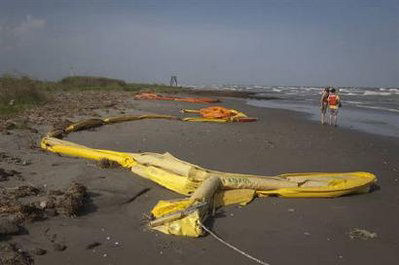 Oil booms sound good in theory but here is how many end up.
|
Oil mixed with the chemical agent can disperse into the water more easily, rather than it staying on the surface, where it could bypass deeper banks like Pinnacles, said Edward Van Vleet, a chemical oceanography professor at the University of South Florida.
The downside is that it causes oil to sink, coating corals and other reef organisms and smothering them, he said.When the dispersed oil is broken into smaller globules, he said they are more easily eaten by smaller reef organisms and can kill them or cause tumors or something else harmful.
Where Were the Government Watch Dogs?
Federal officials who oversee marine sanctuaries and fisheries say it's too early to tell how reefs and other important habitats may be damaged, said Dr. Jane Lubchenco, NOAA's undersecretary of commerce for oceans.
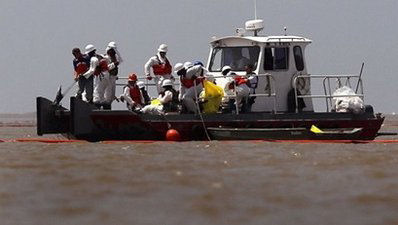 Putting people to work, but will BP be paying the bills? |
NOAA, which manages marine sanctuaries, is also responsible for estimating financial costs of the spill on the sea environment and fisheries. The Pinnacles is a significant habitat for sea life vital to commercial fisheries such as red snapper, crab and shrimp.
The creation of a sanctuary across hundreds of miles of the Gulf would not have blocked oil and gas exploration where the Deepwater Horizon exploded, said Montagna. However, he said it could have resulted in stricter environmental regulation for reefs closest to the spill site, and likely less drilling.
"So you can imagine these animals that make a living on rocks, filtering food out of the water, and the dispersants come along and sink the oil; it's a big concern," Montagna said.
Breeding Ground for Tuna, Whales
The area also is breeding ground for sperm whales and bluefin tuna, species not doing well, he said.
Studies published in a 2005 National Academy of Sciences report show that oil mixed with dispersants damaged certain corals' reproduction and deformed their larvae. The study concluded the federal government needed to study more before using massive amounts of dispersants.
Reefs are made up of living creatures that excrete a hard calcium carbonate exoskeleton.
Dead for a Decade?
Depending on the oil exposure, they can be smothered by the pollutants or become more susceptible to bleaching, which hinders reproduction and growth. While the warm temperatures of Florida could speed the recovery of damaged reefs there, some problems could be seen for a decade or more. In the deeper reefs in colder water closer to the spill, the damage could last even longer.
As the spill increases, the oil oozes toward other reefs that stretch from the blowout site eastward to the Florida Keys National Marine Sanctuary.
The Keys exist in relatively shallow water, so the potential exposure to the oil is higher than for deeper reefs, though BP PLC officials say the oil would be more diffused after having broken down during its travel over hundreds of miles.
This week, researchers from USF and the Florida Department of Environmental Protection are heading to the loop current to get a "chemical fingerprint" of any oil they find to confirm it is from the leaking well.
"We don't expect the loop current to carry oil onto beaches," William Hogarth, dean of the University of South Florida's College of Marine Science, said. "But we do have a great concern for the Keys."
Bahamas, Mexico, Cuba are Next
If oil reaches the Keys, it could threaten one of the country's greatest underwater natural resources as well as its tourism industry.
Locals throughout the ribbon of islands not only relish their ties to the water but rely on it to help bring in 2 million visitors each year.
"They're not going to come if our beaches are tarred and our mangroves have died and it's a polluted dump," said Millard McCleary, program director of the Key West-based Reef Relief. "They'll go to the Bahamas or the Caymans or they'll go to Mexico."