Does Your Lady Need A Facelift?
When it comes to cost vs. benefit, nothing beats a paint job. Investing in a fresh coat of color on the hull will not only make your yacht look new again, but add to its value and/or make it easier to sell when you’re ready to move up. Today, at least in the yachting world, “paint” means two-part linear polyurethane (LP). If your second-favorite lady needs a facelift, LP is the only way to go. (Stay tuned for the botox article.)
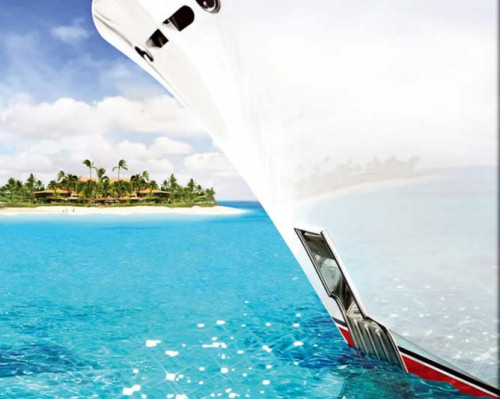 Sooner or later the time will come for most all of the gals. If her time has finally come, bite the bullet, spend a few thousand and make your yacht look like she did when you first met and fell in love. |
By Mike Smith
Traditional paint is a combination of pigments, solvents and other ingredients that actually dry once applied: The solvent goes off into the atmosphere, leaving a pigment film mechanically adhering to the surface. But LP is more like resin: it doesn’t dry, but catalyzes to form a hard, plastic-like film that’s chemically bonded to the substrate. The film is ultra-high gloss and very durable: Expect 10 years of life, and often more, from a properly applied and maintained LP job. Most of the major paint manufacturers have a two-part polyurethane paint in their lineup, but the big three are Awlgrip, DuPont Imron and Sterling; Awlgrip is the 800-lb gorilla, but all brands produce excellent results if expertly applied. Awlcraft 2000, a sister product to Awlgrip, is a two-part acrylic urethane that has the added advantage of being repairable. Awlgrip and other LP paints are almost impossible to touch-up invisibly.
Linear polyurethane is tricky to apply. Some brands can be brushed or rolled, but doing so demands special techniques. The paint must be “tipped,” or smoothed with a dry brush, to remove marks and create a glossy finish. It’s harder than it sounds, but when expertly done results in a good job. However, the best way to paint your yacht is with your checkbook, applied liberally to your boatyard manager. All LP paints – heck, all paints, period -- look best when sprayed on by a skilled professional.
Application is Everything
Applying LP is 90% preparation, 10% application, and the finish coat will be no better than what’s underneath. Even if your gelcoat looks in perfect condition to the naked eye, it’ll need lots of prep. First, the paint crew will scrupulously clean and dewax it with solvents, rags and maybe abrasive pads. If old wax isn’t removed, sanding will drive it into the gelcoat where it will prevent subsequent coatings from sticking. Once the gelcoat is clean, it’s sanded thoroughly and cleaned again before the painter applies a series of primers and/or fillers, then the topcoat.
Even if the gelcoat looks perfect, it needs priming to fill the pores and provide a solid base for subsequent layers. If there are imperfections in the hull – print-through, for instance – the paint crew will use a high-build primer to fill them. Once the substrate is perfect, more primer is sprayed on, followed by two coats of topcoat. After that, just keep it clean. Don’t use wax, although Awlgrip and Awlcraft can be sealed with Awlcare, a synthetic polymer that’s applied by hand. Otherwise, weekly washdowns are the only maintenance required.
The Cost
So what’s the bottom line? Some yards charge by the square, others by the linear foot. No matter how the price is calculated, it’s expensive – figure more than 10 grand to paint your sad-looking 46 Bertram, for example. That’s just for the hull; decks cost more, often two or three times as much. Why? The hardware has to be removed and then reinstalled, and there’s lots of painstaking dewaxing and intricate masking required.
But who said yacht ownership was gonna be cheap? And if you invest in a professional paint job, your present yacht will look so great you’ll stop thinking about buying a new one. It’ll actually save you money!