A Good Fighting Chair Means Business
You’ve just purchased the boat, you’ve got the rods, the reels and the tackle, and you’re ready to head offshore where the big billfish swim. But before you go, you need one more thing: A rugged fighting chair screams “Serious fisherman onboard!” to old salts and dock walkers alike. But how do you choose the right chair, and how do you install it once you’ve found it? While the first fighting chairs were used by boats out of Cuba and the chair came out of a barber shop, a lot has changed, and some things haven’t, when it comes to modern fighting chairs.
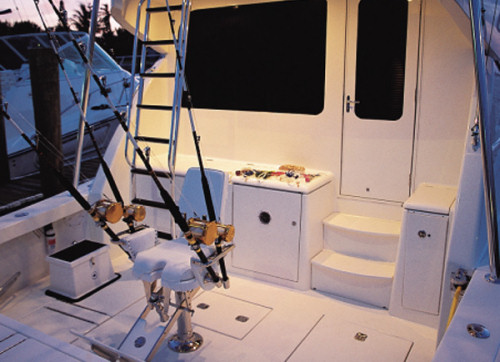 Before buying a boat for big game fishing, make sure the cockpit is big enough for the proper sized chair. Don’t take the issue for granted. |
Report by Mike Smith--
There are lots of fighting chairs on the market – big ones, small ones, in-between ones; chairs with varnished teak seats, painted mahogany seats, fiberglass seats and even plastic seats. Which is the best chair for you? According to Mike Murray, you should match the chair both to the cockpit and to the folks who will use it. Big guys need big chairs, he said, but smaller chairs are friendly to slimmer men, women and children.
Murray Products (www.murrayproducts.com) builds fighting chairs to fit anglers with backsides of all sizes, as do most other manufacturers. Smaller Murray chairs are built just like the big ones – same construction, same features, same options – they’re just more compact.
Cockpit Size Matters
You also want the maximum space around the chair, said Murray, whose father, Frank, and uncle, Ed, built their first Murray Brothers chair in the mid-1960s. “Forty-eight inches is the standard distance from the inside of the transom coaming to the center of the seat; this allows 8 or 9 inches of clearance between the footrest and the coaming.” Smaller chairs are smaller mostly in the seat depth and width, not the footrest length, so skimp on this measurement with care. Don’t install a chair that can’t swivel with the footrest extended all the way, or that passes so close to the coaming that the mate has to climb over it.
Maybe the placement decision has been made for you: Many boat builders glass-in an aluminum or steel plate in the cockpit sole: Drill and tap the plate and fasten the pedestal with machine bolts. If there’s no plate, plan to use through-bolts and a backing plate, but check under the cockpit first: “In some boats, that area’s all tank,” said Mike Rybovich of Rybovich & Sons Boat Works (www.rybovich.com). If you can get to the underside of the cockpit, he said, use as large a backing plate as you can – most pedestal bases are 10” diameter, so use at least a 16” square backer. Bigger is better, but often deck structure will restrict the size of the plate.
Offset Pedestals
While most sportfishing boats have a stiff enough cockpit sole for a straight pedestal, said Rybovich, offset pedestals should be mounted on the keel, “because a big guy connected to a big fish on heavy tackle, combined with the leverage of an 18” offset, creates a lot of strain.” If the pedestal can’t be keel-mounted, it should be tied into a bulkhead or other structure. An offset mount – the pedestal is shaped like a crank – lets the chair orbit around its base rather than simply rotate; it moves the angler and the rod tip closer to the corners of the transom on a beamy boat, minimizing break-offs.
John Rybovich invented the modern fighting chair -- tradition says in 1933, but Mike’s not sure “when the last coat of varnish went onto the first chair.” The Rybovich brothers – John, Tommy and Emil, Mike’s father – not only built the world’s finest sportfishermen, but also invented the tuna tower, transom door and aluminum outriggers. A Rybovich chair prompted the Murray brothers to build their first chair, to replace the one in their 41 Hatteras. Today both companies call West Palm Beach, Fl, home.