How to Extinguish An Engine Room Fire
Several weeks ago we ran an item about a large yacht that had an engine room fire
start as the boat entered the Palm Beach inlet. The boat made it to the dock and all hands were able to get off before the
vessel was ruined by the inferno. We
found ourselves wondering why a large, multi-million dollar yacht didn't have an
automatic engine room fire extinguishing system, or if it had been overcome or had
failed, why weren't the engine room air intakes weren't closed?Perhaps they couldn't be. All
fires on boats are serious, but there is nothing worse than an engine room fire
because it is fed the fuel circulating there.
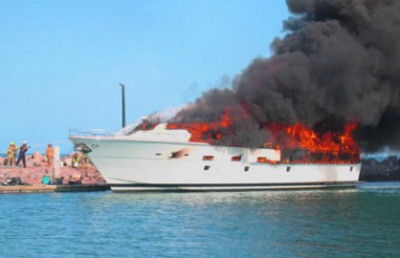 Fires that start in the engine rooms must stopped immediately or the consequences can be serious. |
By Mike Smith
Fire on land is bad enough; at sea it can be disastrous. Since most fires start in the engine room, if you don’t have an automatic fire-extinguishing system, it’s time to install one. When fire breaks out, an automatic system does the dangerous work for you, without need for anyone to enter the compartment until the fire is out. (The inflow of fresh air when you open the hatch might even accelerate the fire and allow it to spread.) With luck, by the time you know you've got a fire, it will be out.
 Fire Rescue crews put out a fire on an 104-foot pleasure craft returning from the Bahamas Sunday morning that pulled into Rybovich Marina at 45th Street and Flagler Drive in West Palm Beach. The fire broke out as the megayacht entered the Palm Beach Inlet. |
Approved Systems
Unlike portable dry-chemical extinguishers, fixed systems use gaseous “clean agents” that quench the fire, then dissipate, leaving no residue behind. When the temperature in the protected compartment rises beyond a preset limit (usually 175 degrees), a valve opens and releases the extinguishing agent. Most systems use one of two agents: FE-241 is approved for use in the U.S., but only in unoccupied spaces, e.g., engine rooms.
European Union-approved HFC-227ea (or FM-200 or FE-227 – same stuff, different manufacturer) is harmless to humans, and therefore acceptable for occupied spaces; it’s also used in portable clean-agent extinguishers. According to Dave Blice, sales and marketing manager at Fireboy-Xintex, both agents are equally effective at firefighting, but HFC-227ea is more expensive; if discharged, it’s also harmless to the ozone layer, while FE-241 has a minuscule impact.
 The new systems are not large and can be easily attached to a bulkhead. |
For engine rooms up to 1500 cubic feet, the sensor and release valve sit atop the pressurized cylinder holding the agent, so installation basically means finding a suitable place to mount the cylinder. Fireboy-Xintex directions say to locate it as high as possible on a forward or aft bulkhead, and as close to the centerline as possible. Aim the discharge toward the opposite bulkhead.
Systems for larger engine rooms (up to 3,000 sq. ft.) use two cylinders mounted at either end of the compartment, both connected to a remote temperature sensor. In either case, Coast Guard regulations require a system-status indicator lamp at every helm station, which means running wires and making simple electrical hookups, too.
When 175-degrees F (79-degrees C) is reached, the extinguisher(s) will automatically discharge, releasing the clean agent gas to totally flood the entire space, smothering the fire.
 Typically the heat sensor is placed on the overhead in the center of the engine room. |
Auto-Shutdown
Diesel-powered boats also need automatic shutdown, triggered by the firefighting system’s temperature sensor, since neither firefighting agent will stall the engine. A running diesel consumes the agent as fuel, lowering its concentration and making it less effective. This adds expense and complexity to the installation, so folks owning diesel powered boats might want to turn the job over to the boatyard.
Adding a further system to shut off air to the engine room is costly ($4,000 to $8,000, or more depending on the size boat and vender), put it is as important as having an automatic engine shut-down device. Many owners take a pass on this option, thinking that it unlikely to be needed -- but you only need it once to have it payoff.
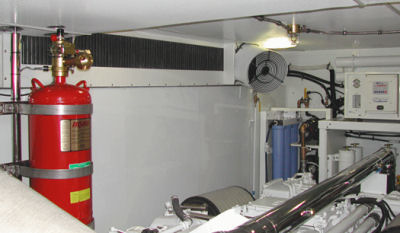 Note that this fire extinguishing system is positioned between the engine room air intake and the engine itself. |
Fixed Systems
Maintaining a fixed fire extinguisher is simple. The U.S. Coast Guard and the National Fire Protection Agency rules both require checking the pressure gauge every six months and weighing the cylinder yearly; weighing is more accurate than the gauge. (This is also true for hand-held extinguishers.) Every 12 years the cylinder must be pressure-tested; the alternative is visual inspection every five years by a qualified expert. Firefighting systems with multiple cylinders also need the linkage between them pressure-tested every five years. The date and results of each check should be recorded on a tag attached to the cylinder. Most local fire departments will check your system and give you a certification card.