Floating Alone
Here’s a good way to waste your money: Buy a liferaft and expensive inflatable PFDs, both items not required, and maybe not even approved, by the U.S. Coast Guard. Ninety-nine times out of a hundred, both will sit, unused, for years, just taking up space and reminding you how much fuel you could have bought with what you spent on them. You can meet the safety requirements with el cheapo PFDs – which you’ll never wear, and maybe not even try on. But if one day you go overboard farther than swimming distance from safety, you’ll find your sense of value has changed. Then, if your fancy inflatable PFD and raft save your life and your crew, you’ll think you got the best deal in town.
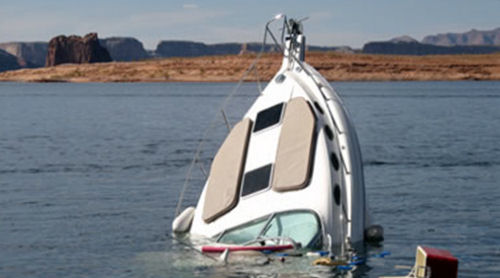 After it struck a submerged object, this cruiser sank in the Glen Canyon Recreational Area on the Arizona/Utah border. The shore isn’t far, but if it’s too far to swim it might as well be miles. Four people were rescued from this boat. |
Most of us visit our PFDs only once, when we take them out of their wrappers and stow them somewhere out of the way. We don’t think we’ll ever need them, unless the USCG pulls alongside for an inspection. And in most cases, that’s correct: Yachts rarely sink. But if the seaweed does hit the fan and your boat slips under the waves, you’ll be happier if your flotation gear is in tip-top condition. Maybe it’s time for a PFD upgrade, too.
Henry Marx is an expert in survival; he’s been giving safety seminars for 25 years, and is founder and president of Landfall (www.landfallnav.com;
800-941-2219), a good source of nautical safety gear, charts and navigational instruments. Marx suggests buying inflatable PFDs: They are comfortable to wear and very buoyant. “Keep your old PFDs to make the Coast Guard happy,” he said, since inflatables are approved only when worn. “Inflate your PFDs when you buy them,” Marx advised, “and leave them overnight. If they’re not still hard in the morning, take them back.” For powerboats, Marx recommends manual-inflation models, which won’t deploy prematurely if they get wet and maybe trap you belowdecks. Inflate, test and repack your PFDs every year, he said. And all PFDs should have lights on them, fitted with fresh batteries – which means replacing them at the beginning of every season.
But the best way to survive in the water is to stay out of it, which means carrying a life raft even if your seagoing adventures don’t stretch beyond the horizon. If your boat sinks from under you, you’ll be safer and more comfortable in a raft, and a lot easier for rescuers to find. A top-quality life raft designed for the most strenuous ocean service costs $7,000 or more, but unless you’re planning on rounding Cape Horn, you won’t have to dig so deep: A six-person coastal raft with canopy costs about half that, and an open model designed for near-shore use even less. Whatever raft you buy, if you’re lucky it’ll be a complete waste of money.
If you already own a life raft, but it hasn’t been serviced in the past couple of years, it’s time. Each manufacturer sets its own service intervals – generally every three years for vacuum-packed rafts, more frequently for others. The service involves inflating the raft, recharging or rebuilding the inflation system, inspecting and replenishing the supplies packed with the raft – typically flares, a signaling mirror, repair kit, pump, flashlight, emergency food, drinking water, etc. – and repacking. Marx said you must be “religious with the repacking schedule.” Many service centers will let you attend the servicing of your raft, something Marx says you should do. “Being there when they open your raft – your raft, not one like it at the boat show or in the showroom -- being able to step into it and see what’s in there, is very valuable.”
Assemble an abandon-ship bag, packed with things you’ll need both while on the raft and after rescue. (Marx said the abandon-ship bag is almost as important as the life raft.) The contents of the bag depend on how long you estimate it’ll take to be rescued, but should always include cash, credit cards and identification, e.g., a copy of your passport. If you already have an abandon-ship bag, check its contents now. Ensure the credit card hasn’t expired, and put new batteries in everything. For a full list of recommended abandon-ship bag contents, check the Landfall website.
Do all of the above now, while you’re safe ashore. If you ever find yourself treading water, you’ll be glad you did.