2009 USCG Annual Accident Report
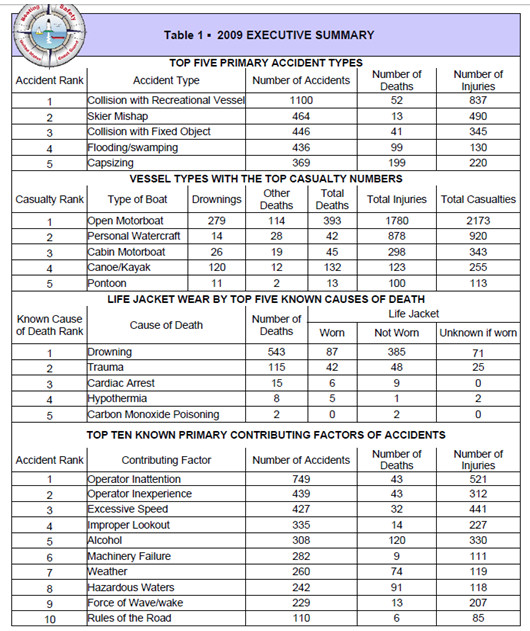
The USCG's Office of Auxiliary and Boating Safety announced its 2009 Recreational Boating Statistics report earlier this month. The report states a total of 4,730 accidents recorded by the CG in 2009 caused 736 deaths, over 3,300 injuries and about $36 million in property damage. The top 5 contributing factors to the accidents included boat operator inattention and inexperience, excessive speed, improper lookout and alcohol consumption. DUI was the leading factor in 16% of deaths. In addition, a full 86% of boat operators involved in fatal accidents had not received boat safety instruction. "Nearly 75% of the 736 people who died in boating accidents in 2009 drowned, and 84% of those victims reportedly were not wearing a life jacket," said Rear Adm. Kevin Cook, the CG's director of prevention policy. "The 2 most important things boaters can do to prevent the loss of life is to wear a life jacket and take a boater education course.
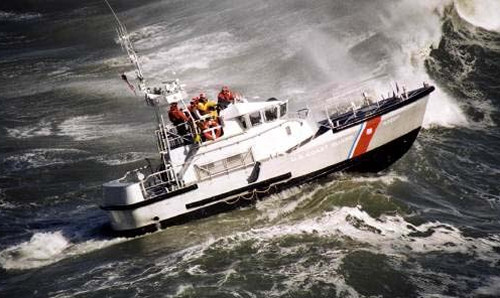 The men and women of the USCG annually risk their lives every day to save ours. |
2009 Recreational Boating Statistics Summary
Recreational boating safety statistics have been published by the Coast Guard for 51 years. The effort represents a collaboration and exchange of information taking place between the states, territories and Coast Guard. Some highlights of the report include:
2009 EXECUTIVE SUMMARY
- In 2009, the Coast Guard counted 4730 accidents that involved 736 deaths, 3358 injuries and approximately $36 million dollars of damage to property as a result of recreational boating accidents.
- The fatality rate was 5.8 deaths per 100,000 registered recreational vessels. This rate represents a 3.6% increase from last year’s fatality rate of 5.6 deaths per 100,000 registered recreational vessels.
- Compared to 2008, the number of accidents decreased 1.23%, the number of deaths increased 3.81% and the number of injuries increased 0.81%.
- Almost three-fourths of all fatal boating accident victims drowned, and of those, eighty-four (84) percent were not reported as wearing a life jacket.
- Only fourteen percent of deaths occurred on boats where the operator had received boating safety instruction.
- Seven out of every ten boaters who drowned were using boats less than 21 feet in length.
- Operator inattention, operator inexperience, excessive speed, improper lookout and alcohol rank as the top five primary contributing factors in accidents.
- Alcohol use is the leading contributing factor in fatal boating accidents; it was listed as the leading factor in 16% of the deaths.
- Eighteen children under age thirteen lost their lives while boating in 2009. 50% of the children who died in 2009 died from drowning. 44% of those who drowned were wearing a life jacket as required to do so by state law.
- The most common types of vessels involved in reported accidents were open motorboats (46%), personal watercraft (22%), and cabin motorboats (14%).
- The 12,721,541 boats registered by the states in 2009 represent a 0.23% increase from last year when 12,692,892 boats were registered.
 |
Boating Causality and Accident Reporting Guidelines
Maintaining accurate boat accident data is vital to national efforts aimed at improving boating safety. Without good baseline data, boating safety professionals would have no idea if safety interventions were effective. The Coast Guard uses the term “vessel” very inclusively, describing any sort of watercraft that is used as transportation on the water. This term includes things like canoes, rafts, rowboats, motorboats, sailboats, houseboats and personal watercraft.
A boating accident is reportable whenever there is a death, missing person, personal injury requiring treatment beyond first-aid, damage to a boat or property exceeding $2,000 or the complete loss of any vessel. Some states have lower property damage limits associated with their reporting requirements. A typical accident report is printed on a single page and takes minimal effort to complete.
Boaters can download boating accident data for the most current year of 2009 at the Coast Guard’s Boating Safety Resource Center. Information is also available for a number of previous years.